

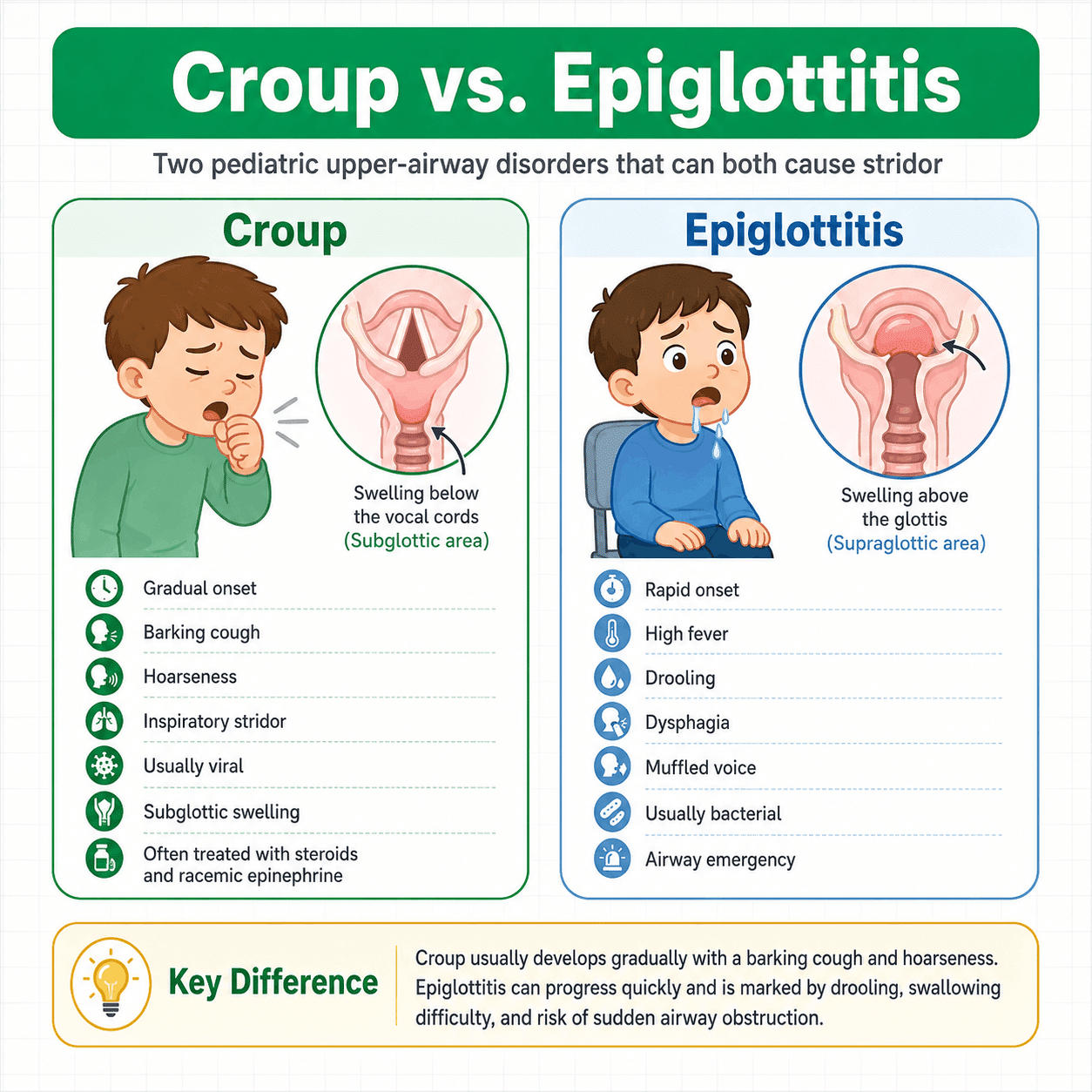
Croup and epiglottitis are pediatric upper-airway disorders that can both cause stridor, respiratory distress, and anxiety in children. Although they may seem similar at first, they differ in cause, onset, severity, physical findings, radiographic appearance, and treatment priorities.
Croup is usually a viral illness that causes subglottic airway narrowing and often responds to medical therapy. Epiglottitis is usually a bacterial supraglottic airway emergency that can rapidly progress to complete obstruction.
Recognizing the difference is essential because some actions that are safe in croup can be dangerous in epiglottitis.

Understanding Pediatric Upper-Airway Obstruction
Children are especially vulnerable to upper-airway obstruction because their airways are smaller than adult airways. Even a small amount of swelling can significantly narrow the airway lumen and increase resistance to airflow. As the airway becomes narrower, the child must work harder to breathe, and turbulent airflow may produce stridor.
Stridor is a high-pitched or harsh sound caused by airflow through a narrowed upper airway. It is different from wheezing, which usually comes from lower-airway narrowing in the bronchi or bronchioles. Stridor often suggests obstruction in the larynx, trachea, epiglottis, or nearby upper-airway structures.
Croup and epiglottitis are two classic causes of pediatric stridor. Both can become serious, but epiglottitis requires a much higher level of urgency because the swollen epiglottis can obstruct the opening to the trachea. The most important first step is recognizing the pattern of illness.
What Is Croup?
Croup, also called laryngotracheobronchitis, is an inflammatory condition of the upper airway that primarily affects the region below the vocal cords. This area is called the subglottic region. Swelling may involve the larynx, trachea, and larger bronchi, which explains why croup is sometimes described as laryngotracheobronchitis.
Croup is most often caused by a viral infection. Parainfluenza virus is a common cause, although respiratory syncytial virus, influenza, adenovirus, and other viruses may also be involved. Because the condition is usually viral, antibiotics are not recommended for uncomplicated cases.
Croup most often affects young children. It is commonly seen in infants and toddlers, especially between about 6 months and 3 years of age, although it may occur in children up to about 6 years old. Younger children are more vulnerable because their smaller airways can become narrowed more easily when swelling develops.
What Happens in Croup?
In croup, inflammation causes swelling below the glottis. The glottis refers to the area of the vocal cords, so subglottic swelling occurs below the vocal cords. As the mucous membranes become swollen, the upper tracheal airway narrows.
This narrowing produces the classic symptoms of croup:
- Barking cough
- Hoarseness
- Inspiratory stridor
- Increased work of breathing in more severe cases
The barking cough is one of the most recognizable findings. It is often described as seal-like. Hoarseness occurs because the laryngeal area is inflamed. Stridor occurs when airflow becomes turbulent through the narrowed upper airway.
Because the obstruction is below the glottis, children with croup usually do not have drooling or severe difficulty swallowing. They are typically able to swallow their secretions. This is one of the most important differences between croup and epiglottitis.
Common Signs and Symptoms of Croup
Croup usually develops gradually. Many children first have symptoms of an upper respiratory infection, such as nasal congestion, runny nose, mild fever, and cough. Over the next 24 to 48 hours, the cough may become more barky, and stridor may appear.
Common findings in croup include:
- Gradual onset
- Cold-like symptoms before airway symptoms
- Barking cough
- Hoarseness
- Inspiratory stridor
- Low-grade fever or no fever
- Anxiety or agitation
- Retractions in more serious cases
- Symptoms that may worsen at night
- Symptoms that may worsen when crying or upset
Note: The child with croup often appears uncomfortable but not severely toxic. This is different from epiglottitis, where the child may look very ill, frightened, and unable to tolerate lying down.
Mild, Moderate, and Severe Croup
Croup can range from mild to life-threatening. Many cases are mild and can be managed without hospitalization. However, respiratory distress should always be taken seriously, especially in young children.
Mild Croup
Mild croup may include a barking cough and occasional stridor with activity or agitation. The child may not have stridor at rest. Oxygen saturation is usually acceptable, and the child does not appear severely distressed.
Moderate Croup
Moderate croup may include stridor at rest, retractions, increased respiratory rate, and more noticeable work of breathing. The child may appear anxious or uncomfortable. Treatment is usually needed to reduce airway swelling and improve airflow.
Severe Croup
Severe croup may include marked stridor at rest, significant retractions, cyanosis, fatigue, decreased air movement, altered mental status, or signs of respiratory failure. These findings require urgent intervention and close monitoring. Intubation is uncommon in croup, but it may be necessary if obstruction progresses or the child develops respiratory failure.
Radiographic Findings in Croup
Croup is usually diagnosed clinically, meaning the diagnosis is often made from the history and physical examination. Imaging is not always necessary when the presentation is clear.
When radiographs are obtained, an anteroposterior neck x-ray may show narrowing of the subglottic trachea. This is called the steeple sign. The upper tracheal air column tapers because swelling narrows the airway below the vocal cords.
The steeple sign is associated with croup because it reflects subglottic narrowing. This is different from epiglottitis, where the swelling is above the glottis and may produce the thumb sign on a lateral neck radiograph.
Treatment of Croup
Treatment for croup focuses on reducing airway inflammation, easing airflow through the narrowed airway, maintaining oxygenation, and keeping the child calm.
Keeping the Child Calm
Agitation can worsen upper-airway obstruction. Crying increases airflow turbulence and may make stridor and respiratory distress worse. For this reason, the child should be kept as calm as possible. Whenever safe, the child may remain with a parent or caregiver to reduce anxiety.
Oxygen Therapy
Supplemental oxygen may be given if oxygen saturation is low or the child shows signs of hypoxemia. Oxygen should be delivered in a way that causes the least distress. A blow-by approach may be used in some situations if a mask increases agitation.
Corticosteroids
Corticosteroids are commonly used because they reduce airway inflammation and edema. They can improve symptoms and reduce the need for further treatment. Oral, intramuscular, or nebulized forms may be used depending on the clinical situation.
Budesonide may also be considered in mild to moderate cases. The goal is to reduce swelling in the subglottic airway and improve airflow.
Racemic Epinephrine
Aerosolized racemic epinephrine may be used in moderate to severe croup. It works by causing mucosal vasoconstriction, which helps reduce airway swelling. It can provide noticeable improvement, but the child must be monitored after treatment because symptoms may return as the medication wears off.
A commonly listed dose is 0.25 to 0.50 mL of 2.25% racemic epinephrine diluted with 3.0 mL of saline. The exact dose and repetition schedule should follow institutional policy and provider orders.
Heliox
Heliox may be considered in severe croup when airflow through the narrowed airway remains difficult. Heliox is a mixture of helium and oxygen. Because helium is less dense than nitrogen, it can reduce turbulent airflow and decrease the work of breathing through a narrowed upper airway.
Heliox does not treat the underlying swelling, but it may help reduce respiratory distress while other therapies take effect.
Intubation and Mechanical Ventilation
Most children with croup do not require intubation. However, intubation and mechanical ventilation may be necessary if the child develops worsening obstruction, severe hypoxemia, decreased level of consciousness, respiratory acidosis, exhaustion, or signs of impending respiratory failure.
What Is Epiglottitis?
Epiglottitis is an acute infection and inflammation of the epiglottis and surrounding supraglottic airway structures. The epiglottis is a flap-like structure that helps protect the airway during swallowing. When it becomes swollen, it can obstruct airflow into the trachea.
Epiglottitis is much more dangerous than typical croup because the swelling occurs above the glottis. A swollen epiglottis can block the airway entrance and lead to sudden complete obstruction. This can progress rapidly and may be fatal without prompt airway management.
Historically, Haemophilus influenzae type B was a major cause of pediatric epiglottitis. Vaccination has made the condition less common in children, but it can still occur. Other organisms may include Streptococcus pneumoniae, Staphylococcus aureus, Klebsiella pneumoniae, Haemophilus parainfluenzae, and beta-hemolytic streptococci.
What Happens in Epiglottitis?
In epiglottitis, infection causes swelling of the epiglottis, aryepiglottic folds, and other supraglottic structures. This swelling narrows the airway above the vocal cords and may cover the entrance to the trachea.
Because the airway can close suddenly, epiglottitis is treated as an airway emergency. The child may appear toxic, anxious, and unwilling to lie down. The safest position is often sitting upright and leaning forward, which helps maintain airway patency.
Unlike croup, epiglottitis commonly causes swallowing difficulty. The child may drool because swallowing is painful or difficult. This is a major clinical clue. Drooling, dysphagia, muffled voice, high fever, and toxic appearance should raise strong concern for epiglottitis.
Common Signs and Symptoms of Epiglottitis
Epiglottitis usually has an abrupt onset. Symptoms may develop over only a few hours. This is different from croup, which often develops over a day or two after cold-like symptoms.
Common findings in epiglottitis include:
- Sudden onset
- High fever
- Severe sore throat
- Drooling
- Dysphagia
- Muffled voice
- Low-pitched or muffled inspiratory stridor
- Toxic appearance
- Anxiety
- Labored breathing
- Tripod position
- Absence of barking cough
- Absence of hoarseness in many cases
Note: The child may refuse to lie down because lying flat can worsen airway obstruction. The child may sit upright, lean forward, extend the neck, or assume a tripod position. These behaviors are attempts to keep the airway open.
Why Drooling Matters
Drooling is one of the most important signs that separates epiglottitis from croup. In croup, the airway swelling is below the vocal cords, and swallowing is usually preserved. The child may cough and sound hoarse but can usually swallow secretions.
In epiglottitis, the swelling involves structures related to swallowing and airway protection. Swallowing may be painful or difficult, so secretions collect and drooling occurs. Drooling in a child with stridor, fever, and respiratory distress should be treated as a warning sign.
Radiographic Findings in Epiglottitis
A lateral neck radiograph may show a swollen, rounded epiglottis. This is called the thumb sign. The aryepiglottic folds may also be swollen, and the vallecula may be poorly visible.
However, imaging should never delay airway management in an unstable child. A child suspected of having epiglottitis should not be forced to lie flat for imaging. Supine positioning may allow the swollen epiglottis to obstruct the airway more severely. If the child is in distress, airway protection takes priority over diagnostic confirmation.
Diagnosis of Epiglottitis
Epiglottitis is diagnosed based on the clinical picture, cautious evaluation, and sometimes imaging or direct visualization in a controlled setting.
A complete blood count may show an elevated white blood cell count with a left shift, which supports bacterial infection. However, laboratory testing is not the priority if the airway is unstable. Blood gas analysis may show respiratory compromise, but a normal or acceptable blood gas does not guarantee that the airway will remain stable.
Direct visualization of the epiglottis may confirm the diagnosis, but this should only be performed by trained personnel in a controlled environment where emergency airway equipment is available. Casual throat inspection with a tongue blade can be dangerous because it may trigger gagging, agitation, laryngospasm, or complete airway obstruction.
Treatment of Epiglottitis
The first priority in epiglottitis is airway protection. Antibiotics are important, but they are not the first step if the airway is threatened. The sequence matters: keep the child calm, maintain the safest position, prepare for controlled airway management, secure the airway if needed, then treat the infection.
Keep the Child Calm and Upright
A child with suspected epiglottitis should be allowed to remain in the position of comfort. This is often upright, leaning forward, or in the tripod position. The child should not be forced to lie down.
Keeping the child calm is critical. Crying, agitation, or panic can worsen obstruction. Whenever safe, the child should remain with a caregiver, and unnecessary procedures should be avoided.
Avoid Throat Examination
The throat should not be examined casually in suspected epiglottitis. Depressing the tongue, attempting to visualize the epiglottis, or stimulating the upper airway can trigger sudden obstruction. Airway evaluation should occur in a controlled setting with trained personnel and proper equipment available.
Provide Oxygen Carefully
Supplemental oxygen may be given as needed, but the delivery method should not upset the child. If a mask causes agitation, another method may be needed. The goal is to support oxygenation while avoiding anything that worsens distress.
Prepare for Controlled Intubation
If epiglottitis is suspected and respiratory distress is significant, the team should prepare for controlled intubation. Appropriate personnel, such as anesthesia, otolaryngology, emergency medicine, or intensive care specialists, may be needed depending on the setting.
Intubation is often performed in a controlled environment such as the operating room. Equipment for difficult airway management and emergency surgical airway access should be available.
Antibiotic Therapy
Once the airway is secure or the child is stable enough for treatment, antibiotics are started to treat the bacterial infection. Broad-spectrum antibiotics, such as a cephalosporin, are commonly used. Therapy may continue for 7 to 10 days depending on the organism, clinical response, and provider judgment.
Hydration, Fever Control, and Supportive Care
Supportive care may include intravenous fluids, fever control, monitoring, and sedation when appropriate. Sedation must be used carefully because it can affect airway tone and respiratory drive. The child may require intensive care monitoring until airway swelling improves.
Croup vs. Epiglottitis: Key Differences
Although both conditions can cause stridor, the pattern is different. Croup usually has a gradual viral pattern, while epiglottitis has an abrupt bacterial pattern.
Cause
Croup is usually viral. Parainfluenza is common, but other respiratory viruses can also cause it. Epiglottitis is usually bacterial. Haemophilus influenzae type B was historically the classic cause, but other bacteria may also be responsible.
Location of Swelling
Croup affects the subglottic region below the vocal cords. Epiglottitis affects the supraglottic region above the vocal cords, especially the epiglottis and surrounding structures.
This location difference explains many of the clinical findings. Subglottic swelling causes barking cough and hoarseness. Supraglottic swelling causes drooling, dysphagia, muffled voice, and a high risk of sudden airway obstruction.
Onset
Croup usually develops gradually over 24 to 48 hours, often after cold-like symptoms. Epiglottitis usually develops abruptly over a few hours.
Fever
Croup may have no fever or a low-grade fever. Epiglottitis usually causes a high fever and a more toxic appearance.
Cough
A barking cough strongly suggests croup. Epiglottitis usually does not produce the classic barking cough.
Voice
Hoarseness is common in croup because the laryngeal area is involved. Epiglottitis often causes a muffled voice instead of hoarseness.
Drooling and Swallowing
Drooling and dysphagia point toward epiglottitis. These findings are usually absent in croup.
Stridor
Croup often causes high-pitched, loud inspiratory stridor. Epiglottitis may cause a lower-pitched or muffled inspiratory stridor. Stridor in either condition indicates upper-airway obstruction and must be assessed carefully.
Radiographic Findings
Croup may show the steeple sign, which represents subglottic narrowing on an AP neck radiograph. Epiglottitis may show the thumb sign, which represents a swollen epiglottis on a lateral neck radiograph.
Urgency
Croup can be serious, but it is usually managed medically with close monitoring. Epiglottitis is an airway emergency and requires careful handling, avoidance of agitation, and preparation for controlled airway management.
Assessment Priorities
Assessment should focus on the child’s airway, breathing, oxygenation, work of breathing, and general appearance. The goal is to identify respiratory distress early and distinguish croup from epiglottitis without causing harm.
Important assessment findings include:
- Respiratory rate
- Stridor at rest or only with agitation
- Retractions
- Breath sounds
- Cough quality
- Voice quality
- Drooling
- Ability to swallow
- Fever
- Skin color
- Oxygen saturation
- Mental status
- Position of comfort
- Overall appearance
Note: A toxic-appearing child with fever, drooling, dysphagia, muffled voice, and tripod positioning should be treated as a possible epiglottitis emergency.
The Role of Blood Gas Analysis
Blood gas analysis may be considered in significant airway obstruction, but it must be interpreted carefully. Blood gas results represent the child’s condition only at the moment the sample is obtained. A child with upper-airway obstruction can deteriorate quickly.
In an unstable child, especially one with suspected epiglottitis, airway management should not be delayed for blood gas sampling. Clinical assessment, oxygen saturation, work of breathing, mental status, and response to treatment are often more important in real time.
Signs such as fatigue, altered mental status, poor air movement, cyanosis, or worsening respiratory distress should not be ignored even if earlier test results were reassuring.
Why Nasotracheal Suctioning Is Contraindicated
Nasotracheal suctioning is absolutely contraindicated in both croup and epiglottitis. Although suctioning may be useful for secretion clearance in some respiratory conditions, it can be dangerous in pediatric upper-airway obstruction.
In epiglottitis, suctioning can stimulate the airway and trigger laryngospasm, worsening swelling, or complete obstruction. In croup, suctioning may increase irritation, agitation, and airway narrowing. Because these children are sensitive to stimulation, unnecessary invasive procedures should be avoided.
This is especially important for respiratory therapists. When a child has upper-airway obstruction from croup or epiglottitis, the safest approach is to reduce agitation and support breathing without provoking the airway.
Common Mistakes to Avoid
Mismanaging upper-airway obstruction can make the child worse. Several mistakes should be avoided when croup or epiglottitis is suspected.
Forcing the Child to Lie Down
A child with epiglottitis may rely on an upright position to keep the airway open. Forcing the child to lie supine can worsen obstruction. This is especially dangerous if the swollen epiglottis falls backward toward the airway opening.
Attempting Throat Inspection in Suspected Epiglottitis
Looking into the throat with a tongue blade may seem simple, but it can be dangerous in suspected epiglottitis. Airway stimulation may trigger obstruction. Visualization should occur only in a controlled setting with trained personnel ready to manage the airway.
Treating Epiglottitis Like Routine Croup
Epiglottitis is not managed like routine viral croup. Racemic epinephrine and steroids may have roles in some airway conditions, but epiglottitis requires airway protection and antibiotics. The airway emergency must be addressed first.
Delaying Airway Management for Testing
Radiographs, blood work, and blood gases can be helpful in selected cases, but they should not delay airway management in an unstable child. Clinical deterioration can happen quickly.
Performing Nasotracheal Suctioning
Nasotracheal suctioning can provoke airway stimulation and worsen obstruction. It should be avoided in both croup and epiglottitis.
Exam Clues for Croup
Croup is often tested using classic pattern recognition. The child is usually younger, has gradual symptoms, and develops a barking cough.
Clues that suggest croup include:
- Age between about 6 months and 3 years
- Gradual onset over 24 to 48 hours
- Recent cold-like symptoms
- Barking cough
- Hoarseness
- High-pitched inspiratory stridor
- No drooling
- No significant swallowing difficulty
- Low-grade fever or no fever
- Normal white blood cell count in many viral cases
- Steeple sign on AP neck x-ray
- Subglottic narrowing
Note: Treatment clues include corticosteroids, nebulized racemic epinephrine, oxygen as needed, monitoring, and possibly heliox in severe cases.
Exam Clues for Epiglottitis
Epiglottitis is often tested as an airway emergency. The child is usually older than the typical croup patient and has sudden severe illness.
Clues that suggest epiglottitis include:
- Sudden onset over a few hours
- High fever
- Severe sore throat
- Drooling
- Dysphagia
- Muffled voice
- Toxic appearance
- Tripod position
- Low-pitched or muffled stridor
- Absence of barking cough
- Absence of hoarseness in many cases
- Elevated white blood cell count
- Thumb sign on lateral neck x-ray
- Supraglottic swelling
Note: Management clues include keeping the child calm and upright, avoiding throat examination, avoiding supine positioning, preparing for controlled intubation, and starting antibiotics after the airway is secure.
Clinical Decision-Making
The key decision is not simply whether the child has stridor. The key decision is whether the pattern fits croup or epiglottitis and how severe the airway obstruction is.
- A child with barking cough, hoarseness, gradual onset, and no drooling likely has croup. Treatment should focus on airway inflammation, oxygenation, and monitoring. Most children respond to corticosteroids and racemic epinephrine when needed.
- A child with fever, drooling, dysphagia, muffled voice, and tripod positioning should be treated as suspected epiglottitis. The priority is not routine testing or throat examination. The priority is calm positioning and airway protection.
Note: When in doubt, the safer assumption is to treat a toxic-appearing child with drooling and stridor as an airway emergency until proven otherwise.
Why the Location of Obstruction Matters
The difference between subglottic and supraglottic obstruction explains much of the contrast between these conditions.
In croup, the swelling is below the vocal cords. This produces a narrowed air column in the upper trachea. Air can still pass through, but it becomes turbulent, causing stridor. The larynx is inflamed, so the voice becomes hoarse. The cough becomes barky because airflow passes through the inflamed upper airway.
In epiglottitis, the swelling is above the vocal cords. The epiglottis and surrounding tissues are swollen and may obstruct the entrance to the trachea. Because these structures are involved in swallowing, dysphagia and drooling occur. Because the airway entrance itself is threatened, complete obstruction can occur suddenly.
Monitoring and Escalation
Both conditions require close observation when symptoms are significant. Pediatric patients can compensate for a period of time and then deteriorate quickly when fatigue develops.
Findings that suggest worsening obstruction include:
- Stridor at rest
- Increasing retractions
- Tachypnea
- Cyanosis
- Decreased oxygen saturation
- Poor air movement
- Fatigue
- Lethargy
- Altered mental status
- Rising carbon dioxide
- Respiratory acidosis
- Decreasing level of consciousness
Note: In croup, worsening signs may require repeated therapy, hospitalization, heliox, or intubation in severe cases. In epiglottitis, worsening signs require urgent airway control by skilled personnel.
Respiratory Therapist Considerations
Respiratory therapists play an important role in recognizing upper-airway obstruction, supporting oxygenation, administering aerosolized therapies, monitoring response, and communicating changes in the child’s condition.
For croup, the respiratory therapist may help administer racemic epinephrine, provide oxygen, monitor pulse oximetry, assess stridor and work of breathing, and watch for symptom recurrence after treatment.
For epiglottitis, the respiratory therapist must recognize the danger of agitation and airway manipulation. The child should be kept calm and upright. Oxygen should be delivered gently. Equipment for emergency airway management should be prepared, but unnecessary stimulation should be avoided.
Note: In both conditions, the respiratory therapist should avoid nasotracheal suctioning and report signs of deterioration immediately.
Quick Comparison
Croup and epiglottitis can be compared by focusing on the most important clinical features.
Croup is usually:
- Viral
- Gradual in onset
- Subglottic
- Associated with barking cough
- Associated with hoarseness
- Less likely to cause drooling
- Less likely to cause dysphagia
- Associated with steeple sign
- Treated with corticosteroids and racemic epinephrine when indicated
Epiglottitis is usually:
- Bacterial
- Abrupt in onset
- Supraglottic
- Associated with high fever
- Associated with drooling
- Associated with dysphagia
- Associated with muffled voice
- Associated with toxic appearance
- Associated with thumb sign
- Managed as an airway emergency
Practical Memory Tips
The fastest way to remember the difference is to connect the symptom pattern to the airway location.
Croup is below the vocal cords, so think of barking cough, hoarseness, and steeple sign. Epiglottitis is above the vocal cords, so think of drooling, dysphagia, muffled voice, tripod position, and thumb sign.
Another useful clinical shortcut is:
- Barking cough suggests croup.
- Drooling and dysphagia suggest epiglottitis.
Note: This does not replace clinical judgment, but it helps identify the most likely condition quickly.
Croup vs. Epiglottitis Practice Questions
1. What type of airway disorder is croup?
Croup is a pediatric upper-airway disorder that causes swelling below the vocal cords, especially in the subglottic region.
2. What type of airway disorder is epiglottitis?
Epiglottitis is a pediatric upper-airway emergency caused by swelling above the glottis, especially involving the epiglottis and supraglottic structures.
3. Which condition is usually more emergent, croup or epiglottitis?
Epiglottitis is usually more emergent because it can rapidly progress to complete airway obstruction.
4. What is another name for croup?
Croup is also called laryngotracheobronchitis.
5. Where does the airway swelling occur in croup?
The swelling in croup occurs below the vocal cords in the subglottic area.
6. Where does the airway swelling occur in epiglottitis?
The swelling in epiglottitis occurs above the glottis, involving the epiglottis and supraglottic airway.
7. What classic cough is associated with croup?
Croup is associated with a barking, seal-like cough.
8. Is a barking cough usually present in epiglottitis?
No. A barking cough is usually absent in epiglottitis.
9. Which condition usually has a gradual onset?
Croup usually has a gradual onset, often developing over 24 to 48 hours.
10. Which condition usually has an abrupt onset?
Epiglottitis usually has an abrupt onset, often developing within a few hours.
11. What common viral cause is associated with croup?
Parainfluenza virus is a common cause of croup.
12. Is croup usually viral or bacterial?
Croup is usually viral.
13. Is epiglottitis usually viral or bacterial?
Epiglottitis is usually bacterial.
14. What organism was historically associated with epiglottitis?
Haemophilus influenzae type B was historically associated with epiglottitis.
15. What radiographic sign is associated with croup?
The steeple sign is associated with croup.
16. What does the steeple sign indicate?
The steeple sign indicates subglottic narrowing of the upper tracheal air column.
17. What radiographic sign is associated with epiglottitis?
The thumb sign is associated with epiglottitis.
18. What does the thumb sign indicate?
The thumb sign indicates a swollen, enlarged epiglottis on a lateral neck radiograph.
19. Which condition is more likely to cause drooling?
Epiglottitis is more likely to cause drooling.
20. Why does drooling occur in epiglottitis?
Drooling occurs because swallowing is painful or difficult due to supraglottic swelling.
21. Is drooling a typical finding in croup?
No. Drooling is generally absent in croup because the obstruction is below the glottis.
22. Which condition is commonly associated with hoarseness?
Croup is commonly associated with hoarseness.
23. Which condition is commonly associated with a muffled voice?
Epiglottitis is commonly associated with a muffled voice.
24. Which condition may cause the child to assume a tripod position?
Epiglottitis may cause the child to sit upright or assume a tripod position to maintain airway patency.
25. Why should a child with suspected epiglottitis not be forced to lie down?
A child with suspected epiglottitis should not be forced to lie down because supine positioning may worsen airway obstruction.
26. What age group is commonly affected by croup?
Croup commonly affects young children, especially infants and toddlers between about 6 months and 3 years of age.
27. What age group is commonly affected by epiglottitis?
Epiglottitis commonly affects young children, often around 2 to 8 years of age.
28. Why are children more vulnerable to airway obstruction than adults?
Children are more vulnerable because their airways are smaller, so even mild swelling can significantly narrow the airway.
29. What type of stridor is commonly heard in croup?
Croup commonly produces loud, high-pitched inspiratory stridor.
30. What type of stridor may occur in epiglottitis?
Epiglottitis may produce low-pitched or muffled inspiratory stridor.
31. What symptoms often appear before croup becomes obvious?
Cold-like symptoms such as nasal congestion, rhinorrhea, mild fever, and cough may appear before croup becomes obvious.
32. Why is hoarseness common in croup?
Hoarseness is common because inflammation involves the laryngeal area near the vocal cords.
33. Why is swallowing difficulty more concerning for epiglottitis?
Swallowing difficulty is concerning because supraglottic swelling can make swallowing painful and may signal a threatened airway.
34. Which condition is more likely to make the child appear toxic?
Epiglottitis is more likely to make the child appear toxic or severely ill.
35. Which condition is more likely to follow a viral upper respiratory infection?
Croup is more likely to follow a viral upper respiratory infection.
36. What is the main treatment goal in croup?
The main treatment goal in croup is to reduce airway swelling, improve airflow, maintain oxygenation, and monitor for worsening obstruction.
37. What is the main treatment priority in epiglottitis?
The main treatment priority in epiglottitis is airway protection.
38. Why should agitation be avoided in croup?
Agitation should be avoided because crying can increase airflow turbulence and worsen stridor and respiratory distress.
39. Why should agitation be avoided in epiglottitis?
Agitation should be avoided because it can worsen upper-airway obstruction and may trigger sudden airway compromise.
40. What medication is commonly used to reduce airway inflammation in croup?
Corticosteroids are commonly used to reduce airway inflammation in croup.
41. When is racemic epinephrine commonly used in croup?
Racemic epinephrine is commonly used for moderate to severe croup when airway swelling and stridor are significant.
42. How does racemic epinephrine help in croup?
Racemic epinephrine causes mucosal vasoconstriction, which helps reduce swelling in the narrowed upper airway.
43. Why must a child be monitored after racemic epinephrine?
The child must be monitored because symptoms may return as the medication wears off.
44. What gas mixture may help reduce turbulent airflow in severe croup?
Heliox may help reduce turbulent airflow through a narrowed upper airway in severe croup.
45. Does heliox treat the underlying inflammation in croup?
No. Heliox may improve airflow and decrease work of breathing, but it does not treat the underlying inflammation.
46. When may intubation be needed in croup?
Intubation may be needed if the child develops worsening obstruction, severe hypoxemia, exhaustion, respiratory acidosis, or decreased consciousness.
47. Why is epiglottitis considered an infection second and an airway emergency first?
It is considered an airway emergency first because airway obstruction can occur rapidly and must be addressed before routine infection management.
48. When should antibiotics be started in epiglottitis?
Antibiotics should be started after the airway is secure or once the child is stable enough for treatment.
49. What type of antibiotics may be used for epiglottitis?
Broad-spectrum antibiotics, such as a cephalosporin, may be used for epiglottitis.
50. Why should throat inspection be avoided in suspected epiglottitis?
Throat inspection should be avoided because upper-airway stimulation can trigger gagging, laryngospasm, or complete obstruction.
51. What should be done first if a child with suspected epiglottitis is unstable?
The airway should be protected first because complete obstruction can occur rapidly.
52. Why is a lateral neck radiograph risky in suspected epiglottitis?
It can be risky if the child is forced to lie flat or becomes agitated, which may worsen airway obstruction.
53. Which condition may show haziness in the supraglottic area on imaging?
Epiglottitis may show haziness in the supraglottic area due to swelling of the epiglottis and surrounding structures.
54. Which condition may show haziness in the subglottic area on imaging?
Croup may show haziness in the subglottic area due to swelling below the vocal cords.
55. What does supraglottic mean?
Supraglottic means above the glottis or vocal cord region.
56. What does subglottic mean?
Subglottic means below the glottis or vocal cord region.
57. Why is croup often less immediately dangerous than epiglottitis?
Croup usually narrows the airway gradually below the vocal cords, while epiglottitis can rapidly block the airway entrance.
58. What clinical finding strongly suggests croup instead of epiglottitis?
A barking cough strongly suggests croup instead of epiglottitis.
59. What clinical findings strongly suggest epiglottitis instead of croup?
Drooling, dysphagia, muffled voice, high fever, and toxic appearance strongly suggest epiglottitis.
60. Why is pulse oximetry useful in both croup and epiglottitis?
Pulse oximetry helps monitor oxygenation and detect worsening respiratory compromise.
61. Why should blood gas results be interpreted cautiously in upper-airway obstruction?
Blood gas results only reflect the patient’s condition at the moment the sample is obtained and may not predict rapid deterioration.
62. Should airway management be delayed to obtain a blood gas in suspected epiglottitis?
No. Airway management should not be delayed for blood gas sampling if the child is unstable.
63. What finding may indicate that a child with croup is worsening?
Stridor at rest, increased retractions, cyanosis, fatigue, or poor air movement may indicate worsening croup.
64. What finding may indicate impending respiratory failure in either condition?
Altered mental status, exhaustion, cyanosis, poor air movement, or respiratory acidosis may indicate impending respiratory failure.
65. Why is nasotracheal suctioning contraindicated in croup?
Nasotracheal suctioning can irritate the airway, increase agitation, and worsen upper-airway obstruction.
66. Why is nasotracheal suctioning contraindicated in epiglottitis?
Nasotracheal suctioning can stimulate the swollen airway and may trigger laryngospasm or complete obstruction.
67. What position is often preferred by a child with epiglottitis?
The child often prefers sitting upright, leaning forward, or assuming a tripod position.
68. Why does a child with epiglottitis often sit upright?
Sitting upright helps maintain airway patency and may reduce the feeling of obstruction.
69. What does a muffled voice suggest in a child with stridor?
A muffled voice suggests supraglottic involvement and may indicate epiglottitis.
70. What does hoarseness suggest in a child with stridor?
Hoarseness suggests laryngeal involvement and is commonly associated with croup.
71. Is imaging required for most cases of croup?
No. Croup is usually diagnosed clinically when the history and physical findings are typical.
72. When may imaging be considered in suspected croup?
Imaging may be considered when the diagnosis is unclear or another disorder, such as epiglottitis, must be ruled out.
73. What is the key difference between the steeple sign and the thumb sign?
The steeple sign indicates subglottic narrowing in croup, while the thumb sign indicates a swollen epiglottis in epiglottitis.
74. Why should oxygen be delivered carefully in suspected epiglottitis?
Oxygen should be delivered in the least upsetting way possible because agitation can worsen airway obstruction.
75. What is the safest general approach when epiglottitis is suspected?
Keep the child calm and upright, avoid throat manipulation, prepare for controlled airway management, and treat it as an airway emergency.
76. What is the main anatomic reason epiglottitis can become fatal quickly?
The swollen epiglottis can cover the tracheal opening and cause sudden complete airway obstruction.
77. Why is croup commonly associated with a normal white blood cell count?
Croup is commonly associated with a normal white blood cell count because it is usually caused by a viral infection.
78. What white blood cell pattern is more likely in epiglottitis?
Epiglottitis is more likely to cause an elevated white blood cell count because it is usually bacterial.
79. What does dysphagia mean?
Dysphagia means difficulty swallowing.
80. Why is a toxic appearance more concerning in a child with stridor?
A toxic appearance suggests a more severe illness, such as epiglottitis, and may indicate a rapidly progressing airway emergency.
81. What is the most important clinical clue that separates barking cough from drooling?
A barking cough points toward croup, while drooling points toward epiglottitis.
82. What should be suspected when a child has sudden fever, drooling, dysphagia, and muffled stridor?
Epiglottitis should be suspected because these findings suggest supraglottic swelling and possible airway obstruction.
83. What should be suspected when a child has gradual cold symptoms, hoarseness, and a barking cough?
Croup should be suspected because these findings suggest viral subglottic airway swelling.
84. Why can crying make croup symptoms worse?
Crying increases airflow turbulence through the narrowed subglottic airway, which can worsen stridor and distress.
85. Why can crying be especially dangerous in epiglottitis?
Crying can increase agitation and airway obstruction, potentially causing rapid deterioration.
86. What does the term laryngotracheobronchitis describe?
It describes inflammation involving the larynx, trachea, and bronchi, which is another name for croup.
87. Why are antibiotics not recommended for uncomplicated viral croup?
Antibiotics are not recommended because uncomplicated croup is usually caused by a virus, not bacteria.
88. Why might bacterial superinfection worsen croup?
Bacterial superinfection can add more inflammation and airway swelling, making obstruction more severe.
89. What is the significance of stridor at rest in croup?
Stridor at rest suggests more significant airway obstruction and may indicate the need for hospital monitoring or treatment.
90. What is the significance of cyanosis in a child with croup?
Cyanosis suggests inadequate oxygenation and more severe respiratory compromise.
91. What does poor air movement indicate in pediatric upper-airway obstruction?
Poor air movement may indicate severe obstruction, fatigue, or impending respiratory failure.
92. Why should epiglottitis not be managed as a routine pediatric respiratory infection?
It can rapidly obstruct the airway, so airway protection must take priority over routine infection treatment.
93. What is the safest way to provide oxygen in suspected epiglottitis?
Oxygen should be provided in the least upsetting way possible while allowing the child to remain in a comfortable position.
94. Why may the operating room be preferred for intubation in epiglottitis?
The operating room provides a controlled setting with trained personnel and equipment for difficult airway management.
95. What emergency airway may be needed if intubation fails in severe epiglottitis?
An emergency surgical airway, such as cricothyroidotomy or tracheotomy, may be needed if intubation fails and obstruction persists.
96. Why is close monitoring important after treatment for croup?
Close monitoring is important because symptoms can worsen or return, especially after temporary relief from racemic epinephrine.
97. What does the phrase “airway emergency first, infection second” mean in epiglottitis?
It means the airway must be protected before focusing on cultures, antibiotics, or other infection-related treatments.
98. What clinical features make croup more likely than epiglottitis?
Gradual onset, barking cough, hoarseness, inspiratory stridor, and absence of drooling make croup more likely.
99. What clinical features make epiglottitis more likely than croup?
Abrupt onset, high fever, drooling, dysphagia, muffled voice, toxic appearance, and tripod positioning make epiglottitis more likely.
100. What is the key takeaway when comparing croup and epiglottitis?
Croup usually causes gradual subglottic narrowing with barking cough and hoarseness, while epiglottitis causes abrupt supraglottic swelling that can rapidly become a life-threatening airway emergency.
Final Thoughts
Croup and epiglottitis both cause pediatric upper-airway obstruction, but they require different levels of urgency.
Croup is usually a viral subglottic illness with gradual onset, barking cough, hoarseness, stridor, and possible steeple sign. Epiglottitis is usually a bacterial supraglottic emergency with abrupt onset, high fever, drooling, dysphagia, muffled voice, toxic appearance, tripod positioning, and possible thumb sign.
The safest approach is to recognize the pattern quickly, avoid unnecessary airway stimulation, monitor closely, and treat epiglottitis as an airway emergency until the airway is protected.

Written by:
John Landry is a registered respiratory therapist from Memphis, TN, and has a bachelor's degree in kinesiology. He enjoys using evidence-based research to help others breathe easier and live a healthier life.
References
- Tibballs J, Watson T. Symptoms and signs differentiating croup and epiglottitis. J Paediatr Child Health. 2011.