
The respiratory system contains several important anatomical landmarks that help clinicians assess airway function and ensure safe patient care. One of the most significant structures is the carina, which plays a vital role in airway anatomy, lung protection, and clinical procedures such as intubation and bronchoscopy.
For respiratory therapists and other healthcare professionals, understanding the carina is essential for confirming airway device placement, preventing complications, and managing critically ill patients.
This article explores what the carina is, its anatomical features, physiological role, and its clinical relevance in respiratory care.

What Is the Carina?
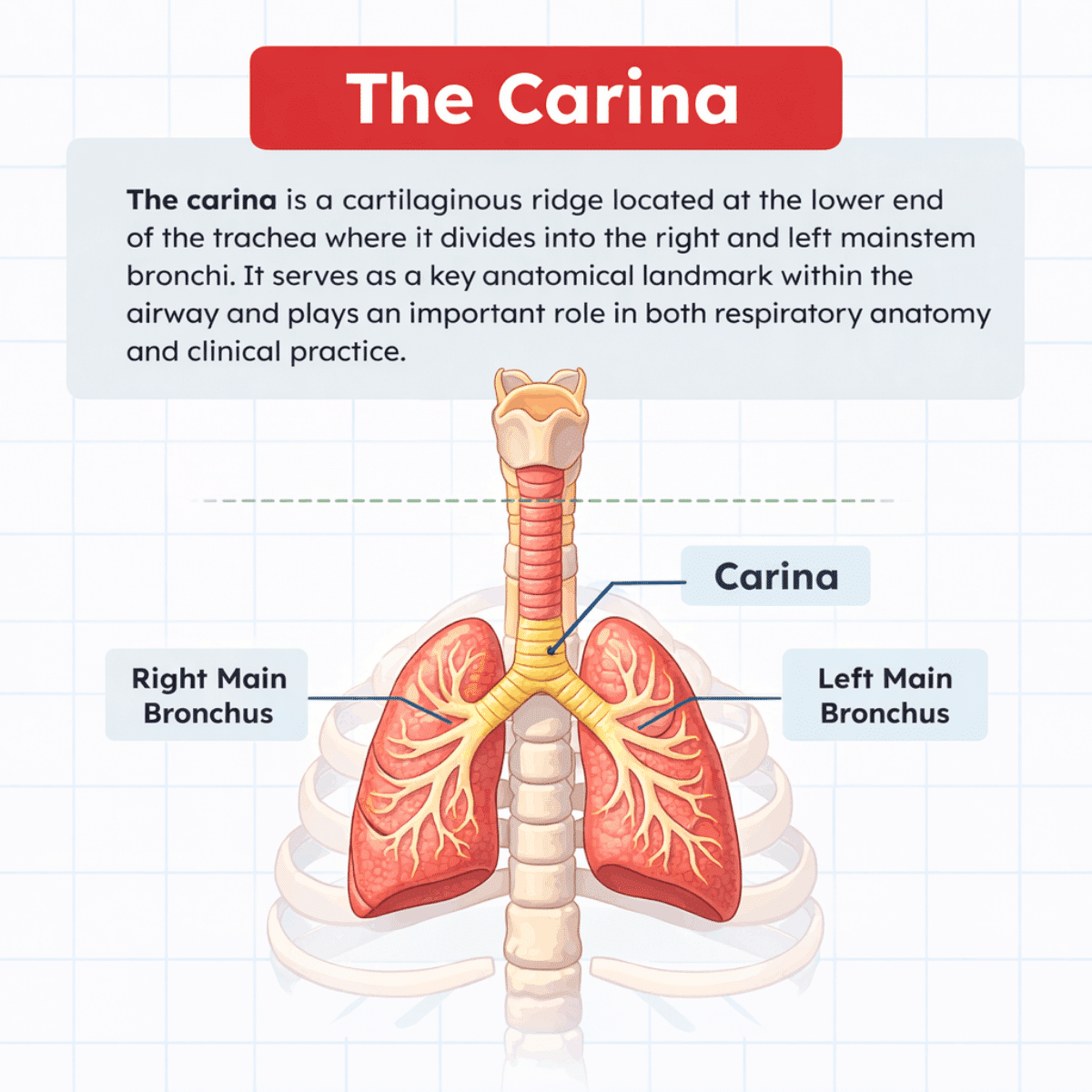
The carina is a ridge of cartilage located at the point where the trachea divides into the right and left mainstem bronchi. It represents the final cartilaginous structure of the trachea and serves as a critical anatomical landmark within the airway.
In most adults, the carina is located near the level of the fourth and fifth thoracic vertebrae (T4–T5). Externally, it corresponds closely with the Angle of Louis, which is the junction between the manubrium and body of the sternum. This external landmark helps clinicians estimate the approximate location of the tracheal bifurcation during physical assessment and imaging interpretation.
The right main bronchus branches from the trachea at an angle of approximately 20 to 30 degrees, making it wider, shorter, and more vertical than the left main bronchus. The left main bronchus branches at an angle of roughly 45 to 55 degrees, making it longer and more angled. These anatomical differences are clinically important because foreign bodies and improperly positioned airway devices are more likely to enter the right bronchial tree.
Anatomical Features and Structure
The carina consists of firm cartilaginous tissue covered by mucous membrane and highly sensitive sensory nerve endings. These nerve endings play a key role in airway protection by triggering the cough reflex when stimulated by foreign particles, secretions, or mechanical irritation.
Structurally, the carina forms a sharp internal ridge separating the entrances of the right and left bronchi. This ridge is often described as knife-like or keel-shaped. During bronchoscopy, a healthy carina typically appears as a sharp, well-defined structure. Changes in its shape or appearance may indicate underlying disease processes such as tumors, inflammation, or airway distortion.
The carina is also closely associated with major thoracic structures, including the aortic arch, pulmonary arteries, and mediastinal lymph nodes. Enlargement of these surrounding structures can compress or distort the carina, which may be visible on imaging studies and assist in diagnosing thoracic pathology.
Physiological Role of the Carina
Although the carina is primarily recognized as an anatomical landmark, it also plays an important physiological role in airway defense and airflow distribution.
The presence of highly sensitive receptors within the carina makes it one of the most cough-sensitive areas of the respiratory tract. When these receptors detect irritants, they stimulate the cough reflex, helping clear secretions, pathogens, and foreign material from the airway. This protective mechanism is essential for maintaining airway patency and preventing lower respiratory infections.
Additionally, the carina helps direct airflow into the two main bronchi, supporting the even distribution of inspired air to both lungs. Any structural abnormality or obstruction at this level can disrupt airflow patterns and compromise ventilation.
Clinical Importance in Airway Management
One of the most important reasons respiratory therapists must understand the carina is its role in confirming proper airway device placement, particularly endotracheal tubes (ETTs) and tracheostomy tubes.
Endotracheal Tube Placement
After intubation, confirming proper ETT placement is essential to ensure effective ventilation and oxygenation. The distal tip of the ETT should generally be positioned approximately 3 to 7 centimeters above the carina when the patient’s head and neck are in a neutral position.
Placement within this range helps prevent complications such as:
- Right mainstem intubation
- Accidental extubation
- Unequal ventilation
- Hypoxemia
- Atelectasis
Note: If the ETT is advanced too far, it often enters the right main bronchus due to its more vertical orientation. This results in ventilation of the right lung only, which can cause hyperinflation of the right lung and collapse of the left lung. Conversely, if the tube is positioned too high, it increases the risk of vocal cord injury or accidental extubation.
Influence of Head and Neck Position
Respiratory therapists must also recognize that ETT position changes with movement of the patient’s head and neck. Flexion of the neck moves the tube downward toward the carina, while extension pulls the tube upward toward the vocal cords. Studies show that this movement can shift tube placement by as much as 4 centimeters.
Note: Because of this, clinicians must assess tube placement after repositioning the patient to avoid airway complications.
Role in Diagnostic and Therapeutic Procedures
The carina serves as a critical landmark during bronchoscopy. When using a flexible bronchoscope to confirm airway placement, visualization of the carina ensures that the tube is located within the trachea rather than in the esophagus or a mainstem bronchus.
Bronchoscopy also allows clinicians to measure the distance between the ETT tip and the carina, enabling precise adjustment of tube depth. This technique is particularly useful in critically ill or mechanically ventilated patients.
Additionally, the carina is used as a reference point when performing procedures such as airway exchange using airway exchange catheters. During these procedures, clinicians often advance devices to a specific distance above the carina to minimize trauma and maintain airway access.
Radiographic Identification of the Carina
Chest radiography remains the most common method for confirming proper airway device placement. Because endotracheal tubes are radiopaque, they appear clearly on chest x-rays, allowing clinicians to visualize their relationship to the carina.
On radiographic imaging, the carina is typically located near the T4–T5 vertebral level and roughly corresponds to the level of the aortic arch. In many cases, the ideal position of the ETT tip is described as being between T2 and T4 vertebral levels, which usually places the tube approximately 4 to 6 centimeters above the carina.
Respiratory therapists play an essential role in interpreting chest radiographs to evaluate tube placement and detect complications such as:
- Mainstem bronchial intubation
- Tube migration
- Airway obstruction
- Lung collapse
- Unequal lung expansion
Pathological Changes Involving the Carina
Changes in the structure or appearance of the carina may indicate underlying disease. For example, tumors originating in the lung or mediastinum can cause widening, distortion, or displacement of the carina. Similarly, enlarged lymph nodes, infections, or inflammatory conditions may alter its shape.
During bronchoscopy, abnormalities in the carina may appear as blunting, thickening, or asymmetry. These findings often prompt further diagnostic evaluation and imaging studies.
Respiratory therapists may encounter these abnormalities while assisting with bronchoscopic procedures or evaluating imaging studies, making familiarity with normal and abnormal carinal anatomy essential.
Importance for Mechanical Ventilation and Critical Care
In mechanically ventilated patients, maintaining proper ETT placement relative to the carina is crucial for ensuring adequate ventilation and minimizing complications. Continuous monitoring is necessary because tube migration can occur due to patient movement, coughing, or repositioning.
Improper tube positioning can lead to ventilator-associated complications such as:
- Ventilator-induced lung injury
- Hypoxemia
- Increased airway pressures
- Reduced tidal volume delivery
- Patient-ventilator dyssynchrony
Note: Respiratory therapists routinely monitor ventilator parameters, chest movement, breath sounds, and imaging studies to ensure that airway devices remain correctly positioned relative to the carina.
Educational Significance for Respiratory Therapists
Understanding the carina is a foundational component of respiratory therapy education and clinical training. Knowledge of this anatomical landmark helps therapists develop competency in airway management, mechanical ventilation, bronchoscopy assistance, and radiographic interpretation.
In emergency and critical care settings, rapid identification of airway malposition can be lifesaving. Respiratory therapists must be able to recognize clinical signs of improper tube placement, such as unilateral breath sounds, increased airway pressures, or sudden changes in oxygenation.
Note: Mastery of airway anatomy, including the carina, allows respiratory therapists to provide safe, effective, and evidence-based patient care.
Carina Practice Questions
1. What is the carina, and where is it located within the airway?
The carina is a cartilaginous ridge at the point where the trachea bifurcates into the right and left mainstem bronchi.
2. Why is the carina considered the final cartilaginous structure of the trachea?
It marks the end of the tracheal cartilage rings before the airway divides into the main bronchi.
3. At what vertebral level is the carina typically located in adults?
The carina is usually located near the level of the T4–T5 thoracic vertebrae.
4. Which external anatomical landmark corresponds closely with the level of the carina?
The Angle of Louis, located at the junction of the manubrium and body of the sternum, aligns closely with the carina.
5. Why is the Angle of Louis clinically useful when assessing airway anatomy?
It helps clinicians estimate the approximate location of the tracheal bifurcation during exams and imaging.
6. How does the angle of the right main bronchus differ from the left?
The right main bronchus branches at a smaller angle (about 20–30 degrees), making it wider, shorter, and more vertical than the left.
7. Why are foreign bodies more likely to enter the right main bronchus?
Its wider diameter and more vertical orientation allow objects to pass more easily into the right lung.
8. What type of tissue primarily forms the carina?
The carina is composed of firm cartilaginous tissue covered by mucous membrane.
9. Why is the carina one of the most cough-sensitive areas of the airway?
It contains dense sensory nerve endings that strongly stimulate the cough reflex when irritated.
10. What role do carinal receptors play in airway protection?
They trigger coughing to help remove secretions, foreign material, and pathogens from the airway.
11. How does a normal carina typically appear during bronchoscopy?
A healthy carina appears sharp, well-defined, and keel-shaped.
12. What clinical significance does a blunted or distorted carina have?
It may indicate pathology such as tumors, inflammation, or external compression.
13. Which surrounding thoracic structures can alter the appearance of the carina?
The aortic arch, pulmonary arteries, and mediastinal lymph nodes can compress or distort it.
14. How does the carina contribute to airflow distribution?
It helps direct inspired air evenly into the right and left main bronchi.
15. Why is knowledge of the carina critical during endotracheal intubation?
It serves as a reference point to ensure proper endotracheal tube depth and prevent complications.
16. Where should the tip of an endotracheal tube ideally be positioned relative to the carina?
Approximately 3 to 7 centimeters above the carina in a neutral head position.
17. What complication can occur if an endotracheal tube is advanced past the carina?
Right mainstem intubation may occur, leading to unequal ventilation.
18. What are potential consequences of right mainstem intubation?
Hyperinflation of the right lung, left lung atelectasis, hypoxemia, and impaired ventilation.
19. Why is placing the endotracheal tube too high also dangerous?
It increases the risk of accidental extubation and vocal cord injury.
20. How does neck flexion affect endotracheal tube position?
Neck flexion moves the tube downward toward the carina.
21. How does neck extension affect endotracheal tube position?
Neck extension pulls the tube upward toward the vocal cords.
22. By how much can head and neck movement alter endotracheal tube position?
Tube position can shift by up to 4 centimeters.
23. Why should tube placement be reassessed after repositioning a patient?
Head or neck movement can significantly change the tube’s distance from the carina.
24. How is the carina used during bronchoscopy to confirm airway placement?
Visualization of the carina confirms that the tube is in the trachea and not in a bronchus or the esophagus.
25. Why is chest radiography commonly used to assess tube position relative to the carina?
Radiopaque endotracheal tubes allow clinicians to visualize tube depth and ensure safe placement.
26. On a chest x-ray, what vertebral levels typically indicate ideal endotracheal tube placement?
Between T2 and T4, which usually places the tube about 4 to 6 centimeters above the carina.
27. Why is the carina an important reference point during airway exchange procedures?
It helps clinicians advance devices to a safe depth while minimizing airway trauma.
28. How can abnormalities at the carina affect ventilation?
Structural changes can disrupt airflow distribution and impair effective ventilation.
29. Why must respiratory therapists understand carinal anatomy during mechanical ventilation?
Proper tube positioning relative to the carina is essential for safe, effective, and balanced lung ventilation.
30. Why are respiratory therapists responsible for interpreting chest radiographs after intubation?
Respiratory therapists evaluate radiographs to confirm proper airway device placement and identify complications such as malposition or lung abnormalities.
31. What is mainstem bronchial intubation, and why is it clinically significant?
Mainstem bronchial intubation occurs when an endotracheal tube enters one main bronchus, causing ventilation of only one lung.
32. How can tube migration affect patient ventilation?
Tube migration can result in improper airway positioning, leading to inadequate ventilation or oxygenation.
33. What radiographic finding may indicate airway obstruction caused by tube malposition?
Atelectasis, air trapping, or asymmetric lung expansion may suggest obstruction related to tube placement.
34. Why is unequal lung expansion a concerning finding after intubation?
It may indicate endotracheal tube malposition, pneumothorax, or airway obstruction.
35. How can tumors affect the appearance of the carina?
Tumors may cause widening, displacement, or distortion of the carinal ridge.
36. Why can mediastinal lymph node enlargement alter carinal anatomy?
Enlarged lymph nodes can compress or displace the tracheal bifurcation, changing the shape of the carina.
37. What bronchoscopic findings may indicate abnormal carinal anatomy?
Blunting, thickening, or asymmetry of the carina may suggest disease or structural abnormalities.
38. Why must respiratory therapists recognize abnormal carinal anatomy during bronchoscopy?
Recognizing abnormalities helps identify airway pathology and assists in accurate airway device placement.
39. Why is maintaining proper endotracheal tube placement essential in mechanically ventilated patients?
Proper placement ensures effective ventilation and reduces the risk of airway and lung complications.
40. What factors commonly contribute to endotracheal tube migration in critically ill patients?
Patient movement, coughing, repositioning, and transport can cause tube displacement.
41. How can improper tube positioning contribute to ventilator-induced lung injury?
Uneven ventilation can lead to overdistension of one lung and inadequate ventilation of the other.
42. Why can malposition of the endotracheal tube cause hypoxemia?
Improper placement may result in poor ventilation-perfusion matching or lung collapse.
43. How can increased airway pressures indicate improper tube placement?
Mainstem intubation or obstruction can increase resistance, leading to elevated airway pressures.
44. Why might improper tube positioning reduce tidal volume delivery?
Airflow may be restricted or directed into only one lung, decreasing effective ventilation.
45. What is patient-ventilator dyssynchrony, and how can tube malposition contribute to it?
Dyssynchrony occurs when the ventilator cycle does not match patient effort, often worsened by airway obstruction or improper tube placement.
46. What clinical assessments help verify proper tube placement relative to the carina?
Respiratory therapists assess breath sounds, chest expansion, ventilator parameters, and imaging studies.
47. Why is the carina considered a key anatomical landmark in airway management training?
It provides a reference point for safe airway device placement and bronchoscopy procedures.
48. What clinical sign may indicate endotracheal tube malposition into one bronchus?
Unilateral breath sounds or asymmetric chest movement may suggest mainstem intubation.
49. Why is rapid recognition of airway malposition critical in emergency care?
Delayed recognition can lead to severe hypoxemia, lung injury, or respiratory failure.
50. Where is the trachea located within the thoracic cavity?
The trachea is positioned midline in the upper mediastinum before dividing into the main bronchi.
51. What structure forms the bifurcation at the base of the trachea?
The last tracheal cartilage ring forms the carina at the point of bronchial division.
52. Why is the aortic arch commonly used as a radiographic landmark for the carina?
The carina typically lies near the level of the aortic arch on chest imaging.
53. Why do endotracheal tubes appear white on chest radiographs?
They are radiopaque and block x-rays, making them visible on imaging.
54. Why are chest radiographs routinely obtained after intubation?
They confirm proper tube placement and help detect complications such as pneumothorax or malposition.
55. How does neck flexion affect endotracheal tube depth?
Neck flexion advances the tube deeper toward the carina.
56. How does neck extension affect endotracheal tube position?
Neck extension pulls the tube upward toward the vocal cords.
57. How much can endotracheal tube position change with full neck movement?
Tube position can shift approximately 4 centimeters between full extension and flexion.
58. Why is neutral head positioning preferred when confirming endotracheal tube placement?
Neutral positioning provides the most accurate assessment of tube depth relative to the carina.
59. What is the recommended distance between the endotracheal tube tip and the carina in adults?
The tube tip should generally be positioned 3 to 7 centimeters above the carina.
60. Where is the carina usually located on chest radiographs in relation to vertebral bodies?
The carina is typically located between the T4 and T5 vertebral levels in most adults.
61. Why must an endotracheal tube be positioned below the thoracic inlet during intubation?
Positioning below the thoracic inlet ensures the tube passes beyond the vocal cords and remains within the trachea.
62. At approximately which cervical vertebral level are the vocal cords typically located in adults?
The vocal cords are usually located near the C5 to C6 vertebral level.
63. What complication occurs if an endotracheal tube is advanced into the right mainstem bronchus?
Right mainstem intubation results in ventilation of the right lung only.
64. Why does right mainstem intubation commonly cause left lung atelectasis?
The left lung receives little or no ventilation, leading to collapse of alveoli.
65. How can right mainstem intubation contribute to hypoxemia?
Unequal ventilation disrupts ventilation-perfusion matching and reduces oxygenation.
66. What is the recommended distance between the distal tip of the endotracheal tube and the carina in adult patients?
The tube tip should generally be positioned 3 to 7 centimeters above the carina.
67. Why is chest radiography useful after airway device placement?
Chest x-rays help confirm tube position and detect complications such as pneumothorax or lung collapse.
68. Why should tube placement be evaluated with the patient’s neck in a neutral position?
Neck movement can significantly alter tube depth and lead to malposition.
69. What bedside procedure can confirm proper endotracheal tube placement without radiography?
Flexible bronchoscopy or fiber-optic laryngoscopy can confirm proper tube placement.
70. How does bronchoscopy verify correct endotracheal tube positioning?
Visualization of the carina below the tube tip confirms tracheal placement.
71. Why might clinicians measure the distance between the tube tip and the carina during bronchoscopy?
Measuring the distance ensures precise airway device positioning and reduces complications.
72. What is the typical recommended distance between an endotracheal tube tip and the carina based on some clinical guidelines?
Many guidelines recommend positioning the tube approximately 3 to 5 centimeters above the carina.
73. Why is maintaining the tube between the second and fourth tracheal rings clinically beneficial?
This position reduces the risk of mainstem intubation or accidental extubation.
74. How does neck flexion affect endotracheal tube depth?
Neck flexion advances the tube deeper toward the carina.
75. How does neck extension influence endotracheal tube placement?
Neck extension withdraws the tube upward toward the vocal cords.
76. Why should clinicians assess head and neck position when evaluating chest radiographs?
Head and neck position can alter tube depth and influence interpretation of placement.
77. What is the recommended action if an endotracheal tube is found to be malpositioned?
The tube should be repositioned using centimeter markings while preventing accidental extubation.
78. Why is repositioning an endotracheal tube often performed by two clinicians?
Two providers help stabilize the airway and reduce the risk of accidental tube removal.
79. What anatomical landmark is formed where the manubrium meets the body of the sternum?
The angle of Louis is formed at this junction.
80. Why is the angle of Louis important in airway management?
It serves as an external landmark for estimating the location of the carina.
81. What airway structure lies beneath the angle of Louis?
The carina is typically located near this landmark.
82. What imaging view is most commonly used to confirm endotracheal or tracheostomy tube placement?
An anteroposterior chest radiograph is commonly used for confirmation.
83. What is the ideal distance between the tube tip and the carina according to many radiographic guidelines?
The tube tip is typically positioned 4 to 6 centimeters above the carina.
84. Between which thoracic vertebral levels is the ideal endotracheal tube tip usually located?
The tip is generally positioned between T2 and T4 vertebral levels.
85. What additional radiographic landmark corresponds to proper tube positioning near the carina?
The superior border of the aortic knob often aligns with proper tube placement.
86. Why is it important to maintain consistent endotracheal tube positioning during patient transport?
Movement can cause tube migration, increasing the risk of airway complications.
87. What are the two primary methods for confirming endotracheal tube placement above the carina?
Chest radiography and fiber-optic laryngoscopy are commonly used confirmation methods.
88. Why is fiber-optic laryngoscopy considered reliable for confirming airway placement?
It allows direct visualization of airway structures and tube location.
89. What is the purpose of using an airway-exchange catheter during tube replacement?
It maintains airway access while allowing removal and replacement of the endotracheal tube.
90. How far above the carina should an airway-exchange catheter be positioned during tube exchange?
The catheter tip is typically placed 2 to 3 centimeters above the carina.
91. Why must the cuff of the old endotracheal tube be deflated during tube exchange?
Deflating the cuff allows safe removal of the tube over the catheter.
92. What is the next step after removing the old endotracheal tube during an airway-exchange procedure?
A new tube is advanced over the catheter to the appropriate depth.
93. Why is cuff inflation important after placing a new endotracheal tube?
Inflating the cuff seals the airway and ensures effective ventilation.
94. Why should the airway-exchange catheter be removed after securing the new tube?
Removal prevents airway obstruction and confirms proper ventilation.
95. What complication can occur if the airway-exchange catheter is advanced too far?
Advancing the catheter too deeply may cause airway trauma or mainstem bronchial insertion.
96. Why is continuous monitoring important during endotracheal tube exchange?
Monitoring helps detect hypoxemia, airway obstruction, or accidental extubation.
97. What clinical sign may indicate endotracheal tube advancement into a bronchus during repositioning?
Unilateral breath sounds may indicate bronchial intubation.
98. Why is careful measurement of tube depth important in airway management?
Accurate depth measurement helps maintain safe placement relative to the carina.
99. What role do centimeter markings on endotracheal tubes play in clinical practice?
They help clinicians track tube depth and ensure consistent positioning.
100. Why is verifying tube placement after repositioning or securing important?
Reassessment ensures that airway devices remain correctly positioned and functional.
Final Thoughts
The carina is a small but critically important structure within the respiratory system. As the point where the trachea divides into the mainstem bronchi, it serves as a key anatomical landmark for airway management, diagnostic procedures, and radiographic interpretation.
For respiratory therapists, understanding the carina is essential for confirming proper airway device placement and preventing potentially life-threatening complications.
By recognizing its anatomical features, physiological role, and clinical significance, healthcare professionals can improve patient outcomes and enhance airway safety. A thorough understanding of the carina remains a cornerstone of effective respiratory care and critical care practice.

Written by:
John Landry is a registered respiratory therapist from Memphis, TN, and has a bachelor's degree in kinesiology. He enjoys using evidence-based research to help others breathe easier and live a healthier life.
References
- Kim CY, Rizzuto K, Tahan D, Shekhawat D, Samrid R, Tabira Y, Bordes SJ, Iwanaga J, Tubbs RS. Anatomy and variations of the carina and its cartilaginous makeup: a cadaveric study. Surg Radiol Anat. 2025.