

End-tidal carbon dioxide (EtCO2) monitoring has become an essential tool in modern respiratory care. By providing real-time information about ventilation, perfusion, and metabolism, it allows clinicians to assess how effectively a patient is eliminating carbon dioxide.
For respiratory therapists, this information is invaluable in both routine and emergency settings. Whether managing mechanical ventilation, monitoring procedural sedation, verifying endotracheal tube placement, or assessing cardiopulmonary resuscitation quality, end-tidal CO2 monitoring offers immediate physiologic feedback that supports safe, evidence-based decision-making.

What Is End-Tidal CO2 Monitoring?
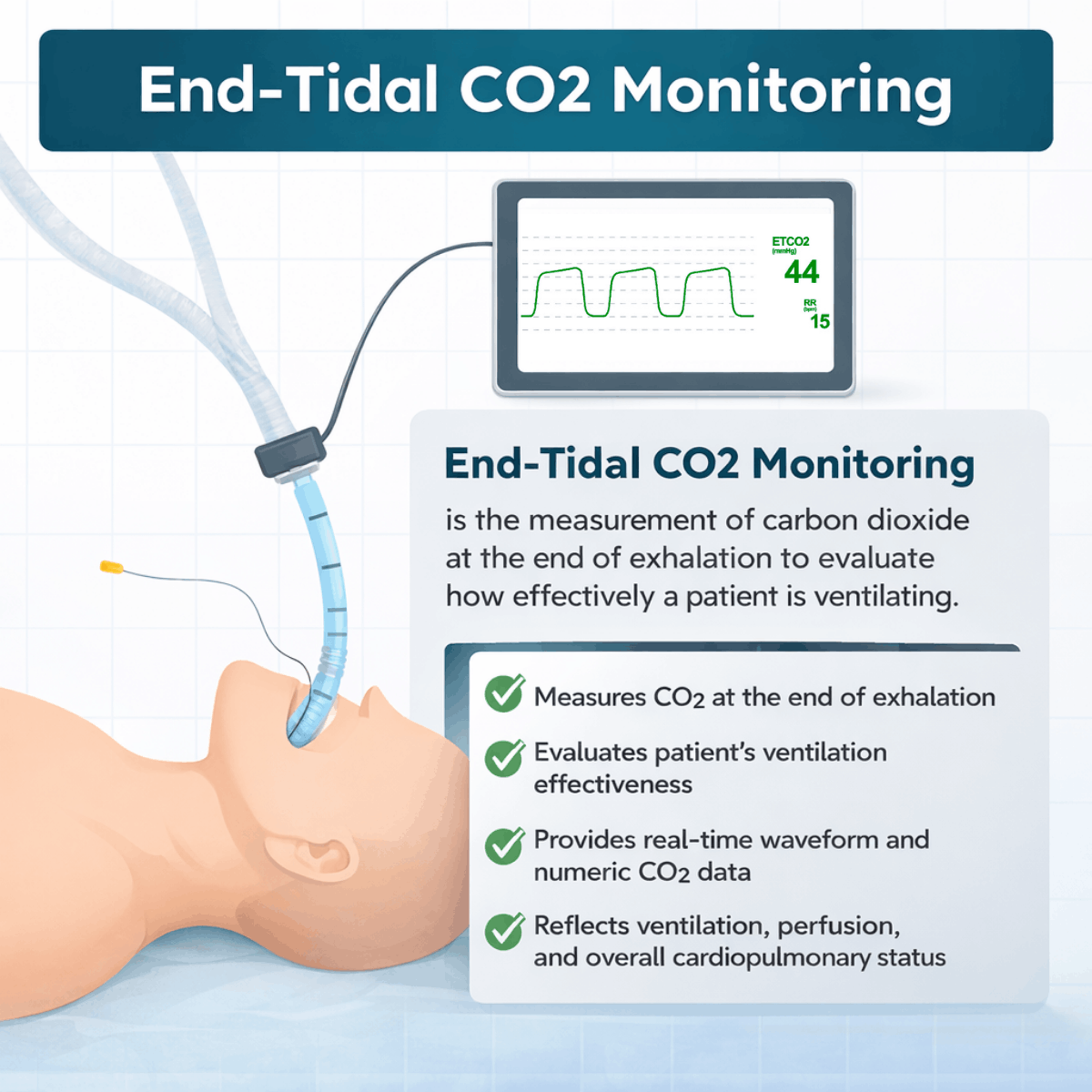
End-tidal CO2 (EtCO2) monitoring is the measurement of the concentration or partial pressure of carbon dioxide at the end of exhalation. It reflects the amount of CO2 present in alveolar gas and provides insight into how effectively a patient is ventilating. EtCO2 is displayed as both a numeric value and a waveform, known as a capnogram, which illustrates CO2 levels throughout the respiratory cycle.
In patients with normal lung function, EtCO2 typically runs 2–5 mm Hg lower than the arterial PaCO2 measured on an arterial blood gas. Because CO2 elimination depends on ventilation, pulmonary perfusion, and metabolism, EtCO2 monitoring offers real-time feedback about all three.
It is widely used in respiratory care to assess ventilatory status, verify endotracheal tube placement, monitor patients during sedation, evaluate cardiopulmonary resuscitation quality, and guide adjustments in mechanical ventilation.
How End-Tidal CO2 Monitoring Works
EtCO2 monitoring measures exhaled CO2 at the airway opening. There are two primary methods:
Mainstream Capnography
A sensor is placed directly in-line between the airway device and the ventilator circuit. This method is commonly used in intubated patients and provides rapid, accurate readings with minimal delay.
Sidestream Capnography
A small sample of exhaled gas is continuously aspirated through a narrow tubing line to a remote analyzer. This method is especially useful in spontaneously breathing patients and during moderate sedation, often using specialized nasal cannulas.
Sidestream systems may introduce a slight delay due to the length and diameter of the sampling tube, but they remain highly valuable for trending and waveform analysis.

Understanding the Capnogram
The capnogram waveform provides more information than the numeric EtCO2 value alone. A normal waveform consists of four phases:
- Phase I (Baseline): Represents inspired gas with minimal CO2.
- Phase II (Expiratory upstroke): Rapid rise as alveolar gas mixes with dead space gas.
- Phase III (Alveolar plateau): Reflects alveolar gas exhalation; the EtCO2 value is measured at the end of this phase.
- Phase IV (Inspiratory downstroke): CO2 drops rapidly to baseline with inspiration.
Note: Changes in waveform shape can signal airway obstruction, rebreathing, ventilator disconnection, or sampling line malfunction. For respiratory therapists, waveform interpretation is a critical skill.
Clinical Significance in Respiratory Therapy
1. Assessing Ventilation
The primary role of the ventilator is CO2 elimination. Because EtCO2 reflects alveolar ventilation, it provides an immediate indication of whether ventilation is adequate.
- Decreased ventilation → Increased EtCO2
- Increased ventilation → Decreased EtCO2
However, the relationship between EtCO2 and PaCO2 is not always linear. With very small tidal volumes approaching dead space volume, PaCO2 may increase while EtCO2 decreases. This is why periodic arterial blood gas (ABG) analysis remains essential for validation.
For respiratory therapists managing mechanical ventilation, EtCO2 trend analysis helps guide adjustments in:
- Tidal volume (VT)
- Respiratory rate
- Minute ventilation
- Positive end-expiratory pressure (PEEP)
2. Detecting Changes in Perfusion
EtCO2 is influenced not only by ventilation but also by pulmonary perfusion. A sudden drop in EtCO2 may indicate:
- Decreased cardiac output
- Pulmonary embolism
- Cardiac arrest
- Severe hypotension
Note: An increase in the PaCO2–EtCO2 gradient suggests increased physiologic dead space, commonly associated with reduced perfusion to ventilated lung units. This makes EtCO2 monitoring especially valuable in critically ill patients with unstable hemodynamics.
3. Verification of Endotracheal Intubation
One of the most critical emergency applications of capnography is confirmation of endotracheal tube placement. After intubation, the presence of sustained exhaled CO2 confirms tracheal placement. Small in-line colorimetric CO2 detectors are widely used for rapid verification.
Absent EtCO2 may indicate:
- Esophageal intubation
- Cardiac arrest
- Airway obstruction
- Ventilator disconnection
Note: For respiratory therapists, capnography is considered a gold standard for confirming airway placement.
4. Monitoring During CPR
Quantitative waveform capnography plays an important role during cardiopulmonary resuscitation (CPR).
Clinical implications include:
- Persistent EtCO2 < 10 mm Hg during CPR is associated with poor outcomes.
- A sudden rise in EtCO2 suggests return of spontaneous circulation (ROSC).
- Decreasing EtCO2 may indicate poor compression quality.
Note: Because EtCO2 reflects pulmonary blood flow during CPR, it indirectly measures cardiac output generated by chest compressions.
5. Sedation and Procedural Monitoring
Capnography is recommended during moderate sedation procedures to detect hypoventilation early.
In spontaneously breathing patients:
- Numeric EtCO2 values may be less accurate.
- Waveform trends are highly useful.
Note: Respiratory therapists involved in bronchoscopy or procedural sedation monitoring can identify early hypoventilation before oxygen desaturation occurs, improving patient safety.
Volumetric Capnography
Beyond standard time-based capnography, volumetric capnography plots CO2 concentration against exhaled volume.
This technique allows for:
- Measurement of CO2 elimination (VCO2)
- Dead space calculation
- Evaluation of ventilatory efficiency
- Optimization of PEEP
Note: Volumetric capnography may help detect pulmonary embolism and monitor patients during liberation from mechanical ventilation. Because dead space ventilation directly influences CO2 elimination, volumetric capnography provides advanced insight into ventilation-perfusion relationships.
Causes of Increased and Decreased EtCO2
Increased EtCO2
- Hypoventilation (↓ VT, ↓ VE)
- Increased CO2 production (agitation, fever, shivering, pain)
- Rebreathing
Decreased EtCO2
- Hyperventilation
- Sedation or reduced metabolic activity
- Decreased lung perfusion
- Pulmonary embolism
- Decreased cardiac output
Absent EtCO2
- Apnea
- Cardiac arrest
- Ventilator disconnection
- Airway obstruction
- Sampling line leak (in sidestream systems)
Note: Rapid recognition of these patterns allows respiratory therapists to intervene quickly.
Limitations of End-Tidal CO2 Monitoring
While EtCO2 is highly valuable, it has limitations:
- It does not directly measure arterial CO2.
- The PaCO2–EtCO2 gradient can widen in lung disease.
- Very low tidal volumes can produce misleading readings.
- Equipment malfunction or sampling line obstruction can cause false alarms.
Therefore, EtCO2 should be used alongside:
- Arterial blood gases
- Pulse oximetry
- Clinical assessment
- Ventilator waveform analysis
Note: It is a powerful monitoring tool, but not a standalone diagnostic test.
Why It Matters to Respiratory Therapists
Respiratory therapists are responsible for managing ventilation, optimizing gas exchange, and ensuring airway safety. End-tidal CO2 monitoring supports all three of these responsibilities.
It provides:
- Immediate feedback on ventilatory adjustments
- Early warning of airway or circuit issues
- Objective data during CPR
- Guidance during weaning from mechanical ventilation
- Insight into ventilation-perfusion mismatch
In critical care environments, rapid physiologic changes are common. EtCO2 monitoring allows therapists to respond proactively rather than reactively.
Because the primary function of mechanical ventilation is CO2 elimination, integrating capnography into ventilator management is logical and clinically beneficial.
End-Tidal CO2 Monitoring Practice Questions
1. What is end-tidal CO2 (EtCO2) monitoring?
The measurement of the partial pressure or concentration of carbon dioxide at the end of exhalation.
2. What does the EtCO2 value represent physiologically?
It reflects the CO2 level in alveolar gas at the end of expiration.
3. What is the difference between capnometry and capnography?
Capnometry provides a numerical CO2 value, whereas capnography includes both the numerical value and the waveform display.
4. What is the graphical waveform produced during capnography called?
A capnogram.
5. In patients with normal lungs, how does EtCO2 typically compare to PaCO2?
EtCO2 is usually 2–5 mm Hg lower than PaCO2.
6. What is the normal range for EtCO2 in adults?
Approximately 30–43 mmHg
7. What does a rising EtCO2 value most commonly indicate?
Hypoventilation or decreased alveolar ventilation.
8. What does a decreasing EtCO2 value most commonly indicate?
Hyperventilation or reduced pulmonary perfusion.
9. Why is capnography useful for verifying endotracheal tube placement?
The presence of sustained CO2 confirms tracheal, not esophageal, intubation.
10. What is the role of colorimetric CO2 detectors during intubation?
They provide rapid visual confirmation of exhaled CO2.
11. Why should EtCO2 values be initially compared with PaCO2?
To validate accuracy and establish a baseline correlation.
12. How does low tidal volume ventilation affect PaCO2 and EtCO2?
PaCO2 may rise while EtCO2 may fall due to increased dead space ventilation.
13. What is volumetric capnography?
A method that plots CO2 elimination against exhaled volume.
14. How can volumetric capnography help calculate dead space?
By analyzing the relationship between exhaled CO2 and tidal volume.
15. Why is capnography recommended during moderate sedation?
To detect early hypoventilation and prevent respiratory compromise.
16. What is the primary role of a ventilator in relation to CO2?
To facilitate carbon dioxide elimination.
17. What is mainstream capnography?
A system in which the CO2 sensor is placed directly at the airway.
18. What is sidestream capnography?
A system that samples exhaled gas through a small tube to an external analyzer.
19. Which capnography method is most commonly used in spontaneously breathing patients?
Sidestream capnography
20. What limitation may occur with sidestream capnography?
A slight delay in CO2 measurement due to gas transport through tubing.
21. Why are trends in EtCO2 often more important than single readings?
Trends reflect changes in ventilation and perfusion over time.
22. How is EtCO2 monitoring useful during cardiac arrest?
It helps assess the effectiveness of chest compressions and return of spontaneous circulation.
23. What does a sudden drop in EtCO2 during mechanical ventilation suggest?
Possible disconnection, airway obstruction, or pulmonary embolism.
24. How does pulmonary embolism affect EtCO2?
It decreases EtCO2 due to increased dead space.
25. Why is EtCO2 monitoring valuable during weaning from mechanical ventilation?
It helps assess ventilatory efficiency and CO2 elimination.
26. What does an elevated EtCO2 waveform plateau typically indicate?
Hypoventilation or increased CO2 production.
27. Why may EtCO2 be inaccurate in patients with severe lung disease?
Ventilation-perfusion mismatch increases the gradient between PaCO2 and EtCO2.
28. What is the capnogram phase that represents alveolar gas exhalation?
Phase III (the alveolar plateau).
29. What clinical condition may cause a gradual rise in EtCO2 during sedation?
Progressive hypoventilation
30. Why should capnography be integrated into critical care ventilators?
Because it provides continuous, real-time monitoring of ventilation status.
31. According to the American Heart Association (AHA), why is quantitative waveform capnography recommended during CPR?
To help monitor CPR quality, guide vasopressor therapy, and detect return of spontaneous circulation (ROSC).
32. What does a persistent end-tidal CO2 (EtCO2) value less than 10 mm Hg during CPR suggest?
It is associated with poor perfusion and a poor resuscitation outcome.
33. What does a sudden sharp increase in EtCO2 during CPR most likely indicate?
Return of spontaneous circulation (ROSC).
34. What EtCO2 value during resuscitation strongly suggests ROSC?
An abrupt increase to ≥40 mm Hg.
35. What does a gradual decrease in EtCO2 during CPR indicate?
Worsening chest compression quality and the possible need to change rescuers.
36. How can arterial blood gases (ABGs) and EtCO2 monitoring together assess ventilation?
They evaluate the effectiveness of CO2 elimination.
37. How are ABGs and pulse oximetry used in combination?
To evaluate oxygenation status.
38. What is the most common cause of increased EtCO2?
Decreased effective ventilation leading to CO2 retention.
39. How does increased CO2 production affect EtCO2?
It causes EtCO2 to rise.
40. What clinical situations can increase CO2 production and raise EtCO2?
Agitation, shivering, pain, anxiety, or recovery from sedation.
41. What is a common cause of decreased EtCO2 due to improved ventilation?
Hyperventilation with increased tidal volume or minute ventilation.
42. How can rapid, shallow breathing affect EtCO2?
It may decrease EtCO2 due to increased dead space ventilation.
43. What effect does sedation or hypothermia have on EtCO2?
They may decrease CO2 production and lower EtCO2.
44. How does pulmonary embolism affect EtCO2?
It decreases EtCO2 due to reduced lung perfusion and increased dead space.
45. What does an absent EtCO2 reading most commonly indicate?
Apnea, cardiac arrest, airway obstruction, or ventilator disconnection.
46. What is the normal PaCO2–EtCO2 gradient in patients with healthy lungs?
Approximately 2–5 mmHg
47. What does an increasing PaCO2–EtCO2 gradient suggest?
An increase in physiologic dead space.
48. What is the most common cause of an increased PaCO2–EtCO2 gradient?
Decreased perfusion to ventilated lung units, such as in pulmonary embolism.
49. What are possible causes of a sudden drop in EtCO2?
Sudden decrease in cardiac output, pulmonary embolism, circuit disconnection, or ET tube displacement.
50. What can capnogram waveform analysis reveal besides ventilation status?
Circuit rebreathing, airway obstruction, or ventilator disconnection.
51. Why should abnormal EtCO2 trends be confirmed with ABG analysis?
Because EtCO2 trends may not precisely reflect PaCO2 changes.
52. What does a rapid drop to 0 mm Hg EtCO2 on sidestream capnography suggest if cardiac arrest is ruled out?
Sampling line obstruction or leak.
53. How does decreased cardiac output affect EtCO2?
It lowers EtCO2 due to reduced CO2 delivery to the lungs.
54. Why is EtCO2 monitoring particularly useful during mechanical ventilation?
It provides continuous feedback on ventilation efficiency.
55. What happens to EtCO2 when minute ventilation increases significantly?
EtCO2 decreases due to enhanced CO2 elimination.
56. What condition may cause both elevated PaCO2 and reduced EtCO2?
Severe dead space ventilation.
57. Why is trend monitoring more important than a single EtCO2 value?
Trends reflect dynamic changes in ventilation and perfusion.
58. What is the clinical significance of a gradually rising EtCO2 in a sedated patient?
Possible hypoventilation or respiratory depression.
59. How can capnography assist in detecting ventilator circuit rebreathing?
By identifying abnormal waveform patterns and elevated baseline CO2.
60. What is the primary physiologic determinant of EtCO2 during stable ventilation?
The balance between CO2 production, ventilation, and pulmonary perfusion.
61. What is the primary determinant of EtCO2 in a mechanically ventilated patient with stable metabolism?
Alveolar ventilation
62. How does an increase in dead space affect the EtCO2 value?
It lowers EtCO2 relative to PaCO2.
63. What capnogram phase represents exhalation of dead space gas?
Phase I
64. What capnogram phase represents the transition between dead space and alveolar gas?
Phase II
65. What capnogram phase represents alveolar plateau?
Phase III
66. What does a slanted or rising Phase III (alveolar plateau) suggest?
Airway obstruction or uneven alveolar emptying.
67. What condition commonly produces a “shark-fin” capnogram waveform?
Bronchospasm
68. What happens to EtCO2 during hypoventilation?
EtCO2 increases
69. What happens to EtCO2 during hyperventilation?
EtCO2 decreases
70. Why might EtCO2 be falsely low in patients with severe hypotension?
Reduced pulmonary perfusion decreases CO2 delivery to alveoli.
71. How does increasing PEEP potentially affect EtCO2?
It may decrease EtCO2 if cardiac output is reduced.
72. What does a gradually increasing baseline on a capnogram indicate?
Rebreathing of CO2
73. What equipment malfunction can cause rebreathing and elevated baseline CO2?
Exhausted CO2 absorber in a circle system.
74. How can capnography help detect accidental extubation?
A sudden loss of waveform and drop to zero EtCO2.
75. What is the role of capnography during procedural sedation?
To detect early hypoventilation before oxygen desaturation occurs.
76. Why does EtCO2 often change before SpO2 during respiratory depression?
CO2 retention occurs before oxygen desaturation.
77. What does a widened PaCO2–EtCO2 gradient indicate in ARDS?
Increased physiologic dead space.
78. How does fever affect EtCO2?
It may increase EtCO2 due to increased CO2 production.
79. How does hypothermia affect EtCO2?
It may decrease EtCO2 due to reduced metabolic CO2 production.
80. What EtCO2 pattern may be seen during partial airway obstruction?
Prolonged expiratory upstroke.
81. Why is EtCO2 monitoring important during transport of ventilated patients?
To continuously assess ventilation and detect disconnections.
82. How does pulmonary embolism affect the capnogram waveform?
It reduces the height of the waveform due to decreased perfusion.
83. What does a flat capnogram with normal chest rise suggest?
Esophageal intubation
84. What is volumetric capnography used to calculate?
Physiologic dead space
85. How can EtCO2 monitoring assist in adjusting ventilator settings?
By guiding changes in tidal volume and respiratory rate.
86. What does a sudden rise in EtCO2 after intubation indicate?
Successful placement in the trachea.
87. What happens to EtCO2 during severe bronchoconstriction?
It may initially rise, then decrease if ventilation worsens.
88. How does increased cardiac output affect EtCO2?
It increases EtCO2 due to greater CO2 delivery to lungs.
89. Why should EtCO2 values be interpreted cautiously in severe lung disease?
Because ventilation–perfusion mismatch alters accuracy.
90. What clinical condition may cause low EtCO2 with normal PaCO2?
Increased alveolar dead space.
91. What does a progressively decreasing EtCO2 during shock indicate?
Worsening perfusion
92. Why is capnography useful during noninvasive ventilation (NIV)?
To monitor ventilation effectiveness and detect hypoventilation.
93. What does an irregular capnogram plateau suggest?
Inconsistent alveolar emptying
94. How does spontaneous hyperventilation affect EtCO2 in anxiety?
It decreases EtCO2.
95. Why is EtCO2 important in patients with neuromuscular weakness?
To detect hypoventilation early.
96. What does a biphasic capnogram plateau suggest?
Partial airway obstruction or uneven lung emptying.
97. How can EtCO2 trends help evaluate response to bronchodilator therapy?
Improved waveform shape and normalized EtCO2 suggest better ventilation.
98. What is the significance of capnography during bronchoscopy?
To monitor ventilation during sedation.
99. How does severe anemia affect EtCO2?
It does not directly alter EtCO2 but may affect oxygen delivery.
100. Why is continuous EtCO2 monitoring preferred over intermittent ABGs in unstable patients?
It provides real-time assessment of ventilation changes.
Final Thoughts
End-tidal CO2 monitoring is far more than a number on a screen. It is a real-time reflection of ventilation, perfusion, and metabolic activity, offering respiratory therapists a window into a patient’s cardiopulmonary status.
From verifying endotracheal tube placement to guiding CPR and optimizing ventilator settings, its applications are broad and impactful.
While it should never replace arterial blood gas analysis or clinical judgment, it significantly enhances patient safety and monitoring precision. Mastery of capnography interpretation is therefore an essential skill for every respiratory therapist committed to delivering high-quality respiratory care.

Written by:
John Landry is a registered respiratory therapist from Memphis, TN, and has a bachelor's degree in kinesiology. He enjoys using evidence-based research to help others breathe easier and live a healthier life.
References
- Richardson M, Moulton K, Rabb D, et al. Capnography for Monitoring End-Tidal CO2 in Hospital and Pre-hospital Settings: A Health Technology Assessment [Internet]. Ottawa (ON): Canadian Agency for Drugs and Technologies in Health; 2016.