
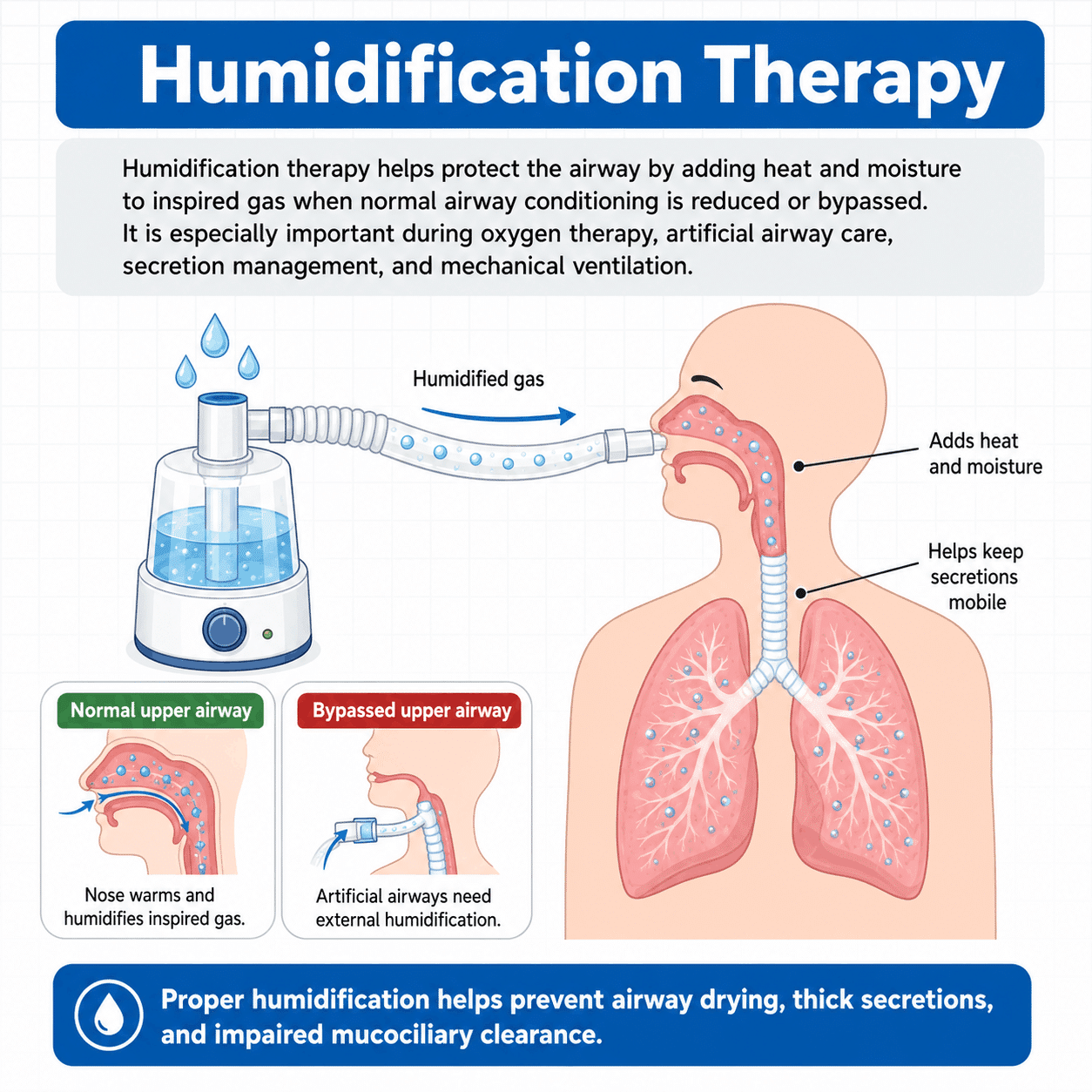
Humidification therapy is the process of adding water vapor, and sometimes heat, to inspired gas to protect the airway and support normal respiratory function. In healthy breathing, the upper airway warms, humidifies, and filters inspired air before it reaches the lower respiratory tract.
When dry medical gases are used, oxygen flows are high, secretions are thick, or an artificial airway bypasses the nose and upper airway, this natural conditioning process may be inadequate.
Humidification therapy helps prevent airway drying, mucus plugging, impaired ciliary activity, atelectasis, and complications during oxygen therapy or mechanical ventilation.

What Is Humidification Therapy?
Humidification therapy refers to the clinical use of devices that add water vapor to inspired gas. In respiratory care, this therapy is used to reduce the humidity deficit created when dry medical gas is delivered to a patient or when the upper airway is bypassed by an artificial airway.
Humidity is water in its molecular, gaseous form. This is different from liquid water droplets suspended in gas. A humidifier adds invisible water vapor to inspired gas, while a nebulizer produces aerosol particles. This difference is clinically important because humidity and aerosol behave differently, deposit differently, and carry different infection-control risks.
The goal of humidification therapy is to help inspired gas reach the airway at a temperature and moisture level that closely matches normal physiologic conditions. When gas is too dry or too cold, the airway must give up its own heat and water to condition that gas. If this demand becomes excessive, airway tissues can dry, secretions can thicken, and normal defense mechanisms can become impaired.
Humidification therapy is especially important for patients who receive:
- Dry medical gases
- Oxygen therapy at higher flows
- Mechanical ventilation
- Endotracheal tubes
- Tracheostomy tubes
- Noninvasive ventilation with dryness or leaks
- Therapy for thick, tenacious, or retained secretions
Note: The type of humidification used depends on the patient’s airway, secretion burden, oxygen flow, ventilatory status, temperature needs, and risk of complications.
Normal Airway Humidification
The respiratory tract is designed to receive gas that has been warmed and humidified before it reaches the lower airway. Under normal conditions, the nose and upper airway perform most of this function.
During inspiration, incoming air passes through the nose, where it is warmed and humidified by the nasal mucosa. The nasal passages have a large surface area, rich blood supply, glandular secretions, goblet cells, and moist mucosal surfaces. These features allow the nose to transfer heat and water vapor to inspired gas efficiently.
During exhalation, the process reverses. Warm, moist gas from the lungs passes back through the upper airway. Some of the heat and moisture condenses on the cooler nasal and upper airway surfaces, allowing the body to reclaim part of the heat and water that would otherwise be lost.
Although the sinuses, pharynx, larynx, trachea, and bronchi also contribute to gas conditioning, the nose is the primary structure responsible for warming and humidifying inspired air.
Key Humidity Terms
Understanding humidification therapy requires knowing a few basic terms.
Absolute Humidity
Absolute humidity is the actual amount of water vapor in a given volume of gas. It is usually measured in milligrams per liter.
For example, fully saturated gas at normal body temperature contains about 44 mg/L of water vapor. This represents the approximate water content expected when gas reaches the lower airway under normal conditions.
Relative Humidity
Relative humidity is the percentage of water vapor present in gas compared with the maximum amount that gas could hold at the same temperature and pressure.
For example, if gas contains half of the water vapor it could hold at a specific temperature, its relative humidity is 50%. If it contains the maximum amount possible at that temperature, its relative humidity is 100%.
Temperature and Water Vapor Capacity
Temperature strongly affects humidity. Warm gas can hold more water vapor than cool gas. As gas warms, its capacity to hold water increases. As gas cools, it may lose water vapor through condensation.
This is why heated humidification can deliver more water vapor than cool humidification. It is also why condensation forms in ventilator tubing when warm, saturated gas cools as it travels through the circuit.
Humidity Deficit
Humidity deficit refers to the difference between the amount of water vapor inspired gas contains and the amount it should contain under normal airway conditions.
If inspired gas is dry, the airway must supply more water to condition it. The larger the humidity deficit, the greater the demand placed on airway tissues.
The Isothermic Saturation Boundary
As inspired gas travels down the respiratory tract, it becomes progressively warmer and more humid. The point at which the gas reaches body temperature and becomes fully saturated with water vapor is called the isothermic saturation boundary.
Under normal conditions, this point is usually located below the carina. This means that the upper airway and larger airways have already conditioned the gas before it reaches the deeper lung regions.
Several conditions can shift the isothermic saturation boundary deeper into the lungs, including:
- Breathing cold gas
- Breathing dry gas
- Mouth breathing
- High minute ventilation
- Endotracheal intubation
- Tracheostomy
- Delivery of dry medical gas
Note: When this boundary shifts deeper, lower airway structures must provide more heat and moisture exchange than they are normally designed to handle. Over time, this can damage the airway epithelium, impair secretion clearance, and increase the risk of airway obstruction.
Why Humidification Therapy Matters
Humidification therapy protects the airway by supporting the normal balance of heat and moisture. This is important because airway function depends on a moist mucosal surface and mobile secretions.
Protection of Airway Mucosa
Dry gas can remove moisture from airway tissues. When the mucosa becomes dry, it may become irritated, inflamed, and more vulnerable to injury. Prolonged exposure to dry gas can contribute to structural damage, especially when gas is delivered directly into the trachea through an artificial airway.
Maintenance of Mucociliary Clearance
The airway is lined with cilia that move mucus, debris, and microorganisms upward so they can be coughed out, swallowed, or suctioned. This mucociliary system depends on proper moisture.
When humidity is inadequate, ciliary movement slows, mucus becomes thicker, and secretion clearance becomes less effective. This increases the risk of mucus retention, infection, atelectasis, and airway obstruction.
Prevention of Thick Secretions
Dry gas can cause secretions to become thick, sticky, and difficult to remove. These dehydrated secretions are often described as inspissated.
Thick secretions can increase airway resistance, plug small airways, block an endotracheal tube or tracheostomy tube, and make suctioning more difficult. Adequate humidification helps keep secretions mobile so they can be cleared more effectively.
Reduction of Heat Loss
Dry and cold inspired gas can increase heat loss from the airway. This may be especially important in infants, neonates, hypothermic patients, and patients receiving prolonged ventilatory support. Heated humidification can help reduce heat loss and support a more stable airway environment.
Effects of Inadequate Humidification
Inadequate humidification can produce several harmful effects. These may develop quickly when dry gas is delivered through an artificial airway because the normal conditioning function of the upper airway is bypassed.
Possible effects include:
- Airway irritation
- Reduced ciliary activity
- Thickened secretions
- Mucus plugging
- Increased airway resistance
- Increased work of breathing
- Increased peak inspiratory pressure during volume ventilation
- Reduced tidal volume during pressure ventilation
- Atelectasis
- Hypothermia
- Airway epithelial damage
- Endotracheal tube or tracheostomy tube obstruction
Note: Dry gas delivered directly into the trachea can injure airway tissue within minutes. Prolonged exposure can lead to mucociliary dysfunction, destruction of the airway lining, retained secretions, and impaired ventilation.
When Humidification Therapy Is Indicated
Humidification therapy is indicated when the patient cannot adequately condition inspired gas through normal airway function or when dry medical gas creates a clinically important humidity deficit.
Dry Medical Gas Administration
Oxygen and compressed medical gases are dry. When these gases are delivered to the airway, they can increase water loss from the mucosa.
For many adults with an intact upper airway, low-flow oxygen at 4 L/min or less may not require added humidity because the upper airway can usually provide sufficient conditioning. However, dry oxygen at flows above 4 L/min should generally be humidified, especially if therapy is prolonged or if the patient reports dryness, irritation, or discomfort.
At very high flows, heated humidification is often preferred because it can provide more water vapor and better match normal airway conditions.
Artificial Airways
Humidification is essential when the upper airway is bypassed by an endotracheal tube or tracheostomy tube. In these patients, inspired gas enters the trachea directly instead of passing through the nose and upper airway.
Without artificial humidification, the tracheal mucosa can dry, secretions can thicken, and mucus plugs can form. These plugs may partially or completely obstruct the airway. For this reason, patients with artificial airways require humidification to replace the function normally provided by the upper airway.
Mechanical Ventilation
Mechanically ventilated patients with artificial airways need properly conditioned gas with every breath. During invasive mechanical ventilation, humidification may be provided by an active heated humidifier or by a heat and moisture exchanger, depending on the patient’s condition.
Humidification is especially important in mechanically ventilated patients because they may have impaired cough, sedation, muscle weakness, retained secretions, or prolonged exposure to dry medical gas.
Thick, Bloody, or Copious Secretions
Patients with thick, bloody, or copious secretions often need more reliable humidification. Thick secretions suggest that ordinary humidification may not be enough or that the current system is not meeting the patient’s needs.
In these patients, an active heated humidifier is often preferred over a passive device. Bland aerosol therapy may also be used in selected cases to help manage retained secretions, although it should not replace adequate systemic hydration.
High Minute Ventilation
Patients with high spontaneous minute ventilation move a larger volume of gas through the airway each minute. This increases the amount of heat and water the airway must provide. If the upper airway cannot keep up, a humidity deficit may develop.
Humidification may be needed to reduce airway drying, improve comfort, and prevent secretion thickening.
Noninvasive Ventilation
Patients receiving noninvasive positive-pressure ventilation may develop dryness, discomfort, secretion retention, or poor tolerance. This is especially likely when there are mask leaks, mouth leaks, low ambient humidity, supplemental oxygen, or prolonged therapy.
Humidification during noninvasive ventilation can improve comfort and adherence. Heated humidification is often preferred when dryness persists or when retained secretions are present. HMEs are generally not recommended during noninvasive ventilation because mask leaks and intentional leaks reduce their effectiveness and because they add dead space and resistance.
Hypothermia
Humidification may help patients with hypothermia by reducing respiratory heat loss. Heated humidity may be used when maintaining body temperature is part of the clinical goal.
Upper Airway Irritation or Edema
Cool humidity or cool aerosol may be used for upper airway irritation, postextubation swelling, croup, or laryngotracheobronchitis. Cool therapy may help soothe irritated tissue and may reduce upper airway swelling through vasoconstriction.
Humidification Targets
The required heat and humidity depend on where the gas enters the airway.
Gas delivered to the nose or mouth requires less conditioning because the upper airway can still contribute to warming and humidification. Gas delivered directly into the trachea requires more complete conditioning because the normal upper airway function has been bypassed.
For tracheal gas delivery, inspired gas should generally be warmed and humidified close to normal body conditions. Common targets include gas delivered around 35°C to 40°C with approximately 40 to 45 mg/L of water vapor and more than 90% relative humidity. During invasive mechanical ventilation, active humidification commonly targets 34°C to 41°C, 100% relative humidity, and about 33 to 44 mg/L of water content.
Note: The general principle is that the gas should be conditioned to match the normal airway conditions at the point where it enters the body.
Humidification Devices
Several types of devices are used to humidify inspired gas. The choice depends on the patient’s needs, the gas flow, the airway interface, and whether mechanical ventilation is being used.
Bubble Humidifiers
A bubble humidifier is a simple device often used with low-flow oxygen systems. Gas flows through a tube and exits beneath the surface of water, producing bubbles. As the bubbles rise through the water, some water vapor is added to the gas.
Bubble humidifiers are commonly used with nasal cannulas and small-bore oxygen tubing. They provide limited humidity and are most appropriate for patients with intact upper airways who are receiving lower oxygen flows.
Bubble humidifiers are not suitable when high levels of humidity are required, such as in patients with artificial airways or thick secretions. A pop-off alarm or whistle on a bubble humidifier usually indicates back pressure. Common causes include kinked tubing, obstructed tubing, or excessive downstream resistance.
Pass-Over Humidifiers
Pass-over humidifiers allow gas to move over the surface of water. As gas passes over the water, evaporation adds water vapor to the gas.
Unheated pass-over humidifiers provide limited humidity. Heated pass-over humidifiers provide more humidity because warmer gas can hold more water vapor. These devices may be used in systems where a higher humidity output is needed than a bubble humidifier can provide.
Wick Humidifiers
A wick humidifier uses an absorbent material to increase the surface area between water and gas. Water moves up through the wick by capillary action. Gas flows around the saturated wick and picks up heat and moisture.
Because the gas does not bubble through the water, wick humidifiers do not generate aerosol. This is an advantage when the goal is humidification without creating liquid droplets.
Wick humidifiers can provide effective humidification while reducing the risk of water particles being carried into the gas stream.
Membrane Humidifiers
Membrane humidifiers separate heated water from the gas stream with a hydrophobic membrane. Water vapor passes through the membrane into the gas, while liquid water remains separate.
This design allows water vapor transfer without direct contact between the gas stream and liquid water. It may help reduce aerosol generation and improve infection-control safety compared with systems that create droplets.
Heated Humidifiers
Heated humidifiers actively add heat and water vapor to inspired gas. They usually include a water reservoir, heating element, temperature monitoring system, and sometimes a heated-wire circuit.
These systems are widely used during mechanical ventilation and are often preferred when full or reliable humidification is needed.
Heated humidifiers are especially useful for:
- Artificial airways
- Invasive mechanical ventilation
- Long-term ventilation
- Thick or bloody secretions
- High ventilatory demands
- Patients who cannot tolerate an HME
- Situations where passive humidification is inadequate
Note: The gas passes through or over heated water, becomes warm and saturated, and then travels through the breathing circuit to the patient.
Heated-Wire Circuits
Heated-wire circuits are often used with heated humidifiers to reduce condensation. A wire in the ventilator tubing helps maintain gas temperature as it travels from the humidifier to the patient.
Without heated-wire tubing, warm saturated gas may cool in the circuit. As it cools, water vapor condenses into liquid water. This is called rainout.
Heated-wire circuits help reduce rainout by keeping the gas temperature more stable. However, they must be used properly. Heating wires should be threaded evenly and should not be bunched together. Heated-wire circuits should not be covered with towels, sheets, or drapes because trapped heat can damage tubing and create circuit leaks.
Heat and Moisture Exchangers
Heat and moisture exchangers, or HMEs, are passive humidification devices. They are sometimes called artificial noses because they partially replace the heat and moisture conserving function of the upper airway.
An HME is placed between the patient’s artificial airway and the ventilator circuit. During exhalation, warm, moist gas passes through the HME. The device captures some of the heat and water. During the next inspiration, incoming gas passes back through the device and picks up some of that stored heat and moisture.
HMEs are simple, compact, and do not require electricity, a heater, or a water reservoir. They also reduce circuit condensation because they do not actively add heated water vapor into the ventilator tubing.
HMEs are often useful during:
- Short-term ventilation
- Patient transport
- Stable ventilation with minimal secretions
- Situations where a compact humidification device is preferred
Note: Some HMEs also include bacterial-viral filtering properties, which may help reduce circuit contamination.
Limitations of HMEs
Although HMEs are useful, they are not appropriate for every patient. Their effectiveness depends on the patient exhaling enough heat and moisture for the device to capture and return.
HMEs commonly return heat and moisture at about 70% efficiency. This may be adequate for selected patients, but it may not provide enough humidification for patients with heavy secretions, high ventilatory demands, or prolonged support.
HMEs add mechanical dead space, often about 30 to 70 mL. This can contribute to carbon dioxide retention, especially in infants, small children, patients with low tidal volumes, and patients with lung-protective ventilation strategies.
HMEs also increase resistance. This resistance may rise as the device absorbs moisture or becomes contaminated with secretions. If mucus or blood obstructs the HME, airflow resistance can increase significantly.
During volume-controlled ventilation, HME obstruction may appear as increased peak inspiratory pressure. During pressure-controlled ventilation, it may appear as reduced delivered tidal volume.
When HMEs Should Be Avoided
HMEs should generally be avoided in patients with:
- Thick secretions
- Bloody secretions
- Copious secretions
- Large airway leaks
- High minute ventilation
- Low tidal volumes
- Carbon dioxide retention
- Core body temperature below 32°C
- Infants or very small children
- Uncuffed endotracheal tubes with significant leak
- Noninvasive ventilation
- Need for frequent aerosol therapy through the airway
Large leaks reduce the amount of exhaled gas returning through the HME, which limits heat and moisture capture. Hypothermia reduces the heat available in exhaled gas, making passive humidification less effective. High minute ventilation may exceed the HME’s ability to maintain adequate humidity.
Note: When an HME is inappropriate or ineffective, an active heated humidifier is usually the better choice.
Humidification During Mechanical Ventilation
Humidification during mechanical ventilation is essential because artificial airways bypass the normal warming and humidifying function of the upper airway.
An endotracheal tube or tracheostomy tube allows gas to enter the trachea directly. This protects the airway and supports ventilation, but it also eliminates much of the natural conditioning process. Without artificial humidification, dry ventilator gas can injure the mucosa, thicken secretions, and increase the risk of tube obstruction.
During mechanical ventilation, humidification helps:
- Maintain artificial airway patency
- Reduce secretion drying
- Support mucociliary function
- Prevent mucus plugging
- Reduce airway resistance
- Reduce the risk of atelectasis
- Improve patient comfort when applicable
- Maintain effective ventilation
Note: A heated humidifier provides active and consistent humidification. An HME provides passive humidification for selected patients. The best choice depends on the patient’s secretion burden, ventilatory demands, tidal volume, risk of carbon dioxide retention, and expected duration of ventilation.
Secretion Management and Airway Patency
Airway patency during mechanical ventilation depends on both humidification and secretion removal. Humidification helps prevent secretions from drying. Suctioning removes secretions that the patient cannot clear independently.
Mechanically ventilated patients may have impaired cough because of sedation, weakness, altered mental status, or the presence of an artificial airway. Secretions may collect inside the tube or ventilator circuit. If secretions become thick and retained, they can narrow the airway lumen and increase resistance to airflow.
Signs that secretion problems may be related to inadequate humidification include:
- Secretions becoming thicker
- Secretions becoming bloody or crusted
- Increased difficulty suctioning
- Increased peak inspiratory pressure
- Reduced delivered tidal volume
- Increased work of breathing
- Visible mucus in the artificial airway
- Frequent HME obstruction
- Mucus plugging
- Atelectasis
Note: When these signs appear, the clinician should reassess the patient, the humidification system, hydration status, suctioning needs, and the appropriateness of the current device.
Condensation and Rainout
Condensation is a common issue with heated humidification systems. When warm, saturated gas cools in the breathing circuit, water vapor changes into liquid water. This collected water is called rainout.
Rainout can create several hazards:
- Increased resistance in the circuit
- Interference with gas flow
- Accidental drainage of water toward the patient
- Ventilator malfunction
- Contamination risk
- Increased circuit handling
Condensate in a ventilator circuit should be treated as infectious waste. It should be drained away from the patient and discarded properly. It should not be drained back into the humidifier reservoir because this may contaminate the water supply.
Note: Water traps may be placed at low points in the circuit to collect condensate. Heated-wire circuits can reduce rainout by maintaining gas temperature along the tubing.
Infection-Control Concerns
Humidification and aerosol systems require careful infection-control practices. Any equipment that contains water can become contaminated if not handled correctly.
Water vapor itself is not the same as aerosol droplets. Pure water vapor does not carry microorganisms in the same way liquid droplets can. However, some humidifiers and nebulizers can produce aerosols that may carry microorganisms from contaminated water or equipment to the patient.
Important infection-control practices include:
- Use sterile water when required
- Follow equipment cleaning and replacement policies
- Avoid draining circuit condensate back into the humidifier
- Treat condensate as infectious waste
- Avoid unnecessary circuit disconnections
- Replace visibly soiled or malfunctioning equipment
- Maintain closed systems when possible
- Handle nebulizers and reservoirs with aseptic technique
Note: Ventilator circuits should not be changed routinely unless visibly soiled or malfunctioning. Unnecessary circuit changes and disconnections may increase contamination risk.
Bland Aerosol Therapy and Humidification
Bland aerosol therapy is related to humidification, but it is not the same. Humidification adds water vapor to inspired gas. Bland aerosol therapy delivers sterile water or saline particles suspended in gas.
Bland aerosols may be hypotonic, isotonic, or hypertonic. They are commonly used to:
- Soothe upper airway irritation
- Reduce upper airway swelling
- Help manage thick secretions
- Overcome heat and humidity deficits in patients with tracheal airways
- Help obtain sputum specimens
Common devices for bland aerosol therapy include large-volume jet nebulizers and ultrasonic nebulizers. Delivery interfaces may include aerosol masks, face tents, tracheostomy masks, T tubes, mist tents, and hoods.
Bland aerosol therapy may be useful for upper airway edema, croup, postextubation irritation, and secretion management. However, it should be used for a clear therapeutic reason rather than as a routine substitute for proper humidification.
Cool Versus Heated Therapy
The temperature of humidification or aerosol therapy should match the clinical goal.
Cool Therapy
Cool humidity or cool aerosol is often used for upper airway irritation and swelling. It may be used after extubation, after bronchoscopy, or in pediatric upper airway conditions such as croup or laryngotracheobronchitis.
Cool aerosols may help reduce upper airway swelling by promoting vasoconstriction. They may also soothe irritated tissues.
Heated Therapy
Heated humidity or heated aerosol is used when the goal is to provide more water vapor, prevent drying, manage thick secretions, support artificial airways, or help maintain thermal balance.
Heated therapy is commonly preferred for:
- Artificial airways
- Mechanical ventilation
- Thick secretions
- Hypothermia
- Neonatal thermal support
- High humidity needs
Note: The choice between cool and heated therapy should be based on patient assessment, not habit.
Aerosol Delivery Interfaces
Several interfaces may be used to deliver humidified gas or bland aerosol.
- Aerosol Mask: Useful for short-term therapy in patients with intact upper airways. It can deliver aerosol to the nose and mouth but may be uncomfortable for some patients.
- Face Tent: Useful when a patient cannot tolerate a mask or has facial trauma, burns, or irritation. It is less precise than a tight-fitting mask but may improve comfort.
- Tracheostomy Mask: Designed to deliver humidity or aerosol to a tracheostomy tube. It is useful when precise or high oxygen concentration is not required and when avoiding traction on the airway is important.
- T Tube: Can be used for patients with an endotracheal tube or tracheostomy tube. It may be useful when moderate to high oxygen concentrations are needed.
- Mist Tent, Hood, or Enclosure: May be used in pediatric care. Cool aerosols delivered by enclosure may help reduce upper airway swelling, but output and oxygen concentration must be monitored carefully.
Hazards of Bland Aerosol Therapy
Bland aerosol therapy can be helpful, but it has risks. These risks are especially important in infants, small children, patients with fluid problems, and patients with airway reactivity.
Possible hazards include:
- Cross-contamination
- Environmental exposure to aerosol
- Inadequate mist output
- Overhydration
- Bronchospasm
- Increased airway resistance
- Swelling of dried secretions
- Noise
- Unreliable oxygen delivery if patient demand is not met
Ultrasonic nebulizers can produce very high water outputs. They should not be used continuously because of the risk of overhydration, especially in infants, small children, and patients with fluid or electrolyte problems.
Hypotonic aerosols can irritate the airway and trigger bronchospasm in susceptible patients. Patients with asthma, reactive airways, or a history of bronchospasm should be monitored closely.
Dried secretions may absorb water and swell after aerosol therapy. If these swollen secretions obstruct small airways, the patient may develop worsening shortness of breath, new crackles, increased work of breathing, or signs of airway obstruction.
Humidification and Systemic Hydration
Humidification can help maintain airway moisture, but it is not a substitute for adequate systemic hydration.
If a patient is dehydrated, secretions may remain thick despite humidification therapy. Improving oral or intravenous fluid intake may be more effective than relying only on aerosol or humidity devices. The clinician should assess hydration status, secretion quality, fluid balance, and the patient’s overall condition.
This is especially important in patients with thick retained secretions. Humidification can help prevent further drying, but it may not fully correct secretions that are already thick because of dehydration, infection, inflammation, or poor fluid intake.
Humidification in Neonates and Infants
Neonates and infants require special attention because small changes in temperature, resistance, dead space, and delivered volume can have large effects.
Humidifiers used in neonatal circuits should provide effective warming and humidification while minimizing compressible volume. Compressible volume is the amount of gas lost into expansion of the circuit or humidifier during positive-pressure inspiration instead of being delivered to the patient. In very small infants, even small volume losses may represent a significant portion of the intended tidal volume.
Wick-type humidifiers are often preferred in neonatal circuits because they can provide effective warming and humidification with low compressible volume.
Temperature probe placement is also important. If a distal temperature probe is placed inside a heated incubator, it may measure the incubator temperature rather than the gas temperature in the circuit. This can cause the heater system to reduce warming and may lead to condensation in the inspiratory tubing. The probe should be positioned so it measures gas temperature accurately.
Note: HMEs are generally not recommended for infants because the added dead space is significant and because uncuffed endotracheal tubes may allow exhaled gas to bypass the device.
Humidification During Noninvasive Ventilation
Noninvasive ventilation can cause dryness, nasal irritation, mouth dryness, thick secretions, and discomfort. Mask leaks and mouth leaks can increase heat and moisture loss. Supplemental oxygen can also add to the drying effect.
Humidification may improve comfort, tolerance, and adherence during noninvasive ventilation. This is especially important for children, infants, patients using oral interfaces, patients with low ambient humidity, and patients who complain of dryness or secretion retention.
Heated humidification may be preferred when symptoms persist despite simple humidification or when supplemental oxygen is used.
HMEs are generally not recommended during noninvasive ventilation. Intentional leaks, mask leaks, and one-way flow patterns impair the HME’s ability to conserve exhaled heat and moisture. The added dead space and resistance may also increase carbon dioxide retention and work of breathing.
Aerosol Medications and HMEs
HMEs can interfere with aerosol medication delivery. If an aerosol medication is delivered while the HME is in place, the device may trap medication particles and prevent them from reaching the patient’s airway.
When aerosol therapy is needed during mechanical ventilation, the HME may need to be removed, bypassed, or positioned correctly. If a metered-dose inhaler is used with an HME, the inhaler should be placed between the HME and the patient so that medication is delivered into the airway instead of being filtered or trapped by the HME.
Note: After treatment, the clinician should restore the humidification setup and ensure the circuit is connected properly.
Troubleshooting Humidification Systems
Respiratory therapists must monitor both the equipment and the patient. Humidification problems may involve the device, circuit, interface, water supply, temperature setting, or patient response.
Equipment Problems
Common equipment problems include:
- Low water level
- Loose connections
- Leaks
- Obstructed tubing
- Excessive condensation
- Improper temperature setting
- Reduced aerosol output
- Malpositioned temperature probe
- Incorrect HME placement
- Soiled or obstructed HME
- Water pooling in tubing
- Circuit disconnection
Loose ventilator circuit connections can cause loss of tidal volume. Water collecting in tubing can increase resistance or accidentally drain toward the patient. Condensation can also interfere with filter performance.
Inspiratory filters should be positioned properly when active humidification is used. Condensation can impair filter function, so filters must be placed according to equipment recommendations.
Patient Problems
Patient signs that may suggest humidification problems include:
- Dry airway
- Thick secretions
- Bloody secretions
- Crusting in the airway
- Increased suctioning difficulty
- Increased work of breathing
- Bronchospasm
- Increased airway pressure
- Decreased tidal volume
- Mucus plugging
- Carbon dioxide retention
- Discomfort during noninvasive ventilation
- Signs of overhydration during aerosol therapy
Note: The clinician should respond by assessing the patient, checking the device, evaluating secretion quality, ensuring adequate systemic hydration, and choosing a more appropriate humidification method when needed.
Choosing the Right Humidification Method
Humidification should be selected according to patient need. No single device is best for every situation.
Intact Upper Airway With Low Oxygen Flow
Patients with intact upper airways receiving low-flow oxygen may not require added humidity when flows are 4 L/min or less. If dryness or discomfort develops, a simple humidifier may be used.
Intact Upper Airway With Higher Oxygen Flow
When oxygen flow exceeds about 4 L/min, humidification is usually appropriate. A bubble humidifier may be adequate for low-flow systems and normal secretions. Higher flows or persistent dryness may require more effective humidification.
Artificial Airway
Patients with endotracheal or tracheostomy tubes require humidification because the upper airway is bypassed. A heated humidifier or HME may be used, depending on the patient’s condition.
Thick or Bloody Secretions
Patients with thick, bloody, or copious secretions should generally receive active heated humidification rather than an HME. Bland aerosol therapy may also be considered when clinically appropriate.
Short-Term Stable Ventilation
An HME may be appropriate for selected stable patients receiving short-term ventilation who have minimal secretions, adequate tidal volumes, no major air leaks, and no significant carbon dioxide retention.
Long-Term Ventilation or High Humidity Needs
A heated humidifier is usually preferred for long-term ventilation, high minute ventilation, secretion problems, or situations where consistent humidity delivery is required.
Noninvasive Ventilation
Active humidification is preferred when humidification is needed during noninvasive ventilation. HMEs should generally be avoided because leaks reduce performance and added dead space may worsen ventilation.
Monitoring the Effectiveness of Therapy
Humidification therapy should be evaluated continuously. The best evidence of effective therapy comes from both patient assessment and equipment assessment.
The clinician should monitor:
- Secretion amount and consistency
- Ease of suctioning
- Breath sounds
- Work of breathing
- Airway pressures
- Delivered tidal volume
- Patient comfort
- Temperature settings
- Water level
- Circuit condensation
- HME resistance or obstruction
- Signs of bronchospasm
- Signs of overhydration
- Signs of carbon dioxide retention
Note: A small amount of condensation near the patient connection may indicate that gas is fully saturated at the set temperature. Excessive condensation, however, can create hazards and should be managed.
Common Clinical Errors to Avoid
Several mistakes can reduce the safety and effectiveness of humidification therapy.
- Using an HME in a patient with thick, bloody, or copious secretions
- Continuing an HME despite rising airway pressures or falling tidal volumes
- Draining circuit condensate back into the humidifier reservoir
- Ignoring water pooling in ventilator tubing
- Covering heated-wire circuits with towels or blankets
- Using bland aerosol continuously without monitoring for overhydration
- Assuming humidification can replace systemic hydration
- Leaving an HME in place during aerosol medication delivery
- Using HMEs during noninvasive ventilation
- Failing to reassess humidification when secretions change
- Choosing a device by habit instead of patient need
Note: Avoiding these errors requires careful assessment, equipment knowledge, and ongoing monitoring.
Humidification Therapy Practice Questions
1. What is humidification therapy?
Humidification therapy is the process of adding water vapor, and sometimes heat, to inspired gas to help maintain airway moisture and normal respiratory function.
2. Why is humidification important in respiratory care?
Humidification helps protect airway tissues, maintain secretion mobility, support mucociliary clearance, and prevent airway drying.
3. What is humidity?
Humidity is water in its molecular, gaseous form.
4. What is absolute humidity?
Absolute humidity is the actual amount of water vapor in a given volume of gas, usually measured in milligrams per liter.
5. What is relative humidity?
Relative humidity is the percentage of water vapor present compared with the maximum amount the gas can hold at the same temperature and pressure.
6. Why does warmer gas hold more water vapor than cooler gas?
Warmer gas has a greater capacity to hold water vapor, which is why temperature strongly affects humidification.
7. Which part of the airway normally provides most heat and moisture exchange?
The nose and upper airway provide most of the body’s normal heat and moisture exchange.
8. What happens to inspired gas as it moves down the airway?
Inspired gas becomes progressively warmer and more humid as it moves down the airway.
9. What is the isothermic saturation boundary?
The isothermic saturation boundary is the point where inspired gas reaches body temperature and becomes fully saturated with water vapor.
10. Where is the isothermic saturation boundary normally located?
Under normal conditions, it is usually located below the carina.
11. What can cause the isothermic saturation boundary to shift deeper into the lungs?
Cold or dry gas, mouth breathing, an artificial airway, and increased minute ventilation can shift it deeper into the lungs.
12. Why is a deeper isothermic saturation boundary harmful?
It forces lower airway structures to provide more heat and moisture exchange than they are designed to handle, which can injure the airway epithelium.
13. Why do dry medical gases often require humidification?
Medical gases are dry and can cause heat and water loss from the airway, especially when delivered at higher flows or for long periods.
14. At what oxygen flow is humidification generally recommended for dry gas delivered to the upper airway?
Humidification is generally recommended when dry gas is delivered to the upper airway at flows greater than 4 L/min.
15. What can cold, dry gas do to the airway?
Cold, dry gas can reduce ciliary movement, irritate the airway, increase mucus production, and thicken secretions.
16. What are inspissated secretions?
Inspissated secretions are thick, dried, dehydrated secretions that can be difficult to clear.
17. Why is humidification especially important with an artificial airway?
An artificial airway bypasses the nose and upper airway, so inspired gas enters the trachea without normal warming and humidification.
18. What can happen if dry gas is delivered through an endotracheal tube or tracheostomy tube?
Dry gas can damage the tracheal epithelium, thicken secretions, impair mucociliary function, and contribute to mucus plugging.
19. What are possible complications of prolonged exposure to improperly conditioned gas through an artificial airway?
Possible complications include hypothermia, thick secretions, mucociliary dysfunction, airway lining damage, and atelectasis.
20. What humidity level is commonly targeted when gas is delivered directly to the trachea?
Gas delivered to the trachea should be warmed and humidified to about 35°C to 40°C with 40 to 45 mg/L of water vapor.
21. What relative humidity is generally desired for gas delivered to the trachea?
Gas delivered to the trachea should generally have greater than 90% relative humidity.
22. What is the main principle for conditioning inspired gas?
Inspired gas should be conditioned to match the normal airway conditions at the point where it is introduced.
23. What are the main indications for humidity therapy?
The main indications are humidifying dry medical gases and correcting the humidity deficit caused by bypassing the upper airway.
24. What are secondary indications for humidity therapy?
Secondary indications include bronchospasm from cold air, thick or bloody secretions, high spontaneous minute ventilation, hypothermia, and dryness during noninvasive ventilation.
25. Why may humidification be important during lung-protective ventilation?
Humidification is important because some passive devices add dead space, which may worsen carbon dioxide retention during low tidal volume ventilation.
26. What is the difference between a humidifier and a nebulizer?
A humidifier adds invisible water vapor to inspired gas, while a nebulizer creates liquid aerosol particles suspended in gas.
27. Why is the difference between humidity and aerosol clinically important?
The difference matters because aerosol droplets can carry microorganisms and require stricter infection-control precautions than water vapor alone.
28. What does a bubble humidifier do?
A bubble humidifier directs gas through water so the gas can pick up moisture as bubbles rise through the liquid.
29. When are bubble humidifiers commonly used?
Bubble humidifiers are commonly used with low-flow oxygen systems in patients with intact upper airways.
30. Why are bubble humidifiers not ideal for artificial airways?
Bubble humidifiers provide limited humidity and usually cannot meet the higher humidity needs of patients with endotracheal or tracheostomy tubes.
31. What does a pop-off alarm on a bubble humidifier usually indicate?
A pop-off alarm usually indicates increased back pressure, often from kinked, obstructed, or blocked oxygen tubing.
32. What is a pass-over humidifier?
A pass-over humidifier allows gas to move over the surface of water so evaporation can add water vapor to the gas.
33. Why does heating a pass-over humidifier increase humidity output?
Heating increases humidity output because warm gas can hold more water vapor than cool gas.
34. What is a wick humidifier?
A wick humidifier uses an absorbent material to draw water upward and increase the surface area for heat and moisture transfer.
35. Why does a wick humidifier not produce aerosol?
A wick humidifier does not produce aerosol because gas flows around the saturated wick rather than bubbling through liquid water.
36. What is a membrane humidifier?
A membrane humidifier uses a hydrophobic membrane to separate heated water from the gas stream while allowing water vapor to pass into the gas.
37. What is an active heated humidifier?
An active heated humidifier uses a water reservoir, heating element, and temperature controls to warm and humidify inspired gas.
38. When are active heated humidifiers commonly used?
Active heated humidifiers are commonly used during mechanical ventilation, especially when an artificial airway is present.
39. Why are heated humidifiers useful for patients with thick secretions?
Heated humidifiers provide more reliable moisture delivery, which helps reduce secretion drying and supports secretion mobility.
40. What is the purpose of a heated-wire circuit?
A heated-wire circuit helps maintain gas temperature as humidified gas travels through the breathing circuit.
41. What is rainout?
Rainout is condensation that forms when warm, humidified gas cools inside the breathing circuit.
42. Why can rainout be dangerous?
Rainout can obstruct gas flow, increase resistance, interfere with ventilator function, and accidentally drain toward the patient.
43. How should condensate in a ventilator circuit be handled?
Condensate should be drained away from the patient and discarded as infectious waste.
44. Why should condensate not be drained back into the humidifier reservoir?
Condensate should not be drained back into the reservoir because it may contaminate the water supply with microorganisms.
45. What is an HME?
An HME, or heat and moisture exchanger, is a passive device that captures heat and moisture from exhaled gas and returns some of it during the next inspiration.
46. Why are HMEs sometimes called artificial noses?
HMEs are called artificial noses because they partially replace the heat and moisture conserving function of the upper airway.
47. Where is an HME usually placed during mechanical ventilation?
An HME is usually placed between the patient’s artificial airway and the ventilator circuit.
48. What are the advantages of HMEs?
HMEs are simple, compact, portable, require no power or water reservoir, and help reduce condensation in the ventilator circuit.
49. What is a major disadvantage of HMEs?
A major disadvantage is that they add mechanical dead space, which can contribute to carbon dioxide retention in some patients.
50. Why can HMEs increase work of breathing?
HMEs can increase work of breathing by adding resistance, especially if the device becomes wet, soiled, or obstructed with secretions.
51. Why should HMEs be avoided in patients with thick or bloody secretions?
HMEs should be avoided because thick or bloody secretions can clog the device, increase resistance, and compromise ventilation.
52. How can an obstructed HME appear during volume-controlled ventilation?
An obstructed HME may appear as increased peak inspiratory pressure because more pressure is needed to deliver the set tidal volume.
53. How can an obstructed HME appear during pressure-controlled ventilation?
An obstructed HME may appear as decreased delivered tidal volume because increased resistance limits gas flow at the set pressure.
54. Why are HMEs generally not recommended for infants?
HMEs are generally not recommended for infants because the added dead space can be significant compared with their small tidal volumes.
55. Why can uncuffed endotracheal tubes reduce HME effectiveness?
Uncuffed endotracheal tubes can allow exhaled gas to leak around the tube instead of passing back through the HME.
56. Why can high minute ventilation reduce HME performance?
High minute ventilation can exceed the HME’s ability to conserve and return enough heat and moisture.
57. Why is hypothermia a contraindication for HME use?
Hypothermia reduces the heat available in exhaled gas, making passive heat and moisture conservation less effective.
58. Why are HMEs not recommended during noninvasive ventilation?
HMEs are not recommended during noninvasive ventilation because mask leaks and intentional leaks reduce moisture conservation, while added dead space and resistance can worsen ventilation.
59. What type of humidification is preferred when noninvasive ventilation causes dryness?
Active humidification, especially heated humidification, is preferred when dryness persists during noninvasive ventilation.
60. How can humidification improve tolerance of noninvasive ventilation?
Humidification can reduce nasal dryness, mouth dryness, airway irritation, secretion thickening, and discomfort.
61. Why is humidification important during invasive mechanical ventilation?
Humidification is important because every breath is delivered through equipment and often through an artificial airway that bypasses normal airway conditioning.
62. What are common signs of inadequate humidification during mechanical ventilation?
Common signs include thick secretions, mucus plugging, increased suctioning difficulty, increased airway pressures, reduced tidal volume, and airway obstruction.
63. Why can inadequate humidification contribute to atelectasis?
Inadequate humidification can thicken secretions and promote mucus plugging, which can block airways and lead to alveolar collapse.
64. What is the relationship between humidification and mucociliary clearance?
Adequate humidification supports ciliary activity and keeps mucus mobile so secretions can be moved out of the airway.
65. Why should humidification be reassessed when secretions become thick?
Thick secretions may indicate that the current humidification method is inadequate or that the patient needs a more effective system.
66. Why is suctioning sometimes needed along with humidification?
Humidification helps prevent secretions from drying, but suctioning may be needed to remove secretions the patient cannot clear independently.
67. Why is systemic hydration important for secretion management?
Systemic hydration helps maintain normal secretion consistency and may be more effective than relying only on airway humidity.
68. Why is humidification not a substitute for hydration?
Humidification helps condition inspired gas, but it cannot fully correct thick secretions caused by dehydration or poor fluid balance.
69. What is bland aerosol therapy?
Bland aerosol therapy is the delivery of sterile water or saline aerosol particles to the airway.
70. How is bland aerosol therapy different from humidification?
Bland aerosol therapy delivers liquid particles suspended in gas, while humidification delivers water vapor in molecular form.
71. What are common indications for bland aerosol therapy?
Common indications include upper airway edema, thick secretions, artificial airway humidity deficits, and sputum specimen collection.
72. What types of solutions may be used for bland aerosol therapy?
Bland aerosols may use hypotonic, isotonic, or hypertonic sterile water or saline solutions.
73. What devices are commonly used to generate bland aerosols?
Large-volume jet nebulizers and ultrasonic nebulizers are commonly used to generate bland aerosols.
74. What interfaces may be used to deliver bland aerosol therapy?
Aerosol masks, face tents, tracheostomy masks, T tubes, mist tents, and hoods may be used.
75. Why may cool aerosol help upper airway swelling?
Cool aerosol may promote vasoconstriction, which can help reduce upper airway swelling.
76. What are common hazards of bland aerosol therapy?
Common hazards include cross-contamination, environmental exposure, inadequate mist output, overhydration, bronchospasm, and noise.
77. Why can ultrasonic nebulizers cause overhydration?
Ultrasonic nebulizers can produce very high water outputs, which may deliver excessive fluid to the airway if used continuously.
78. Which patients are at greater risk for overhydration during aerosol therapy?
Infants, small children, and patients with fluid or electrolyte problems are at greater risk for overhydration.
79. Why can hypotonic aerosols cause bronchospasm?
Hypotonic aerosols may irritate the airway and trigger bronchospasm in susceptible patients.
80. What should be monitored during bland aerosol therapy?
The clinician should monitor mist output, breath sounds, work of breathing, secretion response, fluid status, and signs of bronchospasm.
81. Why must aerosol-producing devices be handled carefully?
Aerosol-producing devices can carry microorganisms from contaminated reservoirs or equipment into the patient’s airway.
82. What does visible mist during inspiration indicate when using an aerosol mask?
Visible mist during inspiration suggests that the aerosol system is meeting the patient’s inspiratory flow demand.
83. What may happen if visible mist disappears during inspiration?
The patient may entrain room air, which can lower the delivered oxygen concentration.
84. Why might a face tent be chosen instead of an aerosol mask?
A face tent may be chosen when the patient cannot tolerate a mask or has facial trauma, burns, or irritation.
85. When is a tracheostomy mask useful?
A tracheostomy mask is useful for delivering humidity or aerosol to a tracheostomy tube without placing traction on the airway.
86. When may a T tube be used?
A T tube may be used for a patient with an endotracheal or tracheostomy tube who needs humidified gas or aerosol delivery.
87. Why should heated-wire circuits not be covered with towels or blankets?
Covering heated-wire circuits can trap heat, damage tubing, and create dangerous circuit leaks.
88. Why must heating wires be arranged properly in heated-wire circuits?
Heating wires should be arranged evenly because bunched wires can create uneven heating and increase the risk of circuit problems.
89. Why is temperature probe placement important in heated humidification systems?
Incorrect probe placement can cause inaccurate temperature readings, leading to inadequate heating or excessive condensation.
90. What can happen if a temperature probe is placed inside a heated incubator?
The probe may sense the incubator temperature rather than the circuit gas temperature, causing the system to reduce heating incorrectly.
91. Why are wick-type humidifiers often preferred in neonatal ventilator circuits?
Wick-type humidifiers can provide effective heat and moisture while maintaining low compressible volume.
92. What is compressible volume?
Compressible volume is gas lost into expansion of the circuit or humidifier during positive-pressure inspiration instead of being delivered to the patient.
93. Why is compressible volume important in neonates?
In neonates, small lost volumes can represent a large portion of the intended tidal volume.
94. How can an HME affect aerosol medication delivery?
An HME can trap aerosol medication particles and prevent them from reaching the patient’s airway.
95. What should be done with an HME during aerosol medication delivery?
The HME should be removed, bypassed, or positioned so the medication can reach the patient instead of being trapped.
96. Where should a metered-dose inhaler be placed if an HME remains in the circuit?
The inhaler should be placed between the HME and the patient so medication is delivered into the airway.
97. Why should direct saline instillation before suctioning be avoided?
Direct saline instillation is not supported for thinning secretions and may contribute to lower airway contamination.
98. What problems can occur if humidification is excessive?
Excessive humidification or aerosol therapy can contribute to overhydration, excessive condensation, airway irritation, and bronchospasm.
99. What patient changes may indicate the need to switch from an HME to a heated humidifier?
Thick secretions, bloody secretions, frequent HME obstruction, rising airway pressures, falling tidal volumes, or carbon dioxide retention may indicate the need to switch.
100. What is the safest approach to humidification therapy?
The safest approach is to match the device to the patient’s airway, secretions, ventilation needs, temperature needs, and risk of complications while monitoring closely.
Final Thoughts
Humidification therapy helps protect the airway when normal heat and moisture conditioning is reduced, bypassed, or overwhelmed. It is especially important during oxygen therapy at higher flows, invasive mechanical ventilation, tracheostomy care, secretion management, and selected cases of noninvasive ventilation.
The main goal is to prevent airway drying, secretion thickening, mucociliary dysfunction, mucus plugging, and heat loss.
Safe therapy requires choosing the correct device, setting the correct temperature, managing condensation, preventing contamination, and reassessing the patient often. When humidification is matched to the patient’s airway, secretions, ventilatory needs, and clinical condition, it supports safer and more effective respiratory care.

Written by:
John Landry is a registered respiratory therapist from Memphis, TN, and has a bachelor's degree in kinesiology. He enjoys using evidence-based research to help others breathe easier and live a healthier life.
References
- Graff TD. Humidification: Indications and hazards in respiratory therapy. Anesth Analg. 1975.