
Humidity and bland aerosol therapy are important parts of respiratory care because they help protect the airway, maintain secretion mobility, and support patients who receive dry medical gases or breathe through artificial airways.
Under normal conditions, the nose and upper airway warm, humidify, and filter inspired gas before it reaches the lower respiratory tract. When this natural system is impaired or bypassed, respiratory therapists must replace some or all of that function.
Understanding the difference between humidity and aerosol therapy is essential for choosing the right device, preventing complications, and monitoring patient response.

What Is Humidity Therapy?
Humidity therapy is the process of adding water vapor to inspired gas. Water vapor is water in its molecular gas form, not visible droplets. This makes humidity therapy different from aerosol therapy, which delivers liquid particles suspended in gas.
The goal of humidity therapy is to maintain normal airway conditions. Inspired gas should be warm and moist enough to prevent drying of the airway mucosa, preserve mucociliary clearance, and keep secretions from becoming thick or difficult to remove. This is especially important when dry oxygen or compressed medical gas is delivered to the patient.
Medical gases from wall outlets and cylinders are dry. If these gases are delivered without adequate humidification, they can cause airway heat and water loss. This may lead to nasal dryness, mucosal irritation, reduced ciliary activity, thickened secretions, mucus plugging, atelectasis, and airway injury.
The need for added humidity depends on where the gas enters the airway. If gas enters through the nose or mouth, the upper airway still contributes to warming and humidifying the gas. If gas enters directly through an endotracheal tube or tracheostomy tube, the upper airway is bypassed, so the need for external humidification becomes much greater.

What Is Bland Aerosol Therapy?
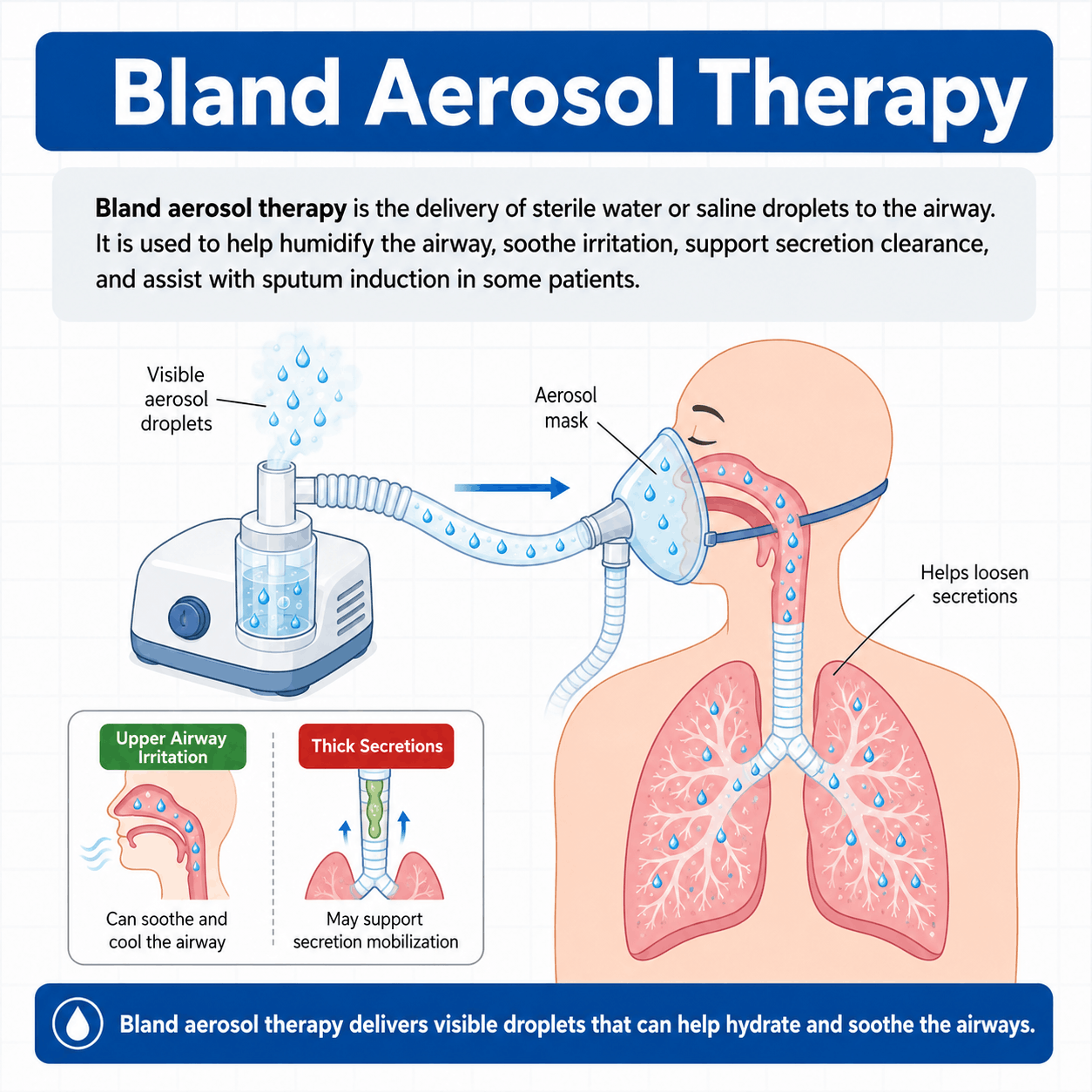
Bland aerosol therapy delivers liquid particles of sterile water or saline to the airway. These particles may be hypotonic, isotonic, or hypertonic, depending on the solution used. The word “bland” means that the aerosol does not contain a medication, although the therapy can still have strong physiologic effects.
Bland aerosol therapy is used for several purposes. It may help soothe upper airway inflammation, support patients with thick secretions, provide humidity for patients with tracheal airways, or help obtain sputum specimens. It is commonly associated with large-volume jet nebulizers, ultrasonic nebulizers, aerosol masks, face tents, tracheostomy masks, T tubes, mist tents, and hoods.
Unlike humidity therapy, bland aerosol therapy produces visible mist. Because aerosol droplets can carry microorganisms, aerosol-generating devices require careful infection-control practices. Bland aerosol therapy can also cause complications such as bronchospasm, overhydration, environmental contamination, and worsening obstruction if secretions swell.
Normal Airway Humidification
The upper airway normally functions as a heat and moisture exchanger. During inspiration, the nose warms and humidifies incoming gas. During exhalation, the upper airway recaptures some heat and moisture from the outgoing breath. This process helps maintain a stable environment in the lower respiratory tract.
The nose is especially effective because it has a large mucosal surface area, rich blood supply, and mucus-covered passages. As inspired air passes through the nasal cavity, heat and water are transferred from the mucosa to the gas. By the time gas reaches the lower airway, it should be close to body temperature and nearly fully saturated with water vapor.
This conditioning protects the trachea, bronchi, and bronchioles. The lower airways are not designed to continuously provide large amounts of heat and moisture to dry inspired gas. When they are forced to do so, epithelial cells may become damaged, ciliary motion may slow, and secretions may become thick and retained.
The Isothermic Saturation Boundary
The isothermic saturation boundary, or ISB, is the point in the airway where inspired gas reaches body temperature and full saturation with water vapor. Under normal conditions, the ISB is located in the upper airway. This means that by the time gas reaches the lower respiratory tract, it has already been properly conditioned.
Several factors can shift the ISB deeper into the lungs. These include mouth breathing, breathing cold gas, breathing dry medical gas, high minute ventilation, and breathing through an artificial airway. When the ISB moves downward, the lower airway must provide extra heat and water.
This shift is clinically important. If the lower airway must repeatedly condition dry gas, mucosal injury can occur. Secretions may become more viscous, ciliary movement may be impaired, and the patient may have difficulty clearing mucus. In severe cases, mucus plugging and atelectasis can develop.
Artificial airways create one of the most important humidity deficits. An endotracheal tube or tracheostomy tube bypasses the nose, mouth, and upper airway. This means inspired gas enters the trachea without the normal warming and humidifying process. For this reason, patients with artificial airways need effective humidification.
Absolute Humidity and Relative Humidity
Two terms are important when studying humidity therapy: absolute humidity and relative humidity.
- Absolute humidity is the actual amount of water vapor present in a volume of gas. It is usually measured in milligrams per liter. At body temperature, fully saturated gas contains about 44 mg/L of water vapor. This is the level normally present in the lower respiratory tract.
- Relative humidity is the percentage of water vapor present compared with the maximum amount of water vapor the gas could hold at that temperature. A gas can be 100% saturated at room temperature but still contain less water vapor than the airway needs at body temperature.
This is a common point of confusion. A gas that has 100% relative humidity is not automatically adequate for the lower airway. Temperature matters because warmer gas can hold more water vapor. For example, fully saturated cool gas contains less absolute humidity than fully saturated gas at body temperature.
Note: Respiratory therapists must consider both temperature and water content. A humidifier may produce saturated gas, but if the gas cools before reaching the patient, condensation can occur and less water vapor may remain in the inspired gas.
Why Dry Gas Can Be Harmful
Dry medical gas can cause immediate heat and water loss from the airway. With ongoing exposure, it can irritate mucous membranes, slow mucociliary clearance, and make secretions thicker. Thick secretions are harder to cough, suction, or mobilize.
In patients with an intact upper airway, low-flow oxygen often does not require added humidity. Oxygen flows of 4 L/min or less are generally tolerated without routine humidification if the upper airway is normal and room humidity is adequate. However, dry oxygen at flows greater than 4 L/min is commonly humidified to reduce dryness and discomfort.
The risk is greater in patients with artificial airways. When dry gas is delivered directly into the trachea, the airway may lose heat and moisture quickly. This can lead to epithelial injury, mucus plugging, increased airway resistance, hypoventilation, atelectasis, and patient discomfort.
During mechanical ventilation, humidification is essential because gas is delivered continuously through a circuit and artificial airway. Every invasively ventilated patient needs either active heated humidification or a passive heat and moisture exchanger, unless a specific situation requires one over the other.
Indications for Humidity Therapy
The primary indications for humidity therapy are humidifying dry medical gases and overcoming the humidity deficit caused by bypassing the upper airway. These situations are common in respiratory care.
Humidification may also be useful for patients with thick or bloody secretions. Added heat and humidity can help prevent secretions from drying further and may support airway clearance when used appropriately.
Patients with high spontaneous minute ventilation may need added humidification because they lose more heat and water through breathing. Patients with hypothermia may also benefit from warmed, humidified gas as part of supportive care.
Humidity can also help patients with cold-air-induced bronchospasm. Warming and humidifying inspired gas may reduce airway irritation and help prevent increased airway resistance. This is similar to how covering the nose and mouth with a scarf can make cold air easier to breathe.
Humidification may also be needed during noninvasive ventilation. High flow, mouth leaks, and mask leaks can dry the airway. Heated humidification often improves comfort and tolerance in patients receiving NIV, while HMEs are usually less desirable because they add dead space and resistance.
Humidifier Performance
Humidifier performance depends on four main physical principles: temperature, surface area, contact time, and thermal mass.
Temperature is important because warm gas can hold more water vapor than cool gas. As water temperature increases, evaporation increases, and the gas can carry more moisture.
Surface area affects how much contact occurs between gas and water. The larger the gas-water interface, the more opportunity there is for evaporation. This explains why bubble humidifiers create bubbles and why wick humidifiers use absorbent material to increase surface area.
Contact time refers to how long gas remains exposed to water. Faster flow reduces contact time and may reduce humidity output. This is one reason some humidifiers become less effective at higher flows.
Thermal mass refers to the ability of a system to hold and transfer heat. A humidifier with greater thermal mass can maintain water temperature more effectively, which helps sustain humidification during gas flow.
Bubble Humidifiers
Bubble humidifiers are simple devices commonly used with low-flow oxygen systems. Gas flows through a tube and exits beneath the surface of sterile water, forming bubbles. As the bubbles rise through the water, evaporation occurs and water vapor is added to the gas.
These devices are most useful for patients with intact upper airways receiving low-flow oxygen. They do not fully condition gas to tracheal levels, so the patient’s upper airway must complete the humidification process.
Bubble humidifiers become less effective at higher flows because contact time decreases and the water reservoir may cool. A low water level can also reduce humidity output. They are not appropriate for patients with bypassed upper airways who need full heat and moisture support.
Bubble humidifiers can also generate microaerosols, especially at higher flows. If the water becomes contaminated, aerosol droplets may carry bacteria toward the patient. For this reason, sterile water and proper infection-control practices are necessary.
Note: Most bubble humidifiers include a pressure-relief pop-off valve. If the valve sounds, it may indicate obstruction distal to the humidifier, excessive flow, or blocked tubing.
Pass-Over, Wick, and Membrane Humidifiers
Pass-over humidifiers expose gas to the surface of water without bubbling it through the liquid. As gas moves across the water surface, evaporation adds water vapor. Because they do not bubble gas through water, they are less likely to generate aerosol particles.
Wick humidifiers improve pass-over humidification by using an absorbent material that increases surface area. Water moves up the wick by capillary action, and gas flows around the wet material. This allows more evaporation than a simple pass-over design.
Membrane humidifiers separate the gas and water with a hydrophobic membrane. Heat and water vapor can transfer across the membrane, but liquid water does not directly mix with the gas. These systems can provide humidification while reducing aerosol-related contamination risk.
Note: These devices are generally safer from an aerosol infection-control standpoint than bubble or jet systems because they produce water vapor rather than liquid particles.
Heated Humidifiers
Heated humidifiers actively warm water so more water vapor can be added to inspired gas. They are commonly used during invasive mechanical ventilation and with patients who have artificial airways.
For patients with tracheal airways or invasive mechanical ventilation, active heated humidifiers are often set to deliver gas near body conditions. A typical target range is 34°C to 41°C with nearly 100% relative humidity. Absolute humidity often falls around 33 to 44 mg/L, depending on the system and clinical setup.
Heated humidifiers can provide effective humidity, but they require careful monitoring. Excessive temperature can cause airway burns, thermal injury, or hyperthermia. Inadequate temperature or poor setup can lead to under-humidification and thick secretions.
Note: These systems also create condensation, often called rainout. When warm saturated gas cools in the ventilator tubing, water vapor condenses into liquid. Heated-wire circuits can reduce condensation by keeping gas warm as it travels toward the patient.
Heat and Moisture Exchangers
Heat and moisture exchangers (HMEs) are passive humidifiers. They trap heat and moisture from exhaled gas and return part of it during the next inspiration. In this way, they function somewhat like the natural upper airway.
HMEs are simple, inexpensive, and easy to use. They require no power source and no water reservoir. They also reduce circuit condensation because they do not add external water to the system.
However, HMEs are not appropriate for every patient. They add dead space, resistance, and weight at the airway. This can increase work of breathing, contribute to hypercapnia, or reduce ventilatory efficiency. These concerns are especially important in patients with low tidal volumes, limited respiratory reserve, or hypercapnic respiratory failure.
An ideal HME should provide adequate humidity, low resistance, minimal dead space, and little added weight. HMEs that provide at least 30 mg/L of water vapor are preferred because lower output may increase the risk of tube obstruction.
HMEs should not be used when patients have copious, thick, or bloody secretions because the device can become obstructed. If an HME becomes clogged, it must be removed and replaced. On volume-controlled ventilation, obstruction may appear as increased peak inspiratory pressure. On pressure-controlled ventilation, it may appear as decreased tidal volume.
Note: HMEs are also generally not recommended for noninvasive ventilation because added dead space and resistance may reduce effectiveness and comfort.
Condensation and Circuit Management
Condensation is one of the most common problems with heated humidification. It occurs when warm saturated gas cools as it travels through the breathing circuit. The water vapor changes back into liquid and collects in the tubing.
Condensate can cause several problems. It may obstruct gas flow, alter ventilator function, increase airway pressure, or accidentally drain into the patient’s airway. It may also become contaminated with microorganisms from the patient’s exhaled gas.
Condensate should always be treated as potentially infectious. It should be drained away from the patient, collected safely, and discarded as hazardous liquid waste according to facility policy. It should not be drained back into the humidifier reservoir, toward the patient, or into the airway.
Ventilator circuits should be positioned so water drains away from the patient. Water traps and heated-wire circuits may help reduce the risk of condensate accumulation. Frequent ventilator circuit changes are not routinely recommended unless the circuit is visibly soiled, malfunctioning, or otherwise clinically indicated.
Infection-Control Considerations
Infection control is a major concern in humidity and bland aerosol therapy. Water vapor itself does not carry pathogens because it consists of individual water molecules. Aerosol droplets and condensate can carry microorganisms.
Devices that produce aerosols, such as jet nebulizers, bubble humidifiers, and ultrasonic nebulizers, require careful cleaning and handling. If contaminated water is aerosolized, pathogens may be delivered to the patient or released into the environment.
Sterile water should be used in humidifiers and nebulizers. Prefilled sterile disposable systems are preferred when available. If nondisposable systems are used, they must be cleaned, disinfected, and replaced according to infection-control policy.
Note: Condensate should never be handled casually. It can contain organisms from the patient’s airway and should be discarded safely. Good hand hygiene, proper device setup, sterile water use, and safe disposal practices help reduce infection risk.
Bland Aerosol Therapy Equipment
Large-volume jet nebulizers are commonly used for bland aerosol therapy. They use gas flow through a small jet orifice to create negative pressure. This draws liquid up through a siphon tube, where it is broken into aerosol particles. Baffles remove larger droplets, allowing smaller particles to remain suspended and travel to the patient.
Jet nebulizers may be used with aerosol masks, face tents, tracheostomy masks, T tubes, mist tents, and hoods. They can provide aerosolized sterile water or saline and may be heated or unheated depending on the clinical goal.
Ultrasonic nebulizers use a piezoelectric crystal to create high-frequency vibrations. These vibrations produce waves on the liquid surface, releasing aerosol droplets. The frequency affects particle size, while amplitude affects output.
Ultrasonic nebulizers can produce dense aerosol with high output. This makes them useful for sputum induction and short-term treatment of thick secretions. However, they are more expensive and require careful cleaning because contaminated reservoirs can spread pathogens through aerosol droplets.
Interfaces for Bland Aerosol Therapy
Several interfaces can be used to deliver bland aerosol therapy. An aerosol mask is commonly used for short-term therapy in patients with intact upper airways. It allows aerosol delivery to the nose and mouth but may not be tolerated by every patient.
A face tent may be used when a patient cannot tolerate a mask or has facial trauma, burns, or discomfort. It provides a less enclosed interface but may deliver a less precise oxygen concentration.
A tracheostomy mask is often used for patients with tracheostomy tubes who need aerosol therapy but do not require a precise or high oxygen concentration. It avoids pulling on the tracheostomy tube and is usually more comfortable than some other interfaces.
A T tube is commonly used with an endotracheal tube or tracheostomy tube when moderate to high FiO2 is needed. The flow must be high enough to meet or exceed the patient’s inspiratory demand.
Mist tents and hoods are enclosure systems often used in pediatric care. They can be difficult to control because aerosol output, temperature, oxygen concentration, and environmental exposure may vary. Heat buildup can occur, so these systems are often run unheated.
Clinical Uses of Bland Aerosol Therapy
Bland aerosol therapy may be used to soothe upper airway inflammation. Cool aerosol is commonly associated with postextubation upper airway irritation, post-bronchoscopy irritation, and pediatric croup. In these cases, the goal is to reduce irritation and support the patient’s breathing comfort.
Bland aerosol may also be used for patients with thick secretions. The aerosol can add moisture to the airway surface and may help loosen secretions. However, it should not be viewed as a substitute for adequate systemic hydration when the patient can safely receive fluids.
For patients with tracheal airways who are breathing spontaneously, bland aerosol may help provide humidity and prevent secretion drying. This is commonly done through a tracheostomy mask or T tube, depending on the airway and oxygen needs.
Note: Bland aerosol therapy may also be used for sputum induction. Hypertonic saline aerosol can irritate the airway enough to stimulate coughing and produce a sputum sample. This is a diagnostic use rather than routine humidification.
Sputum Induction
Sputum induction is performed when a lower-airway secretion sample is needed and the patient cannot produce one spontaneously. Hypertonic saline is commonly used because it stimulates coughing and helps bring secretions up from the lower airway.
Ultrasonic nebulizers are useful for this procedure because they can produce dense aerosol output. A high-density aerosol is usually desired. This may involve using high amplitude and relatively low flow, depending on the device.
The therapist must monitor the patient closely during sputum induction. Hypertonic saline can trigger bronchospasm, especially in patients with asthma or reactive airways. Breath sounds, work of breathing, oxygen saturation, and patient tolerance should be assessed before, during, and after therapy.
Note: If bronchospasm occurs, the treatment should be stopped. Oxygen should be provided as needed, and a bronchodilator may be administered if appropriate.
Hazards of Humidity Therapy
Humidity therapy can cause problems if the device is poorly selected, incorrectly set up, or inadequately monitored. Under-humidification may cause dry mucosa, thick secretions, mucus plugging, atelectasis, airway irritation, and artificial airway obstruction.
Overheating can cause thermal injury, burns, or hyperthermia. Heated systems require temperature monitoring, alarms, proper probe placement, and careful setup. A temperature probe placed incorrectly may lead to inaccurate readings and unsafe gas delivery.
Condensation can cause ventilator problems and infection-control risks. Water collecting in the circuit can increase airway pressure, interfere with flow delivery, or accidentally enter the patient’s airway.
HMEs can become obstructed with secretions or blood. They can also increase dead space and resistance, which may worsen ventilation in certain patients. They should be avoided when contraindications are present.
Hazards of Bland Aerosol Therapy
Bland aerosol therapy also has important hazards. One major risk is bronchospasm. Hypotonic water aerosols are more likely to irritate the airway, especially in patients with asthma or reactive airway disease. Isotonic saline may be better tolerated in some patients.
Another risk is overhydration. Continuous heated aerosol therapy and ultrasonic nebulizers can produce large amounts of water. This is especially concerning in infants, small children, neonates, and patients with fluid or electrolyte problems. Adults with heart failure or pulmonary edema may also be poor candidates for prolonged dense aerosol therapy.
Aerosol exposure can cause secretions to swell. If secretions become larger without being cleared, airway obstruction may worsen. This can increase work of breathing and cause patient distress.
Environmental contamination is another concern. Aerosol particles can spread into the surrounding area, especially when used with open systems. Equipment must be cleaned properly, and therapy should be discontinued if the risks outweigh the benefits.
Monitoring the Patient and Equipment
The respiratory therapist must monitor both the patient and the device during humidity and bland aerosol therapy. Device settings alone are not enough to confirm effective therapy.
For humidifiers, temperature and humidity should be checked when possible. Portable digital hygrometers can be used for spot checks. In the absence of direct measurement, small amounts of condensate near the patient connection may suggest that gas is saturated at the set temperature, but this is not a substitute for proper assessment.
The therapist should monitor airway temperature, water level, flow, alarm function, circuit position, and condensation. With HMEs, the therapist should watch for rising peak pressure, falling tidal volume, increased work of breathing, or visible secretion obstruction.
Patient assessment should include breath sounds, secretion amount and consistency, cough effectiveness, airway patency, oxygen saturation, respiratory rate, work of breathing, and subjective comfort. If the patient reports worsening shortness of breath, chest tightness, or discomfort, therapy should be reassessed.
Choosing the Right Therapy
Choosing the right therapy depends on the patient’s airway, oxygen flow, secretion status, ventilation mode, and clinical condition.
- For a patient with an intact upper airway receiving oxygen at 4 L/min or less, added humidity is often unnecessary. If flow is greater than 4 L/min or the patient complains of dryness, an unheated bubble humidifier may be used.
- For a patient with an artificial airway who is not mechanically ventilated, bland aerosol therapy may be used to provide humidity and support secretion clearance. A tracheostomy mask or T tube may be selected depending on the airway and oxygen requirement.
- For invasive mechanical ventilation, every patient needs either active heated humidification or an HME. Heated humidification is preferred when the patient has thick, bloody, or copious secretions, high spontaneous minute ventilation, hypothermia, low tidal volume ventilation, or hypercapnic respiratory failure. An HME may be appropriate when secretions are minimal and the patient can tolerate the added dead space and resistance.
- For noninvasive ventilation, heated humidification is often preferred when dryness, leaks, or discomfort are present. HMEs are generally avoided because they may increase dead space and resistance.
- For upper airway edema, croup, or postextubation irritation, cool bland aerosol may be used. For sputum induction, hypertonic saline aerosol may be delivered with careful monitoring for bronchospasm.
Humidity and Bland Aerosol Therapy Practice Questions
1. What is the main purpose of humidity therapy?
To add water vapor to inspired gas in order to maintain normal airway moisture, protect mucosa, and keep secretions mobile.
2. How is humidity therapy different from bland aerosol therapy?
Humidity therapy delivers molecular water vapor, while bland aerosol therapy delivers liquid particles of sterile water or saline suspended in gas.
3. What does the upper airway normally do to inspired gas?
It warms, humidifies, and filters inspired gas before it reaches the lower respiratory tract.
4. What is the isothermic saturation boundary?
The isothermic saturation boundary is the point in the airway where inspired gas reaches body temperature and full saturation with water vapor.
5. Where is the isothermic saturation boundary normally located?
It is normally located in the upper airway.
6. What can cause the isothermic saturation boundary to move deeper into the lungs?
Mouth breathing, cold gas, dry gas, high minute ventilation, and artificial airways can shift it deeper.
7. Why is a downward shift of the isothermic saturation boundary harmful?
It forces the lower airways to provide extra heat and moisture, which can damage epithelium and impair secretion clearance.
8. What is absolute humidity?
Absolute humidity is the actual amount of water vapor present in a volume of gas, usually measured in mg/L.
9. What is relative humidity?
Relative humidity is the percentage of water vapor present compared with the maximum amount the gas can hold at that temperature.
10. Why can 100% relative humidity still be inadequate?
Because cool gas may be fully saturated but still contain less absolute humidity than the airway needs at body temperature.
11. What is the approximate absolute humidity of fully saturated gas at body temperature?
About 44 mg/L.
12. What is the water vapor pressure of fully saturated gas at body temperature?
About 47 mm Hg.
13. What is the humidity deficit?
The humidity deficit is the difference between the humidity of inspired gas and the humidity required in the lungs.
14. Why are dry medical gases potentially harmful?
They can dry mucous membranes, slow ciliary motion, thicken secretions, and increase the risk of mucus plugging.
15. At what low-flow oxygen level is added humidity usually unnecessary with an intact upper airway?
At 4 L/min or less, added humidity is usually unnecessary if the upper airway is normal.
16. When should dry oxygen generally be humidified?
Dry oxygen should generally be humidified when flow is greater than 4 L/min.
17. What device is commonly used for low-flow oxygen humidification?
An unheated bubble humidifier is commonly used.
18. Why is a bubble humidifier not enough for a bypassed upper airway?
It does not provide enough heat and humidity to replace the normal function of the nose and upper airway.
19. What type of humidification is recommended for an endotracheal tube or tracheostomy tube?
Heated humidification or an appropriate HME is recommended, depending on the patient’s condition.
20. Why do patients with artificial airways need more humidification?
The artificial airway bypasses the nose and upper airway, removing the body’s normal warming and humidifying system.
21. What can happen if an artificial airway is under-humidified?
Secretions can become thick, mucus plugging can occur, and the airway epithelium may be injured.
22. What are two primary indications for humidification?
Humidifying dry medical gases and overcoming the humidity deficit caused by bypassing the upper airway.
23. Name one secondary indication for humidity therapy.
One secondary indication is managing thick or bloody secretions.
24. How can warmed, humidified gas help cold-air-induced bronchospasm?
It reduces airway irritation and may help prevent an increase in airway resistance.
25. Why may patients on noninvasive ventilation need humidification?
High flow, mouth leaks, and mask leaks can dry the airway and reduce comfort.
26. What are the four physical factors that affect humidifier performance?
Temperature, surface area, contact time, and thermal mass.
27. How does temperature affect humidifier output?
Higher temperature allows gas to hold more water vapor, increasing absolute humidity.
28. Why does increased surface area improve humidification?
It creates more contact between gas and water, allowing more evaporation to occur.
29. How does high gas flow affect contact time in a humidifier?
High gas flow reduces contact time, which can lower humidity output.
30. What is the purpose of thermal mass in a humidifier?
Thermal mass helps the humidifier retain and transfer heat more effectively during operation.
31. How does a bubble humidifier add moisture to gas?
It directs gas through water, forming bubbles that allow evaporation to add water vapor.
32. What type of patient is a bubble humidifier best suited for?
A patient with an intact upper airway receiving low-flow oxygen.
33. What does a sounding pop-off valve on a bubble humidifier usually indicate?
It usually indicates obstruction distal to the humidifier, excessive flow, or a blocked nasal cannula prong.
34. Why can bubble humidifiers create an infection-control concern?
They may generate microaerosols that can carry bacteria if the water becomes contaminated.
35. How does a pass-over humidifier work?
It passes gas over the surface of water so evaporation can add water vapor to the gas.
36. Why are wick humidifiers more efficient than simple pass-over humidifiers?
They use absorbent material to increase surface area for evaporation.
37. What is the advantage of a wick humidifier compared with a bubble humidifier?
A wick humidifier does not bubble gas through water, so it does not produce aerosols.
38. How does a membrane humidifier separate water from gas?
It uses a hydrophobic membrane that allows heat and water vapor transfer without direct liquid mixing.
39. What is the main advantage of heated humidifiers during mechanical ventilation?
They can provide high levels of heat and absolute humidity for patients with artificial airways.
40. What is the typical temperature range for heated humidification with a tracheal airway?
About 34°C to 41°C.
41. What absolute humidity range is commonly targeted during invasive ventilation with active heated humidification?
Approximately 33 to 44 mg/L.
42. What is rainout?
Rainout is condensation that forms when warm, saturated gas cools in the breathing circuit.
43. Why is condensate in a ventilator circuit dangerous?
It can obstruct flow, alter ventilator function, increase airway pressure, or drain into the patient’s airway.
44. How should ventilator circuit condensate be handled?
It should be drained away from the patient and discarded as potentially infectious waste.
45. Why should condensate not be drained back into the humidifier reservoir?
It may contain microorganisms from the patient’s airway and contaminate the system.
46. What is the purpose of a heated-wire circuit?
It helps reduce condensation by keeping gas warm as it travels through the tubing.
47. What is a heat and moisture exchanger?
A heat and moisture exchanger is a passive device that captures exhaled heat and moisture and returns some of it during inhalation.
48. Where should an HME be placed in a ventilator circuit?
It should be placed close to the airway, usually between the ventilator wye and the artificial airway.
49. Why must an HME be placed close to the patient?
It must capture exhaled heat and moisture directly from the patient’s breath to function properly.
50. What humidity output is preferred for an HME?
An HME that provides at least 30 mg/L of water vapor is preferred.
51. What is one major advantage of using an HME?
It is simple to use, requires no power or water, and reduces circuit condensation.
52. What is one major disadvantage of an HME?
It adds dead space and resistance, which can increase work of breathing or contribute to hypercapnia.
53. When should an HME be avoided because of secretion problems?
It should be avoided when the patient has thick, bloody, or copious secretions.
54. What should be done if an HME becomes obstructed?
The HME should be removed, discarded, and replaced.
55. What ventilator change may indicate HME obstruction during volume-controlled ventilation?
An increase in peak inspiratory pressure may indicate obstruction.
56. What ventilator change may indicate HME obstruction during pressure-controlled ventilation?
A decrease in delivered tidal volume may indicate obstruction.
57. Why may HMEs be inappropriate for patients receiving low tidal volumes?
The added dead space can reduce effective alveolar ventilation and increase the risk of CO2 retention.
58. Why are HMEs generally not recommended for noninvasive ventilation?
They add dead space and resistance, which can reduce ventilatory efficiency and increase work of breathing.
59. When should active heated humidification be used instead of an HME?
It should be used when the patient has thick secretions, bloody secretions, copious secretions, high minute ventilation, hypothermia, or HME contraindications.
60. What body temperature finding may indicate the need for active heated humidification?
A body temperature below 32°C may indicate the need for active heated humidification.
61. Why can high spontaneous minute ventilation increase the need for humidification?
The patient loses more heat and water through breathing, increasing the humidity demand.
62. What is bland aerosol therapy?
Bland aerosol therapy is the delivery of aerosolized sterile water or saline without medication.
63. What solutions may be used for bland aerosol therapy?
Hypotonic, isotonic, or hypertonic sterile water or saline solutions may be used.
64. What is a common use of cool bland aerosol?
It is commonly used for upper airway inflammation, such as croup or postextubation edema.
65. Why is cool aerosol often used for pediatric croup?
It may help soothe the upper airway and reduce irritation associated with airway swelling.
66. What is a common use of hypertonic saline aerosol?
It is commonly used for sputum induction.
67. What is the goal of sputum induction?
The goal is to stimulate coughing and obtain a lower-airway secretion sample.
68. Why must patients be monitored during sputum induction?
Hypertonic saline can irritate the airway and trigger bronchospasm.
69. What should be done if bronchospasm occurs during bland aerosol therapy?
The therapy should be stopped, oxygen should be given as needed, and a bronchodilator may be administered if appropriate.
70. Which patients are at increased risk for bronchospasm during bland aerosol therapy?
Patients with asthma or reactive airway disease are at increased risk.
71. Why may isotonic saline be preferred over distilled water in reactive airways?
Isotonic saline is usually less irritating and may be less likely to trigger bronchospasm.
72. What is a large-volume jet nebulizer used for?
It is used to generate bland aerosol for masks, tracheostomy collars, T tubes, mist tents, and other aerosol delivery interfaces.
73. How does a large-volume jet nebulizer create aerosol?
A high-velocity gas jet creates negative pressure, pulls liquid up a siphon tube, and breaks it into aerosol particles.
74. What is the purpose of a baffle in a jet nebulizer?
A baffle removes larger droplets so smaller particles remain suspended and can travel to the patient.
75. Why must total flow from a jet nebulizer meet the patient’s inspiratory demand?
If flow is too low, the patient may entrain room air, changing the delivered oxygen concentration and reducing effective therapy.
76. What is an ultrasonic nebulizer?
An ultrasonic nebulizer is a device that uses high-frequency sound waves to produce aerosol particles.
77. What part of an ultrasonic nebulizer creates the sound waves?
A piezoelectric crystal creates the high-frequency vibrations.
78. How does ultrasonic nebulizer frequency affect aerosol production?
The frequency affects particle size.
79. How does ultrasonic nebulizer amplitude affect aerosol production?
The amplitude affects aerosol output, with higher amplitude producing more aerosol.
80. Why are ultrasonic nebulizers useful for sputum induction?
They can produce a dense aerosol with high output, which helps stimulate coughing and obtain a sputum sample.
81. What is a typical particle size produced by an ultrasonic nebulizer?
A typical mean particle size is about 3 μm.
82. What aerosol output can ultrasonic nebulizers often produce?
They can often produce about 3 to 6 mL/min of aerosol output.
83. Why do ultrasonic nebulizers require careful cleaning?
Their reservoirs can become contaminated and transmit pathogens through aerosol droplets.
84. What is an aerosol mask used for?
An aerosol mask is used to deliver bland aerosol to patients with intact upper airways during short-term therapy.
85. When may a face tent be preferred over an aerosol mask?
A face tent may be preferred when the patient cannot tolerate a mask or has facial trauma or burns.
86. What aerosol interface is commonly used for a tracheostomy patient who does not need precise FiO2?
A tracheostomy mask is commonly used.
87. Why is a tracheostomy mask often preferred for tracheostomy patients?
It provides aerosol therapy without placing excessive traction on the tracheostomy tube.
88. When is a T tube commonly used for aerosol therapy?
A T tube is commonly used for patients with an endotracheal tube or tracheostomy tube who need moderate to high FiO2.
89. Why can mist tents and hoods be difficult to control?
Temperature, oxygen concentration, aerosol output, and environmental exposure can vary inside the enclosure.
90. Why are mist tents and hoods often run unheated?
They are often run unheated because heat buildup can occur inside the enclosure.
91. What is one hazard of continuous heated aerosol therapy?
It can cause overhydration, especially in infants, small children, and patients with fluid or electrolyte problems.
92. Why should prolonged dense aerosol therapy be avoided in some heart failure patients?
It can contribute to excess water gain and may worsen fluid-related respiratory problems.
93. How can bland aerosol therapy worsen airway obstruction?
Secretions may absorb water, swell, and become more obstructive if they are not cleared.
94. Why can aerosol particles create environmental contamination?
Aerosol particles can escape into the surrounding air and may carry microorganisms if the system is contaminated.
95. What should be assessed before giving bland aerosol therapy to a patient with asthma?
The clinician should review the patient’s history, breath sounds, airway reactivity, and risk for bronchospasm.
96. What should be monitored during continuous bland aerosol therapy?
Breath sounds, work of breathing, oxygen saturation, secretion response, patient comfort, and signs of bronchospasm should be monitored.
97. Why should sterile water be used in humidifiers and nebulizers?
Sterile water helps reduce the risk of delivering or spreading microorganisms to the patient.
98. How often should nondisposable large-volume nebulizer units generally be replaced?
They should generally be replaced with sterile or high-level disinfected units every 24 hours.
99. What is the best general rule for selecting humidity therapy?
Match the level of humidification to where the gas enters the airway and the patient’s clinical condition.
100. What is the most important difference between humidity therapy and bland aerosol therapy?
Humidity therapy adds water vapor, while bland aerosol therapy delivers liquid droplets of sterile water or saline.
Final Thoughts
Humidity and bland aerosol therapy both help protect the airway, but they are not the same treatment. Humidity therapy adds water vapor to inspired gas, while bland aerosol therapy delivers liquid particles of sterile water or saline.
The respiratory therapist must understand when each therapy is indicated, which devices are appropriate, and what hazards can occur. The most important principle is to condition inspired gas according to where it enters the airway.
Patients with intact upper airways may need little support, while patients with artificial airways need much more. Careful monitoring helps prevent mucus plugging, bronchospasm, overhydration, contamination, and unsafe device performance.

Written by:
John Landry is a registered respiratory therapist from Memphis, TN, and has a bachelor's degree in kinesiology. He enjoys using evidence-based research to help others breathe easier and live a healthier life.
References
- Re R, Lassola S, De Rosa S, Bellani G. Humidification during Invasive and Non-Invasive Ventilation: A Starting Tool Kit for Correct Setting. Med Sci (Basel). 2024.
- Kuo CD, Lin SE, Wang JH. Aerosol, humidity and oxygenation. Chest. 1991.