

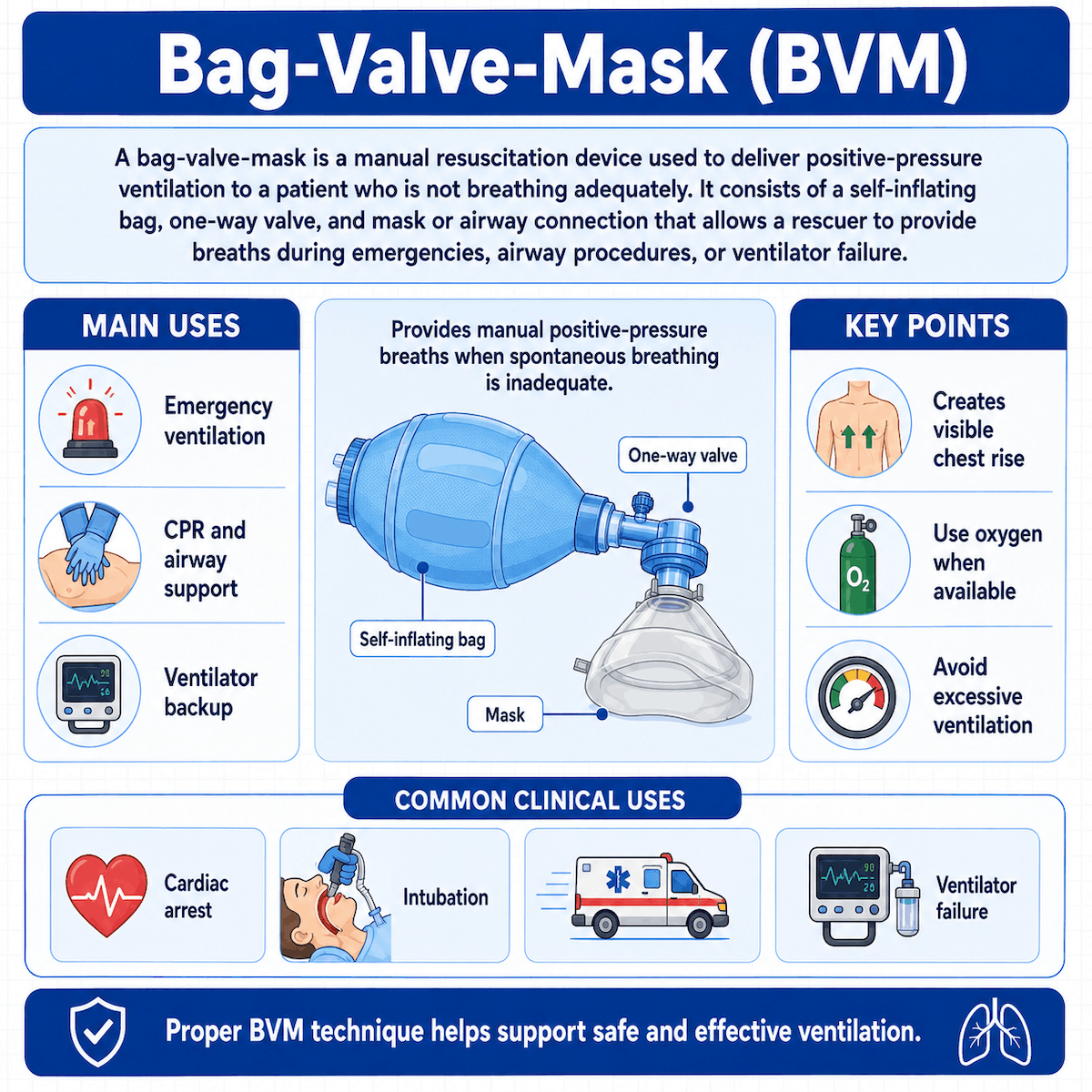
A bag-valve-mask, often called a BVM or manual resuscitator, is one of the most important devices used for emergency ventilation. It allows a clinician or rescuer to provide positive-pressure breaths to a patient who is not breathing adequately.
In respiratory care, the BVM is used during cardiac arrest, airway emergencies, intubation, transport, extubation, and backup ventilation for ventilator-dependent patients.
Although the device looks simple, safe and effective use requires proper technique, correct equipment selection, oxygen delivery, monitoring, and an understanding of the risks of excessive ventilation.

What Is a Bag-Valve-Mask?
A bag-valve-mask (BVM) is a manual ventilation device used to deliver breaths to a patient by squeezing a self-inflating bag. The device typically includes a compressible bag, a one-way valve, a patient connection, and a face mask. When the clinician squeezes the bag, gas is pushed through the valve and into the patient’s airway. When the bag is released, it reinflates and the patient exhales through a separate pathway.
The term bag-valve-mask is commonly used when the device is connected to a face mask. However, the same manual resuscitator can also be connected directly to an endotracheal tube, laryngeal mask airway, tracheostomy tube, or other airway device. For this reason, the BVM is not limited to mask ventilation. It is a broader manual ventilation device that can be used before or after placement of an advanced airway.
Purpose of a BVM
The main purpose of a BVM is to provide manual positive-pressure ventilation when a patient cannot maintain adequate breathing on their own. This may occur during apnea, respiratory failure, cardiac arrest, sedation, anesthesia, airway obstruction, or ventilator failure.
A BVM can be used to:
- Provide ventilation during CPR
- Support breathing before intubation
- Ventilate the patient between intubation attempts
- Provide breaths after endotracheal tube placement
- Assist ventilation during transport
- Provide backup ventilation during ventilator malfunction
- Support oxygenation during extubation procedures
- Ventilate a patient through a tracheostomy tube
- Provide emergency support in home or alternative care settings
Note: Because it can be used quickly and does not require electricity, the BVM is an essential backup device wherever airway emergencies may occur.
Basic Parts of a BVM
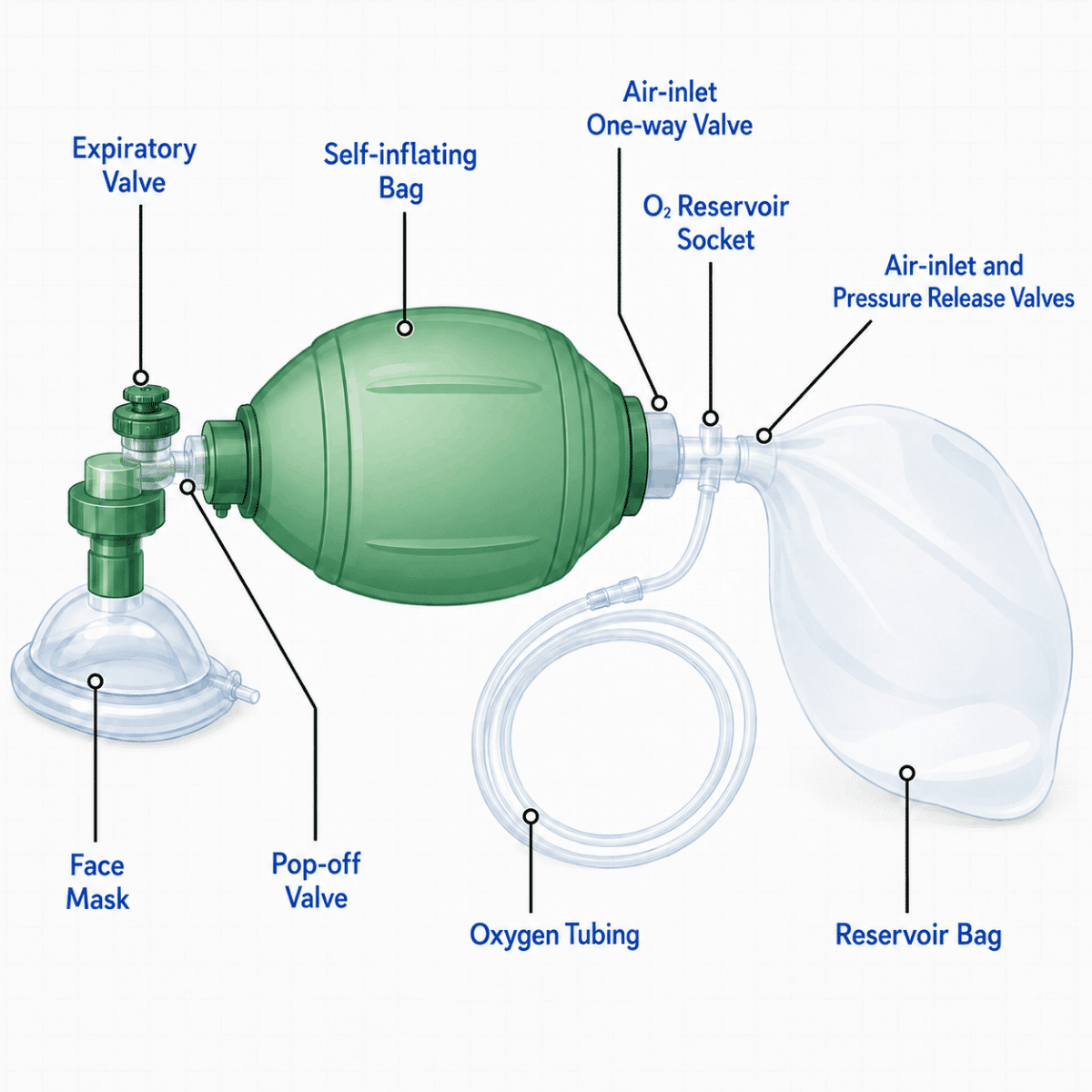
Although different models vary slightly, most bag-valve-mask devices include several basic components.
Self-Inflating Bag
The self-inflating bag is the part the clinician squeezes to deliver a breath. After compression, the bag automatically reinflates. This allows the device to be used even without a compressed gas source, although oxygen should be attached whenever available.
Adult bags are larger than pediatric and infant bags. Selecting the correct size is important because a bag that is too large can increase the risk of excessive tidal volume and pressure, while a bag that is too small may not provide adequate ventilation.
One-Way Valve
The one-way valve directs gas flow through the device. During inspiration, it allows gas from the bag to move toward the patient. During exhalation, it directs exhaled gas away from the bag and out to the environment.
This valve system helps prevent rebreathing and ensures that the patient receives fresh gas during each delivered breath. If the valve is reversed, blocked, jammed, or assembled incorrectly, ventilation may be ineffective.
Face Mask
The face mask is used when the patient does not have an artificial airway. It must fit the patient’s face properly and create an effective seal over the nose and mouth. Masks are available in adult, pediatric, and infant sizes.
A poor mask seal is one of the most common reasons for ineffective BVM ventilation. If air leaks around the mask, less volume reaches the lungs, and the patient’s chest may not rise.
Patient Connection
The patient connection end is standardized so the device can connect to different airway interfaces. The gas outlet commonly has a 22-mm outer diameter for connection to a face mask and a 15-mm inner diameter for connection to an endotracheal tube adapter or other airway device.
This allows the same manual resuscitator to be used before and after artificial airway placement.
Oxygen Inlet and Reservoir
Most BVM devices can be connected to supplemental oxygen. When oxygen is flowing at an appropriate rate and a reservoir is attached, the device can deliver a high oxygen concentration.
The oxygen reservoir helps store incoming oxygen so that the bag fills with oxygen-rich gas. Without the reservoir, the delivered oxygen concentration may be lower because room air is entrained during bag reinflation.
Pressure-Release Valve
Neonatal and pediatric manual resuscitators commonly include a pressure-release, or pop-off, valve. This valve helps reduce the risk of excessive airway pressure. It may open at about 40 cm H₂O, depending on the device.
Some adult devices may also include a pressure-release valve. If present, it should have an easy-to-use override system when higher pressure is clinically necessary.
PEEP Valve
Some manual resuscitators allow an add-on PEEP valve. PEEP, or positive end-expiratory pressure, helps maintain pressure in the lungs at the end of exhalation. This may improve oxygenation in selected patients, especially those who are difficult to oxygenate.
If a PEEP valve is used, the clinician must monitor the patient carefully because excessive pressure can affect ventilation, hemodynamics, and lung protection.
BVM Sizes
Manual resuscitators are available in different sizes based on the patient population.
- Infant or newborn resuscitators are designed for very small patients and usually have a much smaller bag volume.
- Pediatric resuscitators are used for children and have an intermediate bag size.
- Adult resuscitators are used for larger children, adolescents, and adults and usually have a much larger reservoir volume.
Note: Choosing the correct size is important because the goal is not to empty the entire bag with each breath. The clinician should deliver only enough volume to produce visible chest rise. Using the wrong size bag can increase the risk of under-ventilation or over-ventilation.
Oxygen Delivery With a BVM
A BVM can be used with room air, but oxygen should be connected when available. During resuscitation and airway emergencies, high oxygen concentrations are often needed to support oxygenation.
To deliver a high oxygen concentration, the BVM should be connected to an oxygen source with appropriate tubing. Oxygen is commonly set at 15 L/min, and an oxygen reservoir should be attached. With proper oxygen flow and a reservoir system, the device can deliver a high fraction of inspired oxygen.
Oxygen may come from a wall outlet in the hospital or from a portable oxygen cylinder during transport or emergency care. In either case, the clinician should confirm that oxygen is flowing, the tubing is connected, and the reservoir is functioning.
When Is a BVM Used?
The BVM is used in many clinical situations. It is commonly associated with CPR, but its role extends far beyond cardiac arrest.
Cardiac Arrest and CPR
During cardiac arrest, the BVM is used to provide ventilation and oxygenation while chest compressions are performed. Respiratory therapists are often responsible for managing the airway, delivering breaths, assisting with artificial airway placement, and monitoring the patient’s response.
Before an advanced airway is placed, breaths may be delivered using a mask. Once an endotracheal tube or other advanced airway is in place, the BVM can be connected directly to the airway device.
During CPR, ventilation must be controlled carefully. Hyperventilation can increase intrathoracic pressure, reduce venous return to the heart, and decrease the effectiveness of chest compressions. For this reason, rescuers should avoid delivering breaths too quickly or with excessive volume.
Airway Emergencies
A BVM is used when a patient has inadequate breathing due to airway obstruction, respiratory depression, trauma, overdose, respiratory failure, or sudden deterioration. It provides immediate ventilatory support while the team identifies and treats the underlying cause.
In airway emergencies, BVM ventilation may be lifesaving. However, it requires proper airway positioning, mask seal, and ventilation technique. If the patient’s chest does not rise, the clinician must quickly troubleshoot the airway, mask, valve, and device.
Endotracheal Intubation
The BVM is part of standard intubation preparation. Patients may need ventilation before intubation, between attempts, or after tube placement. If an intubation attempt fails, the BVM allows the team to oxygenate and ventilate the patient before trying again.
After an endotracheal tube is inserted, the BVM is attached to the tube adapter. The clinician provides ventilation while another provider confirms tube placement using breath sounds, chest rise, capnography or colorimetric carbon dioxide detection, and clinical assessment.
If breath sounds are absent and air is heard over the stomach, the tube may be in the esophagus and should be removed. The patient should then be ventilated with the BVM before another intubation attempt.
Alternative Airway Devices
A BVM can also be used with alternative airway devices such as a laryngeal mask airway or other supraglottic airway. These devices may be used when endotracheal intubation is difficult or delayed.
Some airway devices are designed to facilitate positive-pressure ventilation. Once placed, the manual resuscitator can be connected to the device to provide breaths. The clinician must still monitor chest rise, breath sounds, oxygen saturation, and carbon dioxide detection when available.
Extubation
Manual resuscitators may also be used during planned airway procedures such as extubation. In some techniques, a large breath is delivered with a manual resuscitator before the tube is removed. This may help support oxygenation and assist with safe tube removal.
Extubation requires preparation because patients can deteriorate quickly if airway obstruction, laryngospasm, secretion retention, or respiratory failure occurs. Having a BVM available ensures that manual ventilation can be provided immediately if needed.
Transport
Patients may need manual ventilation during transport within a hospital or between care areas. A BVM can be used during short transports, during movement from one ventilator to another, or when mechanical ventilation is temporarily unavailable.
During transport, the clinician must ensure that oxygen is available, the reservoir is attached, the airway is secure, and monitoring is in place. Manual ventilation during transport can be physically demanding and requires close attention to rate, volume, pressure, and patient response.
Ventilator Failure or Disconnection
For ventilator-dependent patients, a BVM is essential backup equipment. If the ventilator fails, loses power, alarms unexpectedly, or becomes disconnected, the caregiver must be able to provide manual ventilation immediately.
This is especially important in home care and other alternative care settings. A ventilator-dependent patient should have access to a manual resuscitator, oxygen source if prescribed, suction equipment, backup power, monitoring devices, and emergency supplies.
Proper BVM Technique
Effective BVM ventilation depends on airway positioning, mask seal, correct volume delivery, and appropriate rate.
Position at the Head of the Patient
The rescuer is usually positioned at the head of the patient. This position allows better control of the airway and mask seal. The clinician can align the airway, stabilize the head, hold the mask, and squeeze the bag.
If no neck injury is suspected, the head-tilt and chin-lift maneuver may be used to open the airway. If trauma is suspected, a jaw-thrust maneuver may be preferred to reduce movement of the cervical spine.
Maintain an Open Airway
An open airway is necessary for effective ventilation. If the airway is blocked by the tongue, secretions, vomitus, blood, or foreign material, air may not enter the lungs.
Airway adjuncts such as an oropharyngeal airway or nasopharyngeal airway may help maintain patency in selected patients. Suction should be available to clear secretions, vomitus, or blood.
Create a Good Mask Seal
A proper mask seal is critical. The mask should cover the nose and mouth without pressing into the eyes or slipping below the chin. The clinician must apply enough pressure to seal the mask while avoiding unnecessary force.
The one-person technique often uses the “E-C” hand position. The thumb and index finger form a “C” shape over the mask, while the remaining fingers lift the jaw to form an “E” shape. However, one-person BVM ventilation can be difficult.
A two-person technique is often more effective. One clinician uses both hands to maintain the mask seal and airway position, while the second clinician squeezes the bag. This method can improve ventilation, especially in patients who are difficult to mask ventilate.
Deliver the Correct Tidal Volume
The goal is to deliver only enough volume to produce visible chest rise. Excessive volume is unnecessary and can be harmful.
For many adult patients, this may be approximately 400 to 500 mL per breath, depending on predicted body weight and clinical condition. A commonly referenced target is about 6 to 7 mL/kg predicted body weight.
The clinician should not squeeze the entire bag unless the patient’s size and clinical need justify it. Chest rise, breath sounds, oxygen saturation, and carbon dioxide monitoring can help assess whether ventilation is adequate.
Use a Controlled Inspiratory Time
Each breath should be delivered over about 1 second. Delivering the breath too forcefully can increase airway pressure and push gas into the stomach. A slower, controlled squeeze helps reduce peak pressure and improves the chance that gas enters the lungs instead of the stomach.
Avoid Hyperventilation
One of the most important principles of BVM use is to avoid hyperventilation. This is especially important during cardiac arrest.
Excessive ventilation can:
- Increase intrathoracic pressure
- Reduce venous return
- Lower cardiac output during CPR
- Increase gastric inflation
- Raise the risk of vomiting and aspiration
- Contribute to air trapping in obstructive lung disease
- Cause excessive airway pressure
Note: During CPR after an advanced airway is placed, a common ventilation target is one breath every 6 seconds, or about 10 breaths/min. Breaths should be delivered over about 1 second and should not interrupt chest compressions.
BVM Use During CPR
BVM ventilation during CPR requires coordination with chest compressions and airway management.
Before an advanced airway is placed, ventilations are usually coordinated with compressions according to current resuscitation guidelines. Once an advanced airway is in place, compressions can continue without pausing for breaths, and the rescuer delivers regular breaths at the recommended rate.
The clinician should focus on effective but not excessive ventilation. More ventilation is not better. Too many breaths or overly forceful breaths can reduce the effectiveness of CPR by increasing pressure inside the chest and limiting blood return to the heart.
Monitoring may include pulse oximetry, chest rise, breath sounds, and end-tidal carbon dioxide. During CPR, exhaled carbon dioxide can provide useful information about ventilation, circulation, and the quality of compressions.
Risks and Complications of BVM Ventilation
Although BVM ventilation can be lifesaving, poor technique can cause complications.
Gastric Inflation
Gastric inflation occurs when air enters the stomach instead of the lungs. This can happen when breaths are delivered too quickly, with too much volume, or against a partially obstructed airway.
Gastric inflation increases the risk of vomiting and aspiration. It can also make ventilation more difficult by elevating the diaphragm and reducing lung expansion.
Limiting tidal volume, using a controlled inspiratory time, maintaining an open airway, and avoiding excessive pressure can reduce this risk.
Aspiration
Aspiration occurs when gastric contents, vomitus, secretions, or other material enter the airway. During resuscitation, the risk of aspiration is significant, especially if gastric inflation occurs.
Suction equipment should be available whenever BVM ventilation is performed. If vomiting occurs, the airway should be cleared quickly, and the patient should be repositioned as appropriate while maintaining spinal precautions if needed.
Barotrauma
Barotrauma can occur when excessive pressure damages lung tissue. This is a particular concern in infants, children, and patients with fragile lungs.
Pressure-release valves, appropriate bag size, controlled ventilation, and careful monitoring help reduce the risk. Clinicians should avoid forceful bagging unless clinically necessary.
Inadequate Ventilation
Inadequate ventilation may occur due to poor mask seal, airway obstruction, incorrect device assembly, valve malfunction, low oxygen flow, or failure to attach the device properly to an artificial airway.
The most obvious sign is failure of the chest to rise. Other signs may include worsening oxygen saturation, poor breath sounds, cyanosis, bradycardia, or absent exhaled carbon dioxide.
Hyperventilation
Hyperventilation is common during emergency ventilation because rescuers may bag too quickly under stress. This can worsen outcomes during CPR and may be harmful in other patients as well.
Using a calm, controlled rhythm is essential. The clinician should focus on visible chest rise and the recommended ventilation rate.
Pre-Use Check of a Manual Resuscitator
Before using a BVM, the clinician should check the device to make sure it functions properly. This is especially important before intubation, transport, or use in emergency readiness areas.
A basic pre-use check includes:
- Squeeze and release the bag to confirm that it reinflates
- Confirm that the one-way valve opens and closes properly
- Feel for gas leaving the patient outlet when the bag is squeezed
- Occlude the outlet and squeeze the bag to check for leaks
- Confirm that the pressure-release valve opens if present
- Ensure the mask attaches properly to the 22-mm fitting
- Check that the mask cushion is inflated and intact
- Attach oxygen tubing and confirm oxygen flow
- Make sure the oxygen reservoir is connected if high oxygen concentration is needed
Note: If the device does not function properly, it should be repaired, reassembled, or replaced before patient use.
Troubleshooting BVM Problems
When BVM ventilation is not working, the clinician must quickly identify the problem. A useful first sign is lack of chest rise.
Common causes include:
- Poor mask seal
- Airway obstruction
- Incorrect head or jaw position
- Secretions, vomitus, blood, or foreign material
- Incorrectly assembled valve
- Reversed one-way valve
- Blocked expiratory valve
- Disconnected oxygen tubing
- Reservoir not attached
- Device leak
- Incorrect connection to the airway device
If the patient’s chest does not rise, the clinician should reposition the airway, improve the mask seal, consider a two-person technique, suction the airway, check the device, and verify all connections.
If the one-way valve is obstructed by mucus, vomitus, or blood, the device may need to be disconnected and cleared. If it cannot be cleared quickly, it should be replaced.
BVM and Endotracheal Tube Confirmation
After intubation, the BVM is used to ventilate through the endotracheal tube while tube placement is confirmed.
Important assessment steps include:
- Observe chest rise
- Auscultate both lung fields
- Listen over the stomach
- Use carbon dioxide detection
- Monitor oxygen saturation
- Assess the patient’s clinical response
Equal bilateral breath sounds suggest that the tube is positioned in the trachea and not advanced too far. If breath sounds are louder on the right or absent on the left, the tube may be in the right mainstem bronchus. If air is heard over the stomach and breath sounds are absent, esophageal intubation should be suspected.
Colorimetric carbon dioxide detectors can be placed between the endotracheal tube and the manual resuscitator. A color change indicating exhaled carbon dioxide supports tracheal placement. However, carbon dioxide detection does not confirm that the tube is positioned above the carina rather than in a mainstem bronchus, so breath sounds and clinical assessment remain necessary.
Infection Control Considerations
Because a manual resuscitator contacts the airway or ventilatory circuit, infection control is important. BVM devices can become contaminated with bacteria, secretions, blood, vomitus, and respiratory droplets.
Disposable units are intended for single-patient use and should be discarded according to facility policy. Reusable devices must be cleaned, disinfected, and stored according to infection prevention standards and manufacturer instructions.
Clinicians should use appropriate personal protective equipment during BVM ventilation because the procedure can generate exposure to airway secretions. Filters may be used in some settings to reduce contamination risk, depending on institutional policy and device compatibility.
BVM Use in Alternative Care Settings
Ventilator-dependent patients outside the acute care hospital should have a manual resuscitator available as part of their essential equipment. This includes patients in home care, long-term care, and other alternative care environments.
A BVM may be needed if:
- The ventilator fails
- Power is lost
- The circuit disconnects
- The patient’s airway becomes obstructed
- The tracheostomy tube is changed
- The patient deteriorates suddenly
- Transport is required
Caregivers for ventilator-dependent patients should know where the manual resuscitator is stored, how to connect it to the airway, how to attach oxygen if prescribed, and when to call emergency services.
The BVM is part of a broader safety system that may include suction equipment, pulse oximetry, backup batteries, oxygen supplies, spare tracheostomy tubes, humidification equipment, and emergency contact instructions.
Skills Required for Effective BVM Use
Although the BVM is a basic device, using it well requires practice. The clinician must manage several tasks at the same time:
- Position the airway
- Maintain a mask seal
- Deliver controlled breaths
- Watch for chest rise
- Avoid excessive pressure
- Monitor the patient
- Recognize complications
- Troubleshoot equipment problems
- Coordinate with the resuscitation team
Note: This is why BVM ventilation is often easier and more effective with two trained providers. One person manages the airway and mask seal, while the other squeezes the bag at the correct rate and volume.
Key Exam Points About the BVM
For respiratory therapy students, several BVM concepts are commonly tested:
- A BVM is also called a manual resuscitator.
- It is used to provide manual positive-pressure ventilation.
- It can be used with a face mask or attached directly to an artificial airway.
- The patient connection commonly uses standard 15-mm and 22-mm fittings.
- Oxygen should commonly be set at 15 L/min when high oxygen concentration is needed.
- A reservoir is required to deliver the highest oxygen concentration.
- Adult, pediatric, and infant sizes are available.
- Neonatal and pediatric units should include a pressure-release valve.
- The clinician should deliver only enough volume to produce visible chest rise.
- Excessive ventilation can cause gastric inflation, aspiration, and reduced CPR effectiveness.
- After an advanced airway is placed during CPR, ventilation is commonly delivered at about 10 breaths/min.
- Failure of chest rise requires immediate troubleshooting.
- A malfunctioning or obstructed one-way valve can prevent effective ventilation.
- The BVM is essential equipment during intubation preparation.
- Carbon dioxide detectors may be placed between the endotracheal tube and the BVM.
- A manual resuscitator should be available for ventilator-dependent patients as backup equipment.
Common Mistakes to Avoid
Several common errors can reduce the effectiveness of BVM ventilation or harm the patient:
- Using Poor Airway Positioning: If the airway is not open, squeezing the bag will not provide effective ventilation.
- Failing to Create an Adequate Mask Seal: Air leaks around the mask can prevent the delivered breath from reaching the lungs.
- Squeezing the Bag Too Forcefully: This can increase airway pressure and contribute to gastric inflation.
- Ventilating Too Quickly: Hyperventilation is harmful during CPR and can worsen air trapping in some patients.
- Failing to Check the Device: A reversed valve, blocked valve, missing reservoir, or leak can make ventilation ineffective.
- Ignoring the Patient’s Response: The clinician should continuously assess chest rise, breath sounds, oxygenation, airway pressures when available, and carbon dioxide monitoring when appropriate.
Clinical Importance of the BVM
The BVM is one of the most widely used emergency airway devices because it is simple, portable, and effective when used correctly. It bridges the gap between spontaneous breathing and mechanical ventilation. It also supports the patient during high-risk moments such as cardiac arrest, intubation, extubation, transport, and ventilator failure.
For respiratory therapists, competence with BVM ventilation is essential. The device may be needed with little warning, and the patient’s outcome may depend on the clinician’s ability to ventilate effectively while avoiding complications.
Note: Good BVM technique is not just about squeezing a bag. It involves airway assessment, manual skill, teamwork, oxygen delivery, patient monitoring, and rapid troubleshooting.
Bag-Valve-Mask Practice Questions
1. What is a bag-valve-mask device?
A bag-valve-mask device is a manual resuscitator used to provide positive-pressure ventilation to a patient who is not breathing adequately.
2. What is another common name for a bag-valve-mask?
A bag-valve-mask is also commonly called a manual resuscitator.
3. What is the main purpose of a BVM?
The main purpose of a BVM is to manually ventilate a patient by delivering breaths with positive pressure.
4. When is a BVM commonly used in respiratory care?
A BVM is commonly used during cardiac arrest, airway emergencies, intubation, transport, extubation, and ventilator failure.
5. Why is the BVM considered essential during cardiac arrest?
It is essential because it allows the rescuer to provide oxygenation and ventilation while resuscitation efforts are being performed.
6. What does the clinician do to deliver a breath with a BVM?
The clinician squeezes the self-inflating bag to push gas through the valve and into the patient’s airway.
7. What component of the BVM helps direct gas flow properly?
The one-way valve directs gas flow toward the patient during inspiration and allows exhaled gas to exit through the proper pathway.
8. Why must the one-way valve on a BVM be dependable?
It must be dependable because a malfunctioning valve can prevent proper ventilation or cause the patient to rebreathe exhaled gas.
9. Where should the practitioner position themselves when using a BVM?
The practitioner should usually position themselves at the head of the patient.
10. Why is the head position important during BVM ventilation?
Proper head position helps maintain an open airway so that delivered breaths can enter the lungs.
11. What airway maneuver may be used during BVM ventilation if no neck injury is suspected?
The head-tilt maneuver may be used to help maintain airway patency.
12. What should each delivered breath with a BVM produce?
Each delivered breath should produce visible chest rise.
13. How much tidal volume should generally be delivered with a BVM in an adult?
The clinician should deliver only enough volume to produce visible chest rise, often about 400 to 500 mL.
14. What is the recommended inspiratory time when delivering a BVM breath?
The breath should generally be delivered over about 1 second.
15. Why should excessive tidal volume be avoided during BVM ventilation?
Excessive tidal volume can increase airway pressure and raise the risk of gastric inflation.
16. What is gastric inflation?
Gastric inflation occurs when air enters the stomach instead of the lungs during ventilation.
17. Why is gastric inflation dangerous during BVM ventilation?
It can lead to vomiting and aspiration, which can worsen the patient’s condition.
18. How can the risk of gastric inflation be reduced during BVM ventilation?
The risk can be reduced by using smaller tidal volumes, a controlled inspiratory time, and proper airway positioning.
19. Why should hyperventilation be avoided during CPR?
Hyperventilation can increase intrathoracic pressure, reduce venous return, and decrease the effectiveness of chest compressions.
20. What ventilation rate is commonly recommended after an advanced airway is placed during CPR?
A common recommendation is one breath every 6 seconds, or about 10 breaths/min.
21. Should breaths be synchronized with chest compressions after an advanced airway is placed?
No. Once an advanced airway is in place, breaths are delivered without trying to synchronize them with chest compressions.
22. What can happen if ventilations are delivered faster than recommended during CPR?
Excessive ventilation can increase intrathoracic pressure, impair venous return, and contribute to hyperventilation.
23. How is a BVM used after endotracheal intubation?
After intubation, the BVM can be connected directly to the endotracheal tube to provide ventilation.
24. Why is a BVM included in the equipment needed for endotracheal intubation?
It is included because the patient may need manual ventilation before, between, or after intubation attempts.
25. What should be done if an intubation attempt fails and the patient needs ventilation?
The patient should be ventilated with a BVM while preparing for another attempt or another airway intervention.
26. What BVM component allows the device to reinflate after each breath?
The self-inflating bag allows the device to reinflate after it is squeezed.
27. What is the purpose of the face mask on a BVM?
The face mask creates a seal over the patient’s nose and mouth so positive-pressure breaths can be delivered.
28. Why is a proper mask seal important during BVM ventilation?
A proper mask seal prevents air leaks and helps ensure that delivered breaths reach the lungs.
29. What may happen if the mask seal is poor?
A poor mask seal can cause inadequate ventilation because much of the delivered gas may leak around the mask.
30. What is a common sign that BVM ventilation is effective?
Visible chest rise is a common sign that ventilation is reaching the lungs.
31. What should the clinician suspect if the chest does not rise during BVM ventilation?
The clinician should suspect airway obstruction, poor mask seal, incorrect positioning, valve malfunction, or device failure.
32. What should be checked if gas does not enter or exit the BVM properly?
The clinician should check for a reversed, blocked, or improperly seated one-way valve.
33. What materials can obstruct the expiratory valve of a manual resuscitator?
Mucus, vomitus, blood, or other secretions can obstruct the expiratory valve.
34. What should be done if the BVM valve is obstructed and cannot be cleared quickly?
The device should be replaced if the obstruction cannot be cleared promptly.
35. Why should suction equipment be available during BVM ventilation?
Suction equipment is needed to clear vomitus, blood, or secretions that may obstruct the airway or increase aspiration risk.
36. What oxygen flow is commonly used with a manual resuscitator to deliver a high oxygen concentration?
Oxygen is commonly set at 15 L/min when using a manual resuscitator with a reservoir.
37. What is required for a BVM to deliver near-100% oxygen?
A high oxygen flow and an attached oxygen reservoir are required.
38. What happens if a BVM is used without an oxygen reservoir?
The delivered oxygen concentration may be lower because room air can be entrained during bag reinflation.
39. What are the three basic sizes of manual resuscitators?
Manual resuscitators are commonly available in infant/newborn, pediatric, and adult sizes.
40. Why is patient size important when selecting a manual resuscitator?
Patient size matters because using the wrong bag size can contribute to under-ventilation or over-ventilation.
41. What is the typical reservoir bag volume for an adult manual resuscitator?
An adult manual resuscitator typically has a reservoir bag volume of about 1500 to 2000 mL.
42. What is the typical reservoir bag volume for a pediatric manual resuscitator?
A pediatric manual resuscitator typically has a reservoir bag volume of about 250 to 500 mL.
43. What is the typical reservoir bag volume for an infant or newborn manual resuscitator?
An infant or newborn manual resuscitator typically has a reservoir bag volume of about 250 mL.
44. What safety feature is required on neonatal and pediatric manual resuscitators?
Neonatal and pediatric manual resuscitators should have a pressure-release pop-off valve.
45. At what pressure does a neonatal or pediatric pop-off valve commonly open?
It commonly opens at about 40 cm H₂O.
46. Why is a pressure-release valve useful on pediatric and neonatal BVM devices?
It helps reduce the risk of excessive pressure and barotrauma during manual ventilation.
47. What should an adult BVM have if it includes a pressure-release valve?
It should have an easy-to-operate override system if higher pressure is clinically needed.
48. What standard connection allows a BVM to attach to a face mask?
The 22-mm outer diameter fitting allows connection to a face mask.
49. What standard connection allows a BVM to attach to an endotracheal tube adapter?
The 15-mm inner diameter fitting allows connection to an endotracheal tube adapter.
50. Why can the same manual resuscitator be used before and after artificial airway placement?
It has standard connections that allow it to attach to a face mask before airway placement and directly to an airway device afterward.
51. What should be done before using a manual resuscitator on a patient?
The device should be checked to make sure the bag, valves, mask, oxygen connection, reservoir, and pressure-release system are functioning properly.
52. How can the clinician check whether the bag reinflates properly?
The clinician can squeeze and release the bag to confirm that it refills after compression.
53. What should the clinician feel for when squeezing the BVM before patient use?
The clinician should feel gas leaving the outlet port when the bag is squeezed.
54. How can the clinician check for leaks in a manual resuscitator?
The clinician can occlude the outlet port and squeeze the bag; if gas leaks out, the device may not function properly.
55. Why should the mask cushion be checked before BVM use?
The mask cushion should be checked to ensure it is properly inflated and able to create an effective seal on the patient’s face.
56. What should be done if a manual resuscitator fails the pre-use check?
It should be repaired, reassembled correctly, or replaced before being used on a patient.
57. Why are disposable manual resuscitators discarded after use with one patient?
They are discarded to reduce the risk of cross-contamination and infection transmission.
58. Why can reusable BVM devices become an infection control concern?
They can become contaminated with airway secretions, blood, vomitus, bacteria, or respiratory droplets.
59. What should be done with reusable manual resuscitators after use?
They should be cleaned, disinfected, and stored according to manufacturer instructions and institutional infection control policies.
60. Why should personal protective equipment be used during BVM ventilation?
BVM ventilation can expose clinicians to airway secretions, droplets, vomitus, or blood.
61. How is a BVM used with a laryngeal mask airway?
After the laryngeal mask airway is placed, the BVM can be attached to the airway device to provide positive-pressure ventilation.
62. Why might an alternative airway device be used before endotracheal intubation is achieved?
It may be used when intubation is difficult, delayed, unsuccessful, or not immediately available.
63. What does the use of alternative airway devices show about BVM ventilation?
It shows that manual ventilation may be provided through different airway interfaces, not only through a face mask.
64. Why does effective BVM use require skill?
It requires the clinician to maintain airway patency, seal the mask, deliver appropriate volume, avoid excessive pressure, and monitor the patient.
65. Why is a two-person BVM technique often more effective?
One person can maintain the airway and mask seal while the second person squeezes the bag at the correct rate and volume.
66. What is the role of the respiratory therapist during resuscitation involving a BVM?
The respiratory therapist helps manage the airway, provide oxygenation and ventilation, assist with artificial airway placement, and monitor the patient.
67. How does BVM ventilation support the patient during intubation preparation?
It provides oxygenation and ventilation before the tube is placed or between attempts if the patient is not breathing adequately.
68. Why must suction equipment be assembled before intubation?
Secretions, vomitus, or blood can obscure the airway and interfere with ventilation or tube placement.
69. What should be assessed after attaching the BVM to an endotracheal tube?
Chest rise, bilateral breath sounds, oxygen saturation, carbon dioxide detection, and the patient’s clinical response should be assessed.
70. What may unequal breath sounds after intubation suggest?
Unequal breath sounds may suggest that the tube has entered a mainstem bronchus, often the right mainstem bronchus.
71. What may be suspected if no breath sounds are heard and air is heard over the stomach?
Esophageal intubation should be suspected.
72. What should be done if esophageal intubation is suspected?
The tube should be removed, the patient should be ventilated with a BVM, and another airway attempt should be prepared.
73. Where can a colorimetric carbon dioxide detector be placed during manual ventilation?
It can be placed between the endotracheal tube and the manual resuscitator.
74. What does a color change on a disposable CO₂ detector indicate?
A color change can indicate the presence of exhaled carbon dioxide, supporting tracheal tube placement.
75. Why is CO₂ detection alone not enough to confirm perfect endotracheal tube position?
It can help confirm tracheal placement, but it does not prove that the tube is not too deep in a mainstem bronchus.
76. How can capnometry help during CPR with BVM ventilation?
Capnometry can help assess whether ventilation and chest compressions are moving carbon dioxide from the tissues to the lungs for exhalation.
77. What may little or no exhaled carbon dioxide indicate during CPR?
It may indicate ineffective compressions, poor ventilation, poor circulation, or a very poor patient condition.
78. Why is the absence of exhaled carbon dioxide during proper CPR concerning?
It is concerning because it may suggest that little carbon dioxide is being transported to the lungs, which can reflect poor perfusion.
79. How can a manual resuscitator be used during endotracheal medication administration?
It can be disconnected briefly while medication is instilled into the endotracheal tube, then reconnected to deliver breaths that help move the medication deeper into the lungs.
80. Why are several deep breaths sometimes given after medication is placed through an endotracheal tube?
Several deep breaths help move or aerosolize the medication toward the alveolar level for absorption.
81. Why are gas-powered pneumatic demand-valve resuscitators generally avoided during CPR?
They are generally avoided because delivered tidal volume can be difficult to control and large volumes may force air into the stomach.
82. What is a major advantage of a manual resuscitator compared with a demand-valve resuscitator?
A manual resuscitator allows better control of the delivered breath when used properly.
83. Why is barotrauma a concern during manual ventilation?
Barotrauma can occur when excessive pressure damages lung tissue during positive-pressure ventilation.
84. What type of patient is especially vulnerable to pressure injury during BVM ventilation?
Infants, children, and patients with fragile lungs are especially vulnerable to pressure-related injury.
85. How can clinicians reduce the risk of barotrauma during BVM ventilation?
They can use the correct bag size, avoid forceful squeezing, monitor chest rise, and use pressure-release features when available.
86. What should caregivers have available for ventilator-dependent patients in alternative care settings?
They should have a manual resuscitator available as backup equipment in case the ventilator fails or the patient deteriorates.
87. Why is a BVM important for a ventilator-dependent patient at home?
It provides immediate backup ventilation if the ventilator stops working, loses power, disconnects, or cannot be used.
88. What emergency situations may require BVM use in a ventilator-dependent patient?
Ventilator failure, power loss, circuit disconnection, airway obstruction, tracheostomy problems, transport, or sudden clinical deterioration may require BVM use.
89. Why should caregivers of ventilator-dependent patients know how to use a manual resuscitator?
They may need to provide manual ventilation quickly before emergency help arrives or while equipment problems are corrected.
90. What other equipment is commonly part of the safety system for ventilator-dependent patients?
Suction supplies, oxygen equipment, monitoring devices, backup batteries, spare tracheostomy tubes, and humidification equipment may be part of the safety system.
91. How is a BVM used during some extubation procedures?
A breath may be delivered with the manual resuscitator before the endotracheal tube is removed to support oxygenation during the procedure.
92. Why should a BVM be available during extubation?
A BVM should be available because the patient may develop airway obstruction, respiratory distress, or inadequate ventilation after tube removal.
93. What is the goal of manual ventilation during transport?
The goal is to maintain adequate ventilation and oxygenation while the patient is moved or temporarily disconnected from a mechanical ventilator.
94. What must be confirmed before transporting a patient who may need BVM ventilation?
The clinician should confirm that the airway is secure, oxygen is available, the reservoir is attached if needed, and monitoring is in place.
95. Why can manual ventilation during transport be challenging?
It can be physically demanding and requires close attention to ventilation rate, tidal volume, oxygen delivery, airway position, and patient response.
96. What should the clinician monitor while providing BVM ventilation?
The clinician should monitor chest rise, breath sounds, oxygen saturation, heart rate, patient color, airway patency, and carbon dioxide detection when available.
97. What does cyanosis during BVM ventilation suggest?
Cyanosis may suggest inadequate oxygenation, poor ventilation, airway obstruction, or circulation problems.
98. Why should the clinician avoid squeezing the entire adult bag with every breath?
Squeezing the entire bag may deliver excessive tidal volume, increase airway pressure, and raise the risk of gastric inflation or barotrauma.
99. What is the most important sign that a BVM breath is large enough?
Visible chest rise is the most important sign that the delivered breath is adequate.
100. What is the key principle of safe BVM ventilation?
The key principle is to maintain an open airway, create an effective seal, deliver controlled breaths, avoid excessive ventilation, and monitor the patient’s response.
Final Thoughts
The bag-valve-mask (BVM) is a fundamental device for providing manual ventilation during respiratory and cardiac emergencies. It is used during CPR, airway management, intubation, extubation, transport, and backup ventilation for ventilator-dependent patients.
Safe use requires the correct device size, proper oxygen connection, a patent airway, an effective mask seal, controlled tidal volume, and an appropriate ventilation rate.
Clinicians must avoid hyperventilation, excessive pressure, gastric inflation, and aspiration. Although the BVM is simple in appearance, effective use requires training, practice, and careful monitoring of the patient’s response.

Written by:
John Landry is a registered respiratory therapist from Memphis, TN, and has a bachelor's degree in kinesiology. He enjoys using evidence-based research to help others breathe easier and live a healthier life.
References
- Bucher JT, Vashisht R, Cooper JS. Bag-Valve-Mask Ventilation. [Updated 2025 May 3]. In: StatPearls [Internet]. Treasure Island (FL): StatPearls Publishing; 2026.