

In respiratory care, accurate oxygen delivery is critical for both patient safety and effective treatment. To achieve this, healthcare providers rely on flow meters, which regulate and measure the amount of gas directed to the patient.
Common types include the flow restrictor, Thorpe tube, and Bourdon gauge, each offering distinct advantages in different clinical scenarios.
Among these, the Bourdon gauge is especially valuable in settings where portability, durability, and reliability are essential, such as during patient transport.

What is a Bourdon Gauge?
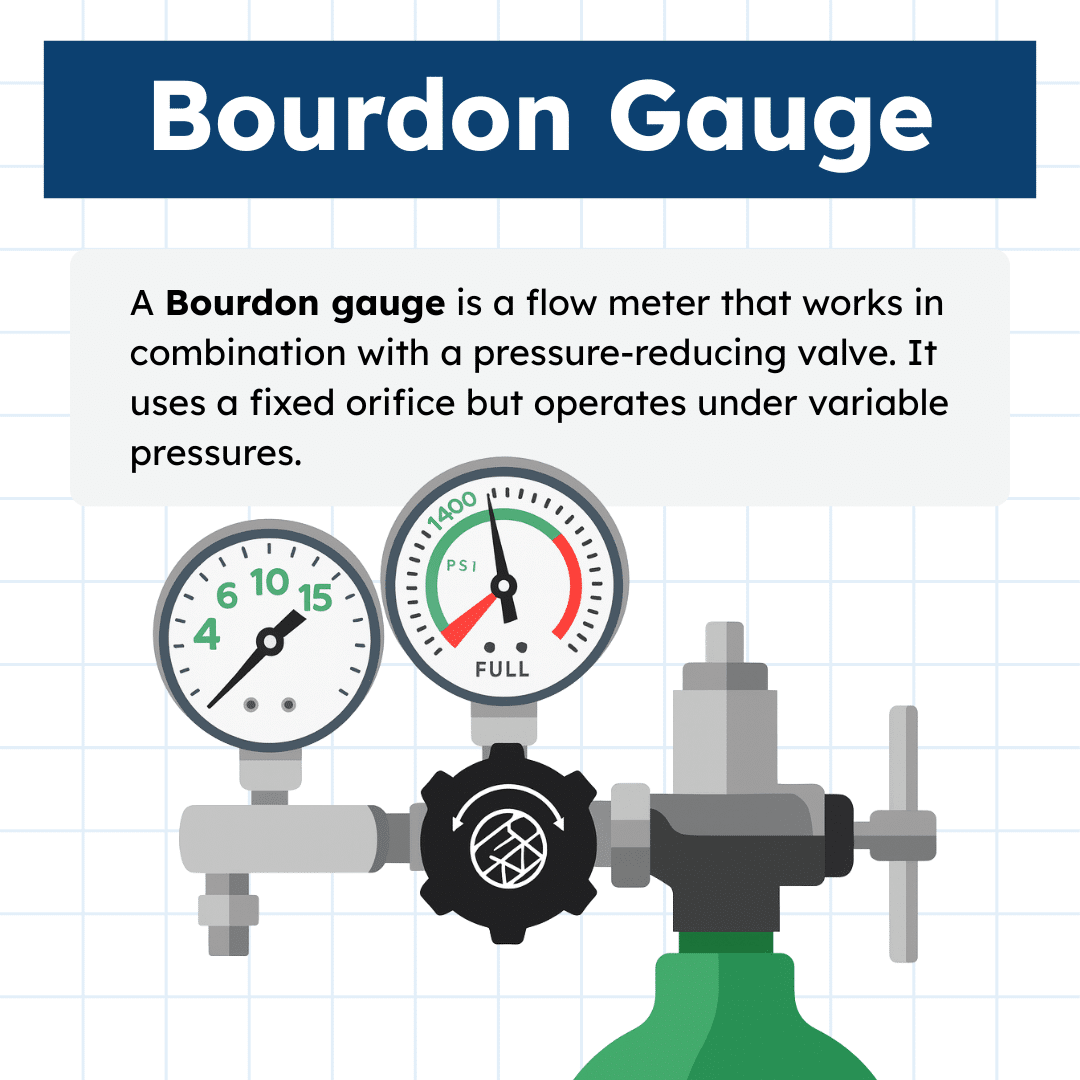
A Bourdon gauge is a flow meter that works in combination with a pressure-reducing valve. It uses a fixed orifice but operates under variable pressures. As upstream pressure is adjusted, the flow of gas leaving the device changes accordingly. Inside the gauge is a curved, hollow tube that straightens in response to pressure.
This motion drives a gear and needle assembly, converting pressure changes into a flow reading, which is displayed in liters per minute (L/min).
Unlike Thorpe tubes, which depend on gravity and must remain upright, the Bourdon gauge can function in any position. This makes it particularly useful in environments where mobility is required.
Advantages of the Bourdon Gauge
- Portability: Because it does not rely on gravity, it is well-suited for use during patient transport with portable oxygen cylinders.
- Continuous flow adjustment: The user can set a wide range of flows by altering the upstream pressure.
- Durability: Its design allows it to withstand the movement and handling associated with transport.
Note: These features make the Bourdon gauge the flow meter of choice in situations where patients are moved between locations, such as from hospital to ambulance or during bedside transport.
Limitations of the Bourdon Gauge
Despite its benefits, the Bourdon gauge has some drawbacks:
- Inaccuracy with downstream resistance: If the patient is connected to equipment that adds resistance (e.g., a high-flow mask), the actual delivered flow may be lower than the gauge reading. This happens because the gauge measures upstream pressure, not the true flow at the outlet.
- False readings when blocked: Even if the tubing is kinked or blocked, the needle will still register a flow based on upstream pressure.
Note: For these reasons, when precise flow delivery is required—particularly with devices that generate back pressure—a compensated Thorpe tube is preferred.
Integration with Modern Systems
In recent years, integrated oxygen systems such as the Grab ‘n Go cylinders have streamlined oxygen delivery. These systems combine the cylinder, regulator, and adjustable flow restrictor in one unit.
They minimize errors associated with attaching regulators and simplify use for healthcare providers by allowing quick setup and adjustment.
Relevance to Respiratory Therapists
Understanding how the Bourdon gauge works, along with its strengths and limitations, is vital for respiratory therapists. These clinicians are often responsible for:
- Selecting the most appropriate flow meter for different patient scenarios
- Ensuring accurate delivery of oxygen therapy
- Anticipating and troubleshooting issues related to flow meter performance
During patient transport, respiratory therapists must prioritize both safety and efficiency. The Bourdon gauge offers an effective solution in these mobile environments, reinforcing its ongoing relevance in the field of respiratory care.
Bourdon Gauge Practice Questions
1. Which three types of flow meters are commonly used in respiratory care?
Flow restrictor, Bourdon gauge, Thorpe tube
2. What type of flow meter operates with a fixed orifice and variable pressure?
Bourdon gauge
3. What component must the Bourdon gauge always be used with?
An adjustable pressure-reducing valve
4. How does a Bourdon gauge respond when upstream pressure is increased?
Gas flow out of the device increases
5. What creates resistance in the Bourdon gauge to allow flow measurement?
A calibrated fixed orifice
6. What physical mechanism inside the Bourdon gauge responds to pressure changes?
A curved hollow closed tube that tends to straighten
7. How does the Bourdon gauge convert pressure into a flow reading?
Tube motion moves a gear assembly and needle calibrated in liters per minute
8. What factor does the Bourdon gauge actually measure, despite displaying flow?
Pressure
9. Why is the Bourdon gauge a good choice for patient transport?
It does not need to be upright to function accurately
10. What happens to the Bourdon gauge reading if downstream pressure increases?
The reading remains high, even though actual flow decreases
11. Why might the Bourdon gauge provide a falsely high reading during obstruction?
Because it measures upstream pressure, not actual flow
12. What is the best alternative to a Bourdon gauge when accurate flow is critical with high-resistance devices?
A pressure-compensated Thorpe tube
13. What is the primary advantage of the Bourdon gauge during transport?
It works accurately in any position and is unaffected by gravity
14. What effect does pinching or narrowing oxygen tubing have on the Bourdon gauge reading?
Flow decreases, but the reading remains falsely unchanged
15. What happens if the outlet of a Bourdon gauge is completely blocked?
The gauge may still register a flow reading.
16. Why is the Bourdon gauge considered a fixed-orifice, variable-pressure device?
Because flow is adjusted by changing the upstream pressure
17. What flowmeter is ideal when the oxygen cylinder cannot remain upright?
Bourdon gauge
18. What common hospital system combines a cylinder, regulator, and adjustable flow meter into one unit?
Integrated oxygen systems like the Grab ‘n Go system
19. What problem does the Grab ‘n Go system solve in portable oxygen use?
It eliminates delays and errors from incorrectly mounted regulators.
20. How do integrated oxygen systems simplify patient oxygen delivery?
They allow flow selection via a single knob and easy tubing connection.
21. Why is the Bourdon gauge not reliable for use with high-resistance equipment?
It overestimates flow because it doesn’t account for downstream pressure drops.
22. What type of reading does the Bourdon gauge provide when connected to a kinked oxygen tube?
Falsely high flow reading
23. What part of the Bourdon gauge moves the indicator needle?
A gear assembly connected to the curved pressure-sensitive tube
24. When using a Bourdon gauge, what causes actual flow to decrease while gauge reading stays the same?
Increased downstream resistance or obstruction
25. What is the primary disadvantage of the Bourdon gauge?
Inaccuracy when downstream pressure changes
26. Why does the Bourdon gauge remain functional when not held upright?
Because it does not rely on gravity for accurate readings
27. What is the primary purpose of the adjustable pressure-reducing valve in a Bourdon gauge setup?
To regulate upstream pressure and control flow
28. What happens to the actual output flow from a Bourdon gauge if downstream resistance increases?
It decreases
29. Despite reduced actual flow, what will the Bourdon gauge display during increased downstream resistance?
A normal or falsely high flow reading
30. What is the best practice when using a Bourdon gauge with devices that create high resistance?
Avoid it and use a compensated Thorpe tube instead.
31. How is the scale on a Bourdon gauge calibrated?
To convert needle movement from pressure into flow (L/min)
32. In what unit does the Bourdon gauge display flow?
Liters per minute (L/min)
33. What real-world situation makes the Bourdon gauge especially practical?
Transporting a patient using a portable E-cylinder
34. What is one reason the Bourdon gauge may falsely indicate oxygen is flowing?
Because it registers pressure, even if the outlet is blocked
35. What reading would you expect from a Bourdon gauge if oxygen tubing is completely kinked?
A falsely high flow reading despite no actual flow
36. What type of flow does the Bourdon gauge deliver?
Continuous, adjustable flow
37. What advantage does the Bourdon gauge have over an uncompensated Thorpe tube during transport?
It can be used in any position without losing accuracy.
38. What must be true for the Bourdon gauge to provide a true flow reading?
There must be no changes in downstream pressure.
39. What causes the Bourdon gauge’s internal tube to straighten?
Increased gas pressure
40. What component of the Bourdon gauge interprets tube movement to indicate flow?
A gear mechanism connected to the indicator needle
41. What happens inside the Bourdon gauge when gas pressure increases?
The curved tube straightens slightly, moving the needle
42. Can the Bourdon gauge be used with a wall-mounted bulk oxygen source?
Yes, but it is not typically the first choice for stationary setups
43. How does a pressure-compensated Thorpe tube differ from a Bourdon gauge?
It measures true flow even in the presence of downstream resistance.
44. What type of error is introduced by using a Bourdon gauge with high-resistance tubing or devices?
Overestimation of actual delivered flow
45. In an integrated Grab ‘n Go oxygen system, what component replaces the traditional Bourdon gauge setup?
A built-in regulator with a flow-adjusting knob
46. What role does the Bourdon gauge play in conserving oxygen during transport?
It allows controlled, adjustable flow delivery.
47. Why should clinicians be cautious when relying solely on Bourdon gauge readings?
The displayed flow may not reflect actual patient delivery under certain conditions.
48. What is the source of mechanical motion inside a Bourdon gauge?
Pressure-induced straightening of a curved metal tube
49. When is a Bourdon gauge most likely to provide an inaccurate reading?
When high downstream resistance is present
50. What is the best indicator that a Bourdon gauge is functioning properly during use?
Stable flow reading with no downstream resistance or obstruction
51. What type of flowmeter is the Bourdon gauge classified as?
A fixed-orifice, variable-pressure device used with a pressure-reducing valve
52. What are the main components of a Bourdon gauge system?
Fixed orifice, curved hollow pressure-sensing tube, gear assembly, and indicator needle
53. What causes the needle to move in a Bourdon gauge?
Straightening of the curved tube due to pressure, which moves the gear assembly
54. What does the indicator needle on a Bourdon gauge actually measure?
It measures pressure but is calibrated to display flow in liters per minute.
55. What type of flow does the Bourdon gauge deliver?
A continuous and adjustable range of flow based on driving pressure
56. What makes the Bourdon gauge ideal for patient transport?
It is gravity-independent and can function in any position.
57. True or False: Gravity affects the accuracy of a Bourdon gauge
False
58. What is the primary disadvantage of using a Bourdon gauge?
It becomes inaccurate when downstream pressure changes.
59. Why might the Bourdon gauge show a normal flow even when actual delivery is reduced?
Because it measures upstream pressure, not downstream resistance
60. What is the function of the pressure-reducing valve in a Bourdon gauge setup?
It regulates the upstream pressure to control flow.
61. What does the Grab ‘n Go System integrate into one portable device?
An oxygen cylinder, pressure regulator, and adjustable flow restrictor
62. What type of flowmeter is a Thorpe tube?
A variable-orifice, constant-pressure flowmeter
63. What power source is required for a Thorpe tube to function?
A 50-psig pressure source
64. How does a Thorpe tube increase gas flow?
By increasing the size of the orifice opening
65. What component inside the Thorpe tube rises to indicate flow?
A float or ball
66. What units are Thorpe tubes typically calibrated in?
Liters per minute (L/min)
67. What are the two designs of Thorpe tubes?
Pressure-compensated and uncompensated
68. What is the benefit of a pressure-compensated Thorpe tube?
It provides accurate flow regardless of downstream resistance.
69. What happens to accuracy in an uncompensated Thorpe tube?
It gives falsely low readings if the downstream resistance increases.
70. True or False: Thorpe tubes are ideal for patient transport
False
71. What is the general purpose of flowmeters in respiratory care?
To meter and regulate the rate of gas flow to the patient
72. What are the three main types of flowmeters used in respiratory therapy?
Flow restrictors, Bourdon gauges, and Thorpe tubes
73. What are the main advantages of flow restrictors?
They are simple, low-cost, safe, and gravity-independent
74. What type of orifice does a flow restrictor contain?
A fixed orifice calibrated for constant flow at 50 psig
75. What is a key limitation of flow restrictors?
Their accuracy depends on maintaining a constant pressure differential.
76. What makes the Bourdon gauge suitable for use with portable oxygen cylinders during patient transport?
It functions accurately in any position and does not rely on gravity.
77. What happens to the Bourdon gauge reading if the outlet is completely blocked?
It will still show a flow reading based on upstream pressure, even though no gas is flowing.
78. Why is the Bourdon gauge less accurate when used with high-resistance devices?
Downstream resistance reduces actual flow, but the gauge continues to display a falsely high reading.
79. What determines the flow rate in a Bourdon gauge system?
The driving (upstream) pressure applied across a fixed orifice
80. How is the Bourdon gauge different from a Thorpe tube in terms of pressure and orifice type?
Bourdon gauge = fixed orifice, variable pressure; Thorpe tube = variable orifice, constant pressure
81. What visual component helps the clinician interpret flow on a Bourdon gauge?
A needle that moves with pressure changes and is calibrated in liters per minute
82. What is a clinical safety concern when using Bourdon gauges with kinked or pinched oxygen tubing?
The gauge may show normal flow even though actual delivery is significantly reduced or blocked.
83. Which gauge should be avoided when accurate flow delivery is critical in the presence of high-resistance equipment?
Bourdon gauge
84. Why is the Bourdon gauge not ideal for use with ventilators or other high-resistance systems?
It overestimates flow and cannot detect changes in downstream pressure.
85. What does the Bourdon gauge measure to estimate flow?
Upstream pressure
86. Why is it important to monitor patients closely when using Bourdon gauges during transport?
Because flow readings can be falsely elevated due to variable downstream resistance
87. In what clinical scenario is the Bourdon gauge the best choice?
Transporting a patient with a portable E-cylinder in a non-upright position
88. What component in a Bourdon gauge straightens in response to gas pressure?
A curved, hollow, closed metal tube
89. What mechanical system inside the Bourdon gauge converts pressure changes into needle movement?
A gear assembly linked to the straightening tube
90. What is a quick clinical “rule of thumb” for using a Bourdon gauge?
Use when you can’t keep the flowmeter upright (e.g., during patient transport)
91. What causes the Bourdon tube to straighten and activate the needle?
The internal gas pressure pushing outward.
92. What part of the Bourdon gauge translates mechanical motion into a readable flow value?
The indicator needle calibrated in L/min
93. What key factor allows the Bourdon gauge to operate in any position?
It does not rely on gravity or a float mechanism.
94. Why must clinicians be cautious of downstream resistance with Bourdon gauges?
Because it causes flow delivery to decrease without changing the flow reading
95. What safety feature does the Bourdon gauge lack compared to pressure-compensated Thorpe tubes?
It cannot detect actual delivered flow when resistance is present downstream.
96. What is the source of gas driving pressure in a Bourdon gauge setup?
A high-pressure oxygen cylinder with a pressure-reducing valve
97. Which portable oxygen system integrates the features of a Bourdon gauge into a compact design?
Grab ‘n Go System
98. What essential respiratory therapy task is supported by the Bourdon gauge during transport?
Metering and delivering therapeutic oxygen flow
99. What causes inaccuracies in Bourdon gauge flow readings when resistance changes?
The fixed orifice and reliance on upstream pressure only
100. When is a Bourdon gauge flow reading most accurate?
When downstream pressure is minimal and tubing is unobstructed
Final Thoughts
In summary, the Bourdon gauge remains an important tool in respiratory care, particularly in situations that demand portability and resilience. While it is not the most accurate choice when downstream resistance is present, its reliability during transport and ability to function in any position make it invaluable in many clinical settings.
For respiratory therapists, knowing when and how to use a Bourdon gauge ensures safer oxygen delivery, better patient outcomes, and greater confidence in providing care across a variety of environments.

Written by:
John Landry is a registered respiratory therapist from Memphis, TN, and has a bachelor's degree in kinesiology. He enjoys using evidence-based research to help others breathe easier and live a healthier life.
References
- Bourgain JL, Benayoun L, Baguenard P, Haré G, Puizillout JM, Billard V. Contrôle des pressions dans les systèmes de distribution de gaz médicaux [Pressure control in medical gas distribution systems]. Ann Fr Anesth Reanim. 1997.