

Cilia are microscopic, hair-like projections that line the respiratory tract and serve as one of the body’s most important defense mechanisms. Although invisible to the naked eye, their coordinated movement plays a critical role in keeping the airways clear of mucus, debris, and pathogens.
For respiratory therapists, understanding how cilia function and what happens when they fail is essential. From oxygen therapy and mechanical ventilation to airway clearance techniques, many clinical decisions directly influence ciliary performance and mucociliary clearance.

What Are Cilia?
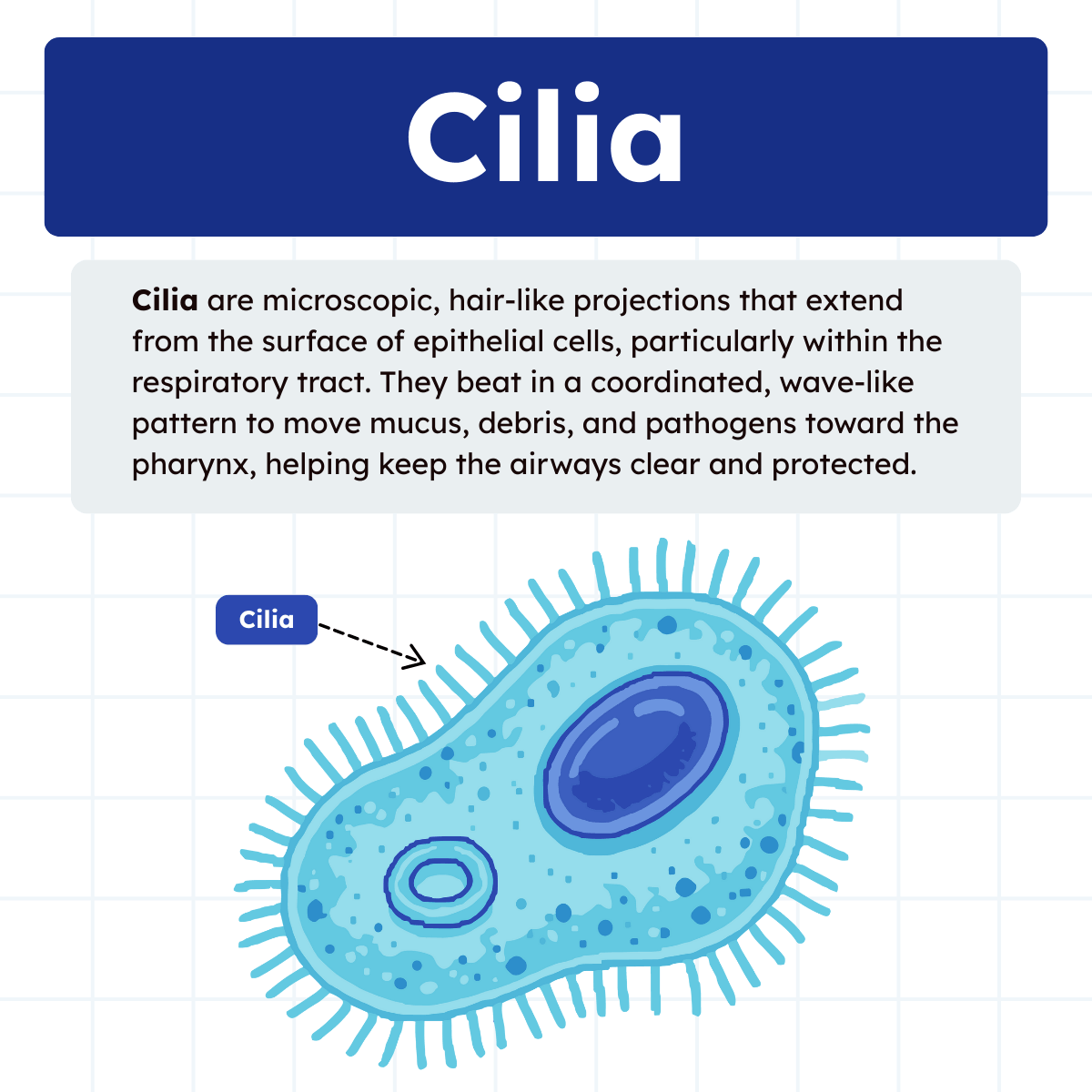
Cilia are microscopic, hair-like projections that extend from the surface of certain epithelial cells, especially those lining the respiratory tract. In the airways, they are found on the ciliated pseudostratified columnar epithelium of the nasal cavity, trachea, and bronchi. Each ciliated cell contains hundreds of cilia that beat in a highly coordinated, wave-like pattern. This synchronized motion, known as a metachronal wave, helps move mucus and trapped particles upward toward the pharynx.
Structurally, each cilium contains a central microtubule-based core called the axoneme, typically arranged in a 9 plus 2 pattern. This structure allows the cilia to bend rhythmically using energy derived from ATP. By continuously sweeping mucus, dust, bacteria, and other inhaled debris out of the airways, cilia play a vital role in maintaining airway cleanliness and protecting the lungs from infection and obstruction.
What is the Mucociliary Escalator?
The coordinated action of cilia is part of a larger defense mechanism known as the mucociliary escalator. This system continuously moves mucus from the lower airways toward the pharynx, where it can be swallowed or expectorated.
Mucus is produced by goblet cells, Clara (club) cells, serous cells, and submucosal glands. In healthy individuals, approximately 10 to 100 mL of secretions are produced daily. These secretions trap inhaled particles, bacteria, viruses, and environmental pollutants.
Cilia then propel this mucus upward at a speed of approximately 2 cm per minute. In the nose, the motion directs material toward the pharynx. From the bronchioles up to the larynx, it continues to move secretions centrally. In healthy lungs, inhaled particles can typically be cleared within 24 hours.
This system depends on:
- Patent airways
- Proper mucus production and composition
- Adequate hydration
- Functional ciliary motion
- An effective cough
Note: If any of these components fail, airway clearance becomes compromised.
Types of Ciliated Cells in the Respiratory Tract
The density and type of epithelial cells change as the airways branch and narrow. In the larger airways, pseudostratified ciliated columnar epithelial cells predominate. These cells form the primary engine of mucociliary clearance.
As the airway diameter decreases:
- Bronchial glands become fewer
- The number of ciliated cells decreases
- Simple columnar and cuboidal epithelial cells become more common
- Goblet cells remain present
- Clara (club) cells increase in number
Clara cells are non-ciliated cuboidal cells with apical granules. They play several important roles:
- Degrading inhaled oxidants
- Contributing proteins to surfactant production
- Synthesizing lipids
- Participating in epithelial repair following injury
Note: For respiratory therapists, this transition in epithelial structure helps explain why smaller airways are particularly vulnerable to obstruction and secretion retention.
Factors That Influence Ciliary Function
Ciliary motion is highly sensitive to environmental and physiologic conditions.
1. Hydration
Cilia operate within a two-layer system:
- A thin, watery sol layer that allows cilia to move freely
- A thicker gel layer of mucus above it
If the sol layer becomes dehydrated, ciliary beating slows or stops. Exposure to dry gases—especially without humidification—can impair ciliary motion. This is particularly relevant in patients receiving supplemental oxygen or mechanical ventilation.
2. Oxygen Concentration
High concentrations of inspired oxygen (FiO2) can impair ciliary function. Prolonged exposure to elevated oxygen levels may slow or stop ciliary beating, contributing to secretion retention.
3. Smoke and Pollutants
Cigarette smoke and environmental pollutants damage cilia, reduce their beat frequency, and may eventually destroy them. Chronic exposure leads to impaired mucociliary clearance, a hallmark of chronic bronchitis.
4. Medications
Certain drugs, including anticholinergic agents such as atropine, can slow ciliary motion. Increased parasympathetic stimulation, on the other hand, increases mucus production.
Note: Understanding these influences is critical when managing patients in acute and chronic respiratory care settings.
Clinical Conditions Associated With Ciliary Dysfunction
Several diseases impair airway clearance by affecting cilia, mucus, airway patency, or cough effectiveness.
Cystic Fibrosis
In cystic fibrosis (CF), abnormal sodium and chloride transport alters the solute concentration of mucus. The result is thick, viscous secretions that are difficult for cilia to propel. Retained secretions lead to chronic infections and progressive lung damage.
Primary Ciliary Dyskinesia
Ciliary dyskinetic syndromes involve structural or functional abnormalities of the cilia. The coordinated beating pattern is disrupted, impairing mucociliary clearance and leading to recurrent respiratory infections.
Bronchiectasis
Bronchiectasis involves permanent dilation and damage to the airways. Even if ciliary motion is intact, distorted airway architecture predisposes to secretion retention and obstruction. Bronchiectasis is common in both CF and ciliary dyskinesia.
Chronic Bronchitis and Asthma
Inflammation, mucus hypersecretion, and bronchospasm narrow the airway lumen. Even functional cilia may be overwhelmed by excessive mucus production.
Neuromuscular Disorders
Conditions such as ALS, muscular dystrophy, spinal muscular atrophy, myasthenia gravis, and cerebral palsy impair cough effectiveness. Even if mucociliary function is normal, inadequate cough results in retained secretions, mucus plugs, and atelectasis.
Note: For respiratory therapists, recognizing these pathophysiologic mechanisms guides appropriate airway clearance strategies.
Why Cilia Matter to Respiratory Therapists
Cilia are directly relevant to nearly every aspect of respiratory care.
Oxygen Therapy and Humidification
Dry medical gases impair ciliary function. Proper humidification helps maintain the sol layer and preserve mucociliary clearance. Inadequate humidification can contribute to secretion thickening and airway obstruction.
Mechanical Ventilation
Intubation bypasses the upper airway’s humidification system. Without adequate humidification, ciliary function declines. This increases the risk of mucus plugging, atelectasis, and ventilator-associated complications.
Airway Clearance Techniques
Respiratory therapists use a variety of interventions to support mucociliary function:
- Chest physiotherapy
- Positive expiratory pressure devices
- High-frequency chest wall oscillation
- Suctioning
- Cough assist devices
Note: Understanding how cilia normally function allows therapists to compensate when they fail.
Smoking Cessation Education
Chronic smoking damages and paralyzes cilia. Educating patients about the impact of smoking on mucociliary clearance reinforces cessation efforts.
Infection Prevention
Impaired ciliary function increases susceptibility to pneumonia and other respiratory infections. Monitoring secretion characteristics and early intervention are essential components of patient care.
The Integration of Cilia and Cough
While cilia continuously move mucus centrally, the cough reflex clears larger airways of excessive secretions and foreign material. These systems work together to maintain airway patency.
When either system fails, secretions accumulate. This can lead to:
- Mucus plugging
- Atelectasis
- Impaired gas exchange
- Increased work of breathing
- Secondary infections
Note: Respiratory therapists play a central role in assessing cough strength, secretion burden, and airway patency to prevent these complications.
Cilia Practice Questions
1. What are cilia?
Cilia are microscopic, hair-like projections that extend from the surface of epithelial cells.
2. Where are cilia primarily located in the respiratory tract?
They are found in the ciliated pseudostratified columnar epithelium lining the nasal cavity, trachea, and bronchi.
3. Approximately how many cilia are present on each ciliated epithelial cell?
Each ciliated epithelial cell contains about 200 cilia on its luminal surface.
4. What is the primary structural component of a cilium?
The central core of a cilium is called the axoneme.
5. What is the classic microtubule arrangement within a cilium?
The axoneme consists of a “9 + 2” arrangement, with nine outer microtubule pairs surrounding a central pair.
6. What proteins are responsible for generating ciliary movement?
Dynein arms generate movement using ATP, while nexin links help maintain structural integrity.
7. What is the energy source for ciliary beating?
Adenosine triphosphate (ATP) provides the energy for ciliary motion.
8. What are the approximate dimensions of a cilium?
Each cilium measures about 6 micrometers in length and 0.2 micrometers in diameter.
9. How frequently do cilia beat under normal conditions?
Cilia beat approximately 10 to 20 times per second in a coordinated manner.
10. What is a metachronal wave?
A metachronal wave is the synchronized, wave-like pattern of coordinated ciliary movement.
11. What is the mucociliary escalator?
The mucociliary escalator is a defense mechanism that moves mucus and trapped particles upward toward the pharynx.
12. What is the primary function of the mucociliary escalator?
It clears inhaled particles, pathogens, and debris from the lower respiratory tract.
13. Which cells produce mucus in the respiratory tract?
Mucus is produced by goblet cells and submucosal glands.
14. How much mucus is typically produced daily in healthy individuals?
Approximately 10 to 100 mL of respiratory secretions are produced daily.
15. At what approximate speed does mucus move in the airways?
Mucus is propelled at about 1 to 2 cm per minute toward the pharynx.
16. How long does it typically take to clear inhaled particles in healthy lungs?
Most inhaled particles are cleared within about 24 hours.
17. What five factors are essential for effective mucociliary clearance?
Patent airways, proper mucus composition, adequate hydration, functional cilia, and an effective cough are required.
18. How does airway branching affect epithelial cell types?
As airways narrow, the number of ciliated cells decreases and simpler epithelial cells become more common.
19. What type of epithelium predominates in the larger airways?
Pseudostratified ciliated columnar epithelium predominates in the larger airways.
20. What are club (formerly Clara) cells?
Club cells are non-ciliated cuboidal cells found in smaller airways with protective and reparative functions.
21. What are the key functions of club cells?
They detoxify inhaled substances, contribute to surfactant components, and participate in epithelial repair.
22. Why are smaller airways more vulnerable to secretion retention?
They contain fewer ciliated cells and narrower lumens, increasing the risk of obstruction.
23. What are the two layers involved in mucociliary transport?
The system includes a thin sol layer and a thicker gel layer of mucus.
24. What happens when the sol layer becomes dehydrated?
Ciliary motion slows or stops, impairing mucus clearance.
25. Why is humidification important for patients receiving oxygen therapy?
Dry gases can impair ciliary function and reduce mucociliary clearance.
26. How can high inspired oxygen concentrations affect cilia?
Prolonged exposure to high FiO2 can reduce ciliary beat frequency.
27. How does cigarette smoke affect ciliary function?
Smoke damages cilia, reduces beat frequency, and may eventually destroy them.
28. What is the impact of chronic pollutant exposure on mucociliary clearance?
Chronic exposure impairs clearance and contributes to diseases such as chronic bronchitis.
29. Why is effective ciliary function critical for respiratory defense?
It prevents accumulation of secretions and reduces infection risk.
30. How does impaired ciliary function contribute to respiratory disease?
Reduced clearance leads to secretion retention, infection, and airway inflammation.
31. How do anticholinergic medications such as atropine affect ciliary function?
Anticholinergic agents can slow ciliary beat frequency and reduce mucociliary clearance.
32. How does increased parasympathetic stimulation affect airway secretions?
Increased parasympathetic activity stimulates mucus production in the airways.
33. Why must respiratory therapists consider medication effects on cilia?
Certain drugs can impair mucociliary clearance and contribute to secretion retention.
34. How does cystic fibrosis impair mucociliary clearance?
Abnormal chloride and sodium transport leads to thick, dehydrated mucus that cilia cannot effectively propel.
35. What are the consequences of retained secretions in cystic fibrosis?
Retained secretions promote chronic infection, inflammation, and progressive lung damage.
36. What is primary ciliary dyskinesia?
Primary ciliary dyskinesia is a genetic disorder characterized by structural or functional abnormalities of cilia.
37. How does primary ciliary dyskinesia affect respiratory health?
Impaired ciliary coordination leads to recurrent respiratory infections and chronic airway disease.
38. What is bronchiectasis?
Bronchiectasis is permanent dilation and destruction of airways that predisposes patients to secretion retention.
39. Why does distorted airway architecture worsen mucus clearance in bronchiectasis?
Abnormal airway structure impairs effective mucus transport even if cilia are functioning.
40. How do chronic bronchitis and asthma affect mucociliary function?
Inflammation and excessive mucus production overwhelm ciliary clearance mechanisms.
41. Why are neuromuscular disorders associated with secretion retention?
Weak cough effort prevents effective clearance even when ciliary function is intact.
42. How does amyotrophic lateral sclerosis (ALS) contribute to impaired airway clearance?
ALS weakens respiratory muscles, reducing cough effectiveness and leading to mucus retention.
43. Why is humidification critical during oxygen therapy?
Dry gases impair ciliary motion and thicken secretions, reducing mucociliary clearance.
44. How does intubation affect mucociliary function?
Intubation bypasses normal upper airway humidification, increasing the risk of ciliary dysfunction.
45. What complications may arise from impaired mucociliary function during mechanical ventilation?
Mucus plugging, atelectasis, and ventilator-associated infections may develop.
46. What airway clearance techniques support mucociliary function?
Chest physiotherapy, positive expiratory pressure devices, high-frequency chest wall oscillation, suctioning, and cough assist devices aid secretion removal.
47. Why is smoking cessation important for mucociliary health?
Chronic smoking damages and paralyzes cilia, impairing airway defense.
48. How does impaired ciliary function increase infection risk?
Reduced clearance allows pathogens to remain in the airways, increasing susceptibility to pneumonia.
49. How do cilia and the cough reflex work together?
Cilia move mucus centrally, while coughing expels accumulated secretions from larger airways.
50. What complications can occur when both ciliary function and cough are impaired?
Mucus plugging, atelectasis, impaired gas exchange, and secondary infections may result.
51. What is the axoneme?
The axoneme is the central microtubule-based cytoskeleton within each cilium.
52. What is the function of the basal body in a ciliated cell?
The basal body anchors the cilium to the cell and organizes microtubule structure.
53. How many cilia are present per square centimeter of respiratory epithelium?
Approximately 1 to 2 billion cilia may be present per square centimeter.
54. What structural feature connects the outer microtubule pairs in a cilium?
The outer pairs are interconnected by a protein called nexin.
55. What role do dynein arms play in ciliary movement?
Dynein arms use ATP to generate sliding forces between microtubules, producing bending motion.
56. How does magnesium contribute to ciliary motion?
Magnesium ions facilitate ATP-dependent dynein activity required for microtubule sliding.
57. How is ciliary movement similar to actin-myosin interaction?
Both involve ATP-driven sliding filament mechanisms that generate motion.
58. What is the difference between primary cilia and motile cilia?
Primary cilia are usually single and involved in signaling, while motile cilia are numerous and responsible for mucus transport.
59. Where are motile cilia located in the respiratory tract?
Motile cilia are found from the nasal cavity through the terminal bronchioles.
60. Why is understanding ciliary physiology important for respiratory therapists?
Knowledge of ciliary function helps guide airway clearance strategies and optimize respiratory care.
61. At what approximate rate do respiratory cilia beat under normal conditions?
Cilia beat at approximately 15 times per second in a coordinated fashion.
62. What term describes the coordinated, wave-like motion of cilia?
The synchronized motion of cilia is called a metachronal wave.
63. What is the approximate wavelength of a metachronal wave?
The metachronal wavelength is approximately 20 micrometers.
64. In which direction does ciliary motion move mucus in the nose?
Cilia in the nasal cavity move mucus posteriorly toward the pharynx.
65. In the lower airways, toward what structure is mucus transported?
From the bronchioles upward, mucus is transported toward the larynx and pharynx.
66. What is the approximate speed of mucus transport by ciliary action?
Mucus is propelled at approximately 1 to 2 cm per minute.
67. What is another name for the continuous upward movement of mucus?
This process is known as the mucociliary escalator.
68. How quickly can inhaled particles be cleared in healthy lungs?
Most inhaled particles can be cleared within about 24 hours.
69. Why is ciliary coordination considered complex?
The precise mechanisms controlling synchronized ciliary motion are not fully understood.
70. How does airway irritation affect mucus production?
Airway irritation increases mucus production as part of the protective response.
71. How does parasympathetic stimulation affect airway secretions?
Increased parasympathetic activity enhances mucus secretion.
72. How does exposure to dry gas affect ciliary function?
Dry gas increases sol layer viscosity and slows or stops ciliary beating.
73. How does cigarette smoke impact ciliary activity?
Smoke exposure reduces ciliary beat frequency and may damage or destroy cilia.
74. How can high inspired oxygen concentrations affect mucociliary clearance?
Prolonged exposure to high FiO2 can impair ciliary motion.
75. How does atropine affect mucociliary function?
Atropine, an anticholinergic agent, can reduce ciliary beat frequency.
76. How does epithelial structure change in smaller airways?
As airway size decreases, ciliated cells decrease and simple columnar or cuboidal cells predominate.
77. What happens to bronchial glands as airways narrow?
Bronchial glands become fewer in number in smaller airways.
78. What type of cells increase in number in bronchioles?
Club (Clara) cells become more numerous in bronchioles.
79. What protective role do club cells play?
Club cells detoxify inhaled oxidants and contribute to epithelial repair.
80. How do club cells contribute to surfactant function?
They produce proteins and lipids that contribute to surfactant components.
81. What four components are required for effective airway clearance?
Patent airways, functional mucociliary transport, adequate hydration, and an effective cough are required.
82. From which region to which region does mucociliary clearance normally occur?
Mucociliary clearance occurs from the respiratory bronchioles up to the larynx.
83. Which cells are responsible for mucus production in the airways?
Goblet cells, club cells, and submucosal glands produce mucus.
84. Where are secretions ultimately directed after mucociliary transport?
Secretions are directed toward the trachea and larynx for swallowing or expectoration.
85. What is the primary function of the cough reflex?
The cough reflex clears larger airways of excessive mucus and foreign material.
86. How does coughing complement mucociliary clearance?
Coughing expels secretions that have been transported centrally by cilia.
87. What can occur if airway patency is compromised?
Obstruction can impair mucus clearance and lead to secretion retention.
88. What conditions can cause internal airway obstruction?
Foreign bodies, tumors, and mucus hypersecretion can obstruct the airway lumen.
89. How can bronchospasm impair airway clearance?
Bronchospasm narrows the airway lumen, limiting mucus movement.
90. Why is asthma associated with impaired airway clearance?
Asthma causes inflammation, bronchoconstriction, and mucus hypersecretion.
91. How does chronic bronchitis affect mucociliary function?
Chronic inflammation and excessive mucus overwhelm ciliary clearance.
92. How does cystic fibrosis alter mucus characteristics?
Abnormal ion transport increases mucus viscosity and impairs its transport.
93. What is a key feature of ciliary dyskinetic syndromes?
Structural or functional abnormalities impair coordinated ciliary beating.
94. Why is bronchiectasis associated with secretion retention?
Permanent airway dilation disrupts normal mucus transport.
95. In which conditions is bronchiectasis commonly observed?
Bronchiectasis is frequently seen in cystic fibrosis and primary ciliary dyskinesia.
96. How can ineffective cough contribute to mucus plugging?
Without sufficient expiratory force, retained secretions accumulate and obstruct airways.
97. What is a common pulmonary consequence of mucus plugging?
Mucus plugs can lead to atelectasis.
98. How do neuromuscular disorders impair airway clearance?
Respiratory muscle weakness reduces cough effectiveness.
99. Which neuromuscular disorders commonly impair the cough reflex?
Conditions such as muscular dystrophy, ALS, spinal muscular atrophy, and myasthenia gravis impair cough strength.
100. Why must respiratory therapists assess both ciliary function and cough strength?
Both systems are essential for airway defense, and impairment of either increases the risk of secretion retention and infection.
Final Thoughts
Cilia may be microscopic, but their clinical importance is enormous. They serve as the frontline defense of the respiratory tract, clearing mucus and protecting the lungs from infection and obstruction.
For respiratory therapists, a strong understanding of ciliary structure and function informs nearly every intervention—from humidification and oxygen therapy to airway clearance and ventilator management. When cilia fail, complications follow.
By preserving and supporting mucociliary function, respiratory professionals help maintain airway patency, optimize gas exchange, and protect patients from preventable respiratory complications.

Written by:
John Landry is a registered respiratory therapist from Memphis, TN, and has a bachelor's degree in kinesiology. He enjoys using evidence-based research to help others breathe easier and live a healthier life.
References
- Pazour GJ. Cilia Structure and Function in Human Disease. Curr Opin Endocr Metab Res. 2024.