

Arterial blood gas (ABG) interpretation is a fundamental skill in respiratory care and critical care medicine. It provides direct insight into a patient’s ventilatory status, metabolic balance, and overall acid-base homeostasis.
While many learners become comfortable identifying single primary disorders such as metabolic acidosis or respiratory alkalosis, real-world clinical scenarios are often more complex.
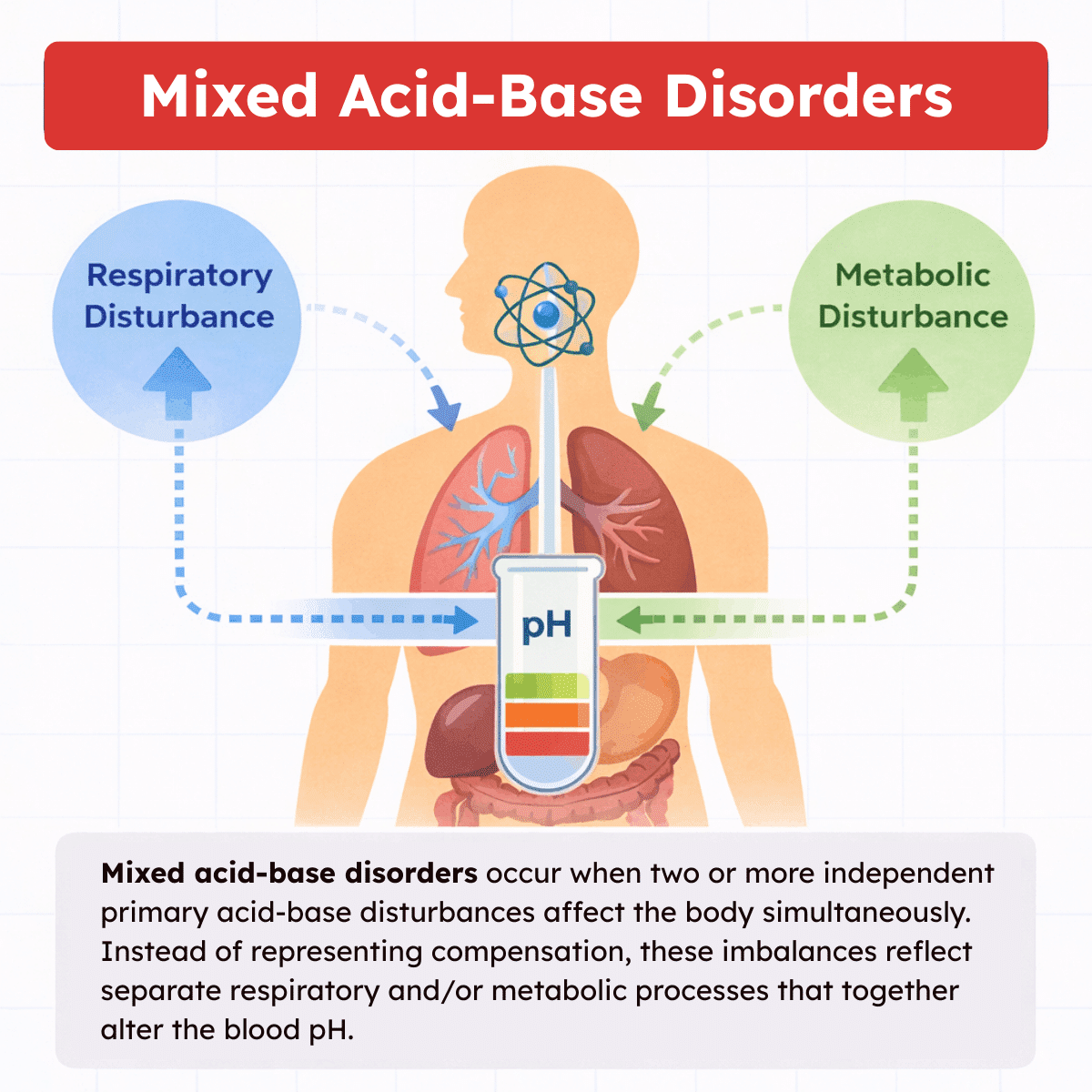
Critically ill patients frequently present with more than one primary acid-base disturbance occurring at the same time. These are known as mixed acid-base disorders, and recognizing them is essential for accurate diagnosis and appropriate management.

Take our free course to master the basics of ABG interpretation with clear explanations and helpful practice questions.
Foundations of Acid-Base Physiology
To understand mixed disorders, it is important to briefly review the basic principles of acid-base balance. The body maintains a tightly regulated arterial pH range of approximately 7.35 to 7.45. Even small deviations outside this range can impair cellular function, enzyme activity, and organ performance.
Acid-base balance is primarily governed by two systems: the respiratory system and the metabolic (renal) system. The lungs regulate the partial pressure of carbon dioxide (PaCO₂), which acts as an acid because carbon dioxide combines with water to form carbonic acid. When ventilation increases, PaCO₂ decreases, causing the pH to rise. When ventilation decreases, PaCO₂ increases, causing the pH to fall.
The kidneys regulate bicarbonate (HCO₃⁻), which acts as a base. They reabsorb or generate bicarbonate to buffer excess acid and excrete hydrogen ions to maintain balance. Metabolic disorders involve primary changes in bicarbonate, while respiratory disorders involve primary changes in PaCO₂.
In a simple acid-base disorder, one system is primarily affected and the other system responds through compensation. For example, in metabolic acidosis, the lungs compensate by increasing ventilation to lower PaCO₂. In respiratory acidosis, the kidneys compensate by retaining bicarbonate. Compensation is predictable and follows established physiologic rules.
Note: Mixed disorders differ from compensation because two or more primary processes are occurring simultaneously, rather than one system attempting to correct the other.
What is a Mixed Acid-Base Disorder?
A mixed acid-base disorder occurs when two or more independent primary acid-base disturbances are present at the same time. These disturbances may involve both the respiratory and metabolic systems, or they may involve two metabolic processes occurring together.
In compensation, the secondary change in PaCO₂ or HCO₃⁻ moves in the opposite direction of the primary disturbance and remains within predictable limits. In a mixed disorder, however, the secondary value exceeds or fails to meet expected compensatory ranges, indicating an additional primary abnormality.
Mixed disorders can be categorized broadly into three types:
- A respiratory and a metabolic disorder occurring together
- Two metabolic disorders occurring together
- Two respiratory disorders occurring together (less common but possible in certain circumstances)
Note: Recognizing mixed disorders requires careful comparison of the measured ABG values to expected compensation formulas and an understanding of the patient’s clinical context.
Why Mixed Disorders Are Clinically Important
Mixed acid-base disorders are common in critically ill patients and often indicate severe underlying pathology. Missing a mixed disorder can result in inappropriate management. For example, assuming that a patient has simple compensated respiratory acidosis when they also have a superimposed metabolic alkalosis could lead to incomplete treatment of the metabolic component.
In some cases, mixed disorders can make the pH appear deceptively normal. For instance, a patient with metabolic acidosis and respiratory alkalosis may have a near-normal pH because the two processes partially offset each other. Without evaluating PaCO₂ and HCO₃⁻ carefully, the clinician may overlook significant pathology.
In other cases, mixed disorders may drive the pH to dangerously high or low extremes. When two acidotic processes occur together, such as metabolic acidosis and respiratory acidosis, the result can be severe acidemia that requires urgent intervention.
Because ABG interpretation directly influences ventilator settings, fluid management, medication adjustments, and resuscitation strategies, accurate identification of mixed disorders is essential in respiratory care practice.
Systematic Approach to ABG Interpretation
Identifying mixed acid-base disorders requires a structured and consistent approach. A stepwise method helps reduce errors and improves diagnostic accuracy.
Step 1: Evaluate the pH
Determine whether the patient is acidemic (pH < 7.35), alkalemic (pH > 7.45), or within the normal range. A normal pH does not exclude a disorder, especially in mixed conditions.
Step 2: Identify the primary process
Determine whether the primary disturbance is respiratory or metabolic by evaluating PaCO₂ and HCO₃⁻. If the pH and PaCO₂ move in opposite directions, the disorder is respiratory. If the pH and HCO₃⁻ move in the same direction, the disorder is metabolic.
Step 3: Assess compensation
Use established compensation rules to determine whether the secondary value falls within the expected range. For metabolic acidosis, Winter’s formula can be used to predict expected PaCO₂:
Expected PaCO₂ = (1.5 × HCO₃⁻) + 8 ± 2
For metabolic alkalosis, expected PaCO₂ rises approximately 0.7 mm Hg for every 1 mEq/L increase in HCO₃⁻ above normal.
For respiratory disorders, renal compensation varies depending on whether the disturbance is acute or chronic. If the measured value does not match predicted compensation, a mixed disorder should be suspected.
Step 4: Calculate the anion gap (if metabolic acidosis is present)
The anion gap is calculated as:
Anion gap = Na⁺ − (Cl⁻ + HCO₃⁻)
An elevated anion gap suggests accumulation of unmeasured acids such as lactate, ketones, or toxins. Further evaluation using the delta gap can reveal additional metabolic processes occurring simultaneously.
Step 5: Correlate clinically
ABG values must always be interpreted in the context of the patient’s clinical condition. Sepsis, renal failure, vomiting, COPD, overdose, and shock frequently produce mixed patterns.
Clues That Suggest a Mixed Disorder
Certain findings should raise suspicion for a mixed acid-base disturbance.
- A near-normal pH with abnormal PaCO₂ and HCO₃⁻ is a common clue. For example, a pH of 7.40 with both elevated PaCO₂ and elevated HCO₃⁻ may indicate metabolic alkalosis and respiratory acidosis occurring together rather than simple compensation.
- Compensation that falls outside predicted ranges is another important indicator. If a patient with metabolic acidosis has a PaCO₂ that is significantly lower or higher than predicted by Winter’s formula, an additional respiratory disorder is likely present.
- Extremely abnormal pH values often suggest multiple processes. Severe acidemia (e.g., pH 7.05) may reflect combined metabolic and respiratory acidosis rather than a single disorder.
- Discrepancies between the anion gap and the change in bicarbonate can reveal concurrent metabolic alkalosis or non-anion gap metabolic acidosis.
Note: Developing comfort with these patterns requires repeated practice and consistent use of formulas rather than relying on visual estimation alone.
Clinical Situations Commonly Associated with Mixed Disorders
Certain patient populations are especially prone to developing mixed acid-base disturbances.
- A patient with chronic obstructive pulmonary disease (COPD) who experiences persistent vomiting may develop respiratory acidosis from hypoventilation and metabolic alkalosis from gastric acid loss.
- A patient with sepsis may develop metabolic acidosis from lactic acid accumulation while simultaneously hyperventilating due to respiratory compensation or central stimulation, producing respiratory alkalosis.
- A trauma patient with hemorrhagic shock may develop metabolic acidosis from poor tissue perfusion while also hyperventilating due to pain or head injury, leading to respiratory alkalosis.
- A patient with renal failure who receives sedatives or opioids may develop metabolic acidosis from impaired acid excretion and respiratory acidosis from hypoventilation.
Note: These scenarios illustrate how multiple pathophysiologic processes can occur simultaneously, producing complex ABG patterns.
Distinguishing Mixed Disorders from Compensation
One of the most common challenges in ABG interpretation is distinguishing true mixed disorders from appropriate compensation.
Compensation is predictable and limited. The body does not overcorrect. For example, respiratory compensation for metabolic acidosis will not raise the pH above normal. If alkalemia is present in a patient with metabolic acidosis, a second primary alkalotic process must be occurring.
Similarly, if a patient with chronic respiratory acidosis has a bicarbonate level that exceeds expected renal compensation, a superimposed metabolic alkalosis should be suspected. Understanding that compensation moves the pH toward normal but does not overshoot it is critical. When laboratory values appear to “overcompensate,” the clinician should strongly consider a mixed disorder.
Common Mixed Acid-Base Disorders
Mixed acid-base disorders follow recognizable physiologic patterns. Identifying them requires careful analysis of the pH, PaCO₂, HCO₃⁻, predicted compensation, and the patient’s clinical condition.
Below are the most common combinations encountered in respiratory and critical care practice, along with the mechanisms and ABG features that help confirm the diagnosis.
1. Metabolic Acidosis + Respiratory Alkalosis
This is one of the most frequently encountered mixed acid-base disorders, particularly in critically ill patients. It occurs when a primary metabolic acidosis develops alongside an independent process that causes hyperventilation and excessive carbon dioxide elimination.
Pathophysiology
Metabolic acidosis results from a primary decrease in bicarbonate due to acid accumulation or bicarbonate loss. At the same time, respiratory alkalosis develops because alveolar ventilation increases beyond what would be expected for compensation alone. As a result, PaCO₂ falls lower than predicted by compensation formulas.
Although respiratory compensation normally occurs in metabolic acidosis, the degree of CO₂ reduction in this mixed disorder exceeds the expected compensatory response, confirming a second primary disturbance.
Common Causes
- Sepsis (lactic acidosis with central hyperventilation)
- Salicylate toxicity
- Liver failure
- Pulmonary embolism with tissue hypoxia
- Pregnancy with concurrent metabolic derangement
Note: Salicylate overdose is a classic example. Early toxicity stimulates the respiratory center, producing respiratory alkalosis. As organic acids accumulate, metabolic acidosis develops. Both disturbances coexist.
ABG Characteristics
- pH: May be low, normal, or slightly elevated
- HCO₃⁻: Decreased
- PaCO₂: Decreased more than predicted by Winter’s formula
Example:
pH 7.36
PaCO₂ 24 mm Hg
HCO₃⁻ 14 mEq/L
Using Winter’s formula:
Expected PaCO₂ = (1.5 × 14) + 8 ± 2
= 29 ± 2 → range 27–31
A measured PaCO₂ of 24 mm Hg is lower than expected, confirming a superimposed respiratory alkalosis.
Clinical Implications
This pattern may produce a near-normal pH despite serious underlying disease. Recognition is critical in conditions such as sepsis and toxic ingestions, where early treatment significantly affects outcomes.
2. Metabolic Alkalosis + Respiratory Acidosis
This combination is commonly seen in patients with chronic lung disease who develop additional metabolic disturbances.
Pathophysiology
Respiratory acidosis results from hypoventilation and carbon dioxide retention. Metabolic alkalosis develops due to hydrogen ion loss or bicarbonate excess. When bicarbonate rises beyond predicted renal compensation for respiratory acidosis, a second primary metabolic alkalosis is present.
Common Causes
- Chronic obstructive pulmonary disease with vomiting
- Chronic CO₂ retention with diuretic therapy
- Volume depletion in patients with chronic lung disease
- Sleep-disordered breathing with alkali intake
Note: A patient with COPD who is receiving loop diuretics may retain CO₂ while also developing contraction alkalosis from volume depletion.
ABG Characteristics
- pH: May be normal or slightly elevated
- PaCO₂: Elevated
- HCO₃⁻: Elevated beyond expected compensation
In chronic respiratory acidosis, bicarbonate increases approximately 3–4 mEq/L for every 10 mm Hg increase in PaCO₂ above 40 mm Hg.
Example:
pH 7.42
PaCO₂ 60 mm Hg
HCO₃⁻ 38 mEq/L
A PaCO₂ of 60 mm Hg represents a 20 mm Hg rise above normal. Expected chronic compensation would increase HCO₃⁻ by about 6–8 mEq/L, yielding approximately 30–32 mEq/L.
A bicarbonate of 38 exceeds predicted compensation, indicating metabolic alkalosis in addition to respiratory acidosis.
Clinical Implications
Because the pH may appear nearly normal, this pattern can be overlooked. Treatment must address both ventilation and the metabolic component, such as correcting volume depletion or electrolyte abnormalities.
3. Metabolic Acidosis + Respiratory Acidosis
This is a dangerous combination because both processes lower the pH. The disturbances reinforce one another rather than offsetting each other.
Pathophysiology
Metabolic acidosis reduces bicarbonate concentration, while respiratory acidosis increases carbon dioxide levels. Both lead to increased hydrogen ion concentration and significant acidemia. The lungs fail to compensate for metabolic acidosis and instead worsen the acid-base imbalance.
Common Causes
- Cardiac arrest
- Severe COPD with hypoventilation and shock
- Opioid or sedative overdose
- End-stage renal disease with ventilatory failure
- Diabetic ketoacidosis with respiratory fatigue
Note: These patients are often critically ill and may require urgent airway management and ventilatory support.
ABG Characteristics
- pH: Markedly decreased
- PaCO₂: Elevated
- HCO₃⁻: Decreased
Example:
pH 7.08
PaCO₂ 65 mm Hg
HCO₃⁻ 18 mEq/L
Using Winter’s formula for metabolic acidosis:
Expected PaCO₂ = (1.5 × 18) + 8 ± 2
= 35 ± 2 → range 33–37
A measured PaCO₂ of 65 mm Hg is significantly higher than expected, confirming superimposed respiratory acidosis.
Clinical Implications
This pattern represents severe physiologic failure. Immediate intervention is often required, including ventilatory support and correction of the underlying metabolic disturbance.
4. Metabolic Alkalosis + Respiratory Alkalosis
This combination is less common but clinically important. Both processes increase the pH.
Pathophysiology
Metabolic alkalosis increases bicarbonate concentration, while respiratory alkalosis lowers carbon dioxide levels. Because both processes drive the pH upward, significant alkalemia may occur.
Common Causes
- Chronic liver disease
- Pregnancy
- Anxiety or pain with diuretic use
- High-altitude exposure with vomiting
Note: At high altitude, hypoxia stimulates hyperventilation, producing respiratory alkalosis. If the patient also experiences vomiting or diuretic-induced alkalosis, a metabolic alkalosis develops concurrently.
ABG Characteristics
- pH: Elevated
- PaCO₂: Decreased
- HCO₃⁻: Elevated
Note: Compensation rules will not explain both abnormalities simultaneously. Instead, each abnormal value reflects an independent primary disturbance.
Clinical Implications
Severe alkalemia can impair oxygen delivery, reduce cerebral blood flow, and precipitate arrhythmias. Identifying both processes ensures that management addresses ventilation and metabolic contributors.
Mixed Metabolic Disorders
Not all mixed acid-base disorders involve the respiratory system. Two metabolic processes may occur simultaneously.
High Anion Gap Metabolic Acidosis + Metabolic Alkalosis
This occurs when acid accumulation is combined with bicarbonate gain or hydrogen ion loss.
Common examples include:
- Diabetic ketoacidosis with vomiting
- Lactic acidosis with diuretic therapy
- Renal failure with nasogastric suction
In these cases, the anion gap is elevated, but the decrease in bicarbonate does not match the rise in the gap. A delta gap calculation helps reveal the second metabolic process.
If the increase in anion gap exceeds the decrease in bicarbonate, a concurrent metabolic alkalosis is present.
Mixed acid-base disorders require methodical analysis rather than pattern recognition alone. Careful comparison of measured values to predicted compensation, combined with clinical correlation, allows accurate identification and appropriate management.
Using Compensation Rules to Confirm Mixed Disorders
Compensation formulas are essential because they define what is physiologically expected. When measured values fall outside predicted ranges, a second primary disorder is present.
Metabolic Acidosis and Winter’s Formula
Winter’s formula estimates appropriate respiratory compensation in metabolic acidosis:
Expected PaCO₂ = (1.5 × HCO₃⁻) + 8 ± 2
If the measured PaCO₂ is:
- Higher than expected → superimposed respiratory acidosis
- Lower than expected → superimposed respiratory alkalosis
Example:
pH 7.25
PaCO₂ 50 mm Hg
HCO₃⁻ 20 mEq/L
Expected PaCO₂ = (1.5 × 20) + 8 ± 2
= 38 ± 2 → range 36–40
A PaCO₂ of 50 mm Hg is significantly higher than predicted, confirming respiratory acidosis in addition to metabolic acidosis.
Metabolic Alkalosis Compensation
In metabolic alkalosis, PaCO₂ increases approximately 0.7 mm Hg for every 1 mEq/L rise in HCO₃⁻ above normal.
If the measured PaCO₂ exceeds or falls short of predicted compensation, a second respiratory disorder is present.
Respiratory Disorders and Renal Compensation
Renal compensation differs between acute and chronic respiratory disturbances:
- Acute respiratory acidosis: HCO₃⁻ rises ~1 mEq/L per 10 mm Hg increase in PaCO₂
- Chronic respiratory acidosis: HCO₃⁻ rises ~3–4 mEq/L per 10 mm Hg increase
- Acute respiratory alkalosis: HCO₃⁻ falls ~2 mEq/L per 10 mm Hg decrease in PaCO₂
- Chronic respiratory alkalosis: HCO₃⁻ falls ~4–5 mEq/L per 10 mm Hg decrease
Note: Failure to distinguish acute from chronic states can lead to incorrect interpretation. When bicarbonate levels exceed expected compensation, a mixed metabolic process is present.
The Anion Gap and Delta Calculations
When metabolic acidosis is identified, calculating the anion gap is critical.
Anion gap = Na⁺ − (Cl⁻ + HCO₃⁻)
A normal anion gap is typically 8–12 mEq/L (lab-dependent). An elevated gap indicates accumulation of unmeasured acids, such as lactate, ketones, or toxins.
Delta Gap (Delta-Delta)
The delta gap compares the change in anion gap to the change in bicarbonate.
Delta AG = Measured AG − Normal AG
Delta HCO₃⁻ = 24 − Measured HCO₃⁻
If the increase in anion gap is greater than the drop in bicarbonate, a concurrent metabolic alkalosis is present.
If the drop in bicarbonate exceeds the rise in anion gap, a concurrent non–anion gap metabolic acidosis is present.
Example:
Na⁺ 140
Cl⁻ 100
HCO₃⁻ 10
AG = 140 − (100 + 10) = 30
Delta AG = 30 − 12 = 18
Delta HCO₃⁻ = 24 − 10 = 14
Because the rise in anion gap (18) exceeds the fall in bicarbonate (14), a concurrent metabolic alkalosis is likely present.
Note: Delta calculations are especially useful in diabetic ketoacidosis, renal failure, and toxic ingestions.
Mixed Respiratory Disorders
Although less common, two respiratory disorders can coexist.
Acute on Chronic Respiratory Acidosis
This occurs when a patient with chronic CO₂ retention develops an acute ventilatory failure.
Example:
A patient with severe COPD (chronic PaCO₂ 55 mm Hg, HCO₃⁻ 32 mEq/L) develops pneumonia and hypoventilates further.
If PaCO₂ rises to 75 mm Hg but bicarbonate remains near 32, renal compensation has not had time to adjust. The acute rise indicates superimposed acute respiratory acidosis.
Note: Recognizing acute-on-chronic patterns is essential in ventilator management decisions.
Interpreting a Normal pH
One of the most challenging aspects of mixed disorders is interpreting a normal or near-normal pH.
A normal pH does not exclude significant acid-base disturbances. Instead, it may indicate that opposing processes are balancing each other.
Example:
pH 7.40
PaCO₂ 55 mm Hg
HCO₃⁻ 34 mEq/L
Both values are abnormal. This may represent chronic respiratory acidosis with metabolic compensation. However, if compensation exceeds predicted levels, a mixed disorder exists.
Note: Always analyze PaCO₂ and HCO₃⁻ independently rather than relying on pH alone.
Clinical Correlation in Respiratory Care
In respiratory care practice, ABG interpretation directly influences ventilator adjustments, oxygen therapy, and airway management decisions.
Ventilator Management
If metabolic acidosis and respiratory acidosis coexist, increasing minute ventilation may be necessary to correct CO₂ retention. However, if respiratory alkalosis is present, excessive ventilation may worsen alkalemia.
Understanding whether low PaCO₂ reflects compensation or a primary respiratory alkalosis prevents inappropriate ventilator settings.
Shock and Sepsis
In septic patients, metabolic acidosis from lactate accumulation may coexist with respiratory alkalosis from hyperventilation. Suppressing ventilation without addressing the metabolic cause may worsen acidemia.
Drug Overdose
Opioid toxicity may produce respiratory acidosis, while coexisting metabolic acidosis from hypoxia worsens acidemia. Rapid identification supports airway protection and reversal therapy.
Renal Failure
Renal failure patients often develop metabolic acidosis. If sedation or fatigue leads to hypoventilation, respiratory acidosis may superimpose. Early recognition guides ventilatory support decisions.
A Practical Stepwise Checklist
When analyzing a suspected mixed acid-base disorder, the following checklist improves consistency:
- Evaluate pH (acidemia, alkalemia, or normal)
- Identify primary process (respiratory or metabolic)
- Calculate expected compensation
- Compare measured values to predicted values
- Calculate the anion gap if metabolic acidosis is present
- Perform delta gap analysis if the anion gap is elevated
- Correlate findings with the clinical scenario
Note: Following these steps prevents premature conclusions and ensures systematic evaluation.
Common Pitfalls to Avoid
- Relying solely on pH
- Assuming all abnormal values represent compensation
- Forgetting to distinguish acute from chronic respiratory disorders
- Skipping anion gap calculations
- Ignoring clinical context
Note: Mixed acid-base disorders require precision. Small miscalculations can lead to incorrect conclusions.
Final Thoughts
Mixed acid-base disorders reflect complex and often severe physiologic disturbances. They occur when two or more independent processes alter pH regulation at the same time, rather than one system compensating for another.
For respiratory therapists and critical care clinicians, mastering mixed disorders strengthens clinical reasoning and improves patient management. A structured, formula-based approach combined with thoughtful clinical correlation transforms ABG interpretation from a confusing task into a reliable diagnostic tool.

Written by:
John Landry is a registered respiratory therapist from Memphis, TN, and has a bachelor's degree in kinesiology. He enjoys using evidence-based research to help others breathe easier and live a healthier life.
References
- Palmer BF, Clegg DJ. Mixed Acid-Base Disturbances: Core Curriculum 2025. Am J Kidney Dis. 2025.
- Hopkins E, Sanvictores T, Sharma S. Physiology, Acid Base Balance. [Updated 2022 Sep 12]. In: StatPearls [Internet]. Treasure Island (FL): StatPearls Publishing; 2025.