

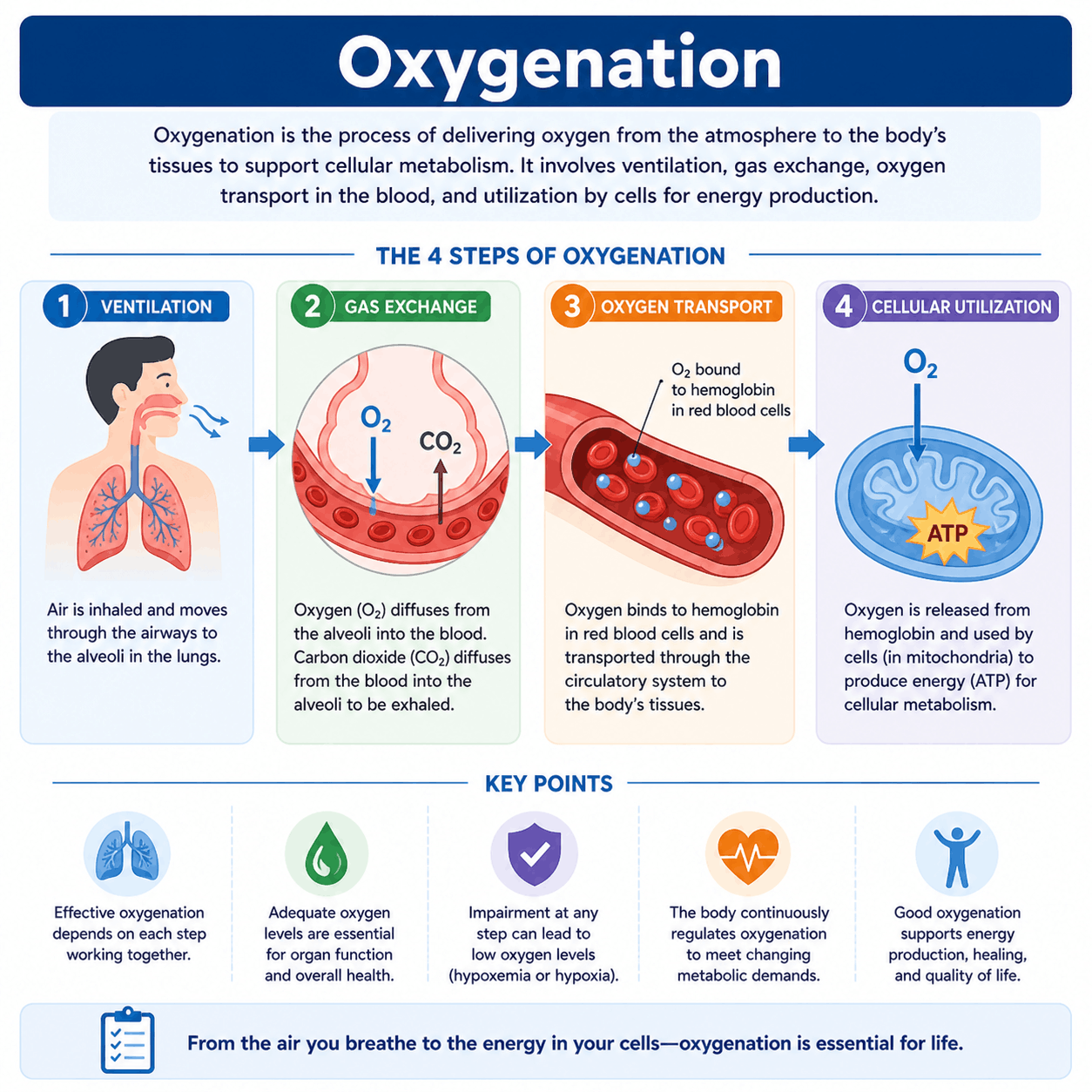
Oxygenation is a fundamental physiologic process that ensures oxygen is delivered from the atmosphere to the body’s tissues to support cellular metabolism. It involves multiple coordinated steps, including ventilation, gas exchange, oxygen transport, and tissue utilization.
In respiratory care, understanding oxygenation is essential for assessing patient status and guiding treatment decisions. Impairments at any stage can lead to serious consequences such as hypoxemia or hypoxia.
This article provides a detailed overview of oxygenation, including its underlying mechanisms, key influencing factors, and clinical relevance.

What Is Oxygenation?
Oxygenation refers to the process of supplying oxygen to the body’s tissues to meet metabolic demands. It is not a single event but a sequence of interconnected steps that depend on the proper functioning of both the respiratory and cardiovascular systems. In clinical practice, oxygenation is commonly evaluated using arterial oxygen tension (PaO₂), oxygen saturation (SpO₂), and patient presentation.
Adequate oxygenation is required for aerobic metabolism, which allows cells to produce energy efficiently in the form of adenosine triphosphate (ATP). When oxygen delivery is insufficient, cells shift to anaerobic metabolism, leading to lactic acid production and potential cellular dysfunction.
The Four Components of Oxygenation
Oxygenation can be divided into four major components:
1. Ventilation
Ventilation is the mechanical process of moving air into and out of the lungs. During inspiration, oxygen enters the alveoli, where it becomes available for gas exchange. During expiration, carbon dioxide is removed from the body.
Adequate ventilation is necessary to maintain proper oxygen levels in the alveoli. Conditions such as airway obstruction, neuromuscular disorders, or depressed respiratory drive can impair ventilation and reduce oxygen availability.
Key factors affecting ventilation include:
- Respiratory rate
- Tidal volume
- Airway patency
- Lung compliance
Note: If ventilation is inadequate, oxygen cannot reach the alveoli effectively, leading to decreased oxygenation.
2. Diffusion (Gas Exchange)
Diffusion is the process by which oxygen moves from the alveoli into the pulmonary capillary blood. This occurs across the alveolar-capillary membrane and is driven by differences in partial pressure.
Oxygen moves from an area of higher partial pressure in the alveoli to a lower partial pressure in the blood. At the same time, carbon dioxide diffuses in the opposite direction to be exhaled.
Several factors influence diffusion efficiency:
- Thickness of the alveolar membrane
- Surface area available for gas exchange
- Partial pressure gradient
- Time available for diffusion
Note: Conditions such as pulmonary fibrosis, pulmonary edema, or acute respiratory distress syndrome can impair diffusion by increasing membrane thickness or reducing surface area.
3. Oxygen Transport
Once oxygen enters the bloodstream, it must be transported to the tissues. Most oxygen is carried bound to hemoglobin in red blood cells, while a small portion is dissolved in plasma.
Oxygen content in the blood depends on:
- Hemoglobin concentration
- Hemoglobin saturation (SaO₂)
- Partial pressure of oxygen (PaO₂)
Note: Even if PaO₂ is normal, a low hemoglobin level can significantly reduce oxygen delivery. This is why patients with anemia may experience hypoxia despite adequate lung function.
4. Tissue Utilization
The final step in oxygenation is the use of oxygen by cells for metabolic processes. Oxygen is utilized in the mitochondria to generate ATP through oxidative phosphorylation.
If oxygen delivery is inadequate, cells shift to anaerobic metabolism. This results in:
- Lactic acid accumulation
- Decreased ATP production
- Cellular dysfunction
Note: This stage is often overlooked but is essential for understanding conditions where oxygen delivery appears normal, but tissue hypoxia still occurs.
Ventilation-Perfusion (V/Q) Relationship
The ventilation-perfusion ratio describes the relationship between airflow (ventilation) and blood flow (perfusion) in the lungs. Optimal oxygenation requires a balance between these two processes.
- Ventilation refers to air reaching the alveoli
- Perfusion refers to blood reaching the alveoli via pulmonary capillaries
Note: When ventilation and perfusion are matched, gas exchange is efficient. However, mismatches can significantly impair oxygenation.
Types of V/Q Mismatch
1. High V/Q (Dead Space Effect)
- Ventilation without adequate perfusion
- Example: pulmonary embolism
2. Low V/Q (Shunt-like Effect)
- Perfusion without adequate ventilation
- Example: pneumonia or airway obstruction
3. True Shunt
- Blood bypasses ventilated alveoli entirely
- Seen in conditions like atelectasis
Note: V/Q mismatch is one of the most common causes of hypoxemia in clinical practice.
The Oxyhemoglobin Dissociation Curve
The relationship between PaO₂ and hemoglobin saturation is described by the oxyhemoglobin dissociation curve. This curve illustrates how oxygen binds to and is released from hemoglobin.
The curve has a sigmoid shape and reflects the affinity of hemoglobin for oxygen.
Key Features
- Plateau Phase: At higher PaO₂ levels, saturation remains relatively stable. This provides a safety margin for oxygen loading in the lungs.
- Steep Phase: At lower PaO₂ levels, small decreases in PaO₂ result in large drops in saturation. This is clinically important when PaO₂ falls below 60 torr.
Factors That Shift the Curve
A rightward shift promotes oxygen release to tissues:
- Increased temperature
- Increased CO₂
- Decreased pH (acidosis)
A leftward shift increases hemoglobin affinity for oxygen:
- Decreased temperature
- Decreased CO₂
- Increased pH (alkalosis)
Note: Understanding these shifts is essential for interpreting oxygenation in different clinical conditions.
Oxygen Delivery (DO₂)
Oxygen delivery refers to the amount of oxygen transported to tissues per minute. It depends on both oxygen content and cardiac output.
Where:
- CaO₂ is arterial oxygen content
- Q is cardiac output
Note: Even if oxygenation in the lungs is adequate, a decrease in cardiac output can impair oxygen delivery. This is commonly seen in shock or heart failure.
Hypoxemia vs. Hypoxia
These two terms are often used interchangeably, but have distinct meanings.
Hypoxemia
- Refers to low oxygen levels in arterial blood
- Measured by PaO₂ or SpO₂
Hypoxia
- Refers to inadequate oxygen at the tissue level
- May occur even with normal PaO₂
Types of Hypoxia
- Hypoxic hypoxia: Caused by low PaO₂
- Anemic hypoxia: Caused by reduced hemoglobin
- Circulatory hypoxia: Caused by reduced blood flow
- Histotoxic hypoxia: Caused by the inability of cells to use oxygen
Note: Recognizing the difference between hypoxemia and hypoxia is essential for selecting appropriate treatment.
Causes of Impaired Oxygenation
Several mechanisms can disrupt oxygenation:
- Low inspired oxygen concentration
- Hypoventilation
- Diffusion impairment
- Ventilation-perfusion mismatch
- Shunt
- Reduced hemoglobin concentration
- Decreased cardiac output
Note: Each mechanism affects a different stage of the oxygenation process, which is why identifying the underlying cause is critical.
Clinical Assessment of Oxygenation
Assessing oxygenation is a key responsibility in respiratory care. Multiple tools are used to evaluate oxygen status.
Arterial Blood Gas (ABG) Analysis
ABG analysis is the gold standard for assessing oxygenation. It provides:
- PaO₂
- PaCO₂
- pH
Note: PaO₂ is the primary indicator of oxygenation status.
Pulse Oximetry (SpO₂)
Pulse oximetry is a noninvasive method that estimates oxygen saturation.
Advantages:
- Continuous monitoring
- Easy to use
Limitations:
- Affected by poor perfusion
- Cannot detect carbon monoxide poisoning
Clinical Signs
Clinical assessment remains important and includes:
- Mental status changes
- Skin color (cyanosis)
- Respiratory effort
- Heart rate
Note: Trends over time are more important than single measurements.
Goals of Oxygen Therapy
The primary goal of oxygen therapy is to correct or prevent hypoxemia. Clinically accepted targets include:
- PaO₂: 60 to 100 torr
- SpO₂: generally 90 percent or higher
A PaO₂ of 60 torr is significant because it corresponds to the steep portion of the dissociation curve, where oxygen saturation declines rapidly with further decreases in PaO₂.
Additional goals include:
- Reducing the work of breathing
- Decreasing cardiac workload
- Improving tissue oxygen delivery
Indications for Oxygen Therapy
Oxygen therapy is indicated when there is evidence of hypoxemia or increased oxygen demand.
Common indications include:
- PaO₂ less than 60 torr
- SpO₂ less than 90 percent
- Signs of hypoxemia, such as cyanosis or confusion
Note: It may also be used in high-risk situations such as trauma, postoperative recovery, or acute cardiac events.
Special Oxygenation Targets
Oxygenation goals are not the same for every patient. Certain populations require adjusted targets to avoid complications while still maintaining adequate tissue oxygenation.
COPD Patients (Chronic CO₂ Retainers)
Patients with chronic obstructive pulmonary disease who retain carbon dioxide require careful oxygen administration. Excessive oxygen can worsen hypercapnia through several mechanisms, including ventilation-perfusion mismatch and reduced hypoxic respiratory drive.
Recommended targets include:
- PaO₂: 50 to 60 torr
- SpO₂: 88 to 92 percent
Note: The clinician must balance correcting hypoxemia while avoiding excessive oxygen levels that may lead to CO₂ retention.
Neonates and Premature Infants
In neonates, especially premature infants, oxygen must be administered with extreme caution. High oxygen concentrations can damage developing retinal vessels and lead to retinopathy of prematurity.
Key considerations include:
- Careful titration of FiO₂
- Avoidance of prolonged high oxygen exposure
- Continuous monitoring of oxygen saturation
Note: Maintaining adequate but not excessive oxygenation is critical in this population.
Critical Illness and Emergency Situations
In certain life-threatening conditions, the priority shifts to maximizing oxygen delivery regardless of typical target ranges.
Examples include:
- Cardiac arrest
- Carbon monoxide poisoning
- Severe anemia
Note: In these cases, high concentrations of oxygen are administered to rapidly improve oxygen availability and tissue delivery.
Oxygen Delivery Systems
Oxygen therapy is delivered through various devices that differ in their ability to provide a consistent fraction of inspired oxygen (FiO₂). These devices are categorized into low-flow and high-flow systems.
Low-Flow Systems (Variable FiO₂)
Low-flow devices provide oxygen at flow rates that do not meet the patient’s total inspiratory demand. As a result, room air is entrained, and the FiO₂ varies depending on the patient’s breathing pattern.
Nasal Cannula
- Flow: 1 to 6 L per minute
- FiO₂: approximately 24 to 44 percent
- Advantages: comfortable, allows eating and speaking
- Limitations: variable oxygen concentration
Simple Face Mask
- Flow: 5 to 10 L per minute
- FiO₂: approximately 35 to 50 percent
- Requires a minimum of 5 L per minute to prevent carbon dioxide rebreathing
Partial Rebreather Mask
- Contains a reservoir bag
- FiO₂: approximately 40 to 70 percent
- Allows rebreathing of the first portion of exhaled gas, which is rich in oxygen
Nonrebreather Mask
- Includes one-way valves to prevent room air entrainment
- FiO₂: up to approximately 90 to 100 percent
- Used in severe hypoxemia and emergency situations
High-Flow Systems (Fixed FiO₂)
High-flow devices deliver a precise oxygen concentration regardless of the patient’s breathing pattern.
Venturi Mask
- Uses air entrainment principles
- Delivers fixed FiO₂ levels such as 24, 28, or 31 percent
- Ideal for patients who require controlled oxygen delivery, such as those with COPD
High-Flow Nasal Cannula (HFNC)
- Delivers heated and humidified oxygen
- Can meet or exceed inspiratory demand
- Provides a mild positive airway pressure effect
- Improves patient comfort and oxygenation
Hazards of Oxygen Therapy
Although oxygen therapy is essential, inappropriate use can lead to complications. Understanding these risks is important for safe patient care.
Oxygen-Induced Hypoventilation
In patients with chronic CO₂ retention, high oxygen levels may reduce respiratory drive and increase carbon dioxide retention. This can lead to worsening hypercapnia and respiratory acidosis.
Absorption Atelectasis
High oxygen concentrations can displace nitrogen in the alveoli. Without nitrogen to help maintain alveolar stability, the alveoli may collapse, reducing surface area for gas exchange.
Oxygen Toxicity
Prolonged exposure to high FiO₂ levels can damage lung tissue. This occurs due to the formation of reactive oxygen species, which cause inflammation and injury to the alveolar-capillary membrane.
Retinopathy of Prematurity
Excess oxygen exposure in premature infants can disrupt normal retinal development and lead to vision impairment or blindness.
Central Nervous System Toxicity
In hyperbaric conditions, exposure to very high oxygen levels can cause neurological symptoms, including seizures.
Monitoring Oxygen Therapy
Effective oxygen therapy requires continuous monitoring to ensure that oxygenation goals are met while minimizing risks.
Pulse Oximetry
Pulse oximetry provides a noninvasive estimate of oxygen saturation and allows continuous monitoring.
Limitations include:
- Reduced accuracy in poor perfusion
- Interference from motion or nail polish
- Inability to detect abnormal hemoglobin such as carboxyhemoglobin
Arterial Blood Gas Analysis
Arterial blood gases provide the most accurate assessment of oxygenation and ventilation.
Key values include:
- PaO₂ for oxygenation
- PaCO₂ for ventilation
- pH for acid-base status
Note: ABG analysis is essential when precise evaluation is required.
Clinical Assessment
Clinical observation remains an essential component of monitoring. Important factors include:
- Level of consciousness
- Work of breathing
- Skin color
- Vital signs
Note: Changes in these parameters often provide early signs of deterioration.
Adjusting Oxygen Therapy
Oxygen therapy must be adjusted based on patient response and objective data. The clinician must decide when to increase, decrease, or maintain oxygen levels.
Indications to Increase Oxygen
- PaO₂ less than 60 torr
- SpO₂ less than 90 percent
- Signs of hypoxemia, such as confusion or cyanosis
Indications to Decrease Oxygen
- Adequate or excessive oxygenation
- Risk of oxygen toxicity
- Rising carbon dioxide levels in susceptible patients
Device Adjustment
In some cases, changing the oxygen delivery device is more appropriate than simply adjusting flow rate. For example:
- Switching from a nasal cannula to a mask for higher FiO₂
- Using a Venturi mask for precise oxygen control
Note: Understanding when to modify the device versus the oxygen concentration is an important clinical skill.
Key Clinical Concepts
Several important principles guide oxygen therapy in practice:
- Always prioritize adequate oxygenation
- Understand the FiO₂ range of each delivery device
- Recognize patient-specific oxygen targets
- Monitor trends rather than isolated values
- Be aware of the potential complications of oxygen therapy
Note: These concepts are frequently tested in clinical scenarios and board examinations.
Oxygenation Practice Questions
1. What is oxygenation?
Oxygenation is the process of delivering oxygen from the atmosphere to the body’s tissues to meet metabolic demands.
2. Why is oxygenation important for cellular metabolism?
Oxygen is required for aerobic energy production, allowing cells to produce ATP efficiently.
3. What are the major steps involved in oxygenation?
The major steps include ventilation, gas exchange, oxygen transport, and tissue utilization.
4. What is the role of ventilation in oxygenation?
Ventilation moves oxygen-rich air into the lungs so oxygen can reach the alveoli for gas exchange.
5. What happens if ventilation is inadequate?
Inadequate ventilation reduces alveolar oxygen availability, which can impair oxygenation.
6. What is gas exchange?
Gas exchange is the movement of oxygen from the alveoli into pulmonary capillary blood and carbon dioxide from the blood into the alveoli.
7. What drives oxygen diffusion across the alveolar-capillary membrane?
Oxygen diffusion is driven by differences in partial pressure between alveolar air and pulmonary capillary blood.
8. What happens to carbon dioxide during gas exchange?
Carbon dioxide diffuses from pulmonary capillary blood into the alveoli so it can be exhaled.
9. What factors affect diffusion efficiency?
Diffusion efficiency depends on membrane thickness, surface area, partial pressure gradients, and time available for diffusion.
10. How can pulmonary fibrosis impair oxygenation?
Pulmonary fibrosis thickens the alveolar-capillary membrane, making oxygen diffusion more difficult.
11. What is the ventilation-perfusion relationship?
The ventilation-perfusion relationship describes the balance between airflow to the alveoli and blood flow through pulmonary capillaries.
12. Why is V/Q matching important?
Proper V/Q matching allows ventilation and perfusion to work together for efficient gas exchange.
13. What is V/Q mismatch?
V/Q mismatch occurs when ventilation and perfusion are not properly matched, reducing oxygenation efficiency.
14. What is an example of a high V/Q problem?
Pulmonary embolism is an example because alveoli may be ventilated but poorly perfused.
15. What is an example of a low V/Q problem?
Pneumonia can cause low V/Q because blood may pass through poorly ventilated lung regions.
16. What is a shunt?
A shunt occurs when blood bypasses ventilated alveoli or passes through alveoli that are not being ventilated.
17. How can atelectasis cause impaired oxygenation?
Atelectasis causes alveolar collapse, allowing blood to pass through areas that are not participating in gas exchange.
18. How is most oxygen transported in the blood?
Most oxygen is transported bound to hemoglobin inside red blood cells.
19. How much oxygen is dissolved directly in plasma?
Only a small fraction of oxygen is dissolved directly in plasma.
20. Why can anemia cause hypoxia even when lung oxygenation is normal?
Anemia reduces hemoglobin concentration, which lowers the blood’s oxygen-carrying capacity.
21. What does the oxyhemoglobin dissociation curve show?
It shows the relationship between PaO₂ and hemoglobin oxygen saturation.
22. What happens when the oxyhemoglobin dissociation curve shifts to the right?
A right shift promotes oxygen unloading from hemoglobin to the tissues.
23. What conditions can shift the oxyhemoglobin dissociation curve to the right?
Increased temperature, increased CO₂, and decreased pH can shift the curve to the right.
24. What happens when the oxyhemoglobin dissociation curve shifts to the left?
A left shift increases hemoglobin’s affinity for oxygen, making oxygen release to tissues more difficult.
25. Why is a PaO₂ of 60 torr clinically significant?
A PaO₂ of 60 torr is on the steep portion of the oxyhemoglobin dissociation curve, where small decreases in PaO₂ can cause large drops in saturation.
26. What is oxygen delivery (DO₂)?
Oxygen delivery is the amount of oxygen transported to tissues per minute.
27. What two main factors determine oxygen delivery?
Oxygen delivery is determined by arterial oxygen content and cardiac output.
28. How does cardiac output affect oxygenation?
Reduced cardiac output decreases oxygen delivery to tissues, even if lung oxygenation is adequate.
29. What is hypoxemia?
Hypoxemia is a condition characterized by low oxygen levels in arterial blood.
30. How is hypoxemia typically measured?
It is measured using PaO₂ from an arterial blood gas or SpO₂ from pulse oximetry.
31. What is hypoxia?
Hypoxia refers to inadequate oxygen supply at the tissue level.
32. Can hypoxia occur without hypoxemia?
Yes, hypoxia can occur with normal PaO₂ in conditions like anemia or poor circulation.
33. What is hypoxic hypoxia?
Hypoxic hypoxia occurs when there is low oxygen in the arterial blood.
34. What is anemic hypoxia?
Anemic hypoxia results from reduced hemoglobin levels or impaired oxygen-carrying capacity.
35. What is circulatory hypoxia?
Circulatory hypoxia occurs when blood flow is insufficient to deliver oxygen to tissues.
36. What is histotoxic hypoxia?
Histotoxic hypoxia occurs when cells are unable to utilize oxygen effectively.
37. What is one cause of low inspired oxygen concentration?
High altitude is a common cause of reduced inspired oxygen levels.
38. What is hypoventilation?
Hypoventilation is inadequate ventilation that leads to reduced oxygen entering the alveoli.
39. How does diffusion impairment affect oxygenation?
It limits the transfer of oxygen from the alveoli into the bloodstream.
40. What role does hemoglobin play in oxygenation?
Hemoglobin binds and transports oxygen from the lungs to the tissues.
41. What is the primary goal of oxygen therapy?
The primary goal is to treat or prevent hypoxemia.
42. What is a common SpO₂ target in most patients?
A common target is 90 percent or higher.
43. What is a common PaO₂ target in oxygen therapy?
A common target is between 60 and 100 torr.
44. Why is oxygen therapy used in trauma patients?
It is used to prevent or treat potential hypoxemia during increased metabolic demand.
45. What are common clinical signs of hypoxemia?
Signs include cyanosis, tachypnea, tachycardia, restlessness, and confusion.
46. What is a nasal cannula used for?
It delivers low-flow oxygen for patients with mild oxygen needs.
47. What is a limitation of low-flow oxygen systems?
They provide variable FiO₂ depending on the patient’s breathing pattern.
48. What is a Venturi mask used for?
It delivers a fixed and precise FiO₂.
49. Why is a Venturi mask useful for COPD patients?
It allows controlled oxygen delivery to avoid worsening hypercapnia.
50. What is a nonrebreather mask used for?
It delivers high concentrations of oxygen in emergency situations.
51. What is the typical FiO₂ range of a nasal cannula?
Approximately 24 to 44 percent depending on the flow rate.
52. Why must a simple face mask be set to at least 5 L per minute?
To prevent rebreathing of carbon dioxide.
53. What is the purpose of the reservoir bag on a partial rebreather mask?
It stores oxygen to increase the delivered FiO₂.
54. How does a nonrebreather mask prevent room air entrainment?
It uses one-way valves to block outside air from entering.
55. What is a key feature of high-flow oxygen systems?
They deliver a fixed FiO₂ regardless of the patient’s breathing pattern.
56. What is high-flow nasal cannula (HFNC)?
A device that delivers heated, humidified oxygen at high flow rates.
57. How can HFNC improve oxygenation?
It meets inspiratory demand and provides a mild positive airway pressure effect.
58. What is oxygen-induced hypoventilation?
A decrease in respiratory drive caused by high oxygen levels in certain patients.
59. Which patients are most at risk for oxygen-induced hypoventilation?
Patients with chronic CO₂ retention, such as those with COPD.
60. What is absorption atelectasis?
Collapse of alveoli due to high oxygen concentrations washing out nitrogen.
61. Why is nitrogen important in the alveoli?
It helps keep alveoli open by maintaining volume.
62. What is oxygen toxicity?
Lung damage caused by prolonged exposure to high oxygen concentrations.
63. What causes oxygen toxicity at the cellular level?
The formation of reactive oxygen species that damage lung tissue.
64. What is retinopathy of prematurity (ROP)?
A condition in premature infants caused by excessive oxygen exposure damaging retinal vessels.
65. What is central nervous system oxygen toxicity?
A condition that can occur with very high oxygen levels, leading to seizures.
66. What is the primary benefit of pulse oximetry?
It provides continuous, noninvasive monitoring of oxygen saturation.
67. What is a limitation of pulse oximetry in carbon monoxide poisoning?
It cannot distinguish between oxyhemoglobin and carboxyhemoglobin.
68. Why is arterial blood gas analysis considered the gold standard?
It provides direct measurement of PaO₂, PaCO₂, and pH.
69. What does PaCO₂ indicate in an ABG?
It reflects the adequacy of ventilation.
70. Why are trends in oxygenation more important than single readings?
They show changes in patient status over time.
71. What is one clinical sign of worsening oxygenation?
A decline in mental status.
72. When should oxygen therapy be increased?
When PaO₂ is below 60 torr or SpO₂ is below 90 percent.
73. When should oxygen therapy be decreased?
When oxygenation is adequate or there is a risk of oxygen toxicity.
74. Why might a clinician change the oxygen delivery device?
To achieve a more appropriate or precise FiO₂.
75. What is an example of switching oxygen devices for better control?
Changing from a nasal cannula to a Venturi mask.
76. What is the normal range for PaO₂ in healthy adults?
Approximately 80 to 100 torr.
77. What is the relationship between PaO₂ and SpO₂?
PaO₂ reflects dissolved oxygen in blood, while SpO₂ reflects hemoglobin saturation with oxygen.
78. Why is SpO₂ not always a perfect indicator of oxygenation?
It can appear normal even when PaO₂ is reduced or in cases of abnormal hemoglobin.
79. What is FiO₂?
FiO₂ is the fraction of inspired oxygen delivered to the patient.
80. What is the approximate FiO₂ of room air?
Room air contains about 21 percent oxygen.
81. How does increasing FiO₂ improve oxygenation?
It raises alveolar oxygen levels, increasing the diffusion gradient into the blood.
82. What is the primary function of hemoglobin in oxygenation?
To bind oxygen in the lungs and transport it to tissues.
83. How does low cardiac output affect tissue oxygenation?
It reduces blood flow, limiting oxygen delivery to tissues.
84. What happens to oxygen consumption (VO₂) during increased metabolic demand?
It increases as tissues require more oxygen.
85. What occurs when oxygen delivery does not meet oxygen demand?
Cells switch to anaerobic metabolism, producing lactic acid.
86. What is cyanosis?
A bluish discoloration of the skin indicating low oxygen levels in the blood.
87. Why is cyanosis considered a late sign of hypoxemia?
It typically appears after significant oxygen desaturation has occurred.
88. What is tachypnea?
An increased respiratory rate often seen in response to hypoxemia.
89. What is tachycardia?
An increased heart rate that may occur as the body attempts to compensate for low oxygen levels.
90. How does confusion relate to oxygenation?
It can result from reduced oxygen delivery to the brain.
91. What is the role of PEEP in oxygenation?
It helps keep alveoli open, improving gas exchange and oxygenation.
92. How does atelectasis impair oxygenation?
It reduces the surface area available for gas exchange.
93. What is the effect of pulmonary edema on oxygenation?
Fluid in the alveoli interferes with oxygen diffusion.
94. Why is oxygen therapy commonly used postoperatively?
To prevent hypoxemia due to anesthesia effects and reduced ventilation.
95. What is one risk of prolonged high FiO₂ therapy?
Development of oxygen toxicity.
96. Why is careful oxygen titration important in neonates?
To avoid complications such as retinopathy of prematurity.
97. What is a common oxygen saturation target for COPD patients?
Between 88 and 92 percent.
98. Why should oxygen be used cautiously in COPD patients?
Excess oxygen can lead to CO₂ retention and worsening respiratory failure.
99. What is the purpose of monitoring mental status in oxygenation assessment?
It helps detect early signs of hypoxia affecting the brain.
100. What is a key principle when managing oxygen therapy?
Provide enough oxygen to meet needs while avoiding excessive exposure.
Final Thoughts
Oxygenation is a complex process that depends on the integration of ventilation, diffusion, oxygen transport, and tissue utilization. Effective management requires a thorough understanding of each component and how various conditions can disrupt them.
In clinical practice, the goal is to maintain adequate oxygen delivery while minimizing the risks associated with therapy. This involves careful assessment, appropriate device selection, and ongoing monitoring. By applying these principles, clinicians can optimize patient outcomes and ensure safe and effective respiratory care.

Written by:
John Landry is a registered respiratory therapist from Memphis, TN, and has a bachelor's degree in kinesiology. He enjoys using evidence-based research to help others breathe easier and live a healthier life.
References
- Pittman RN. Regulation of Tissue Oxygenation. San Rafael (CA): Morgan & Claypool Life Sciences; 2011.