

Water vapor pressure is a fundamental concept in respiratory physiology and gas exchange that plays a critical role in patient care. Although it may seem like a simple physical principle, understanding water vapor pressure helps respiratory therapists accurately assess gas delivery, calculate oxygen concentrations, and manage humidification therapy.
Because inhaled gases become saturated with water vapor as they travel through the airway, this process directly affects the partial pressures of oxygen and carbon dioxide within the lungs.
By understanding how temperature, humidity, and evaporation influence water vapor pressure, respiratory therapists can ensure safe and effective respiratory support for patients in both acute and chronic care settings.

What Is Water Vapor Pressure?
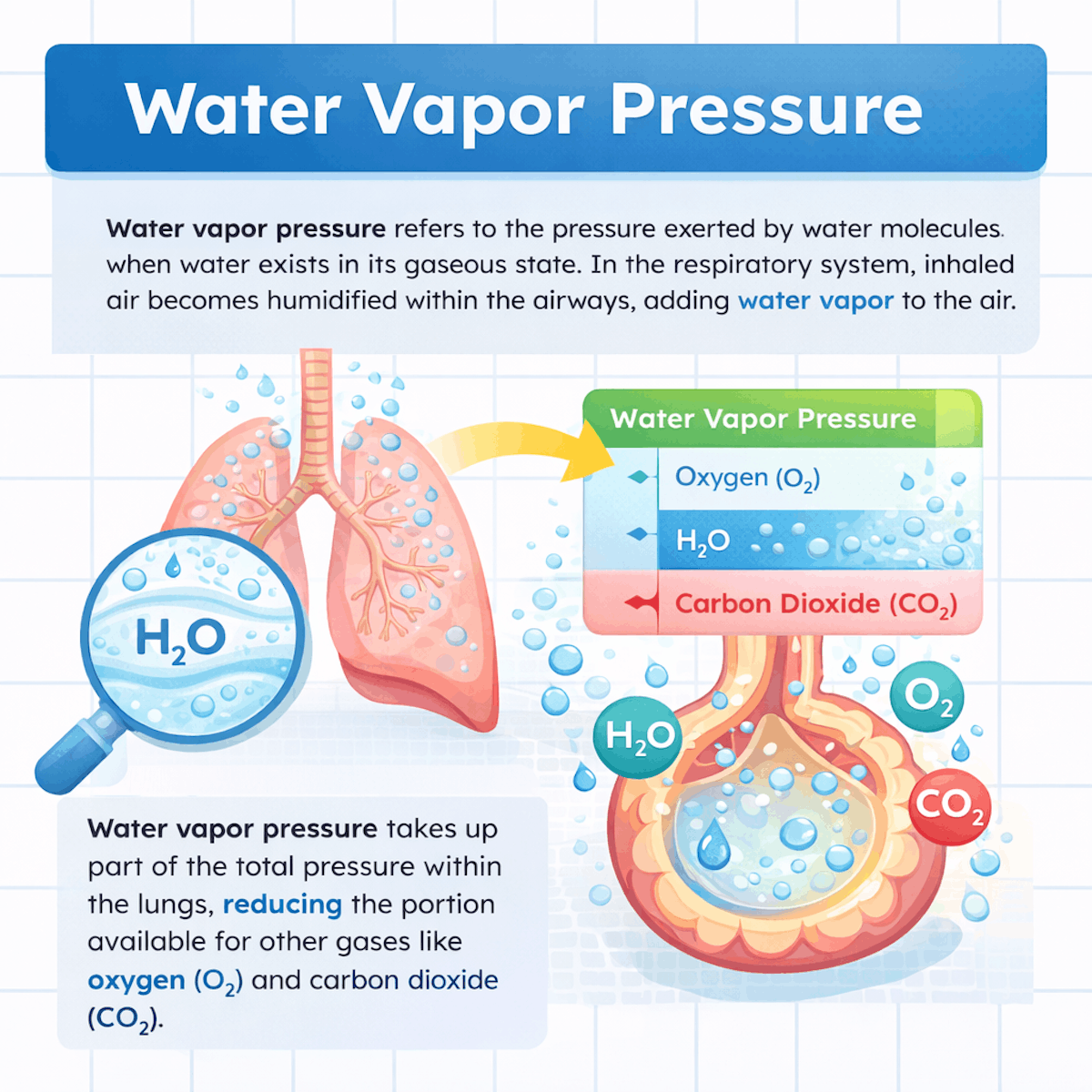
Water vapor pressure refers to the pressure exerted by water molecules when water exists in its gaseous state. When liquid water evaporates into the air, it becomes molecular water vapor, which behaves like any other gas and contributes to the total pressure within a gas mixture. This pressure results from the kinetic activity of water molecules moving freely in the air.
Evaporation occurs when liquid molecules gain enough kinetic energy to escape into the air as vapor. Unlike boiling, which occurs at a specific temperature, evaporation can occur at temperatures below the boiling point. In the respiratory system, evaporation and vaporization are continuously occurring as inhaled air becomes humidified within the airway.
Water vapor pressure must be considered whenever gas exchange is evaluated because it occupies part of the total pressure within the lungs. As water vapor increases, it reduces the amount of pressure available for other gases, such as oxygen and carbon dioxide. This interaction plays a crucial role in respiratory physiology and clinical practice.
The Relationship Between Evaporation and Water Vapor Pressure
Evaporation is the process by which liquid water converts into water vapor. This transformation requires heat energy, which is typically drawn from the surrounding air. As evaporation occurs, the surrounding air cools, a phenomenon known as evaporative cooling.
When water vapor enters the air, the vapor molecules accumulate until the air reaches its maximum capacity to hold moisture. At this point, the air becomes saturated with water vapor. Saturation does not mean evaporation stops; instead, it means the system reaches equilibrium. In this balanced state, water molecules continue to evaporate into the air while an equal number return to the liquid surface.
This equilibrium is particularly relevant in respiratory physiology because inhaled gases passing through the airway eventually become fully saturated with water vapor. As gases warm and humidify in the respiratory tract, water vapor pressure rises until equilibrium is reached at body temperature.
The Influence of Temperature on Water Vapor Pressure
Temperature is the most significant factor affecting water vapor pressure. As temperature increases, air gains the ability to hold more water vapor. Warmer air increases the rate of evaporation and allows more water molecules to escape into the gas phase.
Additionally, heating water increases the kinetic energy of its molecules. As molecular motion intensifies, more water molecules overcome surface tension and enter the air as vapor. If this heated air is contained within a closed environment, it becomes saturated at a higher vapor pressure compared with cooler air.
In respiratory physiology, this principle is especially important because inhaled air is warmed to body temperature as it travels through the upper airway. At normal body temperature of 37°C, fully saturated air exerts a water vapor pressure of approximately 47 mmHg. This predictable value is critical in respiratory calculations and helps clinicians estimate the partial pressures of gases within the lungs.
Absolute Humidity and Relative Humidity
While water vapor pressure describes the pressure exerted by water molecules, humidity describes the amount of water vapor present in a gas. Two primary types of humidity measurements are used in respiratory care: absolute humidity and relative humidity.
Absolute humidity refers to the actual mass of water vapor contained in a given volume of gas. It is commonly measured in milligrams of water vapor per liter of gas (mg/L). Absolute humidity provides an objective measurement of how much moisture is present in inhaled gases.
At body temperature, fully saturated air contains approximately 43.8 mg/L of water vapor. This level of humidity is considered optimal for maintaining normal respiratory function and protecting airway tissues.
Relative humidity, on the other hand, expresses the amount of water vapor present compared with the maximum amount the air can hold at a given temperature. It is expressed as a percentage. For example, if air contains half of the maximum moisture it can hold, it has a relative humidity of 50%.
Note: Relative humidity is especially useful in clinical settings because it helps respiratory therapists determine whether inhaled gases require additional humidification before being delivered to patients.
Water Vapor Pressure and Gas Exchange
Water vapor pressure plays a critical role in pulmonary gas exchange. According to gas laws, the total pressure of a gas mixture is the sum of the individual partial pressures of each gas component. Because water vapor contributes to total pressure, it reduces the partial pressure available for oxygen and other gases.
When air enters the respiratory tract, it becomes fully saturated with water vapor by the time it reaches the alveoli. At body temperature, the 47 mmHg of water vapor pressure must be subtracted from atmospheric pressure when calculating the partial pressure of inspired oxygen.
This adjustment is essential for accurately estimating alveolar oxygen levels and evaluating oxygenation status. Failure to account for water vapor pressure can result in incorrect calculations and misinterpretation of arterial blood gas results.
Respiratory therapists rely on this knowledge when assessing oxygen therapy effectiveness, adjusting ventilator settings, and evaluating gas exchange abnormalities. Understanding water vapor pressure ensures precise clinical decision-making and helps optimize patient outcomes.
The Importance of Humidification in Respiratory Care
The respiratory system naturally humidifies inhaled air through the nasal passages and upper airway. However, when patients receive supplemental oxygen, mechanical ventilation, or artificial airways, this natural humidification process is often bypassed or impaired.
Without proper humidification, inhaled gases can dry out airway tissues, damage mucosal surfaces, and impair mucociliary clearance. These complications can lead to thick secretions, airway obstruction, and increased risk of infection.
Respiratory therapists use humidification devices to restore appropriate moisture levels in inhaled gases. These devices help maintain optimal water vapor pressure and humidity levels, protecting airway integrity and supporting effective ventilation.
Note: Understanding water vapor pressure allows clinicians to select appropriate humidification methods, adjust therapy based on patient needs, and monitor the effectiveness of respiratory treatments.
Clinical Applications for Respiratory Therapists
Water vapor pressure is directly applied in multiple areas of respiratory care practice. One key application involves arterial blood gas interpretation. Accurate ABG analysis requires understanding how water vapor pressure affects alveolar oxygen calculations and oxygen delivery.
Ventilator management is another area where water vapor pressure is essential. Mechanical ventilation systems often include heated humidifiers to ensure delivered gases achieve appropriate humidity levels before reaching the patient. Respiratory therapists must understand how temperature and humidification influence gas composition and patient comfort.
Water vapor pressure is also important when calculating inspired oxygen concentration. Because water vapor occupies part of the total gas pressure in the airway, clinicians must account for its presence when determining oxygen partial pressures.
Additionally, water vapor pressure influences patient comfort and airway health. Proper humidification helps prevent complications such as airway inflammation, secretion retention, and mucosal damage, all of which can compromise respiratory function.
Water Vapor Pressure Practice Questions
1. What is evaporation?
Evaporation is the process by which a liquid changes into a gas at temperatures below its boiling point.
2. Which process allows water to become a gas without reaching its boiling temperature?
Evaporation
3. What term describes the invisible gaseous form of water present in the air?
Molecular water
4. What is water vapor pressure?
Water vapor pressure is the pressure exerted by water molecules in their gaseous state within a mixture of gases.
5. Why is water vapor pressure important in respiratory physiology?
It must be considered when calculating gas exchange and partial pressures of respiratory gases.
6. What provides the energy required for evaporation to occur?
Heat energy from the surrounding environment.
7. What happens to surrounding air temperature during evaporation?
The surrounding air cools as heat is absorbed during evaporation.
8. What term describes the cooling effect produced when heat is removed during evaporation?
Evaporative cooling
9. What occurs when air contains the maximum amount of water vapor it can hold at a given temperature?
The air becomes saturated with water vapor.
10. What condition exists when water molecules evaporate and condense at equal rates?
Equilibrium
11. What factor has the greatest influence on the rate of evaporation?
Temperature
12. How does increasing temperature affect the air’s ability to hold water vapor?
It increases the air’s capacity to hold water vapor.
13. How does heating water affect the evaporation rate?
Heating increases molecular kinetic energy, allowing more water molecules to escape into the air.
14. What happens to water vapor pressure when saturated air is heated?
Water vapor pressure increases because warmer air holds more water vapor.
15. What units are commonly used to measure water vapor pressure?
Millimeters of mercury (mmHg) and kilopascals (kPa).
16. How does temperature influence saturated water vapor pressure?
Higher temperatures produce higher saturated water vapor pressures.
17. What is absolute humidity?
Absolute humidity is the actual mass of water vapor present in a gas, measured in milligrams per liter (mg/L).
18. How is absolute humidity typically measured?
By extracting and weighing water vapor using a drying agent.
19. What happens to water vapor pressure and absolute humidity if a gas is only partially saturated?
Both values decrease proportionally to the degree of saturation.
20. What is relative humidity?
Relative humidity is the percentage of water vapor present in a gas compared to the maximum amount the gas can hold at a given temperature.
21. What is the water vapor pressure of fully saturated air at body temperature (37°C)?
47 mmHg
22. What is the absolute humidity of fully saturated air at 37°C?
Approximately 43.8 mg/L
23. What happens to water vapor pressure when air is 50% saturated at 37°C?
It decreases to approximately 23.5 mmHg
24. Why is molecular water different from mist or fog?
Molecular water is an invisible gas, whereas mist and fog consist of visible liquid water droplets.
25. Why must water vapor pressure be considered when calculating alveolar gas composition?
Because water vapor displaces other gases, affecting their partial pressures.
26. What happens to the rate of evaporation when air temperature increases?
Evaporation occurs more rapidly.
27. Why does covering a container of water eventually stop net evaporation?
Because the air becomes saturated and equilibrium is reached.
28. How does increased kinetic energy of water molecules affect vaporization?
It increases the likelihood that molecules will escape into the gaseous phase.
29. What relationship exists between temperature and water vapor pressure?
They are directly proportional, meaning water vapor pressure increases as temperature increases.
30. Why is understanding humidity important in respiratory care?
Humidity affects airway moisture, mucociliary function, and gas exchange efficiency.
31. What is evaporation in relation to water vapor formation?
Evaporation is the process in which liquid water changes into water vapor by absorbing heat energy from the surrounding environment.
32. Why does evaporation cause cooling of the surrounding air?
Evaporation absorbs heat from the surrounding air, reducing the air’s temperature in a process known as evaporative cooling.
33. What occurs when air reaches its maximum capacity to hold water vapor?
The air becomes saturated with water vapor.
34. Does evaporation stop once air becomes saturated with water vapor?
No, evaporation continues, but an equal number of water molecules condense back into the liquid, creating equilibrium.
35. What does equilibrium mean in the context of evaporation?
Equilibrium occurs when the rate of evaporation equals the rate of condensation.
36. Why is saturation of inhaled gases important in respiratory physiology?
Inhaled gases become fully humidified in the respiratory tract, which protects airway tissues and supports normal gas exchange.
37. How does inhaled air change as it travels through the upper airway?
It becomes warmed and humidified until it reaches full saturation at body temperature.
38. What is the normal water vapor pressure of fully saturated air at body temperature?
Approximately 47 mmHg at 37°C.
39. Why is the 47 mmHg water vapor pressure value clinically important?
It is used when calculating alveolar gas pressures and evaluating gas exchange.
40. How does increasing temperature affect the air’s ability to hold water vapor?
Increasing temperature increases the air’s capacity to hold water vapor.
41. How does heating water influence evaporation?
Heating increases molecular motion, allowing more water molecules to escape into the gaseous phase.
42. What happens to vapor pressure when heated air becomes saturated in a closed environment?
The vapor pressure increases compared with saturation at lower temperatures.
43. Why is warming inhaled air essential for proper respiratory function?
Warming inhaled air ensures adequate humidification and prevents airway drying and irritation.
44. What is humidity in relation to respiratory gases?
Humidity refers to the amount of water vapor present in a gas.
45. What are the two primary measurements used to describe humidity in respiratory care?
Absolute humidity and relative humidity.
46. What is absolute humidity?
Absolute humidity is the actual mass of water vapor contained in a given volume of gas, usually measured in mg/L.
47. What is the absolute humidity of fully saturated air at 37°C?
Approximately 43.8 mg/L
48. Why is maintaining appropriate absolute humidity important for airway health?
It helps preserve mucociliary function and prevents airway tissue damage.
49. What is relative humidity?
Relative humidity is the percentage of water vapor present in a gas compared with the maximum amount the gas can hold at a given temperature.
50. If air contains half the maximum water vapor it can hold at a specific temperature, what is its relative humidity?
50%.
51. Why is relative humidity clinically useful in respiratory therapy?
It helps determine whether supplemental humidification is needed for inhaled gases.
52. What happens to relative humidity if temperature increases but water vapor content remains unchanged?
Relative humidity decreases because warmer air can hold more moisture.
53. How does inadequate humidification affect the respiratory tract?
It can lead to airway drying, thickened secretions, and impaired mucociliary clearance.
54. Why must inhaled medical gases often be humidified before delivery to patients?
Medical gases are typically dry and can damage airway tissues if not properly humidified.
55. How does fully saturated air support normal pulmonary function?
It maintains optimal airway moisture, supports secretion clearance, and promotes effective gas exchange.
56. Why is temperature control critical when delivering humidified respiratory gases?
Temperature directly affects water vapor pressure and the moisture-carrying capacity of inhaled gases.
57. How does evaporation contribute to humidification in the respiratory tract?
Moisture evaporates from airway surfaces, increasing water vapor content in inhaled gases.
58. What happens to water vapor pressure when inhaled air is warmed to body temperature?
Water vapor pressure increases to reach full saturation at 47 mmHg.
59. Why is equilibrium between evaporation and condensation important in airway humidification?
It maintains stable moisture levels within the respiratory tract.
60. How does understanding humidity help respiratory therapists optimize patient care?
It guides proper humidification therapy, supports airway protection, and improves patient comfort and gas exchange efficiency.
61. Why is water vapor pressure important in pulmonary gas exchange?
Water vapor pressure contributes to the total pressure of inhaled gas and reduces the partial pressures of other gases such as oxygen.
62. According to gas laws, how is the total pressure of a gas mixture determined?
The total pressure equals the sum of the partial pressures of each individual gas in the mixture.
63. How does water vapor pressure affect the partial pressure of oxygen in the alveoli?
Water vapor pressure occupies part of the total gas pressure, which reduces the partial pressure available for oxygen.
64. What happens to inhaled air as it travels through the respiratory tract?
It becomes warmed and fully saturated with water vapor by the time it reaches the alveoli.
65. What is the normal water vapor pressure in the alveoli at body temperature?
Approximately 47 mmHg
66. Why must water vapor pressure be subtracted from atmospheric pressure when calculating inspired oxygen pressure?
Because water vapor occupies part of the total pressure within the airway and reduces the pressure available for oxygen.
67. Why is accurate calculation of alveolar oxygen pressure clinically important?
It helps clinicians assess oxygenation status and identify abnormalities in gas exchange.
68. How can failing to account for water vapor pressure affect arterial blood gas interpretation?
It can result in incorrect calculations of oxygen levels and misinterpretation of patient respiratory status.
69. Why do respiratory therapists need to understand water vapor pressure when managing oxygen therapy?
It helps ensure accurate assessment of oxygen delivery and effectiveness of therapy.
70. How does knowledge of water vapor pressure influence ventilator management?
It helps clinicians understand how humidification and temperature affect gas composition and oxygen delivery.
71. What role does the upper airway play in humidifying inhaled air?
The nasal passages and upper airway warm and humidify inhaled air before it reaches the lower respiratory tract.
72. Why is natural humidification often impaired in patients receiving mechanical ventilation or artificial airways?
Artificial airways bypass the upper airway, preventing normal warming and humidification of inhaled gases.
73. What complications can occur if inhaled gases are not adequately humidified?
Airway drying, thickened secretions, impaired mucociliary clearance, and increased infection risk may occur.
74. Why is mucociliary clearance important in respiratory health?
It helps remove mucus, debris, and microorganisms from the airway.
75. How do humidification devices help patients receiving respiratory support?
They add moisture and heat to inhaled gases, helping maintain normal airway function.
76. Why must respiratory therapists select appropriate humidification methods?
Different patients and therapies require specific humidity levels to protect airway tissues and maintain effective ventilation.
77. How does temperature influence humidification during respiratory therapy?
Higher temperatures increase the moisture-carrying capacity of inhaled gases.
78. Why is humidification especially important for patients receiving supplemental oxygen?
Supplemental oxygen is often dry and can irritate or damage airway tissues if not humidified.
79. How does water vapor pressure influence inspired oxygen concentration calculations?
Water vapor reduces the available pressure for oxygen, which must be considered when determining oxygen partial pressure.
80. Why is proper humidification important for patient comfort during respiratory therapy?
Adequate humidity prevents airway irritation, dryness, and discomfort during breathing support.
81. How can inadequate humidification contribute to airway obstruction?
Dry air can thicken secretions, making them more difficult to clear and increasing the risk of blockage.
82. Why is water vapor pressure relevant when evaluating ventilated patients?
It influences gas composition and must be considered when assessing oxygen delivery and ventilator effectiveness.
83. How does humidification support airway tissue integrity?
Proper moisture levels prevent mucosal damage and maintain normal airway defense mechanisms.
84. Why must respiratory therapists monitor humidification therapy effectiveness?
Improper humidity levels can lead to airway complications and reduced treatment effectiveness.
85. How does understanding water vapor pressure improve clinical decision-making in respiratory care?
It allows clinicians to accurately interpret gas exchange, adjust therapy, and optimize patient outcomes.
86. Why is heated humidification commonly used during mechanical ventilation?
It ensures inhaled gases reach body temperature and full saturation before entering the lungs.
87. How does water vapor pressure affect the calculation of alveolar gas equations?
It must be subtracted from total pressure to accurately determine oxygen and carbon dioxide partial pressures.
88. Why does bypassing the upper airway increase the need for artificial humidification?
The natural humidification and warming functions of the nose and upper airway are lost.
89. How does humidification help prevent secretion retention?
Moist air keeps secretions thin and easier to remove from the airway.
90. Why is understanding humidity and water vapor pressure essential for safe respiratory therapy practice?
It helps ensure accurate gas delivery, protects airway health, and improves overall patient respiratory function.
91. How does insufficient water vapor pressure affect airway epithelial cells?
It can cause drying and damage to airway epithelial cells, reducing their ability to protect against infection and irritation.
92. Why is water vapor pressure important when delivering high-flow oxygen therapy?
High-flow oxygen systems must provide adequate humidification to maintain airway moisture and prevent mucosal injury.
93. How does water vapor pressure influence secretion viscosity?
Higher humidity helps maintain thinner secretions, while low humidity can cause secretions to become thick and difficult to clear.
94. Why is humidification especially critical in patients with artificial airways such as endotracheal or tracheostomy tubes?
Artificial airways bypass the natural humidification process of the upper airway, increasing the risk of airway dryness and secretion buildup.
95. How does water vapor pressure contribute to maintaining normal lung compliance?
Adequate humidification prevents airway drying and inflammation, which helps preserve normal lung elasticity and compliance.
96. Why can dry medical gases increase the risk of airway inflammation?
Dry gases remove moisture from airway surfaces, leading to irritation, inflammation, and impaired mucosal function.
97. How does proper humidification improve patient tolerance to respiratory support devices?
It reduces airway dryness, irritation, and coughing, improving patient comfort and compliance with therapy.
98. Why is monitoring gas temperature important when delivering humidified respiratory gases?
Gas temperature directly affects moisture-carrying capacity and ensures gases reach optimal humidity levels before reaching the patient.
99. How can inadequate water vapor pressure impact mucociliary transport?
Reduced humidity can slow or impair mucociliary function, increasing the risk of secretion retention and infection.
100. Why is water vapor pressure an essential concept when managing patients with thick pulmonary secretions?
Adequate humidity helps liquefy secretions, making airway clearance easier and improving ventilation.
Final Thoughts
Water vapor pressure is a foundational concept that connects physics, physiology, and clinical respiratory care. By understanding how evaporation, temperature, and humidity influence water vapor pressure, respiratory therapists can better assess gas exchange, calculate oxygen levels, and provide safe humidification therapy.
This knowledge is essential for managing patients receiving oxygen therapy, mechanical ventilation, and artificial airway support.
As respiratory care continues to evolve, mastering principles such as water vapor pressure remains critical for delivering high-quality, evidence-based patient care. Ultimately, understanding this concept allows clinicians to improve patient outcomes and support optimal respiratory system function.

Written by:
John Landry is a registered respiratory therapist from Memphis, TN, and has a bachelor's degree in kinesiology. He enjoys using evidence-based research to help others breathe easier and live a healthier life.
References
- Pittman RN. Regulation of Tissue Oxygenation. San Rafael (CA): Morgan & Claypool Life Sciences; 2011.