
A respiratory therapy degree opens the door to a dynamic and rewarding healthcare career focused on saving lives and improving breathing. Respiratory therapists play a critical role in diagnosing, treating, and managing patients with heart and lung disorders across a wide range of settings, from emergency departments and intensive care units to outpatient clinics and home care.
However, the opportunities extend far beyond traditional bedside care. With the right experience and credentials, respiratory therapy graduates can pursue roles in education, research, medical sales, case management, pulmonary rehabilitation, and healthcare leadership.
Whether your goal is hands-on patient care, career advancement, or exploring alternative pathways within healthcare, a respiratory therapy degree provides a strong foundation and a wide range of professional possibilities.

What Can You Do With a Respiratory Therapy Degree?
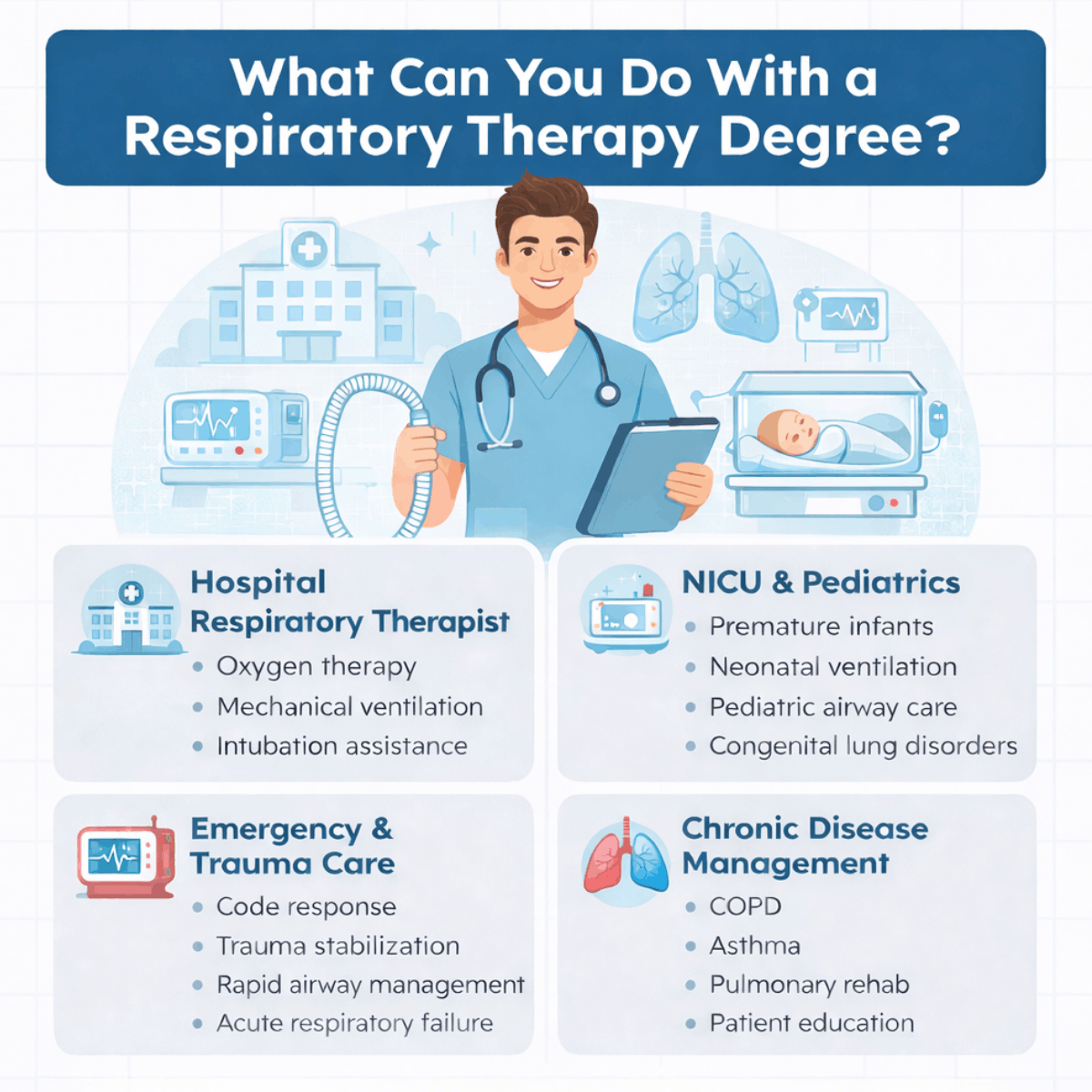
A respiratory therapy degree prepares you for a wide range of career opportunities in healthcare and beyond. Most graduates begin working as respiratory therapists in hospitals, where they care for patients with breathing and cardiopulmonary disorders. This includes managing oxygen therapy, performing pulmonary function testing, assisting with intubation, and overseeing mechanical ventilation in critical care settings. You may work with premature infants in the NICU, trauma patients in the emergency department, or adults with chronic lung diseases such as COPD and asthma.
Beyond bedside care, a respiratory therapy degree can lead to roles in pulmonary rehabilitation, sleep medicine, home care, and transport teams. With additional experience, you can pursue leadership positions such as department manager or clinical supervisor.
Some respiratory therapists transition into education, research, medical device sales, case management, or healthcare administration. The degree also provides a strong foundation for advancing into related fields such as physician assistant programs or other graduate-level healthcare careers.
Clinical Careers in Respiratory Therapy
Clinical roles place you at the bedside, in diagnostic labs, and in high-acuity units where patients depend on precise respiratory care. You assess lung function, manage life-support equipment, and collaborate with physicians and nurses to guide treatment decisions.
Registered Respiratory Therapist Roles
As a Registered Respiratory Therapist (RRT), you provide direct patient care across hospitals, emergency departments, and outpatient clinics. You assess breathing patterns, review medical histories, and measure oxygen levels using pulse oximetry and arterial blood gases.
You initiate and manage oxygen therapy, aerosol treatments, and mechanical ventilation. When a patient struggles to breathe, you respond quickly and adjust ventilator settings to stabilize gas exchange.
You also educate patients with chronic conditions such as COPD or asthma. Clear instruction on inhaler use, airway clearance techniques, and home oxygen equipment reduces hospital readmissions.
Many employers prefer or require the RRT credential because it demonstrates advanced competency. State licensure, continuing education, and Basic Life Support (BLS) or Advanced Cardiac Life Support (ACLS) certification keep you qualified for practice.
Pulmonary Function Technologist
As a Pulmonary Function Technologist, you focus on diagnostic testing rather than ongoing bedside care. You perform spirometry, lung volume measurements, and diffusion capacity testing to evaluate how well the lungs move air and oxygen.
You prepare patients carefully and coach them through precise breathing maneuvers. Accurate instructions and calibration of equipment ensure reliable test results. Physicians rely on your data to diagnose asthma, pulmonary fibrosis, and other lung disorders. You often work in outpatient clinics, specialty practices, or hospital-based pulmonary labs.
This role demands strong attention to detail and comfort with technology. Certification through the National Board for Respiratory Care (NBRC) can improve your job prospects and demonstrate technical proficiency.
Neonatal and Pediatric Respiratory Care
In neonatal and pediatric respiratory care, you treat premature infants and children with underdeveloped or compromised lungs. You manage incubator oxygen levels, continuous positive airway pressure (CPAP), and neonatal ventilators.
Small changes in oxygen concentration can affect infant development, so you monitor blood gases and saturation levels closely. You collaborate with neonatologists and pediatricians to adjust treatment plans. You also support families during stressful situations. Clear communication about procedures and progress builds trust and reduces anxiety.
Note: Many hospitals require specialized training or experience in neonatal intensive care units (NICUs). Pediatric Advanced Life Support (PALS) certification often strengthens your qualifications.
Critical Care Specialist
As a Critical Care Specialist, you work with the most unstable patients in intensive care units. You manage advanced ventilator modes, interpret complex blood gas results, and assist with airway procedures such as intubation.
You participate in rapid response and code blue teams. During emergencies, you secure airways, deliver manual ventilation, and help stabilize cardiopulmonary function.
This role demands strong clinical judgment and calm decision-making under pressure. You coordinate closely with intensivists, nurses, and anesthesiologists to optimize ventilation strategies.
Note: Experience and advanced credentials, such as Adult Critical Care Specialty (ACCS), can expand your responsibilities. Hospitals often rely on your expertise to guide ventilator protocols and improve patient outcomes.
Non-Clinical Opportunities with a Respiratory Therapy Degree
You can apply your clinical knowledge outside direct patient care in roles that influence purchasing decisions, operational efficiency, and insurance approvals. These paths rely on your understanding of respiratory treatments, equipment, and healthcare regulations rather than bedside care.
Medical Equipment Sales
You can work as a sales representative or clinical specialist for companies that manufacture ventilators, CPAP and BiPAP machines, oxygen systems, and aerosol delivery devices. Your respiratory therapy background allows you to explain product features in practical, clinical terms that physicians and hospital staff understand.
In this role, you demonstrate equipment, provide in-service training, and answer technical questions about setup, troubleshooting, and compliance. You often visit hospitals, long-term care facilities, and outpatient clinics.
Compensation typically includes a base salary plus commission. Employers value therapists who understand workflow challenges in critical care and can show how a device improves efficiency, safety, or patient outcomes.
Note: Travel is common, and strong communication skills matter as much as product knowledge. Your credibility comes from real-world clinical experience.
Healthcare Administration
You can move into supervisory or management roles within hospitals, pulmonary clinics, or home care agencies. Positions may include department manager, clinical supervisor, or operations coordinator.
Administrative work focuses on staffing, budgeting, policy development, and regulatory compliance. You may oversee scheduling, performance evaluations, and quality improvement initiatives.
Your clinical experience helps you create practical protocols and evaluate equipment purchases. Many employers prefer candidates with a bachelor’s degree, and some leadership roles require a master’s in healthcare administration or a related field.
Note: You also work closely with nursing leadership, physicians, and finance departments. Clear communication and organizational skills are essential.
Utilization Review
You can work for hospitals, insurance companies, or third-party review organizations to assess the medical necessity of respiratory treatments and hospital stays. This role centers on documentation, payer guidelines, and coverage criteria.
You review patient records to determine whether services such as mechanical ventilation, oxygen therapy, or extended inpatient care meet established standards. If documentation lacks required details, you communicate with providers to clarify clinical justification.
Strong knowledge of evidence-based guidelines and payer policies is critical. Most positions require experience in acute care and familiarity with electronic health records.
Note: Utilization review roles often offer regular business hours and remote work options. You rely on analytical skills rather than hands-on procedures.
Respiratory Therapy in Home Care Settings
You can build a career that brings respiratory care directly into patients’ homes. In this setting, you manage ongoing treatment, monitor equipment, and teach patients and caregivers how to handle daily respiratory needs safely and effectively.
Home Health Respiratory Therapist
As a home health respiratory therapist, you travel to patients’ homes to provide hands-on care. You assess lung function, check vital signs, and monitor oxygen saturation to ensure treatment plans remain effective.
You manage equipment such as oxygen concentrators, CPAP and BiPAP machines, ventilators, and nebulizers. You inspect devices for proper function, adjust prescribed settings within your scope, and coordinate with physicians when changes are needed.
You also document patient progress and report changes in symptoms like increased shortness of breath, wheezing, or reduced oxygen levels. Your observations often guide treatment adjustments and prevent avoidable hospital readmissions.
Note: In home care, you work independently. You make clinical decisions in real time and rely on strong assessment skills to keep patients stable outside a hospital environment.
Patient Education and Training
Education plays a central role in home respiratory therapy. You teach patients how to use inhalers correctly, clean nebulizer parts, replace tubing, and maintain oxygen equipment. You demonstrate proper breathing techniques, including diaphragmatic and pursed-lip breathing. You also explain medication schedules, potential side effects, and when to seek medical attention.
Caregiver training matters just as much. You show family members how to monitor oxygen flow rates, recognize warning signs such as cyanosis or confusion, and respond during equipment alarms.
Clear instruction reduces complications and improves treatment adherence. When patients understand their therapy, they follow it more consistently and manage chronic conditions like COPD or sleep apnea more effectively.
Research and Academic Roles
You can apply your clinical knowledge to structured studies and formal teaching environments. These roles let you influence evidence-based practice and shape how future respiratory therapists train and perform.
Clinical Research Coordinator
As a Clinical Research Coordinator, you manage day-to-day operations of respiratory-related studies. You may work on trials involving ventilator strategies, COPD medications, asthma biologics, or pulmonary rehabilitation programs.
You screen and enroll participants, obtain informed consent, and ensure compliance with federal regulations and institutional review board (IRB) standards. Accurate documentation is critical. You track data, monitor adverse events, and maintain detailed case report forms.
You also collaborate with physicians, statisticians, and sponsors. Strong organizational skills and knowledge of respiratory pathophysiology help you interpret protocols and recognize clinically significant changes in patient status.
Most roles require an associate or bachelor’s degree in respiratory therapy, though research certification such as CCRC (Certified Clinical Research Coordinator) can strengthen your qualifications. Experience in critical care or pulmonary diagnostics increases your value in research settings.
Respiratory Therapy Educator
As a Respiratory Therapy Educator, you teach students in accredited respiratory therapy programs or provide clinical education in hospitals. You develop lesson plans, deliver lectures, and supervise lab simulations covering airway management, mechanical ventilation, and arterial blood gas analysis.
You evaluate student performance through practical exams and clinical rotations. Clear instruction and consistent feedback directly impact patient safety because students rely on your guidance to build foundational skills.
Many academic positions require a bachelor’s degree at minimum, while community colleges and universities often prefer a master’s degree. You may also need state licensure and several years of clinical experience.
Note: Beyond teaching, you assist with curriculum updates to meet CoARC accreditation standards. Your work ensures that graduates meet national credentialing requirements such as the RRT (Registered Respiratory Therapist) credential.
Specialty Areas and Advanced Practice
You can expand your respiratory therapy career by focusing on targeted patient populations and complex conditions. These roles require additional training, certification, and close collaboration with physicians and care teams.
Sleep Disorders Specialist
As a sleep disorders specialist, you evaluate and manage patients with conditions such as obstructive sleep apnea, central sleep apnea, insomnia, and narcolepsy. You often work in sleep labs, hospitals, or outpatient clinics.
You set up and monitor overnight polysomnography studies. This includes placing sensors, tracking respiratory effort, oxygen saturation, heart rate, and brain activity, and identifying abnormal breathing patterns.
You also initiate and adjust CPAP, BiPAP, or adaptive servo-ventilation therapy. After diagnosis, you educate patients on equipment use, mask fitting, cleaning procedures, and adherence strategies.
Many employers prefer credentials such as the Registered Polysomnographic Technologist (RPSGT) or advanced training in sleep technology. Strong data interpretation skills and patient coaching abilities directly affect treatment success and long-term compliance.
Asthma Educator
As an asthma educator, you help patients gain control over chronic airway inflammation and reduce emergency visits. You work in hospitals, outpatient clinics, pulmonary practices, and community health programs.
You assess inhaler technique, medication adherence, and symptom patterns. You teach patients how to use metered-dose inhalers, dry powder inhalers, spacers, and nebulizers correctly.
You create personalized asthma action plans. These plans outline daily management steps, trigger avoidance, peak flow monitoring, and when to seek urgent care.
Many professionals pursue the Certified Asthma Educator (AE-C) credential to strengthen their qualifications. Your role centers on prevention, patient education, and measurable improvement in symptom control and quality of life.
Advancement into Leadership and Management
With experience and strong clinical performance, you can move beyond bedside care into roles that shape operations, staffing, and long-term strategy. Leadership positions allow you to guide teams, manage resources, and influence patient care standards across entire departments or programs.
Department Supervisor
As a Department Supervisor, you oversee daily operations within a respiratory therapy unit. You manage staff scheduling, coordinate shift coverage, and ensure compliance with hospital policies and regulatory standards. You monitor clinical performance and provide direct feedback to therapists. This includes reviewing documentation, evaluating competencies, and organizing ongoing training to maintain licensure and certifications.
Budget awareness becomes part of your role. You track equipment usage, control supply costs, and participate in purchasing decisions for ventilators, monitoring systems, and airway devices. You also act as the primary liaison between respiratory staff and hospital leadership. Clear communication and conflict resolution skills matter because you address staffing concerns, workflow issues, and quality improvement initiatives in real time.
Note: Most employers expect several years of clinical experience, strong performance evaluations, and often a bachelor’s or master’s degree for advancement into this position.
Program Director
As a Program Director, you lead an academic or clinical training program in respiratory therapy. You oversee curriculum development, accreditation standards, faculty coordination, and student outcomes.
You ensure the program meets requirements set by accrediting bodies such as CoARC. This includes maintaining documentation, preparing for site visits, and monitoring graduation and credentialing pass rates. Faculty supervision is a core responsibility. You recruit instructors, evaluate teaching performance, and support professional development.
You also manage budgets, admissions processes, and partnerships with clinical sites. Strong organizational skills and advanced education, typically a bachelor’s or master’s degree, are often required.
Note: This role shifts your focus from direct patient care to shaping the next generation of respiratory therapists through structured education and program leadership.
Opportunities in Industry and Consulting
A respiratory therapy degree can move you beyond bedside care into corporate and advisory roles. You can apply your clinical expertise to product development, professional education, and healthcare system improvement.
Medical Device Training
Medical device companies hire respiratory therapists to train clinicians on ventilators, noninvasive ventilation systems, airway clearance devices, and monitoring equipment. You teach hospital staff how to operate devices safely, interpret data, and apply them in real clinical scenarios.
You may lead in-service sessions, create training materials, and support product launches. Many roles require travel to hospitals, outpatient centers, and long-term care facilities. You also collaborate with sales and engineering teams. Your clinical insight helps refine product features, address user concerns, and ensure compliance with regulatory standards.
Employers often look for strong presentation skills, ICU experience, and familiarity with multiple ventilator platforms. Some roles prefer experience in adult critical care, neonatal care, or pulmonary diagnostics, depending on the product line.
Healthcare Consulting
Healthcare consulting allows you to analyze respiratory care services and recommend operational improvements. You might review staffing models, ventilator utilization rates, supply costs, and adherence to evidence-based protocols.
Hospitals and health systems hire consultants to improve efficiency, reduce readmissions, and standardize respiratory care practices. You use data to identify gaps in care and propose measurable solutions.
You may assist with accreditation preparation, policy development, and quality improvement initiatives. Consultants often evaluate compliance with CMS requirements and Joint Commission standards.
Strong analytical skills and experience in leadership or department management increase your competitiveness. Some professionals pursue certifications in healthcare quality or project management to expand their consulting opportunities.
Global and Humanitarian Respiratory Therapy Careers
You can use your respiratory therapy training to deliver care in low-resource settings and emergency zones. These roles demand clinical precision, cultural awareness, and the ability to work with limited equipment under strict timelines.
International Healthcare Initiatives
You can work with global health organizations, non-governmental organizations (NGOs), or government-funded programs that expand access to pulmonary care. Many initiatives focus on regions with high rates of tuberculosis, asthma, pneumonia, and chronic obstructive pulmonary disease (COPD).
In these roles, you assess patients, manage oxygen therapy, and train local healthcare workers to operate ventilators and CPAP devices. You may also help clinics set up infection control protocols and basic pulmonary function testing.
Programs often require short-term deployments ranging from several weeks to six months. Some positions involve long-term relocation to support capacity building and staff education.
You must adapt to limited supplies, inconsistent electricity, and language barriers. Strong clinical judgment and clear communication skills allow you to maintain safe respiratory care standards in environments with fewer resources.
Disaster Response Specialist
You can serve on medical response teams that deploy after natural disasters, disease outbreaks, or humanitarian crises. Earthquakes, hurricanes, wildfires, and pandemics often create urgent respiratory care needs.
In this role, you manage airway support, administer emergency oxygen therapy, and assist with mechanical ventilation in field hospitals or temporary shelters. You also monitor patients with smoke inhalation, acute respiratory distress syndrome (ARDS), or infectious respiratory illnesses.
Many disaster response specialists work with organizations such as FEMA, the Red Cross, or international relief agencies. Some hospitals maintain internal emergency response teams that deploy regionally.
Note: You must make rapid decisions, triage patients effectively, and collaborate with physicians, nurses, and paramedics. Physical stamina and emotional resilience help you function in high-stress, unpredictable environments.
Continuing Education and Professional Development
You must complete continuing education to maintain your respiratory therapy license. Most states require a set number of continuing education units (CEUs) during each renewal cycle. Check your state board for specific requirements and deadlines.
Professional certifications help you expand your scope of practice. You can pursue advanced credentials such as Neonatal/Pediatric Specialist (NPS) or Adult Critical Care Specialist (ACCS). These certifications demonstrate focused expertise and may qualify you for specialized roles.
You can also strengthen your skills through workshops, conferences, and online courses. Many professional organizations, including the American Association for Respiratory Care (AARC), offer structured learning and networking opportunities. Staying current with clinical guidelines and technology improves patient care and workplace performance.
Some respiratory therapists return to school to earn a bachelor’s or master’s degree. Advanced education can prepare you for leadership, education, research, or case management roles. You may also move into healthcare administration or pursue related graduate programs.
Note: Ongoing professional development keeps your knowledge current and supports long-term career growth. By actively building your skills, you remain competitive in a changing healthcare environment.
FAQs About What You Can Do With a Respiratory Therapy Degree
Is a Respiratory Therapist a Good Career Choice?
Respiratory therapy is considered a strong career choice for individuals interested in healthcare, critical care, and patient-centered work. Respiratory therapists play a vital role in managing patients with cardiopulmonary disorders in hospitals, clinics, and home care settings.
The field offers competitive pay, job stability, and meaningful patient interaction. With growing demand due to aging populations and chronic lung disease, respiratory therapy provides both professional fulfillment and long-term career security.
What Jobs Can You Get With a Respiratory Therapy Degree?
A respiratory therapy degree qualifies you to work as a respiratory therapist in hospitals, emergency departments, and intensive care units. You may also work in neonatal care, pulmonary rehabilitation, sleep labs, home care, and medical transport.
With experience, you can pursue roles in education, management, research, medical device sales, or clinical specialist positions. The degree provides flexibility across various healthcare environments.
What Degree Is Required for a Respiratory Therapist?
Most respiratory therapists earn an associate degree in respiratory therapy from an accredited program. However, many employers now prefer or require a bachelor’s degree. Programs must be accredited to qualify graduates for credentialing exams and state licensure.
Coursework includes anatomy, physiology, pharmacology, and mechanical ventilation, along with clinical rotations to provide hands-on experience before entering the workforce.
What Is the Next Step After a Respiratory Therapist?
After gaining clinical experience, respiratory therapists can advance into leadership roles such as clinical supervisor or department manager. Others pursue specialized credentials in neonatal care, sleep medicine, or pulmonary diagnostics.
Some respiratory therapists return to school for advanced degrees in healthcare administration, education, or physician assistant programs. Career progression often depends on additional certifications, education, and professional goals.
What Are Some Careers That Work With the Respiratory System?
Careers that focus on the respiratory system include respiratory therapists, pulmonologists, sleep technologists, pulmonary rehabilitation specialists, and critical care nurses.
Medical researchers, educators, and respiratory equipment specialists also work closely with lung health and breathing disorders. These roles support patients with asthma, COPD, sleep apnea, and acute respiratory failure across various healthcare settings.
What Is the Best State to Be a Respiratory Therapist?
The best state to practice respiratory therapy depends on factors such as salary, job demand, cost of living, and workplace conditions. States like California, Texas, Florida, and New York often offer strong job markets due to large populations and major healthcare systems.
However, evaluating licensure requirements, pay rates, and local healthcare infrastructure is important when choosing where to practice.
What Is Another Name for a Respiratory Therapist?
Respiratory therapists are sometimes referred to as respiratory care practitioners. In certain settings, they may also be called cardiopulmonary therapists or inhalation therapists, though these terms are less common today.
Note: The official professional title in most regions is Respiratory Therapist (RT), with credentials such as CRT or RRT indicating certification level.
What Are the Disadvantages of Being a Respiratory Therapist?
Respiratory therapy can involve high-stress situations, particularly in emergency and critical care environments. Respiratory therapists often work nights, weekends, and holidays.
Exposure to infectious diseases and physically demanding tasks may also be part of the job. While rewarding, the role requires emotional resilience, adaptability, and strong clinical skills to manage complex patient conditions.
Is Respiratory Therapy Respected?
Respiratory therapy is widely respected within the healthcare community, especially in critical care settings. Respiratory therapists are essential members of the care team, often managing life-support equipment and complex airway interventions.
Their expertise in mechanical ventilation and cardiopulmonary physiology makes them highly valued by physicians, nurses, and other healthcare professionals.
What Business Can I Start as a Respiratory Therapist?
Respiratory therapists may start businesses such as home oxygen supply services, pulmonary rehabilitation programs, consulting services, or medical equipment sales companies.
Some offer tutoring services or exam preparation for respiratory therapy students. Entrepreneurial opportunities depend on state regulations, licensing requirements, and business planning experience.
What Can You Do With a Master’s in Respiratory Therapy?
A master’s degree in respiratory therapy can open doors to advanced leadership, education, research, and administrative roles. Graduates may become program directors, healthcare executives, clinical researchers, or advanced practice specialists.
Note: A graduate degree can also enhance opportunities in policy development, quality improvement, and higher education, expanding career flexibility beyond bedside practice.
Final Thoughts
A respiratory therapy degree offers far more than a single job title. It provides a pathway into a meaningful, flexible, and growth-oriented healthcare career. Whether you choose to work at the bedside in critical care, specialize in areas like neonatal or pulmonary rehabilitation, move into leadership, or transition into education or industry roles, the possibilities are extensive.
As the demand for skilled cardiopulmonary professionals continues to grow, respiratory therapists remain essential members of the healthcare team.
With the right credentials, experience, and dedication, a respiratory therapy degree can open doors to long-term career stability, advancement opportunities, and the chance to make a lasting impact on patients’ lives.

Written by:
John Landry is a registered respiratory therapist from Memphis, TN, and has a bachelor's degree in kinesiology. He enjoys using evidence-based research to help others breathe easier and live a healthier life.
References
- Jones TD, Willis LD, Spray BJ, Berlinski A. Curriculum and Competency Evaluation in Respiratory Therapy Entry-to-Practice Programs. Respir Care. 2023.