

Cardiovascular diseases are an important topic for respiratory therapy students preparing for the board exam. These conditions affect the heart and blood vessels and often have a direct impact on pulmonary function, oxygen delivery, and overall patient stability.
Respiratory therapists must understand how cardiovascular disorders influence breathing, circulation, and gas exchange in order to make appropriate clinical decisions.
This article includes practice questions designed to test your knowledge of key cardiovascular concepts commonly covered on the board exam. Reviewing these questions can help reinforce important principles and improve your ability to apply them in clinical scenarios.
Note: We intentionally did not include the correct answers on this page so you can challenge yourself and assess your understanding of the material. If you’d like to access the correct answers and detailed explanations, you can download the digital study guide using the link below.

Access our quiz that includes sample TMC practice questions and detailed explanations to master the key concepts of cardiovascular diseases.
Why Cardiovascular Diseases Are Important for the Board Exam
Cardiovascular diseases are a critical topic for the respiratory therapy board exam because disorders of the heart and circulation often affect respiratory function and oxygen delivery. Respiratory therapists frequently care for patients with conditions such as heart failure, myocardial infarction, pulmonary edema, and shock.
Understanding how these disorders influence ventilation, perfusion, and gas exchange is essential for making appropriate clinical decisions.
Questions on the board exam often test your ability to recognize signs of cardiovascular compromise, interpret vital signs and diagnostic findings, and determine the best respiratory interventions. A strong understanding of cardiovascular disease helps you connect cardiac and pulmonary physiology, which is necessary for safe and effective patient care.
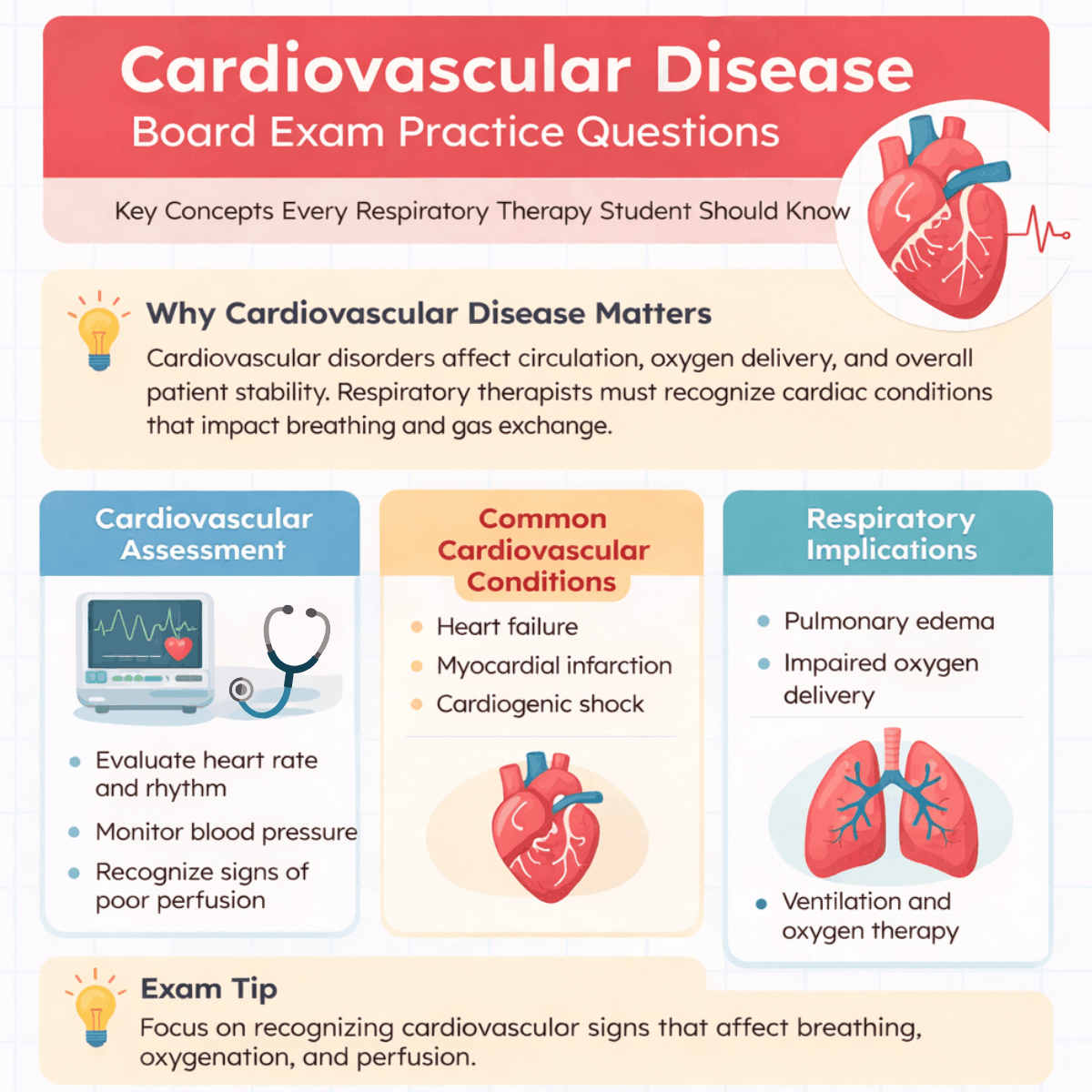
Cardiovascular Disease Board Exam Practice Questions
Review the following cardiovascular disease practice questions to test your understanding of key concepts commonly covered on the respiratory therapy board exam.
These questions are designed to reinforce important principles and help you build confidence before test day.
1. A patient is receiving CPAP therapy at 8 cmH2O for the treatment of post-operative atelectasis. Ten minutes after initiation, the patient develops an irregular heart rate, and their blood pressure drops from 120/80 mmHg to 90/60 mmHg. Which of the following actions would you recommend?
A. Change to IPV therapy at 12 cmH2O
B. Change to BiPAP at 8/4 cmH2O
C. Decrease the CPAP to 4 cmH2O
D. Discontinue the CPAP therapy
2. A respiratory therapist is assisting a physician during the cardioversion of a 67-year-old male patient in the emergency department who is experiencing atrial fibrillation. The patient remains hypotensive with a blood pressure of 70/45 mmHg, and the arrhythmia persists after an initial synchronized shock of 50 joules. What is the next step the therapist should anticipate?
A. Defibrillation at 100 J
B. Defibrillation at 200 J
C. Cardioversion at 100 J
D. Cardioversion at 200 J
3. A 62-year-old male patient with a history of advanced COPD presents to the clinic with worsening dyspnea, fatigue, and pedal edema. Physical examination reveals jugular venous distention (JVD), and an echocardiogram confirms right ventricular hypertrophy. Which of the following is the most likely cause of these findings?
A. Pulmonary embolism
B. Cor pulmonale
C. Acute exacerbation of COPD
D. Congestive heart failure
4. A 57-year-old female patient presents to the emergency department with severe dyspnea, and an EKG is performed to assess her condition. In which of the following rhythms should immediate defibrillation be initiated?
A. Atrial flutter
B. Ventricular fibrillation
C. Supraventricular tachycardia
D. Second-degree heart block
5. A physician has requested the central venous pressure (CVP) measurement for a patient using a strain-gauge pressure transducer. While obtaining the reading, you notice that the transducer is positioned below the level of the patient’s mid-chest (mid-heart level). What effect would this have on the CVP measurement?
A. It would underestimate the CVP
B. It would overestimate the CVP
C. It would cause damping of the signal
D. It would not affect the measurement
6. You are called to assess an adult patient with a history of lung cancer and congestive heart failure. The patient reports progressively worsening shortness of breath over the past 48 hours. On 15 L/min oxygen via a nonrebreather mask, the patient’s SpO2 is 86%. Auscultation reveals clear and equal breath sounds in the upper and middle lung fields but diminished breath sounds at the bases bilaterally. What is the most likely cause of the patient’s respiratory distress?
A. Bilateral pneumonia
B. Tension pneumothorax
C. Lobar consolidation
D. Pleural effusions
7. An adult patient newly admitted to the emergency department and currently intubated is observed to have large amounts of frothy pink secretions. This finding most likely indicates which of the following conditions?
A. ARDS
B. Cor pulmonale
C. Left ventricular failure
D. An electrolyte imbalance
8. A 61-year-old female patient receiving mechanical ventilatory support over the past three days has shown stable fluid intake but a steady decrease in fluid output. At the same time, her peak airway pressures have been progressively increasing. Which of the following is the most likely cause of these findings?
A. Ventilator-associated pneumonia
B. Acute respiratory distress syndrome
C. Pulmonary arterial hypertension
D. Cardiogenic pulmonary edema
9. During the physical assessment of a 56-year-old female patient, you observe pronounced distention of the jugular veins in her neck while she is seated upright. Which of the following is the most likely cause of this finding?
A. Systolic hypertension
B. Hypovolemia
C. Obstruction of the pulmonary vein
D. Right ventricular failure
10. An adult patient with fluid overload received an intravenous dose of furosemide. Shortly after administration, the patient developed a new arrhythmia on the EKG that was not present before. Which of the following would you recommend in this situation?
A. Defibrillate the patient
B. Administer another dose of furosemide
C. Administer a dose of epinephrine
D. Check the patient’s potassium level
11. A 64-year-old female patient arrives at the emergency department complaining of chest tightness and radiating pain to her left shoulder. Which of the following would you recommend as the first course of action?
A. Obtain a stat chest x-ray
B. Provide 100% oxygen
C. Administer an albuterol treatment
D. Obtain an ABG sample
12. A 69-year-old male patient presents with tachypnea, dyspnea, and expiratory wheezes. Despite receiving a bronchodilator treatment, his symptoms have not improved. Which of the following is the most likely explanation for the patient’s condition?
A. Asthma
B. Chronic bronchitis
C. Congestive heart failure
D. Emphysema
13. While administering an adrenergic aerosol bronchodilator treatment to an adult female patient, you observe an increase in her pulse rate from 81 to 125 beats per minute. What action should you take?
A. Use half of the standard dosage next time
B. Add more diluent to the nebulizer chamber
C. Temporarily stop the treatment until the patient’s heart rate decreases
D. Stop the treatment and notify the physician
14. A 66-year-old female patient was newly admitted, and an EKG was performed. While reviewing the results, you notice the absence of identifiable P waves and an irregular ventricular rhythm. Which of the following is the most likely diagnosis?
A. Atrial fibrillation
B. Ventricular tachycardia
C. 1st-degree heart block
D. 2nd-degree heart block
15. A 60-year-old male patient presents with a heart rate of 136 beats per minute and a regular rhythm. Which of the following is the most likely cause of this finding?
A. Arterial hypertension
B. Anxiety or agitation
C. Beta-blocker administration
D. Therapeutic hypothermia
16. While reviewing the EKG rhythm strip of a 63-year-old male patient, you observe the following: heart rate of 81 beats per minute, regular rhythm, normal P waves, P-R interval of 0.30 seconds, and normal QRS complexes. Based on these findings, what is the most likely condition?
A. 1st-degree heart block
B. 2nd-degree heart block
C. 3rd-degree heart block
D. Atrial fibrillation
17. A 53-year-old male patient with supraventricular tachycardia presents with a heart rate of 153 beats per minute. What effect would this elevated heart rate most likely have on his cardiac function?
A. Increased end-diastolic volume
B. Decreased end-diastolic volume
C. Increased stroke volume
D. Mitral valve regurgitation
18. A 45-year-old male undergoes a routine chest x-ray during a preoperative assessment. The radiologist is explaining the findings and points out the position of the heart on the image. Where would you expect the heart to be positioned on the chest radiograph of a healthy adult?
A. Primarily to the left side of the patient’s midline/spine
B. Primarily to the right side of the patient’s midline/spine
C. Entirely to the right side of the patient’s midline/spine
D. Entirely to the left side of the patient’s midline/spine
19. A 50-year-old female patient is being monitored via EKG rhythm strip due to symptoms of dizziness and fatigue. Upon inspection, the following findings are noted:
Rate 145 beats/min
Regular rhythm
Normal P waves
Normal P-R intervals
Normal QRS complexes
Which of the following best describes these results?
A. Atrial flutter
B. Atrial fibrillation
C. Sinus tachycardia
D. Ventricular tachycardia
20. A 69-year-old male patient with a history of congestive heart failure reports experiencing significant difficulty breathing when lying flat and states he often sleeps propped up with multiple pillows. Which of the following best describes this condition?
A. Hyperpnea
B. Orthopnea
C. Apneustic
D. Cheyne-Stokes
21. A 47-year-old male patient is undergoing a cardiopulmonary exercise test as part of an evaluation for unexplained dyspnea. Under which of the following conditions would you recommend ceasing the test?
A. A 10% decrease in SpO2 from the baseline value
B. A 10 mmHg increase in systolic blood pressure
C. An increase in heart rate from 88/min to 135/min
D. An increase in the patient’s level of dyspnea
22. A 56-year-old male patient is being evaluated for a heart murmur. During auscultation, the physician asks about the physiological mechanism responsible for the S2 heart sound. Which of the following best describes the primary cause of this sound?
A. The opening of the semilunar valves
B. The opening of the atrioventricular valves
C. The closing of the semilunar valves
D. The closing of the atrioventricular valves
23. A 58-year-old male patient with a history of chest pain and shortness of breath is undergoing evaluation. The physician has ordered imaging tests to assess the condition of his arteries. Which of the following radiographic imaging procedures would be most appropriate?
A. PET scan
B. V/Q scanning
C. Angiography
D. Standard radiography
24. A 65-year-old male patient with chronic respiratory conditions is being evaluated for postural drainage therapy. The respiratory therapist is considering placing the patient in the Trendelenburg position to facilitate secretion clearance. However, the patient’s medical history includes elevated blood pressure and previous episodes of pulmonary edema. In which of the following conditions would the Trendelenburg position be contraindicated?
A. Bronchiectasis
B. Congestive heart failure
C. Ciliary dyskinesia
D. Cystic fibrosis
25. A 65-year-old female patient presents to the emergency department with shortness of breath, pink frothy sputum, and bilateral crackles on auscultation. A chest x-ray reveals pulmonary vascular congestion, confirming a diagnosis of cardiogenic pulmonary edema. Which of the following represents the primary goal in managing this condition?
A. To increase venous return to the heart
B. To increase pulmonary fluid and blood volume
C. To decrease the right heart and systemic venous pressures
D. To decrease the left heart and pulmonary vascular pressures
Access our quiz that includes sample TMC practice questions and detailed explanations to master the key concepts of cardiovascular diseases.
Final Thoughts
Preparing for the board exam requires a strong understanding of how cardiovascular diseases affect respiratory function and patient care. By reviewing and practicing questions on this topic, you can strengthen your knowledge of key concepts and improve your ability to apply them in clinical situations.
Continue studying the material, identify areas that need improvement, and use practice questions like these to reinforce what you have learned. Consistent practice will help you build confidence and increase your chances of success on the respiratory therapy board exam.

Written by:
John Landry is a registered respiratory therapist from Memphis, TN, and has a bachelor's degree in kinesiology. He enjoys using evidence-based research to help others breathe easier and live a healthier life.
References
- Olvera Lopez E, Ballard BD, Jan A. Cardiovascular Disease. [Updated 2023 Aug 22]. In: StatPearls [Internet]. Treasure Island (FL): StatPearls Publishing; 2026.