
Mechanical ventilation is a critical-care treatment used only when a person cannot breathe adequately on their own. Seeing a loved one “on the vent” often raises urgent questions: How serious is this situation? What are the chances of survival? What complications can develop?
This article answers those questions in clear, direct language for readers without a medical background.
We explain why mechanical ventilation is necessary, outline the main risks and benefits, review factors that influence outcomes, and describe what life looks like during and after ventilator use.

Download our free guide that has over 100+ of the best tips for healthy lungs.
How Serious Is It to Be Placed on a Ventilator?
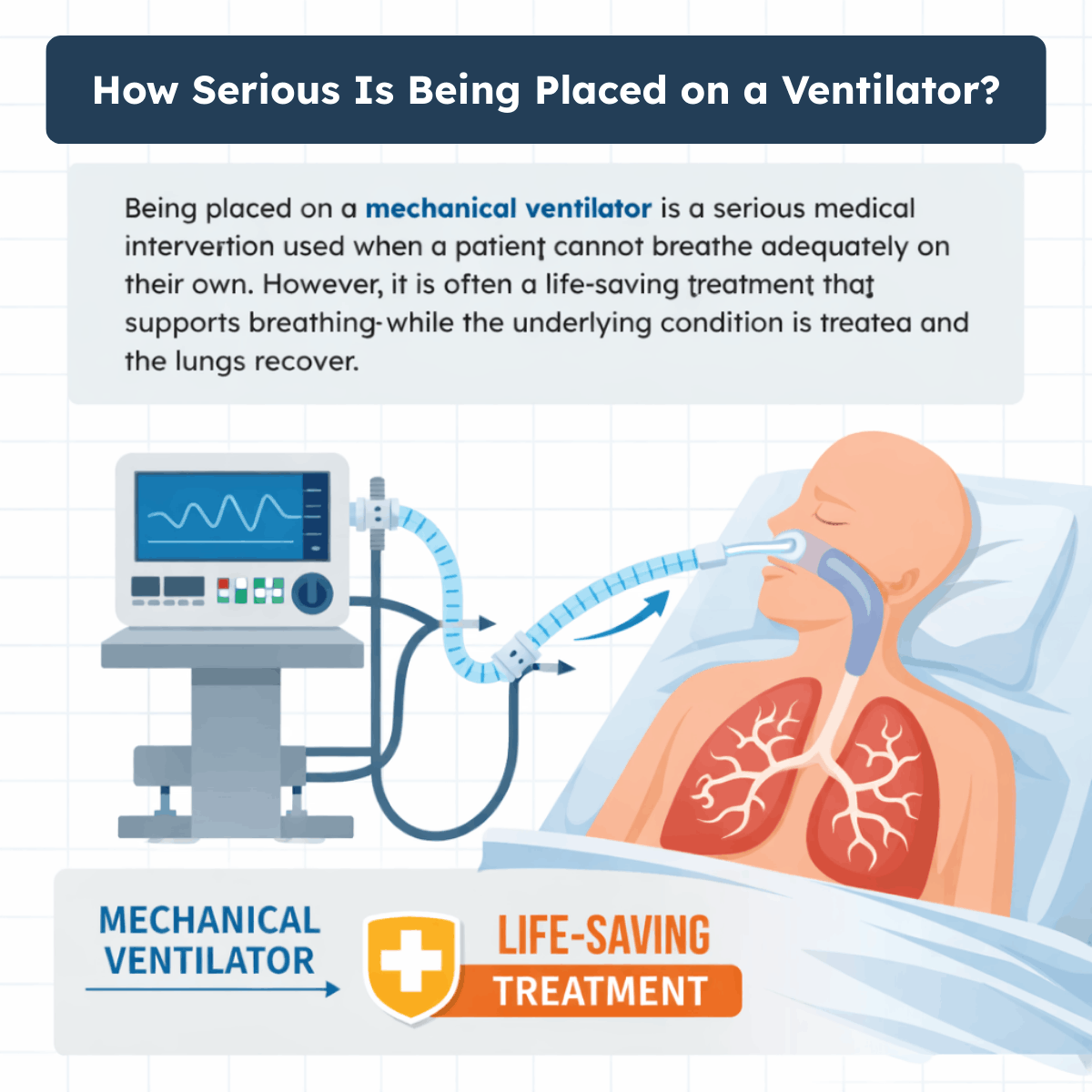
Needing a ventilator is always a sign of critical illness. Doctors decide to intubate only when the lungs or breathing muscles cannot move enough air to keep blood oxygen at safe levels or remove carbon dioxide.
In the United States, hundreds of thousands of patients require invasive mechanical ventilation each year, and nearly all are treated in an intensive-care unit (ICU). Mortality varies widely. Short elective ventilation during surgery carries a very low risk, but mechanical ventilation for severe pneumonia, sepsis, or trauma can have hospital death rates between 25% and 50%.
Length of support matters: the longer a person relies on the machine, the greater the risk of complications and death. Mechanical ventilation is therefore serious, but it is also often the only option that keeps a critically ill patient alive while underlying problems are treated.
Why is a Ventilator Needed?
Common reasons for mechanical ventilation include severe lung infections, acute respiratory distress syndrome (ARDS), sudden worsening of chronic lung diseases such as COPD, major injury to the chest, stroke that impairs the drive to breathe, and generalized weakness from conditions like Guillain-Barré syndrome.
During general anesthesia, a ventilator is used routinely because the drugs used for surgery relax the breathing muscles.
Outside the operating room, non-invasive options such as high-flow nasal oxygen or mask ventilation are tried first when appropriate. If those measures fail or cannot provide enough support, doctors move to invasive mechanical ventilation.
Factors That Affect Ventilator Outcomes
- Underlying Illness: Patients ventilated for conditions that are quickly reversible, such as asthma exacerbation or drug overdose, usually do better than those with advanced cancer or end-stage heart and lung disease.
- Age and Baseline Health: Older adults and people with multiple chronic illnesses have less physiologic reserve and are more likely to experience complications, need longer rehabilitation, or die in the hospital.
- Duration of Ventilation: Short courses of fewer than five days are associated with better outcomes. Dependence beyond two weeks often signals more severe disease and increases the risk of ventilator-associated pneumonia, muscle weakness, and blood clots.
- Hospital Resources: Outcomes improve in ICUs staffed by experienced critical-care teams with adequate nurse-to-patient ratios and ready access to respiratory therapists, pharmacists, and rehabilitation specialists.
Potential Complications of Mechanical Ventilation
- Ventilator-Associated Pneumonia (VAP): A breathing tube bypasses natural airway defenses, making it easier for bacteria to enter the lungs. VAP can extend ICU stay and raise the chance of death.
- Barotrauma and Volutrauma: If ventilator pressures or volumes are set too high, lung tissue can tear, causing air leaks around the lungs (pneumothorax) or under the skin. Modern lung-protective settings reduce but do not eliminate this risk.
- Diaphragm and Muscle Weakness: When a machine does most of the breathing, the diaphragm and other muscles lose strength. Early spontaneous-breathing trials, physical therapy, and limiting deep sedation help minimize weakness, but some patients still require lengthy rehabilitation.
- Delirium: Sedative drugs, disrupted sleep, and the stress of critical illness can cause acute confusion. Delirium is linked to longer hospital stays and can slow cognitive recovery.
- Blood Clots: Immobility increases the risk of a deep vein thrombosis and pulmonary embolism. Preventive measures include blood-thinning injections and early mobility when feasible.
Emotional and Financial Impact
For families, watching a relative on a ventilator is highly stressful. They may feel powerless, especially when the patient is sedated and unable to communicate.
Clear explanations from the care team, regular updates, and encouragement to participate in bedside care (for example, reading to the patient or playing familiar music) can ease anxiety.
Financial strain can also follow. ICU care is expensive, and rehabilitation or long-term care may be needed after discharge. Insurance coverage varies. Social workers help families navigate benefits, equipment needs, and community resources.
Treatment Course From Intubation to Weaning
- Intubation: Doctors give sedatives and, if necessary, muscle relaxants to place the breathing tube safely through the mouth or nose into the windpipe. The tube is secured, and the patient is connected to the ventilator.
- Initial settings: Clinicians choose tidal volume, breathing rate, oxygen concentration, and positive end-expiratory pressure (PEEP) based on the patient’s size and condition. Blood gases, lung pressures, and vital signs are monitored closely.
- Daily assessment: Each day, the team evaluates whether the patient can tolerate lighter sedation and whether spontaneous breathing is possible. If the patient initiates breaths, the ventilator switches to assist modes that provide support only when needed.
- Spontaneous Breathing Trials: When oxygen and pressure requirements fall to safe levels, the team conducts trials in which the ventilator supplies minimal help. Success indicates readiness for extubation. Failure leads to adjustments and further support.
- Tracheostomy: If a patient cannot be weaned after 10–14 days, doctors may recommend a surgical airway (tracheostomy). This can improve comfort, facilitate suctioning, and allow speech with special valves, making long-term weaning easier.
Recovery After Mechanical Ventilation
Leaving the ICU is a major milestone, but recovery continues for weeks to months. Common challenges include fatigue, shortness of breath, muscle weakness, mood changes, and memory gaps.
Outpatient pulmonary rehabilitation, physical therapy, occupational therapy, and counseling address these issues. Most survivors regain a large share of their previous independence within six to twelve months, but progress depends on age, pre-existing conditions, and the severity of the original illness.
Advances Improving Ventilator Safety
Research over the past two decades has produced clear protocols that lower risk. Lung-protective ventilation uses smaller breath sizes and limits pressure to prevent injury.
Elevating the head of the bed, performing regular oral care, and reducing sedation have cut rates of VAP and delirium. Closed-loop oxygen controllers automatically adjust oxygen levels to avoid both hypoxia and excessive oxygen.
New modes such as neural pressure support synchronize ventilation with the diaphragm’s electrical signals, improving comfort and preserving muscle strength. Decision-support software now helps staff fine-tune settings based on continuous data.
FAQs About Being On a Ventilator
How Serious Is Mechanical Ventilation?
Mechanical ventilation is always a marker of critical illness because it is used only when a person cannot maintain safe oxygen or carbon-dioxide levels on their own. Although it often saves lives, it also carries real risks such as infections, lung injury, and muscle weakness.
The seriousness therefore lies in the combination of life-threatening disease and the invasive nature of the therapy. Close monitoring, experienced staff, and evidence-based protocols help lower—but never entirely remove—those risks.
What Are The Chances Of Surviving A Ventilator?
Survival rates vary with the underlying problem, age, and overall health. Patients ventilated briefly after routine surgery usually do very well, while those ventilated for severe pneumonia, sepsis, or major trauma face hospital death rates of roughly 25 % to 50 %.
Recovery chances drop if ventilation continues beyond two weeks, mainly because complications rise over time. Early treatment of the root illness, lung-protective settings, and prompt weaning all improve survival.
Does Being On A Ventilator Mean You Are Dying?
No. A ventilator is a life-support tool designed to prevent death from respiratory failure. Many people, especially those with conditions that can be reversed, such as asthma attacks, drug overdoses, or treatable infections, recover fully and leave the hospital.
However, the presence of a ventilator does confirm that the body is in a dangerous state, and some patients with severe or irreversible disease do not survive despite maximum support.
How Long Can Someone Safely Remain On A Ventilator?
There is no absolute time limit, but risks grow with each passing day. Courses under five days usually carry fewer complications. After about seven to ten days, problems such as ventilator-associated pneumonia, blood clots, and diaphragm weakness become more common.
Note: If weaning is unlikely within two weeks, doctors often recommend a tracheostomy to improve comfort and reduce airway risks during longer support.
What Complications of Mechanical Ventilation Should Families Watch For?
Key complications include ventilator-associated pneumonia, lung injury from high pressures or volumes, delirium caused by sedatives and disrupted sleep, and general muscle wasting from immobility.
ICU teams use head-of-bed elevation, careful airway care, low-pressure ventilation strategies, daily sedation breaks, blood-thinning medications, and early physiotherapy to reduce these dangers. Families can ask daily how each preventive measure is being applied.
Can Patients Communicate While Intubated?
An endotracheal tube passes through the vocal cords, so speech is not possible in the usual way. Patients may communicate with hand signals, writing boards, or simple yes-and-no responses if they are awake enough.
After a tracheostomy, a speaking valve can sometimes allow limited verbal communication when the care team deems it safe. Speech-language pathologists often assist with alternative communication methods.
What Happens If A Patient Cannot Be Weaned From the Ventilator?
When repeated weaning trials fail, doctors evaluate whether the underlying condition is reversible, whether long-term ventilation at home is feasible, and what the patient’s goals of care are. Some patients transition to chronic ventilator support via tracheostomy and portable machines, either in specialized facilities or at home.
Others, particularly those with poor prognoses or advanced directives limiting life support, may shift to comfort-focused care and withdrawal of ventilation under hospice supervision.
How Can Family Members Help During Ventilator Care?
Families play a crucial role by staying informed, asking clear questions, and providing familiar voices and reassuring touch, which help reduce delirium and anxiety.
They can remind staff about the patient’s baseline health, preferences, or any discomfort signs that sedation may mask. After extubation, encouragement and assistance with mobility, eating, and simple breathing exercises speed recovery and strengthen morale.
Final Thoughts
Being placed on a ventilator is serious because it signals life-threatening respiratory failure and introduces risks that require continuous management. Survival depends on the underlying disease, a patient’s baseline health, the quality of ICU care, and how quickly complications are prevented or treated.
Mechanical ventilation can be lifesaving, and many patients recover and return to normal activities, but the process demands careful attention from healthcare teams and support from families.
Understanding why mechanical ventilation is used, what complications may occur, and what recovery involves helps patients and families make informed decisions, ask the right questions, and participate actively in care.

Written by:
John Landry is a registered respiratory therapist from Memphis, TN, and has a bachelor's degree in kinesiology. He enjoys using evidence-based research to help others breathe easier and live a healthier life.
References
- Hickey SM, Sankari A, Giwa AO. Mechanical Ventilation. [Updated 2024 Mar 30]. In: StatPearls [Internet]. Treasure Island (FL): StatPearls Publishing; 2025.
- Karakuzu Z, Iscimen R, Akalin H, Kelebek Girgin N, Kahveci F, Sinirtas M. Prognostic Risk Factors in Ventilator-Associated Pneumonia. Med Sci Monit. 2018.
Recommended Reading
Ventilator Weaning: Overview and Practice Questions