
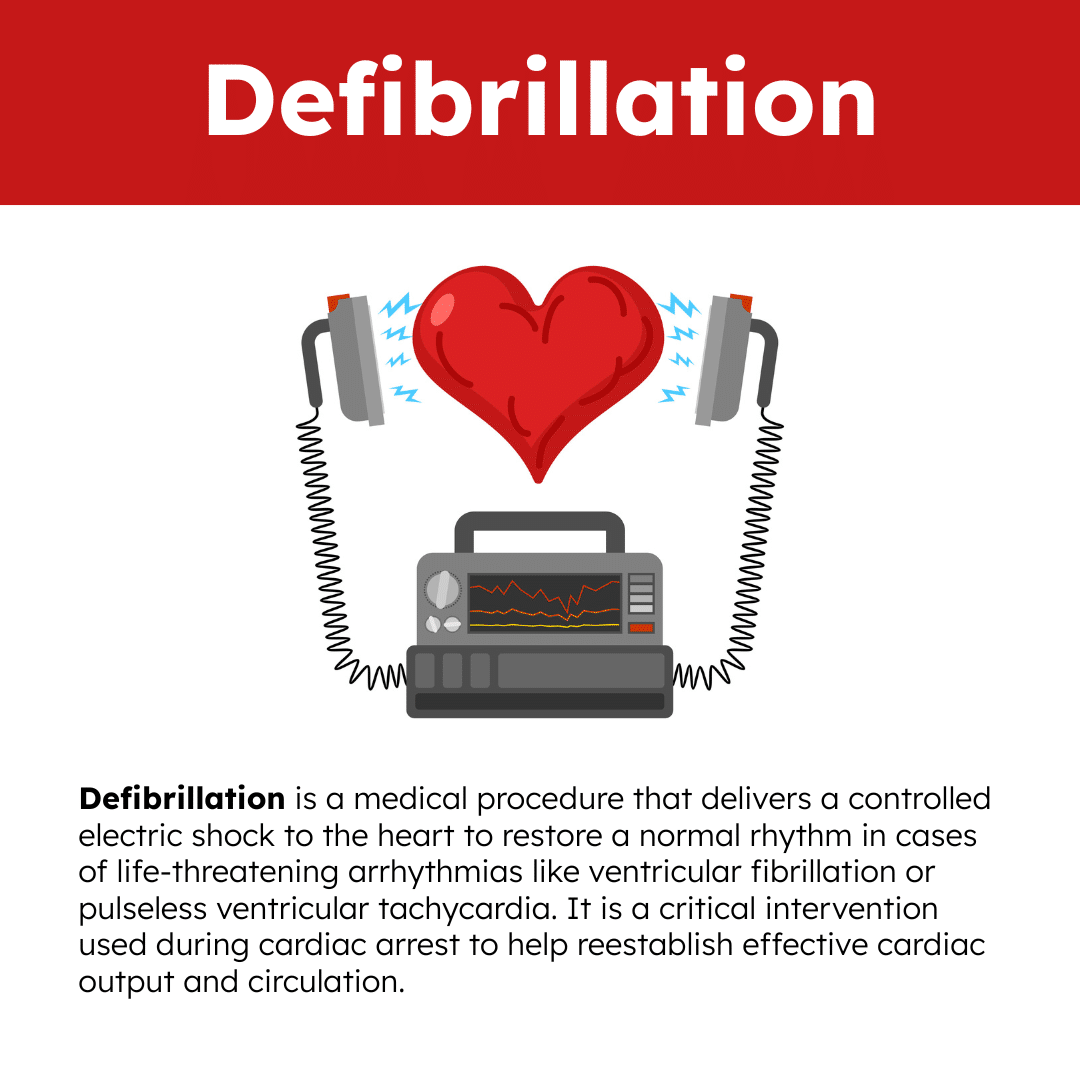
Defibrillation is a critical, life-saving procedure used in emergency situations to restore a normal heartbeat in patients experiencing life-threatening cardiac arrhythmias. Most commonly, it’s performed during cardiac arrest when the heart is quivering ineffectively due to ventricular fibrillation or pulseless ventricular tachycardia.
While it may seem like a purely cardiac intervention, defibrillation holds significant relevance for respiratory therapists who often work closely with patients in acute care settings where cardiopulmonary emergencies are common.
This article provides an overview of defibrillation, explains the different types of defibrillators, and examines the role of respiratory therapists in high-stakes clinical scenarios.

What Is Defibrillation?
Defibrillation is the process of delivering a controlled electric shock to the heart to stop abnormal electrical activity and allow the heart’s normal rhythm to reestablish itself. This is typically done using a defibrillator—either an automated external defibrillator (AED), a manual external defibrillator, or an implantable cardioverter-defibrillator (ICD) in chronic cases.
The electrical shock depolarizes a large amount of the heart muscle simultaneously, halting chaotic impulses that cause fibrillation. Ideally, this gives the heart’s sinoatrial (SA) node—a natural pacemaker—a chance to resume its normal rhythm.
When Is Defibrillation Used?
Defibrillation is indicated for:
- Ventricular fibrillation (VF): A disorganized, rapid, and ineffective quivering of the ventricles.
- Pulseless ventricular tachycardia (VT): A rapid heart rhythm originating in the ventricles that does not allow the heart to fill properly, resulting in little to no cardiac output.
Note: It is not used for asystole (“flatline”) or pulseless electrical activity (PEA), as these rhythms do not benefit from electrical shocks. In such cases, high-quality CPR and pharmacologic interventions are the primary focus.
Types of Defibrillators
- Automated External Defibrillators (AEDs): These are user-friendly devices designed for use by the general public or first responders. AEDs analyze the heart rhythm and determine if a shock is needed, then guide the user through the process with voice or visual prompts.
- Manual Defibrillators: Used in hospitals or by advanced providers, these require training to interpret ECG rhythms and determine the appropriate shock energy level and timing.
- Implantable Cardioverter-Defibrillators (ICDs): Surgically implanted in patients at risk of recurrent ventricular arrhythmias, ICDs monitor heart rhythms and automatically deliver shocks when necessary.
- Wearable Cardioverter-Defibrillators (WCDs): External vests worn by patients temporarily at risk of sudden cardiac arrest, often used as a bridge to ICD implantation.
The Role of Respiratory Therapists in Defibrillation
Although defibrillation is traditionally associated with emergency physicians and nurses, respiratory therapists (RTs) play an indispensable role in the resuscitation team—especially in critical care and emergency settings.
Here’s how RTs are involved:
- Airway Management: During a cardiac arrest, establishing and maintaining a patent airway is a top priority. RTs are often the first to provide manual ventilation with a bag-valve mask (BVM) or secure an advanced airway through endotracheal intubation.
- Oxygenation and Ventilation Support: Defibrillation is only part of the resuscitation process. Effective oxygen delivery before and after the shock is essential to prevent hypoxic injury. RTs manage oxygen devices, mechanical ventilators, and monitor gas exchange to optimize patient outcomes.
- Cardiac Arrest Team Participation: In many hospitals, RTs are integral members of the “Code Blue” team. They assist with compressions, monitor airway devices, administer aerosolized medications, and support post-resuscitation care.
- Equipment Familiarity: Respiratory therapists must be familiar with defibrillator operation in case they need to assist with shock delivery or troubleshoot the machine during emergencies.
- Post-Resuscitation Care: After successful defibrillation, patients often remain unstable. RTs help manage ventilator settings, perform ABG analysis, and optimize respiratory status in the critical minutes and hours that follow.
Why Defibrillation Matters in Respiratory Care
The overlap between cardiac and respiratory emergencies is significant. Respiratory failure can lead to cardiac arrest, and vice versa. In many cases, the respiratory therapist is one of the first responders, making their role in recognizing shockable rhythms, supporting oxygenation, and aiding in defibrillation crucial.
Moreover, education in Advanced Cardiac Life Support (ACLS) is part of the RT’s professional training. Understanding the algorithms that govern defibrillation—including shock timing, rhythm checks, and post-shock care—is essential to fulfilling the therapist’s responsibilities within the multidisciplinary team.
Defibrillation Practice Questions
1. What is defibrillation?
It is the process of delivering an electrical shock to the heart to terminate a life-threatening arrhythmia, such as ventricular fibrillation or pulseless ventricular tachycardia, with the goal of restoring a normal sinus rhythm.
2. What is the equation used to calculate Joules in defibrillation?
Joules = (Voltage × Current × Time) / Impedance
3. What factors can affect electrical impedance during defibrillation?
Tissue density, body mass index, electrode contact quality, and pad placement.
4. What are the two main types of defibrillators?
Monophasic and biphasic.
5. Which type of defibrillator is most commonly used today, and why?
Biphasic defibrillators are preferred because they deliver energy in two directions (two vectors), improving success rates while using less energy.
6. What patient factors can interfere with proper defibrillator pad placement?
Excess adipose tissue, thick chest hair, and wet or oily skin.
7. What is a manual defibrillator?
A device where the operator analyzes the heart rhythm, charges the defibrillator, and delivers the shock manually.
8. What is a semi-automatic defibrillator?
A defibrillator that analyzes the rhythm upon the operator’s prompt and advises whether or not to deliver a shock.
9. What is an automatic external defibrillator (AED)?
A fully automated device that analyzes the rhythm and provides voice prompts to guide the user through defibrillation.
10. When is defibrillation indicated?
When the ventricles are fibrillating or when the heart is in pulseless ventricular tachycardia.
11. What cardiac rhythms require defibrillation?
Ventricular fibrillation (VF) and pulseless ventricular tachycardia (VT).
12. What is the normal conduction pathway of the heart?
SA node → AV node → Bundle of His → Bundle branches → Purkinje fibers
13. What occurs during ventricular tachycardia (VT)?
A re-entry circuit forms in ischemic tissue, creating a rapid ectopic ventricular pacemaker, typically over 150 bpm, resulting in reduced cardiac output.
14. What happens during ventricular fibrillation (VF)?
Multiple ectopic foci in the ventricles cause chaotic electrical activity, preventing coordinated contraction and drastically reducing cardiac output.
15. What are the possible outcomes after defibrillation?
Persistence in VT/VF, conversion to asystole, pulseless organized rhythm, or an organized rhythm with a pulse.
16. What is the maximum number of rhythm analyses or shocks typically delivered in the field?
Four shocks or four rhythm analyses.
17. Under what conditions can a Medical Termination of Resuscitation (TOR) be requested?
Patient is over 18 years old, three rhythm interpretations with no shocks delivered, no return of spontaneous circulation (ROSC), and the arrest was not witnessed by EMS.
18. What should be done if TOR criteria are not met or the defibrillator fails?
Continue CPR and transport the patient immediately.
19. How often should rhythm be analyzed during resuscitation?
Every 2 minutes.
20. What are basic airway management options during cardiac arrest?
Use of an oropharyngeal airway (OPA) and bag-valve-mask (BVM) ventilation.
21. What steps should be taken if a patient becomes VSA (vital signs absent) during transport?
Have the driver pull over, start CPR, apply defibrillator pads, and follow protocol: up to 4 rhythm interpretations if first arrest, or 1 interpretation if it’s a re-arrest after ROSC.
22. When is it inappropriate to request a TOR?
If the patient is under 18, obviously dead, received shocks, or if the arrest was witnessed.
23. What is the best practice for managing non-traumatic cardiac arrest?
High-quality CPR, defibrillation if the patient is older than one month, and consideration of TOR for adults over 18.
24. What is the best practice for managing traumatic cardiac arrest (blunt or penetrating trauma)?
CPR, defibrillation if the patient is over 30 days old, and consideration of TOR for those over 16.
25. What are the criteria for a traumatic TOR?
At least one rhythm interpretation, no shocks delivered, heart rate of zero with PEA, patient is in asystole, and transport time to the hospital exceeds 30 minutes.
26. What should be done if you are unable to clear a foreign body airway obstruction during cardiac arrest?
Deliver one shock if indicated, then immediately begin transport while continuing CPR.
27. What is the correct course of action if you are able to clear the airway during a foreign body obstruction arrest?
Clear the airway and continue management as a medical cardiac arrest.
28. What are the primary goals of defibrillation during cardiac arrest?
To deliver high-quality CPR with minimal interruptions, never compromising patient care or safety.
29. Which heart rhythms are considered shockable by a defibrillator?
Ventricular fibrillation (VF) and pulseless ventricular tachycardia (VT).
30. What patient conditions must be present before an AED can be used?
The patient must be unconscious, unresponsive, not breathing (apneic), and pulseless.
31. What are the ABCs of resuscitation?
Airway, Breathing, Circulation — supported by early defibrillation and high-quality CPR.
32. What does an AED analyze before giving instructions?
It identifies whether the rhythm is shockable or non-shockable.
33. What should be done if a shock is advised by the AED?
Clear the patient, deliver a single shock, then resume CPR for 2 minutes before reanalyzing rhythm and checking for a pulse.
34. What is the correct action if no shock is advised by the AED?
Begin CPR immediately and assist ventilation if necessary.
35. How do cardioversion and defibrillation treat tachydysrhythmias?
By delivering electrical current to depolarize myocardial cells, allowing the SA node to restore normal pacing.
36. What is the key difference between cardioversion and defibrillation?
Cardioversion is synchronized with the patient’s QRS complex; defibrillation is immediate and unsynchronized.
37. What is the physiological purpose of defibrillation?
To deliver a direct current (DC) shock that depolarizes the heart, enabling the SA node to regain pacemaker control.
38. Which arrhythmias are best treated with defibrillation?
Ventricular fibrillation and pulseless ventricular tachycardia.
39. When is defibrillation most effective during a cardiac arrest?
When it is performed within 2 minutes of the onset of the arrhythmia.
40. What are the two main types of defibrillators?
Manual defibrillators (e.g., LifePak) and automated external defibrillators (AEDs).
41. Which rhythms are appropriate for synchronized cardioversion?
Unstable atrial fibrillation, atrial flutter, supraventricular tachycardia (SVT), and ventricular tachycardia with a pulse.
42. Which rhythms should be treated with defibrillation?
Ventricular fibrillation, pulseless ventricular tachycardia, and torsades de pointes.
43. What are the key differences between cardioversion and defibrillation?
Cardioversion is elective, synchronized, and uses lower joules; defibrillation is for emergencies, is unsynchronized, and uses higher joules.
44. What should be done before performing elective cardioversion?
Hold digoxin for 48 hours and ensure the patient is NPO for 4 hours prior to the procedure.
45. When is cardioversion typically indicated after anticoagulation?
If the arrhythmia has lasted more than 48 hours, cardioversion may be performed after several weeks of anticoagulation therapy.
46. Do you shock asystole during cardiac arrest?
No, asystole is not a shockable rhythm. Begin CPR immediately.
47. Do you defibrillate pulseless electrical activity (PEA)?
No, PEA is not a shockable rhythm. Provide high-quality CPR and treat reversible causes.
48. What is the function of Class I antiarrhythmic drugs?
They are sodium channel blockers, such as procainamide, that help suppress abnormal heart rhythms.
49. What is the function of Class II antiarrhythmic drugs?
They are beta-blockers (e.g., metoprolol, propranolol) that control heart rate and reduce arrhythmic events.
50. What is the function of Class III antiarrhythmic drugs?
They are potassium channel blockers (e.g., amiodarone, dofetilide) that prolong repolarization and help control ventricular arrhythmias.
51. What is the role of Class IV antiarrhythmic drugs?
They are calcium channel blockers (e.g., diltiazem) used primarily for rate control in atrial arrhythmias.
52. What is the function of adenosine in cardiac emergencies?
It rapidly converts supraventricular tachycardia (SVT) to normal sinus rhythm by slowing AV node conduction.
53. What is atropine used for in ACLS?
It increases heart rate by reducing vagal tone and is indicated for symptomatic bradycardia.
54. What is digoxin used to treat in cardiac rhythm management?
It is used to manage atrial fibrillation and atrial flutter by controlling ventricular response.
55. What is the purpose of synchronized cardioversion?
To restore normal sinus rhythm in patients with unstable but organized arrhythmias by delivering energy in sync with the QRS complex.
56. What is the main goal of defibrillation in a patient with ventricular fibrillation?
To deliver an electric shock that halts abnormal electrical activity, allowing the SA node to restore a normal rhythm.
57. How does a biphasic defibrillator improve the chances of successful defibrillation?
It delivers current in two directions, reducing required energy levels and increasing shock effectiveness.
58. Why is minimizing the time to first shock critical in cardiac arrest?
The chances of survival decrease significantly for every minute defibrillation is delayed.
59. What safety step must be taken before delivering a defibrillation shock?
Ensure no one is touching the patient and loudly state “Clear!” before delivering the shock.
60. Why should defibrillation pads not be placed over a medication patch?
It can block the electrical current and may cause skin burns or alter drug absorption.
61. Where should defibrillator pads be placed on an adult patient for anterolateral placement?
One pad below the right clavicle and the other at the left side of the chest along the mid-axillary line.
62. Why is it important to avoid metal objects when applying defibrillator pads?
Metal can conduct electricity and cause burns or ineffective shocks.
63. What is the typical energy setting for the first biphasic defibrillation shock?
150 to 200 joules, depending on manufacturer recommendations.
64. How does early CPR support defibrillation efforts?
It maintains partial circulation to vital organs and makes the heart more responsive to defibrillation.
65. What rhythm must be confirmed before delivering a shock with a manual defibrillator?
Ventricular fibrillation or pulseless ventricular tachycardia.
66. What device feature distinguishes a semi-automatic AED from a fully automatic AED?
A semi-automatic AED requires the user to push a button to deliver the shock, while a fully automatic AED delivers it automatically.
67. What should be done if the defibrillator fails to analyze or shock due to a pad error?
Check pad placement and connection, replace if needed, and resume CPR.
68. Can defibrillation be performed on a wet or sweaty chest?
Yes, but the chest should be wiped dry before pad placement to reduce impedance.
69. Why is high-quality chest compression still important even after defibrillation?
Defibrillation does not guarantee return of spontaneous circulation, so CPR is needed to support perfusion.
70. What is the primary action after delivering a defibrillation shock?
Immediately resume chest compressions for 2 minutes without pausing to check rhythm or pulse.
71. What is impedance, and how does it affect defibrillation?
Impedance is the resistance to electrical flow; high impedance reduces the effectiveness of defibrillation.
72. Can a defibrillator be used on a pregnant patient during cardiac arrest?
Yes, defibrillation should not be delayed in pregnant patients as it may save both mother and baby.
73. What modification should be made when defibrillating an infant or small child?
Use pediatric pads and energy settings or a pediatric attenuator system.
74. What is one advantage of adhesive defibrillation pads over paddles?
Pads allow hands-free operation and continuous chest compressions during rhythm analysis.
75. What is the correct defibrillator energy setting range for monophasic defibrillation?
Typically 360 joules for each shock.
76. What should be done if a patient regains a pulse after defibrillation?
Assess airway and breathing, monitor vital signs, and prepare for post-cardiac arrest care.
77. What causes skin burns during defibrillation?
Poor pad contact, moisture, or improper pad placement can lead to arcing and burns.
78. Why should oxygen be removed or moved away during defibrillation?
Oxygen is flammable, and proximity to electrical sparks can cause combustion.
79. What is the role of the charge button on a manual defibrillator?
It prepares the device to deliver the selected energy level when the shock button is pressed.
80. Can a patient with an implanted pacemaker be defibrillated?
Yes, but avoid placing the defibrillator pads directly over the pacemaker.
81. What is the primary indication for defibrillation in advanced cardiac life support (ACLS)?
Pulseless ventricular tachycardia or ventricular fibrillation.
82. How often should rhythm checks be performed during CPR when using a defibrillator?
Every 2 minutes or after 5 cycles of CPR.
83. What is the function of the “analyze” button on an AED?
It assesses the patient’s rhythm to determine if a shock is advised.
84. What complication may arise if defibrillation is attempted on a conscious patient with a pulse?
It may induce cardiac arrest or cause serious arrhythmias.
85. How should you proceed if the AED advises “no shock”?
Immediately resume high-quality CPR for 2 minutes before reassessing.
86. What must be done if the patient has a very hairy chest and pads won’t stick properly?
Quickly shave the chest area or use a second set of pads to remove hair.
87. How does CPR help improve the success of defibrillation?
By maintaining myocardial oxygenation and increasing the likelihood of shockable rhythm conversion.
88. Why is defibrillation not used in asystole?
Asystole lacks electrical activity, making shocks ineffective; CPR and medications are the treatment.
89. What effect does hypothermia have on defibrillation success?
Hypothermia may decrease the effectiveness of shocks and increase defibrillation threshold.
90. What happens to myocardial cells during a defibrillation shock?
They are depolarized simultaneously, allowing the SA node to regain control.
91. Why should bystanders stand clear before delivering a defibrillation shock?
To prevent accidental shock delivery to the rescuer.
92. What is the recommended defibrillation technique for a patient lying on a metal stretcher?
Ensure the patient is insulated from the metal and rescuers are not in contact during shock.
93. What should be done immediately if a shock converts the patient to a perfusing rhythm?
Check for a pulse, support airway and breathing, and begin post-resuscitation care.
94. What is the primary advantage of using AEDs in public settings?
They enable early defibrillation before EMS arrival, improving survival rates.
95. Why is synchronization used in cardioversion but not in defibrillation?
Defibrillation is used for chaotic rhythms without organized R waves; synchronization is only effective with regular rhythms.
96. Can defibrillation be repeated if the first shock fails?
Yes, repeated shocks can be delivered following CPR cycles and rhythm analysis.
97. What is the purpose of using gel or conductive adhesive on defibrillator paddles?
To reduce impedance and prevent burns by ensuring good electrical contact.
98. What is a common sign that defibrillation was successful?
The return of a palpable pulse and an organized rhythm on the monitor.
99. What patient condition requires immediate defibrillation without waiting for further assessment?
Witnessed sudden collapse with pulseless ventricular tachycardia or ventricular fibrillation.
100. Why is it important not to delay defibrillation for IV access or airway placement?
Early defibrillation is the most critical factor in survival from sudden cardiac arrest.
Final Thoughts
Defibrillation is not just a cardiac intervention—it’s a pivotal event that intersects with every facet of acute care, including respiratory therapy. Whether it’s during a hospital code, a transport situation, or critical care monitoring, respiratory therapists must understand defibrillation and be ready to act.
Their ability to manage airways, optimize oxygenation, and work alongside other healthcare professionals can make the difference between life and death.
In an ever-evolving healthcare landscape where interdisciplinary teamwork is essential, respiratory therapists who are confident and competent in defibrillation support enhance patient outcomes and help save lives.

Written by:
John Landry is a registered respiratory therapist from Memphis, TN, and has a bachelor's degree in kinesiology. He enjoys using evidence-based research to help others breathe easier and live a healthier life.
References
- Goyal A, Chhabra L, Singh B, et al. Defibrillation. [Updated 2025 Mar 23]. In: StatPearls [Internet]. Treasure Island (FL): StatPearls Publishing; 2025.