

Cardiac output is a key concept in both cardiovascular and respiratory care because it reflects how much blood the heart pumps through the body each minute. This measurement is critical for ensuring that oxygen and nutrients reach tissues while waste products are carried away.
For respiratory therapists, cardiac output is especially important since the heart and lungs work closely together to maintain effective gas exchange. A change in cardiac output can directly influence oxygen delivery, ventilation, and patient stability.
Understanding this relationship allows respiratory therapists to provide better care and respond appropriately in clinical and critical care situations.

What is Cardiac Output?
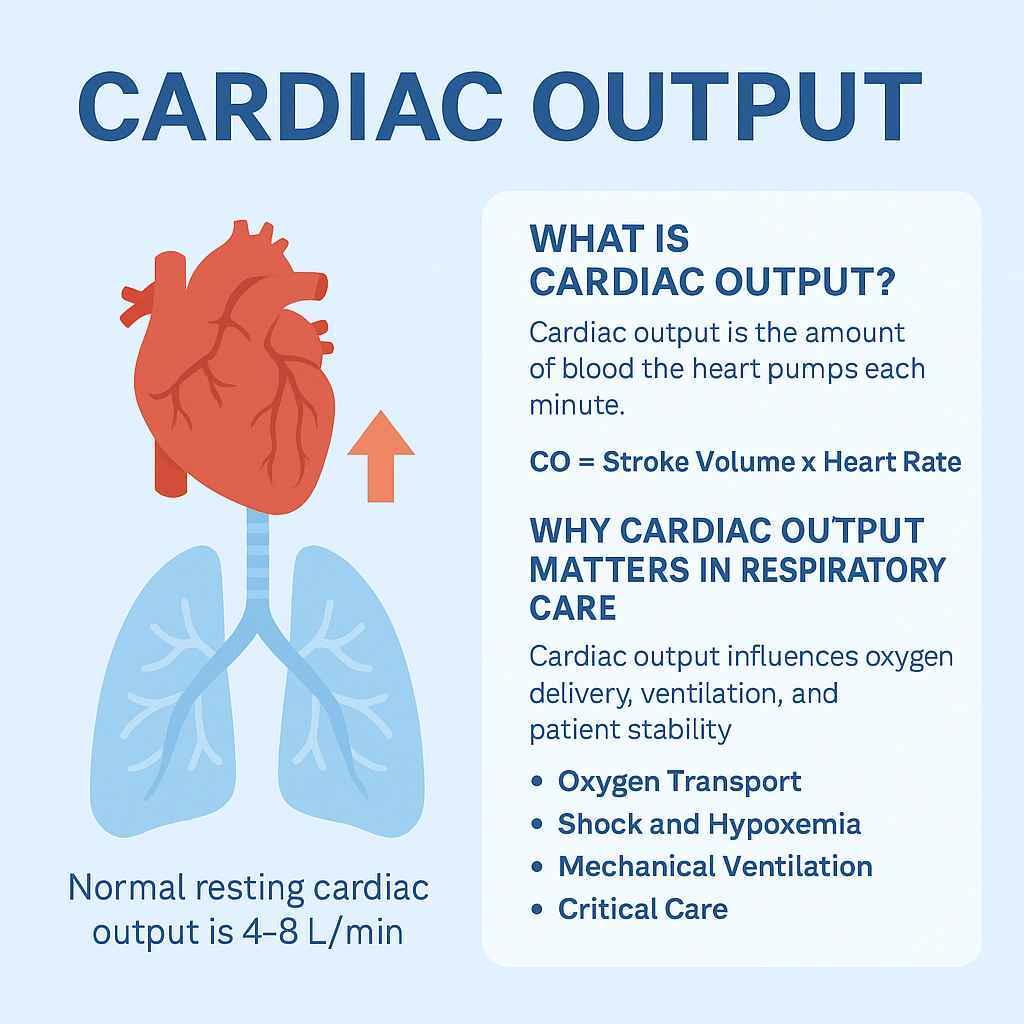
Cardiac output refers to the amount of blood pumped by the heart in one minute, indicating how effectively it delivers oxygen and nutrients to the body. It is calculated by multiplying stroke volume (the amount of blood ejected with each beat) by heart rate (beats per minute).
In adults, normal cardiac output usually ranges between 4 and 8 liters per minute, depending on body size, fitness level, and activity. This measurement is essential in healthcare because even if lung function and oxygenation are adequate, low cardiac output means tissues may still be deprived of oxygen.
Cardiac Output Calculation
Cardiac output (CO) is the amount of blood pumped by the heart each minute. It is calculated with the formula:
CO = Stroke Volume × Heart Rate
- Stroke Volume (SV): the amount of blood ejected from the left ventricle with each heartbeat.
- Heart Rate (HR): the number of heartbeats per minute.
For example, if the stroke volume is 70 mL and the heart rate is 75 beats per minute, cardiac output is:
70 × 75 = 5,250 mL/min, or about 5.2 L/min.
The normal resting cardiac output for an adult ranges from 4–8 L/min, depending on body size and activity level.
Why Cardiac Output Matters in Respiratory Care
Respiratory therapists must closely monitor a patient’s cardiac output, as it affects the amount of oxygen that reaches the tissues. Even if ventilation and oxygenation in the lungs are adequate, poor cardiac output means oxygen delivery to cells will still be insufficient.
Some key connections include:
- Oxygen Transport: Cardiac output, hemoglobin concentration, and oxygen saturation together determine oxygen delivery (DO₂) to tissues.
- Shock and Hypoxemia: In conditions like septic shock, cardiac output may rise, but oxygen delivery is still impaired. In cardiogenic shock, cardiac output falls, leading to hypoxia despite normal lung function.
- Mechanical Ventilation: Positive pressure ventilation can affect venous return and reduce cardiac output, making monitoring essential.
- Critical Care: Therapists working in ICUs often interpret hemodynamic data, such as cardiac output, alongside ABG results to adjust ventilation strategies.
Methods of Measuring Cardiac Output
Cardiac output can be measured or estimated through several methods:
- Thermodilution: via a pulmonary artery (Swan-Ganz) catheter.
- Fick Principle: based on oxygen consumption and arterial-venous oxygen difference.
- Noninvasive methods: echocardiography, bioimpedance, or pulse contour analysis.
Note: Respiratory therapists may not always perform these measurements directly; however, they must interpret the results and understand how cardiac output affects patient care.
Clinical Relevance for Respiratory Therapists
- Ventilator Management: Adjustments in PEEP, tidal volume, or mean airway pressure can alter intrathoracic pressure and reduce venous return, thereby impacting cardiac output.
- Oxygen Therapy: Even when FiO₂ is optimized, patients with low cardiac output may not receive adequate oxygen delivery to tissues, requiring careful evaluation.
- Exercise and Rehabilitation: In pulmonary rehabilitation, understanding cardiac output helps therapists recognize limits to patient endurance and tailor therapy.
- Interpreting Hemodynamics: Respiratory therapists frequently collaborate with physicians and nurses to evaluate hemodynamic data in critically ill patients, ensuring ventilation and oxygen delivery are balanced.
Cardiac Output Practice Questions
1. What is cardiac output?
The amount of blood pumped by the heart in one minute, reflecting how effectively it delivers oxygen and nutrients to the body.
2. How is cardiac output calculated?
By multiplying stroke volume (SV) by heart rate (HR).
3. What is the normal resting cardiac output for an adult?
Between 4 and 8 liters per minute, depending on body size, fitness, and activity level.
4. What does stroke volume represent in cardiac output?
The amount of blood ejected by the left ventricle with each heartbeat.
5. What does heart rate represent in cardiac output?
The number of heartbeats per minute.
6. If stroke volume is 70 mL and heart rate is 75 beats per minute, what is the cardiac output?
About 5,250 mL/min or 5.2 L/min.
7. Why is cardiac output essential in healthcare?
Because even with normal lung function, low cardiac output means tissues may still be deprived of oxygen.
8. What three factors together determine oxygen delivery (DO₂) to tissues?
Cardiac output, hemoglobin concentration, and oxygen saturation.
9. How does cardiac output affect oxygen transport?
It determines how much oxygenated blood is delivered to the body’s tissues each minute.
10. What happens in cardiogenic shock to cardiac output?
It decreases, leading to hypoxia despite adequate lung function.
11. What happens to cardiac output in septic shock?
It may increase, but oxygen delivery is still impaired due to poor tissue utilization.
12. How does mechanical ventilation influence cardiac output?
Positive pressure ventilation can reduce venous return and lower cardiac output.
13. Why is cardiac output especially important to monitor in critical care?
Because it guides decisions about ventilation, oxygen therapy, and hemodynamic management.
14. Which method uses a pulmonary artery catheter to measure cardiac output?
Thermodilution
15. What principle calculates cardiac output using oxygen consumption and arterial-venous oxygen difference?
The Fick principle.
16. What noninvasive test can estimate cardiac output?
Echocardiography
17. Besides echocardiography, what are other noninvasive ways to estimate cardiac output?
Bioimpedance and pulse contour analysis.
18. Why must respiratory therapists understand cardiac output even if they don’t measure it directly?
Because it affects oxygen delivery and guides ventilator and oxygen therapy management.
19. How can PEEP adjustments on a ventilator affect cardiac output?
By increasing intrathoracic pressure, which may reduce venous return and cardiac output.
20. Why is optimizing FiO₂ sometimes not enough in patients with low cardiac output?
Because oxygen delivery depends on cardiac output as well as oxygen levels in the lungs.
21. How does exercise influence cardiac output?
It increases due to higher heart rate and stroke volume, meeting greater metabolic demands.
22. Why is cardiac output important in pulmonary rehabilitation?
It helps determine patient endurance and guides therapy plans.
23. How do respiratory therapists use cardiac output data in ICUs?
They interpret it alongside ABG results to balance ventilation and oxygen delivery.
24. Which organ systems rely most heavily on adequate cardiac output?
The brain, heart, kidneys, and muscles.
25. What clinical complication can result from persistently low cardiac output?
Tissue hypoxia and organ failure.
26. How does anemia affect oxygen delivery even if cardiac output is normal?
Reduced hemoglobin decreases oxygen-carrying capacity.
27. How might tachycardia affect cardiac output?
It may reduce stroke volume, potentially lowering overall cardiac output.
28. How does bradycardia affect cardiac output?
It decreases heart rate, which lowers overall cardiac output unless stroke volume increases.
29. How does cardiac output relate to mean arterial pressure (MAP)?
MAP depends on cardiac output and systemic vascular resistance.
30. Why must respiratory therapists consider both cardiac output and oxygenation together?
Because effective patient care requires balancing ventilation, perfusion, and circulation for adequate oxygen delivery.
31. What is the term for the amount of blood pumped by a ventricle in one minute?
Cardiac output
32. What unit is cardiac output measured in?
Liters per minute
33. True or False: Cardiac output reflects the effectiveness of the cardiovascular system.
True
34. What is the term for the number of heartbeats per minute?
Heart rate
35. What is a cardiac cycle?
A complete heartbeat consisting of contraction and relaxation of both atria and ventricles.
36. What is the amount of blood ejected by the heart per beat?
Stroke volume
37. What is the formula for calculating cardiac output?
Cardiac Output = Heart Rate × Stroke Volume.
38. What does cardiac output reveal about the heart?
How well the heart is functioning.
39. At rest, how many liters of blood does the average adult pump per minute?
Approximately 5.25 liters.
40. True or False: The average resting cardiac output is between 5–6 liters per minute.
True
41. True or False: Any factor that affects heart rate or stroke volume also affects cardiac output.
True
42. What are two external factors that affect cardiac output?
Chronotropic agents and ionotropic agents.
43. How do chronotropic agents affect cardiac output?
They increase or decrease heart rate by influencing the autonomic nervous system.
44. What is an example of a positive chronotropic agent?
Dopamine or epinephrine, which increase heart rate.
45. What is an example of a negative chronotropic agent?
Acetylcholine or beta blockers, which decrease heart rate.
46. How do positive chronotropic agents affect the heart?
They increase heart rate by stimulating the sympathetic nervous system.
47. How do negative chronotropic agents affect the heart?
They decrease heart rate by enhancing parasympathetic activity.
48. How do ionotropic agents influence cardiac output?
They increase or decrease stroke volume by altering the strength of contraction.
49. What is an example of a positive ionotropic agent?
Digoxin, dopamine, dobutamine, or milrinone.
50. What effect do positive ionotropic agents have on the heart?
They increase calcium availability, strengthen contractions, and raise stroke volume.
51. What is an example of a negative ionotropic agent?
Beta blockers or calcium channel blockers.
52. What effect do negative ionotropic agents have on the heart?
They reduce calcium availability, weaken contractions, and lower stroke volume.
53. True or False: Calcium concentration influences the strength of heart contractions.
True
54. True or False: Stronger heart contractions increase the volume of blood ejected.
True
55. True or False: Venous return and afterload are variables that affect cardiac output.
True
56. What is venous return?
The volume of blood returning to the heart.
57. Does the efficiency of venous return affect stroke volume?
Yes, better venous return increases stroke volume.
58. What is the Frank-Starling Law of the heart?
The greater the stretch of ventricular muscle cells, the greater the force of contraction, increasing stroke volume and cardiac output.
59. True or False: The cardiovascular system is a closed system where blood flows in one direction.
Tru
60. What is afterload?
The pressure the ventricles must overcome to eject blood, determined by arterial resistance and aortic valve pressure.
61. Cardiac output refers to what?
The amount of blood the heart pumps in one minute.
62. Stroke volume is the amount of what?
Blood ejected by the heart with each beat.
63. What is the formula for calculating cardiac output?
CO = HR × SV (Cardiac Output = Heart Rate × Stroke Volume).
64. What is the typical resting heart rate for adults?
About 75 beats per minute.
65. Approximately how much blood does the heart eject per beat (stroke volume)?
Around 70 mL
66. What is the average stroke volume range in healthy adults?
60–80 mL per beat
67. How does cardiac output change with physical activity?
It increases to meet higher oxygen and nutrient demands.
68. What are the only two direct ways to affect cardiac output?
By changing heart rate or stroke volume.
69. When heart rate increases significantly, what usually happens to stroke volume?
It decreases due to reduced ventricular filling time.
70. What is the average heart rate of a newborn infant?
About 120 beats per minute.
71. What is the average resting heart rate for young adult females?
Between 72 and 80 beats per minute.
72. What is the average resting heart rate for young adult males?
Between 64 and 72 beats per minute.
73. Bradycardia is defined as a heart rate slower than what value?
60 beats per minute
74. Tachycardia is defined as a heart rate faster than what value?
100 beats per minute
75. What does cardiac output measure clinically?
The effectiveness of the heart’s pumping ability.
76. Cardiac output depends primarily on which two factors?
Venous return and the strength of ventricular contraction.
77. How does stronger ventricular contraction affect stroke volume?
It increases stroke volume.
78. Define cardiac output in terms of ventricles.
The amount of blood pumped out by each ventricle in one minute.
79. Write the equation for cardiac output.
CO = HR × SV
80. Define stroke volume in terms of ventricular function.
The amount of blood ejected from each ventricle in one heartbeat.
81. Write the equation for stroke volume.
SV = EDV – ESV (End-Diastolic Volume minus End-Systolic Volume).
82. What are the typical normal values for heart rate, stroke volume, EDV, and ESV?
HR = 75 bpm, SV = 70 mL, EDV = 120 mL, ESV = 50 mL.
83. How does increased sympathetic nervous system activity affect HR, SV, and CO?
It increases all three values.
84. How does increased venous return affect stroke volume and cardiac output?
It raises stroke volume and cardiac output.
85. How does exercise affect HR, SV, and CO?
It increases all three to meet metabolic demand.
86. How does an increase in calcium affect HR, SV, and CO?
It increases contractility, raising heart rate, stroke volume, and cardiac output.
87. How does a decrease in heart rate affect stroke volume?
It increases stroke volume due to longer ventricular filling time.
88. Why does stroke volume increase with sympathetic stimulation or higher calcium levels?
Because contractility improves, producing stronger contractions.
89. Why does stroke volume increase when heart rate slows down?
Because longer filling time increases end-diastolic volume.
90. What law of the heart explains why increased filling leads to stronger contractions and higher stroke volume?
The Frank-Starling Law
91. What happens to cardiac output during severe blood loss (hemorrhage)?
It decreases due to reduced venous return and stroke volume.
92. How does dehydration affect cardiac output?
It lowers venous return, which reduces stroke volume and cardiac output.
93. Why does cardiac output increase during fever?
Because metabolic demands rise, causing an increase in heart rate.
94. How does anemia influence cardiac output?
It often increases as the body compensates for reduced oxygen-carrying capacity.
95. What effect does hypertension have on afterload and cardiac output?
It increases afterload, making it harder for the ventricles to eject blood, which may lower cardiac output.
96. How does pregnancy typically affect cardiac output?
It increases due to higher blood volume and increased venous return.
97. Why does cardiac output decrease in heart failure?
Because the heart cannot pump effectively, leading to reduced stroke volume.
98. What is the relationship between cardiac output and tissue perfusion?
Adequate cardiac output is essential to maintain sufficient blood flow and oxygen delivery to tissues.
99. Which nervous system primarily regulates short-term changes in cardiac output?
The autonomic nervous system
100. How does endurance training affect resting cardiac output?
Resting cardiac output remains similar, but trained individuals achieve it with lower heart rates and higher stroke volumes.
Final Thoughts
Cardiac output is more than a cardiovascular measurement; it is a vital indicator of how well the body is receiving the oxygen and nutrients it needs. For respiratory therapists, recognizing the interplay between cardiac function and respiratory care is essential to managing patient outcomes.
Whether adjusting ventilator settings, providing oxygen therapy, or working in critical care, understanding cardiac output helps guide safe and effective decisions.
By integrating this knowledge into practice, respiratory therapists can ensure that both the heart and lungs are supported in their shared role of sustaining life and maintaining overall patient stability.

Written by:
John Landry is a registered respiratory therapist from Memphis, TN, and has a bachelor's degree in kinesiology. He enjoys using evidence-based research to help others breathe easier and live a healthier life.
References
- King J, Lowery DR. Physiology, Cardiac Output. [Updated 2023 Jul 17]. In: StatPearls [Internet]. Treasure Island (FL): StatPearls Publishing; 2025.