

Crackles (rales) are one of the most important adventitious lung sounds that respiratory therapists must learn to identify during auscultation. These distinctive, noncontinuous sounds can reveal a great deal about what is happening inside the airways and alveoli—from the movement of secretions to the reopening of collapsed lung units.
Because crackles vary in intensity, timing, and underlying cause, understanding what they represent is essential for accurate assessment and effective clinical decision-making.
In this article, we’ll break down what crackles are, why they occur, the different types you may encounter at the bedside, and what each type can tell you about a patient’s respiratory condition.

What Are Crackles?
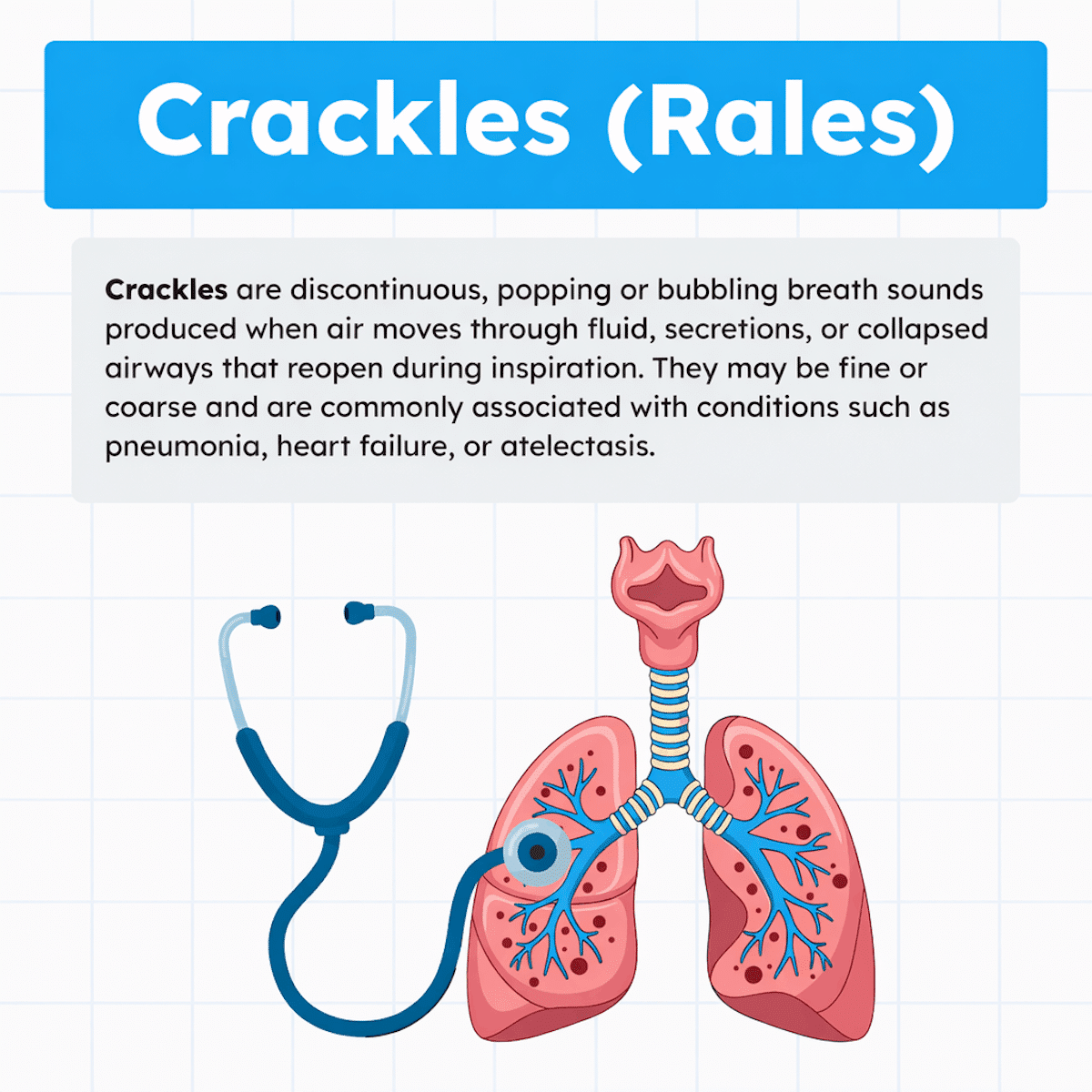
Crackles are discontinuous, short-duration lung sounds produced by air moving through fluid, secretions, or collapsed airways during breathing. They are most commonly heard during inspiration, although they can occasionally occur during expiration depending on the underlying condition. These sounds are considered adventitious because they are not present in healthy lungs and typically indicate pathology.
Crackles occur for two main reasons. The first is when airflow displaces secretions or fluid within the airways, creating intermittent bubbling or popping sounds. The second is when collapsed or narrowed airways suddenly pop open during inspiration. This rapid opening produces a brief, crackling sound that varies depending on the size and location of the airway involved.
Because crackles can reflect different respiratory issues, clinicians must pay close attention to their timing, character, and response to coughing. These features provide critical clues about whether the source is excess secretions, pulmonary edema, atelectasis, or an underlying restrictive process.
Types of Crackles
Crackles are generally divided into two major categories: fine crackles and coarse crackles. Understanding the differences between them is essential because each type points toward different underlying pathologies.
Fine Crackles
Fine crackles are soft, high-pitched, and short in duration. They often sound like rubbing hair between your fingers near your ear. These crackles typically occur when small airways or alveoli that have collapsed reopen suddenly during inspiration. Because they are related to airway recruitment rather than secretions, fine crackles do not usually clear with coughing. When present, they may indicate fluid-filled or stiff lung tissue, as seen with conditions such as congestive heart failure (CHF) or restrictive lung diseases.
Fine crackles can occur early or late in inspiration depending on where the affected airways are located. Late inspiratory fine crackles, in particular, are strongly associated with diseases like pulmonary fibrosis or atelectasis, where the lung has reduced compliance.
Coarse Crackles
Coarse crackles are louder, lower pitched, and longer lasting than fine crackles. They are produced when air moves through larger airways containing secretions, creating a bubbling or rattling sound. Historically, these were referred to as rhonchi, but the term is no longer favored because it has been inconsistently defined.
Unlike fine crackles, coarse crackles often improve or disappear after coughing or suctioning because clearing the secretions removes the source of the sound. They are commonly heard in conditions such as bronchitis, pneumonia, or COPD exacerbations where mucus production is increased.
What Causes Crackles?
Crackles occur when normal airflow is disrupted by abnormal conditions in the airways or alveoli. The underlying mechanisms can be grouped into two primary categories: airflow through secretions or fluid and reopening of collapsed airways.
Airflow Through Secretions or Fluid
When mucus, fluid, or exudate accumulates in the airways, airflow creates intermittent bubbling or popping sounds. This mechanism is responsible for most coarse crackles, which are common in conditions such as pneumonia, bronchitis, or pulmonary edema. Because the source of the sound is physical material in the airway, the crackles may change or clear after coughing, mobilization, or suctioning.
Reopening of Collapsed or Narrowed Airways
Fine crackles often result from airways that have partially or completely collapsed due to disease, atelectasis, or decreased lung compliance. During inspiration, as intrathoracic pressure decreases, these airways suddenly “pop” open, producing a sharp, discontinuous sound. This phenomenon is frequently heard in restrictive lung diseases such as pulmonary fibrosis, or in early stages of CHF when alveoli become fluid-filled.
Timing plays a key role in interpretation.
- Early inspiratory crackles typically arise from larger, more proximal airways.
- Late inspiratory crackles suggest deeper involvement of the distal airways and alveoli, and are often associated with more severe or chronic pathology.
Note: Crackles provide important physiological clues, helping clinicians determine whether a patient’s symptoms stem from secretions, fluid overload, or impaired lung expansion.
Clinical Conditions Associated With Crackles
Crackles are valuable diagnostic clues because they appear in a wide range of respiratory and cardiac conditions. Recognizing the type and timing of crackles helps clinicians narrow down the underlying cause and guide treatment.
Congestive Heart Failure (CHF)
Fine crackles are a hallmark of pulmonary congestion caused by left-sided heart failure. As fluid accumulates in the interstitial and alveolar spaces, small airways collapse and then reopen during inspiration, producing late inspiratory fine crackles. These crackles typically do not clear with coughing.
Pneumonia
In pneumonia, inflammatory exudate fills the airways and alveoli. This can produce both fine and coarse crackles depending on the stage and severity of the infection. Because secretions often play a major role, crackles may change or become less prominent after coughing or suctioning.
Chronic Obstructive Pulmonary Disease (COPD)
Patients with COPD, especially during an exacerbation, may produce coarse crackles due to increased mucus production and airway inflammation. These crackles can be scattered or diffuse and may improve after the airways are cleared.
Pulmonary Fibrosis
Pulmonary fibrosis and other restrictive lung diseases often generate late inspiratory fine crackles. These crackles are sometimes described as “Velcro-like” and reflect stiff, fibrotic lung tissue with repetitive airway opening during inspiration.
Atelectasis
In collapsed lung segments, fine crackles may occur as the alveoli rapidly reopen when the patient takes a deep breath or during early stages of recruitment on mechanical ventilation.
Crackles are rarely diagnostic on their own, but when combined with imaging, patient history, oxygenation status, and other exam findings, they provide strong clues about the underlying pathology.
How to Assess Crackles During Auscultation
Accurate identification of crackles requires proper technique and careful attention to detail. Respiratory therapists must be systematic when listening to breath sounds to ensure no abnormalities are overlooked.
Use a Systematic Approach
Place the stethoscope firmly against the patient’s skin and listen from the apices to the bases of the lungs, comparing one side to the other. Crackles are often more prominent in the lower lung fields where fluid or atelectasis commonly develops, so thorough coverage is essential.
Listen During Both Inspiration and Expiration
Although crackles are most frequently heard during inspiration, they can also occur during expiration in certain conditions. Assessing breath sounds throughout the full respiratory cycle helps determine timing, which is crucial for interpretation.
Evaluate the Sound Quality
Pay attention to whether the crackles are:
- Fine or coarse
- High or low pitched
- Soft or loud
- Brief or prolonged
Note: These characteristics help differentiate between secretions, airway collapse, and fluid-filled alveoli.
Assess Response to Coughing or Suctioning
Crackles caused by mucus or secretions—typically coarse crackles—often diminish or clear after coughing or suctioning. Fine crackles generally do not change with airway clearance techniques. Noting this response provides important diagnostic clues.
Consider Patient Position
Crackles can vary depending on the patient’s posture. For example, gravity can shift fluid or expand dependent lung regions, causing crackles to appear or disappear. Listening in both upright and supine positions may reveal more information.
Note: Careful assessment allows respiratory therapists to differentiate among the many causes of crackles and determine whether immediate intervention is needed.
Why Identifying Crackles Matters in Respiratory Care
Recognizing and correctly interpreting crackles is essential for respiratory therapists because these sounds often provide early and practical insights into a patient’s clinical status. Many respiratory and cardiac conditions first present with subtle changes in lung sounds long before oxygenation drops or imaging is obtained.
Early Detection of Worsening Disease
Crackles may be the first indication of fluid buildup, infection, or decreased lung compliance. Identifying them promptly allows clinicians to initiate treatment earlier, potentially preventing progression to respiratory failure, hypoxemia, or the need for ventilatory support.
Monitoring Treatment Response
Changes in the presence, timing, or intensity of crackles can help clinicians gauge how well a treatment plan is working.
- A decrease in coarse crackles after coughing, suctioning, or bronchodilator therapy may suggest improved airway clearance.
- A shift in wheeze pitch or duration can indicate better airflow, while persistent fine crackles may suggest ongoing fluid overload or restrictive pathology.
Guiding Airway Clearance and Ventilator Strategies
Crackles help determine whether interventions such as chest physiotherapy, positive pressure therapy, deep breathing exercises, or adjustments in ventilator settings are appropriate. For example, persistent fine crackles may indicate the need for recruitment maneuvers in mechanically ventilated patients.
Improving Diagnostic Accuracy
Crackles act as a valuable clinical clue that complements imaging, lab tests, and patient symptoms. When interpreted alongside these other findings, they help clinicians pinpoint causes such as pneumonia, pulmonary edema, atelectasis, or fibrosis more accurately.
Note: Because auscultation is quick, noninvasive, and available at the bedside, crackles play a key role in continuous evaluation of respiratory health.
Crackles Practice Questions
1. What are adventitious lung sounds?
Additional abnormal breath sounds produced when air moves through diseased or obstructed airways.
2. How are adventitious breath sounds classified?
They are classified as discontinuous (crackles/rales) or continuous (wheezes).
3. What characterizes discontinuous adventitious sounds?
Intermittent, crackling, or bubbling sounds of short duration.
4. What are fine crackles?
Low-intensity, brief crackling sounds typically associated with collapsed small airways or fluid-filled alveoli.
5. What are coarse crackles?
Louder, longer crackles usually caused by airway secretions and often clear with coughing.
6. What was the older meaning of the term “rhonchi”?
Low-pitched, continuous sounds associated with secretions in large airways; now considered equivalent to coarse crackles.
7. What produces crackles during inspiration?
Air moving through secretions or the sudden opening of collapsed distal airways.
8. What is the clinical significance of crackles that clear with coughing?
They commonly indicate mucus or secretions in the larger airways.
9. What does the persistence of crackles despite coughing typically suggest?
Fluid-filled airways or collapsed alveoli that reopen during inspiration.
10. What condition is commonly associated with fine crackles that do not clear with cough?
Congestive heart failure due to fluid accumulation in the alveoli.
11. When do early inspiratory crackles usually occur?
When larger or proximal airways abruptly open, often associated with chronic bronchitis.
12. When do late inspiratory crackles typically occur?
Near the end of inspiration when small distal airways or alveoli suddenly pop open.
13. What lung condition is suggested by fine, late inspiratory crackles?
Pulmonary fibrosis or other restrictive lung diseases.
14. Why do fine crackles occur in atelectasis?
Collapsed alveoli reopen during deep or late inspiration, producing a fine popping sound.
15. How does inspiratory effort influence crackles?
Stronger inspiratory effort can recruit deeper airways, altering the timing and intensity of crackles.
16. What breath sound pattern is consistent with airway secretions that shift with ventilation?
Coarse crackles that vary with coughing or suctioning.
17. How do crackles differ from wheezes in terms of sound characteristics?
Crackles are discontinuous popping sounds, while wheezes are continuous musical tones.
18. What does a decrease in pitch and duration of wheezing indicate?
Improved expiratory airflow.
19. Why is it important to distinguish between fine and coarse crackles?
Each type correlates with different pathophysiologic processes such as airway secretion burden vs alveolar collapse.
20. What causes bubbling or crackling sounds during auscultation in pneumonia?
Airflow through fluid or exudate in the alveoli.
21. In which lung regions are crackles most commonly heard?
They are most often heard in the lower lobes.
22. How are crackles typically classified?
They are classified as fine crackles or coarse crackles.
23. What do fine crackles most closely sound like?
The sound of rolling or twisting a strand of hair between the fingers near the ear.
24. What do coarse crackles most closely sound like?
A Velcro-like tearing sound.
25. What is the primary mechanism that produces crackles?
The sudden opening of collapsed small airways and alveoli during inspiration.
26. What do crackles indicate regarding airway or alveolar condition?
They indicate the presence of fluid, secretions, or unstable alveoli.
27. How would you describe fine crackles during auscultation?
High-pitched, brief popping sounds heard at the end of inspiration.
28. How would you describe coarse crackles during auscultation?
Loud, low-pitched bubbling sounds heard during early to mid inspiration.
29. Where are crackles most consistently auscultated?
At the lung bases.
30. What clinical significance do crackles carry?
They suggest fluid accumulation, inflammation, or alveolar instability in the lungs.
31. When do fine crackles typically occur?
Mid to late inspiration, unrelated to secretions or coughing.
32. When do coarse crackles typically occur?
Early inspiration and may change or clear with coughing.
33. What condition commonly presents with fine inspiratory crackles?
Pulmonary fibrosis or other restrictive lung diseases.
34. What condition commonly presents with coarse crackles?
Airway secretion retention such as in bronchitis or pneumonia.
35. Why do coarse crackles sometimes clear after coughing?
Because they are often caused by secretions within larger airways.
36. What type of crackles are associated with congestive heart failure?
Fine crackles heard at the lung bases.
37. What do crackles that do not change with coughing typically indicate?
Fluid in the alveoli or small airway collapse rather than secretions.
38. What breath sound resembles salt sprinkled on a hot pan?
Fine inspiratory crackles.
39. What breath sound resembles water being poured from a bottle?
Coarse crackles.
40. What do persistent fine crackles in the bases suggest?
Late inspiratory alveolar recruitment due to fibrosis or atelectasis.
41. What diseases commonly present with crackles as an early finding?
ARDS, early heart failure, pulmonary edema, and interstitial lung disease.
42. What general pathophysiologic process leads to crackles in restrictive disease?
The reopening of stiff, collapsed alveoli during inspiration.
43. What general process leads to crackles in obstructive or infectious disease?
Airflow moving through secretions or fluid in larger airways.
44. What makes crackles a discontinuous breath sound?
They consist of separate, short, explosive popping noises.
45. Are crackles typically inspiratory, expiratory, or both?
Primarily inspiratory but may occasionally occur during early expiration.
46. Why are crackles more common at the bases?
Gravity causes dependent accumulation of fluid and alveolar collapse in lower lung regions.
47. What does the presence of bilateral fine crackles at the bases strongly suggest?
Pulmonary edema or interstitial lung involvement.
48. What does the presence of unilateral coarse crackles often indicate?
Localized pneumonia with airway secretions.
49. What does a sudden increase in crackles during therapy suggest?
Airway recruitment or movement of secretions.
50. When auscultating crackles, why is patient repositioning helpful?
It helps differentiate gravity-dependent alveolar collapse from secretion-related crackles.
51. What does the presence of late inspiratory fine crackles generally indicate?
It suggests alveolar opening in stiff or fibrotic lung tissue.
52. What do early inspiratory crackles most often indicate?
Airflow obstruction such as chronic bronchitis or COPD.
53. How do crackles differ from wheezes in terms of sound quality?
Crackles are discontinuous popping sounds; wheezes are continuous musical tones.
54. What does it mean if crackles are heard only at the end of deep breaths?
Small airway or alveolar recruitment is occurring during deep inspiration.
55. What type of crackles are often heard in patients recovering from atelectasis?
Fine, late inspiratory crackles.
56. Why might crackles increase after a patient performs incentive spirometry?
More alveoli are opening due to improved lung expansion.
57. What do fine crackles at the lung bases that worsen when lying supine indicate?
Fluid redistribution seen in conditions like heart failure.
58. Why is it important to auscultate crackles before and after suctioning?
To differentiate secretion-related crackles from alveolar crackles.
59. What does the persistence of coarse crackles after suctioning suggest?
Airway inflammation or edema rather than removable secretions.
60. What type of crackles are commonly heard in pulmonary edema?
Diffuse, bilateral fine crackles.
61. Why are crackles frequently heard in dependent lung areas?
These areas are most prone to fluid accumulation and collapse.
62. What does a rapid appearance of crackles during fluid resuscitation indicate?
Possible fluid overload affecting the lungs.
63. What does improvement or resolution of crackles after diuretic therapy suggest?
Reduction of pulmonary congestion.
64. Why do crackles often accompany pneumonia?
Secretions and exudate disrupt airflow in affected lung segments.
65. What does a combination of fever, cough, and localized crackles suggest?
Consolidation in a specific lobe consistent with infection.
66. Why do patients with ARDS often present with widespread crackles?
Alveolar flooding and decreased compliance cause diffuse recruitment sounds.
67. What distinguishes crackles in fibrosis from crackles in edema?
Fibrosis crackles are “dry,” fine, and persistent; edema crackles are often moist and variable.
68. What do asymmetric crackles usually indicate?
Localized disease such as pneumonia or unilateral atelectasis.
69. What does the presence of inspiratory crackles with reduced chest excursion suggest?
Significant alveolar collapse or restrictive lung disease.
70. Why is auscultation at the posterior lung bases essential for detecting crackles?
This is where crackles first appear in many forms of lung pathology.
71. What does it mean if crackles disappear as a patient’s respiratory rate slows?
They were likely related to rapid, shallow ventilation and small airway instability.
72. Why might crackles become more audible during deep breathing?
Greater airflow and lung expansion accentuate alveolar opening.
73. What do coarse crackles in a patient with a productive cough typically suggest?
Secretions in larger airways.
74. What does a sudden onset of crackles following chest trauma raise concern for?
Possible pulmonary contusion.
75. Why do crackles frequently occur in elderly patients?
Age-related decrease in lung elasticity and periodic small airway closure.
76. What condition is suggested by fine crackles that persist even after changing position?
Underlying structural lung disease like fibrosis.
77. What does the combination of crackles and jugular venous distention indicate?
Possible cardiogenic pulmonary edema.
78. Why is listening over multiple respiratory cycles important when assessing crackles?
Crackles may vary with depth and timing of breaths.
79. What does an increase in crackles during bronchodilator therapy indicate?
Improved airflow mobilizing secretions or reopening airways.
80. What does the presence of crackles that worsen during exertion suggest?
Exertional pulmonary congestion or decreased cardiopulmonary reserve.
81. What does it indicate when fine crackles are heard only after a patient takes several deep breaths?
Gradual recruitment of previously collapsed alveoli.
82. What does the presence of crackles that intensify when a patient transitions from sitting to supine suggest?
Redistribution of pulmonary fluid toward dependent regions.
83. What does a finding of bilateral crackles with elevated blood pressure commonly point toward?
Fluid overload leading to pulmonary congestion.
84. Why is it important to differentiate crackles from upper airway sounds transmitted into the lungs?
Upper airway noises may mimic crackles but do not represent lung pathology.
85. What does it mean if crackles diminish significantly after positional drainage therapy?
Secretions moved from distal to more proximal airways.
86. What do crackles heard predominantly on inspiration, but absent on expiration, indicate?
Airway or alveolar opening rather than secretion vibration.
87. What does the presence of crackles in a postoperative patient frequently indicate?
Shallow breathing–induced atelectasis.
88. Why are crackles often an early finding in interstitial lung disease?
Fibrotic changes stiffen alveoli, causing abrupt opening sounds during inhalation.
89. What pattern do crackles typically produce on auscultation in bronchiectasis?
Coarse, gurgling sounds due to retained secretions.
90. Why might crackles appear after extubation?
Residual atelectasis or weakened respiratory effort.
91. What does the recurrence of crackles after suctioning suggest?
Continuous secretion production or ongoing pathology.
92. Why is it significant when crackles are heard during both early and late inspiration?
There may be combined airway obstruction and alveolar involvement.
93. What does the presence of intermittent crackles in a dehydrated patient suggest?
Thickened secretions partially obstructing small airways.
94. Why are crackles often heard in the dependent lung of a patient lying on one side?
Gravity shifts fluid and secretions into the lowermost lung region.
95. What condition is associated with fine crackles that remain unchanged after coughing?
Interstitial or alveolar disease rather than airway secretions.
96. What does it indicate when crackles worsen with rapid shallow breathing?
Small airway collapse due to insufficient tidal volume.
97. Why might crackles be heard in a patient with reduced diaphragmatic movement?
Poor lung expansion increases the likelihood of alveolar collapse.
98. What condition should be suspected when crackles are accompanied by frothy sputum?
Cardiogenic pulmonary edema
99. Why would crackles diminish after the initiation of positive airway pressure therapy?
Improved alveolar recruitment reduces sudden opening events.
100. What does it indicate if crackles appear only at maximum inhalation in an otherwise clear lung exam?
Mild dependent atelectasis or early fluid accumulation.
Final Thoughts
Crackles are a critical clinical finding that offer meaningful insight into a patient’s respiratory status. By understanding how these sounds are produced, what differentiates fine from coarse crackles, and which conditions they suggest, respiratory therapists can make more accurate assessments at the bedside.
Careful auscultation—combined with attention to timing, sound quality, and response to coughing—helps clinicians distinguish between secretions, fluid accumulation, airway collapse, and restrictive disease.
Because crackles often appear early in the course of respiratory compromise, recognizing them promptly can guide timely interventions, improve patient outcomes, and strengthen decision-making across all areas of respiratory care.

Written by:
John Landry is a registered respiratory therapist from Memphis, TN, and has a bachelor's degree in kinesiology. He enjoys using evidence-based research to help others breathe easier and live a healthier life.
References
- Zimmerman B, Williams D. Lung Sounds. [Updated 2023 Aug 28]. In: StatPearls [Internet]. Treasure Island (FL): StatPearls Publishing; 2025.