

Rhonchi are one of the most commonly encountered adventitious lung sounds and an important indicator of mucus or secretions within the airways. Traditionally described as low-pitched, coarse, continuous sounds, rhonchi often resemble a rattling or gurgling noise and typically improve after coughing or suctioning.
Although the term has largely been replaced in modern terminology by “coarse crackles,” many clinicians and respiratory therapists still use rhonchi to describe sounds produced when air moves through mucus-filled or partially obstructed larger airways.
In this article, we will explore the mechanisms behind rhonchi, their clinical implications, and how to evaluate them at the bedside.

What Are Rhonchi?
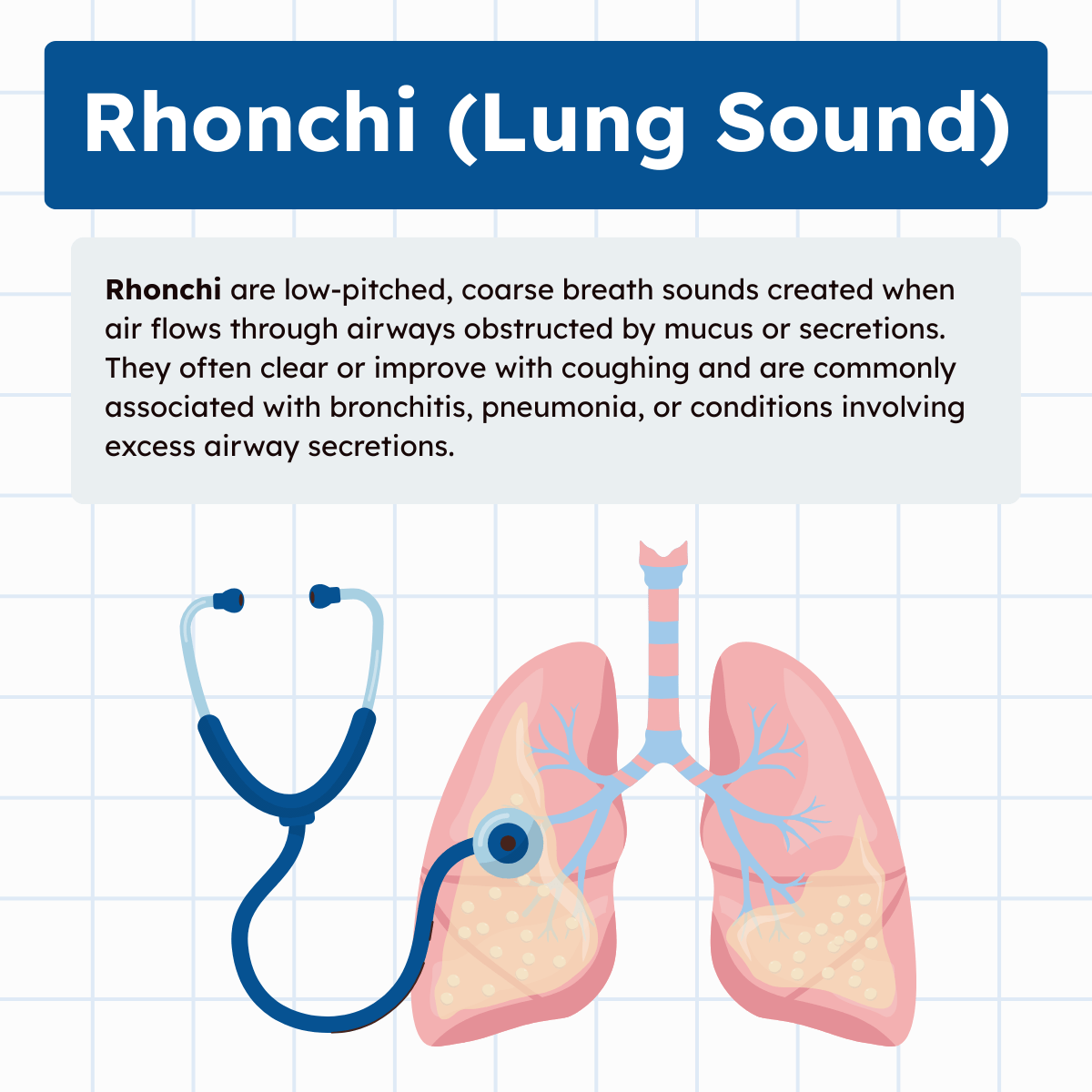
Rhonchi are low-pitched, coarse breath sounds produced when air flows through airways partially obstructed by mucus, secretions, or other debris. They are considered continuous adventitious lung sounds, though in modern terminology they are more accurately classified as coarse crackles. Historically, the term “rhonchi” was used to describe wheeze-like sounds originating in the larger airways, but as pulmonary terminology evolved, rhonchi became closely associated with secretion-related airflow obstruction.
These sounds often have a rattling, rumbling, or gurgling quality and may resemble snoring. Because they result from movement of mucus or the vibration of airway walls coated with secretions, rhonchi frequently change or clear after coughing or suctioning—an important distinguishing feature. Their presence indicates that airflow is interacting with material inside the bronchial passages rather than narrowing caused primarily by bronchospasm.
Rhonchi can occur during inspiration, expiration, or both, and are typically heard over the central airways. Their location and behavior provide valuable clues to the severity of mucus accumulation and the effectiveness of airway clearance.
How Rhonchi Are Produced
Rhonchi originate when airflow encounters mucus, secretions, or fluid within the larger airways. This interaction disrupts smooth airflow and produces vibrations that are heard during auscultation as low-pitched, coarse sounds.
Understanding the mechanism behind rhonchi helps clinicians identify when airway clearance is needed and distinguish these sounds from other adventitious lung sounds.
Airflow Through Mucus or Secretions
The primary mechanism behind rhonchi is air moving through secretions. As air passes over or around mucus plugs, it creates turbulence that causes the airway walls and the mucus itself to vibrate. This produces the characteristic coarse, rattling sound. The thicker and more abundant the secretions, the more pronounced the rhonchi become.
Partial Obstruction of Larger Airways
Rhonchi often develop when secretions partially block larger airways such as the bronchi. Because these airways are wider, airflow through mucus produces deeper, lower-pitched sounds compared to the high-pitched tones of wheezing. This explains why rhonchi are typically described as “coarse” or “rumbling.”
Clearing With Coughing
A key clinical feature of rhonchi is that they frequently improve or disappear after coughing or suctioning. When the patient mobilizes or removes secretions, the obstruction resolves, and the sound diminishes. This behavior helps differentiate rhonchi from fine crackles, which do not clear with coughing, and from wheezes, which arise from airway narrowing rather than secretions.
Note: The mechanism behind rhonchi is closely tied to airway hygiene. Their presence signals that mucus is interfering with airflow and may require therapeutic intervention.
Clinical Conditions Associated With Rhonchi
Rhonchi are strongly linked to excess mucus or impaired airway clearance. Their presence often signals that secretions are obstructing airflow and that respiratory therapy interventions may be needed.
- Bronchitis: Acute and chronic bronchitis commonly produce rhonchi due to inflammation and increased mucus production in the bronchi. These sounds may be scattered or diffuse and frequently improve after coughing.
- Pneumonia: In pneumonia, infection leads to the accumulation of mucus, exudate, and cellular debris in the airways. Rhonchi often accompany other adventitious sounds such as crackles and may change after airway clearance efforts.
- COPD Exacerbations: Patients with chronic obstructive pulmonary disease often experience increased mucus production and impaired mucociliary clearance. During exacerbations, rhonchi are common and may indicate the need for bronchodilator therapy paired with airway clearance techniques.
- Inadequate or Ineffective Cough: Patients with neuromuscular disorders, sedation, pain, or fatigue may be unable to generate an effective cough. As a result, secretions accumulate and create rhonchi. Identifying this allows clinicians to implement assisted cough techniques or suctioning.
- Upper Respiratory Infections: Viral and bacterial infections that increase secretions throughout the airway often produce rhonchi, particularly when mucus pools in the central airways.
Note: In all of these conditions, rhonchi act as a clear indicator of secretion burden. Their presence guides decisions about airway clearance, hydration, mobilization, and suctioning.
How to Assess Rhonchi During Auscultation
Accurate identification of rhonchi requires careful listening and an understanding of how secretions influence breath sounds. Because rhonchi often change with coughing or suctioning, assessment should be both systematic and dynamic.
Listen Over the Larger, Central Airways
Rhonchi are most prominent over the bronchi and central chest regions where secretions tend to accumulate. Auscultating both anteriorly and posteriorly helps determine the extent and location of mucus obstruction.
Assess Sound Quality and Pitch
Rhonchi have a coarse, low-pitched, rumbling quality that may resemble snoring or gurgling. Unlike wheezes, which are musical and high-pitched, rhonchi sound deeper and more rattling. This distinction helps clinicians determine the underlying mechanism.
Evaluate Changes After Coughing
One of the hallmark features of rhonchi is their tendency to clear or diminish after coughing. If the sound improves following a cough or airway suctioning, it strongly suggests secretions as the source rather than airway narrowing or alveolar collapse.
Compare Breath Sounds Side to Side
Symmetry matters. Rhonchi that appear more pronounced on one side may indicate uneven secretion distribution or focal airway obstruction. Diffuse bilateral rhonchi may point to pneumonia, bronchitis, or a COPD exacerbation.
Consider Patient Position
Secretions shift with gravity. Rhonchi may become more prominent when a patient is lying on a particular side or change after repositioning. Listening in multiple positions—upright, supine, or lateral—often reveals useful clinical information.
Note: Effective assessment helps respiratory therapists determine whether the patient needs airway clearance techniques, hydration, coughing assistance, or suctioning.
Why Identifying Rhonchi Matters in Respiratory Care
Rhonchi provide valuable clinical information because they point directly to the presence of mucus and airway obstruction. For respiratory therapists, recognizing these sounds is essential for determining when airway clearance is needed and evaluating the effectiveness of interventions.
Indicating Secretion Burden
Rhonchi are one of the clearest signs that mucus is interfering with airflow in the larger airways. Their presence alerts clinicians that secretions may be thick, excessive, or not being effectively cleared—important clues for patients with pneumonia, bronchitis, COPD, or impaired cough.
Guiding Airway Clearance Strategies
Because rhonchi often improve with coughing or suctioning, they help determine which interventions are most appropriate. For example, persistent rhonchi may indicate the need for chest physiotherapy, positive expiratory pressure (PEP) therapy, mobilization, hydration, or mechanical suctioning.
Monitoring Response to Therapy
Evaluating how rhonchi change after treatments provides instant feedback on the effectiveness of airway clearance techniques. A noticeable decrease in rhonchi suggests improved airway patency, while persistent or worsening sounds may signal retained secretions or ineffective cough.
Differentiating Rhonchi From Other Adventitious Sounds
Recognizing rhonchi helps clinicians avoid misinterpreting secretion-related sounds as wheezes or fine crackles. This distinction is crucial because treatment strategies differ: wheezing calls for bronchodilators, whereas rhonchi often require secretion management.
Preventing Complications
Uncleared secretions can lead to atelectasis, worsening hypoxemia, increased work of breathing, and infection. Identifying rhonchi early allows clinicians to intervene before airway obstruction progresses.
Note: Rhonchi offer actionable clinical insight. Understanding their meaning helps respiratory therapists make informed decisions and provide effective, timely care.
Rhonchi Practice Questions
1. What are rhonchi best described as in modern terminology?
Low-pitched, continuous adventitious lung sounds caused by airflow through mucus-filled larger airways.
2. Why are rhonchi often considered synonymous with coarse crackles?
Because both sounds originate from secretions in larger airways and may clear with coughing or suctioning.
3. What physiologic mechanism most commonly produces rhonchi?
Airflow vibrating mucus or secretions within the bronchi.
4. Which lung pathology most commonly produces rhonchi?
Bronchitis, due to inflammation and increased mucus production.
5. How does suctioning help confirm that a sound is rhonchi?
Rhonchi typically diminish or disappear after secretions are removed.
6. What clinical action is indicated when rhonchi are heard during auscultation?
Assess for retained secretions and consider airway suctioning or airway clearance therapy.
7. Why might a patient with very thick secretions have no audible rhonchi?
Secretions may be too viscous to move with airflow, producing no adventitious sound despite airway obstruction.
8. What additional signs may suggest the need for suctioning when rhonchi are absent?
Weak cough, increased work of breathing, and visible or audible mucus in the airway.
9. In which part of the respiratory tract do rhonchi typically originate?
The larger airways, such as the bronchi.
10. How do rhonchi differ from wheezes?
Rhonchi are low-pitched and associated with secretions, whereas wheezes are high-pitched and caused by airway narrowing.
11. Which patient condition is most likely to produce rhonchi?
A patient with pneumonia producing excessive mucus.
12. When during the respiratory cycle do rhonchi most commonly occur?
During both inspiration and expiration, but often louder during expiration.
13. What characteristic helps distinguish rhonchi from fine crackles?
Rhonchi are lower in pitch and tend to clear with coughing.
14. Why are rhonchi important in assessing airway patency?
They indicate the presence of secretions that may impair ventilation.
15. Which bedside intervention should be considered when rhonchi persist despite coughing?
Airway suctioning or bronchial hygiene techniques.
16. How do inadequate cough mechanics contribute to rhonchi?
Weak or ineffective cough prevents secretion clearance, allowing mucus to accumulate in larger airways.
17. What adventitious sound would most likely improve after hydration and bronchodilator therapy?
Rhonchi, as thinner mucus moves more easily and is easier to clear.
18. What underlying condition may cause rhonchi accompanied by fever and productive cough?
An infectious process such as bronchopneumonia.
19. Why is it essential to reassess breath sounds after suctioning a patient with rhonchi?
To confirm removal of secretions and evaluate airway improvement.
20. What does persistent rhonchi despite suctioning suggest?
Possible mucus plugging deeper in the airways or underlying airway inflammation.
21. What does the presence of rhonchi suggest about airflow in the lungs?
That airflow is moving past secretions or obstruction within the larger airways.
22. How do rhonchi typically change after effective coughing?
They often decrease in intensity or disappear completely.
23. Why is auscultation of both lower and upper lung fields important when rhonchi are present?
Because rhonchi can transmit widely through the chest, making their location easy to misinterpret.
24. What bedside sign may accompany rhonchi in a patient with mucus retention?
A loose, productive cough indicating the presence of secretions.
25. Why might rhonchi be louder during expiration?
Airflow velocity increases as the lungs recoil, causing stronger vibration of mucus.
26. Which airway clearance technique is most appropriate for a patient with persistent rhonchi?
Chest physiotherapy to mobilize secretions from the larger airways.
27. How might dehydration contribute to the presence of rhonchi?
Thickened secretions become harder to clear, increasing airway turbulence.
28. What type of breathing pattern often accompanies rhonchi in mucus-filled airways?
A prolonged expiratory phase due to partial obstruction.
29. Why is rhonchi common in postoperative patients?
Pain and shallow breathing reduce the ability to cough and clear secretions.
30. What is a key indicator that rhonchi originate from large rather than small airways?
The sound is low-pitched and coarse rather than high-frequency.
31. What condition may cause rhonchi that remain unchanged after suctioning?
Bronchial wall inflammation producing edema rather than secretions.
32. Which diagnostic clue helps differentiate rhonchi from crackles?
Rhonchi are continuous sounds, while crackles are intermittent.
33. What physiologic effect can excessive rhonchi have on ventilation?
They can increase airway resistance and reduce effective airflow.
34. How can positioning help reduce rhonchi in a patient with retained secretions?
Gravity can assist drainage of mucus from dependent lung regions.
35. What auscultation finding might accompany rhonchi in severe airway obstruction?
Diminished breath sounds due to limited airflow reaching distal lung areas.
36. Why are rhonchi frequently heard in patients with chronic bronchitis?
Chronic mucus hypersecretion narrows and obstructs large airways.
37. Which therapeutic approach may be beneficial when rhonchi are due to bronchospasm with secretions?
A bronchodilator followed by airway clearance techniques.
38. How can rhonchi impact pulse oximetry readings?
Secretions may cause ventilation–perfusion mismatch, lowering oxygen saturation.
39. Why do rhonchi sometimes appear intermittently rather than consistently?
Secretions can shift position with breathing, temporarily clearing or re-obstructing airways.
40. What finding suggests that rhonchi are due to aspiration?
Sudden onset of coarse, wet breath sounds after eating or swallowing difficulty.
41. What does the persistence of rhonchi despite coughing suggest?
That secretions are fixed, very thick, or associated with structural airway changes.
42. What does the sudden appearance of rhonchi during an acute illness commonly indicate?
The development of mucus accumulation in the major airways.
43. Why do rhonchi often sound louder when the patient breathes forcefully?
Increased airflow velocity intensifies vibration of mucus in the airways.
44. What type of sputum consistency is most associated with prominent rhonchi?
Thick, tenacious mucus that partially obstructs airflow.
45. Why is suctioning a priority when rhonchi are accompanied by a weak cough?
Ineffective cough prevents adequate airway clearance, risking obstruction.
46. How does rhonchi differ from stridor in terms of anatomical origin?
Rhonchi arise from larger bronchial airways, while stridor originates in the upper airway.
47. What bedside sign may precede rhonchi in a patient with worsening mucus plugging?
Increased work of breathing accompanied by diminished breath sounds.
48. What does clearing of rhonchi after hydration therapy suggest?
Improved secretion mobilization due to reduced mucus viscosity.
49. Which airway pathology can cause rhonchi that migrate between lung fields?
Secretions moving with gravity and airflow.
50. What does a combination of rhonchi and fever typically indicate?
Infection-associated mucus production such as in pneumonia or bronchitis.
51. Why should rhonchi be reassessed after administering a bronchodilator?
Bronchodilation may open narrowed airways, changing secretion movement and breath sounds.
52. What mechanical ventilation problem may increase rhonchi intensity?
Inadequate humidification causing thick secretions in the airways.
53. Which condition often produces rhonchi that are diffuse and bilateral?
Acute exacerbations of COPD with mucus hypersecretion.
54. What effect can rhonchi have on alveolar ventilation?
They can reduce airflow to distal lung regions, contributing to hypoventilation.
55. How can rhonchi interfere with effective gas exchange?
Obstructed airways can create areas of low ventilation relative to perfusion.
56. What does improvement in rhonchi after chest physiotherapy indicate?
Mobilization and clearance of mucus from the larger airways.
57. Which patient population is especially prone to rhonchi due to impaired cough reflex?
Those with neuromuscular weakness or reduced level of consciousness.
58. Why do rhonchi tend to worsen in supine positioning?
Secretions pool in dependent airways, increasing obstruction.
59. Which airway disease may present with chronic rhonchi due to long-term mucus hypersecretion?
Chronic bronchitis.
60. Which bedside tool is most helpful in assessing whether rhonchi originate from secretions?
Suction catheter evaluation to determine the presence of mucus.
61. Why are rhonchi a common finding in patients with dehydration?
Low hydration leads to thickened secretions that obstruct the large airways.
62. What change in rhonchi may signal impending airway obstruction?
Becoming louder, more diffuse, or accompanied by reduced airflow sounds.
63. Why do rhonchi often appear during respiratory infections?
Inflammation stimulates mucus production and airway narrowing.
64. How does positive expiratory pressure therapy help reduce rhonchi?
It promotes airway splinting and mucus mobilization toward the upper airways.
65. Why do rhonchi sometimes temporarily disappear during rapid shallow breathing?
Reduced airflow may not generate enough force to vibrate secretions.
66. What clinical clue differentiates rhonchi caused by mucus from those due to airway collapse?
Secretions are typically mobile, improving with coughing.
67. What auscultatory change indicates that rhonchi are improving?
Transition to clearer breath sounds or isolated crackles as secretions thin.
68. Which secretion characteristic is least likely to produce rhonchi?
Very watery secretions, which move freely without significant airway vibration.
69. Why should rhonchi prompt evaluation of the patient’s ability to protect their airway?
Retained secretions may indicate impaired cough or reduced airway clearance.
70. What does rhonchi accompanied by tachypnea and low oxygen saturation most likely indicate?
Significant secretion burden affecting ventilation-perfusion efficiency.
71. What patient complaint commonly accompanies rhonchi due to excessive secretions?
A feeling of chest congestion or “mucus rattling.”
72. Why should rhonchi prompt evaluation of hydration status?
Dehydration thickens mucus, making clearance more difficult.
73. What lung regions are rhonchi most commonly heard in?
Central and lower airway regions where mucus tends to accumulate.
74. Which ventilation issue may worsen rhonchi in mechanically ventilated patients?
Inadequate humidification leading to dried secretions.
75. What does the presence of rhonchi during auscultation of a postoperative patient suggest?
Ineffective cough and retained secretions due to pain or immobility.
76. Why are rhonchi often louder during exhalation?
Airflow is stronger and pushes secretions to vibrate more forcefully.
77. What does rhonchi that shifts after repositioning the patient indicate?
Secretions are mobile and influenced by gravity.
78. Which sputum characteristic is most typically associated with rhonchi?
Thick, yellow or green secretions related to infection.
79. What airway problem is commonly associated with persistent, coarse rhonchi?
Mucus plugging obstructing airflow in larger bronchi.
80. Which respiratory therapy intervention can help reduce rhonchi caused by poor secretion clearance?
Positive airway pressure therapy to mobilize mucus.
81. How does rhonchi differ from diminished breath sounds in terms of airway status?
Rhonchi indicate partial obstruction, whereas diminished sounds suggest severely reduced airflow.
82. What respiratory pattern may develop if rhonchi are not addressed?
Increased work of breathing due to partial airway obstruction.
83. Which patient condition often leads to rhonchi due to impaired mucociliary clearance?
Chronic smoking causing airway inflammation and mucus retention.
84. What should be assessed when rhonchi are heard along with cyanosis?
The possibility of significant ventilation impairment from mucus obstruction.
85. Why do rhonchi sometimes disappear temporarily after inhaled bronchodilators?
Improved airway diameter reduces mucus vibration.
86. What auscultatory finding may accompany rhonchi in severe bronchitis?
Prolonged expiratory phase due to airflow limitation.
87. Why is evaluating cough strength important when rhonchi are present?
Weak cough prevents clearing secretions, risking further obstruction.
88. What does persistent rhonchi in only one lung field suggest?
Localized infection, obstruction, or mucus pooling.
89. Why may rhonchi worsen in patients with impaired mobility?
Reduced movement decreases secretion mobilization and drainage.
90. What does new-onset rhonchi in a recovering pneumonia patient often indicate?
Secretions loosening and mobilizing as inflammation improves.
91. Why does rhonchi intensity commonly fluctuate throughout the day?
Changes in secretion volume and patient positioning.
92. What is a potential risk if rhonchi caused by mucus plugging are not treated promptly?
Progression to atelectasis due to airway obstruction.
93. What change in clinical status should be monitored when rhonchi are accompanied by wheezing?
The potential overlap of secretions and bronchospasm.
94. Why might rhonchi appear in patients with neuromuscular disorders?
Weak respiratory muscles limit effective secretion clearance.
95. What bedside therapy is useful when rhonchi are caused by mucus that is too thick to mobilize?
Nebulized saline to thin secretions.
96. What environment factor may increase the likelihood of rhonchi in hospitalized patients?
Dry indoor air reducing airway humidity.
97. Why must rhonchi be monitored closely in patients receiving opioid medications?
Opioids depress cough and airway clearance.
98. What does rhonchi combined with fever and productive cough suggest?
An active infection with significant mucus production.
99. What does bilateral rhonchi that improve after suctioning indicate?
Secretions were contributing significantly to airway obstruction.
100. What diagnostic test is most helpful when rhonchi persist despite clearing maneuvers?
Chest X-ray to evaluate for consolidation, obstruction, or atelectasis.
Final Thoughts
Rhonchi are important adventitious lung sounds that signal the presence of mucus or secretions obstructing airflow in the larger airways. Recognizing their coarse, low-pitched quality—and understanding how they differ from wheezes and fine crackles—helps clinicians identify secretion-related problems quickly and accurately.
Because rhonchi often change or clear after coughing or suctioning, they provide immediate insight into the effectiveness of airway clearance efforts. For respiratory therapists, accurately assessing rhonchi is essential for guiding treatment decisions, preventing complications, and improving overall airway hygiene.
By understanding what rhonchi represent and the conditions in which they occur, clinicians can deliver more effective and targeted respiratory care.

Written by:
John Landry is a registered respiratory therapist from Memphis, TN, and has a bachelor's degree in kinesiology. He enjoys using evidence-based research to help others breathe easier and live a healthier life.
References
- Zimmerman B, Williams D. Lung Sounds. [Updated 2023 Aug 28]. In: StatPearls [Internet]. Treasure Island (FL): StatPearls Publishing; 2025.