

Residual volume is one of the most important yet often misunderstood concepts in pulmonary physiology. Even after a person exhales as forcefully as possible, a certain amount of air remains trapped inside the lungs. This remaining air, known as residual volume, plays a critical role in maintaining lung stability and ensuring continuous gas exchange.
For respiratory therapists, understanding residual volume is essential for interpreting pulmonary function tests, recognizing obstructive lung disease, and making informed clinical decisions in both acute and chronic care settings.

What Is Residual Volume?
Residual volume (RV) is the amount of air that remains in the lungs after a maximal, forceful exhalation. It represents the lowest lung volume that can be achieved during normal breathing maneuvers. Unlike other lung volumes such as tidal volume or inspiratory reserve volume, residual volume cannot be measured directly with simple spirometry.
In a healthy adult, residual volume typically ranges from about 1,000 to 1,200 mL, though this value varies based on age, sex, height, and lung health. The presence of residual volume prevents the lungs from completely collapsing and allows gas exchange to continue between breaths.
Why Residual Volume Exists
Residual volume exists because the lungs and airways are not perfectly elastic. Several factors contribute to the air that remains in the lungs after exhalation:
- Airway closure occurs before all air can be expelled, especially in the smaller bronchioles
- Elastic recoil limitations prevent the lungs from fully emptying
- Chest wall mechanics resist complete collapse of the lungs
- Surface tension within alveoli helps keep air spaces open
Note: Without residual volume, alveoli would collapse at the end of each breath, making the work of breathing significantly higher and gas exchange far less efficient.
Residual Volume vs. Other Lung Volumes
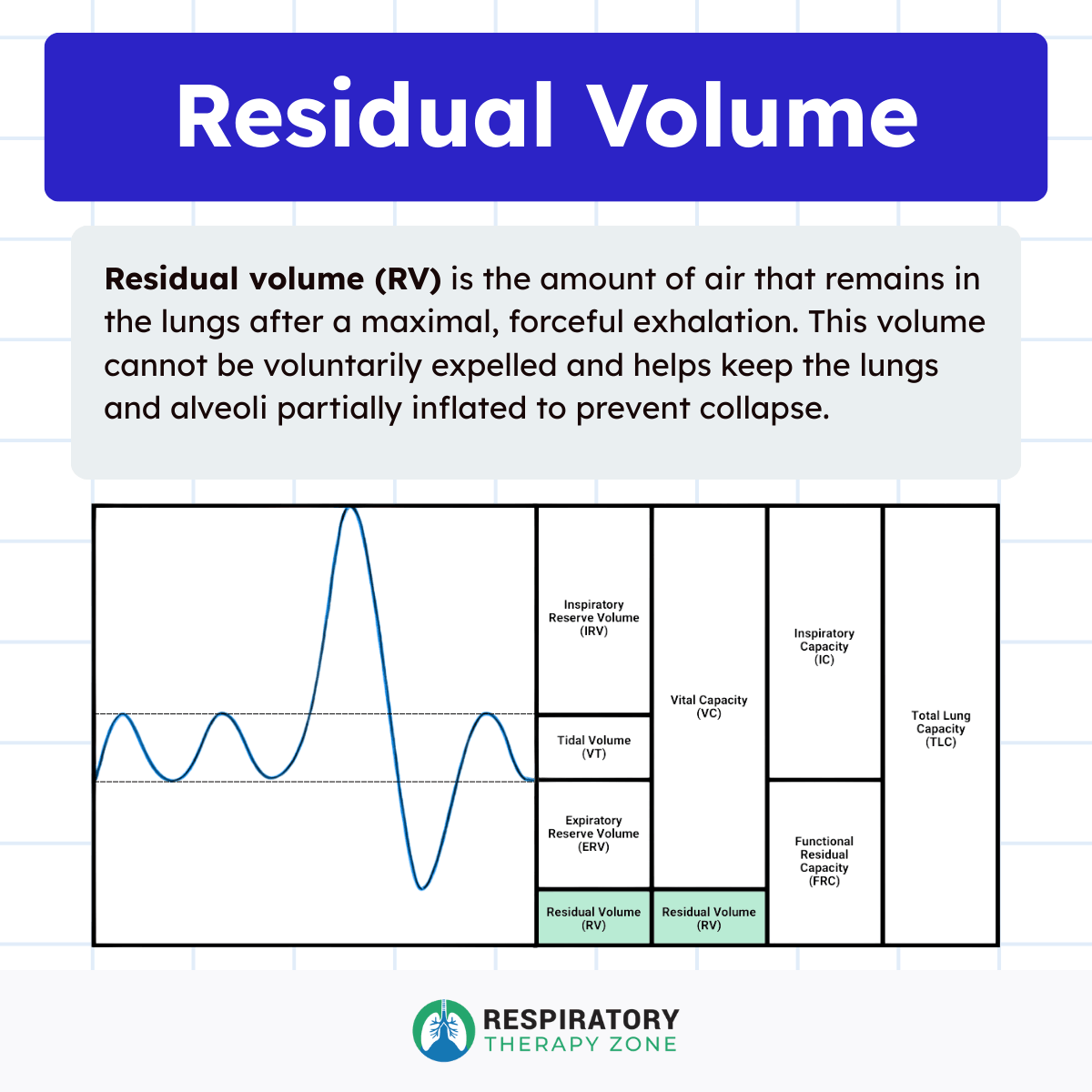
Residual volume is one of four primary lung volumes used to describe breathing mechanics:
- Tidal volume (VT): air inhaled and exhaled during normal breathing
- Inspiratory reserve volume (IRV): extra air inhaled after a normal inspiration
- Expiratory reserve volume (ERV): extra air exhaled after a normal expiration
- Residual volume (RV): air remaining after maximal exhalation
Residual volume is also a key component of lung capacities:
- Functional residual capacity (FRC): ERV + RV
- Total lung capacity (TLC): VT + IRV + ERV + RV
Note: Because residual volume cannot be exhaled, it plays a major role in determining total lung size and resting lung volume.
How Residual Volume Is Measured
Since residual volume cannot be measured directly with spirometry, alternative techniques are required. The most common methods include:
Body Plethysmography
This is the gold standard for measuring residual volume. It calculates lung volumes based on pressure changes inside a sealed chamber and can accurately measure trapped gas, making it especially useful in obstructive lung disease.
Gas Dilution Techniques
Methods such as helium dilution and nitrogen washout estimate residual volume by measuring how a known gas mixes with air in the lungs. These techniques may underestimate RV in patients with significant air trapping.
Imaging-Based Estimates
In some clinical or research settings, imaging such as CT scans can provide indirect assessments of lung volumes, though this is not routine practice.
Clinical Significance of Residual Volume
Residual volume provides valuable insight into lung mechanics and disease severity. Changes in RV often reflect underlying pathology and can guide diagnosis and management.
Increased Residual Volume
An elevated residual volume is commonly associated with obstructive lung diseases, including:
- Chronic obstructive pulmonary disease (COPD)
- Emphysema
- Asthma with air trapping
- Bronchiectasis
Note: In these conditions, airflow limitation prevents complete exhalation, leading to air trapping and lung hyperinflation. This increases the work of breathing and can flatten the diaphragm, reducing respiratory efficiency.
Decreased Residual Volume
A reduced residual volume is less common but may be seen in:
- Restrictive lung diseases
- Pulmonary fibrosis
- Severe chest wall disorders
Note: In restrictive conditions, lung compliance is reduced, limiting overall lung volumes, including residual volume.
Residual Volume and Air Trapping
One of the most important clinical concepts related to residual volume is air trapping. Air trapping occurs when air enters the lungs during inspiration but cannot fully exit during expiration. Over time, this leads to progressive increases in residual volume and functional residual capacity.
For respiratory therapists, recognizing air trapping is critical when managing patients on mechanical ventilation. Inadequate expiratory time or excessive respiratory rates can worsen air trapping and lead to auto-PEEP, hemodynamic compromise, and patient discomfort.
Role of Residual Volume in Gas Exchange
Residual volume plays a key role in maintaining stable gas exchange. Because air remains in the lungs between breaths, oxygen and carbon dioxide concentrations change more gradually, preventing large fluctuations in arterial blood gases.
This buffering effect allows the lungs to maintain relatively constant oxygen levels even during brief pauses in breathing. Without residual volume, oxygenation would be far more dependent on each individual breath.
Relevance to Respiratory Therapists
Residual volume is especially relevant to respiratory therapists because it directly influences assessment, diagnosis, and treatment decisions. Understanding RV helps therapists:
- Interpret full pulmonary function test results
- Differentiate between obstructive and restrictive lung disease
- Identify air trapping and hyperinflation
- Optimize ventilator settings
- Evaluate disease progression and treatment response
Note: In critical care, changes in residual volume can signal worsening obstruction or inadequate ventilation strategies. In outpatient settings, RV trends help monitor chronic lung disease over time.
Residual Volume and Mechanical Ventilation
In mechanically ventilated patients, residual volume has practical implications for ventilator management. Elevated RV can contribute to:
- Auto-PEEP
- Increased intrathoracic pressure
- Reduced venous return
- Increased work of breathing during spontaneous modes
Note: Respiratory therapists must carefully balance tidal volume, respiratory rate, and expiratory time to minimize dynamic hyperinflation, especially in patients with obstructive lung disease.
Factors That Influence Residual Volume
Several factors affect residual volume, including:
- Age: RV increases with aging due to loss of elastic recoil
- Body position: RV is slightly higher in the upright position
- Smoking history: chronic smoking increases RV
- Lung compliance: reduced compliance lowers RV
- Airway resistance: increased resistance raises RV
Note: Understanding these variables helps clinicians interpret results accurately and avoid misdiagnosis.
Common Misconceptions About Residual Volume
One common misconception is that residual volume represents “wasted” air. In reality, RV is essential for normal lung function and survival. Another misunderstanding is assuming that all increases in RV are harmful. While elevated RV often indicates disease, mild increases can occur with normal aging.
Note: Residual volume should always be interpreted in the context of other lung volumes, symptoms, and clinical findings.

Access our quiz with sample TMC practice questions and detailed explanations to help you master pulmonary function testing (PFT).
Residual Volume Practice Questions
1. What is residual volume (RV)?
The volume of air that remains in the lungs after a maximal, forceful exhalation.
2. Why is residual volume considered the lowest lung volume achievable?
Because even with maximal effort, the lungs cannot completely empty due to airway closure and elastic recoil limits.
3. Can residual volume be measured directly with simple spirometry?
No, residual volume cannot be measured directly with spirometry.
4. Why can’t spirometry measure residual volume?
Because residual volume cannot be exhaled out of the lungs.
5. What type of gas is commonly used to determine residual volume indirectly?
Helium, because it is inert and does not dissolve in body tissues.
6. What principle is used to calculate residual volume during gas dilution testing?
The conservation of mass principle using the equation C₁V₁ = C₂V₂.
7. Why does residual volume increase with aging?
Loss of elastic recoil and earlier airway closure trap more air at end-expiration.
8. How does residual volume influence closing capacity?
An increased RV raises closing capacity, promoting airway closure during normal breathing.
9. Why is residual volume important when interpreting lung volumes in COPD?
Because elevated RV explains air trapping and hyperinflation despite reduced expiratory flows.
10. How can residual volume affect oxygenation during sleep?
Increased RV can worsen V/Q mismatch and contribute to nocturnal hypoxemia.
11. How is residual volume calculated after equilibration?
RV = [(C₁ / C₂) − 1] × spirometer volume.
12. What must occur before the final marker gas concentration is measured?
Equilibration between the gas in the lungs and the spirometer.
13. Why is helium an ideal marker gas for measuring residual volume?
It is inert, insoluble in blood, and remains within the lungs.
14. What lung maneuver must the patient perform before starting RV measurement?
A maximal expiration to reach residual volume.
15. Why does airway closure contribute to residual volume?
Small airways close before all air can be expelled from the lungs.
16. How does elastic recoil influence residual volume?
Limited recoil prevents complete emptying of the lungs.
17. What role does the chest wall play in maintaining residual volume?
Chest wall mechanics resist full lung collapse.
18. How does surface tension in the alveoli affect residual volume?
It helps keep alveoli open, preventing complete collapse.
19. Why is residual volume physiologically important?
It prevents alveolar collapse and maintains continuous gas exchange.
20. What would happen if residual volume did not exist?
Alveoli would collapse at end-exhalation, greatly increasing the work of breathing.
21. How does residual volume differ from expiratory reserve volume (ERV)?
ERV is air that can be exhaled after a normal breath, while RV cannot be exhaled.
22. Which lung volume remains constant regardless of breathing pattern?
Residual volume
23. How does residual volume contribute to functional residual capacity (FRC)?
FRC is the sum of ERV and RV.
24. How does residual volume contribute to total lung capacity (TLC)?
TLC includes RV along with VT, IRV, and ERV.
25. Why does an increase in residual volume often indicate obstructive lung disease?
Air trapping prevents full exhalation, increasing the amount of air left in the lungs.
26. What happens to residual volume in emphysema?
It increases due to loss of elastic recoil and airway collapse.
27. How does aging affect residual volume?
Residual volume generally increases with age due to reduced lung elasticity.
28. Why is residual volume reported in liters or milliliters?
Because it represents an absolute lung volume.
29. To what condition are residual volume measurements corrected?
BTPS (Body Temperature, Pressure, Saturated).
30. Why is residual volume essential for interpreting lung capacities?
Because it directly affects FRC and TLC values.
31. What indirect methods can be used to measure residual volume?
Helium dilution, nitrogen washout, and body plethysmography.
32. Which method best measures residual volume in patients with air trapping?
Body plethysmography.
33. Why may gas dilution methods underestimate residual volume?
They may not measure trapped gas in poorly ventilated lung regions.
34. How does residual volume affect breathing at rest?
It maintains a stable lung volume between breaths for efficient gas exchange.
35. What clinical insight does an elevated RV/TLC ratio provide?
It indicates a greater proportion of trapped air within the lungs.
36. Why can residual volume not be measured with simple spirometry?
Because residual volume cannot be exhaled from the lungs.
37. What is considered the gold standard method for measuring residual volume?
Body plethysmography
38. Why is body plethysmography especially useful in obstructive lung disease?
Because it can measure trapped gas that other methods may miss.
39. What principle does body plethysmography use to calculate lung volumes?
Boyle’s law, based on pressure–volume relationships.
40. What lung volume does body plethysmography directly measure?
Thoracic gas volume (TGV), which can be used to calculate residual volume.
41. How do gas dilution techniques estimate residual volume?
By measuring how a known concentration of gas mixes with air in the lungs.
42. What are the two most common gas dilution methods used to estimate residual volume?
Helium dilution and nitrogen washout.
43. Why may gas dilution techniques underestimate residual volume?
Because trapped gas in poorly ventilated lung regions is not measured.
44. In which type of lung disease is gas dilution most likely to underestimate RV?
Severe obstructive lung disease with air trapping.
45. How can imaging studies be used to assess residual volume?
CT scans can provide indirect estimates of lung volumes.
46. Are imaging-based lung volume measurements routinely used in clinical practice?
No, they are mainly used in research or specialized clinical settings.
47. What does residual volume reveal about lung mechanics?
It provides insight into airway patency, elastic recoil, and air trapping.
48. Why is residual volume clinically important?
Changes in RV often reflect disease severity and underlying pathology.
49. An increased residual volume is most commonly associated with which type of lung disease?
Obstructive lung disease
50. Which obstructive conditions are commonly associated with increased residual volume?
COPD, emphysema, asthma with air trapping, and bronchiectasis.
51. Why does obstructive lung disease increase residual volume?
Airflow limitation prevents complete exhalation, leading to air trapping.
52. How does increased residual volume affect the diaphragm?
It flattens the diaphragm and reduces its mechanical efficiency.
53. What is lung hyperinflation?
An increase in lung volumes, particularly residual volume and FRC, due to air trapping.
54. What happens to the work of breathing when residual volume is elevated?
The work of breathing increases.
55. Is a decreased residual volume common?
No, decreased residual volume is less common.
56. In which conditions might residual volume be reduced?
Restrictive lung diseases, pulmonary fibrosis, and severe chest wall disorders.
57. Why is residual volume reduced in restrictive lung disease?
Reduced lung compliance limits overall lung expansion.
58. What is air trapping?
A condition where air enters the lungs during inspiration but cannot fully exit during expiration.
59. How does air trapping affect residual volume over time?
It causes progressive increases in residual volume and functional residual capacity.
60. Why is recognizing air trapping important in mechanically ventilated patients?
Because it can lead to auto-PEEP and hemodynamic compromise.
61. How can ventilator settings worsen air trapping?
By using high respiratory rates or inadequate expiratory time.
62. What is auto-PEEP?
Intrinsic positive end-expiratory pressure caused by incomplete exhalation.
63. How does elevated residual volume affect gas exchange stability?
It buffers changes in alveolar gas concentrations between breaths.
64. Why does residual volume help stabilize arterial blood gases?
Because gas remains in the lungs, preventing large breath-to-breath fluctuations.
65. What would happen to gas exchange if residual volume did not exist?
Oxygenation would vary greatly with each breath.
66. Why is residual volume important for respiratory therapists?
It influences assessment, diagnosis, and ventilator management decisions.
67. How does residual volume help differentiate obstructive from restrictive disease?
RV is typically increased in obstruction and normal or reduced in restriction.
68. What role does residual volume play in interpreting full pulmonary function tests?
It affects FRC and TLC calculations and reveals air trapping.
69. How can elevated residual volume affect mechanically ventilated patients?
It can increase intrathoracic pressure and reduce venous return.
70. What cardiovascular effect can result from elevated intrathoracic pressure due to high RV?
Decreased cardiac output
71. How does age affect residual volume?
Residual volume increases with aging due to loss of elastic recoil.
72. How does body position influence residual volume?
Residual volume is slightly higher in the upright position.
73. How does smoking affect residual volume?
Chronic smoking increases residual volume.
74. What effect does reduced lung compliance have on residual volume?
It lowers residual volume.
75. How does increased airway resistance affect residual volume?
It increases residual volume by promoting air trapping.
76. Is residual volume considered “wasted” air?
No, it is essential for normal lung function.
77. Why is residual volume necessary for survival?
It prevents alveolar collapse and supports continuous gas exchange.
78. Are all increases in residual volume pathological?
No, mild increases can occur with normal aging.
79. Why should residual volume never be interpreted alone?
Because it must be considered alongside other lung volumes and clinical findings.
80. How can trends in residual volume be used clinically?
To monitor disease progression and response to treatment.
81. What happens to residual volume when small airways close prematurely during exhalation?
Residual volume increases due to trapped air.
82. How does loss of elastic recoil affect residual volume?
It increases residual volume by reducing the lungs’ ability to empty.
83. Why is residual volume typically higher in emphysema than in chronic bronchitis?
Destruction of alveolar walls in emphysema causes greater air trapping.
84. How does bronchodilator therapy affect residual volume in obstructive lung disease?
It may reduce residual volume by improving airway patency.
85. What lung capacity is most directly affected by changes in residual volume?
Functional residual capacity (FRC).
86. How does residual volume influence total lung capacity in obstructive disease?
Increased RV leads to an increased TLC.
87. Why is residual volume important when evaluating hyperinflation?
Because RV is the primary contributor to hyperinflation.
88. What spirometry finding may suggest increased residual volume even though RV is not measured directly?
A reduced FVC with evidence of obstruction.
89. How does residual volume affect inspiratory capacity?
An increased RV reduces inspiratory capacity.
90. Why may patients with high residual volumes feel dyspneic at rest?
Hyperinflation places respiratory muscles at a mechanical disadvantage.
91. How does residual volume impact exercise tolerance?
Elevated RV limits ventilatory reserve and reduces exercise capacity.
92. Why does residual volume increase during acute asthma exacerbations?
Airway narrowing prevents full exhalation, causing air trapping.
93. How can residual volume contribute to patient–ventilator asynchrony?
Air trapping and auto-PEEP increase the effort required to trigger breaths.
94. What effect does pursed-lip breathing have on residual volume?
It can help reduce RV by prolonging exhalation.
95. How does residual volume differ between obstructive and restrictive lung disease?
RV is increased in obstruction and normal or reduced in restriction.
96. Why is residual volume measured indirectly rather than directly?
Because it cannot be exhaled from the lungs.
97. What happens to residual volume during deep anesthesia or sedation?
It may decrease due to reduced muscle tone and airway closure.
98. How does obesity influence residual volume?
It often reduces RV due to decreased chest wall compliance.
99. Why is residual volume an important consideration in lung volume reduction surgery?
Reducing RV improves diaphragmatic function and ventilation efficiency.
100. How does residual volume affect the distribution of ventilation in the lungs?
Increased RV promotes uneven ventilation and V/Q mismatch.
Final Thoughts
Residual volume is a foundational concept in respiratory physiology and clinical care. Although it cannot be measured with simple spirometry, its impact on lung mechanics, gas exchange, and disease assessment is profound.
For respiratory therapists, a solid understanding of residual volume improves pulmonary function test interpretation, ventilator management, and patient outcomes. By recognizing how and why residual volume changes, clinicians can better identify underlying pathology and tailor care to meet each patient’s respiratory needs.

Written by:
John Landry is a registered respiratory therapist from Memphis, TN, and has a bachelor's degree in kinesiology. He enjoys using evidence-based research to help others breathe easier and live a healthier life.
References
- Lofrese JJ, Tupper C, Denault D, et al. Physiology, Residual Volume. [Updated 2023 Feb 27]. In: StatPearls [Internet]. Treasure Island (FL): StatPearls Publishing; 2025.