

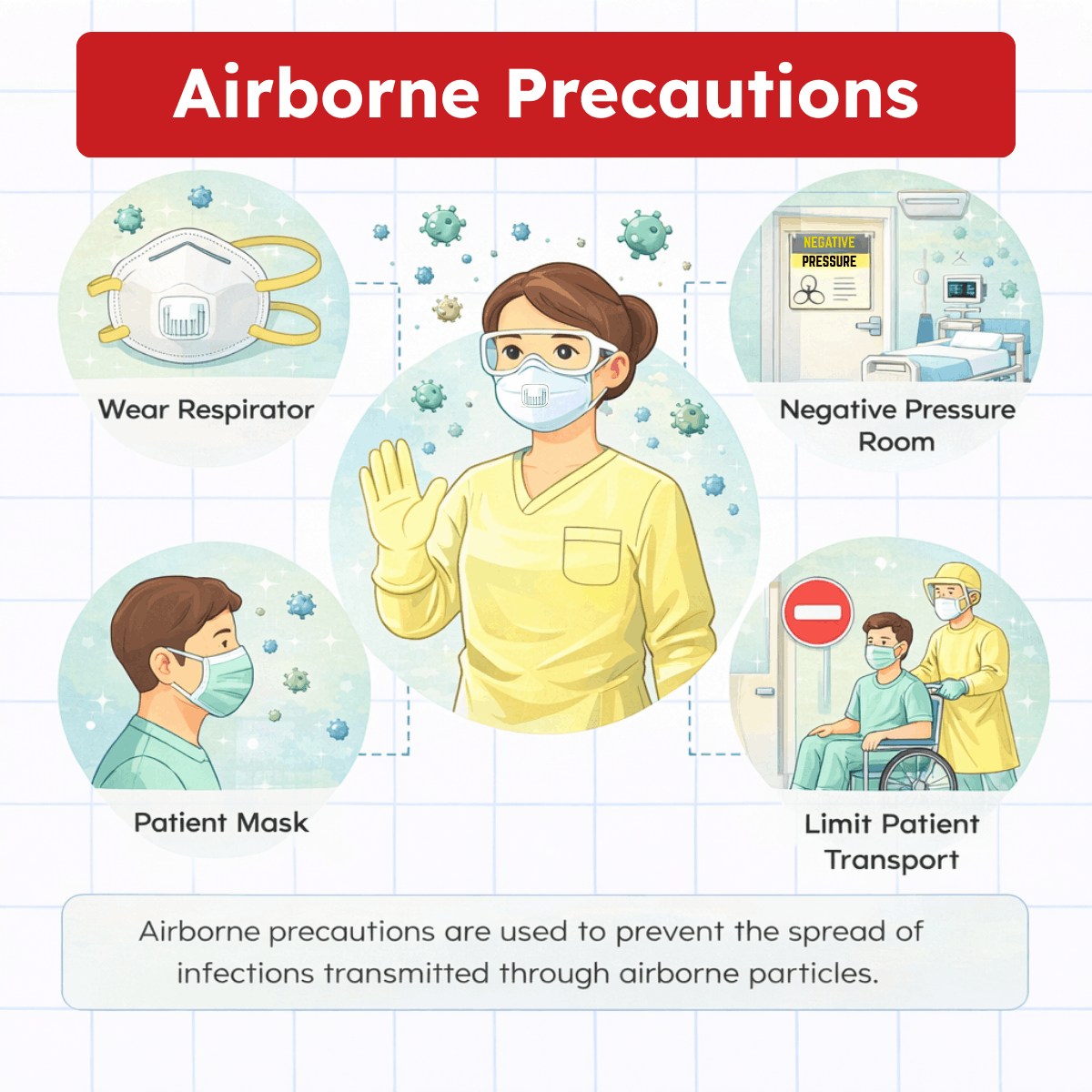
Airborne precautions are specialized infection control measures designed to prevent the transmission of infectious agents that spread through tiny aerosolized particles suspended in the air. These particles can travel long distances and remain airborne for extended periods, increasing the risk of inhalation by healthcare workers and other patients.
Respiratory therapists frequently perform procedures that involve airway management and aerosol therapy, which places them at a higher risk of exposure to airborne pathogens.
Understanding and following airborne precautions is essential for maintaining safe clinical environments and protecting both patients and healthcare providers.

What Are Airborne Precautions?
Airborne precautions are infection prevention strategies used when caring for patients with diseases that spread through airborne transmission. Airborne transmission occurs when infectious microorganisms are carried by small respiratory particles, often called droplet nuclei, that can remain suspended in the air and travel beyond typical close-contact distances.
Unlike droplet transmission, which involves larger respiratory droplets that fall quickly to the ground, airborne particles are small enough to remain airborne for prolonged periods. These particles can be inhaled by individuals who enter the contaminated airspace, even without direct contact with the infected patient.
Airborne precautions are always implemented in addition to standard precautions and may be combined with other transmission-based precautions depending on the infectious organism involved. The goal of airborne precautions is to limit the spread of infectious aerosols and reduce the risk of respiratory infection transmission within healthcare settings.
Common Infections Requiring Airborne Precautions
Several infectious diseases require airborne precautions due to their ability to spread through aerosolized particles. Tuberculosis is one of the most well-known airborne infections and remains a major concern in healthcare environments. Other infections requiring airborne precautions include measles, chickenpox, smallpox, and certain fungal infections such as aspergillosis.
Emerging respiratory viruses and atypical viral infections may also require airborne precautions depending on clinical guidelines and public health recommendations. Respiratory therapists frequently encounter patients with suspected or confirmed airborne infections, making familiarity with these precautions essential for clinical safety.
How Airborne Precautions Differ from Other Infection Control Measures
Airborne precautions differ from contact and droplet precautions based on how infectious organisms spread. Contact precautions focus on preventing transmission through physical contact with contaminated surfaces or equipment. Droplet precautions address infections transmitted through larger respiratory droplets that travel short distances.
Airborne precautions specifically target infections transmitted through microscopic aerosol particles that remain suspended in the air and can spread throughout a room or ventilation system. Because of this increased transmission risk, airborne precautions require specialized environmental controls and respiratory protection.
Key Components of Airborne Precautions
Airborne Infection Isolation Rooms
Patients requiring airborne precautions must be placed in a private airborne infection isolation room whenever possible. These rooms are commonly referred to as negative-pressure rooms because the air pressure inside the room is lower than the surrounding areas.
Negative-pressure rooms are designed to prevent contaminated air from escaping into hallways or adjacent patient care areas. Air within these rooms is directed through specialized ventilation systems that remove infectious particles before the air is discharged outside or filtered through high-efficiency particulate air filtration systems.
These rooms are typically required to maintain specific air exchange rates to ensure adequate removal of airborne contaminants. Maintaining proper airflow direction and keeping room doors closed are essential to preserving the effectiveness of airborne isolation environments.
Respiratory Protection
Healthcare workers entering an airborne isolation room must wear appropriate respiratory protection. The most commonly used device is a fit-tested N95 respirator, which filters airborne particles and reduces inhalation of infectious aerosols.
Proper fit testing and training are critical to ensure that respirators provide adequate protection. In some situations, powered air-purifying respirators may be used as an alternative, particularly for healthcare workers who cannot achieve a proper fit with standard respirators.
Hand Hygiene
Hand hygiene remains a critical component of airborne precautions. Healthcare workers must perform hand hygiene before and after patient contact, after removing respiratory protection, and after contact with potentially contaminated surfaces or equipment.
Although airborne infections primarily spread through inhalation, contaminated surfaces can still contribute to indirect transmission, making proper hand hygiene essential.
Limiting Patient Movement
Patients requiring airborne precautions should remain in their isolation room unless transport is medically necessary. Limiting patient movement reduces the spread of airborne pathogens throughout healthcare facilities.
If transport is required, patients should wear surgical masks to minimize the release of infectious particles into the environment. Healthcare personnel must also ensure that receiving departments are aware of isolation precautions prior to patient transfer.
Use of Eye and Face Protection
Eye protection or face shields may be required during procedures that generate splashes or sprays of respiratory secretions. This additional protection helps prevent exposure of mucous membranes to infectious droplets that may accompany aerosol-generating procedures.
Relevance of Airborne Precautions to Respiratory Therapists
Respiratory therapists play a critical role in managing patients with infectious pulmonary diseases, making airborne precautions highly relevant to their clinical responsibilities.
Exposure During Aerosol-Generating Procedures
Respiratory therapists frequently perform procedures that increase aerosol production, including bronchoscopy, sputum induction, airway suctioning, and aerosol medication delivery. These procedures can increase the concentration of airborne particles, significantly raising the risk of infection transmission.
Adhering to airborne precautions helps respiratory therapists reduce exposure to infectious aerosols while safely performing essential respiratory interventions.
Management of Infectious Respiratory Diseases
Respiratory therapists are often involved in diagnosing and treating patients with tuberculosis, viral respiratory infections, and other airborne diseases. Their responsibilities may include ventilator management, airway clearance therapy, and oxygen therapy for infected patients.
Proper implementation of airborne precautions ensures that respiratory therapists can deliver these treatments while minimizing the risk of spreading infections to other patients or healthcare staff.
Protecting Vulnerable Patient Populations
Patients receiving respiratory care frequently have underlying pulmonary conditions, compromised immune systems, or critical illnesses that increase susceptibility to infection. Preventing airborne transmission is essential for protecting these high-risk individuals from secondary respiratory infections.
Respiratory therapists contribute to patient safety by maintaining strict infection control practices and ensuring that respiratory equipment and treatment environments remain free of contamination.
Preventing Occupational Illness
Healthcare workers, including respiratory therapists, face an increased risk of occupational exposure to airborne pathogens. Tuberculosis and other airborne infections pose significant risks to healthcare professionals who work closely with infected patients.
Note: Following airborne precautions reduces the likelihood of occupational illness and helps protect respiratory therapists from potentially life-threatening infections.
Challenges in Maintaining Airborne Precautions
Maintaining airborne precautions can present several challenges in clinical environments. Limited availability of airborne isolation rooms, increased demand during infectious disease outbreaks, and the need for specialized ventilation systems can complicate infection control efforts.
Proper use of respiratory protection requires consistent training and compliance. Incorrect respirator use or failure to perform fit testing can reduce the effectiveness of protective equipment. Additionally, maintaining airflow systems and environmental controls requires ongoing monitoring and facility support.
Healthcare organizations must provide adequate resources, education, and infrastructure to ensure effective airborne infection control. Respiratory therapists play a vital role in supporting these efforts by following established protocols and promoting safe infection prevention practices.
The Future of Airborne Precautions in Respiratory Care
Advances in healthcare technology, ventilation system design, and infection control research continue to improve airborne precaution practices. Increased awareness of airborne disease transmission has led to improvements in protective equipment, facility design, and clinical protocols.
Respiratory therapists remain at the forefront of managing infectious respiratory diseases and implementing airborne precautions. As new pathogens emerge and global respiratory health challenges evolve, maintaining strong airborne infection control practices will remain essential for safe respiratory care delivery.
Airborne Precautions Practice Questions
1. What are airborne precautions, and when are they implemented?
Airborne precautions are infection control measures used to prevent transmission of pathogens spread through airborne droplet nuclei that remain suspended in the air for long periods.
2. Which types of infectious agents require airborne precautions?
Airborne precautions are required for pathogens transmitted through aerosolized particles such as Mycobacterium tuberculosis, measles, varicella, and smallpox.
3. What type of room is required for patients under airborne precautions?
Patients requiring airborne precautions must be placed in a negative-pressure airborne infection isolation room (AIIR).
4. What is the purpose of a negative-pressure room?
Negative-pressure rooms prevent contaminated air from escaping into surrounding areas by directing airflow into the room and exhausting air outside.
5. What respiratory protection must healthcare workers wear when entering an airborne isolation room?
Healthcare workers must wear a fit-tested N95 respirator or higher-level respiratory protection.
6. Why is fit testing required for N95 respirators?
Fit testing ensures the respirator forms a proper seal around the face, preventing inhalation of airborne pathogens.
7. How many air changes per hour are recommended for airborne infection isolation rooms?
AIIR rooms should provide at least 6 to 12 air changes per hour depending on facility design.
8. Why must the door to an airborne isolation room remain closed?
Keeping the door closed maintains negative pressure and prevents contaminated air from escaping.
9. Which disease commonly requires airborne precautions and respiratory isolation?
Tuberculosis commonly requires airborne precautions.
10. Why should patient transport be minimized for patients requiring airborne precautions?
Limiting transport reduces the spread of airborne pathogens throughout the healthcare facility.
11. What protective measure should be used if an airborne precaution patient must be transported?
The patient should wear a surgical mask during transport to reduce droplet dissemination.
12. Why are airborne particles more difficult to control than droplets?
Airborne particles remain suspended in the air for extended periods and can travel long distances.
13. Which respiratory therapy procedures increase the risk of airborne transmission?
Procedures such as bronchoscopy, sputum induction, and nebulizer treatments can increase airborne transmission risk.
14. Why should aerosol-generating procedures be performed cautiously in airborne precaution patients?
These procedures increase airborne particle production and infection transmission risk.
15. What additional protection may be used if N95 respirators are unavailable or insufficient?
Powered air-purifying respirators (PAPRs) may be used as an alternative.
16. Why should susceptible healthcare workers avoid caring for patients with airborne infections when possible?
Susceptible individuals may be at higher risk of infection if they lack immunity.
17. Which airborne disease is preventable through vaccination but still requires airborne precautions when suspected?
Measles requires airborne precautions despite vaccine availability.
18. Why is proper ventilation essential in airborne infection isolation rooms?
Proper ventilation removes contaminated air and reduces airborne pathogen concentration.
19. What role does high-efficiency particulate air (HEPA) filtration play in airborne precautions?
HEPA filtration removes airborne pathogens from recirculated air.
20. Why is hand hygiene still required when caring for airborne precaution patients?
Hand hygiene prevents contact transmission that may occur alongside airborne transmission.
21. Why should healthcare workers avoid removing respirators while inside airborne isolation rooms?
Removing respirators increases exposure risk to airborne pathogens.
22. Why should equipment used for airborne precaution patients be dedicated or properly disinfected?
Proper equipment handling prevents cross-contamination between patients.
23. Which airborne precaution disease is caused by the varicella-zoster virus?
Chickenpox requires airborne precautions.
24. Why is airborne isolation critical for patients with suspected pulmonary tuberculosis?
Pulmonary TB is highly contagious and spreads easily through airborne particles.
25. Why should healthcare workers perform a seal check after putting on an N95 respirator?
Seal checks confirm the respirator is properly positioned and functioning effectively.
26. Why should airborne precaution patients be placed in single-patient rooms?
Single rooms reduce the risk of airborne transmission to other patients.
27. What airflow pattern is required in airborne isolation rooms?
Airflow must move from hallways into the patient room and be exhausted outside.
28. Why should visitors wear respiratory protection when entering airborne isolation rooms?
Visitors are at risk of inhaling airborne infectious particles.
29. Why should airborne precaution signage be clearly posted outside the patient’s room?
Signage alerts staff and visitors to required infection control measures.
30. Why is rapid identification of airborne infections important in healthcare settings?
Early identification allows prompt isolation and reduces infection spread.
31. Why should healthcare workers avoid touching their respirator during patient care?
Touching the respirator may contaminate hands and increase infection risk.
32. Why is respiratory protection required even if airborne precaution patients appear clinically stable?
Stable patients can still release infectious airborne particles.
33. Why is patient education important for individuals placed under airborne precautions?
Patient education improves compliance with infection control practices and reduces transmission risk.
34. Why must healthcare workers perform hand hygiene after removing an N95 respirator?
Hand hygiene prevents transmission of pathogens that may contaminate the respirator during removal.
35. Why should airborne precaution patients avoid leaving their isolation room unnecessarily?
Limiting movement reduces the risk of airborne pathogen spread throughout the facility.
36. What is the primary difference between airborne and droplet transmission?
Airborne transmission involves smaller particles that remain suspended in air, whereas droplets fall quickly and require close contact.
37. Why is monitoring negative pressure important in airborne isolation rooms?
Monitoring ensures airflow remains directed into the room and prevents contaminated air leakage.
38. How can healthcare facilities verify that an airborne isolation room is functioning properly?
Facilities may use pressure monitoring devices or smoke tests to confirm airflow direction.
39. Why should disposable respiratory equipment be discarded after use in airborne precaution patients?
Proper disposal prevents contamination and cross-infection.
40. Why are surgical masks insufficient protection for healthcare workers caring for airborne infection patients?
Surgical masks do not provide adequate filtration or sealing against small airborne particles.
41. Why is airborne precaution training important for healthcare workers?
Training ensures proper use of protective equipment and reduces infection transmission risk.
42. Why should respiratory therapists minimize time spent inside airborne isolation rooms when possible?
Reducing exposure time lowers the risk of inhaling airborne pathogens.
43. Why should aerosol therapy be administered cautiously to airborne precaution patients?
Aerosol therapy may increase airborne pathogen dispersion.
44. Why should stethoscopes and other diagnostic tools be disinfected after use on airborne precaution patients?
Disinfection prevents transmission of infectious organisms to other patients.
45. Why is it important to assess vaccination status for healthcare workers exposed to airborne diseases?
Vaccination can reduce infection risk and prevent disease spread.
46. Why should airborne precaution patients practice respiratory hygiene?
Respiratory hygiene reduces the release of infectious airborne particles.
47. Why should airborne precaution rooms be located away from high-traffic areas?
Isolation room placement reduces potential exposure to other patients and staff.
48. Why should visitors with respiratory symptoms avoid entering airborne precaution rooms?
Visitors with symptoms may increase transmission risk or worsen infection spread.
49. Why is immediate implementation of airborne precautions important when tuberculosis is suspected?
Early isolation reduces transmission before laboratory confirmation is available.
50. Why should personal protective equipment be removed carefully when exiting airborne isolation rooms?
Improper removal may lead to contamination and infection spread.
51. Why is proper disposal of respiratory secretions important in airborne precaution patients?
Respiratory secretions may contain infectious pathogens capable of airborne transmission.
52. Why should airborne precaution patients be instructed to follow cough etiquette?
Cough etiquette reduces aerosol generation and transmission risk.
53. Why should healthcare workers avoid eating or drinking in airborne isolation rooms?
Eating or drinking increases the risk of pathogen ingestion.
54. Why is maintaining adequate staffing important for airborne precaution patients?
Proper staffing ensures adherence to infection control protocols and safe patient care.
55. Why should healthcare workers inspect respirators before use?
Inspection ensures the respirator is intact and provides proper protection.
56. Why is environmental cleaning essential in rooms of airborne precaution patients?
Cleaning reduces environmental contamination and infection transmission.
57. Why should respiratory therapists use closed suction systems when caring for intubated airborne precaution patients?
Closed suction systems reduce aerosol generation and pathogen spread.
58. Why should linens from airborne precaution patients be handled carefully?
Improper linen handling may disperse infectious airborne particles.
59. Why should airborne precaution patients receive education about isolation procedures?
Education helps improve patient cooperation and infection control compliance.
60. Why is communication between healthcare teams important when caring for airborne precaution patients?
Clear communication ensures consistent application of isolation precautions.
61. Why should medical equipment be dedicated to a single airborne precaution patient when possible?
Dedicated equipment reduces cross-contamination between patients.
62. Why should air from airborne isolation rooms be exhausted directly outdoors or filtered?
Exhausting contaminated air prevents recirculation of airborne pathogens.
63. Why should healthcare workers perform regular respirator fit testing?
Periodic testing ensures continued effectiveness of respiratory protection.
64. Why should staff immediately report breaches in airborne precaution protocols?
Early reporting allows corrective actions to prevent infection transmission.
65. Why should airborne precaution patients be evaluated for immune-compromising conditions?
Immunocompromised patients may require additional infection control measures.
66. Why should airborne precaution rooms have visual airflow indicators?
Airflow indicators help staff verify proper negative-pressure function.
67. Why must healthcare workers keep the airborne isolation room door closed at all times?
Keeping the door closed maintains negative pressure and prevents airborne pathogens from escaping into surrounding areas.
68. Why should a patient suspected of measles be placed on airborne precautions immediately?
Measles is highly contagious through airborne transmission and requires prompt isolation to prevent outbreaks.
69. Why should healthcare workers remove their N95 respirator only after leaving the airborne isolation room?
Removing the respirator inside the room increases the risk of inhaling airborne pathogens.
70. Why is limiting the number of healthcare personnel entering an airborne isolation room recommended?
Limiting entry reduces potential exposure and decreases the risk of infection transmission.
71. Why is it important to verify the seal of an N95 respirator before entering an airborne precaution room?
A proper seal ensures effective filtration and prevents inhalation of contaminated air.
72. Why should airborne precaution patients be transported using predetermined routes within the hospital?
Designated routes minimize exposure to other patients, visitors, and healthcare staff.
73. Why is it important to place airborne precaution signage outside the patient’s room?
Signage alerts healthcare personnel and visitors to follow appropriate infection control measures.
74. Why should respiratory therapists avoid unnecessary aerosol-generating procedures in airborne precaution patients?
Avoiding unnecessary procedures reduces the production of infectious airborne particles.
75. Why is HEPA filtration used in airborne infection isolation rooms?
HEPA filters remove airborne microorganisms and reduce contamination risk.
76. Why should healthcare workers perform a seal check every time they put on an N95 respirator?
Seal checks confirm the respirator fits correctly and provides effective protection.
77. Why is it important to remove gloves before removing respiratory protection when exiting airborne isolation rooms?
Removing gloves first reduces contamination risk during respirator removal.
78. Why should staff limit shared patient care equipment in airborne isolation rooms?
Limiting shared equipment reduces the risk of cross-contamination.
79. Why is regular maintenance of ventilation systems essential in airborne isolation rooms?
Proper ventilation maintenance ensures effective airborne pathogen containment.
80. Why should airborne precaution patients avoid sharing personal items with others?
Shared items may become contaminated and spread infection.
81. Why is patient education about mask use during transport important for airborne precautions?
Mask use helps prevent dispersion of infectious airborne particles during movement.
82. Why should healthcare workers avoid touching the front surface of respirators during removal?
The front surface may be contaminated with infectious pathogens.
83. Why should airborne isolation rooms maintain a specific number of air exchanges per hour?
Adequate air exchanges help remove airborne contaminants and maintain safe air quality.
84. Why should staff perform hand hygiene immediately after removing respiratory protection?
Hand hygiene prevents contamination from pathogens that may be transferred during removal.
85. Why should visitors be instructed on proper airborne precaution procedures before entering the room?
Visitor education reduces accidental exposure and infection transmission.
86. Why is airborne precaution training important for new healthcare employees?
Training ensures proper infection control practices and improves patient and staff safety.
87. Why should healthcare workers avoid placing contaminated equipment on clean surfaces in airborne isolation rooms?
Preventing cross-contamination reduces infection transmission.
88. Why should respiratory therapists monitor patients with airborne infections for worsening respiratory distress?
Early recognition allows prompt intervention and improves patient outcomes.
89. Why should isolation room pressure monitoring alarms be addressed immediately?
Alarm activation may indicate loss of negative pressure and increased transmission risk.
90. Why should healthcare workers remove jewelry before providing care to airborne precaution patients?
Jewelry may harbor pathogens and interfere with proper hand hygiene.
91. Why should airborne precaution patients be encouraged to follow respiratory etiquette even when isolated?
Respiratory etiquette further reduces pathogen spread.
92. Why should healthcare facilities conduct regular audits of airborne precaution compliance?
Audits identify gaps in infection control and improve safety practices.
93. Why should contaminated respiratory equipment be cleaned or discarded according to infection control protocols?
Proper handling prevents infection spread to other patients or staff.
94. Why should airborne precaution patients receive priority placement in negative-pressure rooms?
Prompt placement minimizes the risk of airborne disease transmission.
95. Why is minimizing airflow disruptions important in airborne isolation rooms?
Disruptions can alter airflow direction and allow pathogen escape.
96. Why should healthcare workers avoid storing personal belongings inside airborne isolation rooms?
Personal items may become contaminated and transmit pathogens.
97. Why should airborne precaution patients be monitored for signs of clinical deterioration during isolation?
Close monitoring allows early treatment adjustments and prevents complications.
98. Why should healthcare workers follow proper donning and doffing sequences for airborne precaution PPE?
Correct sequencing reduces self-contamination risk.
99. Why should airborne isolation rooms be clearly labeled and easily identifiable?
Clear labeling ensures rapid identification and proper infection control measures.
100. Why should airborne precaution protocols be updated based on emerging infectious disease guidelines?
Updated protocols ensure healthcare workers follow current best practices for infection prevention.
Final Thoughts
Airborne precautions are a vital component of infection prevention in respiratory care and healthcare as a whole. By implementing measures such as negative-pressure isolation rooms, respiratory protection, and strict patient movement control, healthcare providers can significantly reduce the spread of airborne infections.
Respiratory therapists play a central role in maintaining these precautions due to their involvement in airway management and aerosol-generating procedures.
As healthcare continues to confront emerging respiratory diseases, consistent adherence to airborne precautions helps protect patients, healthcare workers, and clinical environments while supporting safe and effective respiratory therapy practices.

Written by:
John Landry is a registered respiratory therapist from Memphis, TN, and has a bachelor's degree in kinesiology. He enjoys using evidence-based research to help others breathe easier and live a healthier life.
References
- Douedi S, Douedi H. Precautions, Bloodborne, Contact, and Droplet. [Updated 2023 Sep 4]. In: StatPearls [Internet]. Treasure Island (FL): StatPearls Publishing; 2025.