

Forced expiratory volume in one second (FEV1) is one of the most widely used measurements in pulmonary function testing. It provides valuable insight into how well air moves through the airways and helps clinicians detect and monitor obstructive and restrictive lung diseases.
For respiratory therapists, understanding FEV1 is fundamental to assessing lung function, guiding treatment decisions, and evaluating patient response to therapy. This article explains what FEV1 is, how it is measured, how it is interpreted, and why it remains highly relevant in modern respiratory care.

What is FEV1?
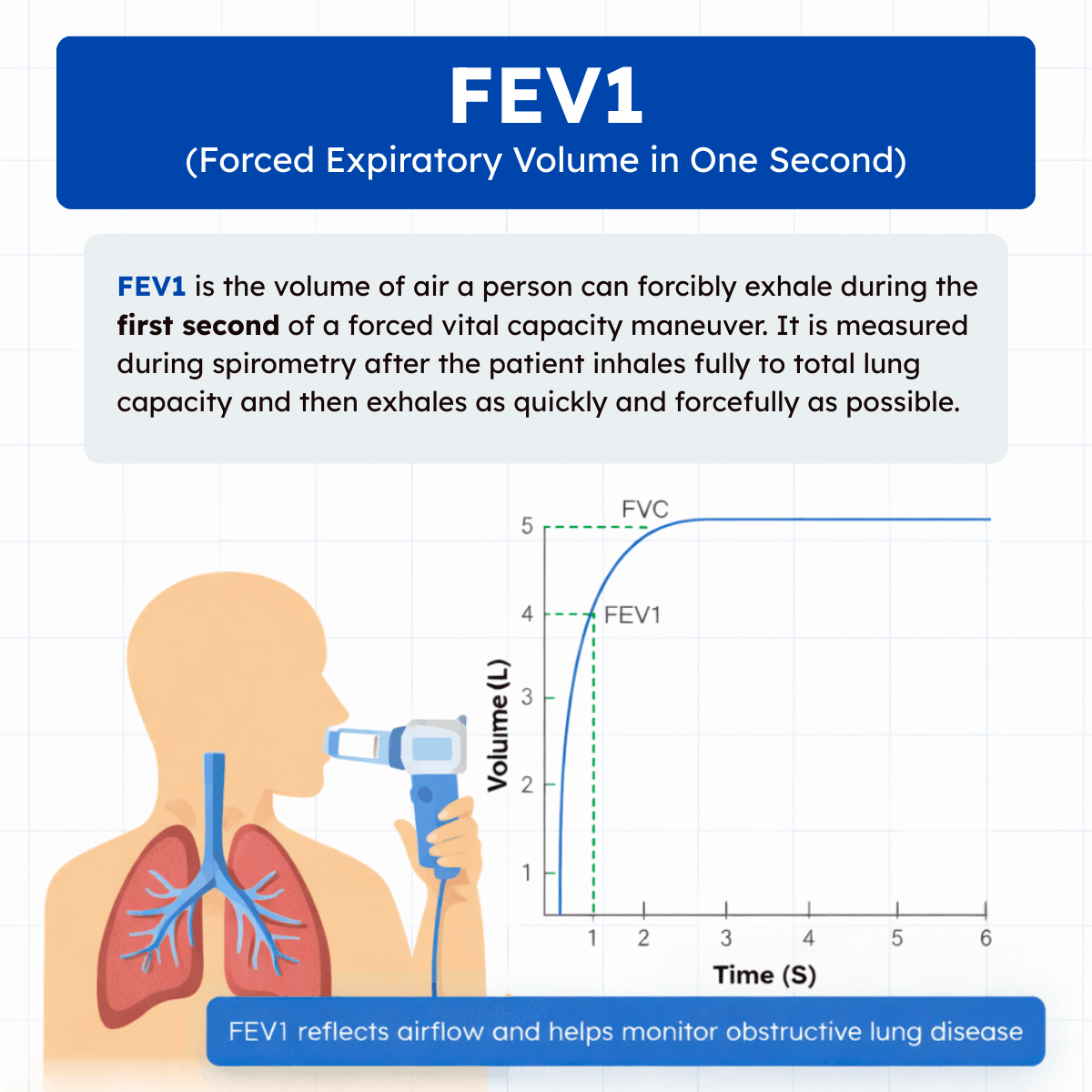
FEV1 stands for forced expiratory volume in one second. It represents the volume of air a patient can forcibly exhale during the first second of a forced vital capacity maneuver.
To obtain FEV1, the patient inhales rapidly and completely to total lung capacity, then exhales as forcefully and as completely as possible into a spirometer. The spirometer measures the total volume exhaled and records how much of that volume leaves the lungs in the first second. That initial one-second volume is the FEV1.
Although it is reported as a volume in liters, FEV1 reflects airflow. It indicates how quickly air can move through the bronchial tree. When airways are narrowed or obstructed, less air can be expelled during that first second, leading to a reduced FEV1.
How FEV1 Is Measured
FEV1 is measured during spirometry, which evaluates airflow and lung volumes during forced breathing maneuvers. Accurate measurement requires careful patient instruction, coordination, and effort.
To ensure validity, at least three acceptable forced vital capacity maneuvers must be performed. The largest FEV1 value from acceptable trials is recorded. For reliability, the two highest FEV1 values should not differ by more than 0.15 liters in adults.
The measurement begins at the zero time point of exhalation. The patient must initiate exhalation abruptly and without hesitation. Any cough during the first second, hesitation at the start, or early termination of the maneuver can invalidate the result.
Note: Because spirometry is effort dependent, respiratory therapists play a key role in coaching patients. Clear instructions, demonstration, and enthusiastic encouragement help ensure accurate and reproducible results.
Predicted Values and Normal Ranges
FEV1 values are interpreted by comparing the measured result with predicted values based on age, sex, height, and sometimes race or ethnicity, depending on the reference equation used.
In a healthy young adult male who is 180 centimeters tall, the predicted FEV1 may be approximately 4.7 liters. However, normal values decline gradually with age as lung elasticity and airway diameter change over time.
Modern interpretation emphasizes comparing measured values to the lower limit of normal rather than relying solely on percent predicted. The lower limit of normal accounts for normal biological variability and helps reduce misclassification of disease, particularly in older adults.
The FEV1/FVC Ratio
FEV1 is rarely interpreted in isolation. It is typically evaluated alongside forced vital capacity, or FVC. The ratio of FEV1 to FVC is calculated by dividing the largest FEV1 by the largest vital capacity measurement.
This ratio helps differentiate obstructive from restrictive patterns.
In obstructive lung disease, airway narrowing increases resistance to airflow. As a result, FEV1 decreases more than FVC, leading to a reduced FEV1/FVC ratio. If the ratio falls below the lower limit of normal, airflow obstruction is present.
In restrictive lung disease, both FEV1 and FVC may be reduced due to smaller lung volumes. However, the ratio often remains normal or even elevated because both values decrease proportionally.
Note: Respiratory therapists rely on this relationship to identify patterns of impairment and guide further testing.
FEV1 in Obstructive Lung Disease
FEV1 is particularly important in the assessment of obstructive conditions such as asthma and chronic obstructive pulmonary disease.
In asthma, airway inflammation and bronchoconstriction narrow the airways, reducing airflow. During an exacerbation, FEV1 may drop significantly. After administration of a bronchodilator such as albuterol, improvement in FEV1 suggests reversible airway obstruction.
In chronic obstructive pulmonary disease, airflow limitation is often progressive and not fully reversible. FEV1 is used to assess severity and monitor disease progression. Lower FEV1 values generally reflect more advanced disease and greater functional impairment.
Note: Changes in FEV1 over time provide valuable information about response to therapy, smoking cessation efforts, and overall disease trajectory.
FEV1 in Restrictive Lung Disease
Although FEV1 is most commonly associated with obstruction, it can also be reduced in restrictive lung disorders.
In conditions such as interstitial lung disease, pulmonary fibrosis, or neuromuscular weakness, total lung capacity and vital capacity are reduced. Because the lungs cannot expand normally, the total volume available for exhalation decreases. As a result, FEV1 may also be lower than predicted.
However, in pure restriction, the FEV1/FVC ratio is typically normal. This distinction highlights why interpreting FEV1 alongside other spirometric values is essential.
Note: Spirometry alone cannot definitively diagnose restriction. Measurement of lung volumes is required to confirm reduced total lung capacity.
Clinical Applications in Respiratory Care
FEV1 has broad clinical utility and remains one of the most frequently used objective measurements in respiratory therapy practice. Because it reflects airflow through the airways, it provides practical information that influences diagnosis, treatment decisions, and long-term management.
Baseline Assessment
Spirometry that includes FEV1 measurement is commonly performed to establish a patient’s baseline pulmonary function. Accurate baseline data are essential for comparison during future evaluations.
To avoid falsely elevated results, patients are often instructed to temporarily withhold short-acting bronchodilators prior to testing. Establishing a reliable baseline allows clinicians to identify early airflow limitation and measure meaningful change over time.
Bronchodilator Response
FEV1 is also central to bronchodilator responsiveness testing. After initial spirometry, a bronchodilator is administered, and the test is repeated. An increase in FEV1 suggests reversible airway obstruction, which is commonly seen in asthma.
The magnitude of improvement helps guide medication selection and ongoing pharmacologic management. A limited response may suggest fixed airflow obstruction or the need for alternative treatment strategies.
Monitoring Disease Progression
For patients with chronic respiratory diseases such as asthma or chronic obstructive pulmonary disease, serial FEV1 measurements help monitor stability or progression.
A gradual decline in FEV1 may indicate worsening airway obstruction, poor adherence, or insufficient control. Tracking trends rather than relying on a single value provides a clearer picture of disease trajectory and treatment effectiveness.
Preoperative Evaluation
FEV1 is frequently assessed before thoracic or upper abdominal surgery to estimate pulmonary reserve. Reduced preoperative values may indicate increased risk for postoperative pulmonary complications, prompting additional evaluation or perioperative planning.
Occupational and Environmental Screening
In occupational health programs, FEV1 is used to monitor workers exposed to airborne irritants. Detecting early reductions in airflow allows for timely intervention, including workplace modifications or medical management, to prevent long-term lung damage.
Flow-Volume Loops and Upper Airway Obstruction
FEV1 contributes to interpretation of the flow-volume loop, which provides a graphical representation of airflow during forced breathing.
In obstructive lung disease, the expiratory portion of the loop often appears scooped or concave due to reduced flow rates at lower lung volumes. This pattern reflects small airway involvement.
FEV1 also aids in identifying upper airway obstruction. Fixed obstructions such as tracheal stenosis may cause flattening of both inspiratory and expiratory limbs of the loop. Variable extrathoracic or intrathoracic obstructions produce distinct patterns depending on the location of the lesion.
Note: Understanding these patterns enables respiratory therapists to recognize abnormalities that may require further investigation.
Effort Dependence and Quality Control
Because FEV1 is effort dependent, quality control is critical. Suboptimal effort can falsely lower values, leading to misinterpretation.
Respiratory therapists must ensure:
- Rapid and complete inhalation to total lung capacity
- Abrupt initiation of exhalation
- Sustained exhalation until an end-expiratory plateau is reached
- No coughing or early termination during the first second
Note: Consistency between trials is necessary for reliability. The difference between the two highest FEV1 values should not exceed 0.15 liters in adults. Proper technique, patient coaching, and adherence to testing standards help maintain accuracy.
Limitations of FEV1
Despite its usefulness, FEV1 has limitations. It does not provide direct information about lung volumes such as total lung capacity or residual volume. It cannot independently confirm restrictive disease. It may also appear falsely reduced in patients with poor effort or in those with air trapping who cannot fully exhale during forced maneuvers.
Additionally, some individuals may have preserved FEV1/FVC ratios despite abnormal spirometry values. In such cases, further testing is required to clarify the underlying physiology. Therefore, FEV1 should always be interpreted in the context of the full pulmonary function test and the patient’s clinical presentation.
Why FEV1 Matters to Respiratory Therapists
For respiratory therapists, FEV1 is more than a numerical value. It reflects airway function, guides therapeutic decisions, and provides objective data to support clinical judgment.
Therapists are responsible for performing spirometry, ensuring quality testing, educating patients, and communicating results to the healthcare team. A solid understanding of FEV1 allows therapists to recognize obstructive patterns, evaluate bronchodilator effectiveness, and monitor disease progression.
In acute care settings, changes in FEV1 may influence medication adjustments, ventilatory strategies, and discharge planning. In outpatient and pulmonary rehabilitation settings, serial measurements help evaluate long-term management.
Note: Competence in spirometry interpretation strengthens the respiratory therapist’s role as an essential member of the pulmonary care team.
FEV1 Practice Questions
1. What does FEV1 stand for in pulmonary function testing?
Forced expiratory volume in one second.
2. How is FEV1 measured during spirometry?
The patient inhales to total lung capacity and then exhales as forcefully and completely as possible; the volume exhaled in the first second is recorded.
3. What does FEV1 primarily reflect: lung volume or airflow?
Airflow through the airways.
4. Why is FEV1 reduced in obstructive lung diseases?
Because narrowed or obstructed airways limit the amount of air exhaled in the first second.
5. What is Forced Vital Capacity (FVC)?
The total volume of air exhaled during a forced expiratory maneuver after a maximal inhalation.
6. What does the FEV1/FVC ratio represent?
The proportion of the total forced vital capacity exhaled in the first second.
7. What is the normal FEV1/FVC ratio in healthy adults?
Approximately 70% to 80%, depending on age.
8. How does aging affect the normal FEV1/FVC ratio?
The ratio gradually decreases with age.
9. How is the FEV1/FVC ratio affected in obstructive lung disease?
It decreases because FEV1 falls more than FVC.
10. What spirometry pattern is typical in asthma?
Reduced FEV1, normal or mildly reduced FVC, and a decreased FEV1/FVC ratio.
11. What spirometry pattern is typical in COPD?
Reduced FEV1, normal or reduced FVC, and a decreased FEV1/FVC ratio.
12. How are FEV1 and FVC affected in restrictive lung disease?
Both FEV1 and FVC are reduced proportionately.
13. What happens to the FEV1/FVC ratio in restrictive lung disease?
It is normal or increased.
14. Why does restrictive lung disease often show a preserved FEV1/FVC ratio?
Because both FEV1 and FVC decrease proportionally.
15. What does a reduced FEV1 with a normal FEV1/FVC ratio suggest?
A restrictive ventilatory pattern.
16. How is FEV1 commonly reported in clinical practice?
As an absolute value in liters and as a percentage of the predicted value.
17. What is considered a normal predicted FEV1 percentage?
Generally 80% or greater of the predicted value.
18. What factors are used to calculate predicted FEV1 values?
Age, sex, height, and ethnicity.
19. Why is FEV1 important in monitoring COPD progression?
It helps assess disease severity and track decline in lung function over time.
20. How is FEV1 used to assess bronchodilator response?
An increase of at least 12% and 200 mL after bronchodilator administration suggests reversibility.
21. Why is FEV1 considered effort-dependent?
Because the patient must exhale forcefully and completely for accurate measurement.
22. What maneuver is required to accurately measure FEV1?
A forced vital capacity (FVC) maneuver.
23. How does pneumothorax affect FEV1 and FVC?
Both values decrease due to reduced lung expansion.
24. How can pleural effusion affect FEV1?
It may reduce FEV1 by limiting lung expansion.
25. How does pulmonary fibrosis affect FEV1?
FEV1 decreases due to reduced lung compliance and lung volumes.
26. Why is FEV1 reduced in emphysema?
Loss of elastic recoil causes airway collapse during forced exhalation.
27. How does airway inflammation impact FEV1?
It narrows airways and reduces airflow, lowering FEV1.
28. What does a severely reduced FEV1 indicate in obstructive disease?
Advanced airflow limitation.
29. Why is FEV1 a key parameter in preoperative evaluation?
It helps assess pulmonary risk prior to surgery.
30. How does smoking affect FEV1 over time?
It accelerates the decline in FEV1.
31. What is the clinical significance of a low FEV1 in respiratory care?
It indicates impaired airflow and helps guide treatment decisions.
32. Why must FEV1 be interpreted along with FVC?
To determine whether the pattern is obstructive or restrictive.
33. What condition may show normal FEV1 but reduced FVC?
Early restrictive lung disease.
34. How does hyperinflation in COPD affect FEV1?
Air trapping reduces expiratory airflow, lowering FEV1.
35. Why is reproducibility important when measuring FEV1?
To ensure accuracy and reliability of spirometry results.
36. How many acceptable spirometry efforts are generally required?
At least three acceptable and reproducible maneuvers.
37. What does a plateau in the volume-time curve indicate during spirometry?
Completion of forced exhalation.
38. How does airway obstruction affect the flow-volume loop shape?
It produces a scooped or concave expiratory curve.
39. Why is FEV1 often used in disease severity classification?
Because it correlates with airflow limitation and symptom burden.
40. How does improvement in FEV1 reflect response to therapy?
An increase suggests improved airway caliber and airflow.
41. During what test is FEV1 measured?
FEV1 is measured during spirometry as part of a forced vital capacity (FVC) maneuver.
42. How many acceptable FVC maneuvers are required for valid spirometry?
At least three acceptable maneuvers are required.
43. Which FEV1 value is recorded for interpretation?
The largest FEV1 obtained from acceptable and reproducible efforts is recorded.
44. What is the acceptable reproducibility standard for FEV1 in adults?
The two highest FEV1 values should not differ by more than 0.15 liters.
45. Why must exhalation begin abruptly when measuring FEV1?
Because hesitation or slow starts can falsely lower the measured FEV1 value.
46. How can coughing during the first second of exhalation affect FEV1?
It can invalidate the maneuver and lead to inaccurate results.
47. Why is spirometry considered effort-dependent?
Because maximal inhalation and forceful exhalation require full patient cooperation and effort.
48. What role does the respiratory therapist play during FEV1 testing?
The therapist provides coaching, demonstration, and encouragement to ensure accurate and reproducible results.
49. How are predicted FEV1 values determined?
They are calculated using reference equations based on age, sex, height, and sometimes ethnicity.
50. Why do FEV1 values decline with age?
Because lung elasticity and airway caliber gradually decrease over time.
51. What is the lower limit of normal (LLN) in spirometry interpretation?
It is the statistically defined lower boundary of normal values, accounting for biological variability.
52. Why is LLN preferred over a fixed cutoff for diagnosing obstruction?
Because it reduces misclassification, especially in older adults.
53. How is the FEV1/FVC ratio calculated?
By dividing the largest FEV1 by the largest FVC value.
54. What does a reduced FEV1/FVC ratio indicate?
Airflow obstruction
55. Why does FEV1 decrease more than FVC in obstructive disease?
Because airway narrowing primarily limits expiratory airflow.
56. What pattern is expected in restrictive lung disease on spirometry?
Reduced FEV1 and FVC with a normal or elevated FEV1/FVC ratio.
57. Why can spirometry alone not confirm restrictive lung disease?
Because lung volume measurements are required to confirm reduced total lung capacity.
58. How is FEV1 used in assessing asthma severity?
Lower FEV1 values indicate greater airflow limitation and disease severity.
59. What defines a significant bronchodilator response?
An increase in FEV1 of at least 12% and 200 mL from baseline.
60. What does improvement in FEV1 after bronchodilator administration suggest?
Reversible airway obstruction.
61. Why is FEV1 important in monitoring COPD progression?
Because declining FEV1 reflects worsening airflow limitation over time.
62. How can FEV1 help evaluate smoking cessation success?
Stabilization or slowed decline in FEV1 suggests reduced disease progression.
63. Why is baseline spirometry important?
It provides a reference point for future comparison and monitoring.
64. Why are patients sometimes instructed to withhold short-acting bronchodilators before spirometry?
To avoid masking underlying airflow limitation.
65. How does neuromuscular weakness affect FEV1?
It may reduce FEV1 due to decreased expiratory muscle strength.
66. Why must both FEV1 and FVC be interpreted together?
To distinguish between obstructive and restrictive ventilatory patterns.
67. How does airway inflammation during an asthma exacerbation affect FEV1?
It reduces airflow and significantly lowers FEV1.
68. What does a progressively declining FEV1 indicate in chronic lung disease?
Disease progression or inadequate control.
69. Why is accurate technique essential for valid FEV1 measurement?
Because improper effort or early termination can falsely lower results.
70. How does FEV1 guide treatment decisions in respiratory care?
It helps determine severity, monitor response to therapy, and guide long-term management strategies.
71. Why are serial FEV1 measurements important in chronic respiratory diseases?
They help monitor disease stability, progression, and response to therapy over time.
72. What may a gradual decline in FEV1 indicate in a patient with COPD or asthma?
Worsening airway obstruction, poor medication adherence, or inadequate disease control.
73. Why is trend analysis more useful than a single FEV1 measurement?
Because serial values provide a clearer picture of disease trajectory and treatment effectiveness.
74. How is FEV1 used in preoperative evaluation?
It helps estimate pulmonary reserve and assess the risk of postoperative pulmonary complications.
75. Why might a low preoperative FEV1 increase surgical risk?
Because reduced airflow suggests limited pulmonary reserve and higher risk for respiratory complications.
76. How is FEV1 used in occupational health screening?
It monitors workers exposed to airborne irritants to detect early airflow limitation.
77. Why is early detection of reduced FEV1 important in occupational exposure?
Because timely intervention can prevent long-term lung damage.
78. What does a concave or “scooped-out” expiratory limb on a flow-volume loop suggest?
Obstructive lung disease involving the small airways.
79. How does FEV1 contribute to interpretation of flow-volume loops?
It helps quantify airflow limitation seen graphically on the loop.
80. What flow-volume loop pattern is seen in fixed upper airway obstruction?
Flattening of both inspiratory and expiratory limbs.
81. How do variable extrathoracic obstructions appear on a flow-volume loop?
They typically cause flattening of the inspiratory limb.
82. How do variable intrathoracic obstructions appear on a flow-volume loop?
They typically cause flattening of the expiratory limb.
83. Why is FEV1 considered effort dependent?
Because accurate measurement requires maximal patient inhalation and forceful exhalation.
84. What patient action is required before measuring FEV1?
A rapid and complete inhalation to total lung capacity.
85. Why must exhalation be sustained during spirometry?
To ensure full expiration and accurate measurement of FVC and FEV1.
86. What is the acceptable reproducibility standard between the two best FEV1 values?
They should differ by no more than 0.15 liters in adults.
87. How can suboptimal effort affect FEV1 results?
It can falsely lower the measured value.
88. Why is patient coaching essential during spirometry?
Because proper technique ensures accurate and reproducible results.
89. Can FEV1 alone diagnose restrictive lung disease?
No, lung volume measurements are required to confirm restriction.
90. Why might FEV1 appear falsely reduced in patients with poor effort?
Because incomplete inhalation or weak exhalation lowers measured airflow.
91. How can air trapping affect FEV1 measurement?
Inability to fully exhale may reduce measured FEV1 and FVC values.
92. Why should FEV1 always be interpreted in clinical context?
Because spirometry results must align with symptoms, history, and other test findings.
93. How does FEV1 guide bronchodilator therapy?
Improvement after medication indicates reversible airway obstruction.
94. Why is FEV1 important in pulmonary rehabilitation programs?
It helps monitor long-term functional improvement or decline.
95. How can FEV1 influence discharge planning in acute care?
Significant airflow limitation may require medication adjustments or follow-up care.
96. What does a stable FEV1 over time suggest?
Effective disease management and stable airway function.
97. Why is quality control essential in spirometry testing?
To prevent misinterpretation caused by poor technique or inconsistent effort.
98. How does FEV1 reflect airway function?
It measures the volume of air exhaled in the first second of forced expiration, indicating airflow through the bronchial tree.
99. Why is FEV1 considered an objective measurement?
Because it provides quantifiable data on airflow limitation.
100. Why is competence in FEV1 interpretation important for respiratory therapists?
Because it supports accurate diagnosis, treatment decisions, and collaboration within the healthcare team.
Final Thoughts
FEV1 is a key measurement obtained during spirometry that reflects how effectively air moves through the airways during forced exhalation. It is central to identifying airflow obstruction, assessing disease severity, and monitoring response to therapy.
Although it must be interpreted alongside other values such as FVC and lung volumes, it provides meaningful insight into pulmonary mechanics.
For respiratory therapists, understanding FEV1 supports accurate testing, thoughtful interpretation, and informed clinical decision making across a wide range of care settings.

Written by:
John Landry is a registered respiratory therapist from Memphis, TN, and has a bachelor's degree in kinesiology. He enjoys using evidence-based research to help others breathe easier and live a healthier life.
References
- David S, Goldin J, Edwards CW. Forced Expiratory Volume. [Updated 2024 Oct 14]. In: StatPearls [Internet]. Treasure Island (FL): StatPearls Publishing; 2025.