

Flow rate is one of the most important yet often underappreciated variables in respiratory care. It influences how gas moves through the airways, how effectively oxygen is delivered, and how mechanical ventilation interacts with the patient.
From ventilator management to aerosol therapy and pulmonary function testing, flow rate affects both diagnostic accuracy and therapeutic outcomes.
Respiratory therapists must understand how flow is generated, measured, and adjusted in various clinical settings to optimize patient comfort, reduce work of breathing, and improve gas exchange.

What is Flow Rate?
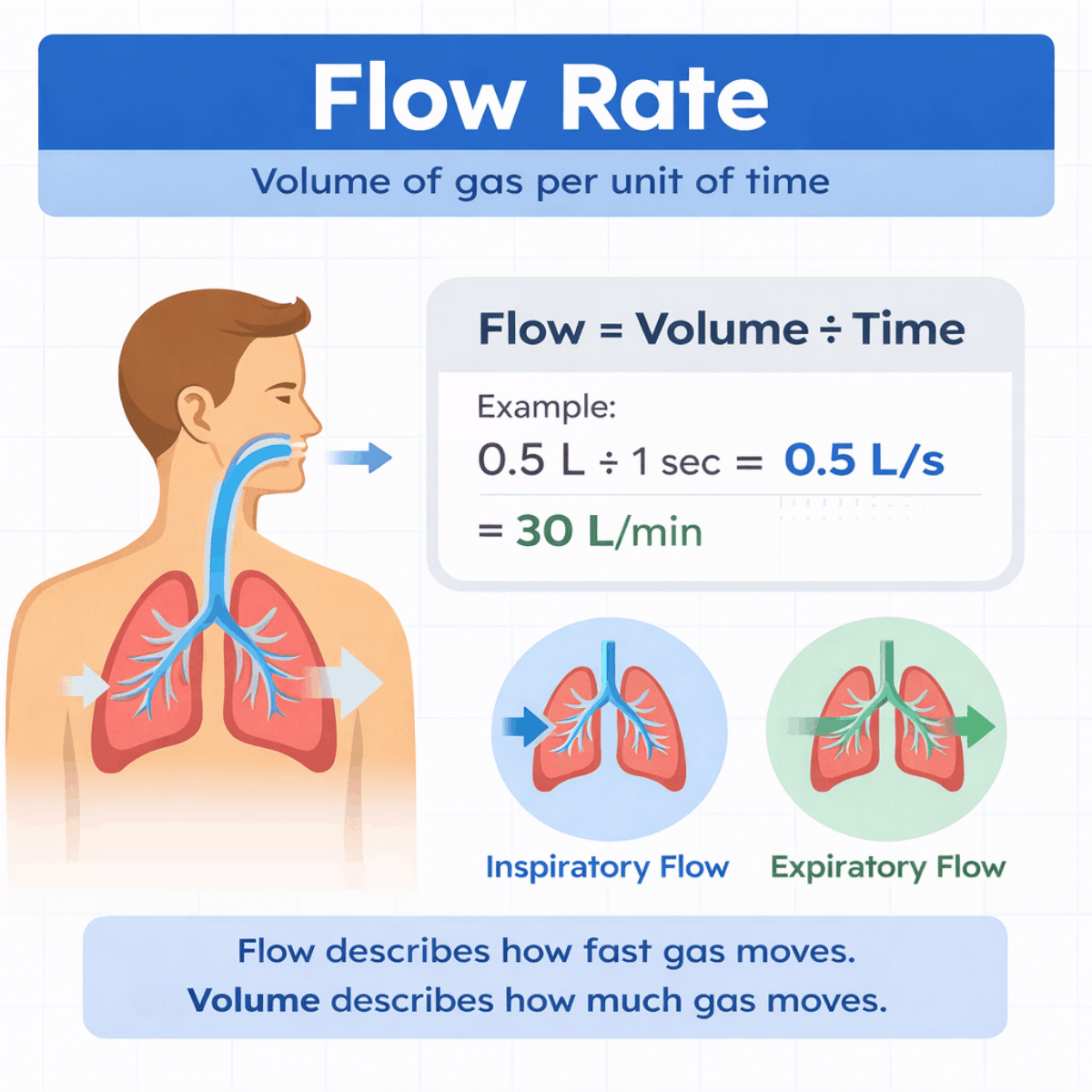
In respiratory care, flow rate refers to the volume of gas delivered or exhaled per unit of time. It is typically expressed in liters per minute (L/min) or liters per second (L/s). Flow describes how quickly gas moves, while volume describes how much gas moves.
Mathematically, flow is defined as:
Flow = Volume ÷ Time
For example, if 0.5 liters of gas are delivered in 1 second, the inspiratory flow rate is 0.5 L/s, which equals 30 L/min.
Flow can be inspiratory or expiratory. Inspiratory flow refers to gas entering the lungs, whether spontaneously or delivered by a ventilator. Expiratory flow refers to gas leaving the lungs and is commonly assessed during pulmonary function testing.
Types of Flow in Clinical Practice
Inspiratory Flow Rate
Inspiratory flow rate is especially important during mechanical ventilation. In volume-controlled ventilation, inspiratory flow and tidal volume determine inspiratory time. If tidal volume is fixed, increasing flow shortens inspiratory time, while decreasing flow lengthens it.
For example, if a tidal volume of 300 mL is delivered at 30 L/min, the inspiratory time is 0.6 seconds. If the same tidal volume is delivered at 60 L/min, inspiratory time is reduced by half.
Matching inspiratory flow to the patient’s demand is essential. If the ventilator does not meet or exceed spontaneous inspiratory demand, the patient may experience increased work of breathing and ventilator asynchrony.
Expiratory Flow Rate
Expiratory flow rate is often measured during spirometry. The peak expiratory flow rate reflects the highest flow achieved during a forced exhalation. Reduced peak flow is commonly seen in obstructive lung diseases such as asthma and COPD.
In obstructive conditions, expiratory flow is limited by airway narrowing and dynamic airway collapse. The flow volume loop may show a scooped appearance during exhalation, indicating reduced flow at various lung volumes.
Oxygen Therapy With a Nasal Cannula
Flow rate also plays a central role in conventional oxygen therapy using a standard nasal cannula. Typical flow rates range from 1 to 6 L/min in adults. As flow increases, the delivered fraction of inspired oxygen generally rises by approximately 3 to 4 percent per liter per minute, although the exact FiO2 varies depending on the patient’s breathing pattern and inspiratory flow demand.
Because a regular nasal cannula does not usually meet or exceed a patient’s inspiratory flow rate, room air is entrained during inspiration. This entrainment dilutes the delivered oxygen and makes the FiO2 variable. Patients with high inspiratory demand may receive a lower effective oxygen concentration than expected.
Additionally, higher flow rates through a standard nasal cannula can cause mucosal dryness and discomfort if the gas is not adequately humidified. Respiratory therapists must therefore consider both oxygenation goals and patient comfort when selecting and adjusting flow rates.
High-Flow Oxygen Delivery
High-flow nasal cannula systems deliver heated and humidified oxygen at flow rates that may range from 40 to 50 L/min in adults. These higher flows can meet or exceed a patient’s inspiratory demand, reducing room air entrainment and improving oxygen delivery.
Because high flow flushes the anatomic dead space and provides a more stable fraction of inspired oxygen, it is often used in patients with hypoxemic respiratory failure. Flow adjustments are used to improve comfort and reduce work of breathing.
Flow Rate and Mechanical Ventilation
Volume-Controlled Ventilation
In volume ventilation, tidal volume is set as a control variable. The inspiratory flow rate determines how quickly the set volume is delivered. Inspiratory time is therefore a function of tidal volume and flow.
If inspiratory flow is too low, inspiratory time increases and expiratory time shortens. This may predispose the patient to air trapping, especially in obstructive lung disease. If inspiratory flow is too high, peak airway pressure may rise.
Respiratory therapists must balance flow rate with inspiratory time and the inspiratory to expiratory ratio. An initial inspiratory time of approximately 0.8 seconds with an I:E ratio of 1:2 is commonly used in adults, but adjustments are often necessary based on lung mechanics and clinical condition.
Pressure-Controlled Ventilation
In pressure-controlled ventilation, inspiratory time is set directly by the clinician. Flow is variable and decelerates as airway pressure equilibrates. If inspiratory time is too short in patients with increased airway resistance, flow may not decelerate to zero before cycling to exhalation, potentially limiting delivered tidal volume.
Thus, in pressure modes, flow rate indirectly reflects airway resistance and lung compliance.
Flow Waveforms
Ventilators offer different inspiratory flow patterns, including square and decelerating waveforms. A square waveform delivers a constant flow throughout inspiration. A decelerating waveform starts with high flow and gradually decreases.
Decelerating flow patterns may improve gas distribution and reduce peak airway pressure. Flow waveform selection can affect mean airway pressure and patient comfort.
Flow Rate and Work of Breathing
Work of breathing increases when inspiratory flow provided by the ventilator does not match patient demand. Patients may exhibit signs of distress such as tachypnea, accessory muscle use, and air hunger.
Low inspiratory flow or insensitive trigger settings can increase effort. Conversely, excessively high flow may cause discomfort and elevated airway pressures. In obstructive diseases such as COPD, higher inspiratory flow rates may shorten inspiratory time and allow for longer expiratory time, reducing air trapping and auto-PEEP.
Note: Understanding the relationship between flow, time, and respiratory cycle duration allows respiratory therapists to tailor ventilator settings to individual patient needs.
Flow Rate in Aerosol Therapy
Flow rate significantly affects aerosol generation and deposition. In nebulizer therapy, higher gas flow can increase aerosol output per minute but may reduce contact time within humidification systems. In ultrasonic nebulizers, amplitude and flow rate determine particle density and output.
Inspiratory flow rate also influences aerosol deposition within the lungs. High inspiratory flows tend to increase inertial impaction in the upper airway, reducing lower airway deposition. Slower, deeper breaths with adequate inspiratory time may improve peripheral deposition.
Dry powder inhalers depend heavily on patient-generated inspiratory flow. Many passive devices require peak inspiratory flows of 40 to 60 L/min to disperse medication effectively. Patients unable to generate sufficient flow may receive suboptimal dosing.
Flow Rate and Humidification
Flow influences humidification efficiency. In bubble humidifiers, deeper water columns increase contact time and enhance evaporation. In pass-over humidifiers, higher gas flow reduces contact time and may decrease humidity output.
High flow rates can also generate microaerosols, which may carry infectious particles if contamination occurs.
In high-flow nasal cannula systems, gas must be heated and humidified before delivery. Conditioning the gas improves mucociliary function, prevents airway drying, and enhances comfort at high flow rates.
Flow Measurement in Pulmonary Function Testing
Pulmonary function testing uses devices that measure gas volume or gas flow. Volume-measuring spirometers compute flow based on changes in volume over time. Flow-measuring devices directly measure the speed of gas movement.
Peak expiratory flow is best visualized on a flow volume loop as the highest point of the expiratory curve. It is effort dependent and requires a maximal inspiration to total lung capacity before forced exhalation.
The FEV1, although expressed as a volume, reflects flow over the first second of forced exhalation. Reduced FEV1 may indicate obstructive or restrictive disease.
Note: Consistent use of the same flowmeter is important in monitoring peak flow trends, as variability exists among devices.
Clinical Application Example
Consider an infant with viral bronchiolitis presenting with tachypnea and hypoxemia. Initiation of high-flow nasal cannula therapy at 8 L/min with an FiO2 of 1.0 may rapidly improve oxygenation and reduce respiratory rate. As clinical status improves, FiO2 can be titrated downward while maintaining adequate flow.
Note: If work of breathing increases when flow is reduced, restoring the previous flow rate may stabilize the patient. In this scenario, flow directly influences oxygen delivery and respiratory mechanics.
Why Flow Rate Matters to Respiratory Therapists
Respiratory therapists manage ventilators, oxygen delivery systems, aerosol devices, and pulmonary function equipment. Flow rate is a unifying variable across all of these areas.
Improper flow settings can lead to ventilator asynchrony, increased work of breathing, inadequate humidification, poor aerosol deposition, or inaccurate diagnostic measurements. Understanding flow allows therapists to interpret waveforms, adjust inspiratory time, optimize I:E ratios, minimize air trapping, and tailor therapy to patient physiology.
Note: Flow rate is not just a number on a ventilator screen. It represents the dynamic movement of gas that sustains ventilation and oxygenation.
Flow Rate Practice Questions
1. What is flow rate in respiratory care?
Flow rate is the volume of gas delivered or exhaled per unit of time, typically expressed in liters per minute (L/min) or liters per second (L/s).
2. What is the mathematical formula for calculating flow?
Flow equals volume divided by time (Flow = Volume ÷ Time).
3. If 0.5 liters of gas are delivered in 1 second, what is the inspiratory flow rate in L/min?
0.5 L/s, which equals 30 L/min.
4. What is the difference between flow and volume?
Flow describes how quickly gas moves, whereas volume describes how much gas moves.
5. What are the two main types of flow in respiratory care?
Inspiratory flow and expiratory flow.
6. How does increasing inspiratory flow affect inspiratory time in volume-controlled ventilation?
Increasing inspiratory flow shortens inspiratory time when tidal volume is fixed.
7. How does decreasing inspiratory flow affect inspiratory time in volume-controlled ventilation?
Decreasing inspiratory flow lengthens inspiratory time when tidal volume is fixed.
8. If a tidal volume of 300 mL is delivered at 30 L/min, what happens to inspiratory time if flow is increased to 60 L/min?
Inspiratory time is reduced by half.
9. Why is matching inspiratory flow to patient demand important?
To reduce work of breathing and prevent patient–ventilator asynchrony.
10. What may occur if the ventilator flow does not meet a patient’s inspiratory demand?
The patient may experience air hunger and increased work of breathing.
11. What is peak expiratory flow rate (PEFR)?
The highest flow achieved during a forced exhalation.
12. In which conditions is peak expiratory flow rate commonly reduced?
Obstructive lung diseases such as asthma and COPD.
13. Why is expiratory flow limited in obstructive lung disease?
Because airway narrowing and dynamic airway collapse restrict airflow.
14. What does a scooped appearance on the expiratory limb of a flow-volume loop indicate?
Airflow obstruction
15. What is the typical flow range for a standard adult nasal cannula?
1 to 6 L/min
16. How much does FiO2 generally increase per liter per minute with a standard nasal cannula?
Approximately 3 to 4 percent per liter per minute.
17. Why is FiO2 variable when using a standard nasal cannula?
Because room air is entrained during inspiration, diluting the delivered oxygen.
18. Why might a patient with high inspiratory demand receive less FiO2 than expected from a nasal cannula?
Because their inspiratory flow exceeds the delivered flow, increasing room air entrainment.
19. What is a common side effect of high flow rates through a standard nasal cannula?
Mucosal dryness and discomfort.
20. What is the typical adult flow range for high-flow nasal cannula (HFNC) therapy?
Up to 40–60 L/min depending on the device and clinical setting.
21. How does high-flow nasal cannula improve oxygen delivery?
By meeting or exceeding inspiratory demand and reducing room air entrainment.
22. How does high-flow therapy affect anatomic dead space?
It helps flush anatomic dead space, improving ventilation efficiency.
23. Why is humidification essential in high-flow systems?
Because high flow rates without humidification can cause airway irritation and drying.
24. How does inspiratory flow influence aerosol delivery during nebulization?
Excessively high inspiratory flow may reduce optimal aerosol deposition.
25. What unit is commonly used to express flow in pulmonary function testing?
Liters per second (L/s).
26. How does flow differ in pressure-controlled ventilation compared to volume-controlled ventilation?
In pressure-controlled ventilation, inspiratory flow is variable and decelerating rather than fixed.
27. What type of inspiratory flow waveform is typical in volume-controlled ventilation?
A constant (square) flow waveform.
28. What type of inspiratory flow waveform is typical in pressure-controlled ventilation?
A decelerating flow waveform.
29. How can insufficient inspiratory flow appear on a ventilator pressure-time graphic?
As a concave or scooped pressure curve during inspiration.
30. What is minute ventilation in relation to flow?
Minute ventilation equals tidal volume multiplied by respiratory rate and reflects total airflow per minute.
31. How does high inspiratory flow affect peak airway pressure in volume ventilation?
Higher inspiratory flow increases peak airway pressure.
32. Why can very low inspiratory flow increase patient discomfort?
Because it may prolong inspiratory time and create a sensation of inadequate air delivery.
33. How does expiratory flow limitation contribute to air trapping?
When expiratory flow is restricted, incomplete exhalation leads to retained air and increased residual volume.
34. What is dynamic hyperinflation?
Air trapping that occurs when expiratory flow is insufficient to allow complete exhalation before the next breath.
35. How does respiratory rate interact with flow in determining inspiratory-to-expiratory ratio?
Higher respiratory rates reduce expiratory time, potentially worsening flow limitation.
36. Why is expiratory flow monitoring important in patients with COPD?
To detect airflow limitation and prevent air trapping.
37. What is the relationship between flow and resistance?
Flow is inversely proportional to airway resistance when pressure is constant.
38. How does airway narrowing affect flow?
It reduces flow for a given pressure gradient.
39. Why is flow adjustment important during noninvasive ventilation?
To improve synchrony and reduce patient effort.
40. What is the primary clinical goal when adjusting flow settings?
To optimize ventilation efficiency while minimizing patient discomfort and work of breathing.
41. In volume-controlled ventilation, what variable determines how quickly the set tidal volume is delivered?
The inspiratory flow rate determines how quickly the preset tidal volume is delivered.
42. How is inspiratory time calculated in volume-controlled ventilation?
Inspiratory time equals tidal volume divided by inspiratory flow rate.
43. What may occur if inspiratory flow is set too low in a patient with obstructive lung disease?
Inspiratory time may lengthen, expiratory time may shorten, and air trapping can occur.
44. How can excessively high inspiratory flow affect peak airway pressure?
It can increase peak airway pressure due to higher resistive pressures.
45. Why is balancing inspiratory flow and I:E ratio important?
To prevent air trapping and ensure adequate time for both inspiration and expiration.
46. What is a commonly used initial inspiratory time in adult mechanical ventilation?
Approximately 0.8 seconds, often with an I:E ratio near 1:2.
47. In pressure-controlled ventilation, who sets inspiratory time?
The clinician directly sets inspiratory time.
48. How does inspiratory flow behave in pressure-controlled ventilation?
Flow is variable and decelerates as airway pressure equilibrates.
49. What may happen if inspiratory time is too short in pressure-controlled ventilation?
Tidal volume delivery may be reduced because flow does not decelerate to zero before exhalation begins.
50. What does inspiratory flow indirectly reflect in pressure-controlled modes?
Airway resistance and lung compliance.
51. What characterizes a square inspiratory flow waveform?
A constant flow is delivered throughout inspiration.
52. What characterizes a decelerating inspiratory flow waveform?
High initial flow that gradually decreases during inspiration.
53. What is one potential benefit of a decelerating flow waveform?
It may reduce peak airway pressure and improve gas distribution.
54. How can mismatched inspiratory flow increase work of breathing?
If flow does not meet patient demand, the patient must generate additional effort.
55. What clinical signs may suggest inadequate inspiratory flow?
Tachypnea, accessory muscle use, and signs of air hunger.
56. Why might higher inspiratory flow be beneficial in COPD?
It shortens inspiratory time, allowing longer expiratory time and reducing auto-PEEP.
57. How does inspiratory flow influence aerosol deposition?
Higher inspiratory flows increase upper airway impaction and reduce peripheral deposition.
58. What breathing pattern improves aerosol deposition in the lower airways?
Slow, deep inhalation with adequate inspiratory time.
59. What peak inspiratory flow is typically required for effective use of many dry powder inhalers?
Approximately 40 to 60 L/min.
60. What happens if a patient cannot generate sufficient inspiratory flow for a dry powder inhaler?
Medication dispersion and delivery may be inadequate.
61. How does increasing gas flow affect aerosol output in jet nebulizers?
Higher flow increases aerosol output per minute.
62. How can high flow rates affect humidification efficiency in pass-over humidifiers?
High flow reduces contact time and may decrease humidity output.
63. Why must gas be heated and humidified during high-flow nasal cannula therapy?
To prevent airway drying and maintain mucociliary function.
64. How does flow influence mean airway pressure?
Flow waveform selection and inspiratory time can alter mean airway pressure.
65. What is the relationship between flow and airway resistance?
For a given pressure gradient, increased resistance decreases flow.
66. Why is expiratory flow monitoring important in ventilated patients?
To detect airflow limitation and prevent dynamic hyperinflation.
67. What is dynamic hyperinflation?
Air trapping that occurs when insufficient expiratory time prevents full exhalation.
68. How can respiratory rate interact with flow to worsen air trapping?
Higher respiratory rates shorten expiratory time, increasing the risk of incomplete exhalation.
69. How is peak expiratory flow best visualized during pulmonary function testing?
As the highest point on the expiratory limb of the flow-volume loop.
70. Why is consistency of flow measurement devices important in peak flow monitoring?
Different devices may produce slightly different readings, affecting trend analysis.
71. How does inspiratory flow affect patient–ventilator synchrony?
Properly matched flow improves synchrony and reduces patient effort.
72. What may occur if inspiratory flow exceeds patient demand?
Discomfort and elevated airway pressures may occur.
73. How can flow adjustments influence I:E ratio in volume-controlled ventilation?
Increasing flow shortens inspiratory time and lengthens expiratory time.
74. Why is adequate expiratory time critical in obstructive lung disease?
To allow complete exhalation and prevent air trapping.
75. How does high-flow therapy help reduce dead space ventilation?
It flushes carbon dioxide from the upper airway, reducing rebreathing.
76. What is the role of flow measurement in volumetric capnography?
It helps calculate carbon dioxide elimination and dead space.
77. How can sudden changes in flow patterns indicate airway obstruction?
Altered waveforms may reflect increased resistance or partial blockage.
78. Why must flow settings be individualized?
Because lung mechanics, disease state, and patient effort vary.
79. How can inappropriate flow settings affect diagnostic testing?
They may lead to inaccurate spirometry or ventilator data interpretation.
80. Why is understanding flow rate essential for respiratory therapists?
Because flow directly affects ventilation efficiency, oxygen delivery, comfort, and overall respiratory mechanics.
81. How is peak inspiratory flow related to inspiratory demand in spontaneously breathing patients?
Peak inspiratory flow should meet or exceed patient demand to prevent increased work of breathing and dyssynchrony.
82. What happens to inspiratory time if tidal volume remains constant and inspiratory flow is doubled?
Inspiratory time is reduced by half.
83. How can insufficient inspiratory flow affect pressure waveforms on the ventilator?
It may produce a scooped or concave pressure-time curve, indicating flow starvation.
84. What is flow starvation?
A condition in which ventilator-delivered inspiratory flow does not meet the patient’s spontaneous inspiratory demand.
85. How does increasing inspiratory flow affect the inspiratory-to-expiratory (I:E) ratio?
It shortens inspiratory time and increases expiratory time, altering the I:E ratio.
86. Why is expiratory flow limitation significant in obstructive lung disease?
Because expiratory flow cannot increase despite greater effort, leading to air trapping.
87. How does turbulent flow differ from laminar flow in the airways?
Turbulent flow increases resistance and requires greater pressure to maintain the same flow rate.
88. What factors promote turbulent airflow in the respiratory tract?
High flow rates, airway narrowing, and irregular airway surfaces.
89. How does airway radius influence flow according to Poiseuille’s law?
Small decreases in airway radius significantly reduce flow due to increased resistance.
90. Why must flow be carefully adjusted in patients with high airway resistance?
To ensure adequate ventilation while minimizing excessive airway pressures.
91. How does inspiratory flow impact patient comfort during noninvasive ventilation?
Flow that matches demand improves comfort and reduces anxiety.
92. What is the relationship between flow and carbon dioxide elimination?
Adequate inspiratory and expiratory flow supports effective alveolar ventilation and CO2 removal.
93. How can flow settings influence ventilator triggering sensitivity?
Improper flow bias may contribute to autotriggering or missed triggers.
94. What is bias flow in mechanical ventilation?
A continuous flow of gas through the circuit used to detect patient-triggered breaths.
95. How can high inspiratory flow affect mean airway pressure in volume-controlled ventilation?
Higher flow with shorter inspiratory time may reduce mean airway pressure.
96. Why is monitoring expiratory flow curves important for detecting auto-PEEP?
Incomplete return to baseline flow before the next breath indicates air trapping.
97. How does high-flow nasal cannula therapy reduce work of breathing?
By meeting inspiratory demand and reducing inspiratory resistance.
98. What effect does increasing flow have on oxygen delivery through a simple mask?
It helps maintain reservoir volume and prevents rebreathing of exhaled CO2.
99. Why is flow adjustment important during weaning from mechanical ventilation?
To ensure patient demand is met while gradually reducing support.
100. How does inspiratory flow influence tidal volume delivery in pressure-targeted modes?
Changes in resistance or compliance alter flow and therefore affect delivered tidal volume.
Final Thoughts
Flow rate plays a central role in nearly every aspect of respiratory care, from mechanical ventilation and oxygen therapy to aerosol delivery and pulmonary function testing. Its impact extends beyond simple gas movement and influences patient comfort, work of breathing, airway pressures, and treatment effectiveness.
Respiratory therapists must recognize how flow interacts with volume, time, and pressure to make informed clinical decisions. A strong understanding of flow principles supports safer ventilator management, more effective oxygen delivery, and improved patient outcomes across diverse clinical settings.

Written by:
John Landry is a registered respiratory therapist from Memphis, TN, and has a bachelor's degree in kinesiology. He enjoys using evidence-based research to help others breathe easier and live a healthier life.
References
- Pleil JD, Ariel Geer Wallace M, Davis MD, Matty CM. The physics of human breathing: flow, timing, volume, and pressure parameters for normal, on-demand, and ventilator respiration. J Breath Res. 2021.
- DeVrieze BW, Goldin J, Giwa AO. Peak Flow Rate Measurement. [Updated 2024 Oct 6]. In: StatPearls [Internet]. Treasure Island (FL): StatPearls Publishing; 2025.