

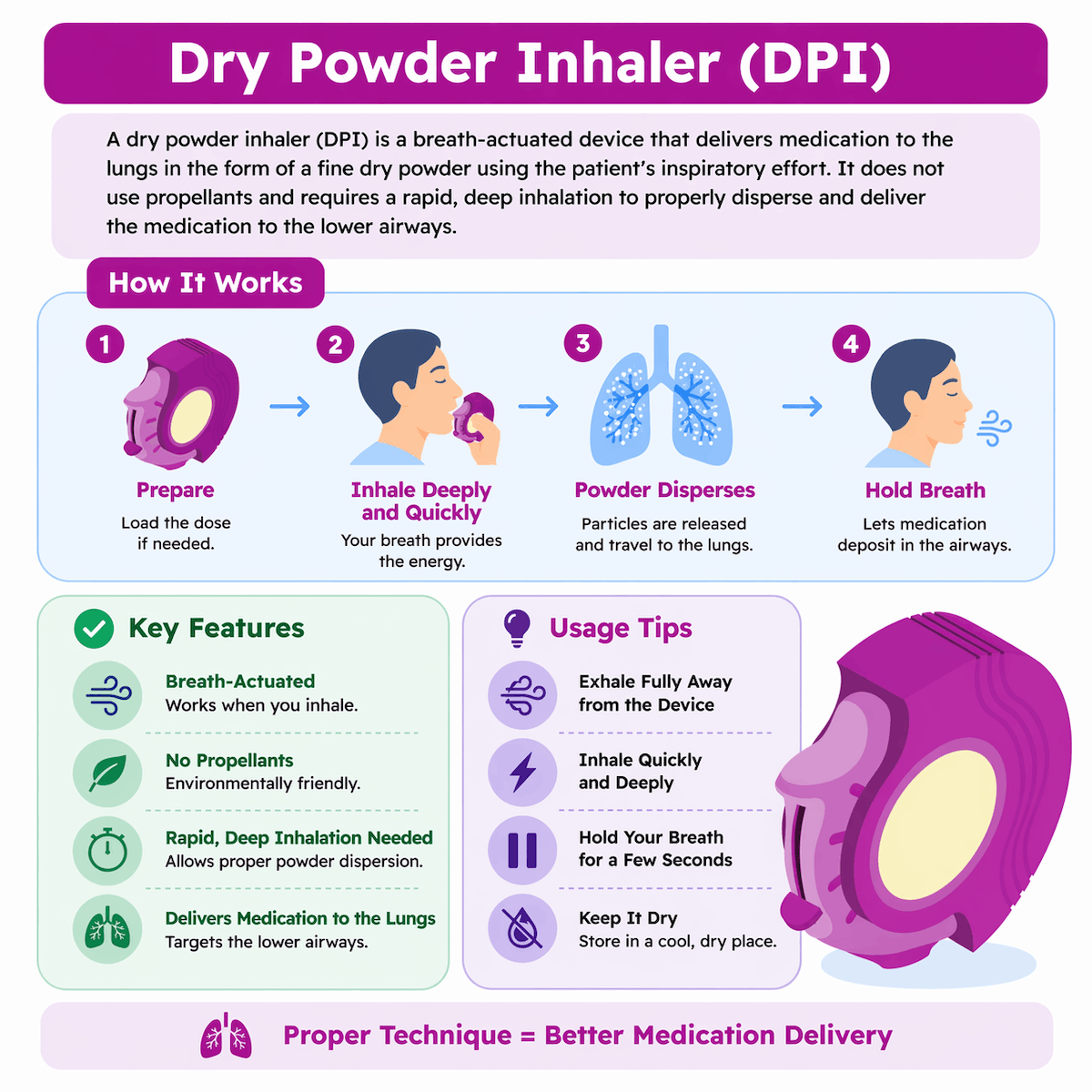
A dry powder inhaler (DPI) is a commonly used device in respiratory care that delivers medication directly to the lungs in the form of a fine powder. Unlike other aerosol delivery systems, DPIs rely entirely on the patient’s own inspiratory effort to disperse and inhale the medication.
This unique characteristic influences how the device works, who can use it effectively, and when it should be prescribed. Understanding the principles behind DPIs is essential for healthcare providers and patients to ensure proper use and optimal therapeutic outcomes.

What Is a Dry Powder Inhaler?
A dry powder inhaler (DPI) is a handheld, breath-actuated device designed to deliver aerosolized medication to the respiratory tract. The medication is stored in a dry powder formulation, which is inhaled into the lungs during a forceful inspiratory maneuver. Because the device does not rely on propellants or compressed gases, it differs significantly from metered-dose inhalers and nebulizers in both design and function.
The powder inside a DPI typically contains micronized drug particles that are small enough to reach the lower airways. These particles are often combined with an inert carrier substance such as lactose or glucose. The carrier improves the flow properties of the powder and helps ensure that the correct dose is delivered consistently.
Mechanism of Action
The function of a DPI depends on the patient’s ability to generate sufficient inspiratory flow. When the patient inhales through the mouthpiece, airflow is created within the device. This airflow generates turbulence, which breaks apart the powder into smaller particles. These particles are then carried into the respiratory tract and deposited in the bronchioles and alveoli.
Because there is no external force driving aerosolization, the inspiratory effort must be both rapid and deep. This is a key difference from other inhalation devices, where a slow and steady breath may be recommended. In the case of DPIs, a forceful inhalation is necessary to effectively disperse the medication.
Most DPIs require a minimum inspiratory flow rate of approximately 40 to 60 liters per minute, with some devices performing best at higher flow rates. If the patient cannot achieve this level of inspiratory effort, the medication may not be adequately aerosolized, resulting in poor lung deposition and reduced therapeutic effect.
Types of Dry Powder Inhalers
Dry powder inhalers are available in several designs, each with a different method of storing and delivering medication. These designs can generally be categorized into single-dose and multiple-dose devices.
Single-Dose Devices
Single-dose DPIs require the patient to manually load a capsule or blister containing a single dose of medication. Once loaded, the device pierces or opens the capsule, allowing the powder to be inhaled. Examples of this type include devices that use capsules inserted before each use.
This design allows for precise dosing but requires additional steps, which may increase the risk of user error. Patients must be trained to load the dose correctly and ensure that the capsule is properly punctured before inhalation.
Multiple-Dose Devices
Multiple-dose DPIs contain several doses of medication within a single device. These doses may be stored in a reservoir or in preloaded blister strips. Each actuation prepares a new dose for inhalation without requiring manual loading.
Many multiple-dose devices include dose counters, which help patients track how many doses remain. This feature can improve adherence and reduce the risk of running out of medication unexpectedly.
Device Examples
Several DPI devices are commonly used in clinical practice, each with unique features. These include Diskus, Ellipta, Flexhaler, Diskhaler, HandiHaler, Neohaler, and Pressair. While their designs vary, they all operate on the same principle of breath-actuated drug delivery.
Particle Size and Deposition
For inhaled medications to be effective, they must reach the appropriate regions of the lungs. Particle size plays a critical role in determining where the drug is deposited within the respiratory tract.
Particles that are larger than 5 micrometers tend to deposit in the oropharynx and upper airways. This reduces the amount of medication that reaches the lungs and may increase the risk of local side effects. In contrast, particles that are between 1 and 5 micrometers are considered respirable and are more likely to reach the lower airways, where they can exert their therapeutic effect.
Very small particles, typically less than 1 micrometer, may remain suspended in the air and be exhaled without depositing in the lungs. Therefore, achieving the optimal particle size range is essential for effective drug delivery.
The formulation of DPI medications is carefully designed to produce particles within this optimal size range. The use of carrier substances helps maintain proper dispersion and prevents the particles from clumping together.
Advantages of Dry Powder Inhalers
Dry powder inhalers offer several advantages that make them a popular choice for the treatment of chronic respiratory diseases.
Breath-Actuated Design
One of the most significant advantages of DPIs is that they are breath-actuated. This eliminates the need for coordination between actuation and inhalation, which is a common challenge with metered-dose inhalers. Patients simply need to inhale through the device to receive the medication.
No Propellants Required
DPIs do not rely on chemical propellants, which reduces environmental impact and simplifies device design. This also eliminates the cold sensation that some patients experience with propellant-based inhalers.
Portability and Convenience
These devices are compact and easy to carry, making them suitable for daily use in outpatient settings. Their convenience supports adherence, especially for patients managing chronic conditions such as asthma or chronic obstructive pulmonary disease.
Consistent Dosing
When used correctly, DPIs can deliver consistent doses of medication. The use of carrier substances and premeasured doses helps ensure that each inhalation provides the intended amount of drug.
Improved Patient Satisfaction
Because DPIs are relatively simple to use and do not require complex coordination, many patients find them easier to manage compared to other inhalation devices. This can lead to better technique and improved treatment outcomes.
Limitations and Disadvantages
Despite their benefits, dry powder inhalers have several limitations that must be considered when selecting a device for a patient.
Dependence on Inspiratory Flow
The most important limitation of DPIs is their reliance on patient-generated inspiratory flow. Patients must be able to inhale forcefully enough to disperse the powder. If they cannot, the medication will not be delivered effectively.
This limitation makes DPIs unsuitable for certain patient populations, including young children, elderly individuals with reduced strength, and patients experiencing severe respiratory distress.
Sensitivity to Moisture
The dry powder formulation is highly sensitive to humidity. Exposure to moisture can cause the powder to clump, reducing its ability to aerosolize properly. For this reason, DPIs must be stored in a dry environment and protected from humidity.
Patients should also avoid exhaling into the device, as this can introduce moisture and compromise the medication.
Technique Dependence
Although DPIs eliminate the need for coordination, they still require proper technique. Patients must inhale rapidly and deeply to achieve effective drug delivery. A slow or weak inhalation can result in inadequate dosing.
Oropharyngeal Deposition
If the powder is not properly dispersed, a significant portion of the medication may deposit in the mouth and throat instead of reaching the lungs. This can reduce effectiveness and increase the risk of local side effects.
Lack of Spacer Compatibility
Unlike metered-dose inhalers, DPIs cannot be used with spacers or valved holding chambers. This limits the ability to modify drug delivery in patients who struggle with inhalation technique.
Clinical Applications
Dry powder inhalers are widely used in the management of chronic respiratory diseases. They are particularly well suited for long-term maintenance therapy, where consistent and convenient drug delivery is essential.
Asthma
In patients with asthma, DPIs are commonly used to deliver inhaled corticosteroids and bronchodilators. These medications help reduce airway inflammation and improve airflow, making them a key component of asthma management.
Chronic Obstructive Pulmonary Disease (COPD)
DPIs are also frequently prescribed for patients with chronic obstructive pulmonary disease. Medications delivered via DPI can help relieve symptoms, improve lung function, and reduce the frequency of exacerbations.
Combination Therapy
Many DPI devices are designed to deliver combination medications, such as a bronchodilator and a corticosteroid in a single inhaler. This simplifies treatment regimens and may improve adherence.
Other Applications
In some cases, DPIs may be used to deliver other types of medications, including antibiotics or mucolytics. These applications are less common but demonstrate the versatility of the device.
Patient Selection Considerations
Choosing the right inhalation device is critical for ensuring effective treatment. When considering a DPI, healthcare providers must evaluate the patient’s ability to use the device properly.
Patients who are good candidates for DPIs typically have adequate inspiratory flow, good cognitive function, and the ability to follow instructions. They should also be able to handle the device and perform the necessary steps for proper use.
On the other hand, patients who may not be suitable for DPIs include those with severe airflow limitation, acute respiratory distress, or limited physical or cognitive ability. In these cases, alternative delivery methods may be more appropriate.
Proper Technique for DPI Use
Correct technique is essential for ensuring that the medication is delivered effectively. Patients must be trained and periodically reassessed to ensure proper use.
The general steps for using a DPI include:
- Preparing or loading the dose, depending on the device
- Exhaling fully away from the device
- Placing the mouthpiece in the mouth and sealing the lips
- Inhaling rapidly and deeply through the device
- Holding the breath for several seconds after inhalation
- Exhaling slowly after removing the device
Note: Each step plays a critical role in maximizing drug delivery and improving clinical outcomes.
Patient Education and Training
Effective use of a dry powder inhaler depends heavily on patient education. Even though DPIs are simpler than some other inhalation devices, incorrect technique remains a common reason for poor therapeutic outcomes. Healthcare providers must ensure that patients understand how to use the device properly and reinforce this education during follow-up visits.
Patients should be instructed to inhale quickly and deeply rather than slowly. This is one of the most important teaching points, as a weak inhalation will not generate enough energy to disperse the powder effectively. Demonstration and return demonstration are essential to confirm proper technique.
In addition, patients should be reminded to exhale fully before inhalation, but always away from the device. Exhaling into the inhaler introduces moisture, which can cause the powder to clump and reduce its effectiveness. Breath-holding after inhalation is also important, as it allows time for the particles to deposit in the lower airways.
Regular reassessment of technique is necessary, especially in elderly patients or those with progressive respiratory disease. Even small errors in technique can significantly reduce drug delivery.
Storage and Maintenance
Proper storage and maintenance are critical for ensuring the effectiveness of DPIs. Because the medication is in a dry powder form, it is highly sensitive to environmental conditions, particularly humidity.
Patients should store their inhalers in a cool, dry place. Bathrooms are not ideal storage locations due to high humidity levels. The device should be kept tightly closed when not in use to prevent exposure to moisture.
Unlike nebulizers, DPIs generally do not require routine cleaning with water. In fact, exposing the device to water can damage it and compromise the medication. If cleaning is necessary, it is usually recommended to wipe the mouthpiece with a dry cloth.
Note: Patients should also be instructed not to shake the device unless specifically indicated by the manufacturer. Shaking is not required for most DPIs and may disrupt the powder formulation.
Medications Delivered via DPI
Dry powder inhalers are used to administer a wide range of medications commonly prescribed for respiratory conditions. These medications are formulated to be effective when delivered directly to the lungs.
Bronchodilators
Bronchodilators are among the most commonly delivered medications via DPI. These include both short-acting and long-acting agents. They work by relaxing the smooth muscles of the airways, leading to improved airflow and reduced symptoms such as wheezing and shortness of breath.
Inhaled Corticosteroids
Inhaled corticosteroids are used to reduce airway inflammation, particularly in patients with asthma. When delivered via DPI, these medications act locally in the lungs, minimizing systemic side effects while effectively controlling inflammation.
Combination Medications
Many DPI devices are designed to deliver combination therapies, which include both a bronchodilator and an anti-inflammatory agent. These combinations simplify treatment regimens and may improve patient adherence.
Other Agents
In certain cases, DPIs may be used to deliver other medications such as antibiotics or mucolytics. While less common, these applications highlight the versatility of dry powder inhaler technology.
Comparison with Other Aerosol Devices
Understanding how DPIs compare with other aerosol delivery systems helps guide clinical decision-making.
Comparison with Metered-Dose Inhalers
Metered-dose inhalers require coordination between actuation and inhalation. This can be difficult for some patients, especially those with limited dexterity or coordination. DPIs eliminate this issue by being breath-actuated.
However, MDIs can be used with spacers or valved holding chambers, which improve drug delivery in patients who have difficulty with inhalation technique. DPIs do not have this option, making proper inspiratory effort essential.
Comparison with Nebulizers
Nebulizers deliver medication in a continuous aerosol over several minutes and do not require a specific inhalation technique. This makes them ideal for patients who are unable to use handheld devices effectively.
In contrast, DPIs are faster to use, more portable, and do not require an external power source. They are better suited for long-term outpatient management rather than acute care settings.
Adverse Effects and Troubleshooting
While DPIs are generally safe and well-tolerated, certain adverse effects and complications may occur. One potential issue is oropharyngeal deposition, which can lead to irritation or, in the case of corticosteroids, fungal infections such as oral candidiasis. Patients using inhaled corticosteroids should be advised to rinse their mouth after each use to reduce this risk.
Another concern is inadequate drug delivery due to improper technique or insufficient inspiratory flow. Patients who do not experience symptom relief should be reassessed for proper use of the device.
In some cases, patients may experience increased coughing or wheezing immediately after using a DPI. This may indicate airway irritation or poor deposition of the medication. In such situations, the medication should be discontinued, and the healthcare provider should be notified.
Clinical Decision-Making
Selecting the appropriate aerosol delivery device is an important aspect of respiratory care. When considering a DPI, clinicians must evaluate several factors, including the patient’s inspiratory capacity, cognitive ability, and overall clinical condition.
Patients who can generate sufficient inspiratory flow and follow instructions are generally good candidates for DPIs. These devices are particularly useful for maintenance therapy in stable patients with chronic respiratory diseases.
However, in patients with severe airflow obstruction, acute exacerbations, or limited ability to perform the required inhalation maneuver, alternative devices should be considered. In such cases, nebulizers or MDIs with spacers may provide more reliable drug delivery.
Note: Clinical judgment should also take into account patient preference and adherence. A device that the patient is comfortable using is more likely to be used correctly and consistently.
Role of the Respiratory Therapist
Respiratory therapists play a central role in the effective use of dry powder inhalers. Their responsibilities include assessing the patient’s ability to use the device, providing education, and monitoring treatment outcomes.
Respiratory therapists must ensure that patients understand the correct technique and are able to demonstrate it. They should also evaluate inspiratory flow when necessary and recommend alternative devices if the patient is unable to achieve adequate flow.
Ongoing follow-up is essential to address any issues with technique or adherence. By providing education and support, respiratory therapists help optimize the effectiveness of DPI therapy and improve patient outcomes.
Special Populations
Pediatric Patients
Young children often lack the ability to generate the inspiratory flow required for DPI use. For this reason, DPIs are generally not recommended for infants and toddlers. Alternative devices such as nebulizers or MDIs with spacers are typically preferred.
Elderly Patients
Elderly individuals may have reduced muscle strength or cognitive impairment, which can affect their ability to use a DPI effectively. Careful assessment and education are necessary to determine whether a DPI is appropriate.
Patients with Severe Disease
Patients experiencing acute respiratory distress or severe exacerbations of chronic disease may not be able to generate sufficient inspiratory flow. In these situations, other delivery methods should be used until the patient’s condition stabilizes.
Future Directions
Advances in inhaler technology continue to improve the design and performance of DPIs. Newer devices aim to reduce the dependence on high inspiratory flow and improve drug delivery efficiency.
Research is also focused on expanding the range of medications that can be delivered via DPI, including biologic agents and vaccines. These developments have the potential to further enhance the role of DPIs in respiratory care.
Note: Improved patient education tools and digital monitoring features may also enhance adherence and technique, leading to better clinical outcomes.
Dry Powder Inhaler (DPI) Practice Questions
1. What is a dry powder inhaler (DPI)?
A device that delivers medication to the lungs in the form of a dry powder using the patient’s inspiratory effort.
2. How do DPIs differ from metered-dose inhalers (MDIs)?
DPIs are breath-actuated and do not use propellants, while MDIs require coordination and use propellants.
3. What drives medication delivery in a DPI?
The patient’s own inspiratory flow.
4. What particle size is ideal for DPI drug delivery?
Particles between 1 and 5 micrometers.
5. Why are particles larger than 5 micrometers less effective?
They tend to deposit in the upper airway instead of reaching the lungs.
6. What happens to particles smaller than 1 micrometer?
They may be exhaled without depositing in the lungs.
7. What is the typical inspiratory flow rate required for DPIs?
Approximately 40 to 60 L/min.
8. What happens if a patient cannot generate enough inspiratory flow?
The medication may not be properly dispersed or delivered.
9. What is the role of lactose in DPI formulations?
It acts as a carrier to improve powder flow and dosing consistency.
10. Are DPIs propellant-based devices?
No, they do not use propellants.
11. What is a key advantage of DPIs over MDIs?
They eliminate the need for coordination between actuation and inhalation.
12. What type of inhalation is required for DPIs?
A rapid and deep inhalation.
13. Why should patients not exhale into a DPI?
It introduces moisture that can clump the powder.
14. What is a single-dose DPI?
A device that requires loading a capsule or blister before each use.
15. What is a multiple-dose DPI?
A device that contains several preloaded doses.
16. What feature helps track medication use in some DPIs?
A dose counter.
17. Why are DPIs sensitive to humidity?
Moisture can cause the powder to clump and reduce effectiveness.
18. Where should DPIs be stored?
In a cool, dry place.
19. Can DPIs be used with spacers?
No, they are not compatible with spacers.
20. What is a major limitation of DPIs?
Dependence on sufficient inspiratory flow.
21. Which patients may struggle to use DPIs effectively?
Young children, elderly patients, and those in respiratory distress.
22. What type of medications are commonly delivered via DPI?
Bronchodilators and inhaled corticosteroids.
23. What is the purpose of holding the breath after inhalation?
To allow medication to deposit in the lungs.
24. What is a common side effect of poor DPI technique?
Reduced drug delivery to the lungs.
25. Why is patient education important for DPI use?
Proper technique is essential for effective medication delivery.
26. What type of device is a DPI classified as?
A breath-actuated aerosol drug delivery device.
27. What creates turbulence inside a DPI during inhalation?
The patient’s inspiratory airflow.
28. What is the purpose of turbulence in a DPI?
To break apart powder into respirable particles.
29. Why is a rapid inhalation necessary for DPIs?
It helps de-aggregate the powder for proper aerosolization.
30. What happens if a patient inhales too slowly with a DPI?
The medication may not disperse effectively.
31. What is the function of a blister pack in some DPIs?
To store individual doses of medication.
32. What is the function of a reservoir in a DPI?
To store multiple doses of powdered medication.
33. Why are DPIs considered convenient for long-term therapy?
They are portable, compact, and easy to use.
34. What type of respiratory conditions commonly use DPIs?
Chronic conditions like asthma and COPD.
35. Why are DPIs not ideal during acute exacerbations?
Patients may not generate sufficient inspiratory flow.
36. What should a patient do before inhaling from a DPI?
Exhale fully away from the device.
37. Why must lips be sealed tightly around the mouthpiece?
To ensure proper airflow through the device.
38. What is the benefit of premeasured doses in DPIs?
They improve dosing accuracy and consistency.
39. What can happen if a DPI is exposed to water?
The device and medication may be damaged.
40. How does a DPI improve adherence in some patients?
By being simple to use and requiring minimal coordination.
41. What should be done after using a corticosteroid DPI?
Rinse the mouth to reduce risk of infection.
42. What type of airway deposition occurs with poor technique?
Oropharyngeal deposition.
43. What is a sign that a DPI may not be working effectively?
Lack of symptom relief.
44. What should be done if symptoms persist despite DPI use?
Reassess technique and device use.
45. What may increased coughing after DPI use indicate?
Airway irritation or improper drug delivery.
46. What is the appropriate response to adverse reactions from a DPI?
Stop the medication and notify the physician.
47. Why are DPIs not ideal for infants?
They cannot generate sufficient inspiratory flow.
48. How does a DPI differ from a nebulizer in drug delivery time?
DPIs deliver medication quickly, while nebulizers take several minutes.
49. What role does patient cognition play in DPI use?
Patients must understand and follow proper technique.
50. Why is follow-up important for patients using DPIs?
To ensure correct technique and effective therapy.
51. What is the primary source of energy for aerosolizing medication in a DPI?
The patient’s inspiratory effort.
52. What is de-aggregation in the context of DPIs?
The process of breaking powder into fine particles during inhalation.
53. Why are carrier particles used in DPI formulations?
To improve flow properties and ensure consistent dosing.
54. What happens to the carrier particles during inhalation?
They separate from the drug and may deposit in the oropharynx.
55. What is the main goal of DPI therapy?
To deliver medication effectively to the lower airways.
56. What type of inhalation technique reduces DPI effectiveness?
A weak or shallow inhalation.
57. Why is it important to check the dose counter on a DPI?
To ensure doses are still available and avoid missed treatment.
58. What can happen if a DPI runs out of medication without the patient realizing it?
The patient may receive no therapeutic benefit.
59. What is a key difference in breathing technique between DPI and MDI use?
DPIs require rapid inhalation, while MDIs require slow inhalation.
60. What can reduce the dispersion of powder inside a DPI?
Insufficient inspiratory flow or moisture exposure.
61. What is one reason DPIs are considered environmentally friendly?
They do not use chemical propellants.
62. What may happen if a patient exhales into a DPI before inhalation?
Moisture can cause the powder to clump.
63. What is the impact of airway obstruction on DPI effectiveness?
It can limit inspiratory flow and reduce drug delivery.
64. Why is DPI technique reassessment important over time?
Patients may develop improper habits or experience disease progression.
65. What role does airway anatomy play in DPI effectiveness?
It influences where particles deposit in the respiratory tract.
66. What is a potential consequence of excessive oropharyngeal deposition?
Increased local side effects and reduced lung delivery.
67. What is the recommended action if a patient cannot use a DPI correctly?
Switch to an alternative delivery device.
68. What type of DPI requires capsule insertion before use?
A single-dose DPI.
69. What type of DPI automatically prepares doses without manual loading?
A multiple-dose DPI.
70. What is the benefit of preloaded blister strips in DPIs?
They simplify dosing and reduce user error.
71. Why should DPIs not be stored in bathrooms?
High humidity can affect the powder.
72. What is a common teaching strategy for DPI use?
Demonstration followed by patient return demonstration.
73. What does poor adherence to DPI therapy often result in?
Worsening of respiratory symptoms.
74. What is a major factor influencing drug deposition in the lungs?
Inspiratory flow rate
75. Why must healthcare providers assess inspiratory capacity before prescribing a DPI?
To ensure the patient can generate adequate flow for effective use.
76. What type of airflow pattern is needed to activate a DPI?
A forceful, turbulent inspiratory flow.
77. What is the main reason DPIs are not ideal for emergency situations?
Patients may be unable to generate adequate inspiratory effort.
78. What happens if the powder in a DPI aggregates?
It reduces aerosolization and drug delivery.
79. What is the function of the mouthpiece in a DPI?
To direct airflow and medication into the airway.
80. Why is a tight seal around the mouthpiece important?
To prevent air leakage and ensure proper drug delivery.
81. What is a common error when using a DPI?
Inhaling too slowly or weakly.
82. What type of drug delivery is achieved with proper DPI use?
Targeted delivery to the lower respiratory tract.
83. What is the advantage of localized drug delivery in the lungs?
Reduced systemic side effects.
84. What happens if a patient skips the breath-hold after inhalation?
Less medication deposits in the lungs.
85. What is a key step before placing the DPI in the mouth?
Exhaling fully away from the device.
86. What can happen if a patient inhales through the nose instead of the mouth?
Reduced medication delivery to the lungs.
87. What type of patient may benefit from DPI simplicity?
Patients who struggle with hand-breath coordination.
88. What is the purpose of a dose preparation mechanism in a DPI?
To ensure a consistent amount of medication is delivered.
89. What is a potential issue with improper DPI storage?
Reduced drug potency or effectiveness.
90. What does consistent dosing help achieve in chronic disease management?
Stable symptom control.
91. What is one advantage of DPIs in outpatient care?
They are easy to transport and use anywhere.
92. What happens if a DPI is not closed properly after use?
Moisture exposure can degrade the powder.
93. What is a key consideration when selecting a DPI for a patient?
Their ability to perform a forceful inhalation.
94. What role does technique play in DPI therapy success?
It directly affects how much medication reaches the lungs.
95. What is a potential result of poor inhalation technique over time?
Disease progression due to inadequate treatment.
96. Why are DPIs commonly used for maintenance therapy?
They provide consistent and convenient drug delivery.
97. What is a common instruction regarding breathing during DPI use?
Do not exhale into the device.
98. What type of airflow is generated inside a DPI during use?
High-velocity airflow that disperses powder.
99. What can happen if a patient does not load a single-dose DPI correctly?
They may receive little or no medication.
100. What is the ultimate goal of proper DPI use?
Effective delivery of medication to improve respiratory function.
Final Thoughts
Dry powder inhalers are an important tool in the management of respiratory diseases, offering a convenient and effective method for delivering medication directly to the lungs. Their breath-actuated design simplifies use and eliminates the need for propellants, making them a practical option for many patients.
However, their effectiveness depends on proper technique and adequate inspiratory flow, which limits their use in certain populations. Careful patient selection, thorough education, and ongoing assessment are essential to ensure successful therapy and optimal clinical results.

Written by:
John Landry is a registered respiratory therapist from Memphis, TN, and has a bachelor's degree in kinesiology. He enjoys using evidence-based research to help others breathe easier and live a healthier life.
References
- Levy ML, Carroll W, Izquierdo Alonso JL, Keller C, Lavorini F, Lehtimäki L. Understanding Dry Powder Inhalers: Key Technical and Patient Preference Attributes. Adv Ther. 2019.