

Respiratory therapy is a specialized healthcare profession focused on the assessment, treatment, and management of patients with cardiopulmonary disorders. What began in the early 20th century as a task-based role centered on oxygen delivery has evolved into a highly skilled clinical discipline.
Today, respiratory therapists (RTs) play a vital role in patient care across multiple settings, utilizing advanced technologies, evidence-based practices, and critical thinking skills.
This article provides a comprehensive overview of the profession, including its history, scope of practice, departmental structure, and essential roles within respiratory care.

Historical Development of Respiratory Therapy
The profession of respiratory therapy was formally established in the United States during the 1930s. In its earliest stages, individuals performing respiratory care were commonly referred to as oxygen technicians or oxygen orderlies. Their primary responsibilities included transporting oxygen cylinders and administering oxygen therapy. Most of these individuals received on-the-job training rather than formal education.
By the late 1940s and early 1950s, structured training programs began to emerge, reflecting the growing need for more skilled practitioners. As medical science advanced, particularly in the areas of anesthesia and mechanical ventilation, the demand for specialized respiratory care increased. The development of intensive care units and postoperative recovery units further expanded the role of respiratory therapists.
Over time, the profession transitioned from a task-oriented role to a knowledge-based clinical discipline. Respiratory therapists became integral members of the healthcare team, assisting physicians in managing critically ill patients and applying complex therapeutic interventions.
Today, respiratory therapy is recognized as one of the fastest-growing healthcare professions, driven by advancements in technology, an aging population, and an increasing prevalence of chronic respiratory diseases.
Scope of Respiratory Care Practice
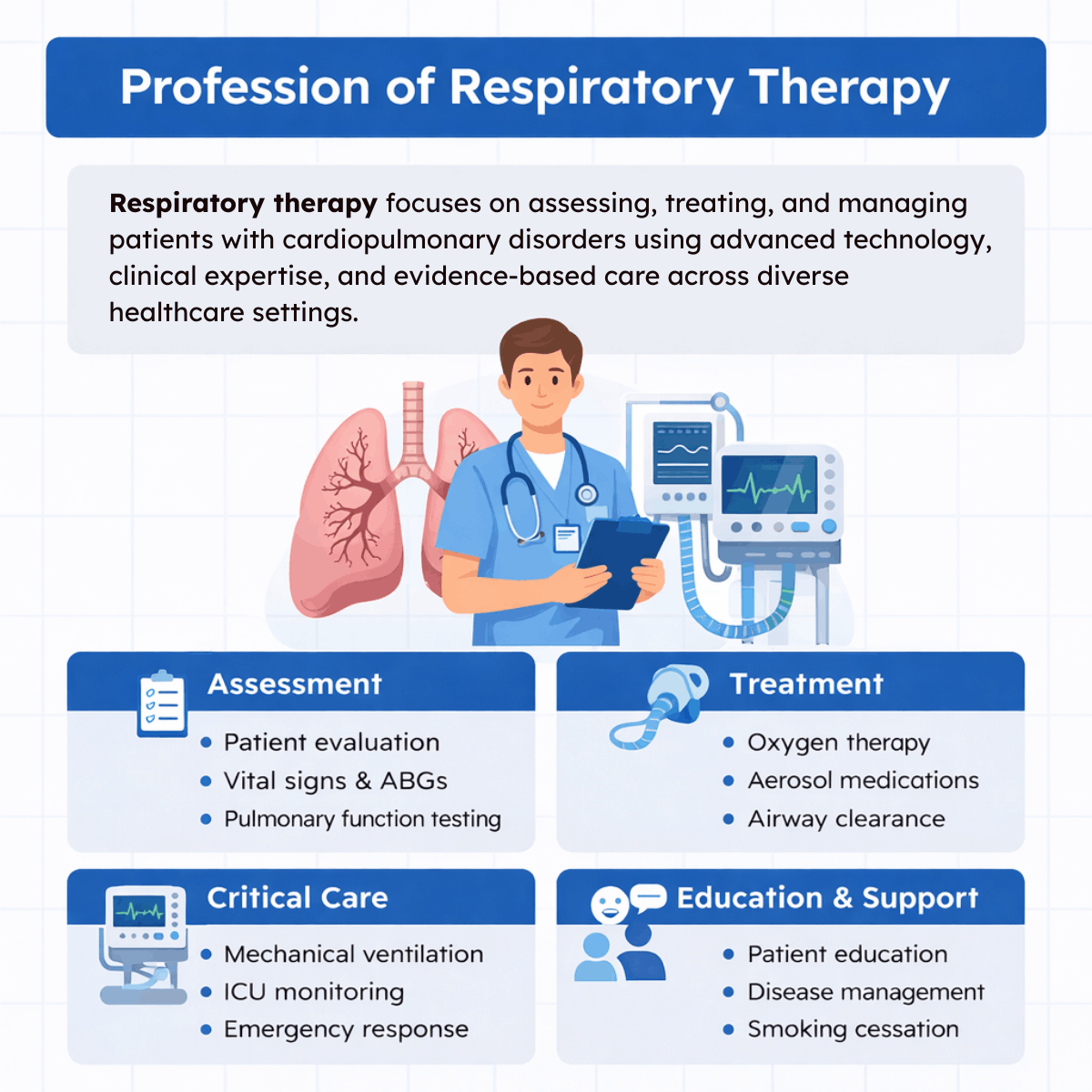
According to the American Association for Respiratory Care (AARC), respiratory therapists are responsible for a wide range of clinical activities related to the cardiopulmonary system. Their scope of practice includes patient assessment, diagnostic evaluation, disease management, therapeutic interventions, education, and rehabilitation.
Diagnostic Responsibilities
Respiratory therapists perform several diagnostic procedures to evaluate cardiopulmonary function. These activities include obtaining and analyzing physiologic specimens such as arterial blood gases, interpreting clinical data, and conducting pulmonary function tests. They may also assist with neurophysiologic studies and sleep disorder evaluations.
The ability to interpret data is a critical component of the RT’s role. Therapists must analyze results in the context of the patient’s clinical condition and communicate findings effectively to the healthcare team.
Therapeutic Interventions
Therapeutic responsibilities include the administration of medical gases, management of mechanical ventilation, and care of artificial airways. Respiratory therapists are also involved in bronchopulmonary hygiene, pharmacologic therapy, and cardiopulmonary rehabilitation.
Mechanical ventilation management is one of the most complex aspects of respiratory care. RTs must select appropriate ventilator settings, monitor patient response, and make adjustments based on clinical data. This requires a strong understanding of respiratory physiology and ventilatory strategies.
Additional therapeutic roles include providing hemodynamic support, assisting with sleep-related breathing disorders, and delivering aerosolized medications. These interventions are essential for maintaining adequate oxygenation and ventilation in patients with acute or chronic respiratory conditions.
Patient and Public Education
Education is a key component of respiratory care. Therapists provide instruction to patients and their families regarding disease processes, treatment plans, and self-management strategies. This is particularly important for individuals with chronic conditions such as asthma and chronic obstructive pulmonary disease.
Public education efforts focus on promoting cardiopulmonary health, including smoking cessation, disease prevention, and early intervention. These initiatives contribute to improved health outcomes and reduced healthcare costs.
Practice Settings
Respiratory therapists work in a variety of healthcare environments, each with unique responsibilities and patient populations.
Hospitals
Hospitals are the primary workplace for most respiratory therapists. Within this setting, RTs provide care in general medical units, intensive care units, emergency departments, and operating rooms. They are responsible for managing ventilators, administering treatments, and responding to emergencies such as cardiac or respiratory arrest.
Critical Care Units
In intensive care units, respiratory therapists manage life-support systems for critically ill patients. This includes advanced ventilator management, airway care, and continuous monitoring of respiratory status. Their role is essential in maintaining patient stability and supporting recovery.
Emergency Departments
In emergency settings, RTs deliver rapid, lifesaving interventions. They assist with airway management, oxygen therapy, and mechanical ventilation for patients in acute distress. Their ability to act quickly and effectively is critical in these high-pressure environments.
Neonatal and Pediatric Care
Respiratory therapists also specialize in caring for newborns and children with respiratory conditions. This includes managing premature infants with underdeveloped lungs and treating pediatric diseases such as cystic fibrosis.
Home Care and Rehabilitation
In home care settings, RTs provide ongoing support for patients with chronic respiratory conditions. They ensure proper use of equipment, monitor progress, and help prevent hospital readmissions. Pulmonary rehabilitation programs focus on improving lung function and quality of life for patients with long-term respiratory diseases.
Sleep Laboratories and Outpatient Clinics
Respiratory therapists play a role in diagnosing and managing sleep disorders such as sleep apnea. In outpatient clinics, they conduct pulmonary function testing and provide patient education and disease management services.
Transport and Specialty Roles
RTs may also participate in ground and air transport teams, providing critical care during patient transfers. Additionally, they work in disease management programs, insurance settings, and smoking cessation initiatives.
Respiratory Therapy Department Structure
Respiratory therapy departments are typically organized to ensure efficient and high-quality patient care. Most departments operate under a centralized model, with unified leadership, policies, and procedures. However, some institutions use decentralized models, where respiratory services are integrated into specific service lines.
Department Director
The department director is responsible for overseeing all aspects of respiratory care services. This includes ensuring the quality and safety of patient care, managing staff, and maintaining compliance with regulatory standards. The director must stay informed about advances in technology and clinical practice to guide the department effectively.
Medical Director
The medical director, often a physician specializing in pulmonary or critical care medicine, collaborates with the department director to ensure clinical excellence. This individual provides medical oversight, approves policies, and serves as a resource for complex clinical decisions.
Educational Coordinator
The educational coordinator focuses on staff development and competency. This role involves assessing educational needs, organizing training programs, and supporting the implementation of new technologies and practices.
Quality Assurance Coordinator
Quality assurance is essential for evaluating the effectiveness and efficiency of respiratory care services. The quality assurance coordinator monitors clinical outcomes, identifies areas for improvement, and ensures compliance with standards and protocols.
Clinical Staff and Leadership Roles
Supervisors and Lead Therapists
Supervisors and lead therapists are experienced RTs who oversee daily operations within the department. They assign workloads, provide clinical guidance, and assist with complex procedures. These individuals also address personnel issues and serve as a link between staff and management.
Respiratory Therapists
The frontline respiratory therapists are the primary providers of care. They work directly with patients, performing assessments, administering treatments, and responding to emergencies. Their competence and professionalism are critical to the success of the department.
Respiratory therapists must be licensed and meet competency standards established by credentialing organizations. Their training combines technical skills with clinical decision-making, enabling them to provide safe and effective care.
Education and Training
To become a respiratory therapist, individuals must complete an accredited educational program. These programs are offered at the associate, baccalaureate, and graduate levels. Accreditation is provided by the Commission on Accreditation for Respiratory Care (CoARC), which ensures that programs meet established standards.
Graduates must pass the National Board for Respiratory Care (NBRC) examinations to obtain professional credentials. The two primary credentials are Certified Respiratory Therapist (CRT) and Registered Respiratory Therapist (RRT). The RRT credential represents a higher level of competency and is increasingly required for licensure in many states.
Educational programs emphasize both technical training and clinical knowledge. Students learn to perform procedures while also developing the critical thinking skills necessary for patient assessment and decision-making.
Credentials and Professional Designations
Respiratory therapists must obtain professional credentials to demonstrate competency and qualify for licensure. The National Board for Respiratory Care (NBRC) administers the credentialing examinations that establish minimum standards for practice.
There are two primary levels of general practice credentials. The Certified Respiratory Therapist (CRT) credential is awarded after passing the entry-level examination. The Registered Respiratory Therapist (RRT) credential represents an advanced level of competence and requires passing both a higher-level written exam and a clinical simulation examination.
In addition to these core credentials, respiratory therapists may pursue specialty certifications to advance their careers. These include neonatal and pediatric specialist, adult critical care specialist, sleep disorders specialist, and pulmonary function technologist credentials. Specialty certifications allow RTs to develop expertise in specific areas of care and contribute to improved patient outcomes.
Note: Credential maintenance requires ongoing continuing education and adherence to professional standards. This ensures that respiratory therapists remain current with evolving technologies and clinical practices.
State Licensure and Regulation
Licensure is required in most states to practice as a respiratory therapist. The purpose of licensure is to protect public health by ensuring that practitioners meet established competency standards.
State licensing boards typically require candidates to hold at least the CRT credential, although there is a growing trend toward requiring the RRT credential for initial licensure. This shift reflects the increasing complexity of respiratory care and the need for a higher level of clinical competence.
In addition to credentialing requirements, respiratory therapists must comply with state regulations related to scope of practice, continuing education, and professional conduct. These regulations help maintain consistency and quality across the profession.
Professional Organizations
Professional organizations play a significant role in advancing the field of respiratory therapy. They provide resources for education, advocacy, research, and professional development.
American Association for Respiratory Care (AARC)
The American Association for Respiratory Care is the primary professional organization for respiratory therapists. It supports the profession through educational programs, publications, and advocacy efforts. The organization promotes best practices, provides access to research, and fosters professional growth among its members.
The AARC publishes professional resources, including journals and newsletters, and hosts conferences that allow practitioners to stay informed about advances in respiratory care. It also works with regulatory bodies to influence policies that affect the profession.
National Board for Respiratory Care (NBRC)
The NBRC is responsible for credentialing respiratory therapists. It establishes examination standards and ensures that practitioners meet competency requirements. The organization plays a critical role in maintaining the integrity of the profession by setting high standards for entry and advancement.
Commission on Accreditation for Respiratory Care (CoARC)
The Commission on Accreditation for Respiratory Care oversees educational programs in respiratory therapy. Accreditation ensures that programs meet established standards and adequately prepare students for clinical practice.
Other Supporting Organizations
Several additional organizations contribute to the advancement of respiratory care. These include foundations that support research and education, as well as interdisciplinary organizations that collaborate on clinical guidelines and standards.
Organizations such as the American Thoracic Society, the American College of Chest Physicians, and the Society of Critical Care Medicine provide valuable research, publications, and clinical guidance that influence respiratory care practice.
Respiratory Therapy Education and Advancement
Respiratory therapy education has evolved significantly to meet the demands of modern healthcare. Entry into the profession typically requires completion of an accredited program at the associate or baccalaureate level.
There is a growing emphasis on baccalaureate and graduate education. Higher levels of education are associated with improved critical thinking skills, better patient outcomes, and increased opportunities for leadership and advancement.
Many respiratory therapists pursue advanced degrees in areas such as education, management, research, or clinical specialization. These programs prepare RTs for roles beyond bedside care, including leadership positions and academic careers.
Note: Degree advancement programs provide opportunities for practicing RTs to continue their education. These programs often offer flexible formats, including online learning, to accommodate working professionals.
Value-Based Care and Quality Improvement
The healthcare system has shifted from a volume-based model to a value-based model, emphasizing quality and outcomes rather than the number of procedures performed.
In respiratory therapy, this shift requires a focus on delivering care that is both effective and efficient. Quality improvement initiatives involve evaluating clinical outcomes, reducing unnecessary treatments, and implementing evidence-based practices.
Respiratory therapy departments must continuously assess their performance and identify opportunities for improvement. This includes monitoring patient outcomes, analyzing data, and refining clinical protocols.
Note: The concept of value-based care also highlights the importance of resource utilization. Respiratory therapists play a key role in ensuring that therapies are appropriate and beneficial, reducing waste and improving overall healthcare efficiency.
Research and Evidence-Based Practice
Research is essential for advancing the science of respiratory care. Evidence-based practice involves integrating clinical expertise with the best available research and patient preferences.
Respiratory therapists contribute to research by participating in clinical studies, evaluating new technologies, and analyzing patient outcomes. This helps identify effective treatments and improve standards of care.
The role of the respiratory therapy researcher has expanded in recent years. These professionals often have advanced degrees and focus on investigating clinical questions that impact patient care. Their work supports the development of new therapies and enhances the overall quality of respiratory care.
Future of Respiratory Therapy
The future of respiratory therapy is shaped by technological advancements, changing healthcare models, and evolving patient needs. The demand for respiratory therapists is expected to increase due to the aging population and the prevalence of chronic respiratory diseases.
Healthcare delivery is shifting toward more outpatient and home-based care. Respiratory therapists will play an important role in managing chronic conditions outside of the hospital setting. This includes disease management programs, telehealth services, and patient education initiatives.
Emerging roles, such as pulmonary disease managers, are becoming more prominent. These professionals focus on helping patients manage chronic conditions through education, monitoring, and coordinated care. This approach aims to reduce hospital admissions and improve quality of life.
Another potential development is the role of the advanced practice respiratory therapist. This role is designed to expand the scope of practice beyond that of the registered respiratory therapist, allowing for more advanced clinical responsibilities. Although still in development, this role reflects the growing complexity of respiratory care and the need for highly trained professionals.
Technological advancements will continue to influence the profession. Innovations in mechanical ventilation, monitoring systems, and data management will require RTs to adapt and develop new skills. The integration of data-driven decision-making will further enhance patient care.
Professionalism in Respiratory Therapy
Professionalism is a fundamental aspect of respiratory therapy. It involves adhering to ethical standards, maintaining competency, and demonstrating a commitment to patient care.
Respiratory therapists must respect patient confidentiality, provide compassionate care, and collaborate effectively with other healthcare professionals. They are expected to engage in lifelong learning and stay current with advancements in the field.
Participation in professional organizations and continuing education activities supports professional development. These efforts contribute to the advancement of the profession and improve the quality of care provided to patients.
Profession of Respiratory Therapy Practice Questions
1. What was the primary role of early respiratory therapists?
They were mainly responsible for transporting oxygen cylinders and administering oxygen therapy.
2. What were early respiratory therapists commonly called?
They were often referred to as oxygen technicians or oxygen orderlies.
3. When was the profession of respiratory therapy officially established in the United States?
It was formally established in the 1930s.
4. What major advancements contributed to the growth of respiratory therapy as a profession?
The development of mechanical ventilation and advances in postoperative and critical care.
5. What type of training did early respiratory therapists typically receive?
Most were trained through on-the-job instruction rather than formal education programs.
6. Which organization helps define the scope of practice for respiratory therapists?
The American Association for Respiratory Care (AARC).
7. What are the core responsibilities included in the respiratory therapist’s scope of practice?
Patient assessment, diagnostic evaluation, disease management, therapeutic intervention, patient education, and rehabilitation.
8. What type of diagnostic specimens do respiratory therapists commonly analyze?
Physiologic specimens such as arterial blood gases (ABGs).
9. What is an example of a diagnostic procedure performed by respiratory therapists?
Pulmonary function testing (PFT)
10. What is a primary therapeutic responsibility of respiratory therapists in acute care settings?
Managing and monitoring mechanical ventilation.
11. What is bronchopulmonary hygiene?
A group of techniques used to mobilize and remove secretions from the airways.
12. What role do respiratory therapists play in pharmacologic therapy?
They administer and monitor medications that affect the cardiopulmonary system.
13. Why is patient education an essential component of respiratory care?
It helps patients understand their condition, adhere to treatment plans, and improve outcomes.
14. What is the purpose of public education in respiratory therapy?
To promote lung health, prevent disease, and increase awareness of respiratory conditions.
15. Where are most respiratory therapists employed?
In hospital settings.
16. What role do respiratory therapists play in the intensive care unit (ICU)?
They manage ventilators, monitor critically ill patients, and adjust therapy based on clinical data.
17. What is the role of respiratory therapists in emergency departments?
They provide rapid assessment and life-saving respiratory interventions.
18. What patient populations are commonly treated by respiratory therapists in neonatal and pediatric care?
Premature infants and children with acute or chronic respiratory conditions.
19. What is the goal of pulmonary rehabilitation programs?
To improve functional capacity, reduce symptoms, and enhance quality of life in patients with chronic lung disease.
20. What is the primary responsibility of a respiratory therapy department director?
To manage departmental operations and ensure high-quality patient care.
21. What role does the medical director serve in respiratory care services?
They provide clinical oversight, establish protocols, and ensure adherence to standards of care.
22. What does an educational coordinator do in a respiratory therapy department?
They develop, implement, and evaluate staff education and training programs.
23. What is the role of a quality assurance coordinator in respiratory care?
To monitor, evaluate, and improve clinical performance and patient outcomes.
24. What is the difference between centralized and decentralized respiratory care departments?
Centralized departments operate under unified leadership, while decentralized departments function within specific clinical service lines.
25. What is the primary responsibility of supervisors or lead respiratory therapists?
To oversee daily operations and provide guidance and support to clinical staff.
26. Who are considered the frontline providers of respiratory care?
Respiratory therapists
27. What credential must be obtained to become a Certified Respiratory Therapist (CRT)?
Passing the National Board for Respiratory Care (NBRC) entry-level examination.
28. What credential indicates an advanced level of competency in respiratory care?
Registered Respiratory Therapist (RRT)
29. Which organization accredits respiratory therapy education programs?
The Commission on Accreditation for Respiratory Care (CoARC).
30. What is the purpose of licensure for respiratory therapists?
To ensure minimum competency standards and protect public safety.
31. What federal agency regulates medical devices used in respiratory care?
The Food and Drug Administration (FDA).
32. What is value-based care in respiratory therapy?
A healthcare approach focused on improving patient outcomes while maximizing efficiency and minimizing unnecessary costs.
33. What is meant by misallocation of respiratory care?
Providing unnecessary or inappropriate therapy or failing to deliver needed care.
34. What is the role of research in the field of respiratory therapy?
To advance clinical practice and improve patient outcomes through evidence-based findings.
35. What trend is expected to influence the future demand for respiratory therapists?
An increase in chronic respiratory diseases and an aging population.
36. Who are the primary clients served by a respiratory therapy department?
Patients, nursing units, and physicians who rely on respiratory care services.
37. What is a centralized respiratory therapy department?
A department with unified leadership, standardized policies and procedures, shared equipment, and coordinated staffing.
38. What is a decentralized respiratory therapy model?
A model in which respiratory care services are integrated into specific service lines with separate leadership structures.
39. What is a key responsibility of a respiratory therapy department director regarding equipment?
Ensuring that all equipment meets safety, regulatory, and performance standards.
40. Which legislation regulates medical devices used in respiratory care?
The Medical Device Amendments Act of 1976.
41. Which federal agency oversees medical devices and medications used in respiratory care?
The Food and Drug Administration (FDA).
42. Why are policies and procedures essential in respiratory care departments?
They promote consistency, safety, and adherence to evidence-based practices.
43. What is required to maintain respiratory care equipment safely?
Routine inspection, preventive maintenance, and adherence to safety protocols.
44. Why can adapting to new respiratory care technology be challenging for department leaders?
Because technology evolves rapidly and requires ongoing training and resource management.
45. Who may assume the role of educational coordinator in smaller respiratory therapy departments?
The department director, supervisor, or experienced respiratory therapists.
46. What is the primary goal of competency programs in respiratory therapy?
To ensure that staff can perform clinical tasks safely and effectively.
47. How has the focus of respiratory care quality metrics evolved in recent years?
From measuring procedure volume to evaluating patient outcomes and value-based care.
48. What does value-based efficiency assess in respiratory care?
The balance between the benefits of care and the resources required to deliver it.
49. What factors may be used to define “benefit” in value-based care?
Patient outcomes, survival rates, cost-effectiveness, and patient satisfaction.
50. What is a general principle of high-quality respiratory care?
It should be both safe and efficient.
51. What is the role of the bedside respiratory therapist?
To deliver direct patient care, monitor therapy, and respond to clinical changes.
52. What types of emergencies do respiratory therapists commonly respond to?
Rapid response calls, cardiac arrests (codes), and disaster situations.
53. What factors contribute to the overall quality of respiratory therapists?
Their education, clinical training, experience, and professional conduct.
54. What is the difference between training and clinical education in respiratory care?
Training focuses on performing tasks, while education emphasizes critical thinking and clinical decision-making.
55. Who typically serves as the medical director of a respiratory therapy department?
A physician specializing in pulmonary medicine, critical care, or anesthesiology.
56. What level of availability is expected from a medical director?
They should be available for consultation at all times, including 24/7 availability.
57. What is a common limitation of traditional physician-ordered respiratory care?
The potential for misallocation of therapy.
58. What is an example of misallocation of respiratory care?
Providing treatments that are not clinically indicated.
59. What is another example of misallocation in respiratory care?
Failing to provide necessary therapy when indicated.
60. Which organization provides credentialing for respiratory therapists?
The National Board for Respiratory Care (NBRC).
61. What exam must be passed at the higher cut score to qualify for the RRT credential?
The Respiratory Therapy Examination.
62. What additional exam was required after passing the higher cut score on the TMC exam, but ended in 2026?
The Clinical Simulation Examination (CSE).
63. What degree is typically awarded after completing a 2-year respiratory therapy program?
An associate degree.
64. What degree is typically awarded after completing a 4-year respiratory therapy program?
A bachelor’s (baccalaureate) degree.
65. What advanced academic degrees can respiratory therapists pursue?
Master’s and doctoral degrees.
66. What is a benefit of graduate-level education in respiratory therapy?
It prepares therapists for roles in leadership, research, and education.
67. Which organization accredits respiratory therapy educational programs?
The Commission on Accreditation for Respiratory Care (CoARC).
68. What is one important professional responsibility of a respiratory therapist?
Participating in continuing education to maintain competence.
69. What ethical principle must respiratory therapists always uphold in patient care?
Maintaining patient privacy and confidentiality.
70. Why is participation in professional organizations important for respiratory therapists?
It supports professional development and advances the field of respiratory care.
71. What type of diagnostic studies may respiratory therapists perform related to sleep disorders?
Sleep studies, including polysomnography to evaluate sleep-related breathing disorders.
72. What is an example of a neurophysiologic assessment performed by respiratory therapists?
Evaluation of sleep-related breathing patterns, such as monitoring airflow, oxygenation, and respiratory effort.
73. What type of support involves assisting the cardiovascular system in critically ill patients?
Hemodynamic support, including monitoring and optimizing oxygen delivery and circulation.
74. What are environmental control systems in respiratory care?
Systems and devices used to regulate oxygen delivery, ventilation, and air quality for patient care.
75. What is the purpose of artificial airway insertion and maintenance?
To establish and maintain a patent airway for adequate ventilation and oxygenation.
76. What type of therapy is used to remove mucus and secretions from the lungs?
Bronchopulmonary hygiene or airway clearance therapy.
77. What is sleep support therapy in respiratory care?
The use of devices such as CPAP or BiPAP to assist patients with breathing during sleep.
78. What type of respiratory care is commonly provided in skilled nursing facilities?
Long-term ventilatory support, oxygen therapy, and pulmonary rehabilitation.
79. What role do respiratory therapists play in smoking cessation programs?
They provide education, counseling, and support to help patients quit tobacco use.
80. What is the role of respiratory therapists in outpatient specialty clinics?
They perform pulmonary diagnostics and provide patient education for chronic respiratory diseases.
81. What is interfacility transport in respiratory care?
The transfer of patients between healthcare facilities while maintaining respiratory support.
82. What challenges may respiratory therapists face during patient transport?
Environmental extremes, limited resources, and maintaining patient stability during movement.
83. What is the purpose of disease management programs in respiratory care?
To develop, implement, and monitor long-term care plans for patients with chronic respiratory conditions.
84. What does the clinical ladder represent in respiratory therapy?
A structured pathway for career advancement based on experience, education, and clinical competency.
85. What is one responsibility of supervisors during advanced respiratory procedures?
Assisting with complex or high-risk procedures to ensure patient safety.
86. What is a key responsibility of supervisors in personnel management?
Resolving staff conflicts and supporting team performance.
87. Why is licensure required for respiratory therapists?
To ensure practitioners meet minimum competency standards and protect patient safety.
88. What does the NBRC credentialing system establish for respiratory therapists?
Standardized competency levels through certification and registration exams.
89. What is one responsibility of the medical director regarding clinical policies?
Reviewing and approving departmental policies and procedures.
90. What role does the medical director play in quality assurance?
Overseeing quality improvement initiatives and ensuring compliance with standards of care.
91. What is the purpose of hospital privilege listings for respiratory therapists?
To define which procedures a therapist is authorized to perform.
92. What should a respiratory therapist do if unsure about assisting with a procedure?
Consult a supervisor or appropriate department leadership.
93. What is the purpose of escalating clinical concerns in respiratory care?
To ensure patient safety and adherence to proper clinical protocols.
94. What is the mission of the National Board for Respiratory Care (NBRC)?
To promote excellence in respiratory care through credentialing.
95. How many sponsoring organizations govern the NBRC?
Four organizations.
96. What method is used to determine passing scores on NBRC examinations?
The modified Angoff method.
97. What does the Angoff method involve?
Expert evaluation to determine the minimum level of knowledge required to pass an exam.
98. What does CoARC accreditation ensure for respiratory therapy programs?
That programs meet established educational and professional standards.
99. Historically, what percentage of entry-level respiratory therapy programs were associate degree programs?
Approximately 80–85%.
100. What is one goal of advancing respiratory therapy education?
To better prepare therapists for complex patient care and evolving clinical responsibilities.
Final Thoughts
The profession of respiratory therapy has evolved from a limited technical role into a complex and essential component of modern healthcare. Respiratory therapists are responsible for a wide range of clinical activities, from diagnostic evaluation to advanced life support. Their contributions are critical in both acute and chronic care settings.
As healthcare continues to change, the role of the respiratory therapist will expand to include greater involvement in disease management, research, and leadership.
Ongoing education, adherence to professional standards, and a focus on evidence-based practice will remain essential for maintaining high-quality patient care and advancing the profession.

Written by:
John Landry is a registered respiratory therapist from Memphis, TN, and has a bachelor's degree in kinesiology. He enjoys using evidence-based research to help others breathe easier and live a healthier life.
References
- Zaccagnini M, Liang F, Tse C, Bucknall A, Nonoyama ML, Wisdom L, Napolitano N, Walsh BK, Quach S. The Contributions of Respiratory Therapists in the United States of America: A Scoping Review. Respir Care. 2025.