

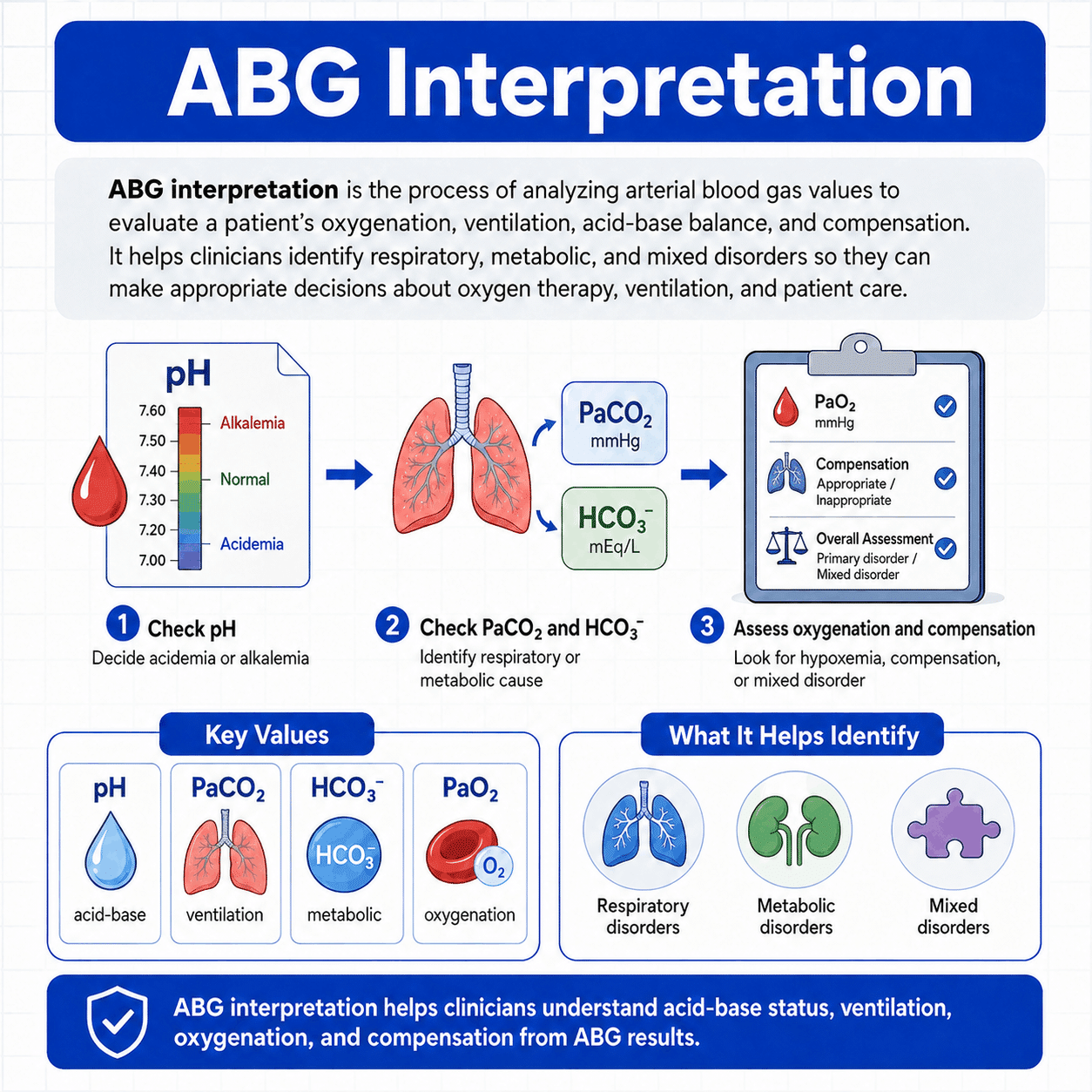
ABG interpretation is the process of analyzing arterial blood gas values to evaluate oxygenation, ventilation, acid-base balance, and compensation. It is an essential skill in respiratory care because ABG results help clinicians identify problems such as hypoxemia, respiratory acidosis, respiratory alkalosis, metabolic acidosis, metabolic alkalosis, and ventilatory failure.
ABGs are also used to guide oxygen therapy, mechanical ventilation, emergency care, and clinical decision-making. A systematic approach helps prevent confusion by separating acid-base status from oxygenation and connecting the results to the patient’s condition.

What Is ABG Interpretation?
ABG interpretation is the clinical process of reviewing arterial blood gas values to determine what is happening with a patient’s breathing, gas exchange, and acid-base balance. An arterial blood gas sample is usually collected from an artery, most often the radial artery, and analyzed to measure or calculate values such as pH, PaCO2, PaO2, HCO3, base excess, and oxygen saturation.
The goal is not simply to memorize numbers. The goal is to understand what those numbers mean for patient care. ABGs can show whether a patient is ventilating adequately, oxygenating properly, compensating for an acid-base disturbance, or developing a combined disorder.
ABG interpretation is especially important for respiratory therapists because it directly affects decisions about oxygen therapy, ventilator settings, airway management, weaning, noninvasive ventilation, and emergency interventions. It is also a major topic on respiratory therapy board exams because ABG values are often included in questions about patient assessment and clinical decisions.
Why ABG Interpretation Matters
ABGs are often described as the gold standard of gas exchange analysis because they provide direct information about arterial oxygen, carbon dioxide, and acid-base status. Pulse oximetry, capnography, and transcutaneous monitoring are useful for trending, but they do not fully replace an ABG.
- Pulse oximetry estimates oxygen saturation but does not measure pH, PaCO2, or PaO2 directly.
- Capnography monitors exhaled carbon dioxide, but it does not always match arterial PaCO2, especially in patients with significant lung disease, poor perfusion, or increased dead space.
- Transcutaneous monitoring can provide useful oxygen and carbon dioxide trends, especially in neonatal and critical care settings, but the values may not always match arterial values exactly.
ABG interpretation is valuable because it provides a more complete picture. It helps answer several important questions:
- Is the patient oxygenating well?
- Is the patient ventilating adequately?
- Is the blood too acidic or too alkaline?
- Is the cause respiratory, metabolic, or mixed?
- Is the body compensating?
- Is the patient improving or worsening after treatment?
Note: These questions are important in patients with respiratory failure, COPD, asthma, pneumonia, ARDS, shock, diabetic ketoacidosis, overdose, trauma, cardiopulmonary arrest, and mechanical ventilation.
Main ABG Values
A standard ABG report contains several values. Each one has a specific role in interpretation.
pH
The pH shows whether the blood is acidic, alkaline, or within the normal range. The normal arterial pH range is 7.35 to 7.45.
A pH below 7.35 indicates acidemia. This means the blood is more acidic than normal. A pH above 7.45 indicates alkalemia. This means the blood is more alkaline than normal.
The pH is the starting point for acid-base interpretation because it tells you the direction of the problem. However, a normal pH does not always mean the patient is normal. A patient may have a fully compensated acid-base disorder, where the pH has returned to the normal range but PaCO2 and HCO3 remain abnormal.
When the pH is normal, it is helpful to see which side of 7.40 it leans toward. A pH of 7.36 is normal but leans acidic. A pH of 7.44 is normal but leans alkaline. This can help identify the original disorder when compensation is present.
PaCO2
PaCO2 is the partial pressure of carbon dioxide in arterial blood. The normal PaCO2 range is 35 to 45 mm Hg.
PaCO2 represents the respiratory component of acid-base balance because the lungs control carbon dioxide removal. When ventilation decreases, carbon dioxide builds up and PaCO2 rises. When ventilation increases, carbon dioxide is blown off and PaCO2 falls.
An elevated PaCO2 above 45 mm Hg suggests hypoventilation, carbon dioxide retention, or respiratory acidosis. A decreased PaCO2 below 35 mm Hg suggests hyperventilation or respiratory alkalosis.
PaCO2 and pH usually move in opposite directions in primary respiratory disorders. If PaCO2 rises, pH falls. If PaCO2 falls, pH rises.
HCO3
HCO3, or bicarbonate, represents the metabolic component of acid-base balance. The normal arterial bicarbonate range is approximately 22 to 26 mEq/L.
Bicarbonate is regulated mainly by the kidneys. A low HCO3 suggests metabolic acidosis. A high HCO3 suggests metabolic alkalosis or renal compensation for a chronic respiratory acidosis.
HCO3 and pH usually move in the same direction in primary metabolic disorders. If HCO3 falls, pH falls. If HCO3 rises, pH rises.
Base Excess
Base excess, often written as BE, helps evaluate the metabolic component of acid-base balance. A normal base excess is usually 0 ± 2 mEq/L.
A base excess greater than +2 suggests excess base, which is associated with metabolic alkalosis or compensation for chronic respiratory acidosis. A base excess less than −2 suggests a base deficit, which is associated with metabolic acidosis.
Base excess is useful because it can help confirm whether a metabolic disturbance is present. It is especially helpful when interpreting compensation or combined acid-base disorders.
PaO2
PaO2 is the partial pressure of oxygen dissolved in arterial blood. A normal PaO2 on room air in a healthy adult is commonly listed as 80 to 100 mm Hg, though acceptable PaO2 decreases with age.
PaO2 is used to assess oxygenation. A low PaO2 indicates hypoxemia. A PaO2 below 60 mm Hg on room air is often considered serious because oxygen saturation begins to fall more quickly below that point.
PaO2 should always be interpreted with the patient’s oxygen level or FiO2. A PaO2 of 60 mm Hg on room air is very different from a PaO2 of 60 mm Hg while receiving a high FiO2.
SaO2
SaO2 is arterial oxygen saturation. It reflects the percentage of hemoglobin binding sites occupied by oxygen. Normal SaO2 on room air is usually about 95% to 98%.
SaO2 helps assess oxygenation, but it must be interpreted carefully. Standard ABG analysis does not always directly measure abnormal hemoglobins such as carboxyhemoglobin or methemoglobin. If those are suspected, CO-oximetry or hemoximetry is needed.
Normal ABG Values
Normal ABG values generally include the following:
- pH: 7.35 to 7.45
- PaCO2: 35 to 45 mm Hg
- PaO2: 80 to 100 mm Hg on room air
- HCO3: 22 to 26 mEq/L
- Base Excess: 0 ± 2 mEq/L
- SaO2: 95% to 98%
These values are the foundation for interpretation, but they must always be applied in context. A patient with chronic COPD may have a PaCO2 above 45 mm Hg and still be near baseline. An older adult may have a lower acceptable PaO2 than a younger adult. A ventilated patient receiving high oxygen may have a PaO2 that looks acceptable but is still lower than expected for the FiO2.
Note: ABG interpretation should never be based only on a memorized normal range. The patient’s diagnosis, oxygen device, ventilator settings, vital signs, mental status, work of breathing, and clinical history all matter.
A Step-by-Step Method for ABG Interpretation
The safest way to interpret ABGs is to use the same method every time. A consistent process reduces mistakes and helps separate acid-base problems from oxygenation problems.
Step 1: Assess the pH
Start with the pH. Determine whether the patient has acidemia, alkalemia, or a normal pH.
A pH less than 7.35 means acidemia. A pH greater than 7.45 means alkalemia. A pH between 7.35 and 7.45 is normal, but a compensated disorder may still be present.
If the pH is abnormal, it identifies the direction of the primary problem. If the pH is low, look for a process causing acidosis. If the pH is high, look for a process causing alkalosis.
Step 2: Assess PaCO2
Next, look at PaCO2 to determine whether the respiratory system explains the pH.
If the pH is low and PaCO2 is high, the primary problem is respiratory acidosis. If the pH is high and PaCO2 is low, the primary problem is respiratory alkalosis.
If PaCO2 is abnormal but does not explain the pH, it may be compensation or part of a mixed disorder.
Step 3: Assess HCO3 or Base Excess
Next, evaluate HCO3 and base excess to determine metabolic involvement.
If the pH is low and HCO3 is low, the primary problem is metabolic acidosis. If the pH is high and HCO3 is high, the primary problem is metabolic alkalosis.
Base excess can support the interpretation. A negative base excess suggests metabolic acidosis. A positive base excess suggests metabolic alkalosis.
Step 4: Determine Compensation
After identifying the primary problem, check whether the opposite system is responding.
If the primary problem is respiratory, the kidneys compensate by adjusting bicarbonate. In respiratory acidosis, the kidneys retain bicarbonate. In respiratory alkalosis, the kidneys excrete bicarbonate.
If the primary problem is metabolic, the lungs compensate by changing ventilation. In metabolic acidosis, ventilation increases to lower PaCO2. In metabolic alkalosis, ventilation may decrease to retain PaCO2.
Respiratory compensation can occur quickly. Renal compensation takes longer and is more commonly seen in chronic respiratory disorders.
Step 5: Assess Oxygenation Separately
Once acid-base status is interpreted, evaluate oxygenation using PaO2 and SaO2. This should be done separately because oxygenation and ventilation are related but not identical.
A patient can have a normal pH and PaCO2 but still be severely hypoxemic. Another patient can have carbon dioxide retention with only mild hypoxemia. Separating oxygenation from acid-base interpretation helps avoid confusion.
Understanding Compensation
Compensation is the body’s attempt to bring pH back toward normal. The system that is not causing the primary problem responds to help correct the imbalance.
Noncompensated Disorders
A noncompensated disorder occurs when the pH is abnormal and the opposite system has not responded.
For example, a patient with low pH, high PaCO2, and normal HCO3 has uncompensated respiratory acidosis. The kidneys have not yet retained bicarbonate enough to compensate. Noncompensated disorders are often acute, but clinical context is still needed.
Partially Compensated Disorders
A partially compensated disorder occurs when the pH is still abnormal, but the opposite system has changed in the expected direction.
For example, a patient with low pH, low HCO3, and low PaCO2 has partially compensated metabolic acidosis. The low bicarbonate identifies the metabolic acidosis, and the low PaCO2 shows respiratory compensation through hyperventilation. Since the pH is still abnormal, compensation is partial.
Fully Compensated Disorders
A fully compensated disorder occurs when the pH has returned to the normal range, but PaCO2 and HCO3 remain abnormal.
For example, a patient with pH 7.36, PaCO2 64 mm Hg, and HCO3 35 mEq/L has fully compensated respiratory acidosis. The PaCO2 is high, showing respiratory acidosis. The HCO3 is high, showing renal compensation. The pH is normal but still leans acidic, which points to the original disorder.
The Body Does Not Usually Overcompensate
A helpful rule is that the body generally does not overcompensate. Compensation brings the pH toward normal, but it usually does not push the pH past normal in the opposite direction.
For example, if the original problem is respiratory acidosis, compensation may return the pH to the normal range, but the pH will usually remain on the acidic side of 7.40. This is why a normal pH still needs careful interpretation.
Respiratory Acidosis
Respiratory acidosis occurs when PaCO2 rises above 45 mm Hg and pH falls below 7.35. It is caused by inadequate alveolar ventilation. When the lungs cannot eliminate carbon dioxide as fast as the body produces it, carbon dioxide accumulates in the blood and lowers the pH.
Causes of Respiratory Acidosis
Respiratory acidosis may occur due to central nervous system depression, drug overdose, head injury, neuromuscular disease, severe COPD, severe asthma, airway obstruction, chest wall restriction, respiratory muscle fatigue, or inadequate mechanical ventilation.
In acute respiratory acidosis, the patient may deteriorate quickly. The pH is low, PaCO2 is high, and HCO3 may be normal or only slightly increased. This pattern may be seen in opioid overdose, sudden ventilatory failure, severe airway obstruction, or acute respiratory muscle fatigue.
In chronic respiratory acidosis, the kidneys retain bicarbonate to compensate. This is common in patients with COPD or other long-term ventilatory disorders. The PaCO2 remains high, but the pH may return toward normal because HCO3 is elevated.
Respiratory Acidosis Example
A patient with chronic emphysema has a pH of 7.36, PaCO2 of 64 mm Hg, and HCO3 of 35 mEq/L. The high PaCO2 indicates respiratory acidosis. The high HCO3 indicates renal compensation. Since the pH is within the normal range but leans acidic, this is fully compensated respiratory acidosis.
This is a common pattern in chronic COPD. The clinician should be cautious when interpreting the PaCO2 because the patient’s baseline may be elevated. Aggressively trying to normalize PaCO2 in a chronic CO2 retainer can cause problems, especially if bicarbonate remains high and the pH shifts toward alkalemia.
Respiratory Alkalosis
Respiratory alkalosis occurs when PaCO2 falls below 35 mm Hg and pH rises above 7.45. It is caused by alveolar hyperventilation. When a patient ventilates more than needed, carbon dioxide is removed too quickly, and the pH rises.
Causes of Respiratory Alkalosis
Common causes include anxiety, pain, fever, sepsis, stimulant drugs, central nervous system lesions, hypoxemia, acute asthma, pneumonia, pulmonary edema, pulmonary vascular disease, pulmonary embolism, and iatrogenic hyperventilation from excessive mechanical ventilation.
It is important not to assume that respiratory alkalosis is caused by anxiety. A patient may hyperventilate because of hypoxemia, sepsis, pulmonary embolism, or another serious condition.
Respiratory Alkalosis Example
A patient with anxiety has a pH of 7.57, PaCO2 of 23 mm Hg, and HCO3 of 22 mEq/L. The pH is high, showing alkalemia. The PaCO2 is low, showing excessive carbon dioxide elimination. The HCO3 is normal, so there is no significant compensation. This is acute uncompensated respiratory alkalosis.
Another patient with asthma or pneumonia may have a similar acid-base pattern but also have a low PaO2. In that case, the hyperventilation may be a response to hypoxemia. The oxygenation problem must be addressed.
Metabolic Acidosis
Metabolic acidosis occurs when HCO3 decreases or fixed acids accumulate, causing the pH to fall. The primary problem is metabolic, not respiratory.
Causes of Metabolic Acidosis
Metabolic acidosis can result from increased acid production, decreased acid excretion, or bicarbonate loss. Common causes include diabetic ketoacidosis, lactic acidosis, renal failure, shock, severe diarrhea, salicylate intoxication, methanol ingestion, ethylene glycol ingestion, renal tubular acidosis, and cardiopulmonary arrest.
High anion gap metabolic acidosis is associated with the accumulation of acids such as lactic acid, ketoacids, or toxins. Normal anion gap metabolic acidosis, also called hyperchloremic metabolic acidosis, can occur with bicarbonate loss, such as in severe diarrhea or certain renal disorders.
Compensation in Metabolic Acidosis
The lungs compensate for metabolic acidosis by increasing ventilation. This removes carbon dioxide, lowers PaCO2, and helps raise the pH toward normal. Deep, rapid breathing in metabolic acidosis is often called Kussmaul respirations, especially in diabetic ketoacidosis.
The low PaCO2 in this setting is not the primary disorder. It is the compensatory response.
Metabolic Acidosis Example
A patient in diabetic coma has a pH of 7.22, PaCO2 of 20 mm Hg, HCO3 of 8 mEq/L, and base excess of −16 mEq/L. The low pH shows acidemia. The very low HCO3 and negative base excess identify the primary problem as metabolic acidosis. The low PaCO2 shows respiratory compensation through hyperventilation. Since the pH is still abnormal, this is partially compensated metabolic acidosis.
Metabolic Alkalosis
Metabolic alkalosis occurs when HCO3 increases or hydrogen ions are lost, causing the pH to rise. The primary problem is metabolic.
Causes of Metabolic Alkalosis
Common causes include vomiting, gastric suctioning, diuretic therapy, low-salt states, hypokalemia, hypochloremia, corticosteroid use, excessive bicarbonate administration, and volume depletion.
Vomiting and gastric drainage are important causes because they remove hydrochloric acid from the stomach. Diuretics may contribute by causing volume and electrolyte changes that promote alkalosis.
Compensation in Metabolic Alkalosis
The lungs may compensate by decreasing ventilation, which allows PaCO2 to rise and lowers the pH toward normal. However, this compensation is limited because excessive hypoventilation can cause hypoxemia.
A typical metabolic alkalosis pattern includes high pH and high HCO3. If compensation is present, PaCO2 may also be elevated.
Metabolic Alkalosis Example
A patient with prolonged vomiting may have a pH of 7.52, PaCO2 of 48 mm Hg, and HCO3 of 38 mEq/L. The high pH shows alkalemia. The high HCO3 identifies the primary problem as metabolic alkalosis. The elevated PaCO2 suggests respiratory compensation.
Combined Acid-Base Disorders
Combined disorders occur when more than one primary acid-base disturbance is present at the same time. These are more complex than simple compensation.
How to Recognize Combined Disorders
A combined disorder may be suspected when PaCO2 and HCO3 or base excess do not move in the expected compensatory direction.
If PaCO2 is high and base excess is low, the patient may have combined respiratory and metabolic acidosis. This means carbon dioxide retention and metabolic acid accumulation are both contributing to the low pH.
If PaCO2 is low and base excess is high, the patient may have combined respiratory and metabolic alkalosis. This means excessive carbon dioxide removal and excess base are both pushing the pH upward.
Combined Acidosis
Combined respiratory and metabolic acidosis is dangerous because both systems worsen the pH in the same direction. It may occur in cardiopulmonary arrest, severe shock, severe hypoxemia, or advanced ventilatory failure.
For example, a patient in cardiac arrest may have a very low pH, high PaCO2, low HCO3, and low PaO2. The high PaCO2 shows ventilatory failure. The low HCO3 or negative base excess shows metabolic acidosis from poor perfusion and lactic acid production.
Treatment should focus on restoring ventilation, oxygenation, and circulation. Simply giving bicarbonate without correcting ventilation and perfusion may not solve the underlying problem.
Combined Alkalosis
Combined respiratory and metabolic alkalosis may occur when a patient has metabolic alkalosis from vomiting, gastric suctioning, or diuretics and also hyperventilates due to pain, anxiety, hypoxemia, or excessive ventilator settings.
This can produce a very high pH, which may affect neurologic function, electrolyte balance, and cardiac rhythm.
Oxygenation Interpretation
After interpreting acid-base status, the clinician should evaluate oxygenation separately. PaO2 and SaO2 are the main values used for this part.
Hypoxemia Categories
Hypoxemia is commonly classified by PaO2. Mild hypoxemia is PaO2 60 to 79 mm Hg. Moderate hypoxemia is PaO2 40 to 59 mm Hg. Severe hypoxemia is PaO2 less than 40 mm Hg.
A PaO2 less than 60 mm Hg on room air is serious because hemoglobin saturation begins to fall more rapidly at that level. Patients may develop arrhythmias, confusion, unstable vital signs, or loss of consciousness if oxygen delivery becomes inadequate.
Consider the Patient’s Age
Acceptable PaO2 decreases with age. A younger adult is expected to have a higher PaO2 on room air than an older adult. For example, a PaO2 that is abnormal in a young adult may be closer to expected for an older adult.
Age does not eliminate the need for clinical judgment. It simply helps prevent overinterpreting mild PaO2 reductions in older adults.
Consider the FiO2
PaO2 must always be interpreted with FiO2. A PaO2 of 62 mm Hg on room air may indicate mild hypoxemia. The same PaO2 while receiving 60% oxygen is much more concerning.
A useful clinical idea is that oxygen response helps identify the severity of the problem. If PaO2 is above 60 mm Hg on less than 60% oxygen, the problem often reflects ventilation-perfusion mismatch and may respond to oxygen therapy. If PaO2 is below 60 mm Hg on more than 60% oxygen, severe shunting may be present, such as in ARDS, and treatment often requires oxygen plus PEEP or CPAP.
ABG Interpretation and Mechanical Ventilation
ABG interpretation is central to mechanical ventilation management. The respiratory therapist must identify whether the problem is ventilation, oxygenation, or both.
PaCO2 and Ventilator Changes
PaCO2 helps guide ventilation changes. If PaCO2 is high and pH is low, the patient may need increased alveolar ventilation. This can be achieved by increasing respiratory rate, tidal volume, pressure support, or minute ventilation, depending on the ventilator mode and clinical situation.
If PaCO2 is low and pH is high, the patient may be overventilated. The clinician may need to decrease respiratory rate, tidal volume, pressure support, or minute ventilation.
The key principle is that PaCO2 is corrected by changing ventilation, not simply by changing oxygen.
PaO2 and Oxygenation Changes
PaO2 helps guide oxygenation changes. If PaO2 is low, the clinician may increase FiO2, adjust PEEP, apply CPAP, improve alveolar recruitment, suction secretions, treat bronchospasm, or address the underlying cause.
FiO2 can improve the oxygen concentration delivered to the patient. PEEP and CPAP can improve oxygenation by helping keep alveoli open and improving gas exchange.
Weaning Decisions
ABGs are also used during ventilator weaning. If a patient develops rising PaCO2, falling pH, worsening hypoxemia, increased work of breathing, or unstable vital signs during weaning, the respiratory therapist may need to stop or change the weaning trial.
ABG results should be interpreted with respiratory rate, tidal volume, oxygen saturation, mental status, hemodynamics, breath sounds, and work of breathing.
ABG Interpretation in CPR and Emergencies
ABGs may be obtained during hospital-based CPR, but they should never delay compressions, ventilations, or defibrillation.
During CPR, ABGs help evaluate oxygenation, ventilation, and acid-base status. A high PaCO2 may suggest inadequate ventilation or poor circulation. A low PaO2 may suggest inadequate oxygen delivery. A low pH with normal or low PaCO2 may suggest uncorrected metabolic acidosis.
Severe acidosis during arrest often reflects both respiratory and metabolic problems. The patient may retain CO2 because ventilation is inadequate and develop lactic acidosis because tissue perfusion is poor.
Note: The clinical priority is to restore effective ventilation, circulation, and oxygenation.
Sampling Considerations
ABG interpretation is only useful if the sample is accurate. Sampling errors can produce misleading results.
Arterial Sampling Sites
The radial artery is usually preferred because it is superficial, easy to palpate, and has collateral circulation through the ulnar artery. Other sites include the brachial, femoral, and dorsalis pedis arteries.
Before radial artery puncture, clinicians often assess collateral circulation with a modified Allen test. They should also consider bleeding risk and review coagulation values such as PT, PTT, or INR when appropriate.
Capillary Samples
Arterialized capillary samples may be used in neonatal or pediatric settings when arterial sampling is difficult. However, capillary values have limitations. Capillary pH may correlate reasonably well with arterial pH, and capillary CO2 may have fair correlation with PaCO2, but capillary oxygen values do not correlate well with PaO2.
This is important because a capillary sample may not be appropriate when accurate oxygenation assessment is needed.
Pre-Analytic Errors
Pre-analytic errors occur before the sample is analyzed. Common problems include air bubbles, venous admixture, excess anticoagulant, delayed analysis, and improper storage.
Air bubbles can alter oxygen and carbon dioxide values. Venous admixture can make the sample appear less oxygenated than true arterial blood. Excess anticoagulant can dilute the sample. Delayed analysis allows ongoing cellular metabolism to change oxygen and carbon dioxide levels.
To improve accuracy, the sample should be collected anaerobically, air bubbles should be removed immediately, proper anticoagulation should be used, and the sample should be analyzed promptly.
Common ABG Examples
Acute Respiratory Acidosis
A patient with an opioid overdose has pH 7.22, PaCO2 78 mm Hg, HCO3 28 mEq/L, and PaO2 38 mm Hg. The low pH shows acidemia. The high PaCO2 identifies respiratory acidosis. The PaO2 is severely low. This is acute ventilatory failure with severe hypoxemia and requires immediate ventilatory support.
Chronic Respiratory Acidosis
A patient with COPD has pH 7.37, PaCO2 76 mm Hg, HCO3 44 mEq/L, and PaO2 56 mm Hg. The high PaCO2 shows chronic ventilatory failure. The high HCO3 shows renal compensation. The pH is near normal, so this is compensated respiratory acidosis with hypoxemia.
Acute Respiratory Alkalosis
A patient with an asthma attack has pH 7.54, PaCO2 27 mm Hg, HCO3 22 mEq/L, and PaO2 58 mm Hg. The high pH and low PaCO2 indicate acute respiratory alkalosis. The low PaO2 shows moderate hypoxemia, which may be driving the hyperventilation.
Partially Compensated Metabolic Acidosis
A patient with diabetic ketoacidosis has pH 7.22, PaCO2 20 mm Hg, HCO3 8 mEq/L, and base excess −16. The low pH and low HCO3 show metabolic acidosis. The low PaCO2 shows respiratory compensation. Since pH remains abnormal, compensation is partial.
Combined Respiratory and Metabolic Acidosis
A patient in cardiopulmonary arrest has pH 7.05, PaCO2 60 mm Hg, PaO2 39 mm Hg, HCO3 16 mEq/L, and base excess −8. This indicates combined respiratory and metabolic acidosis with severe hypoxemia. The high PaCO2 shows ventilatory failure, while the low HCO3 and negative base excess show metabolic acidosis.
Clinical Context Matters
ABG values must always be interpreted with the patient’s clinical picture. The same ABG can mean different things depending on the patient.
A COPD patient with PaCO2 58 mm Hg and pH 7.36 may be chronically compensated. A postoperative patient with the same PaCO2 and falling pH may be developing acute ventilatory failure.
A PaO2 of 65 mm Hg on room air may represent mild hypoxemia. A PaO2 of 65 mm Hg on high FiO2 may represent a severe gas exchange problem.
Note: The clinician should consider the patient’s age, diagnosis, oxygen device, FiO2, ventilator settings, level of consciousness, respiratory rate, breath sounds, chest imaging, hemodynamic status, and recent changes in condition.
ABG Interpretation for Exam Preparation
For respiratory therapy exams, ABG questions often test both interpretation and clinical action. The student must know what the values mean and what to do next.
- A practical exam approach is to identify pH first, PaCO2 second, HCO3 or BE third, compensation fourth, and oxygenation last.
- If PaCO2 is high and pH is low, think respiratory acidosis from hypoventilation. If PaCO2 is low and pH is high, think respiratory alkalosis from hyperventilation. If HCO3 is low and pH is low, think metabolic acidosis. If HCO3 is high and pH is high, think metabolic alkalosis.
- For ventilator questions, remember that PaCO2 problems are ventilation problems. PaO2 problems are oxygenation problems. If PaCO2 is too high, increase ventilation. If PaCO2 is too low, decrease ventilation. If PaO2 is too low, consider FiO2, PEEP, CPAP, recruitment, or treatment of the cause.
- For oxygen therapy questions, consider both PaO2 and FiO2. A low PaO2 on high oxygen is more serious than a low PaO2 on room air.
ABG Interpretation Practice Questions
1. What is ABG interpretation?
ABG interpretation is the process of analyzing arterial blood gas values to evaluate oxygenation, ventilation, acid-base balance, and compensation.
2. What are the three main areas assessed during ABG interpretation?
The three main areas are oxygenation, ventilation, and acid-base balance.
3. Why should ABG interpretation be done systematically?
ABG interpretation should be done systematically to avoid confusion and correctly identify whether the problem is respiratory, metabolic, compensated, or mixed.
4. Which ABG value should be assessed first when interpreting acid-base status?
The pH should be assessed first when interpreting acid-base status.
5. What does the pH value tell the clinician?
The pH tells the clinician whether the blood is acidemic, alkalemic, or within the normal range.
6. What is the normal arterial pH range?
The normal arterial pH range is 7.35–7.45.
7. What does acidemia mean?
Acidemia means the arterial pH is below 7.35.
8. What does alkalemia mean?
Alkalemia means the arterial pH is above 7.45.
9. Why can a normal pH still indicate an acid-base disorder?
A normal pH can still indicate an acid-base disorder if PaCO2 and HCO3 are abnormal and compensation has brought the pH back into range.
10. What does a pH of 7.36 suggest when PaCO2 and HCO3 are abnormal?
A pH of 7.36 is normal but leans acidic, which may help identify a fully compensated acidosis.
11. What does a pH of 7.44 suggest when PaCO2 and HCO3 are abnormal?
A pH of 7.44 is normal but leans alkaline, which may help identify a fully compensated alkalosis.
12. Which ABG value represents the respiratory component of acid-base balance?
PaCO2 represents the respiratory component of acid-base balance.
13. What is the normal PaCO2 range?
The normal PaCO2 range is 35–45 mm Hg.
14. What does PaCO2 greater than 45 mm Hg indicate?
PaCO2 greater than 45 mm Hg indicates hypoventilation, carbon dioxide retention, or respiratory acidosis.
15. What does PaCO2 less than 35 mm Hg indicate?
PaCO2 less than 35 mm Hg indicates hyperventilation or respiratory alkalosis.
16. How do pH and PaCO2 usually move in primary respiratory disorders?
In primary respiratory disorders, pH and PaCO2 usually move in opposite directions.
17. What ABG pattern indicates respiratory acidosis?
A low pH with an elevated PaCO2 indicates respiratory acidosis.
18. What ABG pattern indicates respiratory alkalosis?
A high pH with a decreased PaCO2 indicates respiratory alkalosis.
19. Which ABG value represents the metabolic component of acid-base balance?
HCO3 represents the metabolic component of acid-base balance.
20. What is the normal HCO3 range?
The normal HCO3 range is approximately 22–26 mEq/L.
21. What does a decreased HCO3 suggest?
A decreased HCO3 suggests metabolic acidosis.
22. What does an increased HCO3 suggest?
An increased HCO3 suggests metabolic alkalosis or renal compensation for respiratory acidosis.
23. How do pH and HCO3 usually move in primary metabolic disorders?
In primary metabolic disorders, pH and HCO3 usually move in the same direction.
24. What ABG pattern indicates metabolic acidosis?
A low pH with a decreased HCO3 indicates metabolic acidosis.
25. What ABG pattern indicates metabolic alkalosis?
A high pH with an increased HCO3 indicates metabolic alkalosis.
26. What does base excess help identify in ABG interpretation?
Base excess helps identify whether a metabolic component is present in an acid-base disorder.
27. What is the normal range for base excess?
The normal range for base excess is approximately 0 ± 2 mEq/L.
28. What does a base excess greater than +2 suggest?
A base excess greater than +2 suggests excess base, which is associated with metabolic alkalosis.
29. What does a base excess less than -2 suggest?
A base excess less than -2 suggests a base deficit, which is associated with metabolic acidosis.
30. Which ABG value is used to assess oxygenation?
PaO2 is used to assess oxygenation.
31. What does PaO2 measure?
PaO2 measures the partial pressure of oxygen dissolved in arterial blood.
32. What is the normal PaO2 range on room air in a healthy adult?
The normal PaO2 range on room air in a healthy adult is approximately 80–100 mm Hg.
33. What PaO2 value is often considered serious hypoxemia on room air?
A PaO2 less than 60 mm Hg on room air is often considered serious hypoxemia.
34. Why should PaO2 be interpreted with FiO2?
PaO2 should be interpreted with FiO2 because the meaning of the oxygen level depends on how much oxygen the patient is receiving.
35. What does SaO2 represent?
SaO2 represents the percentage of hemoglobin binding sites occupied by oxygen.
36. What is the normal SaO2 range on room air?
The normal SaO2 range on room air is approximately 95–98%.
37. Why should oxygenation be assessed separately from acid-base balance?
Oxygenation should be assessed separately because a patient can have normal acid-base values and still be hypoxemic.
38. What is mild hypoxemia based on PaO2?
Mild hypoxemia is commonly defined as a PaO2 of 60–79 mm Hg.
39. What is moderate hypoxemia based on PaO2?
Moderate hypoxemia is commonly defined as a PaO2 of 40–59 mm Hg.
40. What is severe hypoxemia based on PaO2?
Severe hypoxemia is commonly defined as a PaO2 less than 40 mm Hg.
41. What does compensation mean in ABG interpretation?
Compensation means the body is using the opposite system to help move the pH back toward normal.
42. Which system compensates for a primary respiratory disorder?
The kidneys compensate for a primary respiratory disorder by adjusting bicarbonate levels.
43. Which system compensates for a primary metabolic disorder?
The lungs compensate for a primary metabolic disorder by changing ventilation.
44. How do the kidneys compensate for respiratory acidosis?
The kidneys compensate for respiratory acidosis by retaining bicarbonate.
45. How do the kidneys compensate for respiratory alkalosis?
The kidneys compensate for respiratory alkalosis by excreting bicarbonate.
46. How do the lungs compensate for metabolic acidosis?
The lungs compensate for metabolic acidosis by increasing ventilation to lower PaCO2.
47. How do the lungs compensate for metabolic alkalosis?
The lungs compensate for metabolic alkalosis by decreasing ventilation to retain PaCO2.
48. Which type of compensation happens faster?
Respiratory compensation happens faster because ventilation can change within seconds.
49. Which type of compensation takes hours to days?
Renal compensation takes hours to days because the kidneys adjust bicarbonate more slowly.
50. What does fully compensated mean?
Fully compensated means the pH has returned to the normal range while PaCO2 and HCO3 remain abnormal.
51. What does partially compensated mean?
Partially compensated means the pH is still abnormal, but the opposite system has started to correct the imbalance.
52. What does uncompensated mean?
Uncompensated means the pH is abnormal and the opposite system has not changed enough to correct the imbalance.
53. Why does the body generally not overcompensate?
The body generally does not overcompensate because compensation moves the pH toward normal but usually does not push it past normal in the opposite direction.
54. What is respiratory acidosis?
Respiratory acidosis is an acid-base disorder caused by elevated PaCO2 from inadequate alveolar ventilation.
55. What causes PaCO2 to rise in respiratory acidosis?
PaCO2 rises when the lungs cannot eliminate carbon dioxide as quickly as the body produces it.
56. What are common causes of respiratory acidosis?
Common causes include COPD, drug overdose, airway obstruction, neuromuscular disease, respiratory muscle fatigue, and inadequate mechanical ventilation.
57. What is acute ventilatory failure?
Acute ventilatory failure is a sudden inability to ventilate adequately, causing PaCO2 to rise and pH to fall.
58. What ABG pattern may be seen in opioid overdose?
Opioid overdose may cause acute respiratory acidosis with high PaCO2, low pH, and hypoxemia.
59. What is chronic respiratory acidosis?
Chronic respiratory acidosis is long-term carbon dioxide retention with renal bicarbonate retention that helps return pH toward normal.
60. Why can COPD patients have elevated PaCO2 with a near-normal pH?
COPD patients can have elevated PaCO2 with a near-normal pH because the kidneys retain bicarbonate over time.
61. Why should PaCO2 not always be aggressively normalized in chronic CO2 retainers?
Aggressively lowering PaCO2 in chronic CO2 retainers may cause alkalemia because bicarbonate may remain elevated.
62. What is respiratory alkalosis?
Respiratory alkalosis is an acid-base disorder caused by decreased PaCO2 from excessive alveolar ventilation.
63. What causes PaCO2 to fall in respiratory alkalosis?
PaCO2 falls when ventilation increases and carbon dioxide is eliminated faster than it is produced.
64. What are common causes of respiratory alkalosis?
Common causes include anxiety, pain, fever, sepsis, hypoxemia, asthma, pneumonia, pulmonary edema, pulmonary embolism, and excessive mechanical ventilation.
65. Why should respiratory alkalosis not automatically be blamed on anxiety?
Respiratory alkalosis should not automatically be blamed on anxiety because serious problems such as hypoxemia, sepsis, asthma, or pulmonary embolism may also cause hyperventilation.
66. What ABG pattern is expected in acute respiratory alkalosis?
Acute respiratory alkalosis usually shows high pH, low PaCO2, and normal or slightly decreased HCO3.
67. What is metabolic acidosis?
Metabolic acidosis is an acid-base disorder caused by decreased bicarbonate or accumulation of fixed acids.
68. What are common causes of metabolic acidosis?
Common causes include diabetic ketoacidosis, lactic acidosis, renal failure, shock, severe diarrhea, salicylate toxicity, methanol ingestion, and ethylene glycol ingestion.
69. What is high anion gap metabolic acidosis associated with?
High anion gap metabolic acidosis is associated with accumulation of acids such as lactic acid, ketoacids, salicylates, or toxic alcohols.
70. What is normal anion gap metabolic acidosis also called?
Normal anion gap metabolic acidosis is also called hyperchloremic metabolic acidosis.
71. What is a common cause of normal anion gap metabolic acidosis?
Severe diarrhea is a common cause because it can lead to bicarbonate loss.
72. What is the primary compensatory response to metabolic acidosis?
The primary compensatory response to metabolic acidosis is hyperventilation to lower PaCO2.
73. What are Kussmaul respirations?
Kussmaul respirations are deep, rapid breaths that may occur as respiratory compensation for metabolic acidosis.
74. What ABG pattern is expected in partially compensated metabolic acidosis?
Partially compensated metabolic acidosis shows low pH, low HCO3, and low PaCO2.
75. Why is the low PaCO2 in metabolic acidosis considered compensation?
The low PaCO2 is considered compensation because the patient is hyperventilating to remove carbon dioxide and raise pH toward normal.
76. What is metabolic alkalosis?
Metabolic alkalosis is an acid-base disorder caused by increased bicarbonate or loss of hydrogen ions, resulting in an elevated pH.
77. What are common causes of metabolic alkalosis?
Common causes include vomiting, gastric suctioning, diuretic therapy, hypokalemia, hypochloremia, corticosteroid use, and excessive bicarbonate administration.
78. Why can vomiting cause metabolic alkalosis?
Vomiting can cause metabolic alkalosis because it removes gastric hydrochloric acid from the body.
79. How do the lungs compensate for metabolic alkalosis?
The lungs compensate for metabolic alkalosis by decreasing ventilation, which allows PaCO2 to rise and helps lower the pH toward normal.
80. Why is respiratory compensation for metabolic alkalosis limited?
Respiratory compensation for metabolic alkalosis is limited because excessive hypoventilation can cause hypoxemia.
81. What ABG pattern is expected in metabolic alkalosis with compensation?
Metabolic alkalosis with compensation usually shows high pH, high HCO3, and elevated PaCO2.
82. What is a mixed acid-base disorder?
A mixed acid-base disorder occurs when two or more primary acid-base disturbances are present at the same time.
83. What ABG pattern suggests combined respiratory and metabolic acidosis?
A high PaCO2 with a low HCO3 or negative base excess suggests combined respiratory and metabolic acidosis.
84. What ABG pattern suggests combined respiratory and metabolic alkalosis?
A low PaCO2 with a high HCO3 or positive base excess suggests combined respiratory and metabolic alkalosis.
85. Why is combined respiratory and metabolic acidosis dangerous?
Combined respiratory and metabolic acidosis is dangerous because both disorders lower the pH, which can cause severe acidemia.
86. What clinical situation may cause combined respiratory and metabolic acidosis?
Cardiopulmonary arrest may cause combined respiratory and metabolic acidosis due to poor ventilation and poor tissue perfusion.
87. Why can severe hypoxemia contribute to metabolic acidosis?
Severe hypoxemia can contribute to metabolic acidosis by causing anaerobic metabolism and lactic acid production.
88. What should treatment focus on in combined respiratory and metabolic acidosis?
Treatment should focus on improving ventilation, oxygenation, circulation, and the underlying cause of the acidosis.
89. What does the 60/60 rule help assess?
The 60/60 rule helps assess whether hypoxemia is likely due to V/Q mismatch or severe shunting.
90. What does PaO2 above 60 torr on less than 60% oxygen often suggest?
PaO2 above 60 torr on less than 60% oxygen often suggests V/Q mismatch that may respond to oxygen therapy.
91. What does PaO2 below 60 torr on more than 60% oxygen often suggest?
PaO2 below 60 torr on more than 60% oxygen often suggests severe shunting, such as ARDS.
92. What therapies may be needed for severe shunting?
Severe shunting often requires oxygen plus PEEP or CPAP to improve alveolar recruitment and oxygenation.
93. How are ABGs used during ventilator management?
ABGs are used during ventilator management to determine whether ventilation and oxygenation settings are adequate.
94. Which ABG value guides changes in ventilation?
PaCO2 guides changes in ventilation.
95. Which ABG value guides changes in oxygenation support?
PaO2 guides changes in oxygenation support.
96. What ventilator change may be needed if PaCO2 is high and pH is low?
The patient may need increased ventilation, such as a higher respiratory rate, tidal volume, pressure support, or minute ventilation.
97. What ventilator change may be needed if PaCO2 is low and pH is high?
The patient may need decreased ventilation, such as a lower respiratory rate, tidal volume, pressure support, or minute ventilation.
98. Why should ABG values be interpreted with the patient’s clinical condition?
ABG values should be interpreted with the patient’s clinical condition because the same numbers can mean different things depending on diagnosis, baseline status, oxygen therapy, and ventilator settings.
99. Why may a capillary sample be limited for oxygenation assessment?
A capillary sample may be limited for oxygenation assessment because capillary oxygen values do not correlate well with arterial PaO2.
100. What is the main goal of ABG interpretation?
The main goal of ABG interpretation is to identify acid-base, oxygenation, and ventilation problems so clinicians can make appropriate treatment decisions.
Final Thoughts
ABG interpretation is a structured process for evaluating oxygenation, ventilation, acid-base balance, and compensation. The key values are pH, PaCO2, HCO3, base excess, PaO2, and SaO2. A reliable method begins with pH, then evaluates PaCO2, HCO3 or base excess, compensation, and oxygenation.
PaCO2 reflects ventilation, PaO2 reflects oxygenation, and HCO3 reflects the metabolic component. Accurate interpretation also requires clinical judgment because ABG values must be connected to the patient’s diagnosis, oxygen therapy, ventilator settings, symptoms, and overall condition.

Written by:
John Landry is a registered respiratory therapist from Memphis, TN, and has a bachelor's degree in kinesiology. He enjoys using evidence-based research to help others breathe easier and live a healthier life.
References
- Castro D, Patil SM, Zubair M, et al. Arterial Blood Gas. [Updated 2024 Jan 8]. In: StatPearls [Internet]. Treasure Island (FL): StatPearls Publishing; 2026.