

Bradypnea is a clinical condition characterized by an abnormally slow respiratory rate. While it may seem like a simple variation in breathing, its presence often signals underlying pathology or physiologic disturbance.
For respiratory therapists, recognizing and managing bradypnea is essential because it directly impacts gas exchange, oxygen delivery, and overall patient stability. Understanding this condition enables clinicians to make timely decisions that can be lifesaving in acute care, emergency, and critical care settings.

What is Bradypnea?
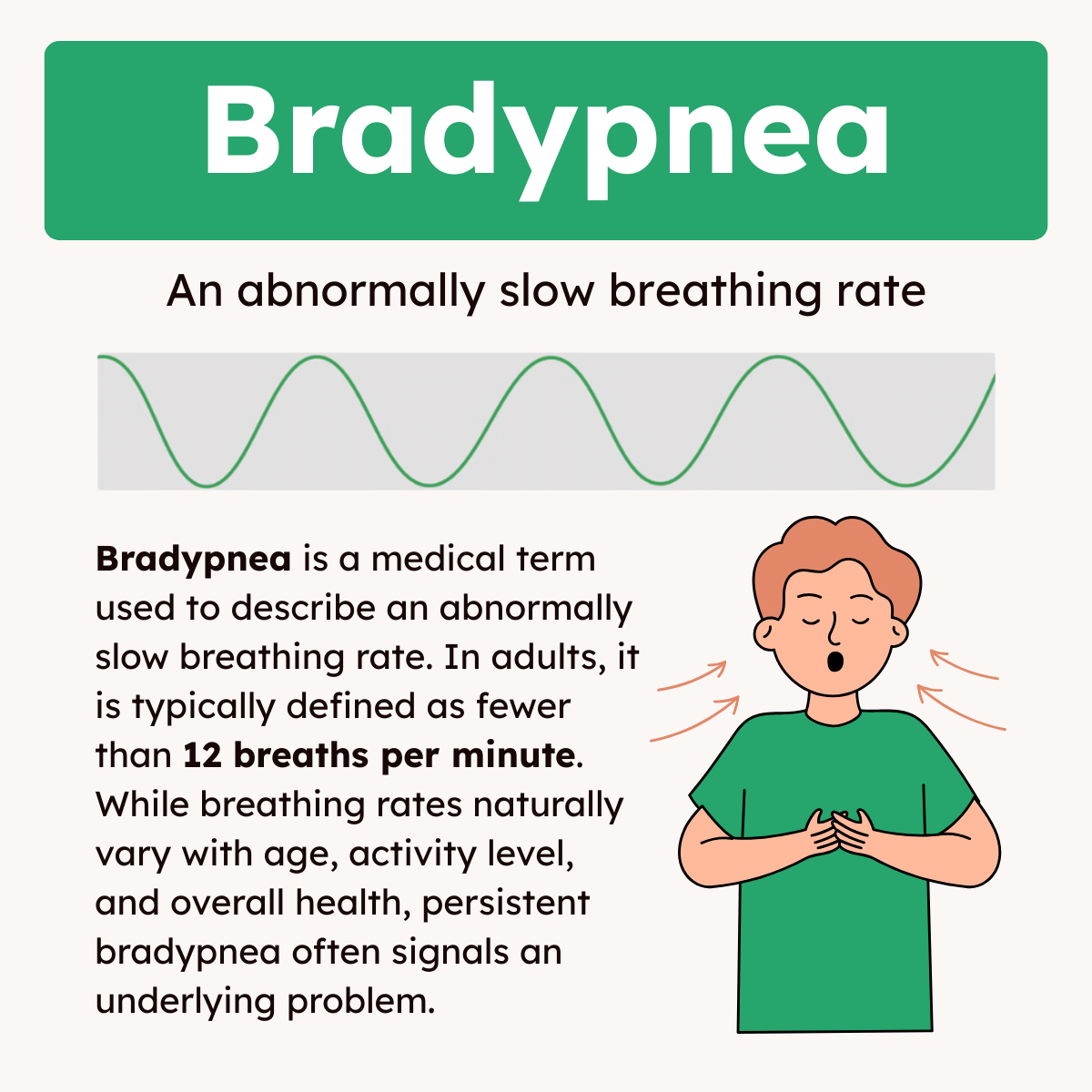
Bradypnea is a medical term used to describe an abnormally slow breathing rate. In adults, it is typically defined as fewer than 12 breaths per minute. While breathing rates naturally vary with age, activity level, and overall health, persistent bradypnea often signals an underlying problem. It can result from conditions such as neurological injuries, drug overdose, metabolic disorders, or neuromuscular weakness.
This slow rate reduces alveolar ventilation, which may lead to elevated carbon dioxide levels (hypercapnia) and respiratory acidosis, both of which can be life-threatening if not addressed.
For respiratory therapists, recognizing bradypnea is critical, as it often requires rapid intervention, such as adjusting medications, providing supplemental oxygen, or initiating ventilatory support to protect the patient’s respiratory function.
Causes of Bradypnea
Bradypnea can result from multiple conditions, including:
- Neurological impairment: Brain injuries, strokes, or increased intracranial pressure can depress the brainstem centers that regulate breathing.
- Medications: Opioids, sedatives, and anesthetics commonly reduce respiratory drive.
- Metabolic or systemic issues: Severe hypothyroidism, electrolyte imbalances, and hypothermia can slow respiration.
- Obstructive sleep apnea: Periods of bradypnea may occur during episodes of airway collapse.
- Fatigue or muscle weakness: Neuromuscular disorders such as myasthenia gravis or Guillain-Barré syndrome may impair the ability to maintain adequate ventilation.
Clinical Significance
For respiratory therapists, identifying bradypnea is critical because:
- It compromises ventilation: Slow breathing reduces alveolar ventilation, which may lead to elevated carbon dioxide (hypercapnia) and respiratory acidosis.
- It signals underlying conditions: Bradypnea is often a red flag for central nervous system depression, drug overdose, or worsening systemic illness.
- It requires immediate response: Severe cases may necessitate airway management, non-invasive support (CPAP or BiPAP), or mechanical ventilation.
Recognizing the clinical significance of bradypnea allows respiratory therapists to act quickly and prevent serious complications. Early intervention not only stabilizes the patient but also provides valuable insight into the underlying cause, guiding more effective treatment and long-term care.
Assessment and Monitoring
Respiratory therapists use a combination of clinical observation and diagnostic tools to evaluate bradypnea, including:
- Respiratory rate measurement: Counting breaths per minute at rest.
- Pulse oximetry: Monitoring oxygen saturation levels.
- Arterial blood gases (ABG): Assessing PaCO₂ and PaO₂ to determine if hypoventilation is present.
- Capnography: Continuous measurement of end-tidal CO₂ provides real-time monitoring of ventilation adequacy.
Treatment and Management
Management depends on the cause and severity:
- Mild cases: Close monitoring and addressing reversible causes (e.g., adjusting sedative medications).
- Moderate to severe cases: Supplemental oxygen, airway management, or initiation of ventilatory support may be required.
- Long-term care: For chronic conditions, interventions may include non-invasive ventilation, tracheostomy care, or rehabilitation strategies.
Why It Matters in Respiratory Care
Bradypnea is more than just a “slow breathing rate”—it is a marker of potential respiratory failure. For respiratory therapists, recognizing early signs and initiating appropriate interventions are vital responsibilities.
Note: Proper assessment and management not only improve patient outcomes but also prevent complications such as hypoxemia, hypercapnia, and cardiac arrest.
Bradypnea Practice Questions
1. What is the definition of bradypnea in adults?
An abnormally slow respiratory rate, typically fewer than 12 breaths per minute.
2. At what respiratory rate is bradypnea generally considered clinically significant?
Less than 10 breaths per minute in an adult.
3. What are common causes of bradypnea related to neurological injury?
Increased intracranial pressure and brain damage.
4. Which medications are well-known to cause bradypnea?
Opioids, sedatives, anesthetics, and recreational drugs that depress the respiratory center.
5. Which cardiovascular event may lead to bradypnea?
A severe myocardial infarction.
6. What are some patient observation cues that may indicate bradypnea?
Slow breathing, confusion, sluggishness, and disorientation.
7. What vital sign finding would confirm bradypnea in an adult?
A documented respiratory rate of 10 breaths per minute or less.
8. What additional vital sign abnormality may accompany bradypnea?
Either a fast or slow pulse rate.
9. Why is bradypnea considered a medical emergency?
Because it reduces alveolar ventilation, leading to hypercapnia and possible respiratory acidosis.
10. What symptoms may a patient with bradypnea experience?
Dizziness, fatigue, weakness, confusion, and impaired coordination.
11. Which endocrine disorder can contribute to bradypnea?
Hypothyroidism
12. How can shock contribute to bradypnea?
By impairing oxygen delivery and depressing respiratory drive.
13. Which toxic substances are linked to bradypnea?
Alcohol, opioids, and sedatives.
14. How does morbid obesity cause bradypnea?
By impairing respiratory mechanics and reducing effective ventilation.
15. What is the immediate treatment for bradypnea caused by opioid overdose?
Administration of naloxone, an opioid antagonist.
16. What potential complications arise from untreated bradypnea?
Hypercapnia, respiratory acidosis, and respiratory failure.
17. How might a respiratory therapist intervene in a patient with severe bradypnea?
By providing supplemental oxygen, adjusting medications, or initiating ventilatory support.
18. Why is recognizing bradypnea important in clinical practice?
Because it often signals a serious underlying condition requiring rapid intervention.
19. What is the relationship between bradypnea and alveolar ventilation?
Bradypnea decreases alveolar ventilation, leading to CO₂ retention.
20. Which populations may naturally have slower breathing rates that are not considered bradypnea?
Well-conditioned athletes and sleeping individuals.
21. How can neurological impairment cause bradypnea?
Brain injuries, strokes, or increased intracranial pressure can depress brainstem centers that regulate breathing.
22. Which class of medications is most commonly associated with bradypnea?
Opioids, sedatives, and anesthetics.
23. How can severe hypothyroidism contribute to bradypnea?
It slows metabolism and reduces respiratory drive.
24. Which metabolic issue can slow the respiratory rate by affecting muscle and nerve function?
Electrolyte imbalances
25. Why does hypothermia cause bradypnea?
Because decreased body temperature slows metabolic processes and respiratory drive.
26. How is bradypnea linked to obstructive sleep apnea?
It may occur during periods of airway collapse in sleep apnea episodes.
27. Which neuromuscular disorders can contribute to bradypnea?
Myasthenia gravis and Guillain-Barré syndrome.
28. Why does bradypnea compromise ventilation?
It reduces alveolar ventilation, leading to hypercapnia and respiratory acidosis.
29. What does the presence of bradypnea often signal clinically?
Underlying central nervous system depression, drug overdose, or systemic illness.
30. What urgent intervention may be needed in severe bradypnea?
Airway management, non-invasive ventilation, or mechanical ventilation.
31. Why must respiratory therapists act quickly when bradypnea is identified?
Early intervention can prevent complications and stabilize the patient.
32. What does measuring the respiratory rate at rest help determine?
Whether the patient’s breathing pattern meets criteria for bradypnea.
33. How does pulse oximetry help in assessing bradypnea?
It monitors oxygen saturation to detect hypoxemia.
34. Which arterial blood gas (ABG) results indicate hypoventilation in bradypnea?
Elevated PaCO₂ and decreased PaO₂.
35. How does capnography assist in monitoring bradypnea?
It provides continuous, real-time measurement of ventilation adequacy through end-tidal CO₂.
36. How are mild cases of bradypnea typically managed?
Through close monitoring and correcting reversible causes, such as adjusting medications.
37. What treatments are appropriate for moderate to severe bradypnea?
Supplemental oxygen, airway management, or ventilatory support.
38. What long-term intervention may be required for chronic bradypnea?
Non-invasive ventilation or tracheostomy care.
39. Why is bradypnea considered a marker of potential respiratory failure?
Because it indicates inadequate ventilation that may progress to hypoxemia and hypercapnia.
40. What complications can arise if bradypnea is not properly managed?
Hypoxemia, hypercapnia, and cardiac arrest.
41. What is the normal resting respiratory rate for a healthy adult?
12 to 20 breaths per minute.
42. Why does bradypnea often result in hypercapnia?
Because slower breathing reduces alveolar ventilation, allowing CO₂ to accumulate.
43. How does bradypnea differ from hypopnea?
Bradypnea is abnormally slow breathing, while hypopnea is abnormally shallow breathing.
44. Which type of brain injury is most associated with bradypnea?
Traumatic brain injury that affects the brainstem.
45. How does opioid-induced bradypnea typically present clinically?
With slow, shallow breathing, pinpoint pupils, and decreased responsiveness.
46. Why is monitoring level of consciousness important in bradypnea?
Changes in alertness may signal worsening hypoventilation and CO₂ retention.
47. What is a key difference between bradypnea and apnea?
Bradypnea is abnormally slow breathing, while apnea is a complete cessation of breathing.
48. How can Guillain-Barré syndrome contribute to bradypnea?
It causes progressive muscle weakness that impairs ventilatory effort.
49. What role does hypothyroidism play in slowing respiration?
It reduces the body’s metabolic demand and depresses respiratory drive.
50. How does alcohol toxicity lead to bradypnea?
It depresses the central nervous system and reduces respiratory drive.
51. Why is it dangerous to ignore bradypnea in a postoperative patient?
Because sedatives or anesthetics may suppress breathing and lead to respiratory failure.
52. How might hypothermia mask the severity of bradypnea?
By lowering metabolic demand and delaying recognition of respiratory insufficiency.
53. What clinical finding often accompanies bradypnea-related hypercapnia?
Headache, drowsiness, or confusion due to CO₂ buildup.
54. Which emergency airway support is most appropriate for severe bradypnea with hypoventilation?
Endotracheal intubation and mechanical ventilation.
55. How does CPAP help in managing bradypnea in sleep apnea patients?
It prevents airway collapse and maintains ventilation during sleep.
56. Why is frequent vital sign monitoring critical in patients at risk for bradypnea?
Because changes in respiratory rate may be the earliest sign of deterioration.
57. What is the effect of bradypnea on arterial blood pH?
It lowers pH, causing respiratory acidosis.
58. Which ABG abnormality is most expected in prolonged bradypnea?
Elevated PaCO₂ with low pH.
59. How does bradypnea increase the risk of cardiac arrhythmias?
By causing hypoxemia and acidosis, which affect myocardial function.
60. What bedside test can quickly identify worsening bradypnea?
Counting breaths per minute while observing chest movement.
61. Why must sedatives be used cautiously in patients with bradypnea?
They can further depress the respiratory center and worsen hypoventilation.
62. How does morbid obesity lead to bradypnea during sleep?
By restricting chest wall movement and promoting hypoventilation.
63. Why might bradypnea develop in severe electrolyte disturbances?
Because imbalances affect nerve conduction and muscle contraction.
64. What nursing intervention is prioritized when bradypnea is suspected?
Assessing airway patency and providing supplemental oxygen if needed.
65. Why is naloxone an important medication in cases of bradypnea?
It reverses opioid-induced respiratory depression.
66. How does bradypnea impair oxygen delivery to tissues?
By decreasing minute ventilation and lowering arterial oxygen content.
67. Which monitoring tool provides continuous assessment of ventilation in bradypnea?
Capnography, which tracks end-tidal CO₂.
68. What does persistent bradypnea in a head trauma patient suggest?
Brainstem injury or increased intracranial pressure.
69. Why is bradypnea a poor prognostic sign in myocardial infarction?
It may indicate brainstem hypoperfusion or impending respiratory arrest.
70. How can non-invasive ventilation help in managing bradypnea?
By supporting ventilation, improving gas exchange, and preventing intubation when possible.
71. How does bradypnea affect tidal volume?
It may remain normal or increase slightly, but overall minute ventilation decreases due to the slow rate.
72. What patient population may naturally have slower respiratory rates that are not considered pathological?
Well-trained athletes and sleeping individuals.
73. Which brain structure primarily controls the respiratory rate and may be affected in bradypnea?
The medulla oblongata.
74. How can sleep deprivation influence bradypnea?
It can exacerbate fatigue-related hypoventilation and worsen slow breathing.
75. Why is bradypnea especially concerning in patients with chronic lung disease?
They already have impaired gas exchange, so slower breathing further increases the risk of hypoxemia and hypercapnia.
76. Which toxic exposure besides alcohol may cause bradypnea?
Carbon monoxide poisoning.
77. What is the relationship between bradypnea and hypoxemia?
Slowed breathing reduces oxygen intake, leading to low arterial oxygen levels.
78. How does bradypnea differ from Cheyne-Stokes respiration?
Bradypnea is a consistently slow rate, while Cheyne-Stokes is a cyclical pattern of increasing and decreasing respirations.
79. What is a key sign that bradypnea has progressed to impending respiratory failure?
Declining oxygen saturation and altered mental status.
80. Which diagnostic imaging might be ordered to investigate neurological causes of bradypnea?
CT or MRI of the brain.
81. Why is frequent ABG analysis useful in patients with bradypnea?
To track changes in CO₂ retention and acid–base balance.
82. What is the primary danger of untreated bradypnea in trauma patients?
Rapid progression to hypoventilation and respiratory arrest.
83. Which symptom distinguishes bradypnea from simple fatigue?
Significant confusion or altered level of consciousness.
84. What is one cardiovascular effect of persistent bradypnea?
Bradycardia due to hypoxemia and acidosis.
85. Why might bradypnea occur in advanced hypothyroidism (myxedema)?
Severe metabolic slowing depresses ventilatory drive.
86. Which electrolyte abnormality can slow respiration by weakening muscles?
Severe hypokalemia.
87. How does bradypnea contribute to acidosis in the body?
By retaining CO₂, which combines with water to form carbonic acid.
88. Why might a patient with Guillain-Barré syndrome require ventilatory support?
Because progressive muscle weakness may cause bradypnea and hypoventilation.
89. Which bedside respiratory assessment is most reliable for identifying bradypnea?
Counting breaths per minute for a full 60 seconds.
90. Why is patient positioning important in managing bradypnea?
Upright positioning can improve ventilation and oxygenation.
91. How does bradypnea influence end-tidal CO₂ readings?
It typically increases ETCO₂ due to hypoventilation.
92. What is one early sign of CO₂ retention in bradypnea?
Headache or flushed skin.
93. Why is mechanical ventilation sometimes necessary for bradypnea?
To ensure adequate alveolar ventilation and prevent respiratory arrest.
94. What medication class besides opioids may depress the respiratory center and cause bradypnea?
Benzodiazepines.
95. How does bradypnea affect exercise tolerance?
It decreases oxygen delivery, causing fatigue and reduced endurance.
96. Why is early recognition of bradypnea critical in overdose patients?
Because untreated respiratory depression can quickly progress to arrest.
97. Which sleep-related breathing disorder is most associated with bradypnea episodes?
Obstructive sleep apnea.
98. Why might elderly patients be at higher risk of bradypnea from sedative medications?
Because of slower drug metabolism and increased sensitivity to CNS depressants.
99. How can neuromuscular weakness lead to bradypnea even with normal lung function?
The patient lacks muscle strength to sustain an adequate respiratory rate.
100. What is the ultimate risk if bradypnea is left untreated?
Respiratory failure, cardiac arrest, and death.
Final Thoughts
Bradypnea refers to an abnormally slow breathing rate that can signal a variety of underlying health concerns, from medication effects to neurological or systemic disorders. While sometimes subtle, its impact on ventilation and gas exchange makes it a clinically significant finding.
For respiratory therapists, awareness and timely response are essential, as bradypnea may progress to hypoxemia, hypercapnia, or respiratory failure if left untreated.
Effective management involves careful assessment, identifying the root cause, and applying appropriate interventions ranging from monitoring to ventilatory support. Understanding bradypnea ensures safer patient care and highlights the critical role of respiratory professionals.

Written by:
John Landry is a registered respiratory therapist from Memphis, TN, and has a bachelor's degree in kinesiology. He enjoys using evidence-based research to help others breathe easier and live a healthier life.
References
- Park SB, Khattar D. Tachypnea. [Updated 2024 Apr 20]. In: StatPearls [Internet]. Treasure Island (FL): StatPearls Publishing; 2025.