
Contact precautions are infection control measures designed to prevent the spread of infectious organisms through direct or indirect physical contact. These precautions are especially important in healthcare environments where pathogens can easily transfer between patients, staff, and contaminated surfaces.
Respiratory therapists frequently interact with patients who have infectious respiratory and systemic conditions, placing them at increased risk of exposure.
By understanding and consistently applying contact precautions, respiratory therapists help reduce healthcare-associated infections, protect vulnerable patients, and maintain a safer clinical environment while delivering effective respiratory care.

What Are Contact Precautions?
Contact precautions are additional infection prevention measures used when caring for patients who are known or suspected to be infected with microorganisms that spread through direct physical contact or indirect contact with contaminated surfaces and equipment. These precautions are always used in addition to standard precautions, which apply to all patient care situations.
The purpose of contact precautions is to interrupt the transmission of pathogens that can spread through touching infected patients, handling contaminated medical equipment, or coming into contact with environmental surfaces within the patient’s room. Many infectious organisms can survive on surfaces for extended periods, making contact transmission a significant concern in healthcare settings.
Common pathogens that require contact precautions include multidrug-resistant organisms such as methicillin-resistant Staphylococcus aureus (MRSA), gastrointestinal infections caused by Clostridioides difficile (C. difficile) or norovirus, and certain wound or skin infections. These pathogens can spread quickly if proper infection control practices are not followed.
How Contact Precautions Differ from Standard Precautions
Standard precautions are applied during all patient care interactions and involve practices such as hand hygiene, personal protective equipment (PPE), and safe handling of medical equipment. Contact precautions add additional protective measures for patients who present a higher risk of transmitting infectious organisms through physical contact.
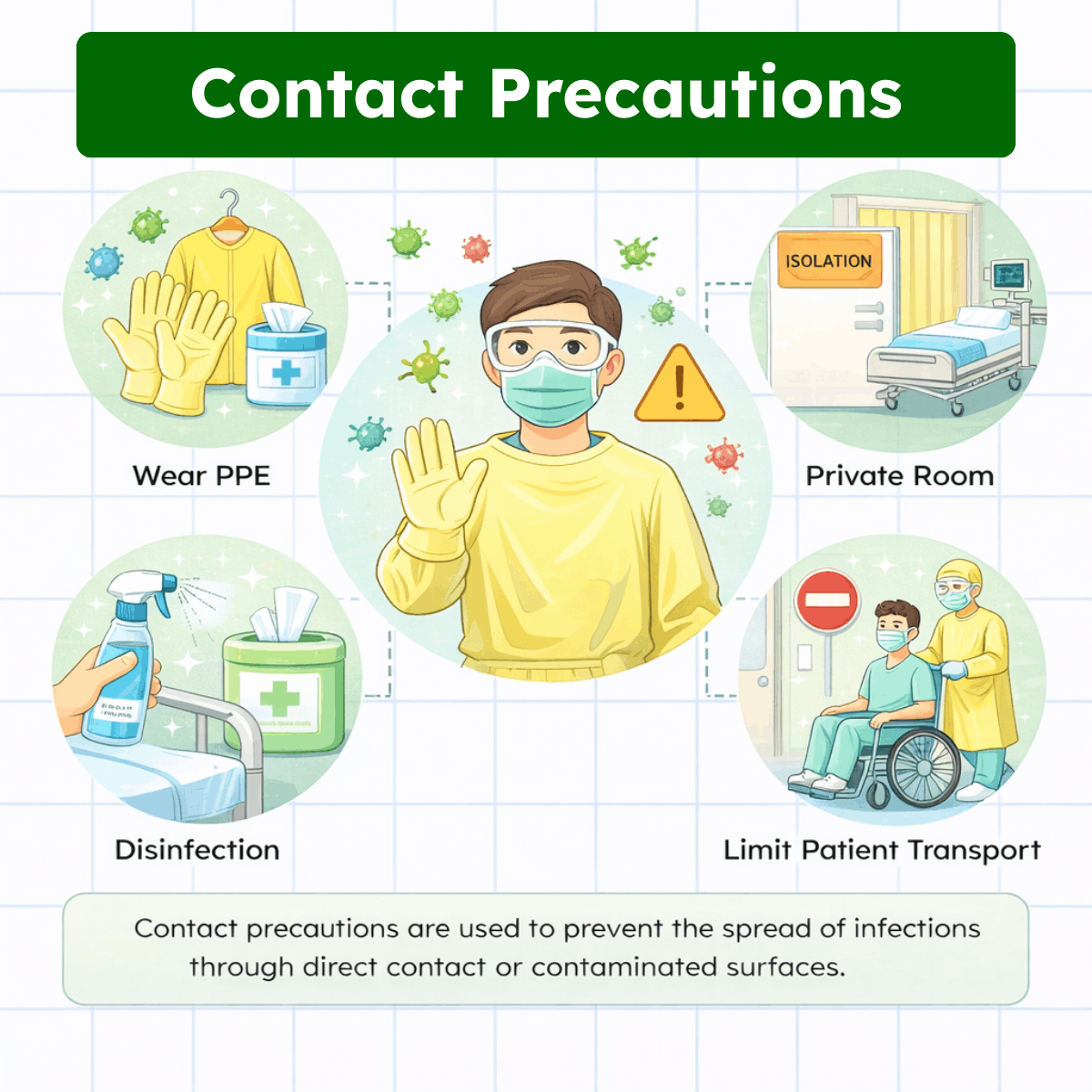
These additional measures typically include wearing gowns and gloves when entering the patient’s environment, placing the patient in a private room when possible, dedicating patient care equipment to a single patient, and limiting patient transport outside the room. By layering these protections on top of standard precautions, healthcare workers reduce the likelihood of cross-contamination.
Key Components of Contact Precautions
Patient Placement
Patients requiring contact precautions are ideally placed in a private room to minimize the spread of infectious organisms. When private rooms are unavailable, patients with the same infection may be placed together, a practice known as cohorting.
Proper patient placement helps reduce the risk of contamination of shared surfaces and limits exposure to other patients who may be vulnerable to infection.
Use of Gloves and Gowns
Healthcare workers must wear clean gloves and gowns when entering the room of a patient on contact precautions. These protective barriers help prevent contamination of the healthcare worker’s skin and clothing.
Gloves should be changed after contact with infectious materials and removed before leaving the patient’s room. Gowns should also be removed before exiting to prevent the spread of microorganisms to other areas of the healthcare facility. Hand hygiene must be performed immediately after removing PPE.
Hand Hygiene
Hand hygiene remains one of the most critical elements of infection control during contact precautions. Healthcare workers should perform hand hygiene before entering the patient’s room, after removing gloves, and after contact with potentially contaminated surfaces or materials.
In cases involving certain pathogens such as C. difficile, soap and water are preferred over alcohol-based sanitizers because alcohol products may be less effective against certain spore-forming organisms.
Equipment Handling and Environmental Cleaning
Medical equipment and environmental surfaces can serve as reservoirs for infectious organisms. Whenever possible, patient care equipment should be dedicated to a single patient. If equipment must be shared, it must be thoroughly cleaned and disinfected before being used with another patient.
Environmental cleaning plays a crucial role in preventing the spread of pathogens. High-touch surfaces such as bed rails, ventilator controls, monitors, and bedside tables require frequent disinfection to reduce contamination risks.
Limiting Patient Transport
Patients on contact precautions should only be transported outside their room when medically necessary. Limiting movement reduces the potential for spreading infectious organisms throughout the healthcare facility. If transport is required, precautions should be taken to minimize contamination of surfaces and equipment during movement.
Relevance of Contact Precautions to Respiratory Therapists
Respiratory therapists play a vital role in patient care, particularly for individuals with pulmonary diseases and critical respiratory conditions. Many of the patients treated by respiratory therapists are vulnerable to infections or may carry contagious organisms.
Frequent Contact with Respiratory Secretions
Respiratory therapists regularly perform procedures such as suctioning, airway clearance therapy, tracheostomy care, and ventilator management. These procedures involve direct contact with respiratory secretions, which may contain infectious pathogens.
Contact precautions help reduce the risk of transmission when therapists handle airway devices, suction catheters, or respiratory therapy equipment that may become contaminated.
Use of Respiratory Equipment
Respiratory therapy involves the use of various devices, including ventilators, nebulizers, oxygen delivery systems, and airway clearance tools. These devices can become contaminated if proper cleaning and handling procedures are not followed.
Adhering to contact precautions ensures that respiratory equipment is handled safely and reduces the risk of cross-contamination between patients.
Protecting High-Risk Patients
Many patients receiving respiratory therapy have weakened immune systems or chronic lung diseases that increase their susceptibility to infections. Preventing the spread of multidrug-resistant organisms and other infectious agents is essential for protecting these vulnerable individuals.
Contact precautions help reduce secondary infections that can worsen respiratory conditions and prolong recovery.
Preventing Healthcare-Associated Infections
Healthcare-associated infections remain a significant challenge in healthcare settings. In respiratory care, these infections may include ventilator-associated pneumonia or infections related to airway devices.
Respiratory therapists contribute to infection prevention by following contact precautions and ensuring that infection control practices are maintained during respiratory treatments and procedures.
Common Conditions Requiring Contact Precautions
Several infectious conditions commonly encountered in respiratory care require contact precautions. Gastrointestinal infections such as C. difficile and norovirus can spread through contaminated surfaces and equipment. Skin and wound infections caused by resistant bacteria also require contact precautions.
Patients colonized or infected with multidrug-resistant organisms such as MRSA or vancomycin-resistant enterococci (VRE) often require additional infection control measures to prevent transmission. Respiratory therapists must remain aware of these conditions and follow facility guidelines to ensure proper precautions are implemented.
Challenges in Maintaining Contact Precautions
Maintaining strict adherence to contact precautions can be challenging in busy clinical environments. Time constraints, staffing shortages, and limited availability of PPE may contribute to inconsistent compliance. Additionally, repeated donning and removal of protective equipment can be physically demanding and time-consuming.
Healthcare facilities must provide adequate training, ensure proper PPE availability, and reinforce infection control policies to support compliance. Respiratory therapists play a leadership role by demonstrating proper infection control techniques and promoting patient safety practices.
Contact Precautions Practice Questions
1. What are contact precautions designed to prevent in healthcare settings?
Contact precautions are designed to prevent transmission of infectious organisms through direct contact with the patient or indirect contact with contaminated surfaces or equipment.
2. When should contact precautions be implemented for a patient?
Contact precautions should be implemented when a patient is known or suspected to have infections transmitted by direct or indirect contact, such as multidrug-resistant organisms or gastrointestinal infections.
3. What personal protective equipment (PPE) is required when entering the room of a patient on contact precautions?
Healthcare workers must wear gloves and a gown when entering the patient’s room.
4. Why must gloves be worn during contact precautions?
Gloves protect healthcare workers from exposure to infectious organisms and prevent transmission between patients.
5. Why is wearing a gown required during contact precautions?
A gown protects skin and clothing from contamination with infectious material.
6. When should gloves be removed when caring for a patient on contact precautions?
Gloves should be removed before leaving the patient’s room and followed by hand hygiene.
7. When should the gown be removed during contact precautions?
The gown should be removed before leaving the patient’s room to prevent environmental contamination.
8. Why is hand hygiene still required after removing gloves during contact precautions?
Gloves may have microscopic defects or contamination can occur during removal, making hand hygiene essential.
9. What type of patient placement is preferred for individuals requiring contact precautions?
Patients should be placed in a private room or cohorted with patients who have the same infection.
10. What is cohorting in infection control?
Cohorting involves placing patients with the same infection in the same room to limit the spread of infection.
11. Why should noncritical patient care equipment be dedicated to patients on contact precautions?
Dedicated equipment prevents cross-contamination between patients.
12. What should be done if shared equipment must be used for patients on contact precautions?
Equipment must be thoroughly cleaned and disinfected before use with another patient.
13. Why should healthcare workers avoid touching environmental surfaces unnecessarily in rooms under contact precautions?
Environmental surfaces may harbor infectious organisms that can spread infection.
14. What types of infections commonly require contact precautions?
Examples include MRSA, VRE, C. difficile, norovirus, and certain wound infections.
15. Why are contact precautions especially important for patients with C. difficile infections?
C. difficile produces spores that are easily transmitted and resistant to many disinfectants.
16. Why is soap and water preferred over alcohol-based hand rubs after caring for patients with C. difficile?
Soap and water physically remove spores that alcohol-based hand rubs cannot eliminate effectively.
17. Why should patient transport be limited for individuals on contact precautions?
Limiting transport reduces the risk of spreading infectious organisms to other areas.
18. What precaution should be taken if a patient on contact precautions must be transported?
Infected or colonized areas should be covered, and healthcare personnel should follow infection control protocols.
19. Why should clean and dirty supply areas be separated when caring for patients on contact precautions?
Separating supplies prevents contamination of sterile or clean equipment.
20. When should gloves be changed during care of a patient on contact precautions?
Gloves should be changed after contact with infectious material and between procedures.
21. Why is environmental cleaning essential for patients on contact precautions?
Frequent cleaning reduces contamination of surfaces that can spread infection.
22. What is the role of visitors when entering a room under contact precautions?
Visitors may be required to wear gloves and gowns and perform hand hygiene.
23. Why should healthcare workers avoid placing personal items in rooms under contact precautions?
Personal items can become contaminated and spread infection outside the room.
24. What is the importance of proper removal technique for gowns and gloves?
Proper removal prevents self-contamination and reduces infection transmission.
25. Why should healthcare workers avoid wearing the same PPE when moving between patients?
Using the same PPE can transfer pathogens between patients.
26. How can contact precautions reduce hospital-acquired infections?
They interrupt the transmission of pathogens spread through physical contact.
27. Why should linens from patients on contact precautions be handled carefully?
Contaminated linens can spread microorganisms if handled improperly.
28. What precaution should be taken when disposing of waste from patients on contact precautions?
Waste should be disposed of following infection control protocols to prevent contamination.
29. Why is education important for healthcare workers caring for patients on contact precautions?
Education ensures correct PPE use and adherence to infection control procedures.
30. Why should healthcare workers avoid sitting or placing equipment on a patient’s bed when contact precautions are in place?
Beds may be contaminated and can transfer microorganisms to clothing or equipment.
31. What role does infection control signage play in contact precautions?
Signage alerts healthcare workers and visitors to required protective measures.
32. Why is monitoring compliance with contact precautions important in healthcare settings?
Monitoring ensures infection control protocols are followed and helps reduce transmission rates.
33. How do contact precautions complement standard precautions?
Contact precautions provide additional protection for infections spread through direct or indirect contact while maintaining standard precaution practices.
34. Why should healthcare workers perform hand hygiene before donning PPE for contact precautions?
Hand hygiene prevents contamination of PPE and reduces the risk of transmitting microorganisms.
35. What is the risk of touching the face or adjusting eyewear while wearing contaminated gloves?
Touching the face can transfer pathogens to mucous membranes, increasing infection risk.
36. Why should stethoscopes and other diagnostic tools be disinfected after use in contact precaution rooms?
These tools can become contaminated and transmit organisms to other patients if not properly disinfected.
37. Why is it important to remove PPE in the correct sequence when leaving a contact precaution room?
Correct removal sequence minimizes the risk of self-contamination.
38. What is the purpose of limiting the number of healthcare workers entering a contact precaution room?
Limiting exposure reduces the potential spread of infectious organisms.
39. Why should reusable medical equipment be reprocessed according to facility protocols after use on contact precaution patients?
Proper reprocessing eliminates pathogens and prevents cross-contamination.
40. What is the role of environmental services staff in maintaining contact precautions?
They ensure thorough cleaning and disinfection of patient rooms and equipment.
41. Why should healthcare workers avoid wearing contaminated gowns outside of the patient room?
Contaminated gowns can spread infectious organisms throughout the facility.
42. Why is it important to educate patients and families about contact precautions?
Education promotes cooperation and reduces accidental transmission of infections.
43. What precaution should be taken when handling patient charts or electronic devices in contact precaution rooms?
Hands and devices should be disinfected to prevent contamination.
44. Why should gloves be removed immediately if they become torn during patient care?
Torn gloves compromise protection and increase infection risk.
45. Why should healthcare workers avoid reusing disposable PPE in contact precaution settings?
Disposable PPE is designed for single use and may harbor pathogens after use.
46. Why is proper disposal of contaminated PPE essential in contact precautions?
Proper disposal prevents environmental contamination and infection spread.
47. What is the risk of wearing contaminated gloves while touching clean medical supplies?
It can contaminate sterile or clean supplies, increasing infection risk.
48. Why should healthcare workers avoid placing used PPE on bedside tables or chairs?
Contaminated PPE can spread pathogens to surrounding surfaces.
49. Why should hand hygiene be performed immediately after removing PPE?
It removes pathogens that may have transferred during PPE removal.
50. Why is it important to follow facility-specific infection control policies for contact precautions?
Policies are designed to meet regulatory standards and reduce infection transmission.
51. Why should shared medical equipment be labeled or tracked when used with contact precaution patients?
Tracking ensures proper cleaning and prevents use on other patients without disinfection.
52. Why is it important to monitor patients for compliance with hygiene measures during contact precautions?
Patient cooperation helps reduce the spread of infectious organisms.
53. Why should healthcare workers avoid bringing unnecessary supplies into contact precaution rooms?
Extra supplies can become contaminated and increase infection risk.
54. Why should hand hygiene be performed after contact with a patient’s environment even if the patient was not touched?
Environmental surfaces can harbor infectious pathogens.
55. Why is it important to use designated waste containers in contact precaution rooms?
Designated containers help prevent contamination of surrounding areas.
56. Why should patient care activities be clustered when caring for patients on contact precautions?
Clustering care reduces repeated exposure and limits room entry.
57. Why is it important to inspect PPE for defects before entering a contact precaution room?
Damaged PPE may not provide adequate protection.
58. Why should healthcare workers avoid leaning against surfaces in a contact precaution room?
Surfaces may be contaminated and transfer pathogens to clothing.
59. Why should disposable patient care items be discarded rather than reused in contact precaution settings?
Disposable items may carry infectious organisms and should not be reused.
60. Why should healthcare workers be cautious when handling patient personal items during contact precautions?
Personal items may be contaminated and contribute to infection spread.
61. Why is documentation of contact precaution status important in patient care?
Documentation ensures all staff follow appropriate infection control measures.
62. Why should healthcare workers remove jewelry or accessories before providing care under contact precautions?
Jewelry can harbor microorganisms and interfere with proper hand hygiene.
63. Why should healthcare workers avoid storing PPE supplies inside the patient room unnecessarily?
Stored supplies may become contaminated and unusable.
64. Why is it important to change gowns between contact with different patients?
Changing gowns prevents cross-transmission of pathogens.
65. Why should healthcare workers remain aware of updated infection control guidelines related to contact precautions?
Guidelines evolve based on new evidence to improve patient and staff safety.
66. Why should contaminated linens from contact precaution patients be handled with minimal agitation?
Minimizing agitation reduces the spread of infectious particles into the air.
67. Why should healthcare workers avoid sitting on a patient’s bed while providing care under contact precautions?
Beds may be contaminated and can transfer pathogens to clothing.
68. Why should contact precaution signage be clearly displayed outside the patient’s room?
Signage alerts healthcare workers and visitors to required protective measures before entry.
69. Why should gloves be worn when handling trash from a contact precaution patient’s room?
Trash may contain contaminated materials that can transmit pathogens.
70. Why is it important to remove gloves before documenting patient care on shared computers?
Gloves may carry microorganisms that contaminate shared equipment.
71. Why should hand hygiene be performed after contact with contaminated PPE?
Pathogens may transfer from PPE to the hands during removal.
72. Why should healthcare workers avoid carrying personal items such as phones into contact precaution rooms?
Personal items can become contaminated and spread infection outside the room.
73. Why is it important to follow proper gown removal techniques during contact precautions?
Improper removal can result in contamination of clothing or skin.
74. Why should visitors receive instruction before entering a contact precaution room?
Education helps visitors follow infection control procedures and reduces transmission risk.
75. Why should patient transport equipment be cleaned after use for contact precaution patients?
Transport equipment can become contaminated and spread pathogens to other patients.
76. Why is it important to perform hand hygiene after removing contaminated linens?
Handling linens can transfer microorganisms to the hands.
77. Why should healthcare workers avoid touching door handles with contaminated gloves?
Door handles can become reservoirs for infection transmission.
78. Why should gloves be changed when moving from a contaminated body site to a clean body site?
Changing gloves prevents cross-contamination between body areas.
79. Why should healthcare workers avoid re-entering a contact precaution room with previously worn PPE?
Previously worn PPE may carry pathogens and increase infection risk.
80. Why should hand hygiene be performed before leaving the patient’s environment?
This reduces the spread of infectious organisms throughout the facility.
81. Why should environmental surfaces be disinfected frequently in contact precaution rooms?
Frequent cleaning reduces microbial contamination and infection transmission.
82. Why should staff minimize touching unnecessary surfaces while in a contact precaution room?
Reducing surface contact decreases the risk of pathogen spread.
83. Why is it important to use facility-approved disinfectants when cleaning contact precaution rooms?
Approved disinfectants are proven effective against specific pathogens.
84. Why should healthcare workers report PPE shortages in contact precaution areas?
Adequate PPE supply is essential for maintaining infection control standards.
85. Why should disposable meal trays be handled carefully in contact precaution settings?
Meal trays may become contaminated during patient use.
86. Why should healthcare workers avoid shaking contaminated linens or clothing?
Shaking can aerosolize microorganisms and increase transmission risk.
87. Why should patient mobility equipment such as walkers or wheelchairs be disinfected after use?
Mobility devices can serve as vectors for pathogen transmission.
88. Why should healthcare workers monitor for signs of PPE contamination during patient care?
Recognizing contamination allows for timely PPE replacement.
89. Why is it important to limit unnecessary room entry for patients under contact precautions?
Reducing entry limits exposure and lowers infection transmission risk.
90. Why should contaminated dressings be disposed of in designated biohazard containers?
Proper disposal prevents environmental contamination and protects staff.
91. Why should healthcare workers avoid touching clean supply carts after providing care under contact precautions?
Contaminated hands or gloves can transfer pathogens to clean supplies.
92. How do contact precautions differ from droplet precautions?
Contact precautions focus on preventing infections spread through direct physical contact or contaminated surfaces, whereas droplet precautions focus on preventing infections spread through respiratory droplets generated by coughing, sneezing, or talking.
93. How do contact precautions differ from airborne precautions?
Contact precautions prevent infections spread through direct contact with patients or contaminated surfaces, whereas airborne precautions prevent infections spread through tiny particles that remain suspended in the air and can travel long distances.
94. Why should healthcare workers notify environmental services when a contact precaution patient is discharged?
Specialized cleaning is required before the room can be used again.
95. Why should hand hygiene be performed after removing gowns in contact precautions?
Pathogens may transfer to hands during gown removal.
96. Why should healthcare workers avoid placing contaminated PPE in regular trash bins?
Improper disposal increases infection transmission risk.
97. Why should healthcare workers avoid adjusting masks or eyewear with contaminated gloves?
This action can transfer pathogens to mucous membranes.
98. Why should healthcare workers perform hand hygiene after handling patient charts or paperwork in contact precaution rooms?
Paperwork and charts may become contaminated during patient care.
99. Why should healthcare workers be cautious when assisting patients with personal hygiene under contact precautions?
Direct contact with bodily fluids increases infection transmission risk.
100. Why should healthcare workers ensure proper PPE fit before entering a contact precaution room?
Properly fitted PPE provides effective protection against exposure.
Final Thoughts
Contact precautions play an essential role in reducing the spread of infectious organisms within healthcare environments. By implementing protective measures such as wearing gowns and gloves, performing proper hand hygiene, and maintaining strict equipment disinfection practices, healthcare providers help limit transmission risks.
For respiratory therapists, who frequently perform procedures involving direct contact with respiratory secretions and medical devices, consistent adherence to contact precautions is vital.
As healthcare continues to face evolving infectious challenges, maintaining strong infection prevention practices helps protect patients, healthcare workers, and the broader clinical environment while supporting safe and effective respiratory care.

Written by:
John Landry is a registered respiratory therapist from Memphis, TN, and has a bachelor's degree in kinesiology. He enjoys using evidence-based research to help others breathe easier and live a healthier life.
References
- Douedi S, Douedi H. Precautions, Bloodborne, Contact, and Droplet. [Updated 2023 Sep 4]. In: StatPearls [Internet]. Treasure Island (FL): StatPearls Publishing; 2025.