

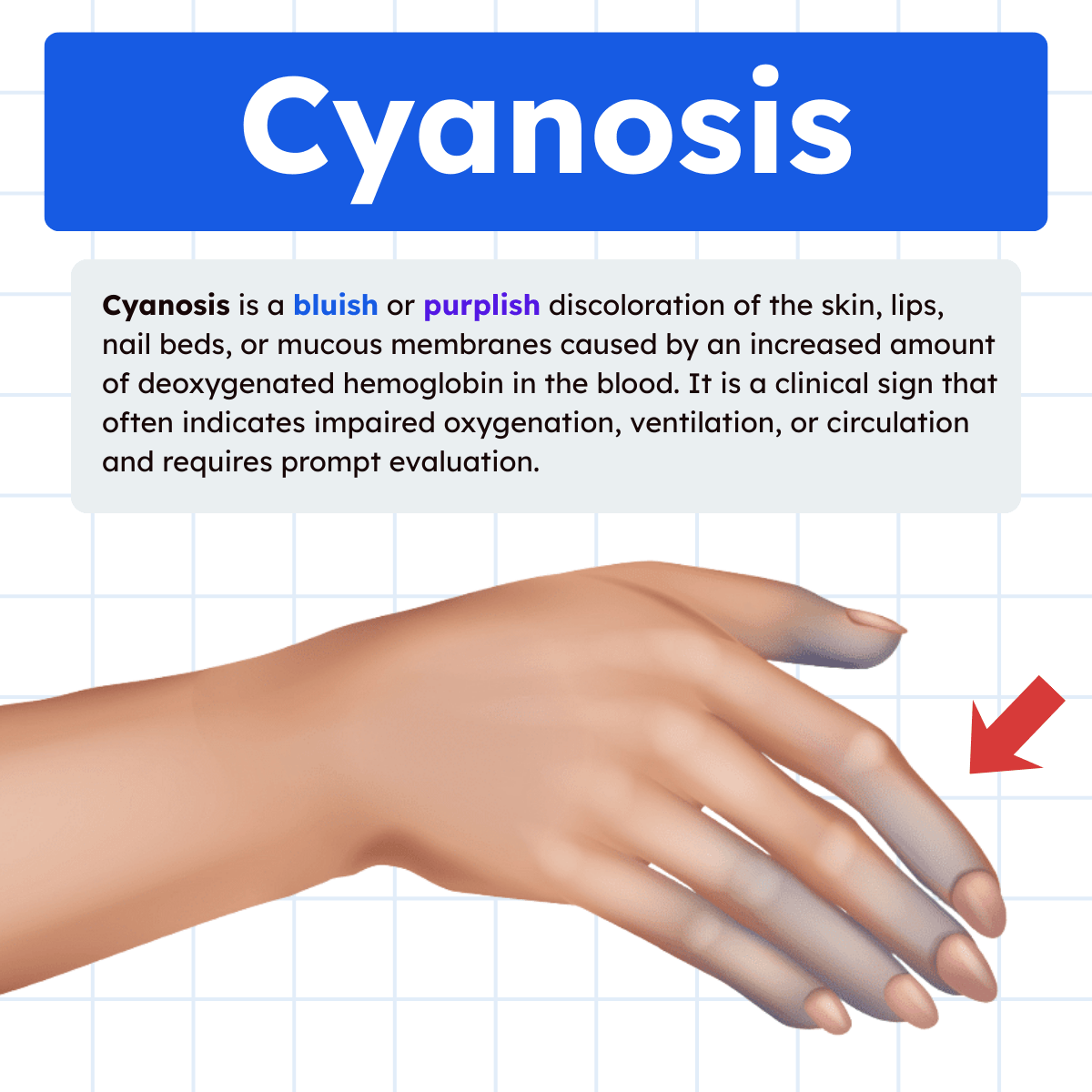
Cyanosis is a visible, often alarming clinical sign that indicates inadequate oxygen delivery to the tissues. It presents as a bluish or purplish discoloration of the skin, lips, nail beds, or mucous membranes and is frequently associated with serious cardiopulmonary conditions.
For respiratory therapists, cyanosis is more than just a visual finding; it is a critical clue that can signal hypoxemia, impaired ventilation, or circulatory compromise.
Understanding what cyanosis is, why it occurs, and how to respond appropriately is essential for timely intervention and optimal patient outcomes.

What Is Cyanosis?
Cyanosis occurs when there is an increased amount of deoxygenated hemoglobin in the blood, typically greater than 5 g/dL. When hemoglobin is not adequately saturated with oxygen, it absorbs and reflects light differently, producing the characteristic bluish color seen through the skin and mucous membranes.
It is important to understand that cyanosis does not always correlate directly with oxygen saturation values alone. A patient with severe anemia may be profoundly hypoxemic yet not appear cyanotic due to low total hemoglobin levels. Conversely, a patient with polycythemia may appear cyanotic even with relatively modest drops in oxygen saturation. This makes clinical context and objective assessment tools essential.
Types of Cyanosis
Cyanosis is generally classified into two main types: central and peripheral. Differentiating between them helps narrow down the underlying cause and guides clinical management.
Central Cyanosis
Central cyanosis is caused by inadequate oxygenation of arterial blood. It is typically visible in the lips, tongue, and oral mucosa. Because it reflects systemic hypoxemia, central cyanosis is usually more concerning and often points to primary respiratory or cardiac pathology.
Common causes include:
- Severe lung disease (e.g., pneumonia, ARDS, COPD exacerbations)
- Hypoventilation
- Ventilation–perfusion mismatch or shunt
- Congenital heart disease with right-to-left shunting
- High altitude exposure
Note: In central cyanosis, warming the extremities does not resolve the discoloration, since the underlying problem is oxygenation rather than blood flow.
Peripheral Cyanosis
Peripheral cyanosis results from reduced blood flow or increased oxygen extraction in the extremities rather than systemic hypoxemia. It is commonly seen in the fingers, toes, and nail beds, while the lips and tongue may remain pink.
Common causes include:
- Low cardiac output states
- Shock
- Peripheral vasoconstriction (e.g., cold exposure)
- Heart failure
- Severe hypotension
Note: Peripheral cyanosis may improve with warming, massage, or restoration of adequate circulation.
Pathophysiology Behind Cyanosis
From a respiratory perspective, cyanosis is most often linked to impaired oxygen transfer. This can occur due to several mechanisms:
- Alveolar hypoventilation: Reduced ventilation leads to carbon dioxide retention and decreased alveolar oxygen levels.
- Diffusion impairment: Thickened alveolar-capillary membranes limit oxygen movement into the bloodstream.
- Ventilation–perfusion mismatch: Areas of the lung are ventilated but not perfused, or perfused but not ventilated.
- Right-to-left shunt: Blood bypasses ventilated alveoli entirely, remaining deoxygenated.
Note: Respiratory therapists frequently encounter cyanosis in patients experiencing acute respiratory failure, advanced chronic lung disease, or complications of mechanical ventilation.
Clinical Assessment of Cyanosis
Visual assessment alone is not enough. Skin tone, lighting, and patient anatomy can all affect how cyanosis appears. Therefore, respiratory therapists must combine observation with objective measurements.
Key assessment tools include:
- Pulse oximetry: Provides rapid, noninvasive estimation of oxygen saturation but may be unreliable in poor perfusion states.
- Arterial blood gases (ABGs): The gold standard for evaluating oxygenation, ventilation, and acid–base status.
- Physical assessment: Work of breathing, respiratory rate, accessory muscle use, and mental status.
- Capillary refill and skin temperature: Helpful in distinguishing central from peripheral causes.
Note: Recognizing cyanosis early allows for faster escalation of care and prevention of deterioration.
Relevance to Respiratory Therapists
Cyanosis is directly tied to the core responsibilities of respiratory therapists. It often signals the need for immediate intervention, such as oxygen therapy, airway support, or ventilatory assistance.
Respiratory therapists are frequently the first clinicians to:
- Identify subtle changes in oxygenation
- Adjust oxygen delivery devices
- Initiate or modify noninvasive ventilation
- Assist with intubation and mechanical ventilation
- Monitor response to therapy using ABGs and pulse oximetry
Note: In neonatal and pediatric care, cyanosis is especially critical. In newborns, cyanosis may be an early sign of congenital heart disease, respiratory distress syndrome, or persistent pulmonary hypertension, requiring rapid evaluation and coordination with the care team.
Cyanosis and Oxygen Therapy
While oxygen therapy is often the first response to cyanosis, it is not always sufficient. The underlying cause must be addressed.
Examples include:
- Cyanosis due to hypoventilation may require ventilatory support rather than higher oxygen flow.
- Cyanosis caused by shunting may show limited improvement with oxygen alone.
- Peripheral cyanosis may not require oxygen if systemic oxygenation is adequate.
Note: This highlights why respiratory therapists must think beyond “turning up the oxygen” and focus on physiology-driven care.
Cyanosis Practice Questions
1. What is cyanosis? Cyanosis is a bluish discoloration of the skin and mucous membranes due to inadequate oxygenation of the blood.
2. What causes cyanosis? Cyanosis occurs due to an increased amount of deoxygenated (reduced) hemoglobin in red blood cells.
3. What are the two main types of cyanosis? Cyanosis can be classified as central cyanosis and peripheral cyanosis.
4. What is central cyanosis? Central cyanosis is caused by desaturation of arterial blood or the presence of abnormal hemoglobin derivatives.
5. What is peripheral cyanosis? Peripheral cyanosis occurs due to reduced blood flow to the extremities, leading to localized oxygen desaturation.
6. Is cyanosis a reliable indicator of oxygenation status? No, cyanosis is an insensitive indicator of oxygenation because it is difficult to detect until arterial oxygen saturation drops below 80%. Early recognition and treatment are critical.
7. What are other terms used for deoxygenated hemoglobin? Reduced hemoglobin, deoxygenated hemoglobin, deoxyhemoglobin, and desaturated hemoglobin all refer to the same concept.
8. What is arterial hypoxemia? Arterial hypoxemia is a condition where the partial pressure of oxygen in arterial blood (PaO2) is below the normal range of 85-100 mmHg.
9. What is the normal oxygen saturation of arterial blood? The normal oxygen saturation of arterial blood is between 95-97%.
10. What factors make cyanosis difficult to detect? Cyanosis can be hard to detect due to factors such as anemia, skin pigmentation, and lighting conditions.
11. Why does anemia make cyanosis harder to detect? In a healthy individual with a hematocrit of 45%, cyanosis appears when oxygen saturation falls to 78% or lower. In an anemic patient with a hematocrit of 18%, cyanosis may not be apparent even at life-threatening oxygen levels.
12. If a patient is cyanotic, what must be true about their condition? They must be hypoxemic but may be normocapnic, hypercapnic, or hypocapnic.
13. What visible signs indicate cyanosis in an emergency? Mouth breathing, air hunger, and visible cyanosis indicate an emergency requiring immediate intervention.
14. Why is cyanosis considered a medical emergency? Cyanosis signifies severe hypoxia and requires immediate oxygen therapy. It takes priority over most other emergencies, except for massive arterial bleeding.
15. What are the two main causes of central cyanosis? Central cyanosis is caused by hypoxemia or anatomical right-to-left (R→L) shunting.
16. What conditions can lead to hypoxemia? Hypoxemia can occur due to reduced inspired oxygen (e.g., high altitude, oxygen supply failure), alveolar hypoventilation (elevated CO2 levels), diffusion impairment, or ventilation-perfusion (V/Q) mismatch.
17. What conditions can cause alveolar hypoventilation and elevated CO2? Alveolar hypoventilation can result from respiratory depression (central or neuromuscular), airway obstruction (e.g., laryngeal paralysis, foreign body, brachycephalic obstructive airway syndrome).
18. What conditions can lead to diffusion impairment? Interstitial lung diseases can impair diffusion, reducing oxygen transport across the alveoli.
19. What conditions can cause ventilation-perfusion mismatch? Pulmonary thromboembolism (PTE) and pulmonary parenchymal diseases can result in ventilation-perfusion mismatch, leading to cyanosis.
20. What are the causes of right-to-left (R→L) shunting in central cyanosis? R→L shunting can be intracardiac or extracardiac.
21. What are the intracardiac causes of R→L shunting? Tetralogy of Fallot, atrial septal defect (ASD) or ventricular septal defect (VSD) with concurrent pulmonic stenosis, and pulmonary hypertension.
22. What are the extracardiac causes of R→L shunting? Reversed patent ductus arteriosus (PDA), pulmonary arteriovenous fistulas, and severe lung lobe consolidation (perfusion without ventilation).
23. What are the causes of peripheral cyanosis? Peripheral cyanosis can be caused by central cyanosis, decreased arterial blood supply, peripheral vasoconstriction, arterial thromboembolism, low cardiac output, and venous drainage obstruction.
24. What key history points should be assessed when determining the cause of cyanosis? Age and breed, respiratory pattern and noise, presence of cough, neurological signs, muscular weakness, episodic weakness or collapse, gait abnormalities, and medication use.
25. What physical exam findings help assess cyanosis? Observing respiratory effort and mucous membrane color, palpating extremities and chest wall for abnormalities, auscultating for heart murmurs, evaluating lung sounds for pulmonary or pleural space disease, and performing a neurological examination.
26. What diagnostic questions should be asked when evaluating cyanosis? Is the cyanosis central or peripheral?, Does the patient require immediate stabilization?, and Can a tentative diagnosis be made based on initial findings?
27. What diagnostic tests help identify the cause of cyanosis? Thoracic radiography, blood gas analysis, and echocardiography (if congenital heart disease is suspected).
28. What is the most critical emergency treatment for cyanosis? Administering oxygen immediately.
29. How is cyanosis managed long-term? Management depends on the underlying cause and may include treating respiratory, cardiac, or vascular conditions.
30. What clinical signs indicate congenital cyanotic heart disease? Stunted growth, stability at rest, exercise intolerance, collapse or syncope (especially in reversed PDA), and owner-reported cyanosis.
31. What are the four components of Tetralogy of Fallot? Pulmonic stenosis, Ventricular septal defect (VSD), overriding aorta, and right ventricular hypertrophy and dilation.
32. In Tetralogy of Fallot, how does blood shunt? Blood shunts from right to left due to pulmonic stenosis and VSD.
33. How is cyanotic congenital heart disease diagnosed? Echocardiography, thoracic radiographs (careful sedation required), and ECG for possible abnormalities.
34. What non-therapeutic management options exist for cyanotic heart disease? Exercise restriction and weight management.
35. What is the treatment for cyanotic congenital heart disease? There is no definitive cure for animals with congenital heart disease and right-to-left shunting. Treatment focuses on managing clinical signs, as surgical correction is rarely feasible.
36. What is the primary concern when a patient presents with cyanosis? Severe hypoxia requiring immediate oxygen therapy.
37. How does chronic hypoxemia affect hemoglobin levels? It can lead to secondary polycythemia as the body produces more red blood cells to compensate.
38. What is the difference between functional and structural cyanosis? Functional cyanosis results from reduced oxygenation, while structural cyanosis is due to congenital heart defects.
39. What is differential cyanosis? Cyanosis that affects only certain parts of the body, usually the lower limbs, due to a right-to-left shunt.
40. What is the role of pulse oximetry in diagnosing cyanosis? It measures oxygen saturation but may be inaccurate in severe cyanosis or poor perfusion states.
41. How does methemoglobinemia contribute to cyanosis? It prevents hemoglobin from effectively carrying oxygen, leading to central cyanosis.
42. What is the most common cause of central cyanosis in newborns? Congenital heart defects causing right-to-left shunting.
43. What is acrocyanosis? A benign condition in newborns where the hands and feet appear blue due to vasoconstriction.
44. How does hypothermia cause cyanosis? Peripheral vasoconstriction reduces blood flow, leading to decreased oxygen delivery to extremities.
45. Why is carbon monoxide poisoning not associated with cyanosis? Carboxyhemoglobin gives the skin a cherry-red appearance instead of blue discoloration.
46. What test is used to differentiate central from peripheral cyanosis? Applying oxygen: central cyanosis persists, while peripheral cyanosis improves.
47. What type of heart murmurs are often present in cyanotic congenital heart disease? Loud systolic murmurs, especially in conditions like Tetralogy of Fallot.
48. How can nail bed cyanosis help determine the type of cyanosis? Nail bed cyanosis suggests central cyanosis, while peripheral cyanosis spares the nail beds.
49. What is the gold standard test for evaluating arterial oxygenation? Arterial blood gas (ABG) analysis.
50. What is the cyanotic spell in Tetralogy of Fallot? A sudden worsening of cyanosis due to increased right-to-left shunting.
51. What position helps improve cyanotic spells in Tetralogy of Fallot? The knee-chest position increases systemic vascular resistance, reducing right-to-left shunting.
52. Why does crying worsen cyanosis in congenital heart disease? Increased intrathoracic pressure enhances right-to-left shunting.
53. What is the most common cause of cyanosis in COPD patients? Severe V/Q mismatch leading to hypoxemia.
54. Why does high altitude exposure cause cyanosis? Reduced atmospheric oxygen leads to lower arterial oxygen levels.
55. What is the treatment for methemoglobinemia-induced cyanosis? Intravenous methylene blue to reduce methemoglobin levels.
56. How does sepsis contribute to cyanosis? Peripheral vasoconstriction in septic shock reduces oxygen delivery to extremities.
57. What is the impact of severe right heart failure on cyanosis? It can lead to central cyanosis due to poor pulmonary circulation and oxygenation.
58. Why do patients with Eisenmenger syndrome develop cyanosis? Long-standing left-to-right shunting reverses to right-to-left due to pulmonary hypertension.
59. How does cyanosis differ from pallor? Cyanosis is caused by deoxygenated hemoglobin, whereas pallor is due to reduced blood flow or anemia.
60. What is the primary goal in managing cyanosis? Identifying and treating the underlying cause while providing oxygen therapy.
61. What is the primary cause of cyanosis in congenital heart disease? Right-to-left shunting of deoxygenated blood.
62. How does cyanosis present differently in polycythemia vs. anemia? It is more pronounced in polycythemia and harder to detect in anemia.
63. What is the earliest sign of cyanosis in newborns? Bluish discoloration of the lips, tongue, and mucous membranes.
64. Why does cyanosis occur in respiratory failure? Hypoventilation leads to inadequate oxygenation of the blood.
65. What is the main treatment for cyanotic heart disease? Oxygen therapy, surgical correction, or palliative interventions.
66. What is the hallmark of central cyanosis? Bluish discoloration of the mucous membranes and skin.
67. Why does severe pneumonia cause cyanosis? Impaired gas exchange due to alveolar inflammation and fluid accumulation.
68. What effect does a pulmonary embolism have on cyanosis? It causes sudden-onset cyanosis due to acute hypoxemia.
69. Why is clubbing associated with chronic cyanosis? Prolonged hypoxia stimulates growth factors that enlarge the fingertips.
70. What lab test confirms cyanosis is due to hypoxemia? Arterial blood gas (ABG) showing low PaO2.
71. What is the difference between acute and chronic cyanosis? Acute cyanosis occurs suddenly, while chronic cyanosis develops over time due to persistent hypoxia.
72. What condition causes “blue baby syndrome”? Tetralogy of Fallot or methemoglobinemia.
73. Why does cyanosis improve with oxygen in some conditions but not others? In central cyanosis due to hypoxia, oxygen helps, but in right-to-left shunting, it does not.
74. How does high altitude sickness lead to cyanosis? Low atmospheric oxygen causes arterial hypoxemia.
75. What type of heart defect worsens with crying or exertion in infants? Cyanotic congenital heart defects like Tetralogy of Fallot.
76. What non-invasive tool is useful for assessing cyanosis? Pulse oximetry to measure oxygen saturation.
77. What is a “Tet spell” in cyanotic heart disease? A sudden episode of severe cyanosis and hypoxia in infants with Tetralogy of Fallot.
78. What is the main difference between cyanosis and Raynaud’s phenomenon? Raynaud’s is episodic and caused by vasospasm, while cyanosis is persistent due to hypoxia.
79. What is the best position to relieve cyanosis in Tetralogy of Fallot? The squatting or knee-chest position.
80. What is the prognosis for untreated central cyanosis? Poor, due to progressive hypoxia and organ damage.
81. How does carbon monoxide poisoning affect cyanosis? It does not cause cyanosis because carboxyhemoglobin is red, not blue.
82. Why does cyanosis worsen with exertion? Increased oxygen demand cannot be met due to impaired oxygenation.
83. What type of cyanosis is seen in sepsis? Peripheral cyanosis due to poor circulation and vasoconstriction.
84. Why does cyanosis not always indicate hypoxia? Abnormal hemoglobins like methemoglobin or sulfhemoglobin can cause cyanosis without hypoxia.
85. How can congenital heart disease be differentiated from pulmonary causes of cyanosis? Congenital heart disease presents with normal lung sounds but abnormal heart findings.
86. What is the main cause of differential cyanosis? Patent ductus arteriosus with right-to-left shunting.
87. What causes acrocyanosis? Peripheral vasoconstriction in response to cold or stress.
88. How does chronic obstructive pulmonary disease (COPD) contribute to cyanosis? Airway obstruction and V/Q mismatch lead to chronic hypoxemia.
89. What is the treatment for methemoglobinemia-induced cyanosis? Methylene blue administration.
90. What is “Harlequin cyanosis”? A transient, benign cyanosis seen in newborns due to immature autonomic control.
91. Why is peripheral cyanosis seen in shock? Decreased perfusion leads to increased oxygen extraction by tissues.
92. How does pulmonary hypertension lead to cyanosis? Increased right-sided heart pressure can cause right-to-left shunting.
93. What role does nitric oxide play in cyanosis? It is used as a pulmonary vasodilator in neonates with persistent pulmonary hypertension.
94. How does cyanosis differ in acute vs. chronic heart failure? Acute heart failure leads to central cyanosis, while chronic heart failure causes peripheral cyanosis.
95. What test can distinguish central from peripheral cyanosis? Warming the affected area resolves peripheral cyanosis but not central cyanosis.
96. What is the effect of high altitude on chronic cyanosis? Long-term exposure can cause secondary polycythemia, worsening cyanosis.
97. What is the cyanotic response in newborns with persistent pulmonary hypertension? Severe hypoxia and central cyanosis despite adequate ventilation.
98. Why does cyanosis not occur in anemia despite low oxygen levels? There is insufficient hemoglobin to produce visible deoxygenated blood.
99. How does left heart failure contribute to cyanosis? Pulmonary congestion impairs oxygen exchange, leading to hypoxemia.
100. How does chronic cyanosis affect red blood cell production? It stimulates erythropoiesis, leading to secondary polycythemia.
Final Thoughts
Cyanosis remains one of the most recognizable indicators of compromised oxygen delivery, but its true value lies in how it is interpreted and acted upon. For respiratory therapists, recognizing cyanosis means looking deeper into the patient’s ventilation, oxygenation, and perfusion status rather than relying on appearance alone.
By combining visual assessment with objective data and clinical reasoning, therapists can identify serious problems early and intervene effectively. Mastery of this concept strengthens bedside decision-making and reinforces the respiratory therapist’s essential role in safeguarding patient stability and outcomes.

Written by:
John Landry is a registered respiratory therapist from Memphis, TN, and has a bachelor's degree in kinesiology. He enjoys using evidence-based research to help others breathe easier and live a healthier life.
References
- Adeyinka A, Kondamudi NP. Cyanosis (Archived) [Updated 2023 Aug 12]. In: StatPearls [Internet]. Treasure Island (FL): StatPearls Publishing; 2025.