

Diminished breath sounds are an important clinical finding that often signal reduced airflow or poor sound transmission through the lungs or chest wall. In healthy lungs, breath sounds travel clearly, but when airflow slows or structural changes block transmission, the sounds become faint.
This can occur with shallow breathing, airway obstruction, hyperinflation, or the presence of air or fluid in the pleural space. Conditions such as COPD, asthma, pneumothorax, and pleural effusion commonly produce diminished breath sounds.
Understanding why these sounds occur and how to identify them is essential for accurate respiratory assessment and effective patient care.

What Are Diminished Breath Sounds?
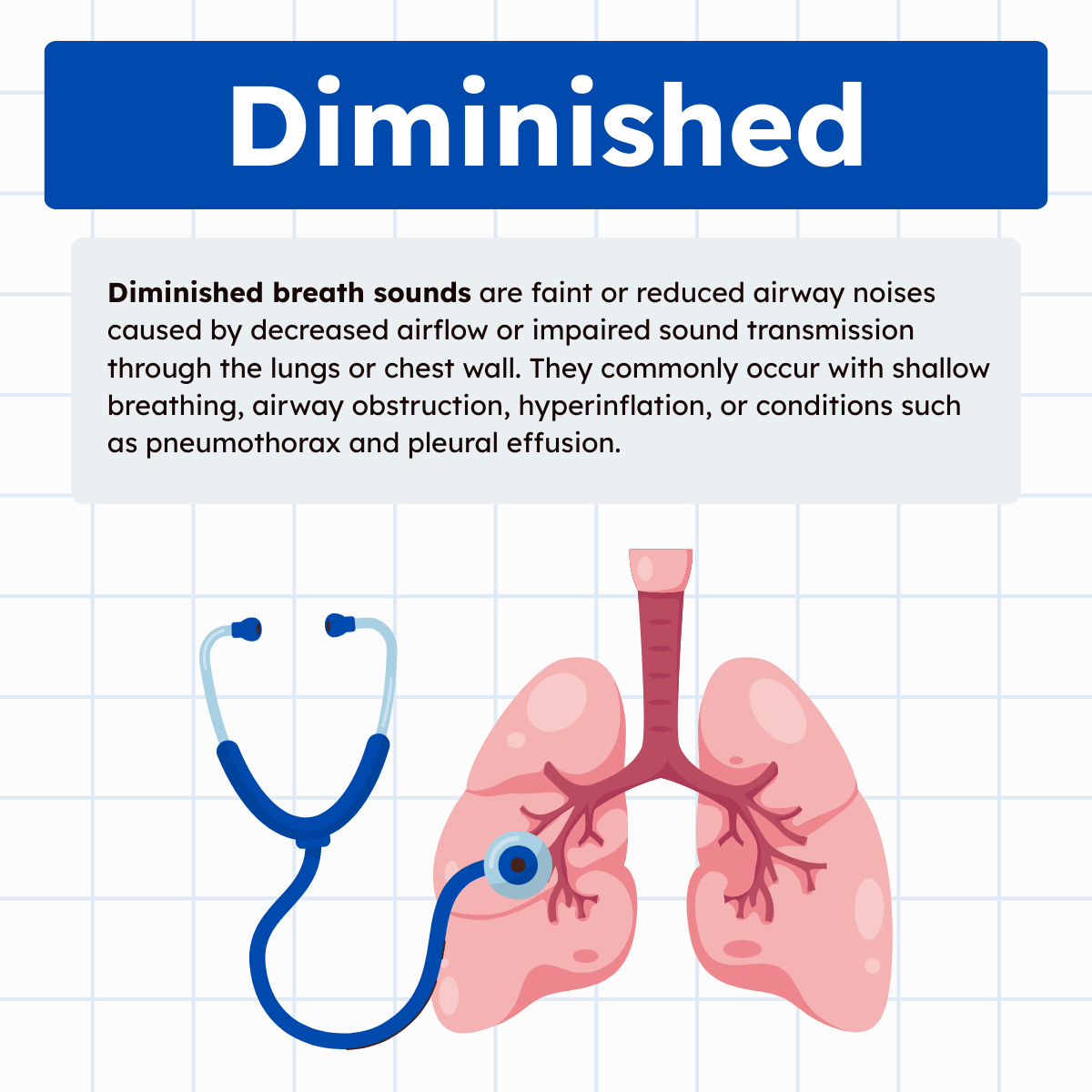
Diminished breath sounds occur when the normal intensity of airflow sounds is reduced, making them faint or difficult to hear during auscultation. In healthy individuals, breath sounds are produced by turbulent airflow in the larger airways and transmitted through lung tissue to the chest wall. When this process is disrupted, the resulting sounds lose clarity and volume.
There are two main reasons breath sounds become diminished. First, airflow may be reduced because the patient is breathing slowly or shallowly, which generates less turbulence. Second, sound transmission may be impaired by conditions that block, absorb, or distance the sound before it reaches the stethoscope. These factors make diminished breath sounds a nonspecific yet important clue in identifying underlying respiratory problems.
How Diminished Breath Sounds Are Produced
Diminished breath sounds result from either reduced airflow intensity or impaired sound transmission. Understanding these mechanisms helps clinicians identify the underlying cause and determine the appropriate intervention.
- Reduced Airflow Velocity: When a patient breathes shallowly or slowly, there is less turbulent airflow in the larger airways. This reduced turbulence produces weaker breath sounds. Shallow breathing may occur with pain, fatigue, sedation, or respiratory muscle weakness.
- Obstructed Airways: Mucus plugging or partial obstruction decreases airflow to certain lung regions. With little or no air movement reaching those areas, breath sounds become faint or may disappear entirely.
- Hyperinflated Lungs: Conditions such as COPD and asthma can trap air in the lungs, stretching alveoli and increasing the distance sound must travel. Hyperinflation reduces the strength of airflow sounds, often making them noticeably diminished during auscultation.
- Air or Fluid in the Pleural Space: A pneumothorax or pleural effusion can block sound transmission by placing air or fluid between the lung and chest wall. Even if airflow is normal, sound cannot reach the stethoscope effectively.
- Increased Tissue Thickness: Obesity, anasarca, or a heavily muscled chest wall increases the physical barrier between the lungs and the stethoscope, reducing sound clarity.
Note: These mechanisms highlight why diminished breath sounds can arise from either changes in airflow or alterations in the structures that transmit sound.
Clinical Conditions Associated With Diminished Breath Sounds
Diminished breath sounds are a common feature of many respiratory and systemic conditions. Identifying the underlying cause is essential because each condition requires a different clinical response.
COPD and Asthma
Both COPD and asthma can cause hyperinflation, which stretches the lung tissue and reduces the transmission of airflow sounds. Early in these diseases, diminished breath sounds may accompany wheezing. In advanced stages, airflow becomes so limited that breath sounds grow faint across large areas of the chest.
Pneumothorax
Air in the pleural space blocks transmission of sound from the lung to the chest wall. A tension pneumothorax often presents with diminished or absent breath sounds on the affected side, along with hyperresonance, tachycardia, and hypotension. This is a clinical emergency.
Pleural Effusion and Hemothorax
Fluid in the pleural space acts as a barrier between the lung and chest wall. As fluid volume increases, breath sounds become progressively more diminished. Large effusions may produce absent sounds over the lower lung fields.
Mucus Plugging
When secretions obstruct an airway, no air can enter the distal lung region. This results in localized areas of diminished or absent breath sounds. After airway clearance therapy, the return of coarse crackles often indicates that the obstruction has moved proximally, which is an expected effect.
Obesity and Anasarca
A thick chest wall or generalized body edema can dampen sound transmission even when lung function is normal. These patients may have consistently diminished breath sounds despite adequate ventilation.
Note: Diminished breath sounds are not a diagnosis themselves but a clue that helps the clinician identify changes in lung mechanics, airway obstruction, or pleural space abnormalities.
How to Assess Diminished Breath Sounds
Accurate assessment of diminished breath sounds requires careful attention to technique and an understanding of how airflow and sound transmission vary across the chest.
Use a Systematic Auscultation Pattern
Listen to the chest in a consistent sequence, comparing right and left lung fields at each level. Diminished sounds isolated to one region suggest a localized issue such as mucus plugging, pneumothorax, or effusion. Bilateral reduction often indicates hyperinflation or shallow breathing.
Ensure Adequate Patient Effort
Ask the patient to take deep breaths through an open mouth. Shallow or hesitant breathing can mimic diminished breath sounds, so ensuring proper effort is an important step in accurate interpretation.
Evaluate for Additional Physical Findings
Percussion and inspection can provide valuable clues. Hyperresonance with diminished breath sounds suggests air trapping or pneumothorax. Dullness may indicate pleural effusion or consolidation. Use these findings together to improve diagnostic accuracy.
Consider Chest Wall Factors
A thick chest wall from obesity, muscle development, or edema can lead to globally diminished breath sounds. Recognizing these physical characteristics helps prevent misinterpretation.
Reassess After Therapy
Airway clearance treatments, bronchodilators, or deep breathing exercises may change the sound profile. For example, breath sounds may shift from diminished to coarse crackles after therapy, indicating mobilized secretions in the larger airways.
Note: A structured, thoughtful approach allows clinicians to correctly identify when diminished breath sounds reflect a serious underlying problem or are simply related to patient effort or body habitus.
Why Identifying Diminished Breath Sounds Matters in Respiratory Care
Recognizing diminished breath sounds is an essential skill for respiratory therapists because this finding often provides early warning of impaired ventilation, airway obstruction, or pleural abnormalities. Understanding the cause helps guide timely and appropriate interventions.
Early Detection of Serious Conditions
Diminished breath sounds may be the first indication of a pneumothorax, pleural effusion, or mucus plugging. Identifying these changes early allows clinicians to respond before the patient develops severe distress, hypoxemia, or hemodynamic instability.
Evaluating Airflow and Ventilation
Changes in breath sound intensity reflect changes in airflow. Patients with COPD or asthma may progress from wheezing to diminished breath sounds as air trapping worsens. This shift often signals declining ventilation and may indicate impending respiratory failure.
Guiding Therapeutic Decisions
Diminished breath sounds help determine when to initiate bronchodilators, airway clearance therapy, or further diagnostic testing. If diminished sounds improve after treatment, it suggests that airflow has increased or that secretions have been mobilized.
Monitoring Response to Therapy
Reappearance of breath sounds after being diminished or absent can indicate improving ventilation. For example, coarse crackles heard following therapy may signal the movement of secretions from distal airways into larger, more audible regions.
Preventing Complications
Unrecognized or untreated causes of diminished breath sounds, such as pleural effusion or tension pneumothorax, can rapidly worsen. Identifying the issue promptly helps prevent deterioration and supports safer clinical outcomes.
Note: Diminished breath sounds provide important insight into a patient’s respiratory status. Proper interpretation is essential for effective assessment and timely intervention.
Diminished Breath Sounds Practice Questions
1. What does the term “diminished breath sounds” indicate during lung auscultation?
Reduced intensity of airflow sound reaching the chest wall.
2. What are the two primary mechanisms that cause diminished breath sounds?
Decreased airflow velocity or impaired sound transmission through the lung or chest wall.
3. How does shallow breathing contribute to diminished breath sounds?
It creates less turbulent airflow, reducing audible sound intensity.
4. Which condition can cause impaired sound transmission due to mucus plugging?
Airway obstruction from thick secretions.
5. Why do hyperinflated lungs, such as in COPD or asthma, produce diminished breath sounds?
Excess air in the lungs traps sound and reduces transmission to the chest wall.
6. Which pleural space abnormality commonly results in diminished or absent breath sounds?
Pneumothorax
7. What finding may accompany diminished breath sounds in a tension pneumothorax?
Hyperresonance on percussion.
8. Why can diminished breath sounds occur in pleural effusion?
Fluid blocks transmission of lung sounds to the chest wall.
9. How can obesity contribute to diminished breath sounds?
Excess chest wall tissue dampens sound transmission.
10. What physical exam finding may be present early in COPD along with wheezing?
Diminished breath sounds
11. What condition should be suspected when diminished breath sounds are accompanied by hypotension and tachycardia?
Tension pneumothorax
12. Why may breath sounds become coarse after chest physiotherapy even if they were diminished before?
Mobilized secretions enter larger airways, creating audible crackles.
13. Which condition causes bilaterally diminished breath sounds with increased resonance to percussion?
Emphysema
14. What auscultatory change occurs when airways are severely obstructed by mucus?
Markedly diminished or absent breath sounds.
15. Why do slow respiratory rates reduce breath sound intensity?
Reduced airflow velocity decreases sound generation.
16. What physical finding helps distinguish diminished breath sounds due to pneumothorax?
Absent or markedly reduced breath sounds on one side.
17. Which condition can cause diminished breath sounds due to generalized fluid overload?
Anasarca
18. Why are diminished breath sounds common in severe asthma?
Air trapping and hyperinflation lessen sound transmission.
19. What explains diminished breath sounds in a patient with large chest muscle development?
Thick musculature reduces transmission of lung sounds.
20. What is a key auscultatory sign that differentiates diminished from absent breath sounds?
Some airflow sound is still audible in diminished breath sounds, whereas none is detected in absent breath sounds.
21. What does unilateral diminished breath sounds combined with tracheal deviation away from the affected side suggest?
A tension pneumothorax.
22. What condition is suspected when diminished breath sounds improve after effective suctioning?
Airway obstruction caused by mucus plugging.
23. Which patient population commonly presents with diminished breath sounds due to weak respiratory effort?
Patients with neuromuscular disorders.
24. How does pleural thickening affect breath sound transmission?
It reduces sound conduction to the chest wall.
25. What finding often accompanies diminished breath sounds in severe atelectasis?
Dullness to percussion over the affected area.
26. Why do patients with severe kyphoscoliosis often have diminished breath sounds?
Chest wall restriction limits lung expansion and airflow.
27. What auscultatory pattern is expected when a large pleural effusion compresses lung tissue?
Markedly diminished or absent breath sounds over the fluid-filled area.
28. When diminished breath sounds occur with wheezing, what does this combination suggest?
Severe airflow limitation with air trapping.
29. What change in breath sounds may indicate worsening airflow obstruction in asthma?
Breath sounds becoming progressively more diminished.
30. What underlying problem is likely if diminished breath sounds occur with paradoxical chest movement?
Flail chest
31. What type of ventilation issue can cause diminished breath sounds in postoperative abdominal surgery patients?
Shallow breathing due to pain-limited ventilation.
32. Why do diminished breath sounds occur in patients who are heavily sedated?
Sedation reduces respiratory drive and airflow.
33. What clinical problem is suspected when diminished breath sounds occur suddenly during mechanical ventilation?
Acute pneumothorax or circuit disconnection.
34. How can dehydration contribute to diminished breath sounds?
Thickened secretions may obstruct airflow and reduce sound transmission.
35. What should be suspected if diminished breath sounds are present along with jugular vein distention and hypotension?
Obstructive shock from tension pneumothorax.
36. How does severe hypoventilation impact breath sound intensity?
It reduces breath sounds due to minimal airflow movement.
37. What does diminished breath sounds at the lung bases during pregnancy usually indicate?
Reduced lung expansion from upward pressure of the diaphragm.
38. What can diminished breath sounds in the right lower lobe indicate after prolonged immobility?
Dependent atelectasis
39. What does bilateral diminished breath sounds with a barrel-shaped chest strongly suggest?
Advanced emphysematous changes.
40. How does chest wall trauma lead to diminished breath sounds?
Pain or instability limits effective ventilation.
41. What intervention may be required when diminished breath sounds are due to severe bronchial obstruction?
Bronchodilator therapy or airway clearance techniques.
42. When breath sounds are diminished and SpO₂ drops despite supplemental oxygen, what should be evaluated immediately?
Presence of pneumothorax or worsening atelectasis.
43. How does severe pulmonary edema alter breath sounds in early versus late stages?
Early: diminished sounds; Late: crackles as fluid enters alveoli.
44. What physical sign may help confirm diminished breath sounds caused by pleural effusion?
Decreased tactile fremitus over the affected area.
45. Why are diminished breath sounds common after thoracic surgery?
Chest tubes, pain, and restricted movement reduce ventilation effectiveness.
46. What auscultatory change may occur if a patient with diminished sounds begins to cough more effectively?
Sounds may become louder or reveal adventitious sounds like crackles.
47. What condition may be suspected when diminished breath sounds occur with a hyperinflated chest and low diaphragm position on X-ray?
Severe COPD with air trapping.
48. Why might diminished breath sounds persist even after successful bronchodilator therapy?
Underlying hyperinflation may still limit sound transmission.
49. What abnormal breathing pattern can further reduce breath sound intensity in respiratory fatigue?
Shallow, rapid breathing with reduced tidal volume.
50. Why are diminished breath sounds considered an early warning sign in patients with acute airway obstruction?
They may indicate critically reduced airflow before complete obstruction occurs.
51. What does markedly diminished breath sounds with tracheal shift toward the affected side suggest?
Severe atelectasis causing lung volume loss.
52. What condition is likely when diminished breath sounds occur over one lung field along with asymmetric chest expansion?
Unilateral pleural effusion or pneumothorax.
53. What does diminished breath sounds with distant heart tones commonly indicate?
Significant hyperinflation of the thorax.
54. How does shallow breathing alter the intensity of breath sounds?
It reduces turbulence and airflow, leading to lower sound intensity.
55. What problem should be suspected if diminished breath sounds develop after NG tube placement?
Accidental tracheobronchial placement or aspiration risk.
56. What physiologic change causes diminished breath sounds in massive obesity?
Excess adipose tissue dampens transmission of lung sounds.
57. What finding may accompany diminished breath sounds in acute bronchospasm?
Prolonged expiratory phase.
58. How does severe dehydration indirectly contribute to diminished breath sounds?
It thickens mucus, increasing the risk of airway obstruction.
59. What clinical situation may present with diminished breath sounds and dull percussion notes?
Large pleural effusion
60. What condition is suggested when diminished breath sounds occur alongside mediastinal shift and severe dyspnea?
Tension pneumothorax
61. Which pleural condition often produces diminished breath sounds before other abnormalities are detected?
Small or evolving pneumothorax.
62. What auscultatory change may occur if diminished breath sounds progress to complete absence?
Total airway obstruction or complete collapse of lung tissue.
63. Why do diminished breath sounds sometimes occur in severe anemia?
Low oxygen-carrying capacity leads to shallow, compensatory breathing.
64. What postoperative complication commonly results in diminished breath sounds?
Atelectasis from poor inspiratory effort or mucus retention.
65. Why might diminished breath sounds appear in a patient with severe abdominal distention?
Diaphragmatic elevation restricts lung expansion.
66. What does unilateral diminished breath sounds combined with fremitus loss suggest?
Pleural effusion preventing vibration transmission.
67. What condition produces diminished breath sounds that may shift when the patient changes position?
Large pleural effusion with fluid movement.
68. What does bilateral diminished breath sounds with minimal chest rise indicate during ventilator dependence?
Inadequate tidal volume delivery or reduced lung compliance.
69. What should be suspected when diminished breath sounds present with new-onset subcutaneous emphysema?
Air leak into the soft tissues, often from pneumothorax or trauma.
70. What condition is suggested when diminished breath sounds occur after a choking episode?
Partial airway obstruction or localized atelectasis.
71. Why do patients with severe pain from rib fractures often develop diminished breath sounds?
Pain limits deep breathing, leading to hypoventilation.
72. What condition may cause diminished breath sounds at the lung apex specifically?
Apical pneumothorax.
73. Why might diminished breath sounds be heard over consolidated lung tissue early in the disease process?
Secretions or reduced ventilation limit airflow before consolidation progresses.
74. What is a likely cause of diminished breath sounds in a patient with severe orthopnea?
Basilar hypoventilation from lying flat.
75. What condition is consistent with diminished breath sounds and increased A–P diameter?
Advanced emphysema with air trapping.
76. How does neuromuscular disease lead to diminished breath sounds?
Respiratory muscle weakness prevents adequate chest expansion.
77. What might cause diminished breath sounds in a patient following aggressive diuresis?
Reduction of pleural effusion, shifting lung mechanics.
78. Why are breath sounds diminished in patients with severe bronchiectasis during exacerbations?
Airway obstruction from mucus pooling reduces airflow.
79. What does diminished breath sounds with inspiratory accessory muscle use indicate?
Increased work of breathing due to impaired ventilation.
80. What is suggested when diminished breath sounds occur with absent diaphragmatic movement on ultrasound?
Phrenic nerve dysfunction or diaphragmatic paralysis.
81. What condition should be suspected when diminished breath sounds accompany jugular venous distention and hypotension?
Tension pneumothorax impairing venous return.
82. Why do diminished breath sounds often appear in patients receiving excessive sedation?
Reduced respiratory drive leads to shallow ventilation.
83. What auscultatory finding may be present when diminished breath sounds are caused by mucus plugging?
Localized absence of airflow over a specific lung segment.
84. What condition is likely if diminished breath sounds occur with tracheal deviation away from the affected side?
Large pleural effusion.
85. How can diminished breath sounds help differentiate COPD from asthma during exacerbation?
COPD may present with hyperinflation and globally diminished sounds.
86. What does diminished breath sounds at the right lower base suggest shortly after abdominal surgery?
Postoperative atelectasis from poor inspiratory effort.
87. What condition should you consider when diminished breath sounds are accompanied by sudden chest pain after coughing?
Spontaneous pneumothorax.
88. Why might diminished breath sounds occur in a patient with severe kyphoscoliosis?
Thoracic deformity restricts lung expansion and airflow.
89. How does severe anxiety contribute to diminished breath sounds?
Rapid, shallow breathing reduces airflow intensity.
90. What does diminished breath sounds combined with dull percussion indicate?
Decreased air content, often from fluid accumulation.
91. Why may diminished breath sounds be heard when suctioning needs increase?
Secretions obstruct airways and limit airflow transmission.
92. What does diminished breath sounds with coarse crackles after CPT typically indicate?
Mobilized secretions reaching larger airways.
93. What physiologic change causes diminished breath sounds during bronchial obstruction from a tumor?
Reduced airflow distal to the obstruction.
94. What might diminished breath sounds with abdominal paradox suggest?
Diaphragmatic fatigue or impending respiratory failure.
95. What condition is consistent with diminished breath sounds and markedly decreased chest wall compliance?
ARDS or severe pulmonary fibrosis.
96. Why do premature infants often present with diminished breath sounds?
Immature lungs and poor chest wall stability reduce air movement.
97. What does diminished breath sounds at the lung apex after trauma suggest?
Apical pneumothorax from rib fracture or blunt injury.
98. Why might diminished breath sounds be detected even when oxygen saturation appears adequate?
Saturation reflects oxygenation, not ventilation or airflow intensity.
99. What does diminished breath sounds with hyperresonance over one hemithorax typically indicate?
Air trapping or pneumothorax on that side.
100. What condition should be considered when diminished breath sounds coexist with frothy secretions and crackles?
Pulmonary edema with variable ventilation patterns.
Final Thoughts
Diminished breath sounds are a key clinical finding that can reveal important information about airflow, lung mechanics, and pleural space conditions. Whether caused by shallow breathing, airway obstruction, hyperinflation, or the presence of air or fluid around the lungs, these faint or reduced sounds signal that ventilation is impaired in some way.
Recognizing when breath sounds are diminished and understanding the possible causes allow clinicians to act quickly and appropriately, whether by encouraging deeper breathing, clearing secretions, or evaluating for more serious conditions like pneumothorax or pleural effusion.
Accurate assessment of diminished breath sounds is essential for effective respiratory care and timely intervention.

Written by:
John Landry is a registered respiratory therapist from Memphis, TN, and has a bachelor's degree in kinesiology. He enjoys using evidence-based research to help others breathe easier and live a healthier life.
References
- Zimmerman B, Williams D. Lung Sounds. [Updated 2023 Aug 28]. In: StatPearls [Internet]. Treasure Island (FL): StatPearls Publishing; 2025.