

Droplet precautions are infection control measures designed to prevent the spread of respiratory infections transmitted through large respiratory droplets. These droplets are typically produced when an infected person coughs, sneezes, talks, or undergoes certain medical procedures.
Respiratory therapists frequently care for patients with infectious pulmonary conditions, making an understanding of droplet precautions essential for maintaining safety in clinical environments.
By following these guidelines, respiratory therapists help reduce the transmission of contagious respiratory illnesses, protect vulnerable patients, and support effective infection prevention strategies across healthcare settings.

What Are Droplet Precautions?
Droplet precautions are specialized infection control measures used when caring for patients who are known or suspected to have infections transmitted through large respiratory droplets. These droplets typically travel short distances, usually within three to six feet, before settling onto surfaces or entering the mucous membranes of nearby individuals.
Droplet precautions are always implemented in addition to standard precautions, which are applied to all patients regardless of infection status. The purpose of droplet precautions is to reduce the risk of infection transmission through respiratory secretions that may contain infectious microorganisms.
Many respiratory pathogens spread through droplet transmission. When an infected patient coughs or sneezes, droplets containing microorganisms can land on the nose, mouth, or eyes of healthcare workers or other patients. These droplets may also contaminate environmental surfaces, increasing the risk of indirect transmission.
Common Infections Requiring Droplet Precautions
Several infectious diseases require droplet precautions because they are primarily transmitted through respiratory droplets. These include influenza, pertussis, mumps, rubella, diphtheria, bacterial meningitis, and certain types of pneumonia caused by respiratory pathogens. Some viral respiratory infections, including severe acute respiratory syndrome and other emerging respiratory viruses, may also require droplet precautions depending on clinical guidelines.
Respiratory therapists frequently encounter patients with these conditions in acute care hospitals, emergency departments, and intensive care units. Understanding which diseases require droplet precautions is essential for preventing outbreaks and protecting both patients and healthcare workers.
How Droplet Precautions Differ from Other Infection Control Measures
Droplet precautions differ from contact and airborne precautions based on the method of disease transmission. Contact precautions focus on infections spread through direct or indirect physical contact with contaminated surfaces or equipment. Airborne precautions address infections transmitted through small aerosol particles that remain suspended in the air for prolonged periods.
Droplet precautions specifically target infections spread through larger respiratory droplets that travel short distances. Unlike airborne precautions, droplet precautions do not require specialized ventilation or negative-pressure rooms. However, respiratory protection and physical distancing remain critical components of these precautions.
Key Components of Droplet Precautions
Patient Placement
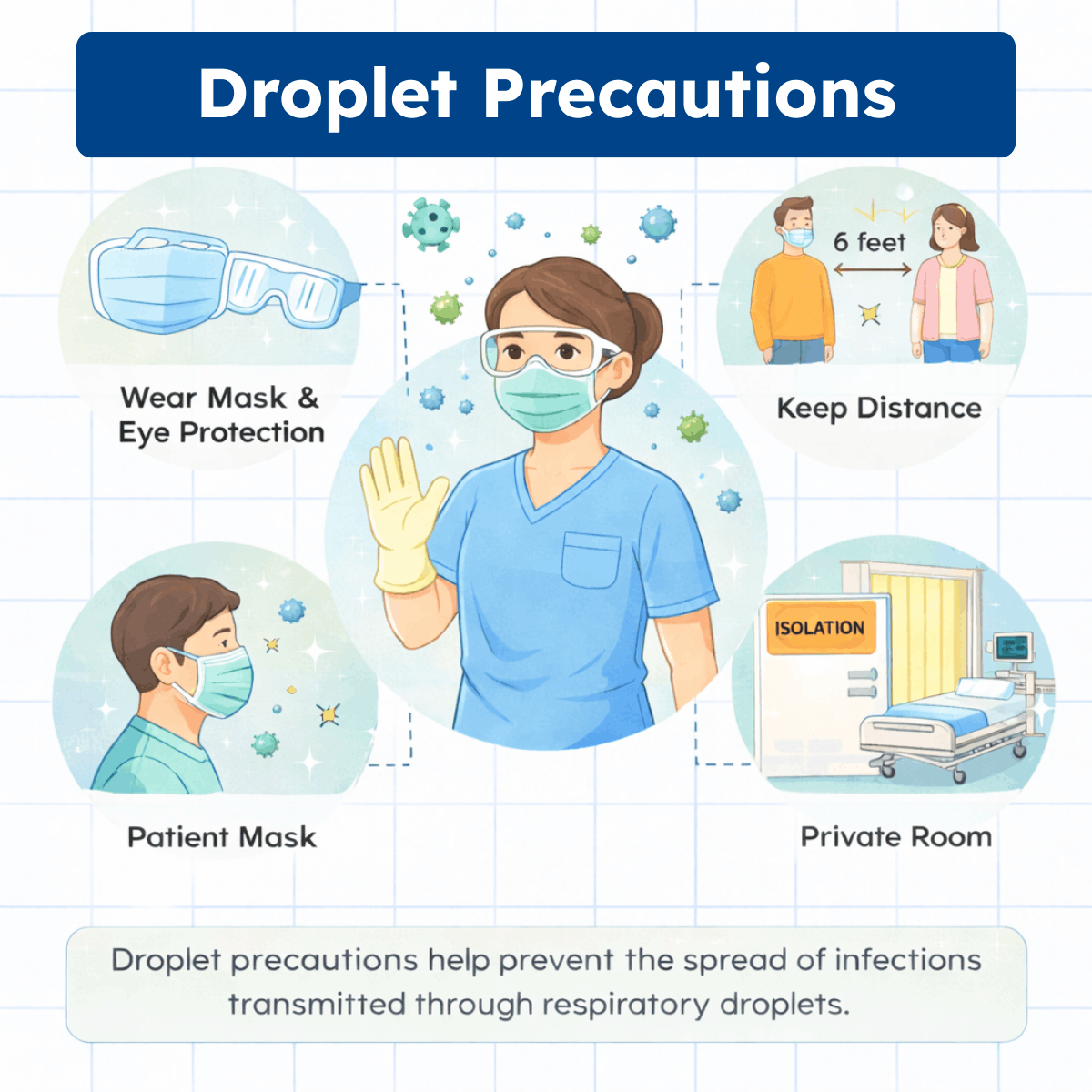
Patients requiring droplet precautions should be placed in a private room whenever possible. If private rooms are unavailable, patients with the same infection may be placed together in a shared space. Proper patient placement reduces the risk of exposing other patients to respiratory pathogens.
Unlike airborne precautions, droplet precautions do not require specialized air handling systems. The door to the patient’s room may remain open in most cases, provided that appropriate protective measures are maintained.
Use of Surgical Masks
Healthcare workers must wear a surgical mask when entering the room of a patient on droplet precautions or when working within close proximity of the patient. Surgical masks help protect the nose and mouth from exposure to infectious respiratory droplets.
Masks should be applied before entering the patient’s environment and removed after leaving the room. Proper disposal and hand hygiene following mask removal are essential to prevent contamination.
Note: Patients on droplet precautions should also wear surgical masks during transport outside their room to minimize the spread of respiratory secretions.
Eye and Face Protection
Eye protection or face shields should be worn during procedures that may generate respiratory splashes or sprays. This protective equipment helps prevent droplets from contacting the mucous membranes of the eyes, which can serve as a route of infection transmission.
Hand Hygiene
Hand hygiene remains a critical component of droplet precautions. Healthcare workers must perform hand hygiene before and after patient contact, after removing PPE, and after contact with respiratory secretions or contaminated surfaces.
Note: Proper hand hygiene helps prevent indirect transmission of respiratory pathogens and reduces cross-contamination between patients.
Limiting Patient Movement
Patients on droplet precautions should only be transported outside their room when medically necessary. Limiting patient movement reduces the spread of infectious droplets within healthcare facilities. When transport is required, patients should wear a surgical mask and follow respiratory hygiene practices.
Relevance of Droplet Precautions to Respiratory Therapists
Respiratory therapists are frequently exposed to respiratory secretions and aerosol-generating procedures, making droplet precautions especially important in their daily clinical practice.
Close Patient Interaction
Respiratory therapists often work in close proximity to patients during procedures such as oxygen therapy, aerosol medication delivery, airway suctioning, and ventilator management. These interactions increase the risk of exposure to infectious respiratory droplets.
Following droplet precautions helps respiratory therapists reduce exposure risks while safely providing essential respiratory treatments.
Aerosol-Generating Procedures
Many respiratory therapy procedures have the potential to produce respiratory droplets or aerosols. Nebulizer treatments, sputum induction, bronchoscopy, and airway suctioning can increase the spread of respiratory secretions into the surrounding environment.
Using appropriate PPE and following droplet precautions help minimize the spread of infectious particles during these procedures.
Protecting Vulnerable Patient Populations
Patients receiving respiratory care often have chronic lung disease, weakened immune systems, or critical illness that increases their susceptibility to infections. Preventing droplet transmission is essential for protecting these high-risk patients from secondary respiratory infections.
Respiratory therapists play a key role in preventing infection transmission by adhering to droplet precautions during respiratory treatments and airway management procedures.
Preventing Healthcare-Associated Infections
Respiratory infections acquired within healthcare settings can lead to increased patient morbidity, extended hospital stays, and higher healthcare costs. By following droplet precautions, respiratory therapists help reduce the spread of respiratory pathogens and contribute to overall infection prevention efforts.
Challenges in Maintaining Droplet Precautions
Maintaining consistent compliance with droplet precautions can be challenging in fast-paced clinical environments. High patient volumes, emergency situations, and limited access to PPE can contribute to lapses in infection control practices.
In addition, frequent entry and exit from patient rooms may increase the risk of improper PPE use. Healthcare organizations must ensure adequate PPE supplies, provide ongoing training, and reinforce infection control protocols to support compliance.
Respiratory therapists play an important leadership role by modeling proper PPE use and promoting safe infection prevention practices within multidisciplinary healthcare teams.
The Role of Education and Training
Ongoing education is essential for maintaining effective droplet precaution practices. Respiratory therapists must stay informed about updated infection control guidelines, emerging respiratory pathogens, and new respiratory therapy technologies that may influence infection risk.
Training programs help reinforce proper mask usage, hand hygiene techniques, and safe performance of aerosol-generating procedures. Continuing education ensures that respiratory therapists remain prepared to respond to infectious disease outbreaks and evolving clinical challenges.
The Future of Droplet Precautions in Respiratory Care
Advances in infection control research, respiratory therapy equipment design, and public health awareness continue to shape droplet precaution practices. Lessons learned from global respiratory outbreaks have emphasized the importance of rapid infection control implementation and improved protective equipment.
Healthcare facilities continue to refine infection prevention protocols to reduce transmission risks. Respiratory therapists remain at the forefront of these efforts due to their direct involvement in airway management and respiratory treatment delivery.
Droplet Precautions Practice Questions
1. What are droplet precautions, and when are they used?
Droplet precautions are infection control measures used to prevent transmission of pathogens spread through respiratory droplets produced during coughing, sneezing, or talking.
2. What size respiratory particles are typically involved in droplet transmission?
Droplet transmission usually involves particles larger than 5 micrometers.
3. How far can infectious respiratory droplets typically travel?
Respiratory droplets generally travel up to approximately 3 to 6 feet before settling.
4. Which types of infections commonly require droplet precautions?
Droplet precautions are used for infections such as influenza, pertussis, mumps, rubella, meningitis, diphtheria, and epiglottitis.
5. Are droplet precautions used alone or in combination with standard precautions?
Droplet precautions are always used in addition to standard precautions.
6. What type of room placement is recommended for patients requiring droplet precautions?
Patients should be placed in a private room or cohorted with patients infected with the same organism.
7. Is special negative-pressure ventilation required for droplet precautions?
No, special air handling or negative-pressure rooms are not required for droplet precautions.
8. What personal protective equipment should healthcare workers wear when entering a droplet precaution room?
Healthcare workers should wear a surgical or procedure mask.
9. When should a mask be applied during droplet precautions?
A mask should be worn before entering the patient’s room or when working within close proximity to the patient.
10. When should healthcare workers remove their mask during droplet precautions?
The mask should be removed after leaving the patient’s room and followed by hand hygiene.
11. Why is hand hygiene important when caring for patients on droplet precautions?
Hand hygiene helps prevent transmission of infectious droplets and contaminated secretions.
12. Why should patient transport be limited under droplet precautions?
Limiting transport reduces the risk of spreading infectious droplets throughout the facility.
13. What should patients wear if transport is necessary during droplet precautions?
Patients should wear a surgical mask during transport.
14. Why is respiratory hygiene important for patients under droplet precautions?
Respiratory hygiene reduces the spread of infectious droplets from coughing or sneezing.
15. Why should visitors follow droplet precaution guidelines when entering the patient’s room?
Visitors can transmit or acquire infections if proper precautions are not followed.
16. Why should healthcare workers wear eye or face protection during certain droplet precaution procedures?
Eye and face protection prevents exposure to respiratory secretions during aerosol-generating procedures.
17. What procedures increase droplet exposure risk and may require additional protection?
Procedures such as suctioning, bronchoscopy, and sputum induction increase droplet exposure risk.
18. Why should clean and contaminated supplies be kept separate in droplet precaution rooms?
Separating supplies prevents contamination and reduces infection transmission.
19. Why should healthcare workers avoid touching their face while wearing contaminated gloves?
Touching the face can introduce pathogens to mucous membranes.
20. Why should disposable tissues be readily available for patients on droplet precautions?
Tissues help contain respiratory secretions and reduce droplet spread.
21. Why should healthcare workers encourage patients to cover their mouth and nose when coughing or sneezing?
Covering respiratory secretions limits environmental contamination and disease transmission.
22. Why should waste containing respiratory secretions be disposed of properly?
Proper disposal prevents contamination of the healthcare environment.
23. Why is it important to disinfect equipment used for patients under droplet precautions?
Medical equipment can serve as a source of infection transmission.
24. Why should healthcare workers avoid unnecessary close contact with droplet precaution patients?
Maintaining distance reduces the risk of inhaling infectious droplets.
25. Why should droplet precaution signage be posted outside the patient’s room?
Signage alerts staff and visitors about required protective measures.
26. Why should healthcare workers monitor patients for worsening respiratory symptoms under droplet precautions?
Worsening symptoms may indicate disease progression or increased transmission risk.
27. Why should healthcare workers perform hand hygiene after removing personal protective equipment?
Hand hygiene prevents contamination after PPE removal.
28. Why should reusable patient care equipment be disinfected before use on another patient?
Proper disinfection prevents cross-infection.
29. Why should healthcare workers avoid sharing personal protective equipment between patients?
Shared PPE can transfer infectious microorganisms.
30. Why should patients with droplet-transmitted infections be educated on cough etiquette?
Patient education helps reduce infection spread.
31. Why is droplet precaution compliance important in healthcare settings?
Compliance reduces healthcare-associated infections and protects patients and staff.
32. Why should healthcare workers promptly replace contaminated masks?
Contaminated masks lose protective effectiveness and increase infection risk.
33. Why should healthcare workers document droplet precaution measures in patient care records?
Documentation ensures continuity of infection control practices and promotes patient safety.
34. When should droplet precautions be discontinued for a patient?
Droplet precautions should be discontinued when the patient is no longer considered infectious based on clinical improvement and institutional or public health guidelines.
35. Why should healthcare workers avoid adjusting masks once they are positioned during droplet precautions?
Frequent mask adjustment can contaminate hands and reduce protective effectiveness.
36. Why should healthcare workers avoid removing masks while inside a droplet precaution room?
Removing masks inside the room increases the risk of inhaling infectious droplets.
37. Why is patient cohorting acceptable when private rooms are unavailable?
Cohorting places patients infected with the same organism together, reducing cross-infection risks.
38. Why should healthcare workers limit the number of visitors for patients on droplet precautions?
Limiting visitors reduces the likelihood of disease transmission.
39. Why should patients be instructed to perform hand hygiene after coughing or sneezing?
Hand hygiene reduces contamination of surfaces and prevents droplet spread.
40. Why should healthcare workers change masks between patient encounters?
Masks may become contaminated and should not be reused between patients.
41. Why is maintaining spatial separation between patients important under droplet precautions?
Maintaining distance reduces the risk of respiratory droplet transmission.
42. Why should droplet precaution patients avoid sharing personal items?
Shared items can become contaminated with respiratory secretions and spread infection.
43. Why should healthcare workers wear protective equipment when handling respiratory secretions?
Respiratory secretions may contain infectious pathogens that can spread disease.
44. Why should healthcare workers disinfect high-touch surfaces in droplet precaution rooms?
High-touch surfaces frequently harbor infectious microorganisms.
45. Why should healthcare workers avoid placing contaminated PPE on clean surfaces?
Contaminated PPE can transfer pathogens to clean areas.
46. Why should droplet precaution patients remain in their room unless medically necessary?
Room confinement helps limit the spread of infectious droplets.
47. Why should healthcare workers monitor droplet precaution patients for fever or worsening symptoms?
Changes in clinical status may indicate increased infectivity or disease progression.
48. Why should surgical masks be worn when within close proximity to patients under droplet precautions?
Masks provide protection from inhaling infectious respiratory droplets.
49. Why should healthcare workers avoid touching environmental surfaces unnecessarily in droplet precaution rooms?
Unnecessary contact increases the risk of contamination and disease transmission.
50. Why should respiratory therapy equipment be cleaned thoroughly after use on droplet precaution patients?
Contaminated equipment can transmit infectious pathogens to other patients.
51. Why should healthcare workers receive training on droplet precaution protocols?
Proper training ensures safe and consistent infection control practices.
52. Why should healthcare workers remove PPE in the correct order during droplet precautions?
Proper PPE removal reduces the risk of self-contamination.
53. Why should contaminated linens from droplet precaution patients be handled carefully?
Improper linen handling can release infectious particles into the environment.
54. Why should droplet precaution patients be encouraged to avoid close contact with others?
Close contact increases the risk of droplet transmission.
55. Why should healthcare workers maintain awareness of evolving infection control recommendations?
Guidelines may change based on emerging infectious diseases or updated evidence.
56. Why should droplet precaution patients be instructed to avoid touching their face frequently?
Touching the face can spread pathogens to mucous membranes.
57. Why should healthcare workers perform hand hygiene after contact with droplet precaution patient surroundings?
Environmental surfaces may be contaminated with infectious droplets.
58. Why should disposable medical supplies be preferred when caring for droplet precaution patients?
Disposable supplies reduce the risk of cross-contamination.
59. Why should droplet precaution patients cover their mouth when speaking, coughing, or sneezing?
Covering the mouth helps prevent the spread of infectious droplets.
60. Why should healthcare workers avoid eating or drinking in droplet precaution patient areas?
Consuming food or beverages increases the risk of pathogen exposure.
61. Why should droplet precaution patient charts and documentation materials remain outside the room when possible?
Keeping documentation outside reduces contamination risk.
62. Why should healthcare workers promptly report suspected droplet-transmitted infections?
Early reporting supports rapid infection control intervention.
63. Why should droplet precaution protocols be followed consistently by all healthcare staff?
Consistent adherence helps prevent healthcare-associated infections.
64. Why should healthcare workers ensure proper mask fit during droplet precautions?
Proper mask fit improves protection against respiratory droplet exposure.
65. Why should healthcare workers avoid overcrowding in droplet precaution patient rooms?
Overcrowding increases exposure risk and compromises infection control.
66. Why should healthcare workers ensure patient education about infection prevention measures?
Patient understanding improves compliance and reduces disease transmission.
67. Why should droplet precaution patients be provided with tissues and waste containers at the bedside?
Providing tissues and disposal containers encourages proper respiratory hygiene and reduces environmental contamination.
68. Why should healthcare workers replace masks if they become moist during droplet precautions?
Moist masks lose filtration efficiency and provide less protection against infectious droplets.
69. Why should droplet precaution patients be educated about proper cough etiquette?
Proper cough etiquette reduces the spread of respiratory pathogens to others.
70. Why should healthcare workers minimize unnecessary room entry for droplet precaution patients?
Reducing room entry limits potential exposure to infectious droplets.
71. Why should healthcare workers avoid reusing disposable masks during droplet precautions?
Disposable masks are designed for single use and may carry infectious particles after exposure.
72. Why should droplet precaution patients avoid close contact with immunocompromised individuals?
Immunocompromised individuals are at higher risk for severe infection.
73. Why should droplet precaution signage be clearly displayed outside the patient’s room?
Clear signage informs healthcare workers and visitors about required protective measures.
74. Why should healthcare workers perform hand hygiene before donning a mask for droplet precautions?
Hand hygiene prevents contamination of the mask and reduces pathogen transmission.
75. Why should droplet precaution patients be instructed to notify staff if respiratory symptoms worsen?
Worsening symptoms may indicate increased infectious risk or disease progression.
76. Why should healthcare workers avoid touching the front of the mask during removal?
The front of the mask is considered contaminated and may contain infectious droplets.
77. Why should droplet precaution patients be provided with dedicated medical equipment when possible?
Dedicated equipment reduces the risk of cross-contamination between patients.
78. Why should healthcare workers maintain proper respiratory protection even during short patient interactions?
Brief exposures can still result in droplet transmission.
79. Why should droplet precaution patients avoid participating in group therapy sessions unless cleared?
Group settings increase the likelihood of droplet transmission to others.
80. Why should droplet precaution patients be instructed to maintain physical distance from healthcare workers when possible?
Maintaining distance reduces the spread of infectious droplets.
81. Why should healthcare workers discard masks immediately after leaving a droplet precaution room?
Mask disposal prevents environmental contamination and reduces transmission risk.
82. Why should droplet precaution patients limit contact with shared hospital items such as phones or remote controls?
Shared items can harbor infectious respiratory droplets.
83. Why should healthcare workers wear eye protection during aerosol-generating procedures on droplet precaution patients?
Eye protection prevents exposure of mucous membranes to respiratory secretions.
84. Why should droplet precaution patients be transported using the shortest route possible?
Limiting travel distance reduces environmental contamination and exposure risk.
85. Why should healthcare workers avoid placing used PPE in pockets or on work surfaces?
Improper storage can contaminate clothing and surrounding environments.
86. Why should droplet precaution patients be instructed to avoid removing their mask during transport?
Removing the mask increases the risk of spreading infectious droplets.
87. Why should healthcare workers monitor droplet precaution patients for complications such as pneumonia?
Early detection allows prompt intervention and improved patient outcomes.
88. Why should droplet precaution patients be reminded to wash hands after touching respiratory secretions?
Hand hygiene prevents the spread of infectious organisms to surfaces and individuals.
89. Why should droplet precaution patient rooms be cleaned frequently?
Regular cleaning reduces environmental contamination from respiratory droplets.
90. Why should healthcare workers avoid leaning over droplet precaution patients during care?
Close proximity increases the risk of inhaling infectious droplets.
91. Why should droplet precaution patients avoid sharing eating utensils?
Utensils may become contaminated with respiratory secretions.
92. Why should healthcare workers document adherence to droplet precautions?
Documentation ensures compliance with infection control protocols and supports quality care.
93. Why should droplet precaution patients be educated about proper mask removal techniques?
Proper mask removal prevents contamination of hands and face.
94. Why should healthcare workers replace protective eyewear if it becomes contaminated?
Contaminated eyewear may expose healthcare workers to infectious pathogens.
95. Why should droplet precaution patients avoid close contact with newborns or elderly individuals?
These populations are more vulnerable to respiratory infections.
96. Why should healthcare workers ensure droplet precaution patients have access to hand sanitizer?
Easy access encourages frequent hand hygiene and reduces pathogen transmission.
97. Why should droplet precaution patients avoid unnecessary physical contact with visitors?
Physical contact increases the likelihood of disease spread.
98. Why should healthcare workers remain vigilant about droplet precaution compliance during shift changes?
Maintaining consistent infection control practices prevents healthcare-associated infections.
99. How do droplet precautions differ from contact precautions?
Droplet precautions prevent the spread of infections transmitted through respiratory droplets produced by coughing, sneezing, or talking, whereas contact precautions prevent the spread of infections through direct physical contact or contaminated surfaces.
100. Why should healthcare workers perform hand hygiene immediately after removing eye protection used during droplet precautions?
Hand hygiene reduces the risk of transferring pathogens from contaminated equipment.
Final Thoughts
Droplet precautions are an essential component of infection prevention in respiratory care and throughout healthcare settings. By implementing protective measures such as surgical mask use, proper patient placement, and strict hand hygiene, healthcare providers can reduce the spread of respiratory infections.
Respiratory therapists, who frequently perform airway-related procedures and work in close proximity to patients, play a critical role in maintaining these precautions.
As respiratory infections continue to pose significant healthcare challenges, consistent adherence to droplet precautions helps protect patients, healthcare workers, and clinical environments while supporting safe and effective respiratory therapy practices.

Written by:
John Landry is a registered respiratory therapist from Memphis, TN, and has a bachelor's degree in kinesiology. He enjoys using evidence-based research to help others breathe easier and live a healthier life.
References
- Douedi S, Douedi H. Precautions, Bloodborne, Contact, and Droplet. [Updated 2023 Sep 4]. In: StatPearls [Internet]. Treasure Island (FL): StatPearls Publishing; 2025.