

Dyspnea is one of the most frequent and distressing symptoms encountered in clinical practice. It is a subjective sensation of breathing discomfort that can arise from a wide range of respiratory, cardiac, and systemic conditions.
Because it often signals underlying illness or worsening disease, recognizing and understanding dyspnea is essential in healthcare, particularly in the field of respiratory care.
For respiratory therapists, assessing and managing dyspnea is a central responsibility, as it provides valuable insight into a patient’s respiratory status and response to treatment.

What is Dyspnea?
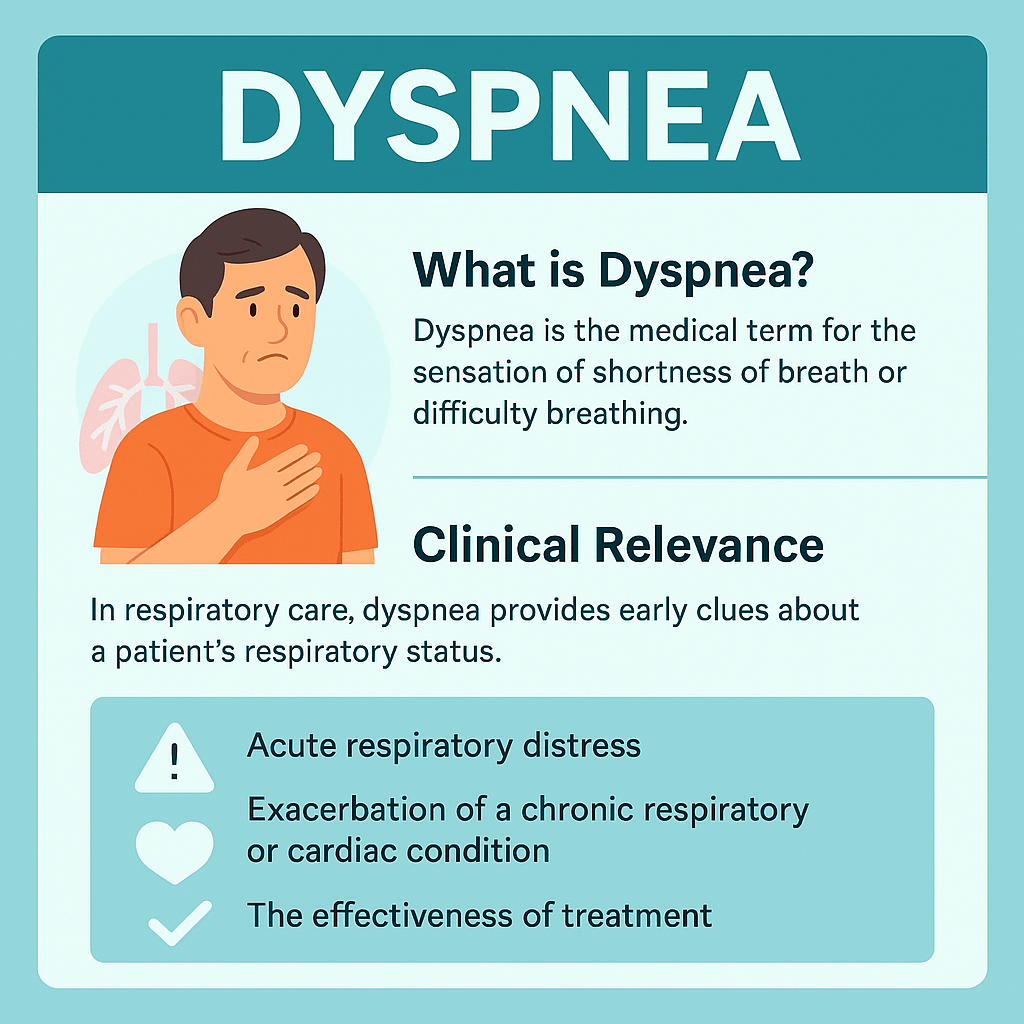
Dyspnea is the medical term for the sensation of shortness of breath or difficulty breathing. It is considered a subjective symptom, meaning it reflects how the patient feels rather than what can be measured directly. People may describe it as “air hunger,” tightness in the chest, or the inability to get enough air.
Dyspnea can develop suddenly, such as during an asthma attack or pulmonary embolism, or gradually in chronic conditions like COPD, heart failure, or interstitial lung disease.
Because it is a common reason for seeking medical care, dyspnea is important in respiratory therapy. It provides early warning of respiratory compromise, helps guide treatment decisions, and is closely monitored to assess a patient’s response to therapy.
Clinical Relevance
In respiratory care, dyspnea is important because it provides early clues about the patient’s respiratory status. While tests like pulse oximetry, arterial blood gases, and pulmonary function testing give measurable data, the patient’s own report of breathlessness is often the first sign of deterioration.
- Acute respiratory distress, often related to hypoxemia, hypercapnia, or bronchospasm
- Exacerbation of a chronic respiratory or cardiac condition
- The effectiveness of treatment, when symptom relief is noted after therapy
Role of the Respiratory Therapist
Respiratory therapists assess and manage dyspnea in a variety of ways:
- Assessment: Listening to how the patient describes their breathing difficulty and correlating it with objective findings
- Treatment: Providing oxygen, aerosolized medications, or ventilatory support when indicated
- Monitoring: Observing changes in the patient’s symptoms as therapy is adjusted
- Education: Helping patients use breathing strategies and respiratory devices correctly
Patient Impact
Beyond its clinical importance, dyspnea has a significant effect on daily life. Persistent breathlessness can limit activity, reduce independence, and contribute to anxiety. Recognizing the physical and psychological aspects of dyspnea is an important part of patient-centered respiratory care.
Dyspnea Practice Questions
1. What is the medical term for the sensation of shortness of breath or difficulty breathing?
Dyspnea
2. Dyspnea is considered what type of clinical finding—subjective or objective?
Subjective
3. Which descriptions might a patient use to explain the feeling of dyspnea?
Air hunger, chest tightness, or inability to get enough air.
4. Dyspnea that develops suddenly is most commonly associated with which conditions?
Asthma attack or pulmonary embolism.
5. Gradual development of dyspnea is typically seen in which chronic conditions?
COPD, heart failure, or interstitial lung disease.
6. Why is dyspnea considered clinically significant in respiratory care?
It often serves as the earliest warning sign of respiratory compromise.
7. What is the primary difference between dyspnea and measurable tests such as ABGs or pulse oximetry?
Dyspnea is a subjective symptom, while those tests provide objective data.
8. What term describes difficulty breathing triggered by exertion?
Exertional dyspnea
9. What term describes difficulty breathing while lying flat, often relieved by sitting up?
Orthopnea
10. What serious condition should be suspected when a patient presents with sudden onset dyspnea and chest pain?
Pulmonary embolism.
11. In COPD patients, what type of dyspnea progression is most common?
Gradual, chronic worsening.
12. What role does the respiratory therapist play in assessing dyspnea?
Listening to patient reports, correlating with objective findings, and monitoring changes.
13. Which treatment might a respiratory therapist provide to relieve dyspnea caused by bronchospasm?
Aerosolized bronchodilators
14. Why is dyspnea important in monitoring the effectiveness of therapy?
Relief of symptoms often indicates successful treatment.
15. Which psychological factor can both result from and worsen dyspnea?
Anxiety
16. Why can dyspnea significantly impact a patient’s daily life?
It limits activity, reduces independence, and causes emotional distress.
17. What symptom, when reported with dyspnea, may suggest acute respiratory distress?
Chest tightness or air hunger
18. What common clinical measurement correlates with dyspnea but does not always match its severity?
Oxygen saturation (SpO₂)
19. What should a respiratory therapist suspect if dyspnea persists despite normal oxygen levels?
Possible hypercapnia, cardiac dysfunction, or anxiety.
20. Which aspect of respiratory therapy education can help reduce dyspnea symptoms in chronic patients?
Teaching proper breathing techniques and device use.
21. Dyspnea is best described as what type of clinical symptom?
A subjective sensation of breathing discomfort.
22. Which patient descriptions are commonly used to express dyspnea?
“Air hunger,” “tightness,” or “can’t get enough air.”
23. Why is dyspnea considered a subjective symptom?
Because it reflects the patient’s perception rather than direct measurable data.
24. Which category of abnormality causes dyspnea in airway obstruction or restrictive disorders?
Ventilation abnormalities
25. Heart failure or anemia are examples of dyspnea arising from which physiologic system?
Circulation
26. Acidosis, fever, and sepsis can trigger dyspnea by affecting which body process?
Metabolism
27. Which accessory muscles are commonly recruited during dyspnea?
Sternocleidomastoid and intercostal muscles.
28. What does thoracoabdominal asynchrony indicate in a patient with dyspnea?
The chest and abdomen move out of sync during breathing.
29. What physical sign may appear alongside severe dyspnea, indicating poor oxygenation?
Cyanosis or diaphoresis
30. Which clinical scale uses a score ≥ 5 to indicate severe dyspnea or strong exertion?
The Borg Scale
31. Which scale is often used in COPD patients to classify chronic dyspnea severity?
The Modified Medical Research Council (mMRC) Scale.
32. Sudden dyspnea with chest pain and risk factors for clotting should raise suspicion for what condition?
Pulmonary embolism
33. A patient with unexplained dyspnea on exertion and minimal other findings may be developing what condition?
Pulmonary hypertension
34. In COPD exacerbations, dyspnea typically occurs along with which other two symptoms?
Increased sputum production and cough.
35. Which diagnostic test directly measures oxygenation and ventilation in dyspnea assessment?
Arterial blood gases (ABGs)
36. What biomarker test helps differentiate dyspnea caused by heart failure versus pulmonary disease?
BNP (B-type natriuretic peptide)
37. In evaluating dyspnea, which life-threatening condition should always be ruled out first?
Pneumothorax, pulmonary embolism, or congestive heart failure.
38. In COPD patients, oxygen therapy is typically titrated to maintain SpO₂ at what range?
88–92%
39. Which treatment is most appropriate for dyspnea related to obstructive airway disease?
Bronchodilators and corticosteroids.
40. Which therapy provides noninvasive support in patients with severe dyspnea and ventilatory failure?
CPAP or BiPAP
41. Which medication class is used to treat dyspnea caused by fluid overload in heart failure?
Diuretics
42. What training intervention has been shown to improve dyspnea and exercise tolerance in COPD patients?
Inspiratory muscle training (IMT)
43. What arterial blood gas pattern is typically seen in early respiratory distress with dyspnea?
Respiratory alkalosis from hyperventilation.
44. What ABG changes occur when a dyspneic patient becomes fatigued?
CO₂ retention and respiratory acidosis.
45. At what SpO₂ threshold is hypoxemia usually defined?
Less than 88%
46. What PaO₂ level indicates significant hypoxemia and possible impending respiratory failure?
Less than 60 mmHg
47. What PaCO₂ threshold suggests ventilatory failure in a dyspneic patient?
Greater than 50 mmHg
48. A Borg score of 7 reported by a patient indicates what level of dyspnea?
Very severe breathlessness
49. Why should both patient-reported symptoms and objective findings be considered in dyspnea assessment?
Because dyspnea is subjective and may not always match objective test results.
50. For exam purposes, what is the best approach when evaluating a patient with dyspnea?
Rule out life-threatening causes first, then assess systematically by system.
51. What type of dyspnea is most often associated with left-sided heart failure?
Orthopnea, which worsens when lying flat.
52. Which form of dyspnea involves waking up gasping for air after several hours of sleep?
Paroxysmal nocturnal dyspnea (PND)
53. A patient develops sudden-onset dyspnea with chest pain. Which conditions should you suspect?
Pulmonary embolism, pneumothorax, or asthma.
54. Chronic progressive dyspnea over months to years is most likely due to which conditions?
COPD, interstitial lung disease, or obesity hypoventilation.
55. Exertional dyspnea most often points to dysfunction in which systems?
Cardiac or pulmonary diffusion, such as CHF or pulmonary fibrosis.
56. What physiological mechanism explains the sensation of dyspnea in obstructive lung diseases?
Air trapping and difficulty exhaling, leading to a feeling of “can’t get air out.”
57. In restrictive disorders like pulmonary fibrosis, what is the main cause of dyspnea?
Difficulty expanding the lungs due to reduced compliance.
58. What triggers dyspnea in heart failure through stimulation of J-receptors?
Pulmonary congestion and interstitial edema.
59. Why does anemia cause dyspnea even when lung mechanics are normal?
Because oxygen delivery to tissues is reduced.
60. What body position do COPD or asthma patients often assume to ease dyspnea?
The tripod position, bracing arms to optimize accessory muscle use.
61. What physical exam finding involves a drop in systolic BP >10 mmHg during inspiration?
Pulsus paradoxus
62. Jugular venous distension and peripheral edema with dyspnea suggest which condition?
Cor pulmonale or congestive heart failure.
63. Fine crackles at the lung bases with dyspnea suggest which pathology?
Pulmonary fibrosis or early heart failure.
64. What does the presence of coarse crackles or wheezing with dyspnea indicate?
Airway involvement, such as asthma or bronchitis.
65. A patient with dyspnea who also demonstrates voice fatigue and weak cough may have what underlying problem?
Neuromuscular disease
66. Which test is most useful for distinguishing obstructive from restrictive causes of dyspnea?
Spirometry
67. A patient with dyspnea shows a low DLCO on pulmonary function testing. What does this suggest?
Emphysema
68. What diagnostic tool is best for evaluating suspected pulmonary hypertension in a patient with dyspnea?
Echocardiography
69. Which lab test helps rule out pulmonary embolism in acute dyspnea?
D-dimer, followed by CT angiography if indicated.
70. What ABG pattern indicates early respiratory distress with dyspnea?
Low PaCO₂ and high pH due to hyperventilation.
71. Rising PaCO₂ in a patient with dyspnea signals what clinical concern?
Fatigue and impending respiratory failure.
72. Which therapy provides heated, humidified oxygen with mild PEEP, useful for moderate hypoxemia and dyspnea?
High-flow nasal cannula (HFNC)
73. Which noninvasive ventilation method reduces work of breathing in COPD exacerbations or cardiogenic pulmonary edema?
BiPAP or CPAP
74. What specialty gas mixture may reduce dyspnea in upper airway obstruction by lowering resistance?
Heliox
75. Which medication can be given in low doses for palliative relief of refractory dyspnea?
Morphine
76. Dyspnea without a clear physiologic cause may be due to what condition?
Psychogenic dyspnea, such as hyperventilation syndrome or panic disorder.
77. What exam clue suggests a cardiac cause when a patient reports exertional dyspnea with normal lung sounds?
Pulmonary vascular disease or left heart dysfunction.
78. On board exams, why is trending values more important than a single ABG in dyspnea?
Because worsening patterns indicate clinical decline.
79. Which breathing pattern is associated with metabolic acidosis in conditions like diabetic ketoacidosis?
Kussmaul respirations.
80. Why is CPAP effective in relieving dyspnea in CHF?
It reduces preload, improves oxygenation, and counteracts pulmonary congestion.
81. When assessing a dyspneic patient, what is the first clinical priority?
Determine if the airway is patent.
82. What vital sign clue best indicates whether oxygenation is adequate in a patient with dyspnea?
SpO₂ level and the presence or absence of cyanosis.
83. What ABG change suggests ventilatory failure in a dyspneic patient?
Decreased PaO₂ with an increased PaCO₂.
84. A patient with severe dyspnea, diaphoresis, confusion, and accessory muscle use most likely requires what intervention?
Immediate ventilatory support such as NIV or intubation.
85. What ABG pattern is typical of early hypoxemic respiratory failure?
Decreased PaO₂ with a decreased PaCO₂ due to compensatory hyperventilation.
86. In a narcotic overdose, what ABG finding is most common?
Normal PaO₂ with ↑PaCO₂ from hypoventilation.
87. A patient with pulmonary fibrosis may show what gas exchange abnormality?
Decreased PaO₂ with a normal PaCO₂, indicating diffusion impairment.
88. Why can a patient with normal SpO₂ still feel profound dyspnea?
Because increased work of breathing or hypercapnia also contribute to the sensation.
89. What key feature distinguishes functional (psychogenic) dyspnea from true physiologic dyspnea?
Normal oxygen saturation and normal lung exam.
90. A patient with anxiety-induced hyperventilation presents with dyspnea. What is the correct intervention?
Reassurance and breathing control, not bronchodilators.
91. What condition should be suspected in an obese patient with chronic dyspnea and hypercapnia?
Obesity hypoventilation syndrome (OHS).
92. Why must sudden severe dyspnea in pregnancy be evaluated urgently?
It may indicate pulmonary embolism.
93. Postoperative patients with dyspnea often benefit from what preventive strategy?
Incentive spirometry and early ambulation.
94. What bedside measurement is most useful in neuromuscular patients with dyspnea?
Vital capacity; <10–15 mL/kg indicates impending respiratory failure.
95. What mechanical factor causes dyspnea in bronchospasm or mucus plugging?
Increased airway resistance.
96. What pulmonary factor causes dyspnea in ARDS or fibrosis?
Decreased lung compliance.
97. What systemic factor contributes to dyspnea in sepsis despite clear lungs?
Increased respiratory drive from metabolic acidosis.
98. A patient with wheezing and hyperresonance on exam most likely has which cause of dyspnea?
Asthma or COPD exacerbation.
99. Crackles and orthopnea in a dyspneic patient point toward what diagnosis?
Congestive heart failure
100. Sudden unilateral chest pain with decreased breath sounds suggests what cause of dyspnea?
Pneumothorax
Final Thoughts
Dyspnea is not only a symptom of shortness of breath but also an important indicator of respiratory and overall health. For patients, it can be uncomfortable and limiting, while for healthcare providers, it offers valuable clues about underlying conditions and treatment effectiveness.
In respiratory care, careful recognition, assessment, and management of dyspnea are essential for supporting patient outcomes and maintaining quality of life. Respiratory therapists use their skills and knowledge to address this common symptom and provide meaningful support to those experiencing breathing difficulties.

Written by:
John Landry is a registered respiratory therapist from Memphis, TN, and has a bachelor's degree in kinesiology. He enjoys using evidence-based research to help others breathe easier and live a healthier life.
References
- Hashmi MF, Modi P, Basit H, et al. Dyspnea. [Updated 2023 Feb 19]. In: StatPearls [Internet]. Treasure Island (FL): StatPearls Publishing; 2025.