
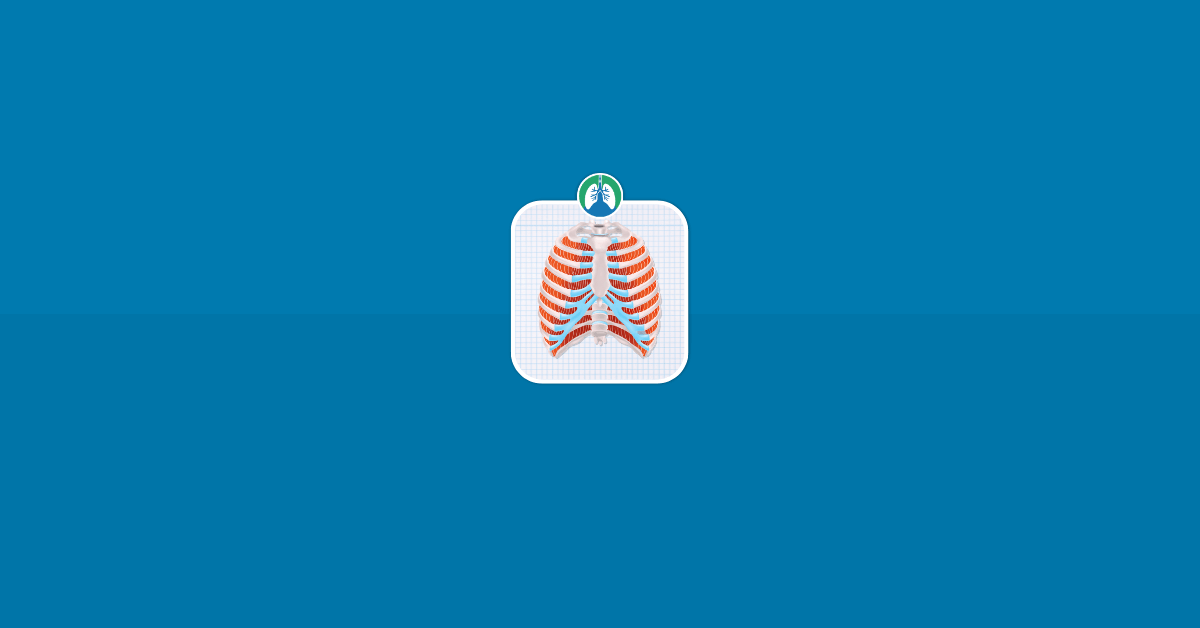
Breathing is a complex mechanical process that relies on coordinated muscle activity to allow air to move in and out of the lungs. While the diaphragm is often considered the primary muscle of respiration, the intercostal muscles play an equally essential role in stabilizing and expanding the thoracic cavity.
Located between the ribs, these muscles help regulate chest wall movement during both inspiration and expiration.
Understanding the structure and function of the intercostal muscles is especially important for respiratory therapists, as these muscles directly influence ventilation, respiratory mechanics, and patient outcomes in both normal and pathological conditions.

What Are Intercostal Muscles?
The intercostal muscles are a group of skeletal muscles located between adjacent ribs within the thoracic cage. Their primary function is to assist with breathing by supporting rib movement and maintaining structural stability of the chest wall. These muscles are essential for altering the volume of the thoracic cavity, which directly affects airflow into and out of the lungs.
There are three main layers of intercostal muscles:
- External intercostal muscles
- Internal intercostal muscles
- Innermost intercostal muscles
Each layer serves a unique role in respiratory mechanics, working together to ensure efficient ventilation. Because they are skeletal muscles, intercostal muscles are under somatic nervous system control, meaning they receive motor signals from spinal nerves that allow voluntary and reflexive breathing movements.

Anatomy of the Intercostal Muscles
The intercostal muscles occupy the spaces between each pair of ribs, known as intercostal spaces. These muscles extend from the posterior thoracic spine to the anterior sternum and are arranged in overlapping layers.
External Intercostal Muscles
The external intercostal muscles form the outermost layer. Their fibers run downward and forward at an oblique angle from the rib above to the rib below. When these muscles contract, they elevate the ribs and expand the thoracic cavity. This movement increases chest volume and lowers intrathoracic pressure, allowing air to enter the lungs during inspiration.
External intercostals are most active during quiet breathing and play a key role in stabilizing the rib cage. Their action is often described using the “bucket-handle” mechanism, where the ribs move outward and upward, increasing the transverse diameter of the chest.
Internal Intercostal Muscles
The internal intercostal muscles lie just beneath the external layer. Their muscle fibers run downward and backward, forming an orientation opposite to that of the external intercostals. When these muscles contract, they pull the ribs downward and inward, compressing the thoracic cavity and assisting with forced exhalation.
Internal intercostals are particularly active during activities that require increased expiratory effort, such as coughing, sneezing, or vigorous exercise.
Innermost Intercostal Muscles
The innermost intercostal muscles are the deepest layer and are structurally similar to the internal intercostals. Although their contribution to breathing is less pronounced, they assist in stabilizing the rib cage and supporting thoracic wall integrity. These muscles also help protect the neurovascular structures located in the costal groove of each rib.
Innervation and Blood Supply
The intercostal muscles receive motor and sensory innervation from the intercostal nerves, which originate from the thoracic spinal nerves (T1 through T12). These nerves provide the signals necessary for muscle contraction and coordinate breathing movements with neural respiratory centers in the brainstem.
Each intercostal space also contains an intercostal artery and vein that supply oxygenated blood and facilitate venous drainage. These vessels, along with the intercostal nerves, travel within the costal groove on the inferior border of each rib. This anatomical arrangement is clinically important, especially during procedures such as thoracentesis or chest tube insertion, where avoiding neurovascular injury is essential.
Role in Respiratory Mechanics
The intercostal muscles contribute significantly to the mechanical process of ventilation by controlling rib movement and thoracic volume changes.
Role During Inspiration
During inhalation, the external intercostal muscles contract, lifting the ribs upward and outward. This movement increases the volume of the thoracic cavity in both the anterior-posterior and lateral dimensions. As thoracic volume expands, intrathoracic pressure decreases, allowing air to flow into the lungs.
This function is especially important during increased respiratory demand, such as physical activity or respiratory distress. The intercostal muscles work synergistically with the diaphragm to produce efficient lung expansion.
Role During Expiration
During normal, quiet breathing, exhalation is largely passive and occurs as the diaphragm and intercostal muscles relax, allowing elastic recoil of the lungs and chest wall. However, during forceful exhalation, the internal intercostal muscles actively contract, pulling the ribs downward and reducing thoracic volume. This helps expel air more rapidly from the lungs.
Accessory Muscle Support and Increased Work of Breathing
Although the diaphragm and intercostal muscles are considered primary respiratory muscles, additional muscles may assist when ventilatory demand increases. Accessory muscles such as the scalene, sternocleidomastoid, pectoral, and abdominal muscles contribute to breathing during respiratory distress or strenuous activity.
In patients experiencing respiratory failure, increased reliance on accessory muscles often indicates increased work of breathing. Respiratory therapists frequently assess intercostal muscle retractions, which occur when negative intrathoracic pressure causes visible inward movement of the intercostal spaces during inspiration. This finding is commonly seen in pediatric respiratory distress and severe airway obstruction.
Reflex Control and Muscle Adaptation
The intercostal muscles contain specialized sensory receptors known as muscle spindles. These structures detect changes in muscle length and tension, helping regulate respiratory muscle performance. When lung compliance decreases or airway resistance increases, muscle spindles trigger reflex responses that enhance respiratory muscle contraction.
This reflex adaptation helps maintain adequate ventilation under increased physiological stress. However, prolonged respiratory muscle fatigue can lead to ventilatory failure, highlighting the importance of respiratory muscle endurance.
Clinical Relevance for Respiratory Therapists
Understanding intercostal muscle function is essential for respiratory therapists because these muscles directly influence ventilation and patient respiratory status.
Assessment of Respiratory Effort
Respiratory therapists routinely evaluate chest wall movement and intercostal muscle activity to assess respiratory distress. Observing intercostal retractions, asymmetrical rib movement, or reduced chest expansion can provide valuable information about airway obstruction, lung compliance, and neuromuscular function.
Mechanical Ventilation Management
Patients receiving mechanical ventilation may experience respiratory muscle weakening due to disuse atrophy. Respiratory therapists play a critical role in optimizing ventilator settings to balance respiratory muscle rest with gradual strengthening during weaning trials.
Neuromuscular Disorders
Conditions such as spinal cord injuries, muscular dystrophy, and Guillain-Barré syndrome can impair intercostal muscle function. These disorders reduce chest wall expansion and may compromise ventilation, often requiring ventilatory support and specialized respiratory care.
Trauma and Rib Fractures
Thoracic trauma and rib fractures can disrupt intercostal muscle integrity, causing severe pain and reduced respiratory effort. Respiratory therapists help manage these patients through airway clearance techniques, incentive spirometry, and pain management strategies to prevent complications such as atelectasis and pneumonia.
Intercostal Muscles in Disease States
Several respiratory conditions directly impact intercostal muscle performance. Chronic obstructive pulmonary disease (COPD), asthma, and pulmonary fibrosis often increase the workload on respiratory muscles. Patients with these conditions may demonstrate hypertrophy or fatigue of the intercostal muscles as they compensate for impaired lung mechanics.
Note: Prolonged mechanical ventilation or severe illness can lead to respiratory muscle atrophy, making rehabilitation and ventilator weaning more challenging.
Importance in Airway Clearance and Cough Effectiveness
Effective coughing requires coordinated contraction of expiratory muscles, including the internal intercostal muscles. These muscles help generate the high intrathoracic pressures necessary to expel secretions from the airways. Weakness of the intercostal muscles can reduce cough effectiveness, increasing the risk of mucus retention and infection.
Respiratory therapists often implement therapies such as assisted coughing techniques, chest physiotherapy, and mechanical insufflation-exsufflation devices to support airway clearance in patients with weakened respiratory muscles.
Intercostal Muscles Practice Questions
1. What are the intercostal muscles?
Intercostal muscles are skeletal muscles located between the ribs that help support the chest wall and assist with breathing.
2. What is the primary function of the intercostal muscles during respiration?
They stabilize the rib cage and help expand or compress the thoracic cavity during breathing.
3. Which respiratory muscles are considered the primary muscles of ventilation?
The diaphragm and intercostal muscles are the primary muscles of ventilation.
4. Where are the intercostal muscles located anatomically?
They are located between adjacent ribs throughout the thoracic cage.
5. What important structures are located in the costal groove beneath each rib?
The costal groove contains the intercostal artery, vein, and nerve.
6. Which nerves supply the intercostal muscles?
The intercostal nerves arising from thoracic spinal nerves T1 through T12 innervate these muscles.
7. How do external intercostal muscles contribute to inspiration?
They elevate the ribs and expand the thoracic cavity.
8. What is the bucket-handle mechanism?
It refers to rib movement outward and upward during inspiration, increasing thoracic diameter.
9. How are the muscle fibers of the external intercostal muscles oriented?
They run downward and forward at an oblique angle between adjacent ribs.
10. During which phase of breathing are external intercostal muscles most active?
They are most active during inspiration.
11. What is the primary function of the internal intercostal muscles?
They pull the ribs downward and inward, compressing the thoracic cavity.
12. During which phase of breathing are internal intercostal muscles most active?
They are most active during forceful exhalation.
13. How do internal intercostal muscles assist with rib stabilization?
They counteract excessive rib movement during forceful breathing.
14. How do intercostal muscles work with the diaphragm during quiet breathing?
They assist the diaphragm in expanding the thoracic cavity.
15. Why are intercostal muscles considered skeletal muscles?
They are under voluntary and involuntary neural control and attach to bones.
16. How does contraction of intercostal muscles change thoracic volume?
Contraction moves ribs, altering chest wall dimensions and lung volume.
17. What role do intercostal muscles play during exercise?
They increase ventilation by assisting in deeper and more rapid breathing.
18. Which accessory muscles assist intercostal muscles during increased respiratory demand?
Scalene, sternocleidomastoid, pectoral, and abdominal muscles assist ventilation.
19. How do abdominal muscles contribute to respiration?
They compress the abdomen and help force air out during exhalation.
20. Why is rib stabilization important during breathing?
It prevents paradoxical chest wall movement and maintains efficient ventilation.
21. What is the relationship between intercostal muscle activity and respiratory workload?
Greater respiratory demand increases intercostal muscle activity.
22. How do intercostal muscles help maintain chest wall integrity?
They hold ribs together and support thoracic structural stability.
23. What happens to intercostal muscle activity during forceful breathing?
Both external and internal intercostals become more active.
24. Why are intercostal muscles important in maintaining normal breathing rhythm?
They coordinate rib movement with diaphragmatic contractions.
25. How does paralysis of intercostal muscles affect ventilation?
It can reduce chest expansion and impair effective breathing.
26. What clinical signs may indicate intercostal muscle fatigue?
Shallow breathing, increased respiratory rate, and accessory muscle use may occur.
27. How do intercostal muscles assist in coughing?
They help generate forceful exhalation to clear airway secretions.
28. Why is intercostal muscle strength important in patients with respiratory disease?
Weakness can increase work of breathing and reduce ventilation efficiency.
29. How do intercostal muscles contribute to thoracic cavity pressure changes?
They alter rib position, which changes intrathoracic pressure.
30. Why are intercostal muscles active during both rest and stress-induced breathing?
They provide baseline support and increase activity when ventilation demand rises.
31. How does neural control regulate intercostal muscle contraction?
Signals from the brainstem travel through intercostal nerves to stimulate muscle activity.
32. What happens to intercostal muscle function during rib fractures?
Pain and structural instability may reduce effective ventilation.
33. Why are intercostal muscles important for respiratory therapists to understand?
They influence ventilation mechanics, respiratory assessment, and patient management.
34. Which nerves innervate the diaphragm and intercostal muscles?
The phrenic nerves innervate the diaphragm, while the intercostal nerves innervate the intercostal muscles.
35. How do the intercostal muscles contribute to inspiration?
They contract to elevate and stabilize the ribs, increasing thoracic volume and promoting airflow into the lungs.
36. How does exhalation normally occur with respect to intercostal muscle activity?
During quiet breathing, exhalation occurs passively when the intercostal muscles relax and allow elastic recoil of the lungs and thoracic cage.
37. Which muscle groups are considered accessory muscles of respiration?
The scalene, sternocleidomastoid, pectoral, and abdominal wall muscles are primary accessory muscles.
38. When do accessory muscles of respiration typically become active?
They become active during increased ventilatory demand such as exercise or respiratory distress.
39. What role do muscle spindles play in respiratory muscle function?
Muscle spindles detect stretch and help regulate reflex responses to maintain effective muscle contraction during increased respiratory load.
40. Where are muscle spindles located within respiratory muscles?
They are located on intrafusal muscle fibers arranged parallel to extrafusal muscle fibers.
41. How do muscle spindles help compensate for decreased lung compliance?
They trigger reflex muscle contraction to help maintain adequate ventilation despite increased respiratory workload.
42. What is the primary function of intercostal muscles in the thoracic cage?
They assist breathing by supporting rib movement and stabilizing the chest wall.
43. How do intercostal muscles influence thoracic cavity volume?
By elevating or depressing ribs, they alter thoracic dimensions and lung expansion.
44. How many layers of intercostal muscles are present in the thoracic wall?
There are three layers: external, internal, and innermost intercostal muscles.
45. What is the primary role of the external intercostal muscles?
They elevate ribs and expand the thoracic cavity during inspiration.
46. How are external intercostal muscle fibers oriented?
They run downward and forward between adjacent ribs.
47. What mechanical action is associated with external intercostal muscle contraction?
It produces the bucket-handle movement that increases chest width.
48. During which breathing pattern are external intercostals most active?
They are most active during quiet inspiration.
49. What is the main function of the internal intercostal muscles?
They depress the ribs and compress the thoracic cavity during forced exhalation.
50. How are internal intercostal muscle fibers oriented compared with external intercostals?
They run downward and backward, opposite the direction of external intercostal fibers.
51. When are internal intercostal muscles particularly active?
They are most active during coughing, sneezing, or vigorous breathing.
52. What is the role of the innermost intercostal muscles?
They help stabilize the rib cage and support chest wall integrity.
53. How do innermost intercostal muscles protect thoracic structures?
They help shield the neurovascular bundle within the costal groove.
54. What structures run within the costal groove of each rib?
The intercostal artery, vein, and nerve run within the costal groove.
55. How do intercostal muscles contribute to maintaining chest wall stability?
They prevent excessive rib displacement during breathing.
56. Why are intercostal muscles classified as skeletal muscles?
They are under voluntary control and receive motor signals from spinal nerves.
57. How does somatic nervous system control affect intercostal muscle function?
It allows voluntary breathing control and reflex respiratory adjustments.
58. How do intercostal muscles assist airflow into the lungs?
They enlarge thoracic volume, lowering intrathoracic pressure and drawing air into the lungs.
59. Why is rib cage stabilization important during deep breathing?
It allows efficient expansion and prevents paradoxical chest movement.
60. How do intercostal muscles work together during ventilation?
External muscles assist inspiration while internal and innermost muscles assist expiration and stabilization.
61. How does contraction of external intercostals affect intrathoracic pressure?
It lowers intrathoracic pressure, promoting lung expansion and airflow.
62. How does contraction of internal intercostals affect lung volume?
It decreases lung volume by compressing the thoracic cavity during forced exhalation.
63. Why is coordination between respiratory muscles important?
Proper coordination ensures efficient ventilation and minimizes respiratory effort.
64. How do intercostal muscles support respiratory mechanics during high ventilatory demand?
They increase rib movement and chest expansion to enhance ventilation.
65. What clinical problems may occur if intercostal muscles become weak?
Patients may develop reduced chest expansion, shallow breathing, and respiratory fatigue.
66. Why are intercostal muscles important for respiratory therapists to assess?
Their function affects breathing mechanics, ventilation effectiveness, and patient respiratory status.
67. How do intercostal muscles assist during coughing?
They help generate forceful expiratory pressure needed to clear airway secretions.
68. How do overlapping intercostal muscle layers enhance respiratory efficiency?
They provide coordinated rib movement and structural reinforcement of the thoracic wall.
69. From which spinal nerve roots do the intercostal nerves originate?
The intercostal nerves originate from the thoracic spinal nerves T1 through T12.
70. What type of innervation do the intercostal nerves provide to the intercostal muscles?
They provide both motor and sensory innervation to the intercostal muscles and surrounding thoracic structures.
71. How do intercostal nerves coordinate breathing with the central nervous system?
They transmit signals between respiratory muscles and brainstem respiratory centers to regulate ventilation.
72. What blood vessels supply the intercostal muscles?
The intercostal arteries provide oxygenated blood, while the intercostal veins facilitate venous drainage.
73. Where are the intercostal artery, vein, and nerve located within each rib?
They travel within the costal groove along the inferior border of each rib.
74. Why is knowledge of intercostal neurovascular anatomy important during thoracic procedures?
It helps clinicians avoid injury during procedures such as thoracentesis and chest tube insertion.
75. What mechanical role do intercostal muscles play during ventilation?
They control rib movement and help regulate thoracic cavity volume.
76. How do external intercostal muscles contribute to inspiration?
They contract to elevate ribs and expand the thoracic cavity, allowing air to enter the lungs.
77. How does thoracic expansion during inspiration affect intrathoracic pressure?
It lowers intrathoracic pressure, facilitating airflow into the lungs.
78. How do the intercostal muscles work with the diaphragm during inspiration?
They act synergistically to increase thoracic volume and enhance lung expansion.
79. What occurs during quiet exhalation in terms of intercostal muscle activity?
Exhalation occurs passively as the intercostal muscles and diaphragm relax, allowing elastic recoil.
80. Which intercostal muscles are primarily active during forced exhalation?
The internal intercostal muscles contract to pull the ribs downward and compress the thoracic cavity.
81. How do accessory respiratory muscles support ventilation?
They assist primary respiratory muscles during increased ventilatory demand or respiratory distress.
82. Which muscles commonly function as accessory muscles of respiration?
The scalene, sternocleidomastoid, pectoral, and abdominal muscles serve as accessory respiratory muscles.
83. What does increased accessory muscle use typically indicate in a patient?
It often indicates increased work of breathing or respiratory distress.
84. What are intercostal retractions and what do they indicate?
Intercostal retractions are inward movement of intercostal spaces during inspiration, indicating increased respiratory effort.
85. In which patient population are intercostal retractions most commonly observed?
They are commonly seen in pediatric patients and individuals with severe airway obstruction.
86. What are muscle spindles and how do they function in respiratory muscles?
Muscle spindles are sensory receptors that detect muscle stretch and regulate contraction strength.
87. How do muscle spindles help maintain ventilation during increased airway resistance?
They trigger reflex muscle contractions to compensate for increased respiratory workload.
88. What can prolonged respiratory muscle fatigue lead to?
It can result in ventilatory failure and inadequate gas exchange.
89. Why is assessment of intercostal muscle activity important for respiratory therapists?
It provides valuable information about respiratory effort, airway obstruction, and lung mechanics.
90. What clinical findings may suggest impaired intercostal muscle function?
Reduced chest expansion, asymmetrical rib movement, or shallow breathing may indicate dysfunction.
91. How can mechanical ventilation affect intercostal muscle strength?
Prolonged ventilation can lead to disuse atrophy and weakening of respiratory muscles.
92. What role do respiratory therapists play in preventing ventilator-associated muscle weakness?
They optimize ventilator settings and implement weaning strategies to promote muscle recovery.
93. How can neuromuscular disorders affect intercostal muscle function?
They can impair chest wall expansion and compromise effective ventilation.
94. Which neuromuscular conditions commonly affect respiratory muscle performance?
Conditions such as spinal cord injuries, muscular dystrophy, and Guillain-Barré syndrome can impair respiratory muscles.
95. How can rib fractures impact intercostal muscle function?
They can cause severe pain and restrict breathing, leading to reduced ventilation.
96. What respiratory complications can result from impaired intercostal muscle function after trauma?
Patients may develop atelectasis, pneumonia, or hypoventilation.
97. How do respiratory therapists help manage patients with rib fractures?
They provide airway clearance techniques, pain management support, and lung expansion therapies.
98. How do chronic respiratory diseases affect intercostal muscle workload?
Diseases such as COPD, asthma, and pulmonary fibrosis increase respiratory muscle demand.
99. What muscular adaptation may occur in patients with chronic lung disease?
Intercostal muscle hypertrophy or fatigue may develop due to increased breathing effort.
100. How can prolonged illness or immobilization affect respiratory muscles?
It can lead to respiratory muscle atrophy and difficulty with ventilator weaning.
Final Thoughts
The intercostal muscles are fundamental components of respiratory mechanics, working alongside the diaphragm to facilitate effective ventilation. Their ability to stabilize the rib cage, expand the thoracic cavity, and assist with forceful breathing makes them essential for maintaining adequate airflow and gas exchange.
For respiratory therapists, understanding the anatomy, function, and clinical significance of these muscles is critical for patient assessment, ventilator management, and respiratory rehabilitation.
Recognizing abnormalities in intercostal muscle function can help guide treatment decisions and improve patient outcomes, making these muscles a vital focus in the field of respiratory care.

Written by:
John Landry is a registered respiratory therapist from Memphis, TN, and has a bachelor's degree in kinesiology. He enjoys using evidence-based research to help others breathe easier and live a healthier life.
References
- Tang A, Bordoni B. Anatomy, Thorax, Muscles. [Updated 2023 Jul 24]. In: StatPearls [Internet]. Treasure Island (FL): StatPearls Publishing; 2025.