
The iron lung is one of the most iconic medical devices in the history of respiratory care. Developed during a time when infectious diseases such as polio caused widespread respiratory paralysis, this machine helped save countless lives by assisting patients who could no longer breathe on their own.
Although it is rarely used today, the iron lung played a crucial role in shaping modern mechanical ventilation techniques. Understanding how this device works and why it was so important provides valuable insight into the evolution of respiratory therapy and critical care medicine.

Download our free guide that has over 100+ of the best tips for healthy lungs.
What Is an Iron Lung?
An iron lung is a type of negative-pressure ventilator designed to help patients breathe when their respiratory muscles are unable to function properly. Unlike modern ventilators that push air into the lungs using positive pressure, the iron lung works by creating negative pressure around the chest, which mimics the body’s natural breathing process.
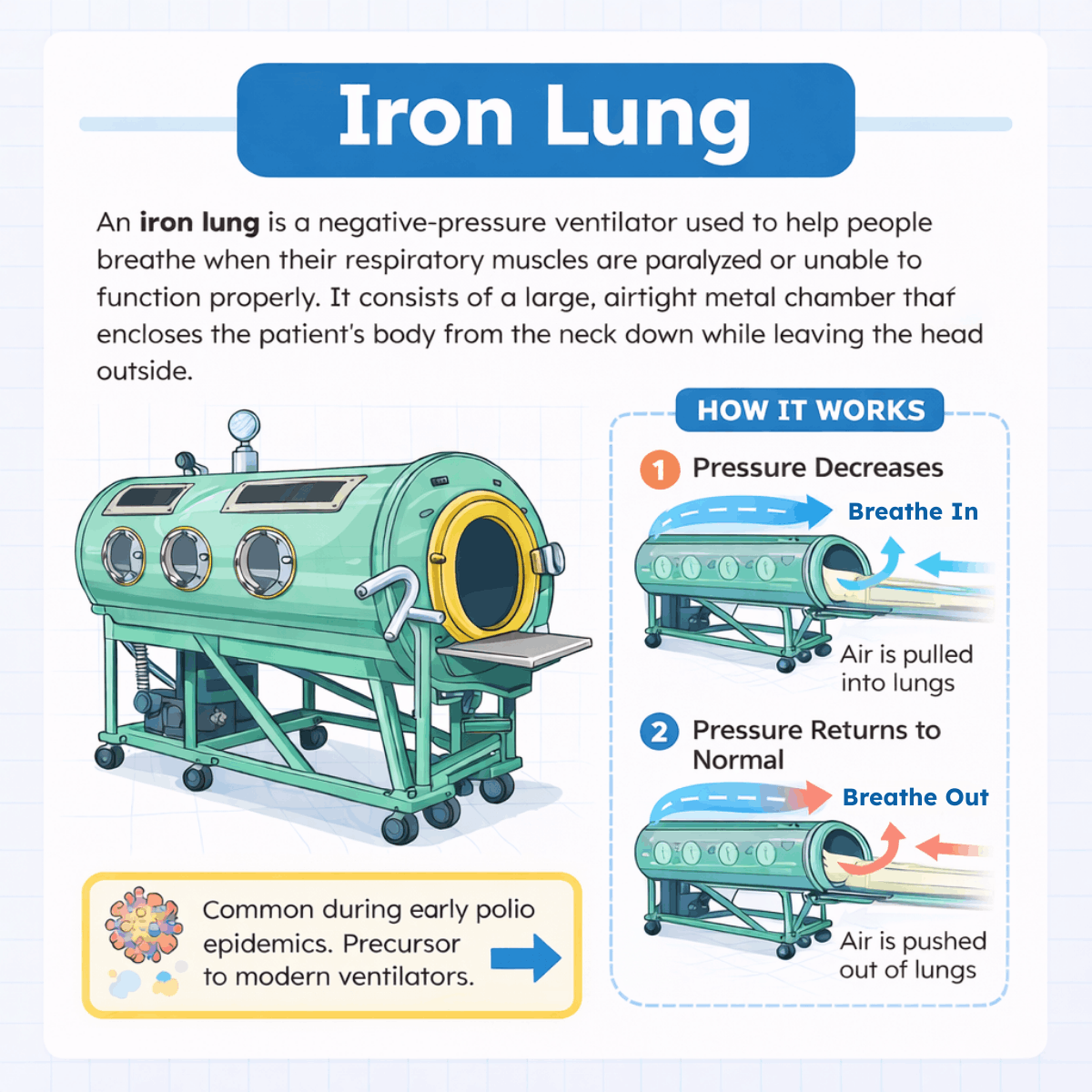
The device consists of a large, airtight metal chamber that encloses the patient’s body from the neck down while leaving the head exposed outside the machine. The patient lies flat inside the chamber, and a cushioned collar around the neck helps maintain an airtight seal. Once the patient is positioned inside, mechanical pumps change the air pressure within the chamber to assist with breathing.
During operation, the iron lung decreases the air pressure inside the chamber, causing the chest to expand. This expansion creates a drop in pressure within the lungs, allowing air to flow into the airways and alveoli, resulting in inhalation. When the pressure inside the chamber returns to normal, the chest wall and lungs recoil naturally, forcing air out of the lungs and producing exhalation.
What Is the Purpose of the Iron Lung?
The primary purpose of the iron lung is to provide ventilatory support for individuals experiencing respiratory failure caused by muscle paralysis or severe neuromuscular weakness. Conditions that affect the nerves or muscles responsible for breathing can prevent patients from generating adequate chest expansion, leading to hypoventilation and dangerously low oxygen levels.
Before the development of modern ventilators, patients with respiratory muscle paralysis often faced life-threatening complications because there were limited treatment options available. The iron lung provided a groundbreaking solution by allowing patients to maintain adequate ventilation without requiring invasive procedures such as endotracheal intubation or tracheostomy, which were less common and more risky during earlier periods of medical history.
The device was especially beneficial for patients with poliomyelitis, commonly known as polio. This viral infection can damage motor neurons in the spinal cord, leading to muscle paralysis, including paralysis of the diaphragm and other respiratory muscles. When this occurred, patients could lose the ability to breathe independently, making ventilatory support essential for survival.
How the Iron Lung Mimics Natural Breathing
The human body normally breathes through a process known as negative-pressure ventilation. During normal inspiration, the diaphragm contracts and moves downward while the intercostal muscles expand the rib cage. These movements increase the volume of the thoracic cavity, which lowers the pressure inside the lungs and allows air to flow inward.
The iron lung replicates this natural physiological process by mechanically lowering the pressure around the chest. This external pressure change allows the lungs to expand without forcing air directly into the airways. Because the device supports breathing in a way that closely resembles normal physiology, it was considered a more natural method of ventilation compared to early positive-pressure techniques.
Note: When the pressure within the chamber returns to its baseline level, the elastic recoil of the lungs and chest wall pushes air out of the lungs. This passive exhalation mirrors the natural relaxation phase of breathing, making the iron lung a relatively gentle method of ventilatory support.
Conditions That Required an Iron Lung
The iron lung was primarily used to treat conditions that caused respiratory muscle paralysis or severe weakness. The most well-known condition associated with iron lung use was poliomyelitis. During polio epidemics in the early and mid-20th century, thousands of patients required ventilatory support due to paralysis of the diaphragm and chest muscles.
In addition to polio, the iron lung was sometimes used to treat other neuromuscular disorders that impaired breathing. Conditions such as spinal cord injuries, Guillain-Barré syndrome, muscular dystrophy, and certain forms of central nervous system disease could all lead to respiratory failure requiring mechanical assistance.
The iron lung was also used in cases of severe drug overdose or trauma that temporarily affected respiratory muscle function. In these situations, the device could provide life-saving support until the patient recovered enough to resume spontaneous breathing.
Design and Structure of the Iron Lung
The iron lung is a large cylindrical metal chamber, typically constructed from steel or other durable materials, designed to maintain an airtight environment. Inside the chamber, the patient rests on a sliding bed that allows healthcare providers to position the patient comfortably and safely.
The machine includes mechanical pumps or bellows that regulate air pressure within the chamber. These pumps cycle between negative pressure and atmospheric pressure, creating the pressure changes necessary to assist breathing. Adjustable controls allow healthcare providers to regulate the rate and depth of ventilation based on the patient’s needs.
Access ports are built into the sides of the chamber to allow caregivers to perform limited patient care activities, such as adjusting positioning, providing hygiene care, or monitoring medical equipment. However, access to the patient was often restricted while the machine was operating, which presented challenges for healthcare providers.
The neck collar plays a critical role in maintaining the airtight seal required for proper function. If air leaks occur around the neck or access ports, the effectiveness of ventilation decreases, which can reduce tidal volume and overall minute ventilation.
Early Challenges With the Iron Lung
While the iron lung was revolutionary for its time, it presented several challenges for both patients and healthcare providers. One major limitation was the size and immobility of the device. Patients often had to remain inside the chamber for extended periods, sometimes for weeks, months, or even years in severe cases.
Communication and daily activities were also difficult for patients using an iron lung. Although their heads remained outside the chamber, movement was limited, and patients often required continuous nursing care to manage nutrition, hygiene, and comfort.
Another challenge involved maintaining an airtight seal. Even small leaks could reduce the effectiveness of ventilation, leading to inadequate oxygenation and carbon dioxide removal.
Note: Healthcare providers had to carefully monitor the device and make frequent adjustments to ensure proper function.
Where The Idea Came From
Long before the iron lung became a symbol of the polio era, clinicians and inventors were trying to solve a basic problem: how do you keep someone alive when their breathing muscles stop working? In the early 1800s, positive-pressure techniques using bag-mask systems or bellows were discussed. But there were serious concerns that forcing air into the lungs could cause lung injury, including a fatal pneumothorax.
That risk contributed to positive-pressure ventilation being rejected around the late 1820s, and interest shifted toward a method that more closely resembled normal breathing: negative-pressure ventilation.
Negative-pressure ventilation works with the same basic concept your body uses every day. When your chest expands, pressure inside the lungs drops and air flows in. When the chest relaxes, the lungs recoil and air flows out. Instead of pushing air into the airway, negative-pressure devices create a pressure change around the chest, letting air move in and out through the nose and mouth.
The First Negative-Pressure “Tank” Ventilators
As negative-pressure ventilation gained traction, early versions began appearing in the 1800s. The first negative-pressure tank ventilator was described in 1832.
Over time, inventors experimented with different designs, but the concept stayed the same: enclose the body (or at least the thorax) in a chamber, then cycle the pressure inside that chamber to create inhalation and exhalation.
Note: These early devices weren’t widespread in everyday hospitals because they were bulky, expensive, and mechanically demanding. Still, they laid the foundation for what would become the most famous negative-pressure ventilator ever made: the iron lung.
Drinker’s Iron Lung
In 1928, the iron lung was developed by Drinker, an industrial hygienist and faculty member at Harvard University. The timing mattered. Infectious diseases were still a major cause of disability and death, and polio was emerging as a public health crisis.
When polio attacked the nervous system, it could paralyze the muscles needed for breathing, especially the diaphragm and intercostal muscles. Patients might be fully awake and alert, but unable to draw in a breath. For these individuals, ventilatory support was not a convenience. It was the difference between life and death.
The iron lung offered a noninvasive way to provide that support. It surrounded the body from the neck down inside an airtight metal cylinder, with the head left outside. By lowering pressure inside the tank during inspiration, the chest wall expanded and air was pulled into the lungs. When the negative pressure was released, the lungs and chest wall recoiled, and exhalation occurred passively.
The Emerson Iron Lung and Wider Adoption
Not long after Drinker’s version, Emerson developed a commercial iron lung that became widely used. This is the version many people picture when they think of the polio era. During outbreaks, hospitals created rows of iron lungs in large wards because so many patients needed respiratory support at once. In the 1930s and 1950s, the device was used extensively during polio epidemics, becoming both a tool of survival and a powerful public image of how devastating respiratory paralysis could be.
For many families, the iron lung represented hope. For clinicians, it represented an urgently needed solution that could be deployed at scale. And for respiratory care, it helped accelerate the understanding that mechanical ventilation is not a single technique, but a spectrum of approaches that can be tailored to the patient.
Other Types of Negative Pressure Ventilation
The iron lung wasn’t the only negative-pressure option. As technology evolved, smaller and more targeted devices appeared.
- Chest cuirass ventilators were introduced in the early 1900s. Instead of enclosing the entire body, they enclosed only the chest with a shell-like device that sealed against the thorax.
- Wrap or poncho-type ventilators appeared later and aimed to provide negative pressure around the chest and torso with a garment-like enclosure.
- Other noninvasive techniques designed to augment ventilation included the rocking bed (introduced around 1950) and the Pneumobelt (introduced around 1959), which supported ventilation through external mechanical movement rather than internal airway pressure.
Note: These alternatives mattered because they were often more practical than a full-body tank. They could reduce space requirements and, in some cases, improve access to the patient. Still, they came with trade-offs related to fit, sealing, and effectiveness.
Disadvantages of Negative-Pressure Ventilation
In theory, negative-pressure ventilation is beautifully simple. In practice, it can be surprisingly difficult to deliver consistently.
A key factor is maintaining the pressure swing that actually drives airflow, often discussed as the pressure change needed to generate tidal volume. When negative pressure is inadequate, or when the system has leaks, ventilation can drop. With iron lungs, the seal around the neck and access ports has to be tight. With chest cuirass ventilators, the seal between the cuirass and thorax must be secure. With wrap or poncho-style devices, the enclosure must remain free of leaks or tears.
If a leak occurs, the effective pressure change decreases and minute ventilation can fall, leading to hypoventilation and CO₂ retention. On the other hand, if negative pressure is set more aggressively than necessary, the patient may hyperventilate due to larger tidal volumes and increased minute ventilation.
There are also patient-related limitations. For example, excessive negative pressure can contribute to upper airway collapse during inspiration in some situations, especially if the upper airway is not well supported.
Note: These risks don’t make negative-pressure ventilation “bad,” but they explain why it requires careful setup, patient selection, and monitoring.
The Biggest Practical Drawback of the Iron Lung
One of the most important disadvantages of the iron lung was simple logistics. Because the patient’s body was inside a sealed tank, access was limited. Caregivers could use built-in ports for certain tasks, but many routine activities became harder, slower, or required briefly interrupting ventilation. That could be a major challenge during acute illness, when patients needed frequent assessment, suctioning, positioning, and other interventions.
This limitation is one reason the field gradually shifted toward positive-pressure ventilation in critical care settings. Once clinicians developed safer ways to deliver positive pressure with better airway control, and once modern ICU ventilators became available in the 1960s, the balance started to change.
The Transition Toward Modern Ventilators
Mechanical ventilation as a field didn’t start with the iron lung, but the iron lung helped define an era. Over time, critical care moved toward devices that could provide precise, adjustable, continuous ventilatory support while allowing full access to the patient. Modern ventilators also made it easier to manage oxygenation, airway protection, secretion clearance, and severe lung disease.
Even so, negative-pressure ventilation never completely disappeared. It was widely used during the polio epidemic, and a small number of devices continued to be used in home settings for selected patients.
The iron lung itself became rare, but its legacy remains central to the story of respiratory care: it showed that ventilation could be provided noninvasively, it demonstrated the life-saving value of mechanical support, and it pushed medicine to innovate faster when a respiratory crisis demanded answers.
Key Components of the Iron Lung
Although the iron lung appears simple on the outside, it contains several important components that work together to support breathing.
The main structure is the airtight metal tank that encloses the patient’s body. This chamber is designed to withstand repeated pressure changes while maintaining a secure seal. The patient rests on a sliding bed that allows caregivers to position them inside the chamber.
A flexible collar surrounds the patient’s neck, forming an airtight seal that prevents air from leaking into the chamber. Maintaining this seal is essential for proper ventilation. Even small leaks can reduce the pressure changes needed to generate adequate tidal volume.
Mechanical pumps or bellows are responsible for changing the air pressure inside the chamber. These pumps create alternating negative and neutral pressure cycles that simulate breathing. Control systems allow healthcare providers to adjust the breathing rate, depth, and pressure levels based on the patient’s clinical condition.
Access ports are located along the sides of the chamber. These sealed openings allow caregivers to reach inside to perform limited patient care tasks such as repositioning the patient or adjusting medical equipment. However, the ports restrict access compared to modern ventilator care, which can make patient management more challenging.
The Importance of Maintaining an Airtight Seal
One of the most critical factors in iron lung function is maintaining a tight seal between the patient and the chamber. The effectiveness of ventilation depends on the ability of the machine to create pressure changes around the chest.
Leaks can occur around the neck collar, access ports, or any structural openings in the chamber. When leaks are present, the pressure change inside the chamber becomes less effective. This reduction in pressure change can decrease tidal volume and reduce overall minute ventilation, potentially leading to hypoventilation and carbon dioxide retention.
Note: Proper positioning of the patient and routine inspection of the chamber were essential parts of iron lung management. Healthcare providers had to monitor ventilation closely to ensure the patient was receiving adequate respiratory support.
What It Was Like for Patients Living in an Iron Lung
For many patients, especially during the polio epidemics, the iron lung became their primary lifeline. Some patients required ventilatory support for only a short period while recovering from temporary respiratory muscle weakness. Others, however, depended on the device for months, years, or even the rest of their lives.
Patients typically lay flat on their backs inside the chamber with limited ability to move. Although their heads remained outside the tank, movement of the neck and upper body was restricted. Nurses and caregivers played a crucial role in helping patients with daily activities such as eating, drinking, hygiene, and communication.
Communication was sometimes difficult, particularly for patients who were weak or fatigued. Many relied on hand signals, speaking softly, or using mirrors and visual aids to interact with caregivers and family members. Over time, some patients adapted remarkably well and were able to read, write, and engage in social interactions while using the device.
Psychological and Emotional Challenges
Living inside an iron lung could be physically and emotionally demanding. The confined environment and limited mobility often created feelings of anxiety, frustration, and isolation. Some patients experienced claustrophobia or emotional distress, particularly during long-term treatment.
Despite these challenges, many patients demonstrated incredible resilience. Support from family members, caregivers, and medical staff played a vital role in maintaining morale and emotional well-being. In some cases, patients developed routines and coping strategies that allowed them to maintain a sense of normalcy while using the device.
Advantages of the Iron Lung
The iron lung provided several important benefits, especially during the early days of respiratory care. One of its greatest advantages was that it allowed patients to receive ventilatory support without requiring invasive airway procedures. This reduced the risk of airway injury and infection associated with early forms of intubation.
The device also mimicked natural breathing mechanics, which many clinicians believed provided a more physiologic method of ventilation. Because air entered the lungs through the nose and mouth rather than through an artificial airway, patients were often able to speak and swallow more easily compared to those receiving invasive ventilation.
Additionally, the iron lung saved countless lives during the polio epidemics, demonstrating the life-saving potential of mechanical ventilation and helping establish respiratory therapy as a specialized medical field.
Limitations and Complications of the Iron Lung
Despite its advantages, the iron lung had several limitations. The large size and lack of portability made it difficult to transport patients or provide care outside of specialized facilities. Patients often remained confined to the device for extended periods, which increased the risk of complications such as pressure injuries and muscle weakness.
Access to the patient’s body was restricted, making routine medical care more difficult. Tasks such as suctioning secretions, repositioning the patient, or performing emergency procedures often required interrupting ventilation or using limited access ports.
Another potential complication involved upper airway collapse during inspiration. Because negative pressure draws air into the lungs, it can also cause soft tissues in the upper airway to collapse in certain patients, particularly if excessive negative pressure is applied.
In addition, maintaining consistent ventilation required careful monitoring to prevent leaks or mechanical failures. Healthcare providers had to remain vigilant to ensure the device functioned properly and the patient received adequate respiratory support.
Why Some Patients Still Use Negative-Pressure Ventilation
Although iron lungs are rarely used today, negative-pressure ventilation has not disappeared entirely. Some patients with chronic neuromuscular disorders continue to use modern versions of negative-pressure devices in home settings. These devices are typically smaller, more portable, and easier to manage than traditional iron lungs.
Negative-pressure ventilation may still be beneficial for patients who require long-term ventilatory support but wish to avoid invasive airway management.
Note: Advances in technology have allowed these devices to become more comfortable and efficient, preserving the original concept while improving practicality.
Why The Iron Lung Fell Out of Widespread Use
The iron lung was life-saving, but it was never an ideal long-term solution for hospital care. Its size made it difficult to move, store, and deploy quickly, especially during large outbreaks when hospitals were already overwhelmed. Patient access was also limited. Even with access ports, many routine tasks became slower and more complicated, and in emergencies, clinicians often had to interrupt ventilation to provide care.
Another limitation was precision. The iron lung could support ventilation, but it could not offer the same level of control over pressures, volumes, oxygen delivery, and monitoring that would later become standard in intensive care units.
Note: As critical care evolved, clinicians increasingly needed ventilators that could be adjusted in fine detail, adapt to changing lung mechanics, and support patients with severe respiratory diseases beyond neuromuscular paralysis.
The Shift Toward Positive-Pressure Ventilation
Over time, positive-pressure ventilation became safer and more practical. Early concerns about barotrauma were real, but improved airway management, better equipment, and a deeper understanding of ventilator settings made positive-pressure ventilation more controllable and reliable. Positive-pressure ventilators also offered a major advantage: full access to the patient.
With an endotracheal tube or tracheostomy in place, clinicians could suction secretions more effectively, protect the airway, manage oxygenation, and provide consistent ventilation even when a patient’s lung condition was unstable. This was especially important as ICUs became more common and hospitals treated increasingly complex cases, including trauma, sepsis, ARDS, and severe pneumonia.
Note: By the time modern critical care ventilators became widely available in the 1960s, the momentum had shifted. The iron lung remained historically significant, but it was no longer the primary tool for mechanical ventilation in most hospitals.
How Polio Vaccines Changed Everything
One of the biggest reasons the iron lung disappeared from hospital wards had nothing to do with engineering and everything to do with public health. When polio cases dropped dramatically after the introduction and widespread use of effective vaccines, far fewer patients developed the kind of respiratory paralysis that required negative-pressure ventilators. In a very real sense, the iron lung became a symbol of a crisis that medicine learned how to prevent.
This shift also changed how society viewed respiratory failure. During the polio era, the public could see the crisis in a striking way: rows of patients in large metal tanks fighting for each breath.
As polio declined, ventilatory support moved behind ICU doors, and mechanical ventilation became more associated with modern critical illness, surgery, and trauma care rather than epidemic paralysis.
Did The Iron Lung Disappear Completely?
Not entirely. While the classic full-body iron lung is now extremely rare, negative-pressure ventilation as a concept still exists. Some patients with chronic neuromuscular disorders have used modern negative-pressure devices at home, and a small number of legacy machines have remained in use for specific individuals who relied on them long-term.
That said, the reasons negative-pressure ventilation is less common today are practical. Positive-pressure ventilation, noninvasive ventilation (like BiPAP), and modern portable ventilators tend to offer more flexibility, better monitoring, and easier integration into daily life and clinical care.
The Iron Lung’s Lasting Impact on Respiratory Therapy
Even though it is rarely used today, the iron lung helped shape the entire field of respiratory care. It proved that ventilation could be mechanically supported and scaled during a public health emergency. It also pushed innovation forward fast, because clinicians needed better devices, better monitoring, and better ways to care for patients with respiratory failure.
The iron lung also left a lasting educational legacy. It is one of the best examples of negative-pressure ventilation, and it remains a powerful teaching tool for understanding how pressure gradients move air, how the chest wall and lungs interact, and why ventilation strategies matter. For respiratory therapy students and clinicians, it connects physiology to history in a way that modern equipment sometimes does not.
FAQs About the Iron Lung
How Does an Iron Lung Work for Polio?
An iron lung helps patients with polio breathe when the virus damages the nerves that control respiratory muscles. The device creates negative pressure around the chest by lowering air pressure inside the chamber, causing the lungs to expand and draw air in. When the pressure returns to normal, the lungs recoil and push air out.
This process mimics natural breathing without requiring muscle effort. By maintaining adequate ventilation, the iron lung helps prevent respiratory failure and supports patients while their bodies recover or adapt to long-term muscle weakness.
What Does an Iron Lung Look Like?
An iron lung is a large, cylindrical metal chamber designed to enclose a patient’s body from the neck down while leaving the head outside. The machine typically has a rigid metal shell with clear viewing windows and sealed ports that allow healthcare providers to monitor and care for the patient.
The neck opening contains a cushioned collar to maintain an airtight seal. The device rests on wheels or a frame and includes motors or bellows that regulate pressure changes to support breathing.
What Is an Iron Lung Used to Treat?
An iron lung is primarily used to treat respiratory failure caused by paralysis of the breathing muscles. Historically, it was most commonly used for patients with poliomyelitis, which could damage nerves controlling the diaphragm and chest muscles.
The device allowed patients to breathe when they were unable to do so independently. In addition to polio, iron lungs were occasionally used for certain neuromuscular disorders, spinal cord injuries, and other conditions that impaired respiratory muscle function, helping patients maintain adequate ventilation.
How Long Do You Stay in an Iron Lung?
The length of time a person stays in an iron lung varies depending on the severity of respiratory muscle paralysis and the individual’s recovery. Some patients required short-term support for days or weeks while their breathing muscles regained function.
Others with permanent paralysis relied on iron lungs for months or even years. In rare cases, individuals lived in iron lungs for decades. The duration depended on the patient’s condition, response to treatment, and availability of alternative respiratory support methods.
How Do People in an Iron Lung Use the Bathroom?
Patients in an iron lung relied on assistance from healthcare providers or caregivers to manage bathroom needs. Because most of the body remained inside the sealed chamber, caregivers used bedpans, urinals, or specialized collection devices inserted through access ports.
Some iron lungs included small openings that allowed limited care without removing the patient from the machine. For patients who required long-term use, caregivers developed routines to maintain hygiene, comfort, and dignity while ensuring continuous respiratory support.
How Do You Eat in an Iron Lung?
Patients in an iron lung could eat because their heads remained outside the machine, allowing them to chew and swallow normally. Caregivers often helped position food and drinks to ensure comfort and safety. Soft foods or liquids were sometimes preferred, especially if swallowing was weak or difficult.
In cases where patients could not eat safely, feeding tubes were used to provide nutrition. Maintaining proper nutrition was essential for recovery, immune function, and overall health while receiving long-term respiratory support.
Are Iron Lungs Still Used Today?
Iron lungs are rarely used today because modern mechanical ventilators provide more efficient and flexible respiratory support. Positive-pressure ventilators, which deliver air directly into the lungs through masks or airway tubes, have largely replaced negative-pressure devices. However, a small number of individuals with long-term respiratory paralysis have continued using iron lungs in home settings.
Note: Although mostly considered historical medical equipment, iron lungs remain important for understanding the evolution of respiratory care and the development of modern ventilation technology.
Final Thoughts
So, what is an iron lung? It is a negative-pressure ventilator that encloses the body from the neck down and supports breathing by cycling pressure around the chest, allowing inhalation and exhalation to occur through natural airflow.
It rose to prominence during the polio epidemics, saved countless lives, and helped lay the groundwork for modern mechanical ventilation. While it has largely been replaced by more advanced and practical technologies, its impact on critical care and respiratory therapy is permanent.

Written by:
John Landry is a registered respiratory therapist from Memphis, TN, and has a bachelor's degree in kinesiology. He enjoys using evidence-based research to help others breathe easier and live a healthier life.
References
- Meyer JA. A practical mechanical respirator, 1929: the “iron lung”. Ann Thorac Surg. 1990.
- Barr M. The iron lung – a polio patient’s story. J R Soc Med. 2010.
- Frederick C. Noninvasive mechanical ventilation with the iron lung. Crit Care Nurs Clin North Am. 1994.