

Pulmonary vascular disease includes a range of disorders that affect the blood vessels of the lungs and interfere with normal blood flow between the heart and pulmonary circulation. These conditions can impair gas exchange, increase strain on the right side of the heart, and lead to serious or life-threatening complications if not identified early.
Because symptoms often resemble common respiratory problems, pulmonary vascular disease is frequently overlooked in its early stages.
Respiratory therapists are uniquely positioned to recognize early changes in oxygenation, ventilation, and hemodynamics, making their understanding of this topic essential to timely diagnosis, effective management, and improved patient outcomes.

What Is Pulmonary Vascular Disease?
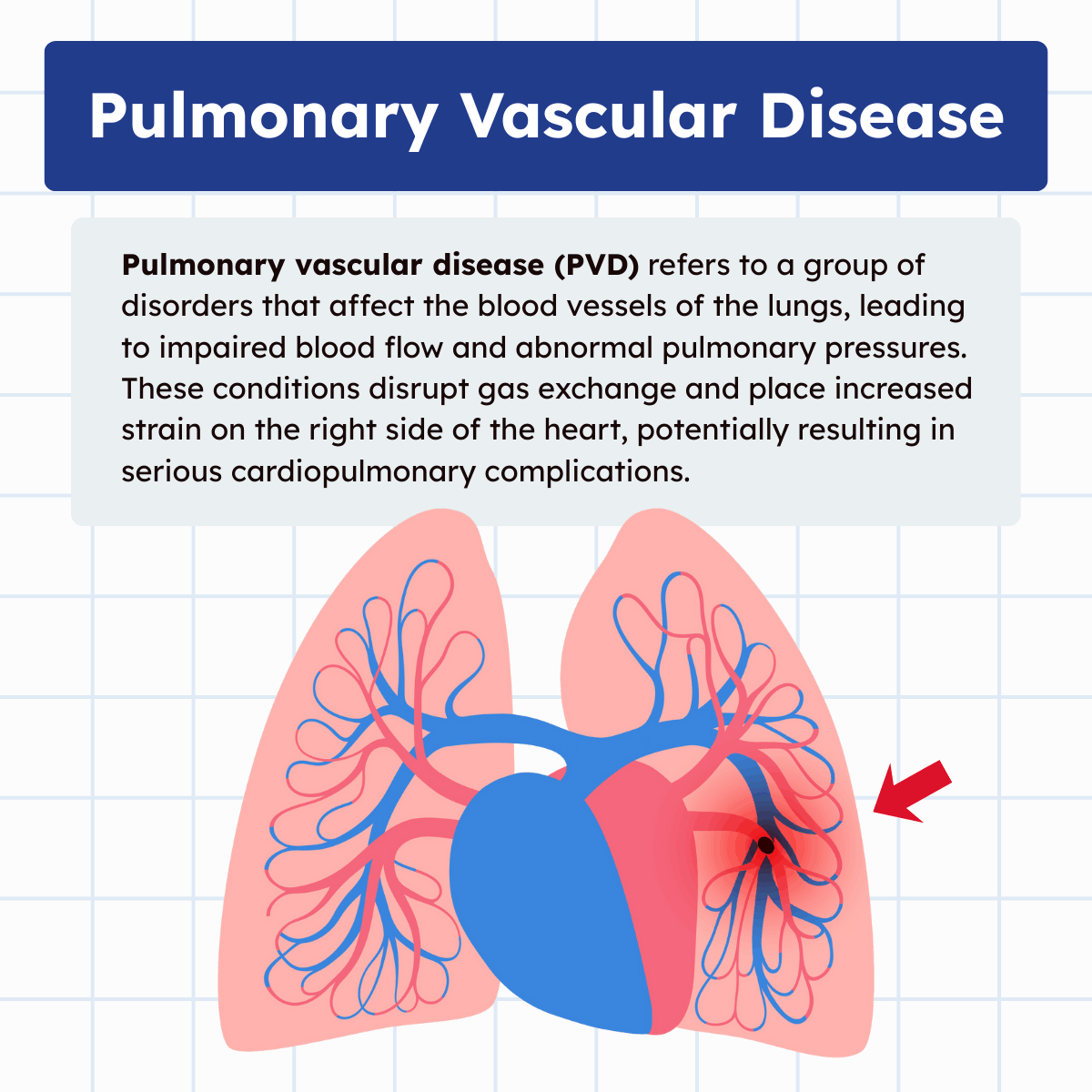
Pulmonary vascular disease (PVD) encompasses conditions that affect the pulmonary arteries, veins, or capillaries. These disorders alter normal pulmonary blood flow, increase pulmonary vascular resistance, or obstruct circulation within the lungs. When blood flow through the pulmonary vasculature is impaired, the lungs cannot efficiently oxygenate blood or remove carbon dioxide. Over time, this can result in hypoxemia, right ventricular dysfunction, and eventual right heart failure.
PVD may develop suddenly, as in the case of an acute pulmonary embolism, or progress gradually, as seen in pulmonary hypertension. Causes range from blood clots and chronic lung disease to cardiac conditions and primary vascular abnormalities. Despite differing mechanisms, all forms of pulmonary vascular disease place significant stress on the cardiopulmonary system.
Types of Pulmonary Vascular Disease
Pulmonary Embolism
Pulmonary embolism (PE) occurs when a blood clot obstructs one or more pulmonary arteries. Most emboli originate as deep venous thrombosis (DVT) in the lower extremities or pelvis and travel to the lungs through the venous circulation. DVT and PE are collectively referred to as venous thromboembolism (VTE).
PE can present with sudden onset dyspnea, pleuritic chest pain, tachypnea, hypoxemia, hemoptysis, or hypotension in severe cases. However, symptoms are often nonspecific, making diagnosis challenging. PE is a major cause of morbidity and mortality in hospitalized patients, with a significant percentage of deaths occurring within the first hour of symptom onset. Early recognition and prompt treatment dramatically reduce mortality rates.
Pulmonary Hypertension
Pulmonary hypertension (PH) is defined as abnormally elevated pressure within the pulmonary arteries. It may result from diseases affecting the pulmonary vasculature, lung parenchyma, left heart function, or chronic hypoxia. Increased pulmonary artery pressure leads to elevated right ventricular workload and can progress to right-sided heart failure if untreated.
PH is classified into several groups based on underlying cause, including pulmonary arterial hypertension, PH due to left heart disease, PH associated with lung disease or hypoxia, chronic thromboembolic pulmonary hypertension, and PH with unclear or multifactorial mechanisms. Regardless of classification, patients commonly present with exertional dyspnea, fatigue, syncope, chest discomfort, and peripheral edema as the disease advances.
Chronic Thromboembolic Pulmonary Hypertension
Chronic thromboembolic pulmonary hypertension (CTEPH) develops when pulmonary emboli fail to resolve and instead become organized fibrotic obstructions within the pulmonary arteries. This leads to persistent elevation in pulmonary vascular resistance and progressive pulmonary hypertension.
Unlike many other forms of PH, CTEPH may be curable with surgical intervention if identified early. Because symptoms often resemble those of other cardiopulmonary disorders, a high index of suspicion is required.
Pulmonary Vascular Disease Secondary to Lung or Heart Disease
Many chronic lung conditions, such as COPD, interstitial lung disease, and sleep-disordered breathing, can cause pulmonary vascular remodeling due to prolonged hypoxia.
Similarly, left-sided heart diseases can elevate pulmonary venous pressure, leading to secondary pulmonary hypertension. In these cases, pulmonary vascular disease develops as a consequence of another primary disorder, making management more complex.
Pathophysiology of Pulmonary Vascular Disease
The pulmonary circulation is designed to be a low-pressure, low-resistance system. When this balance is disrupted, pulmonary vascular resistance increases, impairing blood flow through the lungs. In pulmonary embolism, mechanical obstruction reduces perfusion to ventilated alveoli, creating dead space and worsening ventilation–perfusion mismatch. This leads to hypoxemia and increased work of breathing.
In pulmonary hypertension, chronic vasoconstriction, vascular remodeling, or obstruction increases afterload on the right ventricle. Over time, right ventricular hypertrophy and dilation develop, eventually progressing to right heart failure. These pathophysiologic changes explain why pulmonary vascular disease affects not only oxygenation but also hemodynamics and overall cardiopulmonary stability.
Clinical Presentation and Diagnosis
Pulmonary vascular disease often presents with subtle or nonspecific symptoms. Dyspnea, tachypnea, hypoxemia, chest discomfort, fatigue, and exercise intolerance are common across many conditions. Signs such as unilateral leg swelling, sudden hypoxemia, unexplained hypotension, or worsening oxygen requirements should raise concern for acute vascular pathology.
Diagnostic evaluation typically includes imaging studies, laboratory tests, and hemodynamic assessment. While respiratory therapists do not diagnose these conditions independently, their clinical observations and assessments often trigger further evaluation. Continuous monitoring of oxygenation, ventilation, and patient response to therapy plays a vital role in early detection.
Management of Pulmonary Vascular Disease
Treatment of Venous Thromboembolism
Management of DVT and PE focuses on anticoagulation to prevent clot extension and recurrence. Common therapies include heparin, low-molecular-weight heparin, warfarin, and newer oral anticoagulants. In severe cases, thrombolytic therapy or surgical intervention may be required. Preventive strategies, including early ambulation, pneumatic compression devices, and prophylactic anticoagulation, are critical in at-risk patients.
Management of Pulmonary Hypertension
Treatment of pulmonary hypertension depends on the underlying cause and severity. Therapies may include oxygen supplementation, diuretics, and targeted pulmonary vasodilators. These include calcium channel blockers, prostanoids, endothelin receptor antagonists, phosphodiesterase-5 inhibitors, and soluble guanylate cyclase stimulators. In advanced or refractory cases, lung transplantation may be considered.
Relevance to Respiratory Therapists
Pulmonary vascular disease is highly relevant to respiratory therapists because its manifestations directly affect oxygenation, ventilation, and cardiopulmonary stability. RTs are frequently the first to identify worsening hypoxemia, unexplained dyspnea, or changes in ventilatory requirements. Recognizing early warning signs and communicating concerns to the healthcare team can be lifesaving.
Respiratory therapists also play an active role in prevention and treatment. Ensuring patient compliance with compression devices, monitoring response to oxygen therapy, administering inhaled vasodilators, and managing nitric oxide during vasoreactivity testing are all within the RT scope of practice. In critically ill patients, ventilator management must be carefully adjusted to avoid increasing pulmonary vascular resistance or compromising right ventricular function.
Importance in the Field of Respiratory Care
As the population ages and the prevalence of chronic cardiopulmonary disease increases, pulmonary vascular disorders are becoming more common. Advances in diagnostic tools and targeted therapies have improved outcomes, but early recognition remains the most important factor in survival.
Respiratory therapists serve as a critical link between patient assessment and medical intervention. Education in pulmonary vascular disease strengthens clinical reasoning, improves patient monitoring, and enhances interdisciplinary communication.
Note: A strong understanding of these conditions allows respiratory therapists to contribute meaningfully to both acute care and long-term disease management.
Pulmonary Vascular Disease Practice Questions
1. What is pulmonary vascular disease?
Pulmonary vascular disease refers to conditions that affect the blood vessels of the lungs, most commonly pulmonary embolism (PE) and pulmonary hypertension (PH).
2. What is a pulmonary embolism (PE)?
A pulmonary embolism occurs when a blood clot travels from the venous system and lodges in the pulmonary circulation, obstructing blood flow to the lungs.
3. Where do most pulmonary emboli originate?
Most pulmonary emboli originate from deep venous thrombosis (DVT) in the lower extremities or pelvis.
4. What is deep venous thrombosis (DVT)?
Deep venous thrombosis is the formation of a blood clot in the deep veins, most commonly in the legs.
5. What term is used to collectively describe DVT and PE?
Deep venous thrombosis and pulmonary embolism are collectively referred to as venous thromboembolism (VTE).
6. What is pulmonary hypertension (PH)?
Pulmonary hypertension is a condition characterized by abnormally elevated pressure in the pulmonary arteries due to disease affecting the lung vessels, lung tissue, or heart.
7. What is a key role of respiratory therapists in pulmonary vascular disease?
Respiratory therapists play a critical role by recognizing early signs and symptoms, assisting in diagnostic evaluation, and managing inhaled and supportive therapies.
8. What symptoms may suggest an acute pulmonary embolism?
Acute onset dyspnea, pleuritic chest pain, tachypnea, hypoxemia, hypotension, and unexplained anxiety.
9. Why is early recognition of pulmonary embolism critical?
One-third of deaths from pulmonary embolism occur within one hour of symptom onset, making early recognition potentially lifesaving.
10. How does mortality differ between treated and untreated pulmonary embolism?
Untreated pulmonary embolism has a mortality rate of approximately 30%, whereas treated cases have a mortality rate below 8%.
11. Why is pulmonary embolism often difficult to diagnose clinically?
The signs and symptoms of PE and DVT are often nonspecific, requiring a high index of suspicion in at-risk patients.
12. What patient populations are at increased risk for venous thromboembolism?
Hospitalized patients, those with limited mobility, recent surgery, trauma, cancer, or prior history of VTE.
13. What preventive measures reduce the risk of venous thromboembolism?
Early ambulation, pneumatic compression devices, and compliance with compression stockings.
14. What pharmacologic agents are commonly used for VTE prophylaxis?
Low-dose heparin, low-molecular-weight heparin, warfarin, and newer oral anticoagulants.
15. What is the cornerstone of treatment for confirmed venous thromboembolism?
Anticoagulation therapy to prevent clot extension and recurrence.
16. What is idiopathic pulmonary arterial hypertension (IPAH)?
A rare form of pulmonary hypertension with no identifiable cause, most commonly affecting young adults.
17. What is the primary pathophysiologic problem in pulmonary arterial hypertension?
Progressive narrowing and remodeling of pulmonary arteries leading to increased pulmonary vascular resistance.
18. What classes of medications are used to treat pulmonary arterial hypertension?
Vasodilators such as calcium channel blockers, prostanoids, endothelin receptor antagonists, phosphodiesterase-5 inhibitors, and soluble guanylate cyclase stimulators.
19. What inhaled therapies may be administered in pulmonary arterial hypertension?
Inhaled nitric oxide, iloprost, and treprostinil.
20. What treatment option may be considered for advanced pulmonary hypertension unresponsive to medical therapy?
Lung transplantation
21. What does the term venous thromboembolism (VTE) refer to?
Venous thromboembolism refers to a disease category that includes deep venous thrombosis (DVT) and pulmonary embolism (PE).
22. What is deep venous thrombosis (DVT)?
Deep venous thrombosis is the formation of a thrombus in the deep veins, most commonly in the lower extremities.
23. What is a pulmonary embolism (PE)?
A pulmonary embolism is an obstruction of a pulmonary artery by material such as a thrombus, fat, air, or tumor tissue, most often originating from a peripheral vein.
24. Which patient population has the highest morbidity and mortality from VTE?
Hospitalized patients are at the greatest risk for VTE-related morbidity and mortality.
25. Why is early recognition of pulmonary embolism critical?
Because approximately one-third of deaths from PE occur within one hour of symptom onset, and untreated PE has a high mortality rate.
26. What is the mortality rate of untreated pulmonary embolism?
The mortality rate of untreated pulmonary embolism is approximately 30%.
27. How does treatment affect mortality in venous thromboembolism?
When venous thrombosis is recognized and treated, mortality decreases to less than 8%.
28. Where do most pulmonary emboli originate?
Most pulmonary emboli originate from deep venous thrombosis in the lower extremities or pelvis.
29. Why is diagnosing PE and DVT often challenging?
Their clinical presentation is frequently nonspecific, requiring a high index of suspicion in at-risk patients.
30. Can the risk of venous thromboembolism be reduced?
Yes, appropriate prophylactic therapy significantly reduces the risk of VTE.
31. Why is VTE prophylaxis often ineffective in clinical practice?
Prophylactic therapy is frequently underutilized despite clear evidence of benefit.
32. What pharmacologic agents are commonly used for VTE prophylaxis?
Low-dose subcutaneous heparin, warfarin, low-molecular-weight heparin, and newer anticoagulants.
33. What mechanical methods help prevent venous thromboembolism?
Early ambulation, elastic compression stockings, pneumatic calf compression devices, and calf muscle stimulation.
34. What is the primary treatment for confirmed venous thromboembolism?
Anticoagulation therapy to prevent clot propagation and recurrence.
35. What medications are commonly used for VTE treatment?
Heparin, warfarin, and newer oral anticoagulants.
36. What does idiopathic pulmonary arterial hypertension (IPAH) describe?
A rare form of pulmonary hypertension with no identifiable cause, most often affecting young adults.
37. What pathophysiologic process occurs in IPAH?
Endothelial dysfunction leads to increased vasoconstriction, thrombosis, and vascular remodeling.
38. What therapies are used to manage idiopathic pulmonary arterial hypertension?
Anticoagulation and vasodilator therapy, with lung transplantation considered in refractory cases.
39. What therapy has been shown to improve survival in patients with COPD and pulmonary hypertension?
Long-term oxygen therapy.
40. What diagnostic tests may be used to evaluate a suspected pulmonary embolism?
Chest imaging, ventilation–perfusion scanning, CT pulmonary angiography, and pulmonary angiography.
41. Which diagnostic test is considered the gold standard for confirming pulmonary embolism?
Pulmonary angiography
42. IPAH most commonly affects which age group?
Young adults
43. What are the five major categories of pulmonary hypertension?
Pulmonary arterial hypertension; pulmonary hypertension due to left heart disease; pulmonary hypertension due to lung disease or hypoxia; chronic thromboembolic pulmonary hypertension; and pulmonary hypertension with multifactorial mechanisms.
44. An increased dead space to tidal volume (VD/VT) ratio on mechanical ventilation suggests which condition?
Pulmonary embolism
45. What preventive measure is essential for immobile hospitalized patients?
Venous thromboembolism prophylaxis.
46. What term describes pulmonary hypertension without an identifiable cause?
Idiopathic pulmonary arterial hypertension.
47. What is pulmonary hypertension?
A condition characterized by elevated pressure within the pulmonary arteries due to cardiac, pulmonary, or vascular disease.
48. What is venous thrombosis?
The formation of blood clots within the venous system, often related to immobility or hypercoagulable states.
49. Where do most venous thrombi form?
In the deep veins of the lower legs.
50. What is a pulmonary infarction?
Lung tissue death resulting from prolonged obstruction of pulmonary blood flow by an embolus.
51. What does the term cor pulmonale describe?
Chronic pulmonary hypertension leading to right ventricular hypertrophy and eventual right heart failure.
52. Approximately how many people develop thromboembolic disease each year in the United States?
An estimated 200,000 to 300,000 individuals.
53. How do most venous thrombi develop?
They usually form in the deep veins of the legs, though they may also originate in the right heart.
54. Which patients are at the greatest risk for developing venous thrombosis?
Older adults, bedridden patients, and individuals with trauma, malignancy, or heart failure.
55. How does a pulmonary embolism affect the interaction between the heart and lungs?
A pulmonary embolism obstructs pulmonary blood flow, increasing pulmonary vascular resistance and right ventricular workload, which can reduce cardiac output and impair oxygen delivery.
56. What are the primary hemodynamic consequences of a pulmonary embolism?
Increased pulmonary vascular resistance, elevated right ventricular pressure, and decreased cardiac output.
57. What are the most common clinical symptoms of a pulmonary embolism?
Acute dyspnea and pleuritic chest pain.
58. What are the most frequent physical findings associated with a pulmonary embolism?
Tachypnea, tachycardia, and possible crackles over affected lung regions.
59. What electrocardiographic (ECG) findings are commonly associated with pulmonary embolism?
Sinus tachycardia and nonspecific ST-segment or T-wave abnormalities.
60. What is the primary role of a chest radiograph in evaluating suspected pulmonary embolism?
To exclude other causes of acute respiratory symptoms, such as pneumothorax or pneumonia, since chest x-ray findings are often nonspecific for PE.
61. Why is arterial blood gas (ABG) analysis not diagnostic for pulmonary embolism?
ABG abnormalities such as hypoxemia or respiratory alkalosis are nonspecific and cannot confirm or exclude pulmonary embolism.
62. What is the gold standard test for diagnosing deep venous thrombosis?
Compression ultrasonography of the affected extremity.
63. Which diagnostic studies are sensitive for confirming pulmonary embolism?
Ventilation–perfusion (V/Q) scanning, CT pulmonary angiography, and pulmonary angiography.
64. Can a routine chest x-ray or venous ultrasound directly visualize a pulmonary embolism?
No, these studies do not directly show emboli within the pulmonary arteries.
65. A V/Q scan shows a perfusion defect in the right lower lobe with normal ventilation. What is the most likely diagnosis?
Acute pulmonary embolism
66. What medications are commonly used for pharmacologic prophylaxis against pulmonary embolism?
Low-dose subcutaneous heparin and other anticoagulants.
67. What mechanical methods are used to prevent pulmonary embolism?
Early ambulation, elastic compression stockings, and pneumatic calf compression devices.
68. What is the standard initial pharmacologic therapy for an established DVT or pulmonary embolism?
Anticoagulation with heparin to inhibit further clot formation.
69. A patient with severe dyspnea has a markedly increased minute ventilation but a normal PaCO₂. What physiologic process explains this finding?
Increased dead space ventilation due to pulmonary embolism.
70. When are inferior vena cava (IVC) filters indicated?
When anticoagulation is contraindicated, ineffective, or when patients have recurrent emboli or limited cardiopulmonary reserve.
71. Why is supplemental oxygen important in patients with pulmonary hypertension?
Oxygen increases alveolar oxygen tension, promoting pulmonary vasodilation and reducing pulmonary vascular resistance.
72. Which inhaled medications are commonly used to treat pulmonary arterial hypertension?
Iloprost and treprostinil
73. What role does alveolar hypoxia play in the development of pulmonary hypertension?
Alveolar hypoxia triggers pulmonary vasoconstriction, increasing pulmonary vascular resistance and arterial pressure.
74. What pathophysiologic factors in COPD contribute to pulmonary hypertension?
Loss of pulmonary capillary bed, increased blood viscosity, and hyperinflation compressing pulmonary vessels, all of which increase pulmonary vascular resistance.
75. What is the most common acid–base disturbance seen early in acute pulmonary embolism?
Respiratory alkalosis due to tachypnea and hyperventilation.
76. Why does pulmonary embolism increase physiologic dead space?
Because ventilated alveoli receive little or no perfusion due to vascular obstruction.
77. What effect does a large pulmonary embolism have on right ventricular preload?
It reduces left ventricular preload by impairing right ventricular output.
78. Why can pulmonary embolism lead to systemic hypotension?
Decreased right ventricular output reduces left ventricular filling and cardiac output.
79. What is the clinical significance of sudden unexplained hypoxemia?
It should raise suspicion for pulmonary embolism or acute pulmonary vascular obstruction.
80. Why is pulmonary embolism often difficult to diagnose clinically?
Because symptoms are nonspecific and can mimic many cardiopulmonary conditions.
81. What ventilation–perfusion mismatch pattern is classic for pulmonary embolism?
Normal ventilation with reduced or absent perfusion.
82. What happens to pulmonary artery pressure during an acute pulmonary embolism?
Pulmonary artery pressure increases abruptly due to vascular obstruction.
83. Why can pulmonary embolism cause syncope?
A sudden drop in cardiac output from right ventricular failure can reduce cerebral perfusion.
84. What is the role of D-dimer testing in suspected pulmonary embolism?
It helps exclude PE in low-risk patients when results are normal.
85. Why is pulmonary angiography considered definitive for PE diagnosis?
It directly visualizes filling defects within the pulmonary arteries.
86. What is chronic thromboembolic pulmonary hypertension (CTEPH)?
Pulmonary hypertension caused by unresolved or recurrent pulmonary emboli.
87. How does CTEPH differ from acute pulmonary embolism?
CTEPH results from long-term vascular obstruction and remodeling rather than sudden clot migration.
88. What is a major long-term complication of recurrent pulmonary emboli?
Development of pulmonary hypertension and right heart failure.
89. What heart sound may be accentuated in pulmonary hypertension?
A loud or split second heart sound (P2).
90. Why is early ambulation important for hospitalized patients?
It reduces venous stasis and lowers the risk of thrombus formation.
91. What is Virchow’s triad?
Venous stasis, endothelial injury, and hypercoagulability.
92. Which component of Virchow’s triad is most associated with prolonged bed rest?
Venous stasis.
93. Why does cancer increase the risk of venous thromboembolism?
Malignancy promotes a hypercoagulable state.
94. What is the effect of pulmonary embolism on oxygen delivery despite normal PaO₂?
Reduced cardiac output can impair overall tissue oxygen delivery.
95. Why may wheezing be heard in some patients with pulmonary embolism?
Bronchoconstriction can occur secondary to hypoxia and mediator release.
96. What is the significance of hemoptysis in pulmonary embolism?
It may indicate pulmonary infarction.
97. Why can pulmonary embolism cause pleuritic chest pain?
Ischemia and inflammation of the pleura near the affected lung region.
98. What is the primary goal of anticoagulation therapy in pulmonary embolism?
To prevent clot propagation and recurrent embolization.
99. How does positive-pressure ventilation affect patients with massive pulmonary embolism?
It can worsen hemodynamics by reducing venous return and cardiac output.
100. What clinical finding suggests progression from pulmonary hypertension to cor pulmonale?
Peripheral edema due to right ventricular failure.
Final Thoughts
Pulmonary vascular disease represents a complex group of disorders that significantly impact respiratory function, cardiovascular health, and patient survival. From acute pulmonary embolism to chronic pulmonary hypertension, these conditions often present with subtle respiratory signs that demand careful assessment.
Respiratory therapists play a vital role in recognizing early symptoms, supporting diagnostic efforts, and delivering essential therapies.
By understanding the mechanisms, clinical features, and management strategies of pulmonary vascular disease, RTs help improve outcomes and ensure timely, effective care for some of the most vulnerable patients in the healthcare system.

Written by:
John Landry is a registered respiratory therapist from Memphis, TN, and has a bachelor's degree in kinesiology. He enjoys using evidence-based research to help others breathe easier and live a healthier life.
References
- Mélot C, Naeije R. Pulmonary vascular diseases. Compr Physiol. 2011.