

Tidal volume is one of the most basic yet essential measurements in respiratory physiology. It represents the amount of air that moves into and out of the lungs with each normal, quiet breath. While the concept may seem simple, tidal volume plays a critical role in ventilation, gas exchange, and patient safety.
For respiratory therapists, understanding tidal volume is vital for assessing breathing patterns, managing mechanical ventilation, and preventing ventilator-related complications.
Whether evaluating a spontaneously breathing patient or setting ventilator parameters, tidal volume is a cornerstone of effective respiratory care.

What Is Tidal Volume?
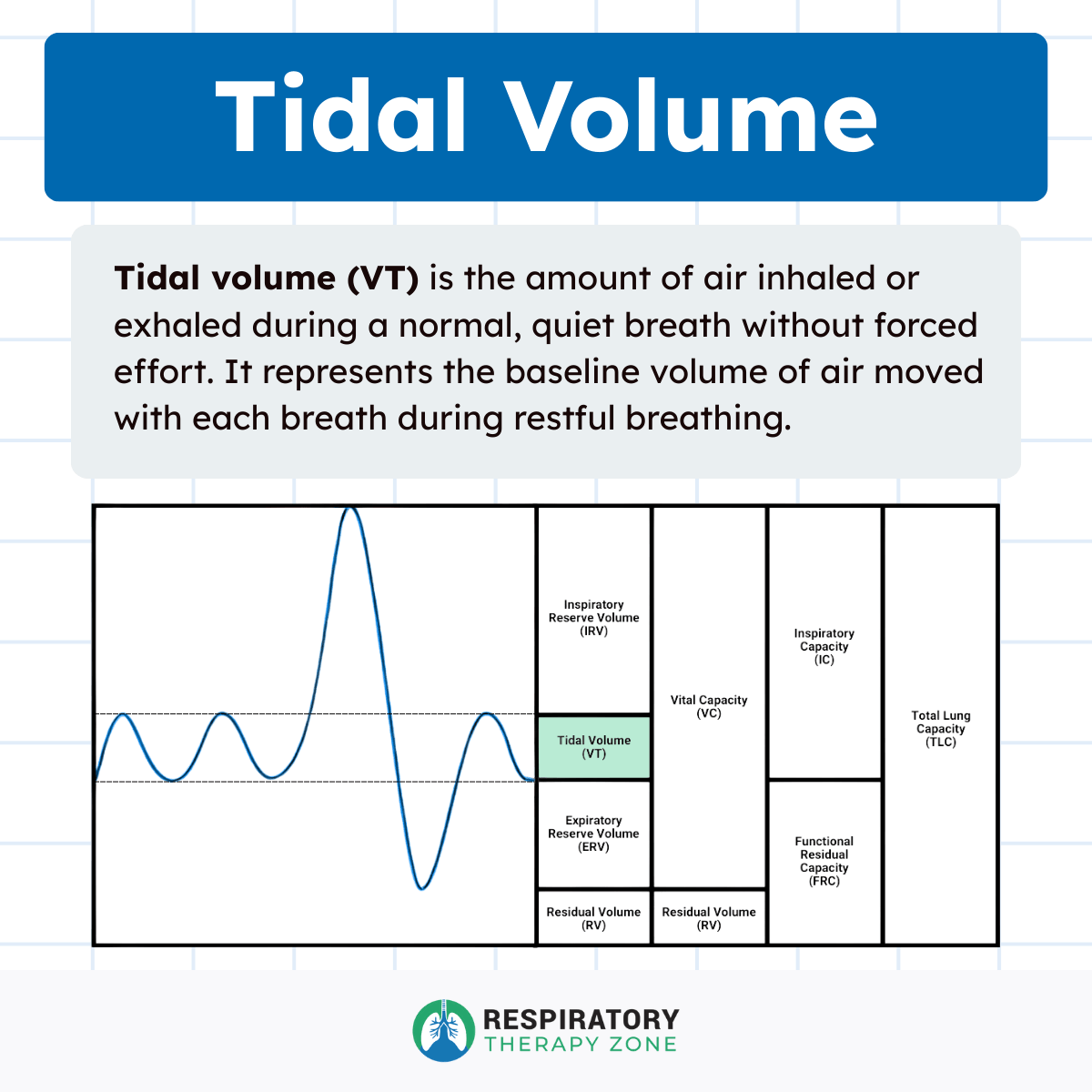
Tidal volume (VT) is the volume of air inhaled or exhaled during a normal, relaxed breath. It reflects the basic breath-to-breath movement of air required to meet the body’s metabolic demands at rest.
In a healthy adult, tidal volume typically averages around 500 mL per breath, though this value varies based on factors such as body size, age, sex, and physiologic condition. Unlike lung capacities that require maximal effort, tidal volume is measured during quiet breathing and represents the most frequently used lung volume in everyday respiration.
Tidal volume is a key component of minute ventilation, which is calculated as tidal volume multiplied by respiratory rate. Together, these two variables determine how much air enters and leaves the lungs each minute.
The Role of Tidal Volume in Normal Breathing
During normal respiration, tidal volume provides sufficient airflow to allow oxygen to enter the alveoli and carbon dioxide to be removed from the body. The size of each tidal breath must be adequate to overcome anatomical dead space and deliver fresh air to the gas-exchanging regions of the lungs.
If tidal volume is too low, ventilation becomes inefficient, leading to carbon dioxide retention and hypoventilation. If tidal volume is excessively high, it can increase the work of breathing and place unnecessary stress on lung tissue.
The body naturally adjusts tidal volume based on metabolic needs. During exercise, illness, or stress, tidal volume often increases to meet higher oxygen demands. At rest or during sleep, tidal volume may decrease slightly while still maintaining adequate gas exchange.
Clinical Importance of Tidal Volume
Assessment of Breathing Patterns
Respiratory therapists routinely assess tidal volume when evaluating a patient’s breathing effectiveness. Shallow breathing with low tidal volumes may indicate pain, neuromuscular weakness, restrictive lung disease, or fatigue. Conversely, unusually large tidal volumes may be seen during anxiety, metabolic acidosis, or compensatory hyperventilation.
Monitoring tidal volume helps clinicians determine whether a patient is ventilating adequately or showing early signs of respiratory compromise.
Tidal Volume and Mechanical Ventilation
Tidal volume is one of the most critical settings on a mechanical ventilator. Selecting the appropriate tidal volume is essential for ensuring adequate ventilation while minimizing the risk of lung injury.
In modern respiratory care, tidal volume is often set based on predicted body weight rather than actual body weight. This approach supports lung-protective ventilation strategies and reduces the risk of ventilator-induced lung injury (VILI).
Excessive tidal volumes can overdistend alveoli, leading to barotrauma and volutrauma. In contrast, very low tidal volumes may result in hypoventilation if not balanced with appropriate respiratory rates.
Lung-Protective Ventilation Strategies
One of the most significant advances in respiratory care has been the adoption of lung-protective ventilation, particularly in patients with acute respiratory distress syndrome (ARDS).
Lower tidal volumes help:
- Reduce alveolar overdistension
- Minimize inflammatory lung injury
- Improve patient outcomes
Note: Respiratory therapists play a key role in implementing and monitoring these strategies, adjusting tidal volume based on patient response and arterial blood gas results.
Tidal Volume in Obstructive and Restrictive Lung Disease
Obstructive Lung Disease
In obstructive conditions such as COPD or asthma, patients may have difficulty exhaling fully. While tidal volume may appear normal or increased, airflow limitation can lead to air trapping and dynamic hyperinflation.
In mechanically ventilated patients with obstructive disease, tidal volume must be carefully selected to avoid worsening hyperinflation and auto-PEEP.
Restrictive Lung Disease
In restrictive disorders, such as pulmonary fibrosis or chest wall abnormalities, tidal volume is often reduced due to decreased lung compliance. Patients may compensate with an increased respiratory rate to maintain minute ventilation.
Understanding this pattern helps respiratory therapists recognize restrictive physiology and tailor ventilatory support accordingly.
Factors That Influence Tidal Volume
Several factors affect tidal volume in both healthy individuals and patients with respiratory disease:
- Body size and height: Larger individuals generally have larger tidal volumes
- Age: Tidal volume changes across the lifespan
- Posture: Supine positioning may reduce tidal volume
- Pain: Shallow breathing reduces tidal volume
- Neuromuscular function: Weakness limits inspiratory effort
- Ventilator settings: Mode and support level directly affect delivered tidal volume
Note: Recognizing these influences allows respiratory therapists to interpret tidal volume measurements accurately in different clinical contexts.
Measuring and Monitoring Tidal Volume
Tidal volume can be measured in several ways depending on the clinical setting:
- Spirometry: Measures tidal volume during pulmonary function testing
- Mechanical ventilators: Display delivered and exhaled tidal volumes in real time
- Bedside assessment: Observing chest rise provides a rough estimate but lacks precision
Note: In ventilated patients, monitoring exhaled tidal volume is especially important to ensure the intended volume is being delivered and returned, helping detect leaks, circuit issues, or changes in lung mechanics.
Tidal Volume and Gas Exchange
Tidal volume directly affects alveolar ventilation, which is the portion of ventilation that participates in gas exchange. Because anatomical dead space remains relatively constant, small tidal volumes result in a greater proportion of each breath being wasted on dead space ventilation.
Increasing tidal volume improves alveolar ventilation up to a point, but excessive increases can harm the lungs. Respiratory therapists must balance tidal volume and respiratory rate to optimize oxygenation and carbon dioxide removal while minimizing risk.
Why Tidal Volume Matters to Respiratory Therapists
Tidal volume is a foundational concept that respiratory therapists encounter daily. It influences nearly every aspect of respiratory care, including:
- Patient assessment
- Pulmonary function testing
- Mechanical ventilation management
- Interpretation of arterial blood gases
- Prevention of lung injury
Note: A strong understanding of tidal volume allows respiratory therapists to make informed clinical decisions, recognize early deterioration, and provide safer, more effective care across a wide range of patient populations.

Access our quiz with sample TMC practice questions and detailed explanations to help you master pulmonary function testing (PFT).
Tidal Volume Practice Questions
1. What is tidal volume (VT)?
The volume of air inhaled or exhaled during a normal, relaxed breath.
2. During what type of breathing is tidal volume measured?
Quiet, resting (eupneic) breathing.
3. What is the average tidal volume for a healthy adult at rest?
Approximately 500 mL per breath.
4. Which factors can influence a person’s tidal volume?
Body size, age, sex, metabolic demand, and physiologic condition.
5. How does tidal volume differ from lung capacities such as vital capacity?
Tidal volume reflects normal breathing, whereas lung capacities require maximal effort.
6. What formula is used to calculate minute ventilation?
Minute ventilation = tidal volume × respiratory rate.
7. Why is tidal volume a key determinant of effective ventilation?
It must be large enough to overcome anatomic dead space and reach the alveoli.
8. What happens if tidal volume is too low?
Alveolar ventilation decreases, leading to hypoventilation and carbon dioxide retention.
9. What are the consequences of excessively high tidal volumes?
Increased work of breathing and potential lung tissue stress or injury.
10. How does the body adjust tidal volume during exercise?
Tidal volume increases to meet higher oxygen demands.
11. How does tidal volume typically change during sleep?
It may decrease slightly while maintaining adequate gas exchange.
12. What clinical conditions may cause abnormally low tidal volumes?
Pain, neuromuscular weakness, restrictive lung disease, and respiratory muscle fatigue.
13. What conditions may cause unusually high tidal volumes?
Anxiety, metabolic acidosis, and compensatory hyperventilation.
14. Why is monitoring tidal volume important in patient assessment?
It helps determine whether ventilation is adequate and detect early respiratory compromise.
15. Why is tidal volume a critical setting on a mechanical ventilator?
It directly affects ventilation adequacy and the risk of lung injury.
16. How is tidal volume typically set on mechanical ventilation?
Based on predicted body weight rather than actual body weight.
17. Why is predicted body weight used instead of actual body weight?
To better reflect lung size and reduce the risk of ventilator-induced lung injury.
18. What lung injuries are associated with excessive tidal volumes?
Barotrauma and volutrauma
19. How can very low tidal volumes affect ventilation if not adjusted properly?
They can cause hypoventilation unless compensated by an increased respiratory rate.
20. What is the goal of lung-protective ventilation strategies regarding tidal volume?
To minimize alveolar overdistension and inflammatory lung injury.
21. Why are lower tidal volumes especially important in ARDS?
They improve outcomes by reducing ventilator-induced lung injury.
22. How does obstructive lung disease affect tidal volume patterns?
Tidal volume may be normal or increased, but airflow limitation leads to air trapping.
23. What ventilatory concern must be considered when setting tidal volume in obstructive disease?
Avoiding dynamic hyperinflation and auto-PEEP.
24. How does restrictive lung disease affect tidal volume?
Tidal volume is reduced due to decreased lung compliance.
25. How do patients with restrictive lung disease maintain minute ventilation?
By increasing respiratory rate to compensate for low tidal volume.
26. Which patient characteristic is most closely associated with larger tidal volumes?
Larger body size and greater height.
27. How does age influence tidal volume?
Tidal volume changes across the lifespan and may decrease in older adults due to reduced lung and chest wall compliance.
28. How does body position affect tidal volume?
The supine position can reduce tidal volume compared to the upright position.
29. Why does pain often lead to reduced tidal volume?
Pain promotes shallow breathing to minimize chest wall or abdominal movement.
30. How does neuromuscular weakness affect tidal volume?
It limits inspiratory muscle strength, reducing the ability to generate adequate tidal volumes.
31. How do ventilator settings influence tidal volume?
Ventilator mode and level of support directly determine the delivered tidal volume.
32. Why is it important for respiratory therapists to recognize factors that influence tidal volume?
To accurately interpret measurements and adjust care based on the clinical context.
33. Which pulmonary function test method directly measures tidal volume?
Spirometry
34. How do mechanical ventilators monitor tidal volume?
They display delivered and exhaled tidal volumes in real time.
35. Why is bedside observation of chest rise an unreliable way to measure tidal volume?
It provides only a rough estimate and lacks precision.
36. Why is monitoring exhaled tidal volume especially important in ventilated patients?
To ensure the intended volume is returned and to detect leaks or circuit problems.
37. What does a sudden drop in exhaled tidal volume suggest?
Possible leaks, disconnections, or changes in lung mechanics.
38. How does tidal volume influence alveolar ventilation?
It determines how much fresh air reaches the alveoli for gas exchange.
39. Why do small tidal volumes reduce alveolar ventilation?
A greater proportion of each breath is lost to anatomic dead space.
40. What remains relatively constant and limits alveolar ventilation when tidal volume is low?
Anatomic dead space
41. How does increasing tidal volume affect alveolar ventilation?
It improves alveolar ventilation up to a point.
42. Why can excessive increases in tidal volume be harmful?
They can overdistend alveoli and increase the risk of lung injury.
43. How should respiratory therapists balance tidal volume and respiratory rate?
To optimize oxygenation and carbon dioxide removal while minimizing lung injury.
44. Why is tidal volume considered a foundational concept in respiratory care?
It influences assessment, ventilation management, and gas exchange interpretation.
45. How does tidal volume affect arterial blood gas results?
Inadequate tidal volume can lead to hypercapnia and respiratory acidosis.
46. In what way does tidal volume help prevent ventilator-induced lung injury?
Appropriate tidal volumes reduce alveolar overdistension.
47. Why is tidal volume important during patient assessment?
Abnormal values may signal early respiratory compromise.
48. How does tidal volume relate to pulmonary function testing?
It provides baseline information about normal breathing mechanics.
49. Why must tidal volume be evaluated alongside other ventilatory variables?
Because tidal volume alone does not fully describe ventilation effectiveness.
50. What clinical advantage does a strong understanding of tidal volume provide respiratory therapists?
It supports safer decision-making and earlier recognition of patient deterioration.
51. What is the average tidal volume for a healthy adult at rest?
Approximately 500 mL per breath.
52. Why is tidal volume considered a resting lung volume rather than a capacity?
It is measured during quiet breathing without maximal effort.
53. How is minute ventilation calculated?
Tidal volume multiplied by respiratory rate.
54. What happens to minute ventilation if tidal volume decreases but respiratory rate stays the same?
Minute ventilation decreases
55. How does exercise affect tidal volume?
Tidal volume increases to meet higher metabolic demands.
56. What happens to tidal volume during sleep?
It may decrease slightly while maintaining adequate gas exchange.
57. Why must tidal volume exceed anatomic dead space?
To ensure fresh air reaches the alveoli for gas exchange.
58. What is the consequence of tidal volume that only ventilates dead space?
Ineffective ventilation and carbon dioxide retention.
59. How does anxiety commonly affect tidal volume?
It may increase tidal volume due to hyperventilation.
60. What breathing pattern is often associated with metabolic acidosis?
Increased tidal volume with an increased respiratory rate.
61. Why is low tidal volume concerning in postoperative patients?
It may indicate pain-related hypoventilation or atelectasis risk.
62. How does restrictive lung disease typically affect tidal volume?
Tidal volume is reduced due to decreased lung compliance.
63. How do patients with restrictive disease compensate for low tidal volume?
By increasing respiratory rate.
64. What effect does lung compliance have on tidal volume?
Lower compliance limits the ability to generate adequate tidal volumes.
65. How does airway obstruction affect tidal volume in spontaneous breathing?
Tidal volume may appear normal but can contribute to air trapping.
66. Why must tidal volume be adjusted carefully in obstructive lung disease?
To prevent dynamic hyperinflation and auto-PEEP.
67. What is volutrauma?
Lung injury caused by excessive tidal volumes.
68. How does lung-protective ventilation relate to tidal volume?
It emphasizes using lower tidal volumes to prevent injury.
69. Why is predicted body weight used to set tidal volume on ventilators?
It better reflects lung size than actual body weight.
70. What problem can occur if tidal volume is set too low on a ventilator?
Hypoventilation and hypercapnia.
71. Why is tidal volume monitored continuously during mechanical ventilation?
To detect changes in lung mechanics or patient condition.
72. What does a rising tidal volume during pressure-controlled ventilation suggest?
Improved lung compliance or reduced airway resistance.
73. What does a falling tidal volume during pressure-controlled ventilation suggest?
Worsening compliance, increased resistance, or fatigue.
74. How does abdominal distention affect tidal volume?
It can restrict diaphragmatic movement and reduce tidal volume.
75. Why is tidal volume important in weaning assessments?
It reflects the patient’s ability to sustain effective spontaneous breathing.
76. What is an appropriate tidal volume range for lung-protective ventilation in adults?
Approximately 6–8 mL/kg of predicted body weight.
77. Why is excessive tidal volume dangerous in patients with ARDS?
It increases the risk of alveolar overdistension and ventilator-induced lung injury.
78. How does shallow breathing affect carbon dioxide elimination?
It reduces alveolar ventilation and can cause CO₂ retention.
79. What change in tidal volume is commonly seen with opioid administration?
A decrease in tidal volume due to respiratory depression.
80. How does fever typically affect tidal volume?
It often increases tidal volume due to higher metabolic demand.
81. What is the relationship between tidal volume and work of breathing?
Larger tidal volumes increase the elastic work of breathing.
82. Why might tidal volume decrease in patients with neuromuscular disease?
Inspiratory muscle weakness limits effective lung expansion.
83. How does kyphoscoliosis affect tidal volume?
It restricts chest wall movement, leading to reduced tidal volume.
84. Why is monitoring exhaled tidal volume important during noninvasive ventilation?
To ensure adequate ventilation and detect mask leaks.
85. What does a significant difference between inspired and expired tidal volume suggest?
A circuit leak or air loss.
86. How does patient positioning affect tidal volume?
Upright positioning generally increases tidal volume compared to supine.
87. What breathing pattern is characterized by low tidal volume and high respiratory rate?
Rapid shallow breathing
88. Why is rapid shallow breathing inefficient?
A large portion of each breath ventilates dead space.
89. How does tidal volume change during acute pain?
It often decreases due to splinting and shallow breathing.
90. What clinical sign may indicate inadequate tidal volume at the bedside?
Minimal chest rise with each breath.
91. How does positive pressure ventilation affect tidal volume delivery?
It mechanically inflates the lungs regardless of patient effort.
92. What ventilator mode guarantees a set tidal volume?
Volume-controlled ventilation
93. In which ventilator mode can tidal volume vary breath to breath?
Pressure-controlled ventilation
94. How does increased airway resistance affect delivered tidal volume in pressure modes?
It reduces tidal volume.
95. Why is tidal volume a poor indicator of oxygenation alone?
Oxygenation depends more on FiO₂ and mean airway pressure.
96. How does tidal volume influence alveolar ventilation mathematically?
Alveolar ventilation = (VT − dead space) × respiratory rate.
97. What happens if tidal volume equals anatomic dead space?
No effective alveolar ventilation occurs.
98. Why may tidal volume appear normal in early respiratory failure?
Compensation can temporarily maintain normal values.
99. How does lung stiffness alter tidal volume during spontaneous breathing?
Stiffer lungs reduce achievable tidal volume.
100. Why is tidal volume considered a foundational concept in respiratory care?
It underlies ventilation, gas exchange, and ventilator management decisions.
Final Thoughts
Tidal volume is a simple measurement with profound clinical significance. It represents the basic unit of ventilation and plays a central role in maintaining effective gas exchange, supporting oxygen delivery, and protecting the lungs from injury.
For respiratory therapists, mastering the principles of tidal volume is essential for patient assessment, ventilator management, and lung-protective strategies.
By understanding how tidal volume interacts with respiratory rate, lung mechanics, and disease states, respiratory professionals can optimize ventilation, improve patient outcomes, and deliver high-quality respiratory care in both acute and chronic settings.

Written by:
John Landry is a registered respiratory therapist from Memphis, TN, and has a bachelor's degree in kinesiology. He enjoys using evidence-based research to help others breathe easier and live a healthier life.
References
- Hallett Reid S, Toro F, Ashurst JV. Physiology, Tidal Volume. [Updated 2023 May 1]. In: StatPearls [Internet]. Treasure Island (FL): StatPearls Publishing; 2025.