

Wheezing is one of the most recognizable adventitious lung sounds and a key indicator of airflow obstruction within the respiratory system. Characterized by its high- or low-pitched musical quality, wheezing occurs when air moves rapidly through narrowed or partially obstructed airways, creating vibrations that clinicians can hear during auscultation.
Although commonly associated with asthma and other obstructive lung diseases, wheezing has a wide range of potential causes—from bronchospasm and airway edema to upper-airway disorders that can mimic lower-airway disease. Understanding how wheezes are produced, what different types of wheezing signify, and which conditions can imitate this sound is essential for accurate diagnosis and effective respiratory care.
In this article, we’ll break down the mechanisms behind wheezing, its clinical significance, and how respiratory therapists can distinguish true wheezing from other similar respiratory sounds.

What Is Wheezing?
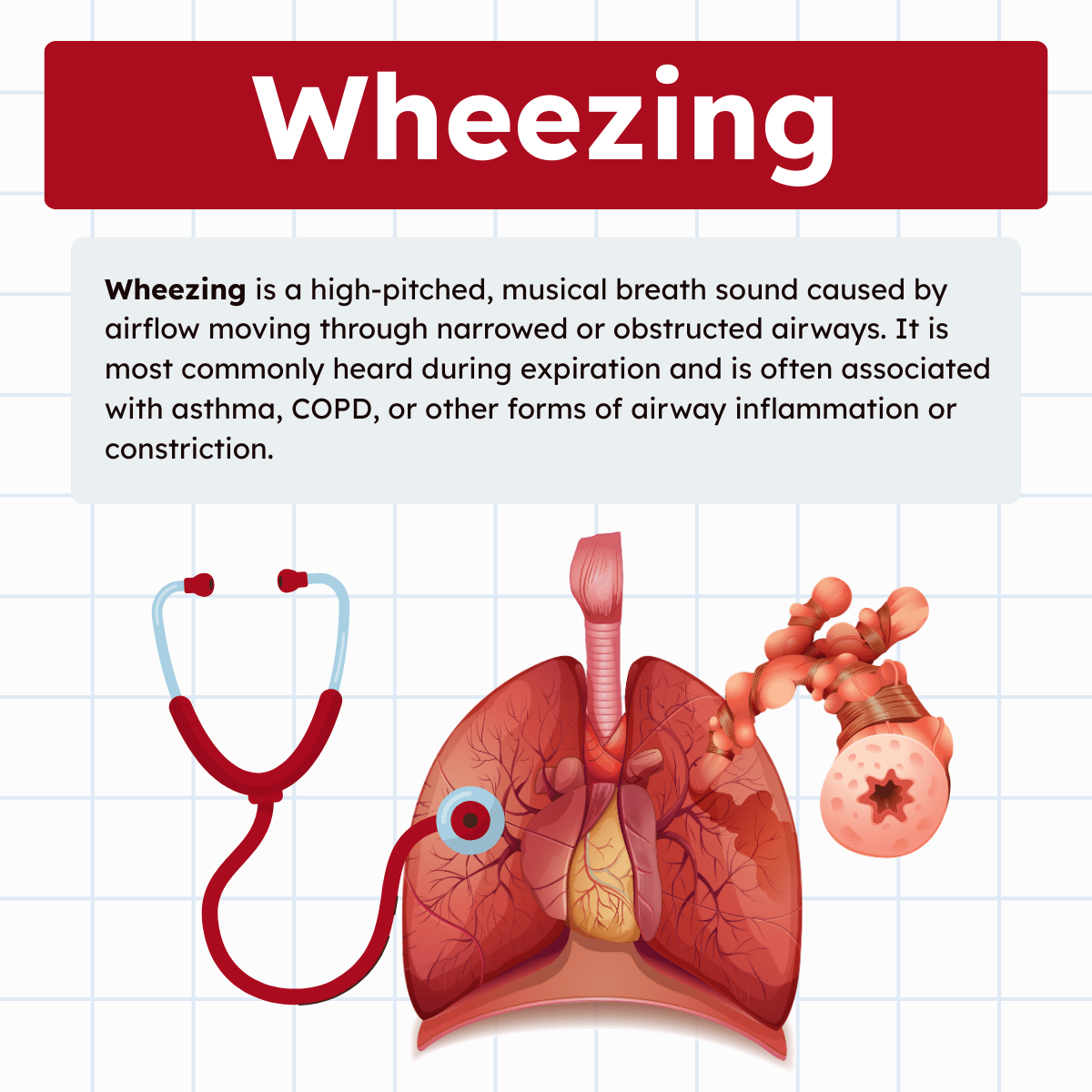
Wheezing is a continuous, musical lung sound produced when air flows at high velocity through narrowed or partially obstructed airways. Unlike crackles, which are brief and discontinuous, wheezes persist for a longer duration and can be heard during inspiration, expiration, or both. They may be loud or faint, isolated or diffuse, and vary in pitch depending on the degree of airway narrowing.
Physiologically, wheezing occurs through a repetitive cycle of airway narrowing and reopening. As air moves rapidly through a constricted airway, lateral wall pressure drops, causing the airway to collapse momentarily and halt airflow. When airflow stops, pressure rises again, allowing the airway to reopen. This cycle repeats many times per second, causing the airway walls to vibrate and producing the characteristic musical sound—much like air flowing across a reed instrument.
Wheezing is most commonly associated with obstructive lung diseases such as asthma or bronchitis, but it is not exclusive to these disorders. A wide range of upper- and lower-airway conditions can create wheeze-like sounds, making careful clinical interpretation essential for accurate diagnosis.
Types of Wheezing
Not all wheezes are the same. Their pitch, timing, and pattern help clinicians determine how many airways are affected and where the obstruction is located.
Monophonic Wheeze
A monophonic wheeze consists of a single musical note. It typically indicates obstruction in a single airway segment. This can occur with a localized blockage such as a tumor, foreign body, or a focal area of severe inflammation. Monophonic wheezing may be heard during inspiration, expiration, or both, depending on the location of the narrowing.
Polyphonic Wheeze
Polyphonic wheezing consists of multiple tones occurring simultaneously. This pattern suggests that many airways are constricted, narrowed, or inflamed at the same time. Because it reflects widespread airway involvement, polyphonic wheezing is characteristic of asthma and other diffuse obstructive diseases. Polyphonic wheezes are heard primarily during expiration, when intrathoracic pressure increases and airway narrowing becomes more pronounced.
Inspiratory vs. Expiratory Wheezing
- Expiratory wheezing is the most common and typically signals intrathoracic airway obstruction, as seen in asthma or bronchitis.
- Inspiratory wheezing is less common and may indicate upper-airway involvement or fixed obstruction.
- Biphasic wheezing (heard during both phases) suggests more severe or fixed obstruction, such as tracheal stenosis.
Note: Each pattern offers essential clues that help clinicians determine the severity and location of airway obstruction.
How Wheezing Is Produced
Wheezing originates from the mechanical effects of airflow passing through narrowed or partially obstructed airways. Several physiological events happen simultaneously to create this continuous, musical sound.
High-Velocity Airflow Through a Narrowed Airway
When an airway becomes narrowed because of bronchospasm, edema, mucus plugging, or structural obstruction, air must travel faster to pass through the restricted opening. This increase in flow velocity lowers lateral wall pressure within the airway. As the pressure drops, the airway walls collapse inward, briefly stopping airflow.
Repetitive Opening and Closing of the Airway
Once airflow ceases, the lateral pressure rises again, allowing the airway to reopen. This rapid cycle—narrowing, collapse, reopening—occurs many times per second and causes the airway walls to vibrate. These vibrations create the musical, sometimes almost whistling quality clinicians recognize as wheezing.
Lower vs. Upper Airway Sources
Although wheezing is typically associated with lower-airway obstruction, similar sounds can arise from the upper airway:
- Lower-airway wheezing usually reflects intrathoracic airway narrowing from asthma, bronchitis, or COPD.
- Upper-airway wheezing or high-pitched sounds may resemble wheezes but often represent stridor, which is linked to laryngeal or tracheal obstruction.
Note: Recognizing the physics behind wheezing helps clinicians understand the severity of airway compromise and anticipate changes in patient status.
Stridor vs. Wheezing: Understanding the Difference
Although both stridor and wheezing are continuous adventitious sounds caused by airflow through narrowed passages, they originate in different locations and signal very different types of airway compromise. Distinguishing between the two is essential because stridor often indicates a potentially life-threatening upper-airway obstruction.
What Is Stridor?
Stridor is a loud, high-pitched sound produced by turbulent airflow through a narrowed upper airway, typically at the level of the larynx or trachea. Unlike wheezing, which is generally heard with a stethoscope, stridor is often audible without any equipment. It occurs most frequently during inspiration, although it may sometimes be expiratory depending on the site of narrowing.
Common Causes of Stridor
Stridor occurs when a structural or inflammatory process restricts the upper airway. In infants and children, laryngomalacia is the most common chronic cause and croup is the most common acute cause. In adults, stridor often results from subglottic narrowing due to trauma, infection, or edema, such as in epiglottitis or after intubation.
- Inspiratory stridor suggests narrowing above the glottis.
- Expiratory stridor points to narrowing in the lower trachea.
Note: Because upper-airway obstruction can rapidly progress, the presence of stridor warrants urgent evaluation.
How Stridor Differs From Wheezing
Wheezing originates from the lower airways, usually due to bronchospasm, airway inflammation, or mucus plugging. Stridor, on the other hand, reflects obstruction in the upper airway. The two can sometimes be mistaken for one another, but careful assessment of timing, intensity, and location helps differentiate them.
Clinical Conditions Associated With Wheezing
Wheezing is commonly linked to obstructive lung conditions, but it can also appear in cardiac disorders or upper-airway abnormalities. Understanding the broad range of potential causes helps clinicians avoid misdiagnosis and select the correct interventions.
Asthma
Asthma is the classic condition associated with wheezing. Bronchospasm, airway inflammation, and mucus production narrow the airways, producing polyphonic expiratory wheezes. Asthmatic wheezing is often episodic and may be accompanied by shortness of breath, chest tightness, and cough. However, the absence of wheezing does not rule out asthma, especially during silent chest scenarios or mild episodes.
Chronic Bronchitis and COPD
Patients with COPD and chronic bronchitis may demonstrate both monophonic and polyphonic wheezes due to mucus plugging, airway inflammation, and loss of elastic recoil. Wheezing in COPD is often diffuse and persistent but may improve with bronchodilators or airway clearance therapy.
Congestive Heart Failure (Cardiac Wheezing)
CHF can cause wheezing due to fluid accumulation in the lungs, airway edema, and transient airway hyperreactivity. This “cardiac wheeze” can mimic asthma, making it challenging to distinguish between the two. Clues such as crackles, peripheral edema, cardiomegaly on chest X-ray, and poor response to bronchodilators help differentiate CHF from obstructive lung disease.
Foreign Body Aspiration
A foreign body lodged in a bronchus may produce a monophonic wheeze. This is especially common in children but can occur in adults as well. Persistent localized wheezing that does not respond to bronchodilators should raise suspicion for obstruction.
Tracheal Stenosis and Fixed Upper-Airway Obstruction
Narrowing of the trachea due to tumors, scarring, or prolonged intubation may produce a biphasic wheeze. Unlike asthma, this type of wheezing tends to be continuous, persistent, and unresponsive to bronchodilator therapy.
Vocal Cord Dysfunction
Vocal cord dysfunction can mimic asthma by producing expiratory wheezing or inspiratory stridor. Because the problem is at the level of the vocal cords rather than the lower airways, bronchodilators offer little benefit. Flow-volume loops and direct visualization help confirm the diagnosis.
Note: Wheezing alone cannot establish a diagnosis, but its characteristics provide valuable clues that, combined with history, imaging, and pulmonary testing, point clinicians toward the correct underlying cause.
How to Assess Wheezing During Auscultation
Accurate evaluation of wheezing requires a systematic approach and a clear understanding of how different airway conditions alter breath sounds. Respiratory therapists must listen carefully not only for the presence of wheezing but also its pitch, timing, and responsiveness to therapy.
Listen Through the Entire Respiratory Cycle
Wheezing may occur during inspiration, expiration, or both, and this timing provides key diagnostic information. Expiratory wheezing typically reflects intrathoracic airway narrowing, whereas inspiratory wheezing or biphasic wheezing may indicate upper-airway obstruction or fixed stenosis.
Assess Pitch, Intensity, and Musical Quality
High-pitched wheezes suggest tighter airway narrowing, whereas lower-pitched wheezes may indicate larger airway involvement. The sound may resemble a whistle, squeak, or musical vibration. Noting whether the wheeze is monophonic or polyphonic also helps determine whether the obstruction is focal or diffuse.
Compare Breath Sounds Symmetrically
Auscultate both lungs in a systematic pattern, comparing right to left at each level. Localized wheezing may indicate obstruction in a single bronchus, while bilateral diffuse wheezing often suggests asthma, COPD, or heart failure.
Check Response to Bronchodilator Therapy
Wheezing caused by bronchospasm usually improves after administration of a bronchodilator. Lack of improvement suggests alternative diagnoses such as tracheal stenosis, vocal cord dysfunction, or cardiac wheezing.
Consider Environmental and Positional Clues
Changes in patient position can alter airflow and airway caliber. Wheezing that worsens when lying flat may indicate CHF or upper-airway involvement. Positional variations contribute to accurate interpretation.
Note: Careful auscultation, paired with a strong understanding of airway physiology, allows clinicians to identify the source of wheezing accurately and respond with appropriate interventions.
When Wheezing Is Not Asthma: Conditions That Mimic Obstructive Disease
Although wheezing is most commonly associated with asthma, it is essential for clinicians to remember that not all wheezing originates from lower-airway bronchospasm. Misinterpreting the cause can delay proper treatment, especially when the true source involves the upper airway, structural obstruction, or cardiac dysfunction.
Fixed Upper-Airway Obstruction
Conditions such as tracheal tumors, subglottic stenosis, or scarring from prolonged intubation can produce continuous, persistent wheezing that does not respond to bronchodilators. Because the obstruction is structural rather than reactive, wheezing remains unchanged over time and may be heard during both inspiration and expiration.
Tracheal Stenosis
Narrowing of the trachea can occur from trauma, prolonged ventilatory support, infection, or autoimmune conditions. Patients often report months of unrelenting wheezing despite multiple inhaled or systemic medications. Flow–volume loops and bronchoscopy can help confirm the diagnosis by visualizing the airway narrowing.
Vocal Cord Dysfunction
Vocal cord dysfunction (VCD) involves inappropriate closure of the vocal cords during inspiration or expiration. Although it often presents with inspiratory stridor, VCD can also cause expiratory wheezing.
Because the problem stems from abnormal vocal cord movement rather than lower-airway constriction, bronchodilators typically have little or no effect. Direct visualization or characteristic findings on a flow–volume loop help differentiate VCD from asthma.
Foreign Body Aspiration
A partially obstructed airway caused by an aspirated foreign object, especially in children, can mimic asthma by producing monophonic wheezing. This presentation persists despite medication until the foreign body is removed. Sudden onset and unilateral wheezing are important clues.
Congestive Heart Failure (Cardiac Wheezing)
CHF may produce wheezing due to airway edema, fluid accumulation, and transient airway hyperreactivity. This “cardiac asthma” can sound similar to true bronchospasm. However, accompanying crackles, lower-extremity edema, orthopnea, and imaging findings help point toward a cardiac rather than pulmonary cause.
Note: Recognizing these alternative sources of wheezing helps prevent misdiagnosis and ensures that patients receive appropriate treatment based on the true underlying pathology.
Why Identifying Wheezing Matters in Respiratory Care
Wheezing provides vital diagnostic information and often serves as an early indicator of airway obstruction or respiratory compromise. For respiratory therapists, recognizing the characteristics of wheezing—and understanding what those characteristics mean—is essential for guiding treatment, evaluating severity, and determining whether the airway is at risk.
Early Recognition of Airway Narrowing
Wheezing often appears before oxygen saturation drops or imaging abnormalities develop. Detecting it early helps clinicians intervene quickly, whether through bronchodilator therapy, airway clearance techniques, or identifying the need for more advanced evaluation.
Monitoring Response to Therapy
Changes in the pitch, length, or intensity of wheezing can reflect improving or worsening airway obstruction. For example, a decrease in pitch and duration often indicates better expiratory flow after bronchodilator treatment. Persistent or worsening wheezing may signal severe obstruction, poor medication response, or an alternative cause that needs further assessment.
Distinguishing True Obstruction From Mimics
Because many conditions can produce wheeze-like sounds, accurate interpretation is crucial. Differentiating asthma from cardiac wheezing, or lower-airway disease from upper-airway obstruction, ensures that patients receive the correct treatment and avoids unnecessary or ineffective interventions.
Guiding Clinical Decisions
Wheezing can influence important decisions, such as whether to escalate bronchodilator therapy, initiate steroids, order imaging, perform a bronchoscopy, or evaluate for cardiac involvement. In patients on mechanical ventilation, new-onset wheezing may indicate bronchospasm, mucus plugging, or changes in airway pressure, prompting immediate bedside action.
Assessing Severity of Disease
The presence, location, and characteristics of wheezing help clinicians gauge the severity of airway narrowing. Diffuse polyphonic wheezing suggests widespread lower-airway involvement, whereas persistent monophonic wheezing may indicate a more serious focal obstruction.
Note: For respiratory therapists, auscultation remains a cornerstone of patient assessment. Understanding wheezing and its clinical implications allows for more precise interventions and improved outcomes across a wide range of respiratory conditions.
Wheezing Practice Questions
1. What is the definition of wheezing?
Wheezing is a high-pitched whistling sound made while breathing, typically caused by the narrowing or obstruction of the airways.
2. What are the causes of bronchoconstriction?
Bronchoconstriction can be caused by bronchospasm, mucosal edema, inflammation, tumors, foreign bodies, and pulmonary edema.
3. What does it indicate if a patient’s wheezing is very high-pitched during the entire expiratory time before treatment and becomes lower in pitch and duration after treatment?
This indicates that the bronchodilator is working and the patient’s condition has improved.
4. What is bilateral wheezing?
Bilateral wheezing refers to wheezing heard on both sides of the chest, indicating a generalized airway obstruction.
5. What is unilateral wheezing?
Unilateral wheezing refers to wheezing heard only on one side of the chest, often suggesting a localized obstruction, such as from a foreign body or tumor.
6. What is recommended for bilateral wheezing?
A bronchodilator is recommended for bilateral wheezing.
7. What is recommended for unilateral wheezing?
A bronchoscopy is recommended for unilateral wheezing to investigate and remove any obstruction.
8. What could cause a foreign body obstruction?
A foreign body obstruction could be caused by a bronchial mass (such as lung cancer) or a swallowed object.
9. What diseases can cause wheezing?
Diseases that can cause wheezing include Cystic Fibrosis, Bronchitis (Chronic), Asthma, Bronchiectasis, and Emphysema (CBABE).
10. What is a monophonic wheeze?
A monophonic wheeze is a wheeze that originates from a single airway partially obstructed, heard during inhalation and/or exhalation.
11. What is a polyphonic wheeze?
A polyphonic wheeze suggests that many airways are obstructed, typically heard during exhalation only, and is commonly associated with conditions like asthma, bronchitis, and CHF with pulmonary edema.
12. What is a wheeze?
A wheeze is a high-pitched noise that occurs when a person inhales and exhales due to the narrowing of the airway from the lungs. Air squeezing through the smaller spaces produces a squeaky or whistling sound, which can be heard with or without a stethoscope. A person who is wheezing may also experience chest tightness, difficulty breathing, and repeated coughing.
13. What are the main causes of wheezes?
The main causes of wheezes are inflammation, infection, irritation, injury, and illness.
14. What are the five I’s?
The five I’s are Inflammation, Infection, Irritation, Injury, and Illness.
15. How does inflammation cause wheezing?
Inflammation, such as that seen in asthma, causes wheezing by making the airways sensitive to environmental triggers, leading to swelling, increased mucus production, and spasms of the bronchial tubes. These triggers can include allergens like pollen, mold, and animal dander, as well as pollutants, physical activity, emotional stress, and certain medications. When air passes through the narrowed bronchial tubes, wheezes can be heard.
16. How does irritation cause wheezing?
Irritation from allergies, which are the immune system’s reaction to foreign invaders, narrows the bronchial tubes and leads to wheezing. The reaction produces antibodies and other components to fight against the substances, causing airway irritation. Symptoms can range from mild to life-threatening, such as anaphylaxis. Substances causing this reaction include foods, medications, insect stings, and cigarette smoke.
17. How does infection cause wheezing?
Infections in the respiratory tract, such as bronchitis and pneumonia, cause wheezing by narrowing the airways due to mucus production. Germs like bacteria, viruses, and fungi trigger the body to secrete mucus to fight against them and prevent germs from entering tissue spaces. The lining of the bronchial tubes becomes thick from the secretions, restricting airflow and producing wheezes.
18. How does injury cause wheezing?
Injuries to the lungs can lead to wheezing. For example, aspiration (inhaling a foreign object) can cause wheezing when only a small amount of air can pass around it, leading to complications like pneumonia and obstructed airways. In emphysema, damage to the lung air sacs disrupts normal airflow, resulting in wheezing.
19. How does illness cause wheezing?
Illnesses affecting air passage through the lungs can cause wheezing. In sleep apnea, throat muscles relax during sleep, blocking airflow. In epiglottitis, an infection causes swelling of the windpipe lid. Heart failure leads to excess fluid buildup in the lung air sacs, blocking airflow. These conditions can all result in wheezing when air flow is obstructed.
20. How to treat wheezing that occurs as a result of bronchospasm?
It should be treated with bronchodilators.
21. How to treat wheezing that occurs as a result of CHF/fluid overload?
It should be treated with diuretics and positive inotropic agents
22. How to treat wheezing that occurs as a result of a foreign body?
It requires a bronchoscopy for treatment.
23. During the assessment of a 72-year-old postoperative patient, you noticed distinct wheezing in both lung fields. Which of the following would you recommend?
Administer a bronchodilator
24. A 45-year-old asthmatic patient presents with severe wheezing despite using their rescue inhaler. What should be your next course of action?
Administer systemic corticosteroids.
25. During a routine check-up, a 60-year-old patient with a history of COPD reports increased wheezing and shortness of breath.
What would be an appropriate recommendation?
Adjust the dosage of the patient’s maintenance bronchodilator.
26. During the assessment of a 50-year-old patient with congestive heart failure, you noticed wheezing and crackles upon auscultation. Which of the following would you recommend?
Administer a diuretic
27. During the assessment of a child presenting with wheezing and a barking cough, they are suspected to have croup. Which of the following would you recommend?
Administer nebulized epinephrine
28. During the assessment of an elderly patient with a history of bronchiectasis, you noticed persistent wheezing unresponsive to bronchodilators. What further evaluation should be considered?
Perform a chest CT scan to check for underlying infections or obstructions
29. During the assessment of a patient with wheezing, high-pitched breath sounds, and a history of smoking, they are suspected of having COPD. What diagnostic test would you recommend?
Conduct spirometry to assess lung function
30. During the assessment of a patient presenting with wheezing and a productive cough, they are diagnosed with acute bronchitis. Which of the following would you recommend?
Prescribe an inhaled bronchodilator and encourage hydration
31. What does bilateral wheezing indicate?
Bilateral wheezing typically indicates bronchospasm and can be treated with a short-acting bronchodilator.
32. What does unilateral wheezing indicate?
Unilateral wheezing is an indication of a foreign body obstruction. In this case, you should recommend a bronchoscopy.
33. A 2-year-old boy was admitted to the emergency department showing signs of respiratory distress. Upon assessment, you heard wheezes in the right lung and normal lung sounds on the left side. Which of the following would you recommend?
Rigid bronchoscopy
34. During the assessment of a 67-year-old female patient, you noticed peripheral edema and wheezing on auscultation. Which of the following is the most likely cause of these findings?
Fluid overload
35. A 42-year-old female patient has been showing signs of dyspnea and wheezing for the past 24 hours. A bronchodilator was administered, but her condition did not improve. This describes which of the following conditions?
Status asthmaticus
36. A 57-year-old patient with a history of CHF presents to the emergency room with dyspnea, shortness of breath, and wheezing. Which of the following would you recommend?
Furosemide (Lasix)
37. During the assessment of a 72-year-old postoperative patient, you noticed distinct wheezing in both lung fields. Which of the following would you recommend?
Administer a bronchodilator
38. What is the first-line treatment for an acute asthma exacerbation causing wheezing?
Administer a short-acting beta-agonist (SABA), such as albuterol.
39. What diagnostic tool is most useful for identifying the cause of persistent wheezing in a non-smoker with no history of asthma?
Perform a chest X-ray to rule out structural abnormalities or other underlying conditions.
40. How does chronic obstructive pulmonary disease (COPD) cause wheezing?
COPD causes wheezing through the combination of bronchial inflammation, increased mucus production, and loss of lung elasticity, leading to narrowed airways.
41. What is the role of corticosteroids in the management of wheezing?
Corticosteroids reduce inflammation in the airways, helping to prevent and control wheezing episodes.
42. In what condition is wheezing most likely to be accompanied by stridor?
Croup, which is characterized by a barking cough and stridor, often seen in children.
43. What are the potential side effects of using bronchodilators for wheezing?
Potential side effects include tremors, tachycardia, headache, and palpitations.
44. Why might a patient with wheezing be prescribed a leukotriene receptor antagonist?
Leukotriene receptor antagonists, like montelukast, help reduce inflammation and bronchoconstriction, especially in asthma patients.
45. What lifestyle modifications can help reduce the frequency of wheezing episodes in asthmatic patients?
Avoiding allergens, smoking cessation, regular exercise, and maintaining a healthy weight can help reduce wheezing.
46. What is the significance of nocturnal wheezing in patients with asthma?
Nocturnal wheezing indicates poorly controlled asthma and may require adjustment of the patient’s medication regimen.
47. How can a peak flow meter be used in the management of wheezing?
A peak flow meter measures the patient’s maximum speed of expiration, helping to monitor asthma control and detect early signs of exacerbations.
48. During an asthma attack, what changes might you observe in peak expiratory flow rate (PEFR)?
You would observe a decreased PEFR, indicating airway obstruction and reduced airflow.
49. What is the role of anticholinergic medications in the treatment of wheezing?
Anticholinergic medications, like ipratropium, help to relax and widen the airways, reducing wheezing, especially in COPD patients.
50. How can environmental control measures help in managing wheezing in patients with allergic asthma?
Environmental control measures, such as using air purifiers, reducing exposure to allergens (dust mites, pet dander), and avoiding outdoor activities during high pollen counts, can help minimize triggers and reduce wheezing episodes.
51. What does a wheeze represent in terms of airway physiology?
A musical, continuous sound created by airflow vibrating through narrowed airways.
52. What type of adventitious lung sound is classified as continuous and musical in nature?
Wheezing
53. What produces the vibration responsible for wheezing?
High-velocity airflow moving through a constricted airway.
54. Why does airway narrowing increase the likelihood of wheezing?
Narrowing increases airflow velocity, reducing lateral wall pressure and causing airway fluttering.
55. What is the difference between monophonic and polyphonic wheezing?
Monophonic involves a single obstructed airway; polyphonic involves multiple obstructed airways.
56. What does monophonic wheezing often indicate?
A localized airway obstruction.
57. What does polyphonic wheezing typically suggest?
Diffuse airway obstruction, such as in asthma or bronchitis.
58. Why is wheezing most commonly heard during exhalation?
Intrathoracic airways narrow further during exhalation, intensifying turbulent airflow.
59. What does inspiratory wheezing most often indicate?
Upper airway obstruction.
60. What does expiratory wheezing most often indicate?
Intrathoracic airway obstruction consistent with obstructive lung diseases.
61. What condition commonly produces polyphonic expiratory wheezing?
Asthma
62. What condition may produce both wheezing and crackles due to airway inflammation and fluid overload?
Congestive heart failure with pulmonary edema.
63. What does a sudden decrease or disappearance of wheezing in a patient with severe asthma indicate?
Critically reduced airflow, suggesting worsening obstruction.
64. What differentiates wheezing from rhonchi in modern terminology?
Wheezes are musical; rhonchi describes low-pitched sounds caused by secretions, now considered coarse crackles.
65. What is stridor?
A high-pitched, continuous inspiratory sound caused by upper airway obstruction.
66. Where is stridor typically heard best?
Over the larynx and trachea.
67. What type of obstruction does inspiratory stridor indicate?
Narrowing above the glottis.
68. What type of obstruction does expiratory stridor indicate?
Narrowing within the lower trachea.
69. What is the most common cause of chronic stridor in infants?
Laryngomalacia
70. What is the most common acute cause of stridor in children?
Croup
71. What is a common cause of stridor in adults?
Laryngeal or subglottic edema from trauma or infection.
72. What effect does improved airflow have on wheezing characteristics?
It reduces both pitch and duration of the wheeze.
73. Why does bronchospasm produce wheezing?
Smooth muscle constriction narrows the airways, increasing turbulent airflow.
74. What condition should be suspected when wheezing is unilateral?
Foreign body aspiration or localized obstruction.
75. What causes polyphonic wheezing in CHF with pulmonary edema?
Widespread airway narrowing due to interstitial fluid and airway wall swelling.
76. What does the term “musical quality” refer to in wheezing?
The harmonic vibration of airway walls during airflow.
77. Why might wheezing be absent in advanced airway obstruction?
Airflow may be too minimal to generate vibration.
78. What does wheezing that worsens with forced expiration indicate?
Dynamic airway collapse common in obstructive lung disease.
79. What is the significance of wheezing that persists after bronchodilator therapy?
Airway edema, secretions, or fixed obstruction rather than reversible bronchospasm.
80. What differentiates wheezing from crackles in terms of timing and cause?
Wheezes are continuous and due to narrowing; crackles are discontinuous and due to airway opening or fluid.
81. Why is asthma considered a clinical diagnosis supported by testing rather than a test-only diagnosis?
Because symptoms may be intermittent and no single laboratory measurement definitively establishes asthma.
82. What classic symptoms raise suspicion for asthma?
Episodic wheezing, shortness of breath, chest tightness, and cough.
83. Why does the absence of wheezing not exclude asthma?
Because some asthma presentations—especially cough-variant—may involve cough as the only symptom.
84. What respiratory sound may be the only manifestation of cough-variant asthma?
A persistent dry cough without audible wheezing.
85. Why must clinicians consider causes of wheezing other than asthma?
Because upper airway obstruction, heart failure, and vocal cord dysfunction can all produce similar sounds.
86. What does continuous wheezing over months without improvement from bronchodilators suggest?
A condition mimicking asthma rather than typical reversible airway obstruction.
87. What is a key feature that argues against asthma in a patient with chronic, non-responsive wheezing?
Lack of improvement after bronchodilators and corticosteroids.
88. Which two types of disorders are important to consider when wheezing does not respond to therapy?
Upper airway disorders and cardiac conditions.
89. What upper airway pathology commonly mimics asthma by producing wheezing?
Tracheal stenosis
90. What fixed obstruction can cause persistent, non-reversible wheezing?
A tracheal tumor obstructing airflow.
91. What condition causes paradoxical vocal cord closure and may mimic asthma?
Vocal cord dysfunction.
92. What hallmark finding is associated with vocal cord dysfunction during inspiration?
Stridor caused by paradoxical adduction of the vocal cords.
93. Can vocal cord dysfunction produce wheezing on expiration?
Yes; it can cause expiratory wheezing when the cords close during exhalation.
94. What diagnostic test helps differentiate upper airway obstruction from asthma?
A flow-volume loop.
95. What flow-volume loop pattern suggests a fixed upper airway obstruction?
Flattening of both inspiratory and expiratory limbs.
96. What bedside or procedural exam can confirm vocal cord dysfunction?
Flexible laryngoscopy or bronchoscopy observing cord movement.
97. What cardiac condition is commonly mistaken for asthma due to wheezing?
Congestive heart failure.
98. What term describes wheezing caused by pulmonary edema in heart failure?
Cardiac wheeze
99. What lung sound, when present alongside wheezing, supports CHF rather than asthma?
Crackles (rales), especially at the lung bases.
100. What imaging finding may help differentiate CHF from asthma?
Cardiomegaly or pleural effusions on chest X-ray.
Final Thoughts
Wheezing is a key clinical finding that offers valuable insight into what is happening within a patient’s airways. By understanding how wheezes are produced, recognizing the differences between monophonic and polyphonic patterns, and identifying the many conditions that can mimic or cause wheezing, respiratory therapists can make more accurate and timely assessments.
Careful auscultation—combined with evaluation of pitch, timing, and response to therapy—helps distinguish true lower-airway obstruction from upper-airway abnormalities, cardiac causes, and structural disorders.
Because wheezing can signal anything from mild bronchospasm to life-threatening airway compromise, accurate interpretation is essential for guiding treatment decisions and optimizing patient outcomes.

Written by:
John Landry is a registered respiratory therapist from Memphis, TN, and has a bachelor's degree in kinesiology. He enjoys using evidence-based research to help others breathe easier and live a healthier life.
References
- Patel PH, Mirabile VS, Sharma S. Wheezing. [Updated 2023 May 1]. In: StatPearls [Internet]. Treasure Island (FL): StatPearls Publishing; 2024.
- Zimmerman B, Williams D. Lung Sounds. [Updated 2023 Aug 28]. In: StatPearls [Internet]. Treasure Island (FL): StatPearls Publishing; 2025.