
Passing the Clinical Simulation Exam (CSE) is the final and most critical hurdle on your journey to becoming a Registered Respiratory Therapist (RRT). While reaching this stage is a major accomplishment, it also represents a shift from simply learning information to demonstrating that you can apply it effectively in real-world clinical situations.
This exam is specifically designed to evaluate your ability to think like a clinician. It tests not only your foundational knowledge but also your clinical judgment, decision-making skills, and ability to prioritize patient care in simulated scenarios. In other words, it challenges you to bridge the gap between theory and practice.
It’s no secret that many students struggle with the CSE, even after successfully passing the TMC Exam. However, this is rarely due to a lack of intelligence or effort. More often, candidates fall into common and preventable traps that can significantly impact their performance.
With the right preparation strategy and mindset, these mistakes can be avoided. By understanding what to watch out for ahead of time, you can approach the exam with greater confidence and clarity.
In this article, we’ll break down the most common mistakes to avoid on the CSE and provide practical insights to help you stay on track. By recognizing these pitfalls early, you can turn them into opportunities for improvement and increase your chances of passing on your first (or next) attempt.

Take our free course to learn essential tips, insights, and strategies to pass the Clinical Simulation Exam (CSE) on your first (or next) attempt.
What are the Most Common Mistakes to Avoid On the Clinical Simulation Exam (CSE)?
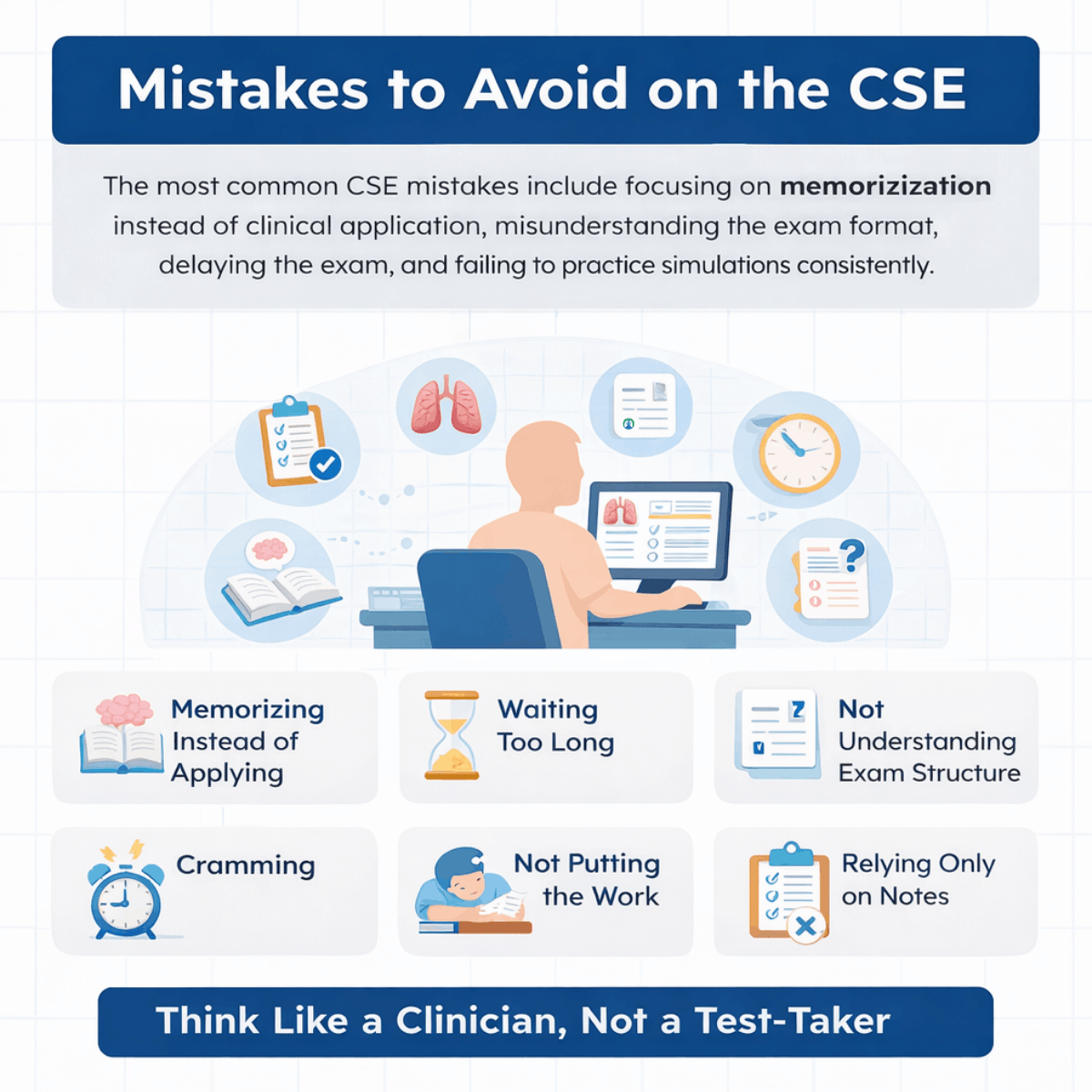
The most common mistakes to avoid on the Clinical Simulation Exam (CSE) include studying the wrong material, waiting too long to take the exam, and not understanding the exam’s structure. Many students focus too heavily on memorization instead of learning how to apply knowledge in clinical scenarios, which is the core of the CSE.
Delaying the exam after passing the TMC can also lead to knowledge loss and decreased confidence. Another major mistake is cramming the night before, which often results in fatigue and poor decision-making.
Additionally, some candidates underestimate the effort required and fail to put in consistent practice, especially with simulation-based questions. Relying solely on personal notes instead of using comprehensive study resources can also limit your preparation. Finally, giving up too soon or losing motivation after setbacks can prevent success. Avoiding these mistakes and staying committed to a structured study plan can significantly improve your chances of passing.
Mistakes to Avoid on the Clinical Simulation Exam (CSE)
The Clinical Simulation Exam (CSE) challenges your ability to think critically and apply knowledge in real-world patient scenarios. Watch this video and keep reading to learn how to avoid costly errors and improve your chances of passing on your first attempt.
Studying the Wrong Things
A critical mistake that many students make is spending too much time studying the wrong material. While it may feel productive to review textbooks, memorize definitions, or revisit lecture notes, this approach alone does not fully prepare you for the demands of the CSE.
The CSE is not a recall-based exam. Instead, it evaluates how well you can apply your knowledge in realistic clinical scenarios. This means you must be able to interpret patient data, select appropriate interventions, and make sound clinical decisions under pressure.
Focusing heavily on memorization without understanding how concepts are applied in practice can leave you unprepared when faced with simulation-based questions. You may recognize the information, but struggle to use it effectively in a clinical context.
To avoid this mistake, it’s essential to align your study efforts with the NBRC’s outlined competencies. These guidelines provide a clear roadmap of what you are expected to know and, more importantly, how you are expected to apply that knowledge.
Additionally, make sure to utilize resources that emphasize clinical reasoning and simulation practice. High-quality preparation materials will not only reinforce your understanding but also train you to think through patient scenarios step by step.
Note: By shifting your focus from passive memorization to active application, you’ll build the skills necessary to navigate the exam with confidence and precision.
Waiting Too Long to Take the Exam
Procrastination is another common mistake that can negatively impact your performance on the CSE. After passing the TMC Exam, it may be tempting to delay scheduling the CSE in hopes of feeling more prepared. However, this often has the opposite effect.
The longer you wait, the more likely it is that key concepts and clinical reasoning skills will begin to fade. Information that once felt fresh and familiar can become harder to recall, especially under the pressure of an exam setting.
The period immediately following the TMC Exam is when your knowledge base is strongest. This is the ideal time to reinforce what you’ve learned and transition into CSE-specific preparation, rather than allowing that momentum to slow down.
Instead of delaying, create a clear timeline for your exam date and commit to it. Having a structured plan helps maintain focus, encourages consistent study habits, and prevents unnecessary gaps in preparation. By taking the exam while your knowledge is still fresh, you give yourself a significant advantage and reduce the risk of needing to relearn material that you’ve already worked hard to master.
Note: While we generally suggest taking the CSE 1–3 weeks after you pass the TMC Exam, it’s important to adjust this timeline based on your individual learning style, confidence level, and readiness.
Not Understanding the Exam Structure
One of the most overlooked yet impactful mistakes is failing to fully understand the CSE’s unique structure before exam day. Unlike traditional multiple-choice exams, the CSE presents a series of clinical simulations that require you to make decisions in a step-by-step format.
Each scenario is designed to mimic real-life patient care, where you must gather information, interpret findings, and choose the most appropriate actions. Your selections directly influence how the scenario unfolds, making it essential to think critically at every step.
This format requires more than just knowledge. It demands strong clinical reasoning, prioritization skills, and the ability to avoid unnecessary or harmful interventions. Without familiarity with this structure, it’s easy to make strategic mistakes, even if you understand the underlying concepts.
For example, poor pacing, over-ordering diagnostic tests, or missing key decision points can all lead to lost points. This is why understanding how the exam is structured is just as important as knowing the content itself.
To prepare effectively, take advantage of practice simulations that replicate the actual exam experience. These tools help you become comfortable with the flow of the test and teach you how to approach each scenario methodically.
Additionally, consider using structured study resources that focus specifically on CSE strategies. These programs can help you develop a systematic approach, improve your decision-making, and build confidence before test day. By understanding the exam format ahead of time, you can avoid unnecessary mistakes, manage your time effectively, and approach each simulation with a clear and focused strategy.
Note: Becoming familiar with the exam format through repeated practice is one of the most effective ways to reduce anxiety and improve performance on test day.
Cramming the Night Before
Cramming the night before an exam may have helped you get through certain tests in respiratory therapy school, but it is not an effective strategy for the CSE. This exam requires more than short-term memorization. It demands clear thinking, clinical judgment, and the ability to apply knowledge in high-pressure scenarios.
While it may feel productive to review as much material as possible in the final hours, this approach often leads to mental fatigue, increased stress, and reduced cognitive performance on exam day. Instead of reinforcing your knowledge, cramming can overwhelm your brain and make it harder to recall important information when you need it most.
The CSE challenges you to think critically and make sound clinical decisions. These skills rely heavily on mental clarity and focus. If you enter the exam feeling exhausted or mentally overloaded, your ability to interpret patient data and choose appropriate interventions can be significantly impaired.
Rather than cramming, use the final hours before your exam for light review, confidence-building, and relaxation. Focus on reinforcing key concepts, reviewing your approach to clinical simulations, and ensuring you understand your strategy. Most importantly, prioritize rest so you can perform at your best.
Note: Walking into the exam well-rested and mentally prepared gives you a far greater advantage than trying to squeeze in last-minute information.
Not Willing to Put in the Work
Earning the RRT credential is a significant achievement, and the CSE requires a high level of commitment from those who want to succeed. Unfortunately, some students fall into the trap of complacency after passing the TMC Exam, assuming that the most difficult part is already behind them.
This mindset can lead to a dangerous mistake: underestimating the effort required to prepare for the CSE. While the TMC Exam focuses on knowledge recall, the CSE evaluates how well you can apply that knowledge in realistic clinical situations. This requires a deeper level of understanding and significantly more practice.
Success on the CSE is not achieved through minimal effort or casual review. It requires consistent study, active engagement with the material, and repeated exposure to clinical scenarios. Candidates who dedicate time to practicing simulations and refining their decision-making skills are far more likely to perform well.
To maximize your chances of success, commit to using comprehensive resources that are specifically designed for CSE preparation. These tools can help you build confidence, improve your clinical reasoning, and develop a systematic approach to each scenario.
Note: By putting in the necessary work and maintaining a disciplined study routine, you position yourself for success not only on the exam but also in your future clinical practice.
Thinking Your Notes Are Good Enough
While your personal notes can be helpful for reviewing key concepts, relying on them as your primary or only study resource is a common mistake. Notes are often limited in scope and may not fully capture the depth or breadth of information required for the CSE.
In some cases, your notes may even contain gaps or misunderstandings that can negatively impact your performance. Because the CSE emphasizes clinical application, it is essential to have a well-rounded understanding of respiratory care principles that goes beyond what is written in your notebook.
The exam requires you to analyze patient scenarios, interpret clinical data, and make appropriate decisions. These skills cannot be developed through passive review alone. Instead, they must be practiced through active learning and simulation-based exercises.
To strengthen your preparation, incorporate practice simulation problems into your study routine. These exercises help you apply your knowledge in a realistic context and improve your ability to think critically under pressure.
Additionally, consider using structured preparation programs like the CSE Boost Course, which includes 50+ in-depth video lessons designed to help students develop the skills needed to pass. These types of resources provide a more comprehensive and practical approach to studying.
Note: By expanding beyond your notes and engaging with a variety of high-quality materials, you can build a stronger foundation and improve your ability to perform on exam day.

Giving Up
The path to passing the CSE is not always easy. Many students experience frustration, setbacks, and moments of self-doubt along the way. However, one of the most damaging mistakes you can make is allowing these challenges to push you toward giving up.
Like any worthwhile goal, success on the CSE requires persistence, resilience, and a willingness to keep moving forward despite difficulties. It’s important to recognize that setbacks are a normal part of the learning process, not a sign of failure.
Instead of becoming discouraged, use these challenges as opportunities to identify areas for improvement. Reflect on what went wrong, adjust your study strategy, and continue building your skills. Every obstacle you overcome brings you one step closer to your goal.
Seeking support can also make a significant difference. Connect with classmates, join study groups, or reach out to mentors who can provide guidance and encouragement. Surrounding yourself with a supportive network can help you stay motivated and accountable.
Most importantly, remember why you chose this profession. Keeping your long-term goals in mind can provide the motivation you need to push through difficult moments and stay committed to your success.
Note: With determination and persistence, you can overcome the challenges of the CSE and achieve your goal of becoming an RRT.
How to Avoid These CSE Mistakes
Understanding the most common mistakes on the Clinical Simulation Exam (CSE) is only half the battle. The next step is knowing exactly how to avoid them. By implementing a structured approach to your preparation, you can eliminate guesswork, improve your confidence, and significantly increase your chances of passing on your first (or next) attempt.
First, focus on active learning rather than passive review. Instead of simply rereading notes or watching videos, spend the majority of your time working through clinical simulation scenarios. This trains your brain to think critically and apply knowledge in real time, which is exactly what the CSE requires.
Second, create a clear and realistic study plan. Break your preparation into manageable sessions that include reviewing key concepts, practicing simulations, and analyzing your mistakes. Consistency is far more effective than last-minute cramming.
Third, develop a systematic approach to each simulation. Always start by gathering the necessary patient information before jumping to conclusions. Avoid the temptation to select treatments too early, and instead focus on building a complete clinical picture before making decisions.
Finally, review your mistakes carefully. Every incorrect decision is an opportunity to improve. By understanding why an answer was wrong and what the correct approach should have been, you strengthen your clinical reasoning skills and reduce the likelihood of repeating the same mistake.
Key Strategies for Success on the CSE
In addition to avoiding common mistakes, there are specific strategies that can help you perform more effectively during the exam. These techniques are designed to align your thinking with how the NBRC evaluates candidates.
One of the most important strategies is learning to think like the NBRC. This means prioritizing patient safety, selecting the most appropriate and least invasive interventions first, and avoiding unnecessary tests or treatments. Over-ordering diagnostics or jumping ahead in the treatment process can cost you valuable points.
Another key strategy is recognizing the difference between information-gathering and decision-making phases. Early in a scenario, your focus should be on collecting relevant data, such as patient history, vital signs, and diagnostic results. Only after you have enough information should you begin making clinical decisions.
Time management is also critical. Avoid spending too much time second-guessing yourself. Make thoughtful decisions, trust your training, and move forward with confidence. Overthinking can lead to unnecessary changes in your answers and reduce your overall efficiency.
Lastly, practice maintaining a calm and focused mindset. The CSE can be stressful, but staying composed allows you to think clearly and make better decisions throughout each scenario.
Example of a Common CSE Mistake
To better understand how these mistakes play out, consider this example:
A patient presents with shortness of breath and low oxygen saturation. Instead of first reviewing the patient’s history, vital signs, and arterial blood gas results, a student immediately selects multiple diagnostic tests and initiates treatments.
This approach can lead to point deductions because the student skipped the information-gathering phase and selected unnecessary interventions. On the CSE, it’s essential to follow a logical sequence: assess first, then decide.
A better approach would be to gather all relevant data, interpret the findings, and then choose the most appropriate and targeted intervention. This demonstrates clinical reasoning and aligns with how the exam is scored.
Quick Recap: CSE Mistakes to Avoid
- Focusing too much on memorization instead of clinical application
- Delaying the exam and losing momentum after the TMC
- Not understanding how the simulation format works
- Cramming the night before instead of resting
- Underestimating the effort required to prepare
- Relying only on personal notes
- Losing motivation or giving up after setbacks
Note: By keeping these points in mind and following a structured preparation strategy, you can approach the CSE with confidence and significantly improve your chances of success.
Final Thoughts
Navigating the Clinical Simulation Exam (CSE) can feel overwhelming, but it is also one of the most important and rewarding milestones in your journey toward becoming a respiratory therapist.
By recognizing and avoiding the common mistakes outlined in this article, you can significantly improve your chances of passing. More importantly, you will develop the clinical reasoning and decision-making skills that are essential for providing high-quality patient care.
The CSE is more than just a test. It is a reflection of your readiness to step into a clinical role and make informed, effective decisions that impact patient outcomes. Preparing for it properly not only helps you pass the exam but also prepares you for real-world responsibilities.
Stay focused, remain disciplined, and approach your preparation with a clear strategy. Consistent effort, combined with the right resources and mindset, will set you apart.
Your hard work and dedication will pay off. By staying committed and avoiding these common pitfalls, you can move forward with confidence and take the next step toward a successful career as a Registered Respiratory Therapist (RRT).

Written by:
John Landry is a registered respiratory therapist from Memphis, TN, and has a bachelor's degree in kinesiology. He enjoys using evidence-based research to help others breathe easier and live a healthier life.
References
- The National Board for Respiratory Care. Clinical Simulation Examination (CSE). Published: January 1, 2020.