
Becoming a respiratory therapist requires a combination of academic preparation, clinical training, and professional credentialing. While the path is relatively straightforward compared to many other healthcare careers, the exact timeline can vary depending on the educational route you choose and how quickly you complete each step.
Some students enter the field in just a couple of years, while others take a longer, more advanced path to expand their opportunities. Understanding how long it takes and what each stage involves can help you plan your journey with clarity and confidence.

How Long Does It Take to Become a Respiratory Therapist?
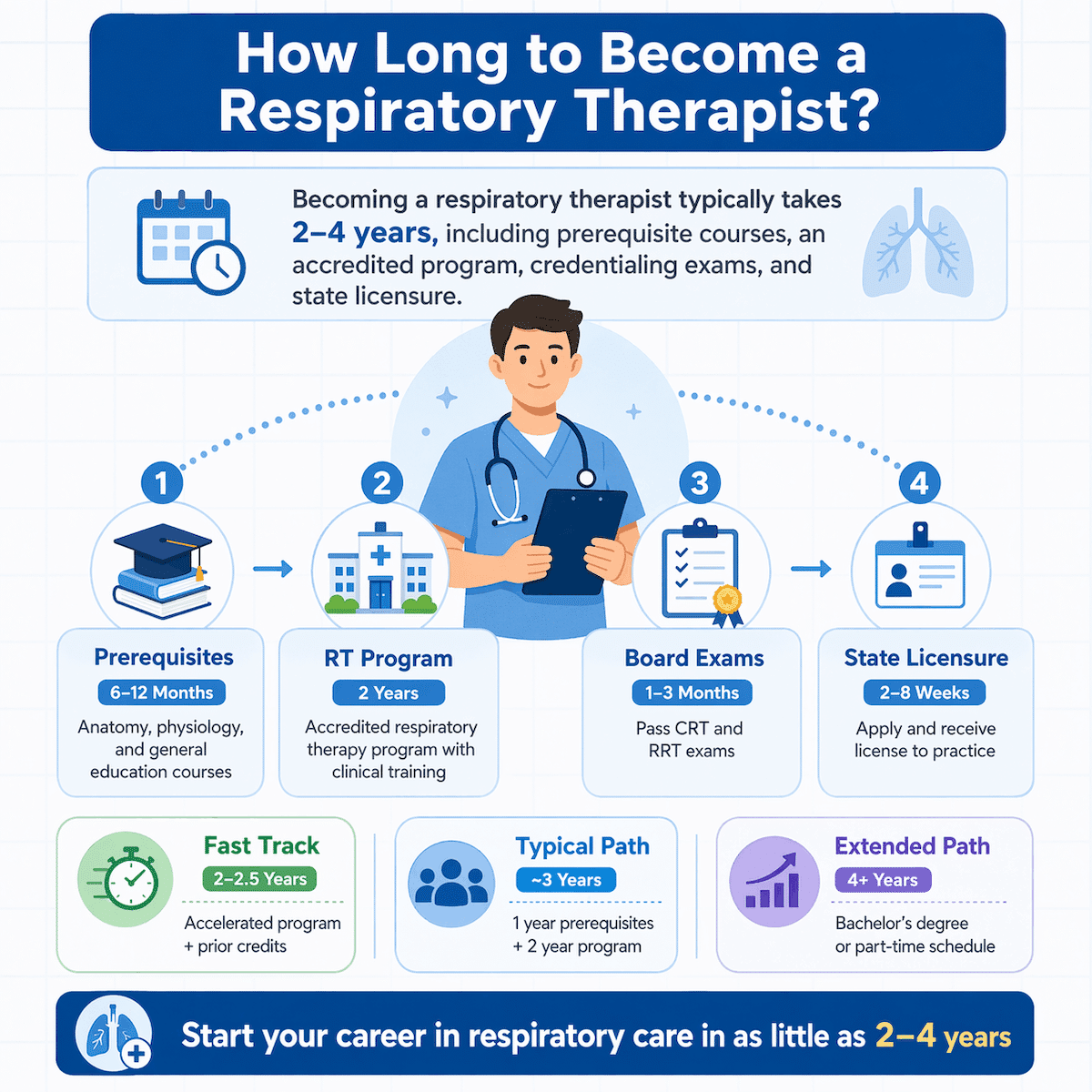
In most cases, it takes between two and four years to become a respiratory therapist. This timeframe includes completing prerequisite coursework, graduating from an accredited respiratory therapy program, and obtaining the necessary credentials to begin practicing.
For many students, the most direct path involves earning an associate degree, which typically takes about two years once admitted into a program. However, when you factor in prerequisite courses, the total time often extends to around three years. Students who pursue a bachelor’s degree or take a slower academic pace may spend closer to four years completing their education.
There are also accelerated pathways available. These programs are designed for individuals who have already completed general education or healthcare-related coursework. In these cases, it may be possible to complete the professional phase of training in as little as 18 to 24 months. Ultimately, the timeline depends on several factors, including your starting point, chosen degree level, and how quickly you move through each stage of the process.
Overview of the Educational Path
The journey to becoming a respiratory therapist follows a structured sequence. Each step builds on the previous one and contributes to the overall timeline.
High School Preparation
The process begins in high school or with obtaining a GED. While this stage is often overlooked, it plays an important role in setting the foundation for future success.
Students interested in respiratory therapy should focus on subjects such as biology, chemistry, algebra, and physics. These courses help develop the scientific understanding needed for more advanced topics later on. Strong performance in these areas can also make it easier to gain admission into competitive respiratory therapy programs.
Note: Although high school does not directly count toward the professional timeline, it prepares students for the academic rigor they will encounter in college.
Prerequisite College Courses
Before entering a respiratory therapy program, most colleges require students to complete a set of prerequisite courses. These are typically taken at a community college or university and may take one year to complete, depending on the student’s schedule.
Common prerequisites include:
- Human anatomy and physiology
- Microbiology
- Chemistry
- College algebra or statistics
- English composition
- Psychology or general education electives
Some students complete these courses quickly by taking a full course load, while others may spread them out over a longer period due to work or personal responsibilities. This is one of the main reasons the overall timeline can vary from person to person.
Note: Students who already hold a degree or have completed similar coursework may be able to skip this step or finish it more quickly.
Accredited Respiratory Therapy Program
After completing prerequisites, the next step is enrolling in an accredited respiratory therapy program. This is the core component of your training and typically takes two years to complete for an associate degree.
These programs are offered at community colleges, technical schools, and universities. Accreditation is essential because it ensures that the program meets established educational standards and qualifies graduates to take national board exams.
During this phase, students complete both classroom instruction and clinical training. The curriculum is designed to provide a comprehensive understanding of respiratory care, preparing students to work in real-world healthcare settings.
Note: Some universities offer bachelor’s degree programs, which may take four years in total. These programs often include additional coursework in leadership, research, and advanced clinical topics.
What You Learn in Respiratory Therapy School
Respiratory therapy programs cover a wide range of subjects that prepare students to assess, treat, and manage patients with cardiopulmonary conditions.
Core Scientific Knowledge
Students begin by building a strong foundation in respiratory anatomy and physiology. This includes learning how the lungs function, how gas exchange occurs, and how breathing is regulated.
They also study pathology, which focuses on diseases that affect the respiratory system. This helps students understand conditions such as asthma, chronic obstructive pulmonary disease, pneumonia, and respiratory failure.
Pharmacology is another essential component. Students learn about medications used in respiratory care, including bronchodilators, corticosteroids, and other drugs that affect the airways and lungs.
Clinical and Technical Skills
In addition to theory, students develop hands-on skills that are critical for patient care.
These include:
- Administering oxygen therapy
- Delivering aerosol medications
- Performing airway management techniques
- Operating mechanical ventilators
- Conducting pulmonary function tests
- Drawing and analyzing arterial blood gases
Note: Students also learn how to assess patients, interpret diagnostic data, and make clinical decisions based on their findings.
Clinical Rotations
One of the most important parts of respiratory therapy school is clinical training. Students complete rotations in hospitals and other healthcare settings, where they work under the supervision of experienced respiratory therapists.
These rotations provide real-world experience and allow students to apply what they have learned in the classroom. They may work in areas such as:
- Intensive care units
- Emergency departments
- Neonatal and pediatric units
- General medical floors
Note: Clinical experience is required for graduation and is a key factor in preparing students for entry-level practice.
Associate Degree vs. Bachelor’s Degree Timeline
One of the biggest decisions that affects how long it takes to become a respiratory therapist is the type of degree you pursue.
Associate Degree
An associate degree is the most common pathway. It typically takes:
- 1 year of prerequisites
- 2 years in the respiratory therapy program
Note: The total time is about 3 years. This option allows students to enter the workforce relatively quickly while still meeting all requirements for licensure and certification.
Bachelor’s Degree
A bachelor’s degree in respiratory therapy usually takes 4 years to complete. This includes both general education and professional coursework. Some students choose this route because it offers additional opportunities for career advancement. It may also be preferred by certain employers, especially for leadership or specialized roles.
Note: In some cases, students complete an associate degree first and then enroll in a bridge program to earn their bachelor’s degree while working.
Accelerated and Alternative Pathways
Not all students follow the traditional timeline. There are alternative pathways that can shorten or extend the process.
Accelerated Programs
Accelerated respiratory therapy programs are designed for students who have already completed prerequisite coursework. These programs focus only on the core respiratory curriculum and clinical training.
In some cases, students can complete their education in 18 to 24 months, making this the fastest route into the profession. However, these programs are often intensive and require a significant time commitment.
Part-Time and Flexible Options
Some students choose to complete their education on a part-time basis. This can be helpful for those who are working or have family responsibilities.
While this approach offers flexibility, it can extend the timeline to four years or longer, depending on how many courses are taken each semester.
Bridge Programs
Bridge programs are designed for individuals who are already working in healthcare or who have an associate degree in respiratory therapy. These programs allow students to earn a bachelor’s degree in a shorter period, often one to two additional years.
What Happens After Graduation?
Graduating from an accredited program is a major milestone, but it is not the final step. There are additional requirements before you can begin working as a respiratory therapist.
National Board Exams
After completing your education, you must pass the credentialing exams offered by the National Board for Respiratory Care (NBRC).
Most graduates earn the Certified Respiratory Therapist (CRT) credential or Registered Respiratory Therapist (RRT) credential, which is considered the standard for advanced practice.
Note: Preparing for and passing these exams can take several weeks to a few months, depending on the individual.
State Licensure
In addition to national credentials, most states require respiratory therapists to be licensed. The requirements vary, but they generally include:
- Graduation from an accredited program
- Passing the NBRC exam
Note: The licensure process can take anywhere from a few weeks to a couple of months, depending on the state and how quickly paperwork is processed.
Total Time to Start Working
When you combine all the steps, the total time to become a respiratory therapist typically looks like this:
- Associate pathway: about 3 years
- Bachelor’s pathway: about 4 years
- Accelerated pathway: about 2 to 2.5 years
Note: After passing exams and obtaining licensure, most graduates can begin working shortly thereafter.
Day-to-Day Responsibilities of a Respiratory Therapist
Understanding what respiratory therapists actually do on the job provides important context for why the education and training timeline is structured the way it is. The role requires a balance of technical skill, clinical judgment, and patient interaction.
Respiratory therapists are responsible for assessing patients with breathing disorders and implementing appropriate treatments. This often begins with reviewing a patient’s medical history, evaluating symptoms, and performing a physical assessment. From there, therapists may recommend or initiate therapies based on physician orders and clinical findings.
Common responsibilities include administering oxygen therapy, delivering aerosolized medications, and managing airway clearance techniques. In more critical settings, therapists play a key role in managing patients on mechanical ventilation, adjusting settings, monitoring responses, and assisting with weaning.
They are also trained to respond to emergencies such as respiratory failure or cardiac arrest. In these situations, respiratory therapists often assist with intubation, provide ventilation support, and participate in rapid response or code teams.
In addition, they perform diagnostic procedures such as pulmonary function tests and arterial blood gas analysis. These tests help evaluate lung function and guide treatment decisions.
Note: Because of the complexity of these responsibilities, the educational process is designed to ensure that graduates are prepared to handle a wide range of clinical scenarios safely and effectively.
Skills Required to Succeed in Respiratory Therapy
The time it takes to become a respiratory therapist is not only about completing coursework. It also involves developing a specific set of skills that are essential for patient care. One of the most important is clinical competence. Respiratory therapists must be able to apply their knowledge in real time, especially when working with critically ill patients. This includes interpreting data, recognizing changes in patient condition, and making informed decisions.
Technical proficiency is equally important. Therapists work with a variety of medical devices, including ventilators, oxygen delivery systems, and monitoring equipment. Understanding how to operate and troubleshoot this equipment is a key part of the job.
Communication skills also play a major role. Respiratory therapists interact with patients, families, and healthcare teams on a daily basis. They must be able to explain procedures, provide education, and collaborate effectively with other professionals.
Attention to detail is critical when administering treatments and documenting patient information. Even small errors can have significant consequences in a clinical setting. In addition, respiratory therapists must have emotional resilience. They often work with patients who are critically ill or experiencing significant distress. Maintaining professionalism while providing compassionate care is an essential part of the role.
Note: These skills are developed gradually throughout the educational process, particularly during clinical training.
Factors That Can Affect the Timeline
While the general timeline to become a respiratory therapist falls between two and four years, several factors can influence how long it actually takes. One of the most significant factors is whether a student attends school full-time or part-time. Full-time students typically complete prerequisites and program requirements more quickly, while part-time students may take longer due to a reduced course load.
Another factor is the availability of respiratory therapy programs. Some programs have competitive admissions and limited enrollment, which can result in waitlists. This may delay the start of the professional phase of training.
Academic performance can also play a role. Students who struggle with prerequisite courses or program requirements may need additional time to complete them. Personal responsibilities, such as work or family obligations, can further impact the pace at which a student progresses. Many individuals balance school with other commitments, which can extend the timeline.
In some cases, students may choose to pursue additional certifications or advanced degrees, which adds to the total time but may enhance career opportunities.
Note: Understanding these variables can help prospective students set realistic expectations and plan accordingly.
Cost and Time Investment Considerations
In addition to time, becoming a respiratory therapist requires a financial investment. The cost can vary widely depending on the type of program and institution. Community college programs are generally more affordable and are often the most cost-effective option for earning an associate degree. Tuition at public institutions is typically lower, especially for in-state students.
Bachelor’s degree programs at universities may have higher tuition costs, but they can provide additional opportunities for advancement in the long term.
Students should also consider the cost of textbooks, uniforms, clinical supplies, and examination fees. The credentialing exams offered by the National Board for Respiratory Care (NBRC) require payment, as does the application for state licensure.
Despite these costs, respiratory therapy is often considered a worthwhile investment due to the relatively short training period and strong job outlook. Many graduates are able to enter the workforce within a few years and begin earning a stable income.
Note: Financial aid, scholarships, and grants may be available to help offset costs. Some employers also offer tuition reimbursement for employees who pursue further education.
Career Outlook and Job Opportunities
The demand for respiratory therapists continues to grow, which is another important factor to consider when evaluating the time required to enter the field.
According to data from the U.S. Bureau of Labor Statistics (BLS), employment for respiratory therapists is expected to increase in the coming years. This growth is driven by an aging population, increased prevalence of chronic respiratory diseases, and ongoing needs within healthcare systems.
Respiratory therapists work in a variety of settings, including hospitals, outpatient clinics, rehabilitation centers, and home care environments. Hospitals remain the most common workplace, particularly in intensive care units and emergency departments.
There are also opportunities to specialize in areas such as neonatal and pediatric care, pulmonary rehabilitation, and sleep medicine. Some therapists move into roles in education, research, or management over time.
Note: The relatively short timeline to enter the profession, combined with strong demand, makes respiratory therapy an appealing option for individuals interested in healthcare careers.
Continuing Education and Career Advancement
Becoming a respiratory therapist is not the end of the educational journey. Continuing education is required to maintain credentials and stay current with advances in the field. Respiratory therapists must complete ongoing education to maintain their certification through the National Board for Respiratory Care (NBRC) and meet state licensure requirements. This ensures that they remain competent and up to date with evolving practices.
Many therapists choose to pursue advanced credentials or specialize in specific areas of care. For example, certifications in neonatal or pediatric respiratory care can open doors to specialized roles. Others may return to school to earn a bachelor’s or master’s degree. These advanced degrees can lead to opportunities in leadership, education, or research.
Note: While additional education extends the timeline beyond initial entry into the field, it can provide long-term benefits in terms of career growth and earning potential.
Is Respiratory Therapy a Good Career Choice?
For many individuals, respiratory therapy offers a balanced combination of relatively short training time and meaningful clinical work. Compared to other healthcare professions that may require extensive schooling, respiratory therapy provides a faster path to entering the workforce. At the same time, it offers opportunities to work closely with patients and make a direct impact on their health.
The role is well-suited for individuals who enjoy science, problem-solving, and hands-on patient care. It also requires adaptability, as therapists often work in fast-paced environments where patient conditions can change quickly. While the job can be demanding, particularly in critical care settings, it also provides a sense of purpose and professional fulfillment.
Note: Understanding both the timeline and the nature of the work can help you decide whether this career aligns with your goals.
Step-by-Step Timeline Breakdown
To better understand the timeline for becoming a respiratory therapist, it helps to break the process into clear, step-by-step stages. Although individual paths may differ, the following outline reflects a typical progression for most students.
Step 1: High School Diploma or GED (4 Years)
The journey begins with completing high school or earning a GED. During this time, students should focus on science and math courses that will prepare them for college-level work.
Although this stage is part of general education, it plays a critical role in building the academic foundation needed for success in a respiratory therapy program.
Step 2: Complete Prerequisite Courses (6–12 Months)
After high school, most students spend about one year completing prerequisite courses. These classes are required for admission into an accredited respiratory therapy program.
Some students may finish faster if they take a full course load or already have transferable credits. Others may take longer if balancing work or family responsibilities.
Step 3: Enroll in an Accredited Program (2 Years)
Once accepted into a respiratory therapy program, students typically spend two years completing both classroom instruction and clinical training.
This is the most intensive phase of the journey. Students learn core respiratory concepts, develop clinical skills, and gain hands-on experience through rotations in healthcare settings. At the end of this stage, graduates earn an associate degree and become eligible to take credentialing exams.
Step 4: Pass Credentialing Exams (1–3 Months)
After graduation, students must pass national board exams administered by the National Board for Respiratory Care (NBRC).
The process typically involves:
- Earning the Certified Respiratory Therapist (CRT) credential
- Advancing to the Registered Respiratory Therapist (RRT) credential
Note: Preparation time varies, but most graduates spend several weeks reviewing material before taking the exams.
Step 5: Obtain State Licensure (2–8 Weeks)
After passing the required exams, graduates must apply for licensure in their state. This process includes submitting documentation, verifying credentials, and paying licensing fees.
The timeline depends on how quickly the application is processed, but most candidates receive their license within a few weeks.
Step 6: Begin Working as a Respiratory Therapist
Once licensed, you can begin working in a clinical setting. Many graduates secure employment shortly after completing their exams, especially in areas with high demand.
At this point, the total time investment is typically around three years for the associate degree pathway.
Fastest vs. Longest Timeline Scenarios
Fastest Possible Path
The fastest route to becoming a respiratory therapist usually involves:
- Completing prerequisites in advance or already having college credits
- Enrolling in an accelerated program
- Passing exams on the first attempt
Note: In this scenario, it is possible to enter the workforce in as little as 2 to 2.5 years.
Typical Timeline
For most students, the process looks like this:
- 1 year of prerequisites
- 2 years in an accredited program
- A few months for exams and licensure
Note: The total time is about 3 years. This is considered the standard pathway.
Longest Timeline
Some students may take longer due to:
- Attending school part-time
- Waiting for program admission
- Pursuing a bachelor’s degree
- Balancing other responsibilities
Note: In these cases, the timeline may extend to 4 years or more.
Can You Become a Respiratory Therapist Faster?
Many prospective students want to know if there is a way to shorten the timeline. While there are options, they come with trade-offs. Accelerated programs are the most common way to reduce the time required. However, they are often more demanding and require a strong academic background.
Another option is completing prerequisite courses ahead of time, even during high school, through dual enrollment programs. This can significantly reduce the time spent before entering a professional program.
Some students also take summer courses to stay on track or graduate earlier. While it is possible to move faster, it is important to ensure that you fully understand the material and are prepared for clinical practice.
Comparing Respiratory Therapy to Other Healthcare Careers
One reason respiratory therapy is appealing is the relatively short time required to enter the field compared to other healthcare professions.
For example, becoming a registered nurse can take two to four years, depending on the degree. Physical therapists typically require a doctoral degree, which can take seven years or more. Physicians require extensive education and training that often exceeds a decade.
In contrast, respiratory therapy allows individuals to begin working in a specialized healthcare role in a shorter period. This makes it an attractive option for those who want to enter the medical field without a long educational commitment.
Work-Life Balance During Training
The time commitment required to become a respiratory therapist is not just about the number of years. It also involves the intensity of the training. Respiratory therapy programs are known for being demanding. Students must balance lectures, lab work, and clinical rotations, often within the same week.
Clinical rotations may require early mornings, long shifts, or weekend hours. This schedule is designed to reflect real-world healthcare environments. Many students find it helpful to develop strong time management skills and maintain a consistent study routine. Support from family, friends, and classmates can also make a significant difference.
Note: While the training period can be challenging, it is temporary and leads to a stable and rewarding career.
Final Thoughts
Becoming a respiratory therapist typically takes between two and four years, depending on your educational path and personal circumstances. The most common route involves completing prerequisite courses followed by a two-year accredited program, along with passing credentialing exams and obtaining state licensure.
While the timeline may vary, the process is structured to ensure that graduates are well-prepared to provide safe and effective patient care. For those interested in a healthcare career that offers a relatively quick entry point, strong job demand, and meaningful clinical work, respiratory therapy is a practical and worthwhile option.

Written by:
John Landry is a registered respiratory therapist from Memphis, TN, and has a bachelor's degree in kinesiology. He enjoys using evidence-based research to help others breathe easier and live a healthier life.
References
- Rickards T, Kitts E. The roles, they are a changing: Respiratory Therapists as part of the multidisciplinary, community, primary health care team. Can J Respir Ther. 2018.