

Atelectasis is a common and clinically significant condition encountered in respiratory care, characterized by the collapse of alveoli and a reduction in lung volume. It frequently occurs in hospitalized patients, especially those who are postoperative, immobilized, or experiencing impaired airway clearance.
Although often reversible, atelectasis can lead to serious complications if not recognized and treated promptly.
Understanding its underlying mechanisms, causes, and clinical implications is essential for respiratory therapists and healthcare professionals, as it directly impacts patient assessment, oxygenation, and the selection of appropriate therapeutic interventions.

What Is Atelectasis?
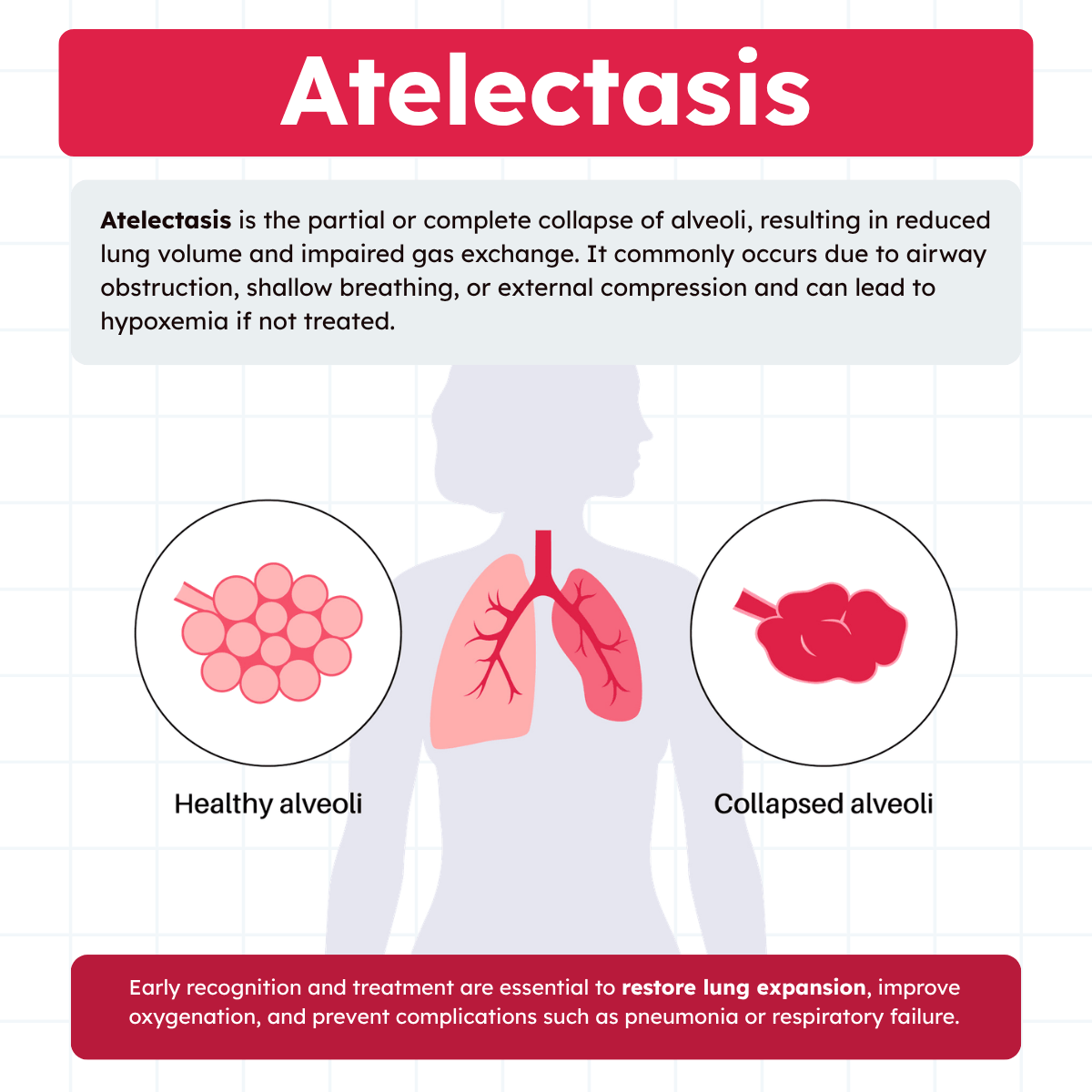
Atelectasis refers to the partial or complete collapse of alveoli, resulting in reduced or absent gas exchange in the affected portion of the lung. When alveoli collapse, they are no longer ventilated, which disrupts normal oxygen and carbon dioxide exchange. This leads to a mismatch between ventilation and perfusion, often resulting in hypoxemia.
The condition may involve a small segment of the lung or extend to an entire lobe, depending on the underlying cause. Because of its impact on gas exchange and lung mechanics, atelectasis is a key concept in both patient care and exam preparation for respiratory therapy students.
Basic Lung Physiology Relevant to Atelectasis
To understand atelectasis, it is important to review how normal alveoli function. The alveoli are tiny air sacs where gas exchange occurs. They must remain open and stable to allow oxygen to enter the bloodstream and carbon dioxide to be removed.
Several factors help keep alveoli open:
- Surfactant reduces surface tension within the alveoli, preventing collapse
- Adequate ventilation ensures that fresh air replenishes oxygen
- Normal lung compliance allows the lungs to expand easily
- Functional respiratory muscles generate sufficient tidal volume
Note: When any of these factors are disrupted, the alveoli become susceptible to collapse. Atelectasis occurs when the balance between forces that keep the alveoli open and those that promote collapse is lost.
Pathophysiology of Atelectasis
The primary mechanism behind atelectasis is the loss of lung volume due to alveolar collapse. This can occur through several interconnected processes.
Gas Absorption
One of the most common mechanisms is gas absorption. When airflow to a region of the lung is obstructed, the oxygen within the alveoli continues to diffuse into the pulmonary capillary blood. Because no new air is entering the alveoli, the volume gradually decreases, leading to collapse.
This process is especially common in cases of mucus plugging or airway obstruction. It is often referred to as absorption atelectasis and is frequently seen in postoperative patients or those with retained secretions.
Airway Obstruction
Obstruction of the airways prevents air from reaching distal alveoli. Common causes include mucus plugs, tumors, foreign bodies, or thick secretions. Once airflow is blocked, the trapped air is absorbed, resulting in alveolar collapse.
Airway obstruction is a major contributor to atelectasis in patients who are unable to cough effectively, such as those with neuromuscular disorders or sedation.
Surfactant Dysfunction
Surfactant plays a critical role in maintaining alveolar stability by reducing surface tension. When surfactant production is decreased or its function is impaired, alveoli become more prone to collapse.
This mechanism is particularly important in neonates with immature lungs and in patients with acute lung injury. Without sufficient surfactant, the alveoli require greater pressure to remain open, increasing the likelihood of atelectasis.
External Compression
Atelectasis can also occur due to external pressure on the lung. Conditions such as pleural effusion, pneumothorax, or abdominal distension can compress lung tissue and reduce its ability to expand.
Compression atelectasis reduces lung volume and limits ventilation to the affected area, contributing to impaired oxygenation.
Shallow Breathing
Shallow breathing is another key factor. Patients who are in pain, sedated, or immobile often take small, ineffective breaths. This reduces alveolar ventilation and promotes collapse over time.
Postoperative patients are especially at risk due to pain from surgical incisions, which limits their ability to take deep breaths or cough effectively.
Types of Atelectasis
Atelectasis can be classified based on its underlying cause. Understanding these types helps guide diagnosis and treatment.
Obstructive Atelectasis
This is the most common type and occurs when an airway is blocked. The obstruction prevents air from reaching the alveoli, leading to absorption of trapped gas and eventual collapse.
Common causes include:
- Mucus plugging
- Foreign body aspiration
- Tumors obstructing the airway
Nonobstructive Atelectasis
Nonobstructive atelectasis occurs without a physical blockage of the airway. Instead, it results from factors that impair lung expansion or stability.
Subtypes include:
- Compression atelectasis from pleural effusion or pneumothorax
- Adhesive atelectasis due to surfactant deficiency
- Passive atelectasis from reduced lung expansion
Postoperative Atelectasis
Postoperative atelectasis is a specific and highly common form. It is typically caused by a combination of shallow breathing, impaired cough, retained secretions, and immobility.
This type often develops within the first 24 to 48 hours after surgery and is a leading cause of postoperative pulmonary complications.
Causes and Risk Factors
Atelectasis develops when normal lung function is disrupted by various underlying factors. Identifying these causes is critical for both prevention and treatment.
Postoperative State
Patients who have undergone surgery are at high risk. Pain, anesthesia, and sedation all contribute to decreased respiratory effort. This leads to reduced tidal volume and ineffective coughing, which promotes secretion retention and airway obstruction.
Thoracic and abdominal surgeries carry the highest risk due to their direct impact on breathing mechanics.
Prolonged Immobility
Bedridden patients often experience decreased lung expansion and impaired secretion clearance. Without regular movement or deep breathing, alveoli may gradually collapse. This is commonly seen in patients with extended hospital stays or critical illness.
Neuromuscular Weakness
Conditions that weaken respiratory muscles can impair the ability to take deep breaths or generate an effective cough. This results in secretion buildup and airway obstruction.
Examples include:
- Spinal cord injuries
- Neuromuscular diseases
- Severe fatigue or critical illness
Airway Obstruction
Any condition that blocks airflow can lead to atelectasis. This includes both internal obstructions, such as mucus plugs, and external compression from masses or tumors.
Reduced Consciousness
Patients who are sedated or have decreased levels of consciousness are less likely to maintain adequate ventilation or clear secretions. This increases the risk of airway obstruction and alveolar collapse.
Mechanical Ventilation Factors
In ventilated patients, inadequate tidal volume, insufficient positive end-expiratory pressure, or secretion buildup can contribute to atelectasis. Improper ventilator settings may fail to keep alveoli open, especially in critically ill patients.
Clinical Significance
Atelectasis has important implications for patient outcomes. While it may initially present as a mild condition, it can progress and contribute to more serious complications if not addressed.
Collapsed alveoli reduce the available surface area for gas exchange, leading to hypoxemia. As oxygen levels decrease, the patient may develop increased work of breathing and respiratory distress.
In addition, atelectasis creates an environment that promotes infection. Retained secretions and impaired ventilation increase the risk of pneumonia, particularly in hospitalized patients.
Because of these risks, early recognition and intervention are essential. Respiratory therapists play a key role in identifying atelectasis and implementing appropriate treatment strategies.
Clinical Signs and Symptoms
The clinical presentation of atelectasis depends on the extent of lung involvement and how rapidly it develops. Small areas of collapse may produce minimal or no symptoms, while larger areas can lead to noticeable respiratory compromise.
One of the most common symptoms is dyspnea, or shortness of breath. Patients may report difficulty breathing or an inability to take a full breath. This is often accompanied by tachypnea, as the body attempts to compensate for reduced oxygenation.
On physical examination, diminished or absent breath sounds over the affected area are a key finding. Because airflow is reduced or absent in collapsed regions, auscultation reveals decreased air movement. In some cases, crackles may be present as partially collapsed alveoli reopen during inspiration.
Another important clinical sign is hypoxemia. As alveoli collapse, gas exchange is impaired, leading to decreased oxygen levels in the blood. This may be reflected in reduced oxygen saturation and abnormal arterial blood gas values.
In more significant cases, patients may exhibit increased work of breathing, including the use of accessory muscles, nasal flaring, or intercostal retractions. These signs indicate that the respiratory system is under stress and struggling to maintain adequate ventilation.
A distinguishing feature in some cases is tracheal deviation toward the affected side. This occurs because the loss of lung volume creates a pulling effect. This finding is clinically important because it helps differentiate atelectasis from conditions such as pneumothorax, where the trachea shifts away from the affected side.
Fever may also be present, particularly in postoperative patients. While fever can indicate infection, it is also commonly associated with atelectasis due to inflammation and impaired ventilation. This distinction is often tested in clinical scenarios.
Diagnosis and Assessment
Accurate diagnosis of atelectasis requires a combination of clinical assessment and diagnostic testing. Early identification is essential to prevent progression and complications.
Clinical Evaluation
The initial assessment includes a thorough review of the patient’s history and risk factors. Postoperative status, immobility, neuromuscular weakness, and recent changes in respiratory function should raise suspicion for atelectasis.
Physical examination findings such as decreased breath sounds, tachypnea, and signs of hypoxemia support the diagnosis. Monitoring trends in vital signs and oxygenation is also important, as atelectasis often develops gradually.
Imaging Studies
Chest imaging is commonly used to confirm the presence of atelectasis. A chest X-ray may reveal areas of increased density, indicating collapsed lung tissue. Additional findings can include volume loss, displacement of fissures, or shifting of mediastinal structures.
Although imaging findings are not always detailed in exam scenarios, recognizing when to suspect atelectasis based on clinical clues is essential.
Arterial Blood Gas Analysis
Arterial blood gas analysis may show hypoxemia due to impaired gas exchange. In some cases, carbon dioxide levels may also be affected, depending on the severity and extent of lung involvement.
While ABG interpretation is important, atelectasis is often identified primarily through clinical assessment and imaging rather than relying solely on laboratory values.
Monitoring Trends
Trend evaluation plays a key role in identifying atelectasis. A gradual decline in oxygenation, increasing respiratory rate, and worsening breath sounds may indicate developing lung collapse. Recognizing these patterns early allows for timely intervention and improved patient outcomes.
Management and Treatment
The management of atelectasis focuses on re-expanding collapsed alveoli, improving ventilation, and removing any underlying obstruction. Treatment strategies vary depending on the cause and severity of the condition.
- Lung Expansion Therapy: This is the primary approach to treating atelectasis. These interventions aim to increase lung volume and reopen collapsed alveoli.
- Deep Breathing Exercises: Encouraging patients to take slow, deep breaths helps increase alveolar ventilation and promote expansion. This is one of the simplest and most effective interventions, particularly in postoperative patients.
- Directed Coughing: These techniques help clear secretions from the airways. Removing mucus plugs allows air to reach previously obstructed alveoli, facilitating re-expansion.
- Incentive Spirometry: This is widely used to encourage sustained deep breathing. Patients are instructed to inhale slowly and deeply to reach a target volume, which helps improve lung expansion and prevent further collapse.
- Early Mobilization: This is a critical component of treatment. Sitting up, standing, and walking all promote better ventilation and improve secretion clearance. Even simple position changes can significantly reduce the risk of atelectasis and enhance recovery.
- Positive Airway Pressure Therapy: This helps maintain alveolar patency by applying pressure to the airways.
- Continuous Positive Airway Pressure (CPAP): This provides a constant level of pressure throughout the breathing cycle, helping to keep alveoli open and improve oxygenation.
- Positive Expiratory Pressure (PEP): This involves exhaling against resistance, which helps maintain airway pressure and improve secretion clearance.
- Intermittent Positive Pressure Breathing (IPPB): This delivers breaths under positive pressure, assisting patients who are unable to generate adequate tidal volume on their own.
- Noninvasive Ventilation: This provides additional respiratory support when basic interventions are insufficient. It can improve ventilation, enhance oxygenation, and promote alveolar recruitment without the need for intubation.
- Airway Clearance Techniques: This is essential when secretions contribute to atelectasis.
- Chest Physiotherapy: This includes techniques such as percussion and postural drainage to mobilize secretions.
- Suctioning: This is used when patients are unable to clear secretions independently. This is especially important in intubated or critically ill patients.
- Bronchoscopy: In cases where mucus plugging is severe or persistent, bronchoscopy may be required. This procedure allows direct visualization and removal of obstructing material.
Addressing Underlying Causes
Effective management also requires treating the underlying cause of atelectasis. This may include:
- Improving pain control to allow deeper breathing
- Adjusting ventilator settings to optimize lung expansion
- Treating infections or inflammation
- Removing obstructions such as tumors or foreign bodies
Note: By addressing the root cause, clinicians can prevent recurrence and improve overall outcomes.
Prevention of Atelectasis
Preventing atelectasis is a primary goal in respiratory care, particularly in high-risk populations such as postoperative and critically ill patients. Because the condition is often predictable and associated with known risk factors, early intervention can significantly reduce its occurrence and related complications.
Early Mobilization
Encouraging patients to move as soon as it is safe is one of the most effective preventive strategies. Sitting upright, standing, and walking promote lung expansion and improve ventilation distribution. Movement also enhances secretion clearance by stimulating deeper breathing and coughing.
Even simple interventions, such as repositioning the patient regularly in bed, can reduce the risk of dependent lung collapse.
Adequate Pain Control
Pain management plays a crucial role in prevention. Patients who are experiencing significant pain, especially after surgery, tend to take shallow breaths and avoid coughing. This leads to reduced lung expansion and secretion retention.
Providing appropriate analgesia allows patients to breathe more deeply and participate in lung expansion exercises. It is important to balance pain control carefully to avoid excessive sedation, which can further impair respiratory effort.
Incentive Spirometry
Routine use of incentive spirometry is widely recommended for patients at risk of atelectasis. This device encourages slow, deep inhalation and helps maintain alveolar inflation.
Patients should be instructed on proper technique and encouraged to use the device regularly throughout the day. Consistent use has been shown to reduce postoperative pulmonary complications.
Deep Breathing and Coughing Exercises
Teaching patients how to perform deep breathing exercises and effective coughing techniques is essential. These practices help maintain lung volume and prevent secretion buildup. Respiratory therapists often guide patients through these exercises, ensuring proper technique and adherence.
Airway Clearance Strategies
Maintaining a clear airway is critical in preventing atelectasis. Patients who have difficulty clearing secretions may require additional support, such as chest physiotherapy or suctioning. Adequate hydration also helps thin secretions, making them easier to remove from the airways.
Proper Positioning
Positioning plays an important role in lung expansion. Elevating the head of the bed improves diaphragmatic movement and ventilation.
In some cases, specific positioning techniques may be used to improve ventilation to certain areas of the lung. Frequent repositioning helps prevent prolonged compression of lung tissue.
Monitoring and Early Detection
Continuous monitoring allows healthcare providers to identify early signs of atelectasis. Changes in respiratory rate, oxygen saturation, and breath sounds should be evaluated promptly. Early detection enables timely intervention, preventing progression to more severe complications.
Atelectasis in Mechanical Ventilation
Atelectasis is a common concern in patients receiving mechanical ventilation. Several factors related to ventilator management can contribute to alveolar collapse.
Reduced Lung Volumes
If tidal volumes are too low, certain regions of the lung may not receive adequate ventilation. This can lead to collapse, particularly in dependent areas. Maintaining appropriate tidal volume is essential to ensure sufficient alveolar ventilation without causing lung injury.
Inadequate Positive End-Expiratory Pressure
Positive end-expiratory pressure helps keep alveoli open at the end of expiration. When PEEP levels are too low, alveoli may collapse between breaths, contributing to atelectasis. Appropriate PEEP settings are necessary to maintain alveolar recruitment and improve oxygenation.
Secretion Retention
Ventilated patients are often unable to cough effectively, leading to accumulation of secretions. These secretions can obstruct airways and promote collapse of distal alveoli. Regular suctioning and airway clearance techniques are important components of care.
Patient-Ventilator Asynchrony
Poor synchronization between the patient and the ventilator can reduce effective ventilation. This may result in inadequate lung expansion and increased risk of atelectasis. Careful monitoring and adjustment of ventilator settings can help optimize patient comfort and ventilation.
Complications of Atelectasis
If left untreated, atelectasis can lead to a range of complications that negatively impact patient outcomes.
Hypoxemia
The most immediate consequence is hypoxemia. Collapsed alveoli do not participate in gas exchange, leading to decreased oxygen levels in the blood.
Persistent hypoxemia can place stress on vital organs and may require supplemental oxygen or ventilatory support.
Pneumonia
Atelectasis increases the risk of pneumonia by creating an environment where secretions accumulate and bacteria can grow. Impaired ventilation and reduced clearance of pathogens contribute to infection. Hospital-acquired pneumonia is a significant concern in patients with prolonged atelectasis.
Respiratory Failure
In severe cases, atelectasis can progress to respiratory failure. This occurs when the lungs are unable to maintain adequate oxygenation or ventilation. Respiratory failure may require advanced interventions, including mechanical ventilation.
Increased Length of Hospital Stay
Patients who develop atelectasis often require additional treatment and monitoring, which can prolong hospitalization. This increases healthcare costs and the risk of further complications.
Impaired Recovery
Atelectasis can delay recovery, particularly in postoperative patients. Reduced oxygenation and increased work of breathing may limit the patient’s ability to participate in rehabilitation and other aspects of care.
Atelectasis in Clinical Practice and Exam Preparation
Atelectasis is frequently encountered in both clinical settings and respiratory therapy examinations. Understanding how it presents and how it is managed is essential for success in both areas.
Clinical Application
In practice, atelectasis is often identified through a combination of patient history, physical examination, and monitoring trends. Respiratory therapists must be able to recognize early signs and implement appropriate interventions.
Clinical decision-making involves determining the most likely cause of atelectasis and selecting the best treatment approach. This may include initiating lung expansion therapy, improving airway clearance, or adjusting ventilator settings.
Exam Relevance
On examinations, atelectasis is rarely presented as a simple definition question. Instead, it is embedded in clinical scenarios that require analysis and decision-making.
Common exam concepts include:
- Identifying postoperative patients at risk
- Recognizing diminished breath sounds and tracheal shift
- Determining appropriate interventions such as incentive spirometry or bronchoscopy
- Differentiating atelectasis from other conditions like pneumothorax
Note: Understanding the underlying principles allows students to answer these questions accurately.
Key Patterns to Recognize
Several patterns are commonly associated with atelectasis in exam scenarios:
- Gradual onset of respiratory symptoms
- Decreased breath sounds over a localized area
- Hypoxemia that may not respond fully to oxygen therapy
- History of surgery, immobility, or secretion retention
Note: Recognizing these patterns helps guide both clinical decisions and exam responses.
Atelectasis Practice Questions
1. What is atelectasis?
Atelectasis is the collapse of alveoli resulting in reduced lung volume and impaired gas exchange.
2. What happens to gas exchange in atelectasis?
Gas exchange is reduced or absent in the affected alveoli.
3. What is the primary physiologic problem in atelectasis?
Loss of lung volume due to alveolar collapse.
4. What type of V/Q imbalance occurs in atelectasis?
Ventilation-perfusion mismatch due to reduced ventilation (shunt-like effect).
5. What is absorption atelectasis?
Collapse of alveoli caused by gas being absorbed without replacement due to airway obstruction.
6. What commonly causes airway obstruction leading to atelectasis?
Mucus plugs or retained secretions.
7. How does oxygen absorption contribute to alveolar collapse?
Oxygen diffuses into the blood without replacement, reducing alveolar volume.
8. What role does surfactant play in preventing atelectasis?
It reduces surface tension and helps keep alveoli open.
9. What happens when surfactant function is impaired?
Alveoli become more prone to collapse.
10. What type of atelectasis results from pleural effusion?
Compression atelectasis
11. Why are postoperative patients at risk for atelectasis?
They often have shallow breathing, pain, and impaired cough.
12. How does anesthesia contribute to atelectasis?
It reduces respiratory drive and promotes shallow breathing.
13. What effect does immobility have on the lungs?
It decreases lung expansion and impairs secretion clearance.
14. Why are bedridden patients prone to atelectasis?
They have reduced tidal volume and retained secretions.
15. How does neuromuscular weakness increase atelectasis risk?
It impairs the ability to take deep breaths and cough effectively.
16. What is a key symptom of atelectasis?
Shortness of breath
17. What breathing pattern is often seen in atelectasis?
Tachypnea
18. What auscultation finding is common in atelectasis?
Decreased or absent breath sounds.
19. What happens to oxygen levels in atelectasis?
They decrease, leading to hypoxemia.
20. What physical sign may indicate lung volume loss in atelectasis?
Tracheal deviation toward the affected side.
21. Why does the trachea shift toward the affected side?
Because of the pulling effect from lung volume loss.
22. How does atelectasis differ from pneumothorax in tracheal shift?
Atelectasis shifts toward the affected side, pneumothorax shifts away.
23. What symptom may be present in postoperative atelectasis?
Low-grade fever
24. What imaging study is commonly used to detect atelectasis?
Chest X-ray
25. What may be seen on a chest X-ray with atelectasis?
Areas of increased density with signs of volume loss.
26. What is the most common type of atelectasis?
Obstructive (resorptive) atelectasis.
27. What causes obstructive atelectasis?
Blockage of an airway preventing airflow to distal alveoli.
28. What is nonobstructive atelectasis?
Alveolar collapse without airway blockage, often due to external or physiologic factors.
29. What is adhesive atelectasis?
Atelectasis caused by surfactant deficiency leading to increased surface tension.
30. What is passive atelectasis?
Collapse due to reduced lung expansion, such as shallow breathing or pleural pressure changes.
31. When does postoperative atelectasis typically develop?
Within 24 to 48 hours after surgery.
32. What type of surgery carries the highest risk for atelectasis?
Thoracic and upper abdominal surgery.
33. How does pain contribute to atelectasis?
It limits deep breathing and effective coughing.
34. What is dyspnea?
Shortness of breath or difficulty breathing.
35. What is tachypnea?
An increased respiratory rate.
36. What causes hypoxemia in atelectasis?
Reduced alveolar surface area available for gas exchange.
37. What is a sign of increased work of breathing?
Use of accessory muscles.
38. What is nasal flaring an indicator of?
Respiratory distress
39. What are intercostal retractions?
Inward movement of the chest wall during inspiration.
40. What do diminished breath sounds indicate?
Reduced airflow in a region of the lung.
41. What diagnostic method helps confirm atelectasis?
Chest imaging such as X-ray.
42. What may happen to lung structures on imaging with atelectasis?
They may shift toward the affected side due to volume loss.
43. What is one purpose of arterial blood gas analysis?
To assess oxygenation and ventilation status.
44. What ABG finding is common in atelectasis?
Low PaO₂
45. What trend may indicate developing atelectasis?
Gradually worsening oxygenation.
46. Why is trend monitoring important in atelectasis?
Because it often develops progressively over time.
47. What is lung expansion therapy?
Interventions aimed at reopening collapsed alveoli.
48. What is the goal of deep breathing exercises?
To increase lung volume and reopen alveoli.
49. What is the purpose of directed coughing?
To clear secretions from the airways.
50. Why is secretion removal important?
It restores airflow to previously obstructed alveoli.
51. What is the primary goal of treating atelectasis?
To re-expand collapsed alveoli and restore normal gas exchange.
52. How does incentive spirometry help prevent atelectasis?
It encourages slow, deep breaths to promote alveolar expansion.
53. What type of breathing pattern does incentive spirometry promote?
Sustained maximal inspiration.
54. Why should patients use incentive spirometry regularly?
To maintain lung expansion and prevent alveolar collapse.
55. What is early mobilization?
Encouraging movement such as sitting, standing, or walking to improve lung function.
56. How does ambulation help prevent atelectasis?
It improves ventilation and promotes secretion clearance.
57. What is CPAP used for in atelectasis?
To maintain continuous positive airway pressure and keep alveoli open.
58. What does PEP therapy help improve?
Airway clearance and alveolar stability.
59. What is the function of IPPB therapy?
To deliver positive pressure breaths to assist ventilation and lung expansion.
60. When is noninvasive ventilation indicated in atelectasis?
When basic therapies are insufficient to improve ventilation and oxygenation.
61. What is the purpose of chest physiotherapy?
To mobilize and remove secretions from the lungs.
62. What technique involves clapping on the chest wall?
Percussion
63. What is postural drainage?
Using body positioning to help drain secretions from specific lung segments.
64. When is suctioning necessary?
When patients cannot effectively clear secretions on their own.
65. What procedure may be needed for persistent mucus plugging?
Bronchoscopy
66. What does bronchoscopy allow clinicians to do?
Directly visualize and remove airway obstructions.
67. Why is hydration important in preventing atelectasis?
It helps thin secretions for easier clearance.
68. How does proper positioning improve lung function?
It enhances diaphragmatic movement and ventilation.
69. What position helps improve lung expansion?
Elevating the head of the bed.
70. Why should patients be repositioned frequently?
To prevent prolonged lung compression and promote even ventilation.
71. What is a key prevention strategy in postoperative patients?
Routine use of lung expansion exercises.
72. How does excessive sedation contribute to atelectasis?
It suppresses respiratory drive and reduces ventilation.
73. What is a common complication of untreated atelectasis?
Pneumonia
74. Why does atelectasis increase infection risk?
Due to retained secretions and impaired ventilation.
75. What is a serious outcome of severe atelectasis?
Respiratory failure
76. What happens to lung compliance in areas of atelectasis?
It decreases due to collapsed alveoli.
77. How does atelectasis affect functional residual capacity (FRC)?
It reduces FRC.
78. What is the effect of atelectasis on oxygen saturation?
It lowers oxygen saturation levels.
79. What is the relationship between atelectasis and shunt?
Atelectasis creates a physiologic shunt where blood passes unoxygenated through non-ventilated alveoli.
80. Why may oxygen therapy alone be insufficient in atelectasis?
Because collapsed alveoli are not available for gas exchange.
81. What is a key indicator that atelectasis is worsening?
Increasing oxygen requirements.
82. How can breath sounds change as atelectasis progresses?
They become increasingly diminished or absent.
83. What is a common cause of atelectasis in ventilated patients?
Inadequate PEEP
84. How does PEEP help prevent atelectasis?
It maintains alveolar pressure and prevents collapse at end expiration.
85. What is alveolar recruitment?
The reopening of collapsed alveoli.
86. Why is alveolar recruitment important?
It improves gas exchange and oxygenation.
87. What ventilator adjustment may help treat atelectasis?
Increasing PEEP
88. What is a risk of using too little tidal volume?
Alveolar collapse (especially without adequate PEEP).
89. What patient population is at high risk due to weak cough?
Neuromuscular patients
90. What type of fever is often associated with atelectasis?
Low-grade postoperative fever.
91. How does mucus plugging appear clinically?
With decreased breath sounds and possible hypoxemia.
92. What distinguishes atelectasis from consolidation on exam?
Atelectasis shows volume loss with tracheal shift toward the affected side.
93. What is a hallmark sign of airway obstruction causing atelectasis?
Localized decreased airflow.
94. What happens to ventilation in atelectatic regions?
It is significantly reduced or absent.
95. What is a key goal of respiratory therapy in atelectasis?
To restore lung expansion and ventilation.
96. What bedside tool is commonly used to monitor oxygenation?
Pulse oximetry
97. What does a drop in SpO₂ suggest in a high-risk patient?
Possible development or worsening of atelectasis.
98. Why is coughing important in prevention?
It clears secretions that can obstruct airways.
99. What clinical scenario commonly leads to atelectasis?
A postoperative patient with shallow breathing and pain.
100. Why is early intervention important in atelectasis?
To prevent progression to hypoxemia and complications.
Final Thoughts
Atelectasis is a common and important condition in respiratory care, characterized by alveolar collapse and impaired gas exchange. It is frequently seen in postoperative and immobilized patients and is often preventable with appropriate interventions.
Early recognition through clinical assessment and monitoring is essential to prevent progression and complications. Management focuses on lung expansion, airway clearance, and addressing underlying causes.
For respiratory therapists and students, understanding atelectasis in both clinical and exam contexts is critical for providing effective care and making informed decisions that improve patient outcomes.

Written by:
John Landry is a registered respiratory therapist from Memphis, TN, and has a bachelor's degree in kinesiology. He enjoys using evidence-based research to help others breathe easier and live a healthier life.
References
- Grott K, Chauhan S, Sanghavi DK, et al. Atelectasis. [Updated 2024 Feb 26]. In: StatPearls [Internet]. Treasure Island (FL): StatPearls Publishing; 2026.