

Computed tomography (CT) is a widely used imaging modality that provides detailed cross-sectional views of the chest and surrounding structures. In respiratory care, CT plays an important role in evaluating lung parenchyma, pleural disease, vascular abnormalities, and mediastinal pathology.
Unlike a standard chest x-ray, CT allows clinicians to examine thin slices of tissue with greater anatomical clarity. For respiratory therapists, understanding how CT works and what it reveals supports more informed clinical decisions, particularly when managing oxygenation, ventilation, and airway-related conditions.

What Is Computed Tomography?
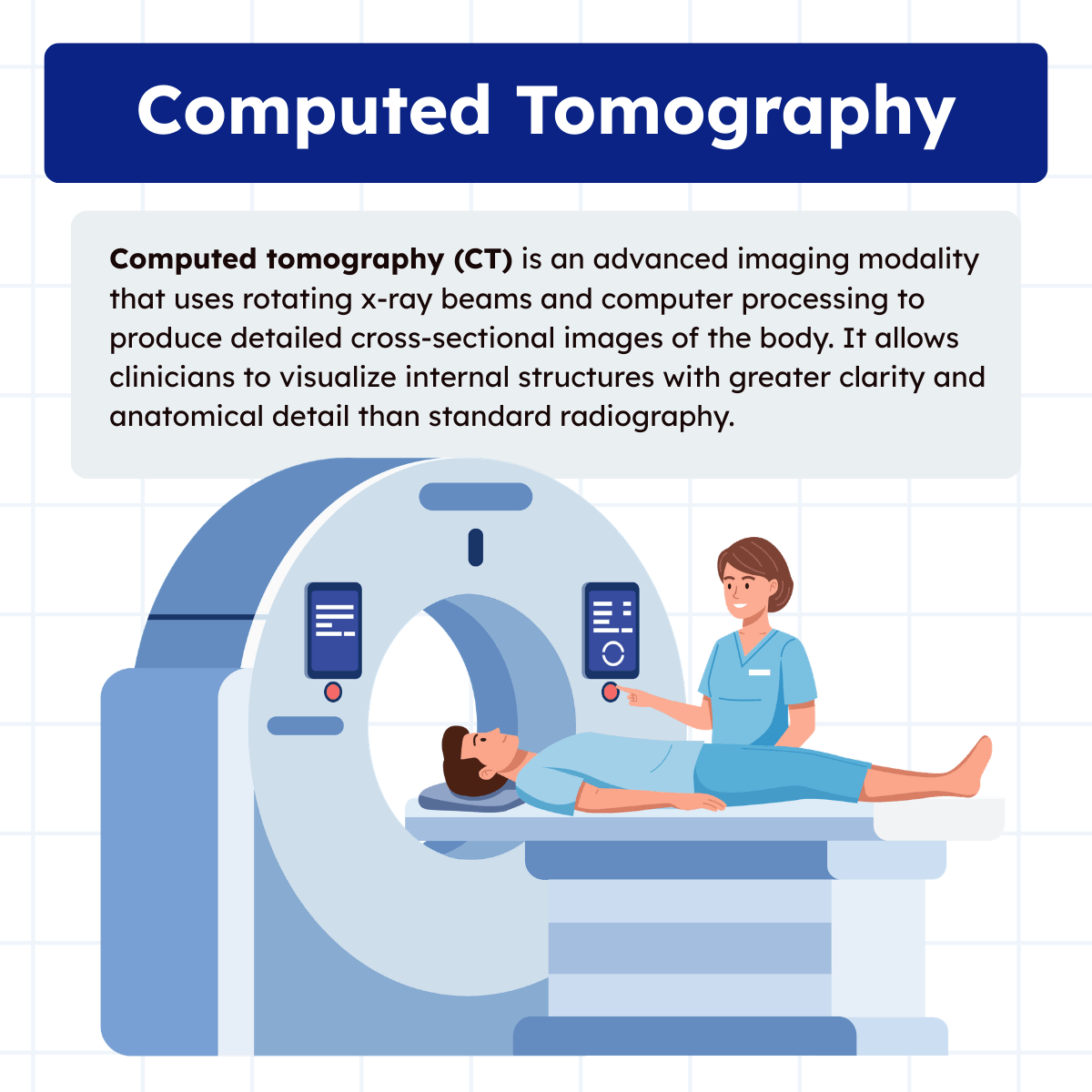
Computed tomography (CT) is an advanced imaging technique that uses rotating x-ray beams and detectors to generate detailed cross-sectional images of the body. Unlike a conventional chest radiograph, which produces a two-dimensional projection image, CT provides thin “slices” of tissue that can be viewed individually or reconstructed into three-dimensional images.
During a CT scan, the patient lies on a motorized table that moves through a circular opening called a gantry. Inside the gantry, an x-ray tube rotates around the patient while detectors measure the amount of radiation that passes through different tissues. A powerful computer processes this information and constructs high-resolution images that represent the internal anatomy.
Modern CT scanners are typically spiral or helical, meaning the patient moves continuously through the gantry while the x-ray tube rotates. This allows rapid acquisition of images, often completing a full chest scan in less than 10 seconds. The result is exceptional anatomical detail, with structures as small as 1 millimeter clearly visible.
Why a CT Scan is Superior to a Chest X-Ray
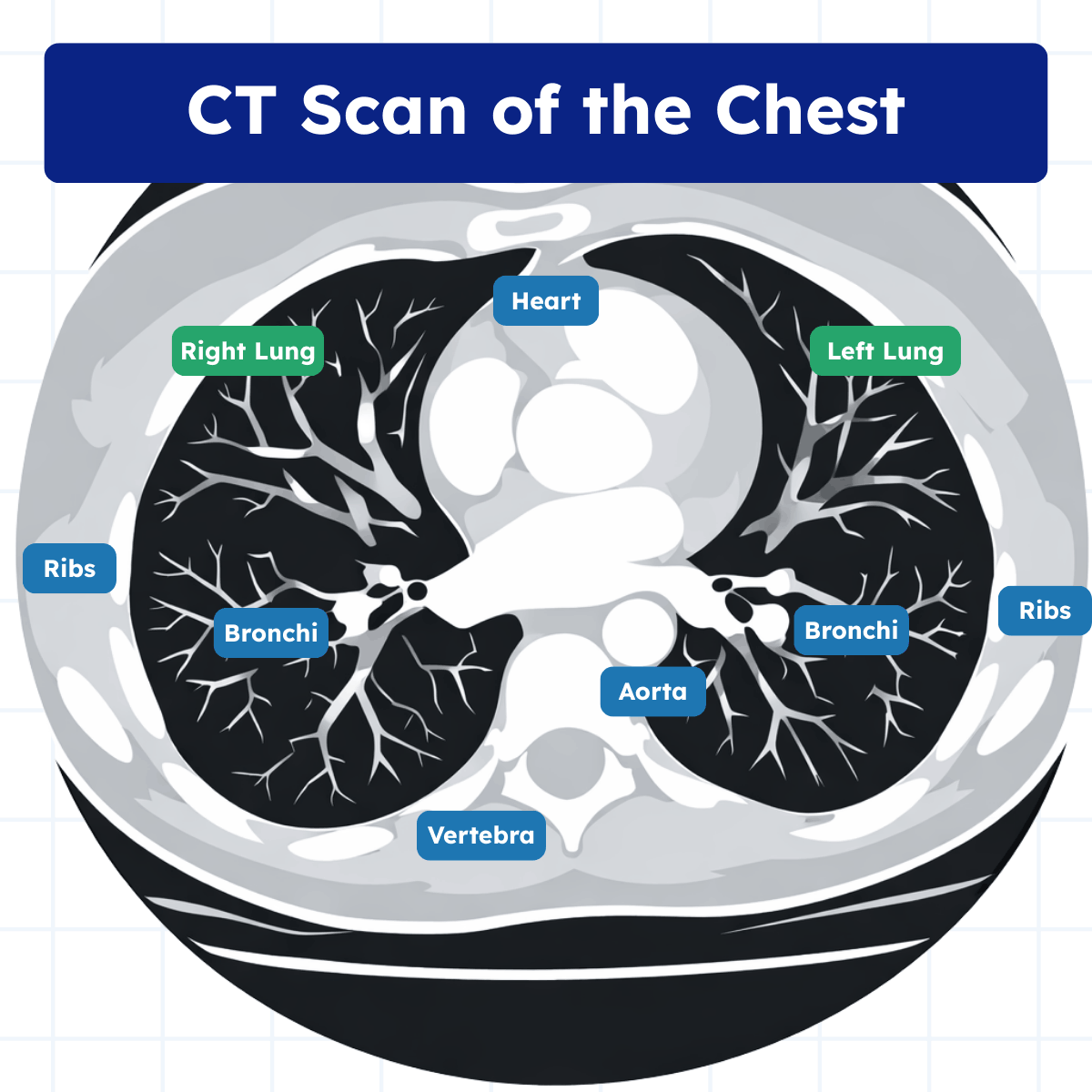
The standard chest x-ray remains a valuable screening tool in respiratory care, but CT provides far greater anatomical resolution and detail. On a chest x-ray, overlapping structures can obscure pathology. CT eliminates this limitation by imaging thin sections of the chest individually.
Key advantages of CT include:
- Superior visualization of lung parenchyma
- Detailed evaluation of the mediastinum and great vessels
- Clear assessment of pleural surfaces
- Improved detection of small nodules or masses
- Ability to reconstruct images in multiple planes
For example, small pulmonary nodules that may be invisible on a chest x-ray are often easily detected on CT. Similarly, subtle interstitial changes suggestive of early fibrosis can be identified with high-resolution CT (HRCT), which uses thin 1-mm slices to evaluate fine lung architecture.
However, CT exposes patients to higher radiation doses compared to standard chest radiography. A standard-dose chest CT may expose a patient to radiation equivalent to dozens of chest x-rays. Because of this, CT is used judiciously and often tailored to the clinical question.
CT Scan and Pulmonary Embolism
One of the most important applications of CT in respiratory care is the diagnosis of pulmonary embolism (PE). CT pulmonary angiography (CTPA) has largely replaced older diagnostic modalities for PE due to its speed, accuracy, and widespread availability.
In CT angiography, intravenous contrast is injected rapidly through a large-bore IV line to opacify the pulmonary arteries. The contrast makes blood vessels appear bright on imaging, allowing visualization of filling defects caused by emboli. Modern CT scanners can detect emboli in even small peripheral arteries.
For respiratory therapists, PE is a critical diagnosis because it can cause sudden hypoxemia, tachypnea, and hemodynamic instability. Recognizing the clinical signs and understanding how CT confirms the diagnosis helps therapists anticipate oxygen requirements, mechanical ventilation needs, and potential complications.
High-Resolution CT and Interstitial Lung Disease
High-resolution CT (HRCT) is particularly valuable in evaluating interstitial lung disease (ILD). By using thin slice thickness, typically around 1 mm, HRCT provides detailed images of the lung’s fine structures.
Findings such as ground-glass opacities, reticulation, honeycombing, and traction bronchiectasis can be clearly identified with HRCT. These findings help differentiate between various types of ILD and guide treatment decisions.
For respiratory therapists managing patients with restrictive lung disease, understanding HRCT findings helps explain clinical patterns such as reduced lung compliance, increased work of breathing, and impaired gas exchange. It also aids in anticipating long-term oxygen needs and ventilatory strategies.
CT Scan in Lung Cancer Screening
Low-dose CT has become a vital tool in screening high-risk individuals for lung cancer. Studies have demonstrated a significant reduction in lung cancer mortality among high-risk patients screened with low-dose CT compared to chest x-ray alone.
Screening criteria typically include:
- Age within a specified high-risk range
- Significant smoking history measured in pack-years
- Current smokers or those who quit within a certain timeframe
Low-dose CT uses significantly less radiation than standard CT while still detecting small lung nodules. Early detection dramatically improves survival rates.
Respiratory therapists frequently care for patients with chronic obstructive pulmonary disease (COPD) or long smoking histories. Awareness of CT screening recommendations enables therapists to educate patients about early detection and preventive care.
CT Scan and Pleural Disease
CT is highly effective in evaluating pleural abnormalities. It can easily detect pleural effusions, pleural thickening, nodularity, and loculated fluid collections.
In supine patients, free pleural fluid typically accumulates in dependent posterior regions. If fluid does not shift to dependent areas, it may be loculated, suggesting infection or malignancy.
CT findings that may indicate empyema include:
- Elliptical pleural fluid collection
- Pleural thickening
- Enhancement after contrast administration
- Presence of gas within the pleural space without recent intervention
Note: Respiratory therapists may encounter these patients in critical care settings where ventilator management and oxygenation are directly affected by pleural disease. Understanding CT findings helps anticipate decreased lung expansion and impaired ventilation.
CT Angiography and Vascular Assessment
Advancements in CT technology have enabled detailed visualization of the thoracic aorta and coronary arteries. CT angiography can identify:
- Aortic dissection
- Aneurysm
- Pulmonary embolism
- Coronary artery disease
This rapid diagnostic capability is crucial in emergency and ICU settings. Patients with acute chest pain, hypoxemia, or sudden hemodynamic collapse may undergo CT angiography to rule out life-threatening conditions.
Respiratory therapists often play a role in stabilizing these patients before and after imaging. Understanding what CT angiography evaluates improves interdisciplinary communication and care coordination.
Three-Dimensional Reconstruction and Virtual Bronchoscopy
Modern CT scanners allow for three-dimensional reconstruction of thoracic structures. These reconstructions can simulate airway visualization, sometimes referred to as virtual bronchoscopy.
Three-dimensional imaging is particularly useful for:
- Preoperative planning
- Evaluating airway obstruction
- Assessing complex anatomy
- Guiding interventional procedures
Note: Although virtual bronchoscopy does not replace traditional bronchoscopy, it provides a noninvasive way to visualize airway structures. For respiratory therapists involved in airway management, this technology enhances understanding of anatomical variations and obstructions.
Practical Considerations for Respiratory Therapists
CT scanning requires patients to lie flat and remain still. For patients with orthopnea or severe dyspnea, this may pose challenges. Respiratory therapists may need to:
- Provide supplemental oxygen
- Monitor oxygen saturation during transport
- Assist with ventilator management during scanning
- Ensure airway security
Critically ill patients often undergo CT scanning while mechanically ventilated. Therapists must ensure ventilator settings are appropriate, alarms are managed properly, and oxygenation is maintained throughout transport and imaging.
Sedation may be required for pediatric patients or those with claustrophobia. Additionally, patients with renal impairment must be evaluated carefully before receiving iodinated contrast.
CT Scan Compared to Other Imaging Modalities
While CT offers exceptional detail, it is not the only imaging option in thoracic evaluation.
- Chest x-ray is quick and low radiation but limited in detail.
- MRI is useful for certain vascular and mediastinal assessments but less commonly used for lung parenchyma.
- Ultrasound is valuable for detecting pleural effusions and guiding thoracentesis.
- PET-CT combines metabolic and anatomical imaging to differentiate benign from malignant lesions.
Note: Each modality has strengths and limitations. CT remains the primary tool for detailed structural assessment of the chest.
Radiation Considerations
A major limitation of computed tomography is radiation exposure. Standard-dose chest CT delivers significantly more radiation than a chest x-ray. Ongoing technological improvements continue to reduce radiation doses through advanced detector systems and optimized imaging protocols.
Low-dose CT protocols are particularly important in lung cancer screening programs. Respiratory therapists should be aware of radiation risks and the importance of appropriate imaging indications.
Computed Tomography Practice Questions
1. What is computed tomography (CT) of the chest?
Computed tomography (CT) of the chest is an advanced imaging technique that uses rotating x-ray beams and detectors to create detailed cross-sectional images of thoracic structures.
2. How does a CT scanner generate images of the chest?
A CT scanner rotates an x-ray tube and detectors around the patient, collects attenuation data, and reconstructs the information into thin cross-sectional images using a computer.
3. What is the function of the gantry in a CT scanner?
The gantry houses the rotating x-ray tube and detectors that acquire image data as the patient passes through the scanner.
4. What is meant by a “slice” in CT imaging?
A slice refers to a thin cross-sectional image of tissue, typically 1 to 5 mm thick, reconstructed from the acquired data.
5. What is the difference between step-and-shoot CT and helical (spiral) CT?
Step-and-shoot CT acquires images in discrete steps, whereas helical CT continuously rotates around the patient as the table moves, producing a spiral data set.
6. Why is intravenous iodinated contrast used in chest CT?
Intravenous contrast enhances vascular structures and soft tissues, improving visualization of pulmonary emboli, aortic pathology, and mediastinal structures.
7. What structures are better evaluated with chest CT compared to chest x-ray?
CT provides superior evaluation of the mediastinum, pleura, lung apices, costophrenic angles, lung parenchyma, and great vessels.
8. What is high-resolution CT (HRCT) of the chest?
HRCT uses thin slices, typically about 1 mm thick, to evaluate fine lung parenchymal detail, especially in interstitial lung disease.
9. What is a major advantage of thin-slice CT imaging?
Thin slices improve spatial resolution and allow detection of small nodules and subtle interstitial abnormalities.
10. What is a disadvantage of thin-slice CT imaging?
Thin slices produce more image noise and generate a large number of images, increasing interpretation time.
11. How quickly can modern CT scanners image the entire chest?
Modern multidetector CT scanners can image the entire chest in less than 10 seconds.
12. Why is CT particularly useful in critically ill patients?
Its rapid acquisition time allows quick evaluation of life-threatening thoracic conditions.
13. How does CT radiation exposure compare to chest x-ray?
A standard chest CT exposes patients to significantly more radiation than a single chest x-ray.
14. Why is radiation dose an important consideration in CT imaging?
Higher radiation exposure increases cumulative lifetime cancer risk.
15. How has technology reduced radiation exposure in CT?
Advances such as dose modulation and low-dose protocols have significantly reduced radiation levels.
16. What is low-dose chest CT primarily used for?
Low-dose chest CT is commonly used for lung cancer screening in high-risk individuals.
17. Who qualifies as high risk for lung cancer screening with CT?
Individuals aged approximately 55 to 77 years with a 30 pack-year smoking history who currently smoke or quit within the past 15 years.
18. What benefit has lung cancer screening CT demonstrated?
Large clinical trials have shown reduced lung cancer mortality compared to chest x-ray screening.
19. Why must patients remain still during CT scanning?
Movement can cause image artifacts that degrade image quality.
20. What accommodations may be required for claustrophobic patients undergoing CT?
Sedation or reassurance may be necessary.
21. Why might supplemental oxygen be needed during CT scanning?
Patients with orthopnea or respiratory distress may require oxygen while lying supine.
22. What is a pulmonary embolism CT study commonly called?
CT pulmonary angiography (CTPA)
23. Why is contrast particularly important in CT pulmonary angiography?
It opacifies pulmonary arteries, allowing visualization of filling defects caused by emboli.
24. What are multidetector CT scanners?
Scanners equipped with multiple rows of detectors, allowing faster image acquisition and improved resolution.
25. What is spatial resolution in CT imaging?
The ability to distinguish two closely spaced structures as separate entities.
26. Why is CT superior to chest x-ray for evaluating mediastinal lymph nodes?
CT provides cross-sectional detail and better soft tissue contrast.
27. What role does CT play in evaluating lung nodules?
It characterizes size, shape, density, and growth over time.
28. How does CT assist in evaluating pleural disease?
It identifies pleural thickening, effusions, and masses more accurately than x-ray.
29. What is the purpose of reconstruction algorithms in CT?
They process raw detector data into interpretable images.
30. Why may obese patients require specialized CT scanners?
Standard scanners may have weight or gantry size limitations.
31. How does CT differentiate between air, soft tissue, and bone?
By measuring differences in x-ray attenuation and assigning grayscale values.
32. What is a key advantage of CT over plain radiography?
It eliminates overlapping structures by producing cross-sectional images.
33. Why is CT valuable in trauma assessment?
It rapidly identifies pneumothorax, hemothorax, vascular injury, and fractures.
34. What is image noise in CT?
Random variation in pixel intensity that reduces image clarity.
35. Why is CT commonly used to evaluate the aorta?
It accurately detects aneurysm, dissection, and other vascular abnormalities.
36. What is the typical slice thickness range for standard chest CT?
Between 1 and 5 mm.
37. Why are thin slices preferred when evaluating suspected pulmonary embolism?
They increase detection sensitivity for small emboli.
38. How does CT improve visualization of lung apices?
It avoids clavicular and rib overlap seen on plain films.
39. What is the primary limitation of CT imaging?
Exposure to ionizing radiation.
40. Why is CT considered an essential diagnostic tool in modern respiratory care?
It provides rapid, detailed, and comprehensive evaluation of thoracic anatomy and pathology.
41. What is computed tomography angiography (CTA)?
Computed tomography angiography (CTA) is a specialized CT technique that uses rapid image acquisition and intravenous contrast to visualize vascular structures in detail.
42. Why must intravenous contrast be injected at a high rate during CTA?
A high injection rate ensures adequate opacification of blood vessels for optimal visualization.
43. What type of intravenous access is required for CT angiography?
A large-bore peripheral IV, typically in the antecubital vein, or a central line capable of high flow rates is required.
44. What are the most common indications for chest CTA?
Chest CTA is commonly used to evaluate pulmonary embolism and thoracic aortic dissection.
45. How has modern CT technology improved detection of pulmonary emboli?
Multidetector CT scanners allow visualization of emboli in smaller, more peripheral pulmonary arteries.
46. How can CT angiography be used in coronary artery evaluation?
Coronary CT angiography provides noninvasive visualization of coronary arteries and may serve as an alternative to diagnostic cardiac catheterization in selected patients.
47. What is three-dimensional (3D) reconstruction in CT imaging?
3D reconstruction processes CT data to create volumetric images that can be viewed from multiple angles.
48. How are 3D CT images useful in surgical planning?
They allow surgeons to better understand complex anatomy before operative procedures.
49. What is virtual bronchoscopy?
Virtual bronchoscopy is a CT-based 3D reconstruction that simulates the view seen during an actual bronchoscopy.
50. Where does pleural fluid accumulate on CT in a supine patient?
Free pleural fluid typically collects in the posterior, dependent portions of the thoracic cavity.
51. What is loculated pleural fluid?
Loculated pleural fluid does not shift with gravity and remains confined due to adhesions or inflammation.
52. How does pleural enhancement appear on contrast-enhanced CT?
The pleural lining appears brighter (enhanced) after contrast administration.
53. What CT finding suggests empyema?
An elliptical pleural fluid collection with adjacent pleural thickening and enhancement suggests empyema.
54. What does the presence of gas within pleural fluid indicate in the absence of recent procedures?
It strongly suggests empyema.
55. Why is thoracic imaging essential in pulmonary disease?
It helps determine the cause, severity, and progression of lung pathology.
56. What are the four basic tissue densities seen on a chest x-ray?
Air, fat, soft tissue (water), and bone.
57. What is the first step in interpreting a chest x-ray?
Assess the technical quality, including rotation and penetration.
58. What systematic approach should be used when reviewing a chest x-ray?
Review bones, soft tissues, heart, neck structures, airways, lungs, pleura, mediastinum, and upper abdomen in a stepwise manner.
59. Why are lungs radiolucent on chest x-ray?
They contain air, which appears darker on radiographs.
60. Why are bones radiopaque on chest x-ray?
Bone absorbs more x-rays, making it appear white.
61. What conditions can cause airspace opacities on chest imaging?
Pulmonary edema, pneumonia, and pulmonary hemorrhage.
62. What are air bronchograms?
Air-filled bronchi visible against surrounding consolidated alveoli.
63. What radiographic signs suggest pulmonary edema?
Upper lobe blood flow redistribution, Kerley B lines, and alveolar filling.
64. What chest x-ray findings suggest chronic heart failure?
Cardiomegaly and bilateral pleural effusions.
65. What are signs of atelectasis on chest imaging?
Diaphragmatic elevation, mediastinal shift toward the affected side, rib space narrowing, hilar displacement, and fissure shift.
66. Why is chest x-ray useful for monitoring tubes and lines?
It confirms proper placement and identifies complications.
67. Where should the tip of an endotracheal tube be positioned?
Approximately 3 to 7 cm above the carina with the neck in a neutral position.
68. How does CT compare to chest x-ray in anatomic detail?
CT provides significantly greater cross-sectional detail.
69. What is a major disadvantage of CT compared to chest x-ray?
Higher radiation exposure.
70. When is MRI used in thoracic imaging?
MRI is useful for evaluating vascular structures, mediastinal masses, and cardiac anatomy.
71. What are advantages of ultrasound in thoracic care?
It assists with central line placement, detects pleural fluid, guides thoracentesis, and can identify pneumothorax.
72. How does PET-CT assist in lung nodule evaluation?
It helps differentiate malignant from benign nodules based on metabolic activity.
73. What is a limitation of PET-CT imaging?
False positives may occur with inflammatory or infectious processes.
74. Why is CTA preferred in suspected pulmonary embolism?
It rapidly provides high-resolution images of pulmonary arteries.
75. How does contrast enhancement improve vascular imaging?
It increases radiodensity of blood, distinguishing vessels from adjacent tissues.
76. Why must treatment not be delayed while awaiting imaging in suspected acute coronary or pulmonary emergencies?
Clinical stabilization and timely intervention take priority in life-threatening conditions.
77. How does CT help evaluate mediastinal masses?
It defines size, location, density, and relationship to adjacent structures.
78. Why is CT valuable for evaluating the lung apices?
It avoids overlap from clavicles seen on plain radiographs.
79. What is the clinical significance of contrast timing in CTA?
Proper timing ensures optimal arterial enhancement during image acquisition.
80. Why is CTA considered a cornerstone of modern thoracic vascular imaging?
It provides rapid, detailed, and noninvasive visualization of thoracic vascular pathology.
81. What is the difference between a contrast-enhanced CT and a non-contrast CT of the chest?
A contrast-enhanced CT uses intravenous iodinated dye to better visualize vascular structures and soft tissues, while a non-contrast CT evaluates anatomy without vascular enhancement.
82. Why must renal function be assessed before administering iodinated contrast?
Because contrast can worsen kidney function, especially in patients with preexisting renal impairment.
83. What laboratory value is commonly checked prior to contrast administration?
Serum creatinine (and estimated glomerular filtration rate, eGFR).
84. What is contrast-induced nephropathy?
A decline in renal function that occurs after exposure to iodinated contrast media.
85. Why should RT students understand CT findings in a pulmonary embolism?
Because CT pulmonary angiography is the diagnostic test of choice for suspected pulmonary embolism.
86. What CT finding is classic for a pulmonary embolism?
An intraluminal filling defect within a contrast-opacified pulmonary artery.
87. How does a CT scan help in diagnosing acute respiratory distress syndrome (ARDS)?
It can show bilateral diffuse infiltrates, dependent consolidation, and areas of atelectasis.
88. What CT finding is commonly seen in emphysema?
Areas of low attenuation representing destruction of alveolar walls.
89. What is a ground-glass opacity on a CT scan?
A hazy area of increased lung attenuation that does not obscure underlying bronchial or vascular markings.
90. What conditions can cause ground-glass opacities?
Interstitial lung disease, pulmonary edema, pneumonia, ARDS, and pulmonary hemorrhage.
91. What is consolidation on a CT scan?
An area of increased density that obscures underlying vascular markings due to alveolar filling.
92. How does a CT scan assist in evaluating interstitial lung disease (ILD)?
High-resolution CT (HRCT) reveals patterns such as reticulation, honeycombing, and traction bronchiectasis.
93. What is honeycombing on a CT scan?
Clustered cystic air spaces typically seen in advanced pulmonary fibrosis.
94. Why is HRCT preferred in suspected pulmonary fibrosis?
It provides thin slices that better visualize fine lung parenchymal detail.
95. What CT scan finding suggests pneumothorax?
A visible pleural line with absence of lung markings peripheral to it.
96. How can a CT scan help identify bronchiectasis?
By showing dilated bronchi that are larger than the accompanying pulmonary artery.
97. What is the significance of mediastinal shift on a CT scan?
It may indicate large pleural effusion, pneumothorax, mass effect, or severe atelectasis.
98. Why is a CT scan helpful in evaluating trauma patients?
It rapidly identifies pulmonary contusions, pneumothorax, hemothorax, and vascular injury.
99. What is the role of a CT scan in evaluating lung nodules?
It characterizes size, margins, calcification, and growth over time.
100. Why must respiratory therapists understand radiation exposure risks associated with computed tomography?
Because minimizing unnecessary imaging and understanding dose implications are important aspects of patient safety.
Final Thoughts
Computed tomography is a foundational imaging tool in modern respiratory care. It offers detailed anatomical information that supports the diagnosis and management of conditions such as pulmonary embolism, interstitial lung disease, pleural effusion, and lung cancer.
Although CT involves greater radiation exposure than standard radiography, its diagnostic value often justifies its use when appropriately indicated. For respiratory therapists, familiarity with CT findings and scanning considerations improves interdisciplinary communication and patient care. A practical understanding of CT enhances clinical reasoning and strengthens the therapist’s role in evaluating and managing complex cardiopulmonary disease.

Written by:
John Landry is a registered respiratory therapist from Memphis, TN, and has a bachelor's degree in kinesiology. He enjoys using evidence-based research to help others breathe easier and live a healthier life.
References
- Patel PR, De Jesus O. CT Scan. [Updated 2023 Jan 2]. In: StatPearls [Internet]. Treasure Island (FL): StatPearls Publishing; 2025.