

Coronary artery disease (CAD) is one of the most common and deadly cardiovascular conditions worldwide. It occurs when the arteries that supply blood to the heart muscle become narrowed or blocked, reducing oxygen delivery to the myocardium.
Although CAD is primarily considered a cardiac disorder, it has significant implications for respiratory therapists.
From managing oxygen therapy and mechanical ventilation to recognizing signs of acute coronary syndrome, respiratory care professionals play a vital role in the assessment, stabilization, and ongoing management of patients with coronary artery disease.

What Is Coronary Artery Disease?
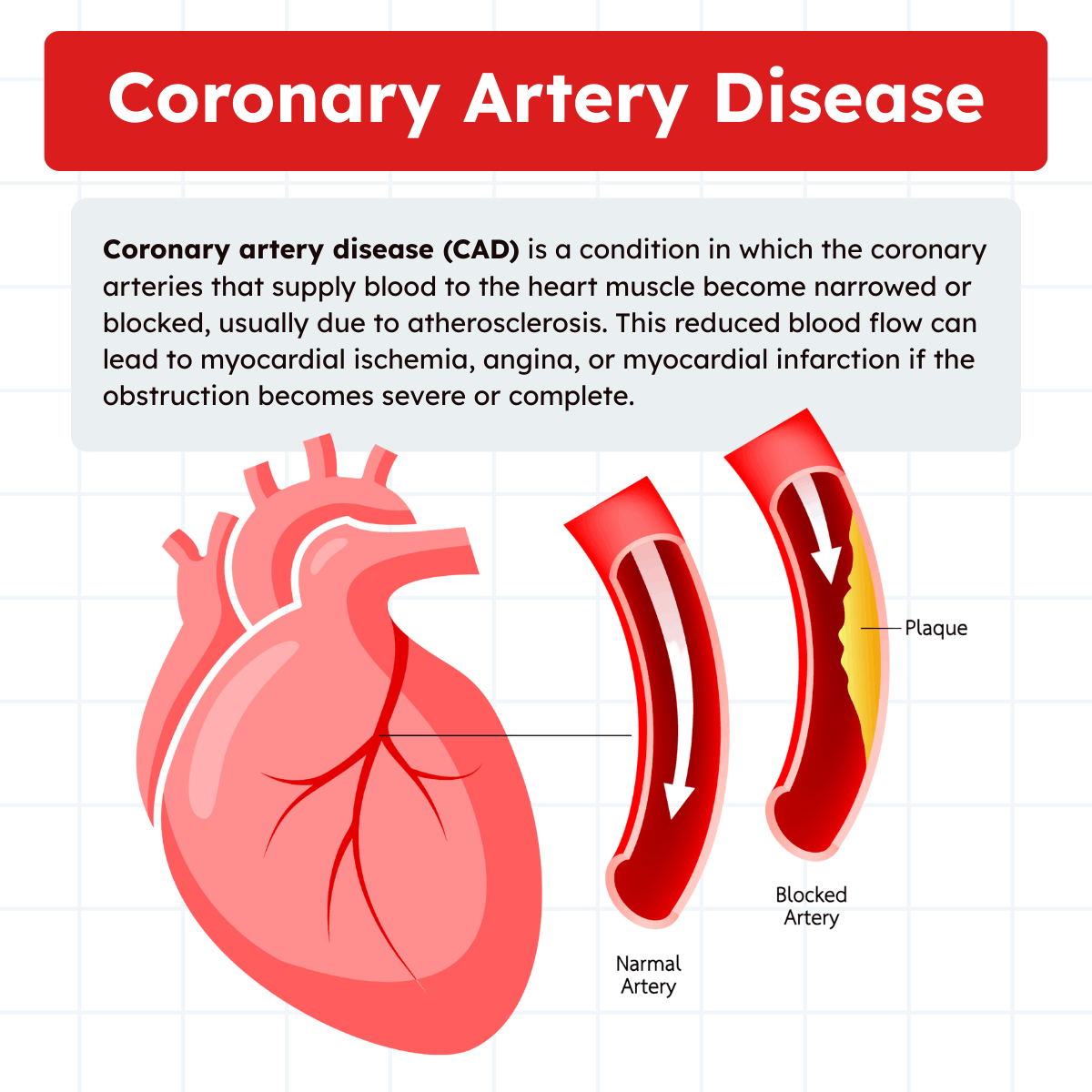
Coronary artery disease is a pathologic condition affecting the coronary arteries, most commonly due to atherosclerosis. Over time, fatty deposits known as atherosclerotic plaques accumulate within the arterial walls. These plaques narrow the vessel lumen and restrict blood flow to the heart muscle.
When myocardial oxygen supply becomes insufficient to meet demand, ischemia occurs. This may cause chest pain, known as angina pectoris. If blood flow is severely reduced or completely blocked, myocardial infarction (MI), commonly referred to as a heart attack, can result.
CAD is the most common cause of sudden death in adults. While mortality rates have declined in recent decades due to improved prevention and treatment strategies, it remains responsible for a substantial percentage of deaths in individuals over age 35.
Pathophysiology of CAD
The underlying mechanism of CAD is atherosclerosis, a chronic inflammatory process involving lipid accumulation, endothelial dysfunction, and plaque formation.
Key steps include:
- Endothelial injury from smoking, hypertension, or diabetes
- Accumulation of low-density lipoprotein (LDL) cholesterol in the vessel wall
- Inflammatory cell infiltration
- Formation of fibrous plaques
- Progressive narrowing of the coronary arteries
Plaque rupture can trigger platelet aggregation and thrombus formation, leading to acute vessel occlusion. The severity of obstruction determines clinical presentation.
Partial obstruction typically results in ischemia and angina, while complete occlusion leads to myocardial infarction.
Risk Factors
Several well-established risk factors increase the likelihood of developing CAD:
- Hyperlipidemia (especially elevated LDL cholesterol)
- Hypertension
- Diabetes mellitus
- Cigarette smoking
- Sedentary lifestyle
- Obesity
- Family history of premature coronary disease
- Advanced age
Note: Many of these risk factors overlap with pulmonary disease risk factors, making CAD especially relevant in patients with chronic respiratory disorders such as COPD.
Clinical Manifestations
Stable Angina
Stable angina occurs when myocardial oxygen demand exceeds supply during exertion or stress. Symptoms typically include:
- Substernal chest pressure or tightness
- Pain radiating to the jaw, shoulder, or arm
- Shortness of breath
- Relief with rest or nitroglycerin
Note: The pattern of symptoms remains consistent over time.
Unstable Angina and Acute Coronary Syndrome
When plaque rupture or thrombosis leads to sudden worsening of coronary obstruction, the condition is termed acute coronary syndrome (ACS).
ACS includes:
- Unstable angina
- Non–ST-segment elevation myocardial infarction (NSTEMI)
- ST-segment elevation myocardial infarction (STEMI)
STEMI involves complete coronary artery occlusion and requires urgent revascularization.
Symptoms of ACS may include:
- Persistent chest pain or pressure
- Diaphoresis
- Nausea
- Dyspnea
- Hypotension
- Syncope
Note: Some patients, particularly diabetics, may present with minimal or atypical symptoms.
Diagnosis
Evaluation of CAD involves clinical assessment, laboratory testing, imaging, and invasive studies.
For Stable CAD
- Detailed history and risk factor assessment
- Physical exam including peripheral pulses
- 12-lead ECG
- Lipid panel and fasting glucose
- Cardiac stress testing
- Echocardiography
- Coronary angiography (gold standard)
For Acute Coronary Syndrome
- Immediate 12-lead ECG
- Cardiac biomarkers (troponin, CK-MB)
- Continuous monitoring
- Chest x-ray
- Oxygen saturation assessment
Note: It is critical not to delay treatment while waiting for laboratory confirmation in suspected MI.
Treatment of CAD
Management depends on severity.
Stable Angina Management
- Smoking cessation
- Regular exercise
- Dietary modification
- Weight control
- Statin therapy for LDL reduction
- Antiplatelet therapy (aspirin or clopidogrel)
- Beta blockers
- Calcium channel blockers
- Nitrates
Note: For severe disease, elective revascularization via percutaneous coronary intervention (PCI) or coronary artery bypass grafting (CABG) may be indicated.
Acute Coronary Syndrome Management
Initial therapy for suspected ACS includes:
- Morphine for pain
- Oxygen if SpO₂ < 90%
- Nitroglycerin
- Aspirin
- Beta blocker
For STEMI, emergency revascularization within 90 minutes is recommended when available. If not, fibrinolytic therapy is administered.
NSTEMI is typically managed with antiplatelet and anticoagulant therapy, followed by risk stratification and possible revascularization.
Why Coronary Artery Disease Matters to Respiratory Therapists
Although CAD is a cardiac condition, respiratory therapists frequently encounter its consequences in multiple clinical settings.
1. Oxygen Therapy Management
Myocardial ischemia is fundamentally an oxygen supply–demand mismatch. Respiratory therapists are responsible for ensuring adequate oxygenation while avoiding hyperoxia. Current guidelines recommend administering oxygen only when SpO₂ falls below 90%, as excessive oxygen may cause coronary vasoconstriction.
Note: Understanding when oxygen is beneficial versus unnecessary is critical in ACS management.
2. Mechanical Ventilation and Cardiac Performance
Positive pressure ventilation affects preload, afterload, and cardiac output. In patients with CAD or heart failure:
- High PEEP may reduce venous return
- Excessive intrathoracic pressure can impair coronary perfusion
- Hypoxemia and hypercapnia increase myocardial oxygen demand
Note: Respiratory therapists must carefully manage ventilator settings to balance oxygenation and hemodynamics.
3. Recognition of ACS in Respiratory Patients
Patients admitted for respiratory distress may actually be experiencing myocardial ischemia. Dyspnea is a common presenting symptom of ACS.
Respiratory therapists often detect:
- Sudden changes in work of breathing
- New-onset crackles indicating pulmonary edema
- Hypotension
- Arrhythmias
Note: Prompt recognition and communication with the medical team can be lifesaving.
4. Bronchoscopy and Sedation Risks
During procedures such as fiberoptic bronchoscopy, adrenergic discharge caused by hypoxemia, under-sedation, or acute respiratory acidosis can precipitate myocardial ischemia in patients with CAD.
Additionally, high doses of topical lidocaine may cause arrhythmias or conduction disturbances. Respiratory therapists must carefully monitor oxygenation, heart rhythm, and blood pressure to prevent cardiac complications.
5. Cardiogenic Pulmonary Edema
CAD can lead to left ventricular dysfunction, which may cause pulmonary edema. Respiratory therapists manage these patients using:
- Noninvasive ventilation (CPAP or BiPAP)
- Mechanical ventilation
- Oxygen therapy
- Airway clearance
Note: Understanding the cardiac origin of pulmonary symptoms improves treatment decisions.
6. Interaction With Chronic Lung Disease
Patients with chronic lung diseases such as COPD or interstitial lung disease often have independent risk factors for atherosclerosis.
Cardiac disease may be mistaken for worsening pulmonary pathology.
For example:
- Dyspnea may reflect ischemia rather than airway obstruction
- Pulmonary edema may mimic pneumonia
- Fatigue may result from reduced cardiac output
Note: Respiratory therapists must consider cardiac causes when pulmonary treatments fail to produce expected improvement.
Hemodynamic and Gas Exchange Considerations
The heart and lungs function as an integrated unit. CAD affects oxygen delivery in several ways:
- Reduced cardiac output lowers systemic oxygen transport
- Myocardial ischemia impairs left ventricular function
- Pulmonary congestion interferes with gas exchange
Additionally, normal anatomic shunts such as coronary and thebesian venous drainage contribute to small reductions in arterial oxygen content. In critically ill patients, even minor reductions in oxygen delivery may have significant consequences.
Respiratory therapists must understand the following oxygen transport principles to optimize therapy:
- Oxygen content
- Hemoglobin saturation
- Cardiac output
- Ventilation–perfusion relationships
Revascularization and Respiratory Care
Patients undergoing PCI or CABG frequently require respiratory support postoperatively.
After CABG, common respiratory complications include:
- Atelectasis
- Pneumonia
- Impaired cough
- Pleural effusions
Respiratory therapists assist with:
- Incentive spirometry
- Early mobilization
- Airway clearance
- Weaning from mechanical ventilation
Note: Knowledge of CAD pathophysiology enhances postoperative management.
Coronary Artery Disease Practice Questions
1. What is coronary artery disease (CAD)?
Coronary artery disease is a condition in which the coronary arteries become narrowed or hardened, most commonly due to atherosclerosis.
2. What is the primary cause of coronary artery disease?
The most common cause is atherosclerosis, which involves plaque buildup within the coronary arteries.
3. How does atherosclerosis lead to myocardial ischemia?
Plaque buildup narrows the coronary arteries, reducing blood flow and oxygen delivery to the heart muscle.
4. What is acute coronary syndrome (ACS)?
Acute coronary syndrome refers to a spectrum of conditions caused by sudden reduction or blockage of coronary blood flow.
5. What three conditions are included under ACS?
Unstable angina, non–ST-segment elevation myocardial infarction (NSTEMI), and ST-segment elevation myocardial infarction (STEMI).
6. What distinguishes STEMI from NSTEMI?
STEMI involves complete coronary artery occlusion with ST-segment elevation on ECG, whereas NSTEMI typically involves partial occlusion without ST elevation.
7. Why is STEMI considered more emergent than NSTEMI?
STEMI reflects complete vessel obstruction and requires rapid reperfusion therapy to limit myocardial damage.
8. What is angina pectoris?
Angina pectoris is chest discomfort caused by myocardial ischemia without permanent heart muscle damage.
9. What characterizes stable angina?
Stable angina presents with predictable chest discomfort triggered by exertion and relieved by rest or nitroglycerin.
10. What defines unstable angina?
Unstable angina involves new-onset, worsening, or rest-related chest pain and signals increased risk of myocardial infarction.
11. What are major risk factors for CAD?
Hyperlipidemia, hypertension, diabetes, smoking, obesity, sedentary lifestyle, and family history increase risk.
12. How does elevated LDL contribute to CAD?
High LDL cholesterol promotes plaque formation within arterial walls.
13. Why is diabetes a significant CAD risk factor?
Diabetes accelerates atherosclerosis and damages vascular endothelium.
14. What is the ankle–brachial index (ABI)?
The ABI is the ratio of ankle systolic blood pressure to brachial systolic pressure.
15. What ABI value suggests peripheral arterial disease and possible CAD?
An ABI less than 0.90 supports the diagnosis of peripheral arterial disease.
16. Why are carotid bruits clinically relevant in CAD assessment?
Carotid bruits suggest atherosclerosis, which may also affect coronary arteries.
17. Why does a normal ECG not exclude CAD?
Ischemia may be intermittent or not present at the time of testing.
18. What laboratory test evaluates cholesterol levels in CAD assessment?
A lipid panel measuring total cholesterol, LDL, HDL, and triglycerides is used.
19. What inflammatory marker may be elevated in atherosclerosis?
C-reactive protein (CRP) may be elevated in inflammatory vascular disease.
20. What is the gold standard for diagnosing CAD?
Coronary arteriography via cardiac catheterization is the gold standard.
21. What imaging test can noninvasively evaluate coronary arteries?
Computed tomography coronary angiography can identify coronary artery blockages.
22. What are classic symptoms of ACS?
Central chest pain or pressure that may radiate to the jaw, arm, shoulder, or back.
23. What additional symptoms may accompany myocardial infarction?
Dyspnea, diaphoresis, nausea, lightheadedness, and syncope may occur.
24. Why should oxygen saturation be monitored in suspected ACS?
Hypoxemia may worsen myocardial ischemia.
25. What lung finding may suggest heart failure in ACS?
Crackles on auscultation may indicate pulmonary edema.
26. What ECG findings are suggestive of myocardial ischemia?
ST-segment deviation of 1 mm or greater or T-wave inversion in multiple leads suggests ischemia.
27. What cardiac biomarkers are elevated in myocardial infarction?
Troponin and CK-MB levels increase with myocardial injury.
28. Why should treatment not be delayed while awaiting lab results in ACS?
Prompt reperfusion therapy is critical to limit myocardial damage.
29. How can adrenergic discharge during airway procedures affect CAD patients?
Sympathetic stimulation may trigger ischemia, arrhythmias, or cardiac arrest.
30. Why must sedation and oxygenation be carefully managed in CAD patients?
Hypoxemia and acute respiratory acidosis increase myocardial oxygen demand and ischemic risk.
31. What ECG finding defines a STEMI?
ST-segment elevation of 1 mm or greater in two or more contiguous leads indicates STEMI.
32. Why is a new left bundle branch block (LBBB) concerning in suspected MI?
A new LBBB may mask ST-segment elevation and is treated as a STEMI equivalent in appropriate clinical settings.
33. What typically causes ST-segment elevation in STEMI?
Complete coronary artery occlusion causes transmural myocardial ischemia, producing ST elevation.
34. What ECG changes are commonly seen in NSTEMI or unstable angina?
Ischemic ST-segment depression or dynamic T-wave inversion is often present.
35. What differentiates unstable angina from NSTEMI?
NSTEMI includes elevated cardiac biomarkers, whereas unstable angina does not.
36. What is the primary pathophysiology of NSTEMI?
NSTEMI usually results from partial or intermittent coronary artery occlusion.
37. How does management differ between stable angina and ACS?
Stable angina is treated conservatively, whereas ACS requires urgent evaluation and intervention.
38. What lifestyle modification is recommended for stable CAD?
Smoking cessation, regular moderate exercise, weight control, and a heart-healthy diet are recommended.
39. Why is cardiac rehabilitation important after MI?
Cardiac rehabilitation improves functional capacity and reduces recurrence risk.
40. Why is hemoglobin A1c monitoring important in diabetic CAD patients?
Tight glucose control reduces vascular complications and slows atherosclerosis progression.
41. What is the role of antiplatelet therapy in stable CAD?
Antiplatelet agents reduce the risk of thrombus formation.
42. Why is aspirin commonly prescribed in CAD?
Aspirin inhibits platelet aggregation and lowers the risk of myocardial infarction.
43. What is the purpose of beta blockers in CAD?
Beta blockers reduce heart rate and myocardial oxygen demand.
44. How do nitrates relieve angina?
Nitrates dilate coronary arteries and reduce preload, improving myocardial oxygen supply-demand balance.
45. What is the role of calcium channel blockers in angina?
They decrease myocardial oxygen demand and relieve coronary vasospasm.
46. Why are statins prescribed in CAD patients?
Statins lower LDL cholesterol and stabilize atherosclerotic plaques.
47. When is coronary artery bypass grafting (CABG) considered in stable CAD?
CABG is considered when significant coronary stenosis limits activity despite medical therapy.
48. What does the acronym “MONA” represent in ACS management?
Morphine, Oxygen, Nitroglycerin, and Aspirin.
49. Why is oxygen administered in suspected ACS?
Oxygen is given to maintain adequate saturation and reduce myocardial hypoxia.
50. When is nitroglycerin contraindicated in ACS?
Nitroglycerin is contraindicated in hypotension or recent use of phosphodiesterase inhibitors.
51. Why are beta blockers used early in ACS?
They reduce heart rate, blood pressure, and myocardial oxygen demand.
52. What is the goal door-to-balloon time for STEMI reperfusion?
Primary percutaneous coronary intervention should ideally occur within 90 minutes.
53. When are fibrinolytics indicated in STEMI?
Fibrinolytic therapy is used when timely PCI is unavailable.
54. Why are fibrinolytics not used in NSTEMI?
NSTEMI usually involves partial occlusion and does not benefit from fibrinolysis.
55. What clinical changes suggest worsening NSTEMI?
Rising troponin, new ECG changes, refractory angina, arrhythmias, or hemodynamic instability.
56. What are the ABCs in ACS management?
Airway, breathing, and circulation must be stabilized first.
57. Why is cardiogenic shock a medical emergency in MI?
It indicates severe ventricular dysfunction and high mortality risk.
58. What percentage of coronary artery narrowing often warrants intervention?
Stenosis greater than 50–70% typically indicates need for revascularization.
59. What is the coronary sinus?
The coronary sinus is a large vein that drains venous blood from the myocardium into the right atrium.
60. What is an anatomic shunt in cardiac circulation?
An anatomic shunt occurs when venous blood bypasses the lungs and mixes with arterial blood, slightly lowering systemic oxygen content.
61. What is myocardial ischemia?
Myocardial ischemia is reduced blood flow to the heart muscle resulting in inadequate oxygen supply.
62. What symptom is most commonly associated with myocardial ischemia?
Chest pressure or tightness, often described as squeezing or heaviness, is the most common symptom.
63. What is the typical duration of chest pain in myocardial infarction?
Chest pain lasting longer than 20 minutes and not relieved by rest suggests myocardial infarction.
64. What population may present with atypical symptoms of MI?
Women, older adults, and diabetic patients may present without classic chest pain.
65. What is silent myocardial infarction?
Silent MI refers to myocardial infarction without typical chest pain symptoms.
66. How does smoking increase CAD risk?
Smoking damages vascular endothelium and promotes atherosclerotic plaque formation.
67. What is the role of hypertension in CAD?
Hypertension accelerates arterial wall damage and plaque development.
68. Why is early reperfusion important in STEMI?
Early reperfusion limits infarct size and preserves myocardial function.
69. What is percutaneous coronary intervention (PCI)?
PCI is a catheter-based procedure used to open narrowed or blocked coronary arteries.
70. What is balloon angioplasty?
Balloon angioplasty inflates a balloon within a narrowed artery to restore blood flow.
71. What is a coronary stent?
A coronary stent is a mesh tube placed in an artery to maintain vessel patency after angioplasty.
72. What is the goal of dual antiplatelet therapy after stent placement?
Dual therapy prevents stent thrombosis by reducing platelet aggregation.
73. What is cardiogenic shock?
Cardiogenic shock is severe pump failure resulting in inadequate tissue perfusion.
74. What lung finding may occur in cardiogenic shock?
Pulmonary edema with crackles may be present due to left ventricular failure.
75. What is the significance of troponin elevation?
Troponin elevation indicates myocardial cell injury or necrosis.
76. Why are serial troponin measurements performed?
Serial testing confirms evolving myocardial infarction.
77. What does ST-segment depression indicate?
ST-segment depression suggests subendocardial ischemia.
78. What is ventricular arrhythmia a complication of?
Ventricular arrhythmias may complicate acute myocardial infarction.
79. Why are defibrillation and ACLS readiness important in ACS?
Malignant arrhythmias can occur suddenly and require immediate intervention.
80. What is the relationship between CAD and heart failure?
Repeated ischemia or infarction can weaken the myocardium and lead to heart failure.
81. How does obesity contribute to CAD?
Obesity increases risk factors such as hypertension, diabetes, and dyslipidemia.
82. What is the significance of family history in CAD?
A positive family history increases genetic predisposition to atherosclerosis.
83. What is unstable plaque?
Unstable plaque is prone to rupture and thrombus formation.
84. What triggers acute plaque rupture?
Inflammation and mechanical stress may cause plaque rupture.
85. What is thrombus formation in CAD?
A thrombus is a blood clot that forms at the site of plaque rupture.
86. Why is aspirin given immediately in suspected MI?
Aspirin inhibits platelet aggregation and reduces clot propagation.
87. What is the role of heparin in ACS?
Heparin prevents further clot formation by inhibiting the coagulation cascade.
88. What does an echocardiogram evaluate in MI?
Echocardiography assesses wall motion abnormalities and ejection fraction.
89. What is ejection fraction?
Ejection fraction is the percentage of blood pumped out of the left ventricle with each contraction.
90. Why is reduced ejection fraction clinically important?
Reduced ejection fraction indicates impaired cardiac function and worse prognosis.
91. What dietary modification reduces CAD risk?
A diet low in saturated fat and high in fiber reduces atherosclerosis risk.
92. How does sedentary lifestyle affect CAD?
Physical inactivity contributes to obesity and metabolic risk factors.
93. What is metabolic syndrome?
Metabolic syndrome is a cluster of conditions increasing cardiovascular risk.
94. Why is early symptom recognition important in CAD?
Prompt treatment reduces myocardial damage and improves survival.
95. What is exertional angina?
Exertional angina is chest discomfort triggered by physical activity.
96. How does CAD affect myocardial oxygen supply-demand balance?
Narrowed arteries reduce oxygen supply while demand may remain high.
97. What is the role of oxygen therapy in ACS?
Oxygen is administered when hypoxemia is present to improve tissue oxygenation.
98. Why is blood pressure control important in CAD?
Controlled blood pressure reduces arterial wall stress and progression of plaque.
99. What is the difference between chronic stable CAD and ACS?
Chronic stable CAD has predictable symptoms, whereas ACS involves acute plaque disruption and thrombosis.
100. Why must respiratory therapists understand CAD?
CAD impacts oxygen delivery, ventilatory management, and emergency response in cardiac patients.
Final Thoughts
Coronary artery disease remains one of the leading causes of morbidity and mortality worldwide. While it is classified as a cardiac disorder, its effects are frequently seen in patients receiving respiratory care.
From identifying subtle signs of acute coronary syndrome to carefully managing oxygen therapy, ventilator settings, and post–cardiac surgery recovery, respiratory therapists are critical members of the healthcare team.
A strong understanding of how cardiac dysfunction influences oxygenation, ventilation, and overall hemodynamics enables respiratory professionals to anticipate complications, respond quickly to clinical deterioration, and contribute to safer, more effective patient care across all settings.

Written by:
John Landry is a registered respiratory therapist from Memphis, TN, and has a bachelor's degree in kinesiology. He enjoys using evidence-based research to help others breathe easier and live a healthier life.
References
- Shahjehan RD, Sharma S, Bhutta BS. Coronary Artery Disease. [Updated 2024 Oct 9]. In: StatPearls [Internet]. Treasure Island (FL): StatPearls Publishing; 2025.