
When faced with a potential foreign body obstruction in the upper airway or bronchus, rapid and accurate diagnosis is essential for effective management. Questions about foreign body aspiration frequently appear on the respiratory therapy board exam, particularly those related to when diagnostic imaging should be recommended.
Understanding the indications for imaging, the different radiographic views available, and how to interpret key findings can help respiratory therapists make appropriate clinical decisions.
In this article, we will review when a chest radiograph should be ordered for suspected foreign body aspiration, which imaging techniques provide the most diagnostic value, and how to recognize radiographic signs that suggest airway obstruction.

Take our free course to learn essential tips, insights, and strategies to pass the TMC Exam on your first (or next) attempt.
How to Detect Foreign Body Aspiration on a Chest X-Ray
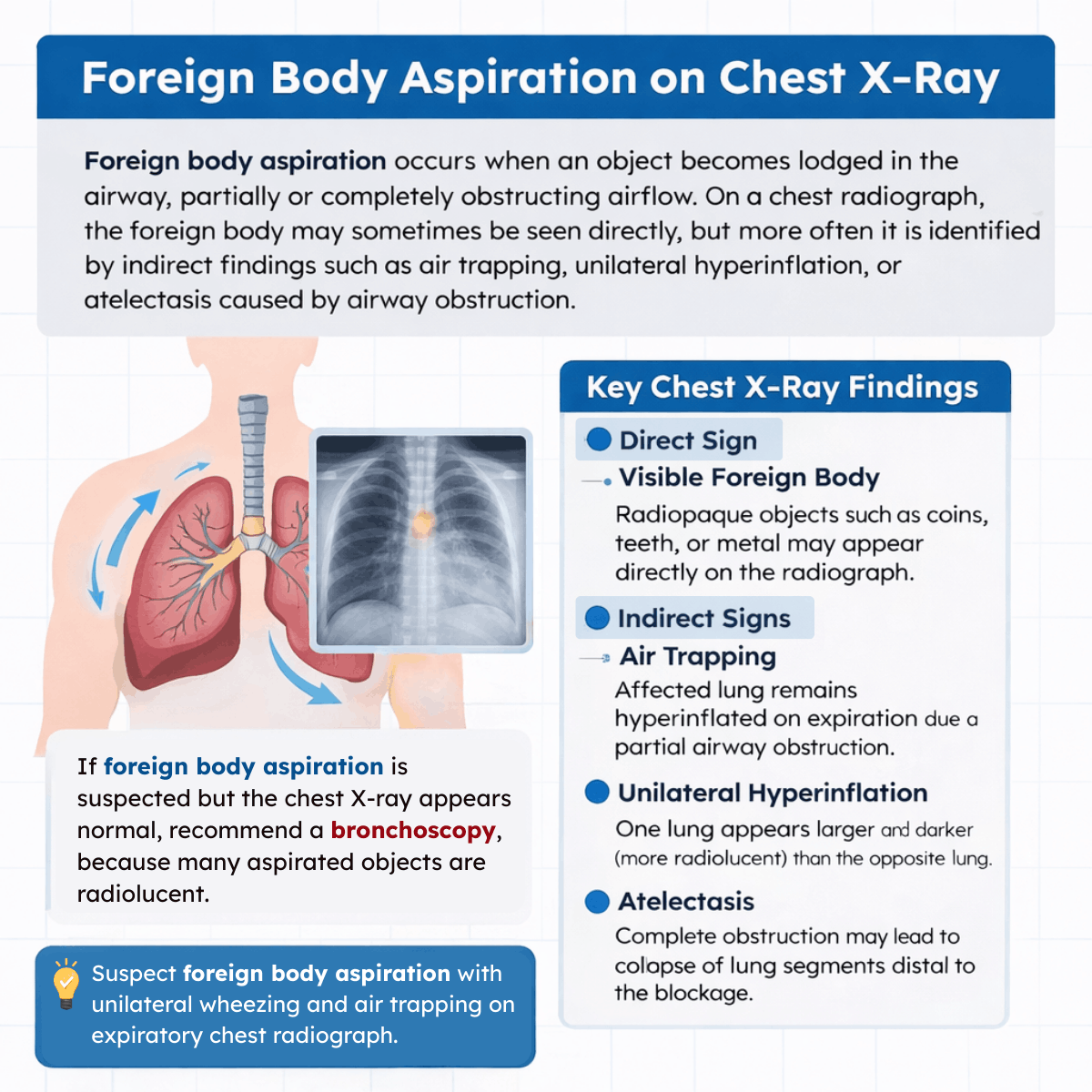
Foreign body aspiration can sometimes be detected on a chest X-ray by identifying either the object itself or indirect signs of airway obstruction. Radiopaque objects such as metal or certain dense materials may appear directly on the radiograph. However, many aspirated items, including food particles or plastic, are radiolucent and do not appear clearly on imaging.
In these cases, clinicians look for secondary findings that suggest airway blockage. One common sign is unilateral hyperinflation, which occurs when a partial obstruction traps air in one lung. Air trapping on an expiratory film may also be visible, with the affected lung remaining inflated while the normal lung deflates.
Atelectasis can occur if the airway becomes completely obstructed, causing part of the lung to collapse and appear more opaque. In severe cases, mediastinal or tracheal shift may be seen. When suspicion remains high despite normal imaging, bronchoscopy is often required for definitive diagnosis and removal.
Recognizing the Need for a Chest Radiograph in Foreign Body Aspiration
Foreign body aspiration is a potentially life-threatening emergency that requires prompt recognition and appropriate diagnostic evaluation. It occurs most commonly in children, particularly those under the age of three, but adults are also at risk. Individuals with neurological disorders, impaired swallowing reflexes, sedation, or altered consciousness are especially vulnerable.
The clinical presentation can vary depending on the size, location, and type of aspirated material. Patients often develop sudden coughing, wheezing, stridor, or respiratory distress immediately after aspiration. However, symptoms may also be subtle if the obstruction is partial.
In some cases, patients present later with persistent respiratory symptoms such as chronic cough, localized wheezing, recurrent pneumonia, or unexplained respiratory infections.
When foreign body aspiration is suspected, a chest radiograph is often the initial imaging study recommended. Although many aspirated objects are not visible on standard X-ray images, radiographs can reveal indirect findings that strongly suggest airway obstruction.
The decision to obtain imaging depends on the patient’s clinical presentation, history, and physical examination findings. Selecting the appropriate radiographic view can significantly improve diagnostic accuracy.
Choosing the Right Imaging Modality
The type of radiographic study ordered depends on the suspected location of the foreign body within the airway.
- Anterior-Posterior (AP) and Lateral Chest Radiographs: These are commonly ordered when a foreign body is suspected in the trachea or lower airways. Radiopaque objects such as metal, bone, or certain calcified materials may be directly visible.
- Lateral Neck X-ray: If obstruction is suspected in the upper airway, particularly the larynx or proximal trachea, a lateral neck radiograph can help visualize soft tissue swelling, airway narrowing, or structural abnormalities.
- Expiratory Chest Radiograph: This view is particularly useful for detecting radiolucent foreign bodies. If the obstruction functions as a check valve, air may enter the lung during inspiration but cannot exit during expiration. This results in unilateral hyperinflation on the affected side.
- Fluoroscopy or CT Scan: When standard radiographs are inconclusive but clinical suspicion remains high, additional imaging may be necessary. A low-dose CT scan provides excellent sensitivity for detecting radiolucent objects and identifying airway obstruction.
Note: Selecting the appropriate imaging technique helps clinicians detect airway obstructions more quickly. Recognizing radiographic findings such as hyperinflation, mediastinal shift, or atelectasis can guide timely intervention, including bronchoscopy for foreign body removal.
Interpreting Radiographic Findings
After obtaining a chest radiograph, careful interpretation of the images is necessary to evaluate for signs of airway obstruction. While radiopaque foreign bodies may be directly visible, most aspirated objects such as food, plastic, or organic materials are radiolucent and do not appear on standard X-ray images.
Because of this, clinicians must often rely on indirect radiographic findings that suggest airway obstruction.
- Unilateral Hyperinflation: When a foreign body partially obstructs a bronchus, it may create a check valve effect. Air enters during inspiration but becomes trapped during expiration. This produces overinflation of the affected lung and may cause a mediastinal shift toward the unaffected side. This finding is best seen on expiratory films.
- Atelectasis (Lung Collapse): A complete obstruction can prevent ventilation of the affected lung segment. This results in collapse of the lung tissue, which appears as increased radiopacity on the radiograph. Mediastinal structures may shift toward the affected side.
- Air Trapping on Expiratory View: A standard inspiratory chest radiograph may appear normal, but an expiratory film can reveal persistent inflation of the affected lung, indicating air trapping.
- Tracheal or Mediastinal Deviation: Significant air trapping or lung collapse may shift the trachea or mediastinum. The direction of the shift depends on whether the lung is hyperinflated or collapsed.
- Soft Tissue Swelling on a Lateral Neck Radiograph: If the foreign body is located in the upper airway, surrounding soft tissue swelling may be visible. Subglottic narrowing may also appear on imaging.
Next Steps in Management
If foreign body aspiration is confirmed or strongly suspected based on clinical findings and radiographic evidence, prompt intervention is required. Delayed treatment can lead to worsening airway obstruction, infection, or respiratory failure.
Management typically includes the following:
- Bronchoscopy: Bronchoscopy is the gold standard for diagnosing and removing airway foreign bodies. Rigid bronchoscopy is commonly used in children because it provides better airway control and allows removal of larger objects. Flexible bronchoscopy may be used in adults for both diagnosis and retrieval.
- Oxygen and Airway Support: Patients experiencing respiratory distress may require supplemental oxygen or ventilatory support. In severe cases, endotracheal intubation or emergency airway management may be necessary to maintain adequate ventilation.
- Observation and Follow-Up: If imaging is inconclusive but suspicion remains high, close monitoring is required. Persistent symptoms such as localized wheezing, recurrent pneumonia, or unexplained cough should prompt further evaluation or bronchoscopy.
Board Exam Tips for Chest X-Rays in Foreign Body Aspiration
Foreign body aspiration scenarios frequently appear on the respiratory therapy board exam. These questions often test your ability to recognize clinical signs, recommend the correct imaging study, and interpret radiographic findings.
Understanding when imaging is indicated and recognizing key radiographic patterns can help you quickly select the correct answer.
Know When to Recommend Imaging
- If a patient presents with sudden coughing, wheezing, stridor, or respiratory distress, always consider foreign body aspiration.
- For suspected upper airway obstruction, a lateral neck radiograph can help visualize airway narrowing or swelling.
- For suspected bronchial obstruction, a chest radiograph with inspiratory and expiratory views helps detect air trapping.
Recognize Indirect Signs on Imaging
- Unilateral hyperinflation suggests a partial obstruction that allows air entry but limits exhalation.
- Atelectasis and mediastinal shift may indicate a complete airway obstruction.
- Persistent air trapping on expiratory films strongly suggests a bronchial foreign body.
Understand the Next Diagnostic Step
- If clinical suspicion remains high despite a normal chest radiograph, bronchoscopy should be recommended.
- A CT scan may be considered when radiolucent foreign bodies are suspected but not visible on standard radiographs.

Take our free course to learn essential tips, insights, and strategies to pass the Clinical Simulation Exam (CSE) on your first (or next) attempt.
Key Takeaways
When preparing for board exam questions about foreign body aspiration, remember the following essential points:
- Always suspect foreign body aspiration in patients with sudden-onset coughing, wheezing, or respiratory distress, particularly in children.
- Select the appropriate imaging study based on the suspected location of the obstruction.
- Recognize indirect radiographic signs such as hyperinflation, air trapping, atelectasis, and mediastinal shift.
- Understand that bronchoscopy is both the definitive diagnostic method and the primary treatment for airway foreign bodies.
Note: Mastering these concepts will help you answer board exam questions more confidently and improve your ability to manage airway emergencies in clinical practice.
Final Thoughts
Foreign body aspiration is a serious respiratory emergency that requires rapid recognition and appropriate diagnostic evaluation. Although chest radiographs do not always reveal the foreign body itself, they often provide important indirect clues such as hyperinflation, air trapping, or atelectasis.
Choosing the correct imaging modality, including expiratory chest radiographs, lateral neck films, or CT scans when necessary, can help clinicians detect airway obstruction earlier and guide timely treatment.
For respiratory therapists preparing for the board exam, understanding when to recommend imaging and how to interpret radiographic findings is essential. Developing these skills will not only improve exam performance but also enhance patient care in real-world clinical situations.

Written by:
John Landry is a registered respiratory therapist from Memphis, TN, and has a bachelor's degree in kinesiology. He enjoys using evidence-based research to help others breathe easier and live a healthier life.
References
- Cramer N, Jabbour N, Tavarez MM, et al. Foreign Body Aspiration. [Updated 2023 Jul 31]. In: StatPearls [Internet]. Treasure Island (FL): StatPearls Publishing; 2025.