

Arterial blood gas (ABG) analysis is one of the most important diagnostic tools used in respiratory care and remains a major topic on the respiratory therapy board exam. ABGs provide essential information about a patient’s oxygenation, ventilation, and acid-base balance. Because respiratory therapists frequently rely on ABG data to guide treatment decisions, it is critical to understand how to interpret these values accurately.
Mastering ABG analysis will not only help you succeed on the board exam but will also strengthen your ability to evaluate critically ill patients and make appropriate adjustments to respiratory therapy treatments.
In this guide, we will review several key tips and strategies to help you confidently answer ABG-related questions on the board exam, bringing you one step closer to earning your RRT credentials.

Take our free course to learn essential tips, insights, and strategies to pass the TMC Exam on your first (or next) attempt.
Why ABG Interpretation Is Important for the Board Exam
Arterial blood gas (ABG) analysis is one of the most important topics on the respiratory therapy board exam because it evaluates your ability to interpret acid-base balance, ventilation, and oxygenation. Respiratory therapists frequently rely on ABG results to make clinical decisions about oxygen therapy, ventilator settings, and patient management.
Because of this, many exam questions present a clinical scenario with ABG values and require you to determine the patient’s condition and recommend the most appropriate intervention.
To succeed on these questions, you must understand normal ABG ranges, recognize respiratory and metabolic disorders, and apply that knowledge to real-world situations. Mastering ABG interpretation will help you confidently analyze patient data and select the safest and most effective treatment option.
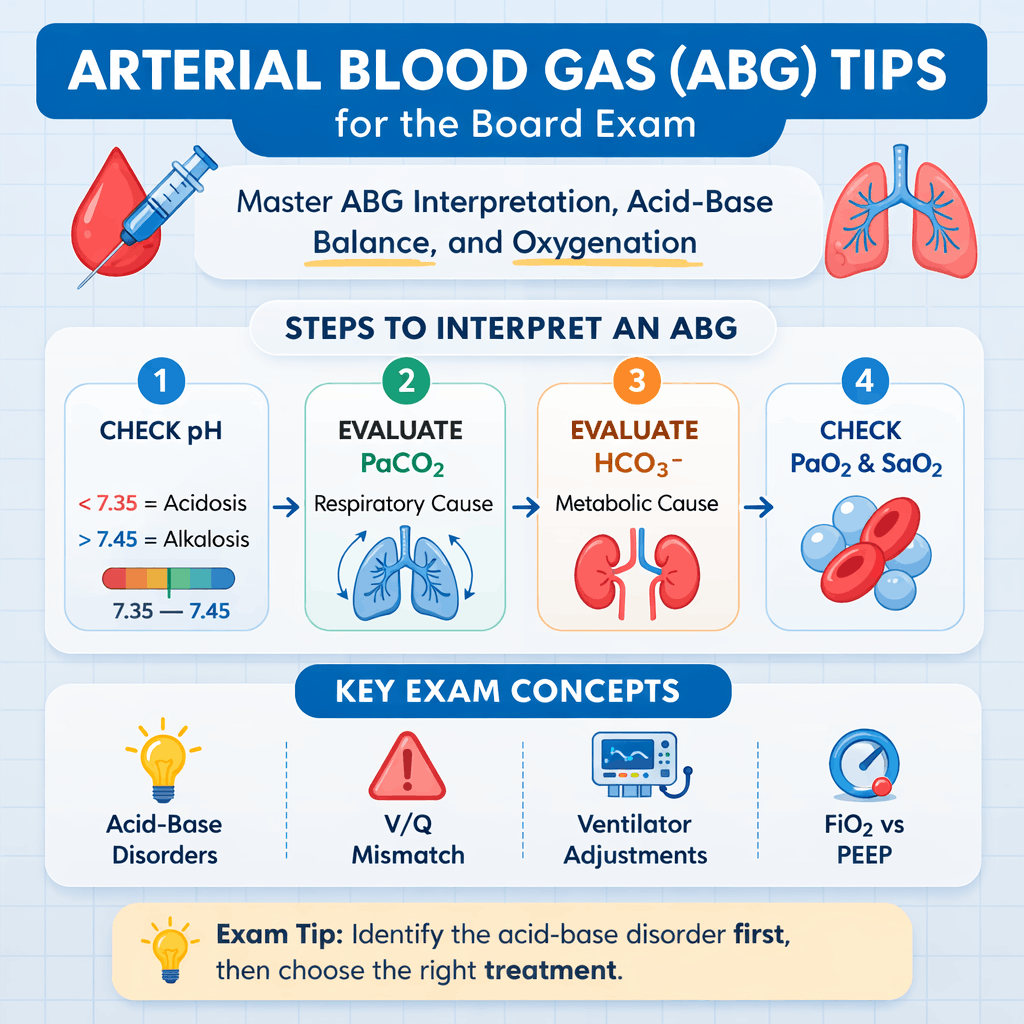
ABG Tips for the Board Exam
- Master ABG interpretation
- Remember ABG quality control
- Understand capillary blood gases
- Understand V/Q mismatch
- Know how to optimize a patient’s PaO2
Watch the video and continue reading to learn important tips that will help you master ABG questions that commonly appear on the respiratory therapy board exam.
1. Master ABG Interpretation
If you have made it this far in your respiratory therapy journey, you have likely already spent significant time learning how to interpret arterial blood gases. This skill is not only essential for patient care but is also one of the most frequently tested concepts on the respiratory therapy board exam.
ABG interpretation is considered a core competency for respiratory therapists. On the board exam, you will often encounter patient scenarios that include ABG results. You will then be expected to analyze the ABG values, determine the patient’s acid-base disorder, and recommend the most appropriate clinical intervention.
To answer these questions correctly, it is helpful to follow a consistent interpretation process:
- Evaluate the pH to determine if the patient is acidotic or alkalotic
- Analyze the PaCO2 to determine if the disorder is respiratory
- Evaluate the HCO3 to determine if the disorder is metabolic
- Determine whether compensation is present
- Assess the PaO2 and oxygen saturation to evaluate oxygenation
Note: The board exam frequently tests your ability to apply ABG interpretation to ventilator management decisions. The following example demonstrates how this type of question may appear.
Example Question
A 66-year-old male patient weighing 80 kg is receiving volume-controlled ventilation in SIMV mode. The ventilator settings are as follows: tidal volume 350 mL, rate 10/min, FiO2 30%, and PEEP 5 cmH2O. An ABG sample was obtained with the following results:
pH: 7.28
PaCO2: 52 torr
HCO3-: 25 mEq/L
PaO2: 87 torr
SaO2: 95%
Which of the following changes would you recommend?
A. Increase the set rate
B. Increase the tidal volume
C. Increase the level of PEEP
D. Add mechanical dead space
Explanation
To determine the correct answer, the first step is to interpret the ABG values.
- pH 7.28 indicates acidemia
- PaCO2 52 torr indicates elevated carbon dioxide levels
- HCO3- 25 mEq/L falls within the normal range
- PaO2 87 torr and SaO2 95% indicate adequate oxygenation
The abnormal pH combined with an elevated PaCO2 confirms that the patient is experiencing acute respiratory acidosis. Because the bicarbonate level is normal, there is no metabolic compensation present.
The underlying issue is inadequate ventilation, which has resulted in CO2 retention. The goal of treatment is therefore to increase the patient’s minute ventilation in order to eliminate excess carbon dioxide.
Minute ventilation can be increased in two ways:
- Increase the tidal volume
- Increase the respiratory rate
Next, evaluate the current ventilator settings to determine the best adjustment.
- The set respiratory rate is 10 breaths per minute, which is within the normal range
- The tidal volume is 350 mL, which is significantly lower than the recommended range for this patient
For an 80 kg patient, the appropriate tidal volume range using lung-protective ventilation is approximately 6 to 8 mL/kg. This corresponds to roughly 480 to 640 mL.
Because the current tidal volume is well below this range, increasing the tidal volume is the most appropriate intervention.
Correct Answer: B. Increase the tidal volume
Adjusting the tidal volume into the recommended range will increase minute ventilation and help reduce the patient’s PaCO2 level, thereby correcting the respiratory acidosis.
This example highlights why ABG interpretation is so important. Many board exam questions require you to analyze ABG results and apply them to clinical decisions such as ventilator adjustments, oxygen therapy changes, or medication selection.
Note: Developing a structured approach to ABG interpretation will make it much easier to recognize acid-base disorders and determine the correct treatment when similar questions appear on the board exam.

Access our quiz with sample TMC practice questions and in-depth explanations to master essential ABG concepts.
2. Remember ABG Quality Control
The Levey-Jennings chart is an important quality control tool used to monitor the accuracy and reliability of ABG analyzers. Respiratory therapists rely on these analyzers to provide accurate blood gas measurements, so it is essential to recognize when the equipment may be producing unreliable results.
Questions about ABG quality control occasionally appear on the respiratory therapy board exam. These questions test your ability to interpret a Levey-Jennings chart and determine whether an analyzer is functioning properly or requires troubleshooting.
The Levey-Jennings chart displays quality control measurements plotted over time. A horizontal line represents the mean value, while additional lines show the acceptable limits, typically set at plus or minus two standard deviations from the mean.
Each plotted point represents a quality control measurement taken from the analyzer. By examining how the points are distributed around the mean, you can determine whether the analyzer is functioning correctly.

Types of Patterns and What They Mean
- In Control: All plotted values remain within two standard deviations of the mean. This indicates that the analyzer is functioning normally and producing reliable results.
- Random Error: A single value falls outside the acceptable range while the remaining values stay within limits. This type of error may occur due to a temporary issue such as a small air bubble in the sample or a minor handling error. Usually no immediate action is required, but the analyzer should continue to be monitored.
- Trend: Values gradually increase or decrease over time but remain within the acceptable limits. This pattern suggests that the analyzer is slowly drifting away from calibration and may soon become inaccurate. Preventive maintenance or recalibration is typically recommended.
- Shift: All values remain within the acceptable limits but suddenly cluster above or below the previous average. This change often indicates a calibration change or an electrode issue that may require adjustment.
- Out of Control: Multiple values fall outside the acceptable range. This indicates that the analyzer is no longer producing reliable measurements and must be serviced or recalibrated before further patient testing is performed.
Exam Strategy
When you encounter a Levey-Jennings chart on the board exam, follow these steps:
- Identify the Pattern: Examine where the plotted points fall relative to the mean and standard deviation lines.
- Determine the Error Type: Decide whether the pattern represents random error, a trend, a shift, or an out-of-control situation.
- Select the Appropriate Action: Choose the answer that best describes the problem and the correct corrective action.
Note: Being able to quickly recognize these patterns will help you answer quality control questions efficiently during the board exam. Understanding how ABG analyzers are monitored for accuracy helps ensure reliable test results and demonstrates an important aspect of respiratory therapy practice.
3. Understand Capillary Blood Gases
A capillary blood gas test is commonly used to evaluate ventilation in newborns and infants. Instead of collecting blood from an artery, the sample is obtained from capillary circulation by performing a small skin puncture.
This test provides useful information about the patient’s acid-base status and ventilation. However, it is important to understand its limitations, especially when answering questions on the respiratory therapy board exam.
A capillary blood gas sample is typically collected from the lateral portion of the infant’s heel. This area is preferred because it contains a rich network of capillaries and minimizes the risk of damaging underlying bone structures.
Note: If the heel cannot be used, alternative sites may include the fingertip, big toe, or earlobe. These locations are generally considered secondary options.
Key Concepts for Capillary Blood Gases
- pH and PaCO2: Capillary blood gas measurements correlate fairly well with arterial values for pH and PaCO2. This makes the test useful for evaluating a patient’s ventilatory status.
- PaO2: Oxygen levels measured from a capillary sample are unreliable. Capillary blood gases should not be used to assess oxygenation because the oxygen tension does not accurately reflect arterial oxygen levels.
The board exam may include questions that require you to determine whether a capillary sample is appropriate in a given scenario.
The key concept to remember is simple:
- Capillary blood gases are useful for evaluating ventilation.
- Capillary blood gases should not be used to evaluate oxygenation.
Preferred Puncture Sites
- Primary Site: Lateral heel
- Alternative Sites: Fingertip, big toe, or earlobe
Note: The lateral heel is preferred because it is well vascularized and reduces the risk of complications. Understanding when and how capillary blood gases are used will help you answer neonatal and pediatric questions more confidently on the board exam.
4. Understand V/Q Mismatch
A ventilation-perfusion (V/Q) mismatch occurs when the balance between airflow and blood flow within the lungs becomes disrupted. Because efficient gas exchange requires both ventilation and perfusion, any imbalance can result in impaired oxygenation.
The normal V/Q ratio in a healthy lung is approximately 0.8. This means that perfusion slightly exceeds ventilation. When this balance is disrupted, oxygenation problems can occur.
High V/Q Ratio: Ventilation Without Adequate Perfusion
A high V/Q ratio occurs when ventilation is present but perfusion is reduced. In this situation, air reaches the alveoli but there is insufficient blood flow to exchange gases. This creates areas of physiologic dead space.
- Example: Pulmonary embolism
- Mechanism: A blood clot blocks pulmonary circulation
- Result: Alveoli receive ventilation but lack blood flow for gas exchange
Note: Although air is moving through the lungs, oxygen cannot be effectively transferred to the bloodstream.
Low V/Q Ratio: Perfusion Without Adequate Ventilation
A low V/Q ratio occurs when blood flow remains normal but ventilation is reduced. This condition results in poorly ventilated alveoli receiving blood flow, which leads to inadequate oxygenation.
This situation is often referred to as a shunt.
- Example: Atelectasis
- Mechanism: Collapsed alveoli prevent ventilation
- Result: Blood passes through the lungs without becoming fully oxygenated
Low V/Q states commonly result in hypoxemia and may require interventions that improve alveolar recruitment.
Both high and low V/Q ratios can contribute to refractory hypoxemia, which is a condition in which oxygen levels remain low despite increasing oxygen therapy.
In these situations:
- Increasing FiO2 alone may not correct the problem
- Increasing PEEP may help recruit alveoli and improve gas exchange
Note: Understanding the difference between dead space and shunt physiology is essential for answering oxygenation questions on the board exam. V/Q mismatch is a foundational concept in respiratory physiology and frequently appears in exam questions involving oxygenation and ventilator management.
5. Know How to Optimize a Patient’s PaO2
Another concept that frequently appears on the respiratory therapy board exam is understanding how to adjust ventilator settings to manage oxygenation. This requires knowing when to modify the FiO2 and when to adjust the level of PEEP.
Example Scenario
A patient has been intubated and placed on mechanical ventilation with an FiO2 of 100 percent and a PEEP of 5 cmH2O. Thirty minutes later, an ABG reveals that the PaO2 is significantly elevated.
This indicates that the patient is receiving more oxygen than necessary. Excessive oxygen exposure can lead to oxygen toxicity, so adjustments must be made.
How to Decrease PaO2
- Decrease the FiO2 first: Gradually reduce the FiO2 until it reaches approximately 60 percent or lower.
- Decrease PEEP second: Once FiO2 is at or below 60 percent, PEEP may be reduced if oxygenation remains excessive.
Note: Reducing FiO2 first helps minimize the risk of oxygen toxicity while maintaining adequate oxygen delivery.
How to Increase PaO2
If a patient’s PaO2 is too low, the goal is to improve oxygenation while maintaining safe ventilator settings.
- Increase FiO2 first: Increase the oxygen concentration up to approximately 60 percent.
- Increase PEEP second: If oxygenation remains inadequate, increase PEEP to recruit additional alveoli.
PEEP helps stabilize alveoli, improve functional residual capacity, and reduce intrapulmonary shunting. This can significantly improve oxygenation in patients with conditions such as ARDS or atelectasis.
A helpful rule to remember for exam questions is:
Adjust FiO2 first, then adjust PEEP.
Note: This sequence is commonly tested because it reflects the safest approach to managing oxygenation in mechanically ventilated patients.

Unlock insider strategies and proven exam hacks to master key concepts, avoid common pitfalls, and pass the exam on your first (or next) attempt.
Final Thoughts
ABG interpretation is one of the most important skills tested on the respiratory therapy board exam. Developing a strong understanding of acid-base disorders, ventilation management, and oxygenation strategies will greatly improve your ability to answer these questions correctly.
Focus on recognizing normal ABG values, identifying abnormal patterns, and applying clinical reasoning to determine the best treatment for each patient scenario.
If you found these tips helpful, consider exploring our TMC Exam Hacks video course for additional strategies, expert insights, and practical study techniques that can help you succeed on your journey toward becoming a registered respiratory therapist (RRT).

Written by:
John Landry is a registered respiratory therapist from Memphis, TN, and has a bachelor's degree in kinesiology. He enjoys using evidence-based research to help others breathe easier and live a healthier life.
References
- Castro D, Patil SM, Zubair M, et al. Arterial Blood Gas. [Updated 2024 Jan 8]. In: StatPearls [Internet]. Treasure Island (FL): StatPearls Publishing; 2025.