

Pulmonary function testing equipment is used to measure how well the lungs move air, exchange gases, and support ventilation and oxygenation. These devices help respiratory therapists evaluate airflow, lung volumes, airway resistance, diffusion, and blood gas status.
Accurate results depend on more than simply having the right machine. The equipment must be properly selected, calibrated, assembled, cleaned, and used with correct patient coaching.
Understanding how PFT equipment works is important because small errors in setup, leaks, contamination, or patient technique can lead to inaccurate results and incorrect clinical interpretation.

What Is PFT Equipment?
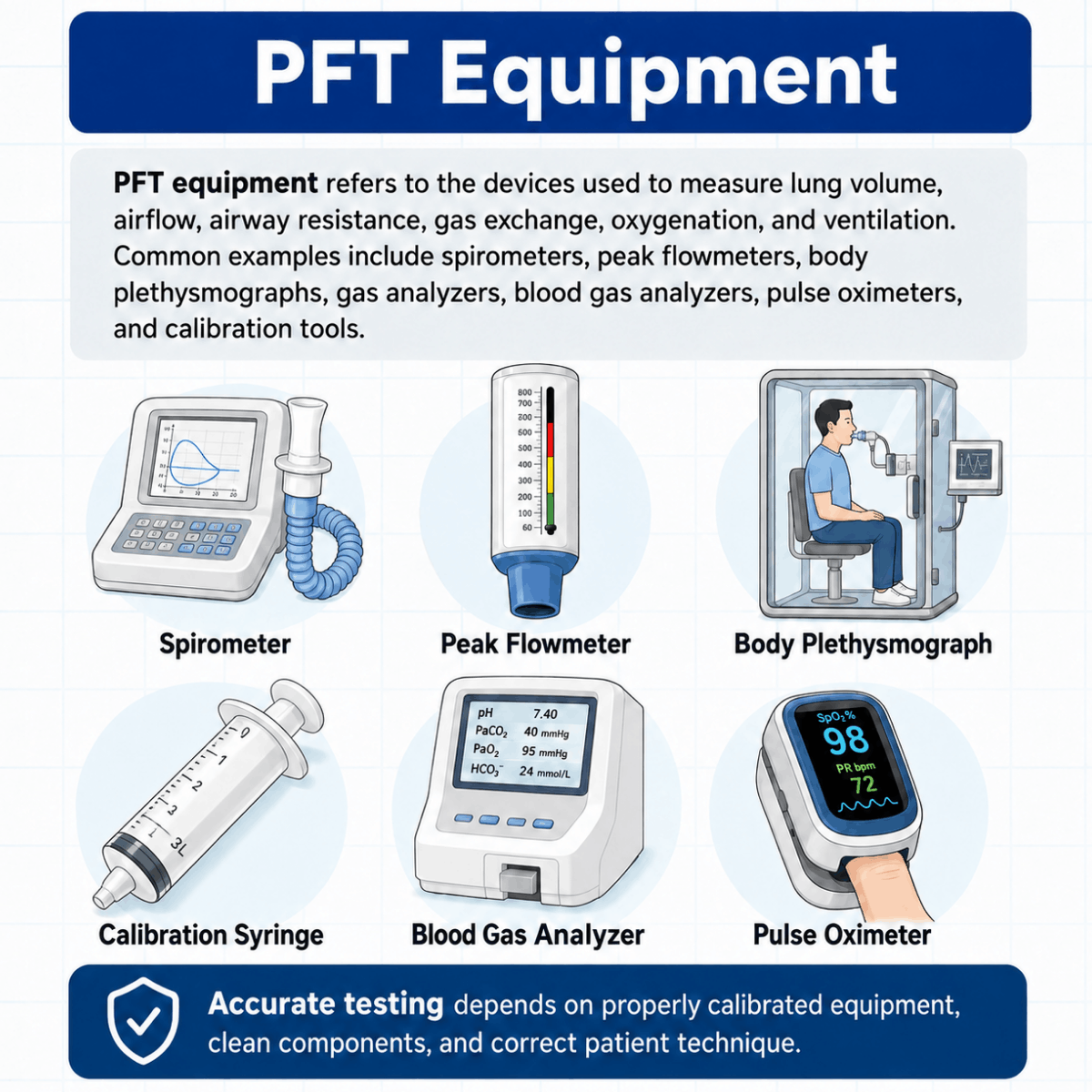
PFT equipment refers to the instruments used to perform pulmonary function tests. These tests measure different aspects of lung function, including how much air a patient can inhale or exhale, how fast air moves through the airways, how much air remains in the lungs, and how well gases move between the lungs and blood.
The main types of PFT equipment include:
- Spirometers
- Pneumotachometers
- Peak flowmeters
- Body plethysmographs
- Pulmonary gas analyzers
- Gas-conditioning devices
- Blood gas analyzers
- Pulse oximeters
- Breathing valves
- Calibration syringes
- Computer-based testing systems
Each device has a specific role. Some measure volume directly, some measure flow, some analyze gas concentrations, and others help control gas movement during testing. In a modern pulmonary function laboratory, these devices often work together as part of a computerized measurement system.
Why PFT Equipment Matters
Pulmonary function testing is only useful when the data are accurate and repeatable. A patient’s results may influence diagnosis, disease staging, treatment decisions, disability evaluation, preoperative risk assessment, or response to therapy. If the equipment is inaccurate, the interpretation may also be inaccurate.
PFT equipment matters because it helps clinicians:
- Identify obstructive lung disease
- Evaluate restrictive patterns
- Measure airway resistance
- Assess lung volume abnormalities
- Evaluate gas exchange
- Monitor disease progression
- Measure response to bronchodilator therapy
- Support bedside respiratory assessment
- Track asthma control
- Assess oxygenation and ventilation status
Even high-quality equipment can produce poor results if it is assembled incorrectly, contaminated, poorly calibrated, or used without proper patient instruction. For this reason, respiratory therapists must understand both the purpose of each device and the common problems that can affect test quality.
Spirometers
A spirometer is a device used to measure the volume of air inspired or expired by the lungs. Spirometry is one of the most common pulmonary function tests because it provides useful information about airflow limitation and lung volume changes.
Spirometers can measure values such as:
- Vital capacity
- Forced vital capacity
- Forced expiratory volume in 1 second
- Peak expiratory flow
- Forced expiratory flow rates
- Slow vital capacity
- Tidal volume
- Minute ventilation
Note: Spirometers are used in pulmonary function laboratories, physician offices, clinics, hospitals, and bedside settings. They are especially important in the evaluation of asthma, COPD, restrictive lung disease, and other disorders that affect ventilation.
Volume-Displacement Spirometers
Volume-displacement spirometers measure gas volume directly. These devices collect exhaled gas and measure the amount of physical displacement caused by the patient’s breathing.
Classic examples include:
- Water-seal spirometers
- Bellows spirometers
- Dry rolling seal spirometers
- Piston spirometers
- Wedge-type spirometers
A water-seal spirometer uses a bell suspended in water. When the patient exhales into the spirometer, the bell rises. When the patient inhales from the spirometer, the bell falls. The movement of the bell corresponds to the measured gas volume.
Older systems recorded this movement with a pen on a rotating drum. The tracing could then be measured manually. Although these devices were once common in pulmonary function laboratories, their use has decreased because newer flow-sensing spirometers are smaller, easier to maintain, and more portable.
Volume-displacement spirometers can be highly accurate when they are leak-free and have low mechanical resistance. However, they require proper maintenance, space, and attention to mechanical parts. They may also require temperature and pressure corrections because measured gas volume is influenced by environmental conditions.
Flow-Sensing Spirometers
Flow-sensing spirometers measure airflow rather than volume directly. These devices detect how fast gas moves through the sensor. The system then calculates volume by integrating flow over time.
In simple terms, the spirometer measures airflow repeatedly during the breathing maneuver. The computer adds these flow measurements together over time to calculate the total volume of air moved.
Flow-sensing spirometers are often called pneumotachometers, although the term is sometimes used more specifically for certain pressure-differential flow sensors.
Common types of flow sensors include:
- Turbine sensors
- Pressure-differential sensors
- Heated-wire sensors
- Pitot tube sensors
- Ultrasonic sensors
Note: Flow-sensing spirometers are widely used because they are compact, portable, easier to clean, and often compatible with disposable patient-contact parts. They are common in office spirometry, bedside testing, and modern computerized PFT systems.
Turbine Spirometers
Turbine spirometers use a rotating element that moves as gas flows through the device. The speed of rotation is related to airflow. The system converts this movement into a signal that can be used to calculate flow and volume.
These devices are simple and portable, but moving parts can introduce mechanical limitations. If the turbine is dirty, damaged, or affected by friction, the measurement may become inaccurate. Turbine devices must be maintained according to manufacturer recommendations.
Pressure-Differential Pneumotachometers
A pressure-differential pneumotachometer measures airflow by detecting the pressure drop across a known resistance. The resistance may be a screen, mesh, bundle of small tubes, or fixed orifice. As airflow increases, the pressure difference across the resistance increases.
Pressure-relaying tubes connect the flow sensor to a differential-pressure transducer. The transducer converts the pressure difference into an electrical signal. A computer then calculates flow and volume.
Common problems include:
- Leaks around the mouthpiece
- Cracked pressure tubing
- Disconnected hoses
- Mucus on the resistive element
- Condensation in the sensor
- Obstructed ports
- Incorrect zeroing
Note: Many pneumotachometers are heated to reduce condensation. Moisture can interfere with the pressure signal and cause inaccurate readings.
Heated-Wire Flow Sensors
Heated-wire flow sensors, also called hot-wire or thermistor-type devices, measure flow based on heat loss. A heated wire or thermistor is cooled as gas flows past it. The device measures the energy required to maintain the sensor at a set temperature. This information is then converted into airflow.
These devices do not require pressure-relaying hoses, which makes their setup different from pressure-differential pneumotachometers. However, they still require calibration, proper cleaning, and protection from contamination.
Ultrasonic Flow Sensors
Ultrasonic flow sensors use sound waves to measure gas flow. They detect changes in sound transmission as gas moves through the sensor. Some ultrasonic devices use vortex principles, while others use nonvortex methods.
These sensors can be accurate and responsive, but they still depend on proper calibration, clean sensor pathways, and correct software processing.
Peak Flowmeters
A peak flowmeter is a handheld device that measures peak expiratory flow rate. Peak expiratory flow is the highest flow achieved during a forceful exhalation. Peak flowmeters are commonly used for asthma monitoring because they are portable, inexpensive, and easy to use. Patients can use them at home to track changes in airway function over time.
Peak flow monitoring can help patients and clinicians:
- Assess asthma control
- Detect worsening airflow obstruction
- Evaluate response to medication
- Identify early signs of an asthma flare
- Guide action plans
Note: Peak flowmeters do not provide the same level of detail as full spirometry. They do not measure the full forced vital capacity maneuver or generate complete flow-volume loops. However, they are useful for repeated monitoring when trends are more important than a single diagnostic measurement.
Bedside Mechanical Respirometers
Mechanical respirometers are used for bedside volume measurements. A common example is the Wright respirometer, which uses a turbine mechanism to measure exhaled volume.
These devices can measure:
- Tidal volume
- Minute ventilation
- Inspiratory capacity
- Slow vital capacity
- Expired volume
The Wright respirometer contains internal vanes and gears that move as gas passes through the device. The movement is translated into a displayed volume.
A one-way breathing valve is usually attached so the patient inhales room air and exhales through the device. Nose clips are often used to prevent leaks. A bacterial or HEPA filter may be used to reduce contamination.
Mechanical respirometers are best for nonforced bedside volume measurements. They should not be used for high-flow forced vital capacity maneuvers because forceful exhalation can damage or distort the internal vane and gear mechanism. They may also be inaccurate for very small pediatric tidal volumes because the mechanical parts may not respond well to very low volumes or flows.
Portable Electronic Spirometers
Portable electronic spirometers combine a flow sensor with a computer module. They are commonly used in offices, clinics, screening programs, and bedside testing.
These systems can:
- Store patient information
- Select reference equations
- Measure flow and volume
- Display results
- Print reports
- Check maneuver quality
- Store test data
- Provide prompts for repeat testing
Portable electronic spirometers may use hot-wire, Doppler, turbine, ultrasonic, or pressure-differential technology. Regardless of the sensor type, the device must meet accepted performance standards for diagnostic spirometry.
A portable spirometer should be accurate across the expected volume and flow ranges. It should also allow appropriate reference values based on patient factors such as age, height, sex, and ethnicity. Many devices include automated validity checks to help identify poor effort, cough, slow start, early termination, or an inadequate end-of-test plateau.
Body Plethysmographs
A body plethysmograph is an enclosed chamber used to measure lung volumes and airway resistance. The patient sits inside the chamber and breathes through a mouthpiece while pressure and volume changes are measured.
Body plethysmography is especially useful for measuring thoracic gas volume and airway resistance. It can also help determine residual volume and total lung capacity.
One major advantage of body plethysmography is that it can measure gas trapped behind closed or poorly ventilated airways. This makes it especially useful in obstructive lung disease, where gas trapping and hyperinflation may be present.
Body plethysmographs are often called body boxes. They may be classified as pressure plethysmographs or flow plethysmographs.
Note: Because plethysmographs are sensitive instruments, they require careful setup. Room pressure changes, vibration, air movement, leaks, and environmental conditions can affect results. Equipment placement, validation, and routine maintenance are important for accurate testing.
Breathing Valves
Breathing valves control the direction of airflow during pulmonary function testing. They may appear to be simple accessories, but they are essential for accurate gas measurement and patient safety.
Common types include:
- Free-breathing valves
- Demand valves
- Directional valves
- Gas-sampling valves
- One-way valves
These valves help separate inspired and expired gas, direct exhaled gas toward analyzers, and allow test gases to be delivered during specific maneuvers.
Gas-sampling valves are especially important in tests such as single-breath diffusing capacity. During this test, the patient inhales a test gas, holds the breath, and exhales into a sampling system. The valve must open and close at the correct time so the proper gas sample is collected.
Valve problems can affect test accuracy. Leaking, sticking, deterioration, incorrect assembly, or poor sealing can contaminate gas samples or alter measured volumes. Some valves must be disassembled and cleaned between patients, while others may be used with disposable components or in-line filters.
Pulmonary Gas Analyzers
Pulmonary gas analyzers measure gas concentrations during pulmonary function testing. Different tests require different analyzers depending on the gas being measured.
Pulmonary gas analyzers may measure:
- Oxygen
- Carbon dioxide
- Helium
- Nitrogen
- Carbon monoxide
- Nitric oxide
Oxygen and carbon dioxide analyzers are often used during metabolic testing and exercise testing. Helium analyzers are used in helium dilution lung volume testing. Nitrogen analyzers are used in nitrogen washout methods. Carbon monoxide analyzers are used in diffusing capacity testing. Nitric oxide analyzers may be used to assess airway inflammation, especially in asthma evaluation.
Several technologies may be used, including:
- Infrared absorption
- Thermal conductivity
- Gas chromatography
- Chemoluminescence
- Emission spectroscopy
- Electrochemical analysis
Note: The analyzer must respond quickly and accurately. Response time, transport time, and phase delay are important because gas concentration signals often need to be matched with flow signals. If the gas signal is delayed or too slow, calculated results may be inaccurate.
Gas-Conditioning Devices
Gas-conditioning devices prepare gas samples before they reach sensors or analyzers. Exhaled gas is warm, humid, and may contain mucus or other contaminants. These factors can affect equipment performance.
Gas-conditioning devices may:
- Remove excess moisture
- Protect gas sensors
- Stabilize temperature
- Reduce contamination
- Improve analyzer response
- Support measurement accuracy
Note: These devices are important because moisture and contamination can change sensor behavior, slow analyzer response, or cause inaccurate readings. Proper gas conditioning helps preserve the accuracy and reliability of the testing system.
Blood Gas Analyzers
A blood gas analyzer measures pH, carbon dioxide tension, and oxygen tension in blood. These values help evaluate ventilation, oxygenation, and acid-base status.
Blood gas analyzers commonly measure:
- pH
- PaCO₂
- PaO₂
- Bicarbonate
- Oxygen saturation
- Base excess or base deficit
The main measurement components include pH electrodes, PCO₂ electrodes, and PO₂ electrodes. These sensors use electrochemical principles to determine the concentration or tension of gases in the blood sample.
Blood gas analysis is especially important for patients with acute or chronic respiratory failure, acid-base disturbances, shock, severe lung disease, or ventilatory problems. Although blood gas analyzers are not the same as spirometers, they are part of the broader group of equipment used to assess respiratory function.
Oximeters
Oximeters measure oxygen saturation. Pulse oximeters estimate arterial oxygen saturation noninvasively by using light absorption through tissue, usually at the finger, toe, earlobe, or forehead.
Pulse oximetry provides rapid information about oxygenation. It is widely used in hospitals, clinics, pulmonary function labs, emergency care, and home monitoring.
Pulse oximeters are useful because they are:
- Noninvasive
- Fast
- Easy to apply
- Suitable for continuous monitoring
- Helpful for detecting hypoxemia
However, pulse oximetry has limitations. It estimates oxygen saturation rather than directly measuring arterial oxygen tension. Accuracy can be affected by poor perfusion, motion, nail polish, skin pigmentation, abnormal hemoglobin species, bright light, and sensor placement.
Spectrophotometric oximeters, including CO-oximeters, analyze blood samples and can measure different hemoglobin species more directly. This is important when abnormal hemoglobins such as carboxyhemoglobin or methemoglobin are suspected.
Calibration Syringes and Quality Control
Quality control is essential in pulmonary function testing. The most common calibration tool is the 3.0-L calibration syringe. This syringe is used to verify that spirometers and flow sensors measure volume accurately.
Daily volume calibration is a standard part of PFT quality control. Many laboratories also verify accuracy before each patient test.
With a 3-L calibration syringe, acceptable readings are generally expected to fall within the accepted accuracy range. If the reading is too low, a leak may be present. If the reading is too high, the therapist should check zeroing, correction factors, temperature conditions, and equipment setup.
Quality control may include:
- Daily leak checks
- Daily volume calibration
- Flow linearity checks
- Volume linearity checks
- Time accuracy checks
- Biological control testing
- Documentation of maintenance
- Software update logs
- Review of errors and corrective actions
Note: For volumetric spirometers, leak testing is especially important. A leak can cause underestimation of volume and invalidate patient results. Common leak sources include loose connections, cracked tubing, damaged seals, missing gaskets, and improperly assembled valves.
Computers in PFT Systems
Modern PFT systems rely heavily on computers. Computers collect, process, calculate, display, store, and report pulmonary function data.
Computerized systems may:
- Acquire signals from sensors
- Convert analog signals into digital data
- Calculate measured values
- Apply correction factors
- Display flow-volume loops
- Display volume-time curves
- Compare results with reference values
- Store patient data
- Generate reports
- Control valves and testing sequences
- Monitor maneuver quality
Computers improve efficiency and reduce manual calculations, but they do not replace the respiratory therapist. A trained clinician is still needed to coach the patient, evaluate effort, inspect curves, recognize errors, and determine whether the results are acceptable.
Automated prompts can help identify poor starts, coughing, leaks, early termination, or inadequate exhalation. However, the therapist must still use clinical judgment. A computer may flag technical issues, but it cannot fully replace careful observation and knowledge of proper testing technique.
Infection Control for PFT Equipment
PFT equipment can become contaminated during testing because patients breathe through mouthpieces, tubing, valves, and filters. Saliva, mucus, blood, exhaled droplets, and condensation can carry microorganisms.
Important infection control practices include:
- Hand hygiene between patients
- Standard precautions
- Gloves when handling contaminated parts
- Disposable mouthpieces when available
- Proper use of bacterial or HEPA filters
- Cleaning and disinfection of reusable parts
- Replacement of tubing or valves when contaminated
- High-level disinfection or sterilization when indicated
Mouthpieces, valves, tubing, and other patient-contact parts should be disposed of, sterilized, or disinfected between patients. If reusable parts show condensation from exhaled air, they should be cleaned and processed before reuse.
Filters are often used to reduce contamination between the patient and the equipment. However, filters must be used correctly and changed between patients. Infection control does not eliminate the need for proper cleaning, inspection, and maintenance.
Common Equipment Problems
PFT equipment problems can lead to inaccurate results. Respiratory therapists must be able to recognize and correct these issues before testing continues.
Common problems include:
- Leaks around the mouthpiece
- Loose tubing connections
- Cracked pressure hoses
- Blocked ports
- Condensation in the sensor
- Mucus contamination
- Incorrect valve assembly
- Wrong port connection
- Sensor drift
- Incorrect zeroing
- Calibration failure
- Software or reference value errors
- Improper correction settings
- Poor temperature matching during calibration
Note: A common exam principle is to check simple causes first. If a bedside respirometer or spirometer is not reading correctly, the therapist should verify the setup, check the on/off switch, confirm correct valve position, inspect connections, and look for leaks or obstruction before assuming the device is defective.
Patient Technique and Equipment Accuracy
PFT results depend on both equipment accuracy and patient performance. Even properly calibrated equipment can produce invalid data if the patient performs the maneuver incorrectly.
Common patient-performance errors include:
- Incomplete inhalation
- Weak expiratory effort
- Slow start to exhalation
- Coughing during the maneuver
- Air leak around the mouthpiece
- Exhaling through the nose
- Closing the glottis
- Stopping too early
- Variable effort between attempts
The respiratory therapist must explain the maneuver clearly, demonstrate when needed, coach the patient throughout the test, and evaluate the curves after each attempt. Forced spirometry requires maximal effort, rapid start, continuous exhalation, and an adequate end-of-test plateau.
Note: This is why PFT equipment and therapist skill must work together. The machine measures the maneuver, but the therapist helps ensure the maneuver is valid.
Choosing the Right PFT Device
The correct device depends on the test being performed. Not all equipment is appropriate for all measurements.
For example, a mechanical respirometer may be appropriate for bedside tidal volume or slow vital capacity, but it should not be used for forced expiratory testing. A portable spirometer may be appropriate for screening spirometry, but full lung volume testing may require a body plethysmograph or gas dilution system. Diffusing capacity testing requires gas analyzers and specialized valves.
In general:
- Use mechanical respirometers for bedside volume measurements
- Use electronic spirometers for forced expiratory tests
- Use peak flowmeters for peak expiratory flow monitoring
- Use body plethysmographs for thoracic gas volume and airway resistance
- Use gas analyzers for lung volume, diffusion, and exercise testing
- Use blood gas analyzers for ventilation, oxygenation, and acid-base status
- Use pulse oximeters for noninvasive oxygen saturation monitoring
Note: Correct equipment selection helps ensure that the test matches the clinical question.
PFT Equipment Practice Questions
1. What is PFT equipment?
PFT equipment refers to the devices used to measure lung volumes, airflow, airway resistance, gas exchange, oxygenation, and ventilation.
2. What are the two major categories of PFT measuring devices?
The two major categories are volume-measuring devices and flow-measuring devices.
3. What does a spirometer measure?
A spirometer measures the volume of air inspired or expired by the lungs.
4. What is a volume-displacement spirometer?
A volume-displacement spirometer is a device that measures gas volume directly by physical movement of a bell, piston, or bellows.
5. How does a water-seal spirometer work?
A water-seal spirometer uses a bell suspended in water that rises during exhalation and falls during inhalation.
6. Why do volume-displacement spirometers require correction factors?
They may require correction because gas volume is affected by temperature, pressure, and water vapor conditions.
7. What are examples of volume-displacement spirometers?
Examples include water-seal spirometers, bellows spirometers, dry rolling seal spirometers, piston spirometers, and wedge-type spirometers.
8. What is a flow-sensing spirometer?
A flow-sensing spirometer measures airflow directly and calculates volume by integrating flow over time.
9. What is another name for a flow-sensing spirometer?
A flow-sensing spirometer is commonly called a pneumotachometer.
10. How does a pneumotachometer calculate volume?
It measures airflow over time, and the computer adds those flow measurements together to calculate volume.
11. What are common types of flow sensors used in spirometers?
Common types include turbine, pressure-differential, heated-wire, pitot tube, and ultrasonic flow sensors.
12. How does a turbine flow sensor work?
A turbine flow sensor uses a rotating element that spins as gas moves through the device.
13. How does a pressure-differential flow sensor work?
It measures the pressure drop across a known resistance as gas flows through the sensor.
14. What does a differential-pressure transducer do?
A differential-pressure transducer converts pressure differences into an electrical signal that can be processed by the spirometer.
15. How does a heated-wire flow sensor measure airflow?
It measures the cooling effect of moving gas on a heated wire or thermistor.
16. Why are flow-sensing spirometers widely used?
They are smaller, easier to maintain, easier to clean, and well suited for portable or office-based testing.
17. What can interfere with the accuracy of a flow sensor?
Accuracy can be affected by moisture, mucus, debris, gas density, gas viscosity, electronic drift, leaks, or poor calibration.
18. What is a peak flowmeter?
A peak flowmeter is a handheld device that measures peak expiratory flow rate during a forced exhalation.
19. Why are peak flowmeters useful for patients with asthma?
They help monitor changes in airway function and can show worsening obstruction before symptoms become severe.
20. What is a limitation of a peak flowmeter?
A peak flowmeter does not provide the detailed volume and flow data obtained from full spirometry.
21. What is a Wright respirometer?
A Wright respirometer is a turbine-type handheld spirometer used for bedside volume measurements.
22. What values can a mechanical respirometer measure?
It can measure tidal volume, minute ventilation, expired volume, inspiratory capacity, and slow vital capacity.
23. Why should a Wright respirometer not be used for forced vital capacity testing?
A forceful maneuver can distort or damage the internal vane and gear mechanism.
24. Why can a Wright respirometer be inaccurate for very small pediatric tidal volumes?
The inertia of the internal vane and gears may cause falsely low readings with very small volumes.
25. What device is commonly used to check spirometer volume accuracy?
A 3.0-L calibration syringe is commonly used to verify spirometer volume accuracy.
26. What is the main purpose of a 3.0-L calibration syringe?
A 3.0-L calibration syringe is used to verify that a spirometer or flow sensor is measuring volume accurately.
27. What is the acceptable calibration range for a 3-L syringe using the ±3% standard?
The acceptable range is 2.91 L to 3.09 L.
28. What should the therapist suspect if a spirometer reads low during calibration?
The therapist should suspect a leak or loss of volume in the system.
29. What should the therapist check if a spirometer reads high during calibration?
The therapist should check zeroing, correction settings, temperature matching, and whether BTPS correction is turned off during calibration.
30. How often should leak testing be performed on volumetric spirometers?
Leak testing should be performed daily and after cleaning, disassembly, or reassembly.
31. How is a leak test commonly performed on a volumetric spirometer?
About 3 L of air is injected, the patient interface is occluded, the system is pressurized, and volume loss is observed over 1 minute.
32. What is the maximum acceptable volume loss during a spirometer leak test?
The system should lose no more than 10 mL per minute.
33. What are common sources of leaks in PFT equipment?
Common sources include loose connections, cracked tubing, damaged seals, missing gaskets, and improperly assembled valves.
34. Why is quality control important in pulmonary function testing?
Quality control is important because inaccurate PFT data can lead to incorrect interpretation and inappropriate clinical decisions.
35. What should be included in a PFT quality assurance program?
A program should include technician training, equipment checks, calibration, validity checks, maintenance documentation, and quality review.
36. What is volume linearity testing?
Volume linearity testing checks whether a spirometer remains accurate across different volume ranges.
37. How often is volume linearity commonly checked?
Volume linearity is commonly checked quarterly.
38. What is flow linearity testing?
Flow linearity testing checks whether the spirometer measures accurately at different flow rates.
39. How often is flow linearity commonly checked?
Flow linearity is commonly checked weekly at different flow ranges.
40. What is a biological control in pulmonary function testing?
A biological control is a known subject tested to help verify that equipment and software are producing consistent results.
41. When may a biological control be especially useful?
It may be useful after software updates or major equipment changes.
42. What is a body plethysmograph?
A body plethysmograph is an enclosed chamber used to measure lung volumes and airway resistance.
43. What is another common name for a body plethysmograph?
A body plethysmograph is often called a body box.
44. What important lung volume can body plethysmography help measure?
Body plethysmography can help measure residual volume.
45. Why is body plethysmography useful in obstructive lung disease?
It can measure gas trapped behind closed or poorly ventilated airways.
46. What does thoracic gas volume represent?
Thoracic gas volume represents the volume of gas in the chest during the measurement.
47. What are the two broad types of body plethysmographs?
The two broad types are pressure plethysmographs and flow plethysmographs.
48. What environmental factors can affect body plethysmograph accuracy?
Room pressure changes, vibration, air movement, and equipment placement can affect accuracy.
49. Why must a body plethysmograph be carefully installed and validated?
It must be carefully installed and validated because environmental disturbances and leaks can alter pressure and volume measurements.
50. What is airway resistance?
Airway resistance is the opposition to airflow through the airways, which can be measured during body plethysmography.
51. What is the purpose of breathing valves in PFT equipment?
Breathing valves direct airflow during testing and help separate inspired gas from expired gas.
52. What are common types of breathing valves used in pulmonary function testing?
Common types include free-breathing valves, demand valves, directional valves, gas-sampling valves, and one-way valves.
53. Why are gas-sampling valves important during DLCO testing?
They help direct the correct portion of exhaled gas into the collection or analysis system.
54. What can happen if a breathing valve leaks during a PFT?
A leaking valve can contaminate gas samples, alter measured volumes, and produce inaccurate results.
55. Why must some breathing valves be cleaned or disinfected between patients?
They may contact exhaled gas, saliva, mucus, or condensation that can carry microorganisms.
56. What is a pulmonary gas analyzer?
A pulmonary gas analyzer measures the concentration of gases used during pulmonary function testing.
57. What gases may be measured by pulmonary gas analyzers?
Pulmonary gas analyzers may measure oxygen, carbon dioxide, helium, nitrogen, carbon monoxide, and nitric oxide.
58. What gas is central to diffusing capacity testing?
Carbon monoxide is central to diffusing capacity testing.
59. What gas is commonly used in helium dilution testing?
Helium is commonly used in helium dilution testing to measure functional residual capacity.
60. What gas is measured during nitrogen washout testing?
Nitrogen is measured during nitrogen washout testing.
61. What is the purpose of a nitric oxide analyzer?
A nitric oxide analyzer is used to assess airway inflammation, especially in asthma evaluation.
62. What type of analyzer is commonly associated with carbon dioxide measurement?
Infrared absorption analyzers are commonly associated with carbon dioxide measurement.
63. What analyzer technology is commonly used for nitric oxide measurement?
Chemiluminescence is commonly used for nitric oxide measurement.
64. Why does gas analyzer response time matter?
Response time matters because gas concentration signals must match the timing of flow signals for accurate calculations.
65. What is phase delay in pulmonary gas analysis?
Phase delay is the time difference between the flow signal and the gas concentration signal.
66. Why must phase delay be corrected in some PFT systems?
It must be corrected so gas concentration data align properly with the patient’s airflow data.
67. What is a gas-conditioning device?
A gas-conditioning device prepares gas samples before they reach sensors or analyzers.
68. Why is gas conditioning important in PFT equipment?
Gas conditioning helps remove moisture, protect sensors, and improve measurement stability.
69. How can moisture affect PFT equipment?
Moisture can contaminate sensors, slow analyzer response, alter signals, and reduce accuracy.
70. What is a blood gas analyzer?
A blood gas analyzer measures pH, carbon dioxide tension, and oxygen tension in blood.
71. What respiratory problems can blood gas analysis help evaluate?
Blood gas analysis can help evaluate oxygenation, ventilation, and acid-base status.
72. What are the main electrodes used in a blood gas analyzer?
The main electrodes include pH electrodes, PCO₂ electrodes, and PO₂ electrodes.
73. What does the PCO₂ electrode help measure?
The PCO₂ electrode helps measure the carbon dioxide tension in a blood sample.
74. What does the PO₂ electrode help measure?
The PO₂ electrode helps measure the oxygen tension in a blood sample.
75. Why are blood gas analyzers important in respiratory care?
They provide direct information about gas exchange, ventilation, oxygenation, and acid-base balance.
76. What is a pulse oximeter?
A pulse oximeter is a noninvasive device that estimates arterial oxygen saturation using light absorption.
77. What value does a pulse oximeter display?
A pulse oximeter displays SpO₂, which is an estimate of arterial oxygen saturation.
78. Where is a pulse oximeter sensor commonly placed?
It is commonly placed on a fingertip, toe, earlobe, or forehead.
79. What are common factors that can affect pulse oximeter accuracy?
Poor perfusion, motion, nail polish, abnormal hemoglobin, bright light, and poor sensor placement can affect accuracy.
80. How is a CO-oximeter different from a pulse oximeter?
A CO-oximeter analyzes a blood sample and can measure different hemoglobin species more directly.
81. Why are computers important in modern PFT systems?
Computers collect, process, calculate, display, store, and report pulmonary function data.
82. What type of signal conversion occurs in computerized PFT systems?
Analog physiologic signals are converted into digital data for computer processing.
83. What graphs are commonly displayed by computerized spirometry systems?
Computerized systems commonly display flow-volume loops and volume-time curves.
84. What correction factors may computerized PFT systems apply?
They may apply BTPS or STPD corrections depending on the test and measured gas conditions.
85. Why do computers not replace the respiratory therapist during PFTs?
A therapist is still needed to coach the patient, assess effort, review curves, and judge test acceptability.
86. What patient error can cause falsely low spirometry values?
Incomplete inhalation before the maneuver can cause falsely low spirometry values.
87. What patient error can affect the start of a forced expiratory maneuver?
A slow start to exhalation can affect the accuracy of forced expiratory measurements.
88. What patient error can interrupt a forced vital capacity maneuver?
Coughing during the maneuver can interrupt airflow and make the result unacceptable.
89. Why is a tight lip seal important during spirometry?
A tight lip seal prevents air leaks that could reduce measured volume and flow.
90. Why are nose clips often used during spirometry?
Nose clips help prevent air from escaping through the nose during the maneuver.
91. What is one reason a portable spirometer may be used outside the PFT lab?
Portable spirometers are useful for office, bedside, and screening spirometry because they are compact and easy to use.
92. What standards should portable spirometers meet for diagnostic testing?
They should meet accepted performance standards for accurate volume and flow measurement.
93. What patient information is often entered into an electronic spirometer?
Age, height, sex, and ethnicity are commonly entered to select appropriate predicted values.
94. What are automated validity checks used for in spirometry?
They help detect problems such as poor effort, slow start, coughing, early termination, and inadequate exhalation.
95. What is infection control important for in PFT equipment?
It helps prevent cross-contamination through mouthpieces, valves, tubing, filters, and contaminated surfaces.
96. What PFT parts commonly require disposal, cleaning, disinfection, or sterilization between patients?
Mouthpieces, nose clips, tubing, valves, filters, and other patient-contact parts may require processing or replacement.
97. Why are HEPA or bacterial filters used with PFT equipment?
They help reduce contamination between the patient and the equipment.
98. What should be done if reusable PFT parts show condensation?
They should be cleaned and disinfected or sterilized before reuse.
99. What is the first step when a PFT device gives an unexpected reading?
The therapist should check simple setup problems first, including connections, leaks, ports, valves, and zeroing.
100. What is the overall goal of proper PFT equipment use?
The goal is to produce accurate, repeatable, and clinically useful information about lung function.
Final Thoughts
PFT equipment includes much more than a spirometer. It includes sensors, valves, gas analyzers, calibration tools, filters, blood gas devices, oximeters, computers, and quality-control systems.
Each component plays a role in producing accurate and clinically useful information about lung function. Respiratory therapists must understand what each device measures, how it works, when it should be used, and how errors can occur.
Accurate pulmonary function testing depends on proper equipment selection, calibration, infection control, troubleshooting, patient coaching, and careful review of test quality. When these elements are managed correctly, PFT equipment provides reliable data for respiratory assessment and clinical decision-making.

Written by:
John Landry is a registered respiratory therapist from Memphis, TN, and has a bachelor's degree in kinesiology. He enjoys using evidence-based research to help others breathe easier and live a healthier life.
References
- Ponce MC, Sankari A, Sharma S. Pulmonary Function Tests. [Updated 2023 Aug 28]. In: StatPearls [Internet]. Treasure Island (FL): StatPearls Publishing; 2026.