

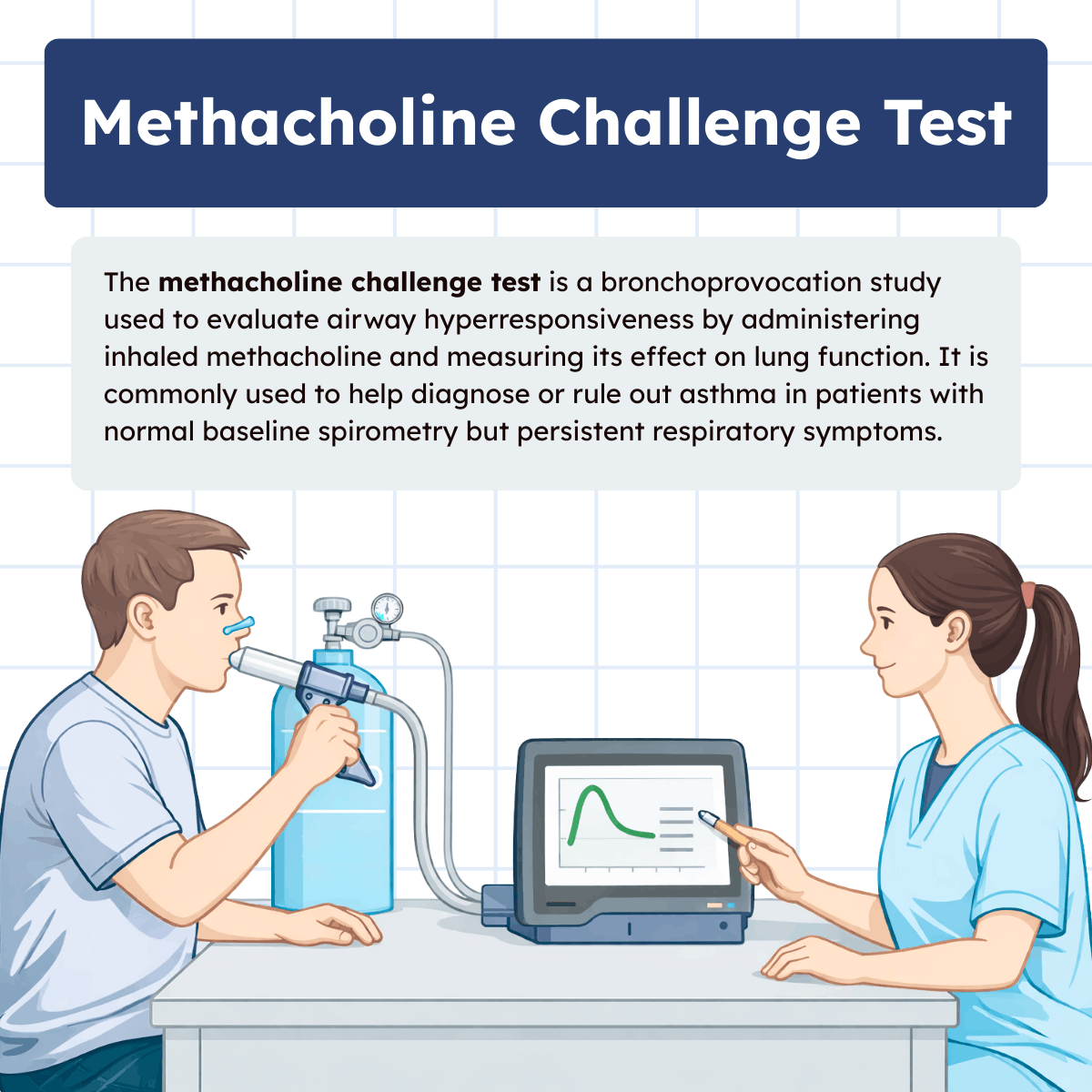
The methacholine challenge test is a specialized pulmonary function procedure used to evaluate airway hyperresponsiveness, most commonly in patients suspected of having asthma. While standard spirometry can identify airflow obstruction, it may appear normal in patients with intermittent or mild symptoms.
This is where the methacholine challenge test becomes especially valuable. By intentionally provoking bronchoconstriction in a controlled setting, the test helps clinicians determine whether a patient’s airways are overly reactive.
For respiratory therapists, understanding this test is essential for accurate assessment, patient safety, and effective collaboration in diagnostic decision-making.

What Is the Methacholine Challenge Test?
The methacholine challenge test is a bronchoprovocation test designed to assess how sensitive a patient’s airways are to a known bronchoconstrictor agent called methacholine. Methacholine is a synthetic compound that stimulates muscarinic receptors in the airway smooth muscle, causing bronchoconstriction when inhaled.
In healthy individuals, methacholine produces little to no airway narrowing. However, in patients with hyperresponsive airways, even small doses can trigger measurable airflow limitation. The degree of bronchoconstriction is quantified using spirometry, specifically by measuring changes in the forced expiratory volume in one second (FEV₁).
The test is primarily used when asthma is suspected but not clearly demonstrated by routine pulmonary function tests or clinical history alone.
Why the Methacholine Challenge Test Is Performed
The methacholine challenge test is most commonly ordered to help rule out or confirm asthma when symptoms such as coughing, wheezing, chest tightness, or shortness of breath are present, but baseline spirometry is normal.
A negative methacholine challenge test makes active asthma very unlikely, which is one of the test’s greatest strengths. A positive test supports the diagnosis but must be interpreted in the context of symptoms and clinical findings, as airway hyperresponsiveness can be seen in other conditions.
The test is especially useful in patients with:
- Exercise-induced symptoms
- Occupational or work-related respiratory complaints
- Chronic cough of unclear origin
- Atypical or intermittent respiratory symptoms
The Role of Methacholine in Airway Provocation
Methacholine is a direct-acting cholinergic agonist that mimics the effects of acetylcholine on the airway smooth muscle. When inhaled, it causes dose-dependent bronchoconstriction.
Because it acts directly on the smooth muscle, methacholine provides a reliable way to evaluate airway responsiveness. Patients with asthma typically respond at much lower doses compared to individuals without asthma.
Note: This predictable response allows clinicians to measure how reactive the airways are and to compare results across standardized dosing protocols.
How the Methacholine Challenge Test Is Performed
The test begins with baseline spirometry to ensure that the patient’s lung function is within acceptable limits to proceed safely. Most protocols require a baseline FEV₁ of at least 60 to 70 percent of predicted.
The patient then inhales increasing concentrations of methacholine aerosol through a nebulizer. After each dose, spirometry is repeated to measure changes in FEV₁.
The test continues until one of the following occurs:
- A 20 percent or greater drop in FEV₁ from baseline
- The maximum methacholine concentration is reached
- The patient develops significant symptoms
Note: Once the test endpoint is reached, a bronchodilator is administered to reverse bronchoconstriction, and spirometry is repeated to confirm recovery.
Understanding Test Results and PC20
The key measurement obtained from the methacholine challenge test is the PC20, which stands for the “provocative concentration” of methacholine that causes a 20 percent decrease in FEV₁.
Lower PC20 values indicate greater airway hyperresponsiveness. For example, a patient who experiences a 20 percent drop in FEV₁ at a very low methacholine concentration is considered to have highly reactive airways.
Interpretation of results generally follows this pattern:
- Normal response: No significant drop in FEV₁ at high concentrations
- Borderline response: Mild decline at moderate doses
- Positive response: Significant decline at low doses
Note: It is important to remember that a positive result does not automatically confirm asthma without supporting clinical evidence.
Clinical Indications and Patient Selection
Appropriate patient selection is critical for safe and meaningful test results. The methacholine challenge test is best suited for patients with suspected asthma who have normal or near-normal baseline spirometry.
Patients with obvious airflow obstruction typically do not require bronchoprovocation testing, as asthma can often be diagnosed through standard pulmonary function testing and clinical response to bronchodilators.
Note: Careful screening helps minimize risk and ensures that the test provides useful diagnostic information.
Contraindications and Safety Considerations
Because the methacholine challenge test intentionally induces bronchoconstriction, patient safety is a top priority. Certain conditions make the test unsafe and are considered contraindications.
These include:
- Severe airflow obstruction
- Recent myocardial infarction or stroke
- Uncontrolled hypertension
- Aortic aneurysm
- Pregnancy in some cases
Note: Respiratory therapists play a crucial role in monitoring patients throughout the test, watching for signs of distress, and ensuring prompt bronchodilator administration when needed.
The Role of Respiratory Therapists
Respiratory therapists are central to the successful execution of the methacholine challenge test. Their responsibilities include patient education, test administration, spirometry performance, and patient monitoring.
Clear instructions are essential, as accurate spirometry depends heavily on patient effort and technique. Therapists must also recognize early signs of significant bronchoconstriction and respond appropriately.
Note: In addition, respiratory therapists help ensure adherence to standardized testing protocols, which improves test reliability and diagnostic accuracy.
Relevance to the Field of Respiratory Care
The methacholine challenge test highlights the diagnostic expertise of respiratory therapists beyond routine bedside care. It reinforces the therapist’s role in advanced pulmonary diagnostics and collaborative clinical decision-making.
Understanding this test deepens knowledge of airway physiology, bronchial responsiveness, and the mechanisms underlying asthma. It also strengthens the therapist’s ability to educate patients and support physicians in making informed diagnoses.
Limitations of the Methacholine Challenge Test
Despite its usefulness, the methacholine challenge test has limitations. A positive result indicates airway hyperresponsiveness, but this finding is not exclusive to asthma.
Conditions such as allergic rhinitis, chronic obstructive pulmonary disease, and recent respiratory infections can also produce positive responses. Additionally, test results may be influenced by recent medication use, environmental exposures, or patient technique.
Note: For these reasons, results should always be interpreted alongside clinical history and other diagnostic findings.
What is a Bronchoprovocation Study?
A bronchoprovocation study is a pulmonary function test used to assess airway hyperresponsiveness by intentionally exposing the airways to a stimulus that can trigger bronchoconstriction. The goal is to determine how reactive a patient’s airways are, particularly when asthma is suspected but baseline spirometry is normal.
These studies measure changes in lung function, most commonly a drop in FEV₁, after exposure to a provoking agent or condition. Bronchoprovocation can be performed using different methods, including inhaled chemicals, exercise, cold air, or hyperventilation.
A methacholine challenge test is one specific type of bronchoprovocation study. It uses inhaled methacholine, a direct-acting bronchoconstrictor, to provoke airway narrowing in a controlled and dose-dependent manner. While all methacholine challenge tests are bronchoprovocation studies, not all bronchoprovocation studies use methacholine. The methacholine test is especially valued for its high sensitivity and strong ability to rule out asthma when results are negative.

Access our quiz with sample TMC practice questions and detailed explanations to help you master pulmonary function testing (PFT).
Methacholine Challenge Test Practice Questions
1. What is the methacholine challenge test?
Also known as the bronchoprovocation test, it is performed to evaluate how reactive or responsive a patient’s lungs are to things in the environment.
2. What can be determined by the methacholine challenge test?
If a patient has asthma
3. How does the methacholine challenge test work?
The patient inhales doses of methacholine, which is a drug that can cause narrowing of the airways (as seen in asthma). A breathing test is performed after each dose of methacholine to measure the degree of constriction in the airways. The patient starts with receiving a very small dose of methacholine and then the doses will be increased until either there is a 20 percent drop in breathing ability, or they receive the maximum dose with no change in lung function.
4. What bronchodilators should be withheld for 24 hours before bronchial challenge testing?
Long-acting inhaled B-agonists and anticholinergic agents.
5. When should theophylline be withheld?
For 48 hours before bronchial challenge testing.
6. A decrease in sGaw of 35 to 45% may be considered what?
A positive methacholine or histamine response.
7. What should you conclude after a decrease of 15% after 5 minutes of hyperventilation?
The patient is breathing cold air and has hyperreactive airways.
8. What are the two methods of delivering methacholine?
5-breath dosimeter or 2-minute tidal breathing
9. How do you know if a patient has asthma from a methacholine challenge test?
If their FEV1 decreases at least 20% or more at a low dose.
10. What are the nebulizer factors that need to be controlled?
Nebulizer output, particle size, and breath-hold time.
11. What is a negative mannitol challenge test?
When there is a cumulative dose of 635 mg and the FEV1 has not dropped more than 15 percent.
12. What do you call the direct bronchoprovocation test?
Methacholine
13. When is a mannitol test indicated?
When a patient has a cough after exertion and their spirometry and lung volumes are normal.
14. A patient should not do vigorous exercise for four hours before what test?
An exercise bronchoprovocation test.
15. How many hours after an exercise test should you wait before another test is performed?
4 hours
16. What is methacholine?
A drug that causes bronchoconstriction by increasing the parasympathetic tone in bronchial smooth muscle.
17. What does the methacholine challenge test help with?
An asthma diagnosis
18. What are the symptoms of asthma?
Wheezing, dyspnea, chest tightness, and persistent coughing.
19. What are the absolute contraindications of the methacholine challenge test?
Severe airflow obstruction (FEV1 less than 50% predicted), heart attack or stroke within last 3 months, uncontrolled HTN (systolic greater than 200, or diastolic greater than 100), and a known aortic aneurysm.
20. What are the relative contraindications of the methacholine challenge test?
Inability to perform spirometry and pregnant/nursing mothers.
21. What are the hazards of the methacholine challenge test?
Shortness of breath, cough, chest tightness, wheezing, and headache.
22. What should the patient withhold before performing a methacholine challenge test?
Short-acting bronchodilators, medium-acting bronchodilators, long-acting bronchodilators, oral bronchodilators, and mediator modifiers.
23. What is the ventilatory reserve?
It is the difference between the highest level of ventilation in exercise and the ventilatory capacity.
24. In what type of patients is bronchoprovocation testing used?
It is used in patients with bronchospasms who have normal PFTs or nonspecific results of bronchodilator studies.
25. What is a direct bronchoprovocation test?
It has high sensitivity and low specificity.
26. What is an indirect bronchoprovocation test?
It has low sensitivity and high specificity.
27. What are the indications for bronchoprovocation tests?
Diagnosis of asthma, airway hyperresponsiveness severity assessment, and seeing the response of asthma treatment.
28. What are the absolute contraindications of bronchoprovocation testing?
Severe airflow limitation where the FEV1 is less than 50 percent, myocardial infarction or ischemic stroke during the past three months, high blood pressure that cannot be controlled, and having a known aneurysm.
29. What are the relative contraindications of bronchoprovocation testing?
Moderate airflow limitation where the FEV1 is less than 60 percent, recent upper respiratory tract infection within 2 weeks, pregnancy or breastfeeding, and spirometry measurements cannot be performed at an acceptable level.
30. What type of cells does a direct stimulus affect?
Effector cells
31. What type of cells does an indirect stimulus affect?
Intermediary cells
32. What makes up effector cells?
Airway smooth muscle cells, bronchial endothelial cells, and mucus-producing cells.
33. What types of cells make up intermediary cells?
Inflammatory cells and neuronal cells.
34. If the direct stimulus is methacholine, then the indirect stimulus is what?
Mannitol
35. If the direct stimuli are prostaglandins, then what is in the indirect stimulus?
Exercise
36. How long should inhaled short-acting beta-agonists be withheld before a bronchial challenge test?
8 hours
37. How long should inhaled long-acting beta-agonists be withheld before a bronchial challenge test?
48 hours or longer
38. How long should anticholinergic agents (e.g., Ipratropium) be withheld before a bronchial challenge test?
24 hours
39. How long should histamine be withheld before a bronchial challenge test?
72 to 96 hours
40. How long should caffeine-containing drinks be withheld before a bronchial challenge test?
6 hours
41. How long should leukotriene modifiers be withheld before a bronchial challenge test?
24 hours
42. What is the definition of PC20?
It is the provocative concentration of methacholine that causes a 20% decrease in the parameter of interest.
43. What does the PC20 describe?
It describes airway hyperresponsiveness. For example, if the PC20 value is high, airway hyperresponsiveness is normal and asthma is unlikely.
44. What does PC20 represent?
A 20% decline in FEV1.
45. What PC2O value is consistent with daily symptoms and requires more serious treatment?
A PC20 value of less than 2 mg/mL.
46. How is nebulizer quality control done before a methacholine challenge test?
The nebulizer is weighed on an accurate scale before and after the delivery of saline.
47. How is the delivered dose of methacholine standardized?
By using a fixed number of breaths (usually 5) or by breathing for a fixed length of time (2 minutes).
48. What is the baseline spirometry requirement during a methacholine challenge test?
It should be greater than 60 to 70 percent of the predicted or the previously reported best value.
49. What might cause a negative methacholine challenge result?
Asthma that has been suppressed by anti-inflammatory medications, or occupational asthma that is triggered by a specific agent.
50. What are two common side effects of the inhalation of antihistamines?
Flushing and headaches
51. When can a histamine challenge be repeated?
Within 2 hours after the patient has returned to baseline.
52. When is the peak action of the histamine challenge?
30 to 120 seconds
53. How is the histamine challenge carried out?
The patient inhales aerosols via tidal volume breathing for two minutes.
54. What device is the mannitol challenge carried out with?
Dry powder inhaler
55. At a molecular level, how does the mannitol challenge work?
It causes a hypertonic stimulus that results in the release of mediators from mast cells and basophils.
56. What FEV1 makes a subject ineligible for an exercise challenge?
If the FEV1 is less than 65%.
57. What does the exercise challenge analyze?
Airway heat and water loss during increased ventilation with exercise.
58. When is bronchospasm expected to occur during exercise testing?
It should occur immediately after the exercise rather than during the exercise. Most of the time, a short period of moderately heavy work is all that is required to trigger exercise-induced bronchospasm.
59. When is a repeat exercise test done?
After 4 hours because of the refractory period where the bronchoconstriction lessens.
60. What are the symptoms of methacholine?
Methacholine, when inhaled, can induce bronchoconstriction. Symptoms include coughing, wheezing, shortness of breath, and chest tightness.
61. Can a patient pass the methacholine challenge and still have asthma?
Yes, a patient can pass the methacholine challenge and still have asthma. While the test is sensitive, no diagnostic test is perfect. Clinical judgment based on a comprehensive review of the patient’s symptoms, history, and other tests is essential.
62. Does everyone react to methacholine?
No, not everyone reacts to methacholine. Individuals with normal bronchial reactivity might not show any significant response, even at higher doses. However, those with bronchial hyperreactivity, such as many asthmatics, will likely have a bronchoconstrictive response at lower doses.
63. What gas concentration is used in eucapnic voluntary hyperventilation?
5 percent mixture of CO2 with air
64. What PC20 value is asymptomatic for diagnosing asthma?
PC20 value of more than 20mg/ml
65. What is the maximum dose of methacholine that can be delivered?
16 mg/mL
66. What is the primary purpose of baseline spirometry before a methacholine challenge test?
To confirm adequate lung function and ensure it is safe to proceed with bronchoprovocation.
67. Why must emergency equipment be readily available during a methacholine challenge test?
Because significant bronchospasm or respiratory distress can occur and may require immediate treatment.
68. What medication is routinely administered at the end of a positive methacholine challenge test?
A short-acting bronchodilator to reverse bronchoconstriction.
69. What parameter is most commonly monitored to assess airway response during the test?
Forced expiratory volume in one second (FEV1).
70. Why is methacholine considered a direct bronchial stimulus?
Because it acts directly on airway smooth muscle receptors to cause constriction.
71. What receptor type does methacholine primarily stimulate in the airways?
Muscarinic (M3) receptors on bronchial smooth muscle.
72. Why is a methacholine challenge test considered highly sensitive for asthma?
Because most patients with asthma will demonstrate airway hyperresponsiveness at low doses.
73. What does a rapid decline in FEV1 after a low methacholine dose suggest?
Marked airway hyperresponsiveness.
74. Why is the test stopped once a 20% fall in FEV1 is achieved?
To limit patient risk and because diagnostic criteria have already been met.
75. What does a flat dose–response curve during testing indicate?
Normal airway responsiveness
76. Why should smokers avoid smoking before a methacholine challenge test?
Smoking can alter airway responsiveness and affect test accuracy.
77. What effect can recent respiratory infections have on test results?
They may cause false-positive airway hyperresponsiveness.
78. Why is patient coaching important during spirometry measurements in the test?
Accurate effort-dependent measurements are essential for valid results.
79. What population is least likely to benefit from methacholine challenge testing?
Patients with clearly established airflow obstruction on baseline spirometry.
80. What does a steep dose–response curve signify during the test?
Severe airway hyperreactivity
81. Why is methacholine challenge testing not used to monitor asthma control?
Because it assesses airway responsiveness, not current symptom severity.
82. What role does airway inflammation play in a positive methacholine response?
Inflammation increases airway sensitivity to bronchoconstrictive stimuli.
83. Why is FEV1 preferred over peak expiratory flow for test interpretation?
FEV1 is more reproducible and sensitive to airway narrowing.
84. What safety measure should be taken if a patient experiences severe symptoms during testing?
Immediately stop the test and administer a bronchodilator.
85. Why is the methacholine challenge test best interpreted alongside clinical history?
Because test results alone cannot definitively diagnose or exclude asthma.
86. What indicates a technically acceptable spirometry maneuver during a methacholine challenge test?
A rapid start, smooth exhalation, no coughing, and consistent reproducibility between efforts.
87. Why is a saline (control) inhalation performed before methacholine administration?
To establish a stable baseline and ensure the patient does not react to nebulization alone.
88. What does a failure to recover FEV1 after bronchodilator administration suggest?
The need for continued monitoring and possible medical intervention.
89. Why are beta-blockers considered a concern before methacholine testing?
They may blunt bronchodilator response and worsen bronchoconstriction.
90. What does a PC20 between 4 and 16 mg/mL typically indicate?
Borderline or mild airway hyperresponsiveness.
91. Why is patient age considered when interpreting methacholine challenge results?
Airway responsiveness can vary with age, affecting test sensitivity and specificity.
92. What precaution should be taken in patients with cardiovascular disease?
Careful screening and avoidance of testing due to increased risk from bronchospasm.
93. Why should the patient avoid heavy meals before testing?
A full stomach can impair diaphragmatic movement and spirometry performance.
94. What does consistent coughing during testing most likely affect?
The accuracy and reliability of FEV1 measurements.
95. Why is methacholine challenge testing rarely performed in patients with severe asthma?
The risk of inducing dangerous bronchospasm outweighs diagnostic benefit.
96. What is the purpose of documenting cumulative methacholine dose?
To quantify airway responsiveness and determine the PC20.
97. Why is technician consistency important during methacholine testing?
Variability in technique can significantly alter test outcomes.
98. What finding supports stopping the test even without a 20% FEV1 drop?
Severe symptoms such as chest tightness, wheezing, or patient distress.
99. How does airway remodeling affect methacholine challenge results?
It can increase airway responsiveness and lower the PC20 value.
100. Why is the methacholine challenge test considered an adjunct rather than a standalone diagnostic tool?
Because asthma diagnosis requires correlation with symptoms, history, and other objective findings.
Final Thoughts
The methacholine challenge test is an important diagnostic tool for assessing airway hyperresponsiveness, particularly in patients with suspected asthma and normal baseline spirometry.
For respiratory therapists, it represents a blend of technical skill, clinical judgment, and patient-centered care. Mastery of this test enhances diagnostic accuracy, promotes patient safety, and strengthens the therapist’s role in pulmonary diagnostics.
By understanding how and why the test is performed, respiratory care professionals can contribute meaningfully to early diagnosis, appropriate treatment decisions, and improved respiratory outcomes.

Written by:
John Landry is a registered respiratory therapist from Memphis, TN, and has a bachelor's degree in kinesiology. He enjoys using evidence-based research to help others breathe easier and live a healthier life.
References
- Sayeedi I, Goldin J, Widrich J. Methacholine Challenge Test. [Updated 2025 Sep 14]. In: StatPearls [Internet]. Treasure Island (FL): StatPearls Publishing; 2025.