
Foreign body aspiration occurs when an object is accidentally inhaled into the airway. This can obstruct the upper airway, trachea, or bronchial tree and may quickly become life-threatening, especially in infants and young children.
Chest X-rays are often used to help evaluate suspected aspiration, but the foreign body is not always visible.
Many aspirated objects, such as food or plastic, may be radiolucent. For this reason, detection depends on combining the patient’s history, physical findings, and direct or indirect radiographic signs.

What Is Foreign Body Aspiration?
Foreign body aspiration occurs when a person inhales an object that does not naturally belong in the airway. The object may lodge in the larynx, trachea, mainstem bronchus, lobar bronchus, or smaller airway. Depending on its size and location, it may cause complete obstruction, partial obstruction, air trapping, atelectasis, pneumonia, or respiratory distress.
This condition is especially common in children younger than 3 years old because they frequently place small objects in their mouths and have immature chewing and swallowing coordination. Peanuts, seeds, toy pieces, coins, buttons, and small household objects are common examples.
Adults can also aspirate foreign bodies, especially if they have neurologic disease, impaired swallowing, altered mental status, dental problems, intoxication, or decreased airway protective reflexes.
From a respiratory therapy perspective, foreign body aspiration is important because it may appear in exam questions involving sudden respiratory distress, unilateral wheezing, stridor, abnormal breath sounds, atelectasis, air trapping, or chest X-ray interpretation.
Why Chest X-Ray Interpretation Can Be Difficult
A common mistake is assuming that a normal chest X-ray rules out foreign body aspiration. It does not.
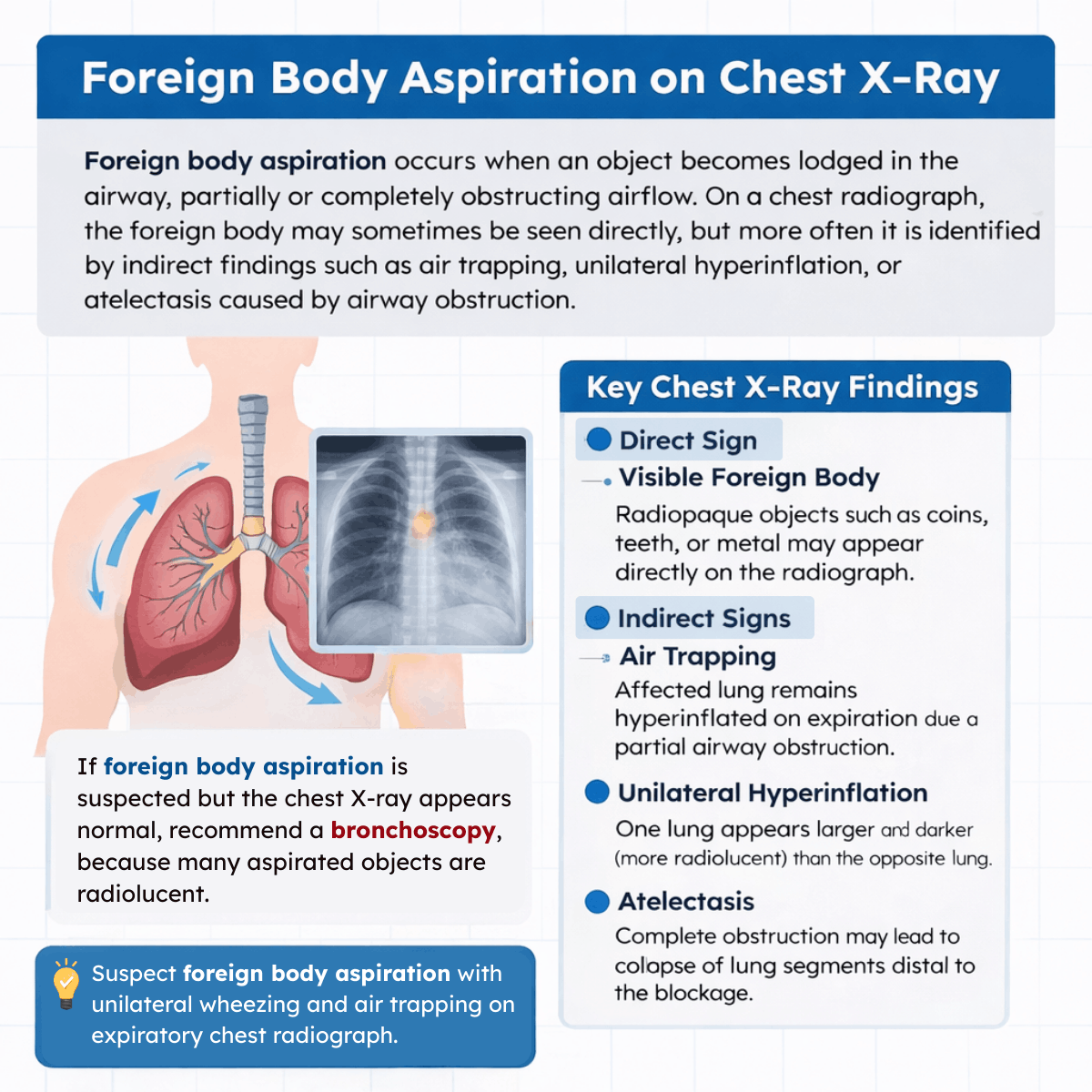
Some aspirated objects are radiopaque, meaning they block X-rays and appear white on the film. Coins, metal buttons, pins, bullets, stones, and some dental materials may be directly visible. These objects are easier to identify because they create a clear white shadow in or near the airway.
However, many commonly aspirated objects are radiolucent. This means they allow X-rays to pass through and may not appear clearly on the image. Food particles, peanuts, seeds, plastic toy pieces, and organic material may be difficult or impossible to see directly.
For this reason, the chest X-ray often shows the effects of the obstruction rather than the object itself. The clinician must look for indirect findings, such as unilateral hyperinflation, air trapping, atelectasis, abnormal diaphragm position, mediastinal shift, or recurrent pneumonia in the same area.
Start With the Clinical History
Foreign body aspiration is often suspected from the history before it is confirmed by imaging. A sudden choking episode followed by coughing, wheezing, stridor, cyanosis, or respiratory distress should immediately raise suspicion.
In a child, the classic history may involve sudden coughing or difficulty breathing while eating, playing, laughing, or crying. The child may have been previously healthy, then abruptly developed respiratory symptoms. This pattern is different from asthma, bronchiolitis, pneumonia, or croup, which usually develop more gradually.
Important clinical clues include:
- Sudden onset of coughing
- Choking episode
- Inspiratory stridor
- Persistent cough
- Unilateral wheezing
- Decreased breath sounds on one side
- Dyspnea or tachypnea
- Cyanosis
- Retractions
- Asthma-like symptoms that do not improve with treatment
- Recurrent pneumonia in the same lung region
Note: Sudden choking plus unilateral wheezing should strongly suggest foreign body aspiration, even if the chest X-ray appears normal.
Understand Radiopaque vs. Radiolucent Objects
When interpreting a chest X-ray for suspected foreign body aspiration, it is important to understand how different densities appear on radiographs.
Air appears black because it allows X-rays to pass through easily. Normal air-filled structures, such as the trachea and main bronchi, should appear as dark columns.
Soft tissue appears gray to white because it has more density than air. Bone appears white because it absorbs more X-rays. Metal appears as a bright white, sharply defined shadow because it is very dense and blocks X-ray penetration.
A radiopaque foreign body, such as a coin or metal object, may appear as a clearly outlined white structure in the airway, esophagus, hypopharynx, trachea, or bronchial tree. A radiolucent foreign body, such as a peanut or plastic toy piece, may not be seen directly.
Note: This distinction matters because the absence of a visible object does not eliminate the diagnosis. Instead, the clinician must inspect the airway and lungs for secondary signs of obstruction.
Look for a Visible Foreign Body
The first step in evaluating the image is to look for an obvious foreign object. Metallic objects, coins, pins, buttons, stones, and some dental materials may be visible.
A coin, for example, may appear as a round white disk on the AP or PA view. On the lateral view, the same coin may appear as a thin white line. This is why multiple views can be useful. One view may show the face of the object, while another helps determine its depth and location.
When a visible object is present, determine whether it is located in the airway or the esophagus. This distinction can affect management. An airway foreign body may produce respiratory distress, stridor, wheezing, or asymmetric breath sounds. An esophageal foreign body may compress the trachea or cause swallowing symptoms, but it is not the same as aspiration into the airway.
Note: A visible foreign body should never be ignored, especially when it appears near the upper airway, trachea, carina, or mainstem bronchi.
Evaluate the Upper Airway and Tracheal Air Column
The trachea should appear as a dark vertical air column. If a foreign body is lodged in the upper airway or trachea, the normal dark column may appear narrowed, distorted, interrupted, or displaced.
A white shadow within the airway may represent a radiopaque foreign body. However, radiolucent objects may only cause subtle changes, such as airway narrowing or irregularity.
If upper airway obstruction is suspected, a lateral neck X-ray may be helpful, especially if the patient has stridor, hoarseness, aphonia, or signs of laryngeal or tracheal obstruction. A neck film may reveal a radiopaque object, narrowing of the airway, or soft tissue changes.
However, just like with chest X-rays, neck X-rays have limitations. They are most useful when the object is visible or when airway narrowing can be identified.
Compare Both Lungs Side by Side
Foreign body aspiration often produces unilateral findings. This means one lung or one region of the lung looks different from the other side.
When reviewing the chest X-ray, compare the right and left lung fields carefully. Look at the overall size, darkness, vascular markings, diaphragm position, and degree of expansion.
Important questions include:
- Does one lung look darker than the other?
- Is one side more expanded?
- Is one hemidiaphragm lower or flatter?
- Are lung markings decreased on one side?
- Is there opacity or volume loss in one lobe?
- Is the mediastinum shifted?
- Are the rib spaces wider or narrower on one side?
Note: A subtle side-to-side difference may be the most important clue, especially when the object itself is not visible.
Unilateral Hyperinflation and Air Trapping
One of the classic indirect signs of foreign body aspiration is unilateral hyperinflation. This occurs when the foreign body creates a partial obstruction.
In a partial obstruction, air may enter the affected lung during inspiration but cannot exit normally during expiration. This is often described as a check-valve or ball-valve effect. The result is air trapping distal to the obstruction.
On chest X-ray, the affected lung may appear larger and darker than the opposite lung. The hemidiaphragm on the affected side may be depressed or flattened. The rib spaces may appear wider due to overexpansion.
This finding is especially important when the aspirated object is radiolucent, such as a peanut, seed, or plastic toy piece. The object may not be seen, but the trapped air reveals its physiologic effect.
Expiratory chest radiographs can make this finding more obvious. During expiration, the normal lung becomes smaller and denser, while the obstructed lung remains overinflated and lucent because air cannot escape.
Note: For exam purposes, unilateral hyperinflation after a choking episode should strongly suggest foreign body aspiration.
Unilateral Hemidiaphragm Depression
Another important sign of air trapping is depression of one hemidiaphragm. Normally, the right and left hemidiaphragms appear as smooth domes. Their positions may vary slightly, but a marked unilateral depression can suggest overinflation on that side.
If a foreign body creates a check-valve obstruction, trapped air can expand the affected lung region and push the hemidiaphragm downward. This may be seen as a lower, flatter hemidiaphragm on the affected side.
Note: In a child with a sudden cough, unilateral wheeze, and a depressed hemidiaphragm on chest X-ray, foreign body aspiration should be high on the list of possibilities.
Atelectasis From Complete Obstruction
Foreign body aspiration can also cause the opposite pattern: atelectasis. This occurs when the obstruction completely blocks airflow to a lung segment, lobe, or entire lung. When air can no longer enter the distal airways, the remaining gas may be absorbed into the blood. The affected lung tissue then collapses. This produces volume loss.
On chest X-ray, atelectasis may appear as an area of increased opacity. The affected region may look whiter because there is less air and more collapsed tissue density.
Other signs of atelectasis include:
- Reduced lung volume
- Elevated hemidiaphragm on the affected side
- Mediastinal shift toward the affected side
- Narrowing of rib spaces
- Displacement of the hilum
- Movement of fissures
- Crowding of lung markings
Note: This pattern differs from unilateral hyperinflation. Hyperinflation suggests partial obstruction with trapped air. Atelectasis suggests complete obstruction with absorption of air and collapse.
Mediastinal Shift
The direction of mediastinal shift can provide an important clue. If foreign body aspiration causes complete obstruction and atelectasis, the mediastinum may shift toward the affected side because lung volume is lost. The collapsed lung creates a pulling effect.
If the obstruction causes severe air trapping and hyperinflation, the expanded lung may push the mediastinum away from the affected side. This is more likely when there is significant overexpansion.
This distinction is important because not all shifts mean the same thing. Atelectasis pulls structures toward the abnormal side. Space-occupying conditions, such as a large pleural effusion, tension pneumothorax, or severe hyperinflation, may push structures away.
Note: In suspected aspiration, the shift must be interpreted with the rest of the image and the patient’s history.
Why the Right Lung Is Commonly Involved
Foreign bodies often enter the right bronchial tree because of airway anatomy. The right mainstem bronchus is more vertical and has a straighter path from the trachea compared with the left mainstem bronchus.
Because of this angle, aspirated material is more likely to travel into the right mainstem bronchus or right-sided segmental bronchi. This does not mean left-sided aspiration cannot occur. It can. However, right-sided findings are common and should be carefully evaluated.
On chest X-ray, this may appear as right-sided hyperinflation, right-sided atelectasis, or recurrent right-sided pneumonia, depending on the degree and duration of obstruction.
Note: In young children, the anatomy may be less dramatically different than in adults, but right-sided aspiration is still commonly described.
Look for Recurrent or Nonresolving Pneumonia
Foreign body aspiration is not always diagnosed immediately. In some cases, the initial choking episode may be missed, forgotten, or unwitnessed. The patient may later present with persistent cough, localized wheezing, recurrent infection, or nonresolving pneumonia.
A retained foreign body can block normal secretion clearance and cause inflammation or infection distal to the obstruction. On chest X-ray, this may appear as recurrent consolidation or infiltrates in the same lung region.
This is an important clue. Pneumonia that keeps returning to the same lobe or segment should prompt evaluation for an obstructing lesion, including a foreign body, mucus plug, or tumor.
In children, recurrent pneumonia in the same area after a possible choking event should raise concern for foreign body aspiration.
Use Inspiratory and Expiratory Views
Standard chest X-rays are often taken during inspiration. However, a standard inspiratory film may look normal in foreign body aspiration, especially if the obstruction is partial and the object is radiolucent.
Expiratory films can help reveal air trapping. During normal expiration, both lungs should decrease in volume and become slightly more opaque. If one lung remains hyperinflated and lucent, this suggests trapped air from an obstructing foreign body.
This is especially useful in children with suspected bronchial foreign body aspiration.
In some cases, lateral decubitus views may also be used when a child cannot cooperate with inspiratory and expiratory imaging. The dependent lung should normally become less inflated. If it remains overinflated, air trapping may be present.
Consider PA, AP, Lateral, and Oblique Views
Multiple radiographic views may be needed to locate a foreign body.
- An AP or PA chest radiograph provides a frontal view of the chest. It can show lung asymmetry, visible foreign bodies, hyperinflation, atelectasis, and mediastinal shift.
- A lateral chest radiograph can help determine the depth and location of a visible object. It may also show airway narrowing or posterior lung changes that are not obvious on the frontal image.
- Oblique views may be useful in selected cases to better localize a foreign body or distinguish overlapping structures.
- A lateral neck X-ray may be chosen if the suspected obstruction is in the upper airway, larynx, or trachea.
Note: The choice of view depends on the suspected location, symptoms, and degree of respiratory distress.
Know the Limits of Chest X-Ray
Chest X-ray is useful, but it is not perfect. A normal chest X-ray does not exclude foreign body aspiration. This is especially true when the object is radiolucent, the obstruction is intermittent, the film is taken early, or the radiographic findings are subtle.
Clinical suspicion should guide management. If the history is convincing, such as a witnessed choking episode followed by persistent cough, unilateral wheeze, or decreased breath sounds, further evaluation may be needed even if the X-ray is normal.
Note: This is a major exam concept. Do not let a normal radiograph override a strong clinical picture.
When CT May Be Helpful
A CT scan may be considered when chest X-ray findings are inconclusive but suspicion remains high. CT can provide more detailed visualization of the airway, lung parenchyma, and obstructing object.
It may be especially helpful for detecting radiolucent foreign bodies, airway narrowing, localized air trapping, atelectasis, or complications such as pneumonia or abscess. However, CT does not replace the need for bronchoscopy when the airway must be directly inspected or when removal is needed. It is an imaging tool, not definitive treatment.
Note: CT may be the best next imaging study when standard X-rays are nondiagnostic and suspicion remains, but bronchoscopy is still the definitive diagnostic and therapeutic procedure.
Bronchoscopy Is the Definitive Procedure
When foreign body aspiration is confirmed or strongly suspected, bronchoscopy is usually required. Bronchoscopy allows direct visualization of the airway and may allow removal of the object.
Flexible bronchoscopy may be used for evaluation, especially in adults or stable patients. Rigid bronchoscopy is often preferred for removal of larger foreign bodies, especially in children, because it provides better airway control and a larger working channel.
For respiratory therapy students, the key point is this: imaging can support the diagnosis, but bronchoscopy confirms it and treats it.
Note: If an exam question describes a child with sudden choking, persistent unilateral wheezing, and a normal chest X-ray, bronchoscopy should still be considered.
Common Chest X-Ray Patterns in Foreign Body Aspiration
Foreign body aspiration may produce several different radiographic patterns. The appearance depends on the object’s density, location, and degree of obstruction.
A radiopaque foreign body may appear as a white object in the airway or near the airway. A coin, pin, metal button, or dental object may be directly visible. A radiolucent foreign body may not appear directly. In this case, the clinician must look for indirect findings.
Partial obstruction may cause unilateral air trapping, hyperinflation, increased lucency, depressed hemidiaphragm, or mediastinal shift away from the affected side. Complete obstruction may cause atelectasis, increased opacity, volume loss, elevated hemidiaphragm, narrowed rib spaces, and mediastinal shift toward the affected side.
Note: Delayed diagnosis may lead to pneumonia, consolidation, abscess, or recurrent infection in the same lung region. The chest X-ray may also be normal, especially early or when the obstruction is subtle.
Step-by-Step Approach to Reading the Chest X-Ray
A systematic approach helps avoid missing subtle findings.
- Confirm the patient information, date, and image quality. Make sure the film belongs to the correct patient and was taken at the correct time.
- Identify the view. Determine whether the film is AP, PA, lateral, expiratory, or another view. Portable AP films may have different image characteristics than upright PA films.
- Inspect the airway. Look at the tracheal air column, carina, and mainstem bronchi. Check for narrowing, deviation, interruption, or a visible object.
- Compare both lung fields. Look for one lung appearing darker, larger, smaller, or more opaque than the other.
- Evaluate lung volume. Check the diaphragm position, rib spacing, and overall expansion of each lung.
- Look for atelectasis. Search for wedge-shaped opacity, volume loss, elevated diaphragm, fissure movement, or mediastinal shift toward the affected side.
- Look for air trapping. Identify unilateral hyperinflation, increased lucency, depressed diaphragm, or persistent inflation on expiratory views.
- Assess the mediastinum. Determine whether it is shifted and in which direction.
- Connect the image findings with the patient’s history and physical exam. A subtle X-ray abnormality becomes much more significant when paired with sudden choking, stridor, unilateral wheezing, or decreased breath sounds.
Clinical Signs That Support the X-Ray Findings
Radiographic interpretation should not be done in isolation. Foreign body aspiration is a clinical diagnosis supported by imaging. Upper airway foreign bodies may cause stridor, hoarseness, aphonia, retractions, cyanosis, and severe respiratory distress. The patient may have difficulty speaking or crying if the obstruction is significant.
Tracheal foreign bodies may produce stridor, diffuse wheezing, cough, dyspnea, and intermittent symptoms as the object moves. Bronchial foreign bodies often cause localized wheezing, unilateral decreased breath sounds, persistent cough, tachypnea, or recurrent infection.
If the child has unilateral wheezing that does not respond to bronchodilators, foreign body aspiration should be considered. Asthma usually produces more diffuse wheezing, while a foreign body often causes localized or asymmetric findings.
Board Exam Tips
For the board exam, foreign body aspiration often appears as a decision-making scenario. The question may ask which test to recommend, what the chest X-ray finding means, or what the next step should be.
Remember these points:
- A sudden choking episode followed by cough, stridor, wheezing, or respiratory distress suggests foreign body aspiration.
- A normal chest X-ray does not rule it out.
- Radiopaque objects may be directly visible.
- Radiolucent objects may only cause indirect signs.
- Unilateral hyperinflation suggests partial obstruction with air trapping.
- A depressed hemidiaphragm may indicate air trapping on that side.
- Atelectasis suggests complete obstruction and volume loss.
- Mediastinal shift toward the affected side suggests collapse.
- Mediastinal shift away from the affected side may occur with severe hyperinflation.
- Inspiratory and expiratory films can help detect air trapping.
- Lateral neck X-ray may help with suspected upper airway foreign bodies.
- Bronchoscopy is the definitive diagnostic and therapeutic procedure.
Note: A good exam phrase to remember is: choking history plus unilateral wheeze means suspect foreign body aspiration, even with a normal X-ray.
Example Scenario
A 2-year-old child suddenly begins coughing while eating peanuts. The child later develops persistent wheezing on the right side. A standard chest X-ray does not show a visible foreign body.
This does not rule out aspiration. Peanuts are radiolucent and may not appear directly on the film. The clinician should look for indirect signs, such as right-sided hyperinflation, air trapping on expiratory imaging, depressed right hemidiaphragm, or right-sided atelectasis.
Note: If suspicion remains high, bronchoscopy is indicated because it can directly visualize and remove the foreign body.
Avoiding Common Mistakes
One common mistake is looking only for a visible object. Many aspirated objects are not visible on X-ray. Another mistake is assuming that wheezing always means asthma. Unilateral wheezing after a choking event should suggest airway obstruction.
A third mistake is overlooking subtle asymmetry. Side-to-side differences in lung volume, lucency, diaphragm position, or vascular markings may be the only clue.
Another common error is misinterpreting mediastinal shift. Collapse tends to pull the mediastinum toward the affected side, while significant air trapping may push it away.
Finally, clinicians should avoid delaying further evaluation when the clinical history is strongly suspicious. Imaging is helpful, but bronchoscopy may still be needed.
Foreign Body Aspiration and Imaging Practice Questions
1. What is foreign body aspiration?
Foreign body aspiration is the accidental inhalation of an object into the airway, where it may obstruct the upper airway, trachea, bronchus, or smaller airways.
2. Why is foreign body aspiration important for respiratory therapy students to understand?
Foreign body aspiration is important because it can cause acute airway obstruction, respiratory distress, abnormal chest X-ray findings, and exam questions that require quick clinical decision-making.
3. Which age group is most at risk for foreign body aspiration?
Infants and toddlers, especially children younger than 3 years old, are most at risk for foreign body aspiration.
4. Why are young children more likely to aspirate foreign bodies?
Young children are more likely to aspirate foreign bodies because they often place objects in their mouths and have immature chewing and swallowing coordination.
5. What clinical history strongly suggests foreign body aspiration?
A sudden choking episode followed by coughing, wheezing, stridor, cyanosis, or respiratory distress strongly suggests foreign body aspiration.
6. Can a normal chest X-ray rule out foreign body aspiration?
No. A normal chest X-ray does not rule out foreign body aspiration, especially when the aspirated object is radiolucent.
7. What does radiopaque mean on a chest X-ray?
Radiopaque means that an object is dense enough to block X-rays, causing it to appear white or bright on the radiograph.
8. What does radiolucent mean on a chest X-ray?
Radiolucent means that an object allows X-rays to pass through, making it appear dark or difficult to see on the radiograph.
9. Which types of foreign bodies are usually radiopaque?
Metal objects, coins, pins, buttons, stones, and some dental materials are usually radiopaque and may be directly visible on X-ray.
10. Which types of foreign bodies are often radiolucent?
Peanuts, seeds, food particles, and plastic toy pieces are often radiolucent and may not be directly visible on X-ray.
11. What is the key problem with detecting food aspiration on chest X-ray?
The key problem is that many food particles are radiolucent, so the X-ray may show indirect signs of obstruction instead of the object itself.
12. What is the classic X-ray finding with partial bronchial obstruction?
The classic X-ray finding with partial bronchial obstruction is unilateral hyperinflation due to air trapping.
13. What causes air trapping in foreign body aspiration?
Air trapping occurs when the foreign body acts like a check valve, allowing air to enter during inspiration but preventing it from leaving during expiration.
14. How does unilateral hyperinflation appear on a chest X-ray?
Unilateral hyperinflation appears as one lung or lung region that is more expanded and darker than the opposite side.
15. What happens to the hemidiaphragm on the affected side with air trapping?
The hemidiaphragm on the affected side may become depressed or flattened due to overinflation.
16. What may occur if a foreign body completely obstructs a bronchus?
Complete obstruction may cause absorption of air beyond the blockage, leading to atelectasis or lung collapse.
17. How does atelectasis appear on a chest X-ray?
Atelectasis often appears as increased opacity, decreased lung volume, elevated hemidiaphragm, narrowed rib spaces, and possible mediastinal shift toward the affected side.
18. What direction does the mediastinum shift with atelectasis?
With atelectasis, the mediastinum usually shifts toward the affected side because of volume loss.
19. What direction can the mediastinum shift with severe air trapping?
With severe air trapping, the mediastinum may shift away from the affected side because the overinflated lung pushes it across the chest.
20. Why is the right mainstem bronchus a common location for aspirated foreign bodies?
The right mainstem bronchus is more vertical and has a straighter path from the trachea, making it a common pathway for aspirated objects.
21. What physical assessment finding is highly suggestive of bronchial foreign body aspiration?
Localized or unilateral wheezing is highly suggestive of bronchial foreign body aspiration, especially after a choking episode.
22. What upper airway sound may occur with foreign body aspiration?
Stridor may occur when the foreign body obstructs the upper airway, larynx, or trachea.
23. When is a lateral neck X-ray useful in suspected foreign body aspiration?
A lateral neck X-ray is useful when upper airway obstruction is suspected, especially if the patient has stridor or signs of laryngeal or tracheal obstruction.
24. Why are inspiratory and expiratory chest X-rays useful?
Inspiratory and expiratory chest X-rays are useful because expiratory views can reveal unilateral air trapping that may not be obvious on a standard inspiratory film.
25. What is the definitive diagnostic and therapeutic procedure for foreign body aspiration?
Bronchoscopy is the definitive procedure because it allows direct visualization of the airway and removal of the foreign body.
26. What is the main reason a foreign body may not be visible on a chest X-ray?
A foreign body may not be visible because many aspirated objects, such as food, seeds, peanuts, and plastic pieces, are radiolucent.
27. What does a radiopaque foreign body look like on X-ray?
A radiopaque foreign body usually appears as a bright white or sharply outlined shadow on the radiograph.
28. What does a coin look like on an AP chest or neck radiograph?
A coin may appear as a solid white disk on an AP view if it is positioned face-on to the X-ray beam.
29. Why is a lateral view helpful when evaluating a suspected coin aspiration?
A lateral view can show the edge of the coin as a thin white line and help determine its depth and location.
30. What should the trachea normally look like on a chest X-ray?
The trachea should normally appear as a straight, dark air column because it is filled with air.
31. What may a white shadow within the tracheal air column suggest?
A white shadow within the tracheal air column may suggest a radiopaque foreign body or another obstructing abnormality.
32. What does narrowing of the dark airway column suggest?
Narrowing of the dark airway column may suggest airway obstruction, compression, swelling, or a foreign body.
33. Why should the right and left lungs be compared carefully?
The right and left lungs should be compared because foreign body aspiration often produces unilateral changes, such as air trapping, atelectasis, or decreased breath sounds.
34. What does one lung appearing darker than the other suggest in suspected aspiration?
One lung appearing darker than the other may suggest unilateral air trapping from partial bronchial obstruction.
35. What does one lung appearing smaller than the other suggest in suspected aspiration?
One lung appearing smaller may suggest volume loss from atelectasis caused by complete bronchial obstruction.
36. Why can foreign body aspiration mimic asthma?
Foreign body aspiration can mimic asthma because it may cause wheezing, cough, dyspnea, and respiratory distress.
37. What finding helps distinguish foreign body aspiration from asthma?
Unilateral wheezing or decreased breath sounds helps distinguish foreign body aspiration from asthma, which usually causes more diffuse wheezing.
38. What is the significance of a persistent cough after choking?
A persistent cough after choking suggests that a foreign body may still be lodged in the airway.
39. What does stridor suggest in a patient with suspected foreign body aspiration?
Stridor suggests obstruction in the upper airway, larynx, or trachea.
40. What does localized wheezing suggest in suspected foreign body aspiration?
Localized wheezing suggests that a foreign body may be lodged in a bronchus or smaller airway.
41. What chest X-ray view is especially helpful for detecting air trapping?
An expiratory chest X-ray is especially helpful for detecting air trapping from a partial bronchial obstruction.
42. Why might an inspiratory chest X-ray appear normal in foreign body aspiration?
An inspiratory chest X-ray may appear normal because air trapping may only become obvious during expiration.
43. What happens to the normal lung during an expiratory chest X-ray?
During expiration, the normal lung becomes smaller and slightly more opaque as air leaves the lung.
44. What happens to the obstructed lung during an expiratory chest X-ray?
The obstructed lung may remain overinflated and dark because trapped air cannot escape normally.
45. What is the ball-valve effect?
The ball-valve effect occurs when a foreign body allows air to enter during inspiration but blocks air from leaving during expiration.
46. What radiographic sign can result from the ball-valve effect?
The ball-valve effect can cause unilateral hyperinflation, increased lucency, and depression of the hemidiaphragm on the affected side.
47. What is the difference between partial and complete obstruction on X-ray?
Partial obstruction often causes air trapping and hyperinflation, while complete obstruction may cause atelectasis and volume loss.
48. What is an indirect radiographic sign of a radiolucent foreign body?
An indirect sign may include unilateral hyperinflation, air trapping, atelectasis, mediastinal shift, or recurrent pneumonia.
49. Why can recurrent pneumonia suggest foreign body aspiration?
Recurrent pneumonia in the same lung region may suggest a retained foreign body that blocks secretion clearance and causes repeated infection.
50. What should be suspected when a child has recurrent pneumonia in the same lobe?
A retained foreign body should be suspected, especially if there is a history of choking or persistent localized wheezing.
51. What complication may occur if foreign body aspiration is not diagnosed early?
Delayed diagnosis may lead to pneumonia, atelectasis, lung abscess, recurrent infection, or persistent airway inflammation.
52. Why can a retained foreign body cause pneumonia?
A retained foreign body can block normal secretion clearance, allowing mucus and bacteria to collect distal to the obstruction.
53. What is the most important clinical clue when a chest X-ray is normal?
The most important clue is the history, especially a sudden choking episode followed by cough, wheezing, stridor, or respiratory distress.
54. What does decreased breath sounds on one side suggest?
Decreased breath sounds on one side may suggest that a foreign body is obstructing airflow to one lung or lung region.
55. What does a depressed hemidiaphragm suggest in suspected foreign body aspiration?
A depressed hemidiaphragm may suggest air trapping and hyperinflation on the affected side.
56. What does an elevated hemidiaphragm suggest in suspected foreign body aspiration?
An elevated hemidiaphragm may suggest atelectasis or volume loss from complete airway obstruction.
57. Why should the carina be inspected on a chest X-ray?
The carina should be inspected because foreign bodies may lodge near the main airway bifurcation or enter one of the mainstem bronchi.
58. What does interruption of the normal dark airway column suggest?
Interruption of the normal dark airway column may suggest an obstructing foreign body, tumor, mucus plug, or airway narrowing.
59. What is the best next step if foreign body aspiration is strongly suspected despite a normal X-ray?
Bronchoscopy should be considered because it allows direct visualization of the airway and removal of the foreign body.
60. Why is bronchoscopy considered both diagnostic and therapeutic?
Bronchoscopy is diagnostic because it allows direct visualization of the airway and therapeutic because it can be used to remove the foreign body.
61. Which type of bronchoscopy is often preferred for large foreign body removal in children?
Rigid bronchoscopy is often preferred because it provides better airway control and allows removal of larger objects.
62. When might flexible bronchoscopy be used in suspected foreign body aspiration?
Flexible bronchoscopy may be used for airway evaluation, especially in stable patients or adults.
63. What is the role of CT in suspected foreign body aspiration?
CT may help detect radiolucent foreign bodies or subtle airway obstruction when standard X-rays are inconclusive.
64. Does CT replace bronchoscopy in foreign body aspiration?
No. CT can help with diagnosis, but bronchoscopy is still needed when direct airway inspection or object removal is required.
65. What chest X-ray finding suggests complete obstruction with lung collapse?
Increased opacity with decreased lung volume suggests complete obstruction causing atelectasis.
66. What chest X-ray finding suggests partial obstruction with trapped air?
Increased lucency and hyperinflation on one side suggest partial obstruction with trapped air.
67. Why is a unilateral finding important in suspected foreign body aspiration?
A unilateral finding is important because foreign body obstruction often affects one bronchus or one lung region rather than both lungs equally.
68. What does localized decreased vascular marking suggest in suspected aspiration?
Localized decreased vascular marking may occur when one lung region is overinflated and more radiolucent from air trapping.
69. What does narrowing of rib spaces suggest?
Narrowing of rib spaces may suggest volume loss from atelectasis on the affected side.
70. What does widening of rib spaces suggest?
Widening of rib spaces may suggest hyperinflation from air trapping on the affected side.
71. Why can foreign body aspiration be mistaken for bronchiolitis?
Foreign body aspiration can be mistaken for bronchiolitis because both may cause cough, wheezing, tachypnea, and respiratory distress.
72. What finding makes bronchiolitis less likely and foreign body aspiration more likely?
A sudden choking episode with unilateral wheezing or decreased breath sounds makes foreign body aspiration more likely.
73. Why can foreign body aspiration be mistaken for croup?
Foreign body aspiration can be mistaken for croup when the object affects the upper airway and causes stridor, cough, or respiratory distress.
74. What finding would make foreign body aspiration more likely than croup?
A sudden onset of symptoms during eating or playing makes foreign body aspiration more likely than croup.
75. What is the key limitation of a lateral neck X-ray?
A lateral neck X-ray may only detect the foreign body if it is radiopaque or if it causes visible airway narrowing or soft tissue changes.
76. What does a standard chest X-ray often show in foreign body aspiration?
A standard chest X-ray may show a visible radiopaque object, indirect signs of obstruction, or no obvious abnormality at all.
77. Why should a normal X-ray not end the evaluation when suspicion remains high?
A normal X-ray should not end the evaluation because many aspirated foreign bodies are radiolucent and may only be detected by clinical findings or bronchoscopy.
78. What is the significance of sudden cyanosis after a choking episode?
Sudden cyanosis after choking suggests significant airway obstruction and requires immediate assessment and intervention.
79. What does aphonia suggest in suspected foreign body aspiration?
Aphonia, or inability to produce voice, may suggest severe upper airway obstruction involving the larynx or trachea.
80. What does hoarseness suggest in a patient with suspected aspiration?
Hoarseness may suggest irritation or obstruction near the larynx or upper airway.
81. Why is patient history especially important in pediatric foreign body aspiration?
Patient history is especially important because the chest X-ray may be normal, and the diagnosis often depends on a witnessed choking event or sudden onset of symptoms.
82. What should be suspected when a previously healthy child suddenly develops wheezing?
Foreign body aspiration should be suspected, especially if the wheezing began suddenly after eating, playing, laughing, or crying.
83. Why can peanuts be difficult to identify on chest X-ray?
Peanuts are usually radiolucent, so they may not create a visible white shadow on the chest X-ray.
84. Why can plastic toy pieces be missed on chest X-ray?
Plastic toy pieces can be missed because their density may be similar to soft tissue or air, making them hard to see directly.
85. What does a sharply outlined white shadow suggest on chest X-ray?
A sharply outlined white shadow may suggest a radiopaque foreign body, such as metal, a coin, or another dense object.
86. What does a darker lung field usually represent on chest X-ray?
A darker lung field usually represents increased air content or decreased tissue density.
87. What does increased whiteness in a lung region usually suggest?
Increased whiteness may suggest atelectasis, consolidation, fluid, soft tissue density, or another area with less air than normal.
88. Why is side-to-side comparison important when checking for air trapping?
Side-to-side comparison helps reveal whether one lung remains more inflated or more radiolucent than the other.
89. What does persistent unilateral air trapping suggest after a choking episode?
Persistent unilateral air trapping suggests partial bronchial obstruction from an aspirated foreign body.
90. What does volume loss on the affected side suggest?
Volume loss on the affected side suggests complete or near-complete airway obstruction causing atelectasis.
91. What may happen to lung markings with atelectasis?
Lung markings may appear crowded or increased because the affected lung region has lost volume.
92. What may happen to lung markings with hyperinflation?
Lung markings may appear more spread out or decreased because the affected lung region is overexpanded.
93. Why might a foreign body cause nonresolving pneumonia?
A foreign body may cause nonresolving pneumonia by blocking drainage and ventilation in the affected airway.
94. What should be considered when pneumonia keeps returning to the same lung area?
An obstructing lesion, such as a foreign body, should be considered when pneumonia repeatedly occurs in the same lung area.
95. What is the main role of the respiratory therapist in suspected foreign body aspiration?
The respiratory therapist helps recognize signs of obstruction, recommend appropriate imaging, assess breath sounds, support oxygenation, and identify when bronchoscopy may be needed.
96. What imaging study may be recommended for suspected lower airway foreign body aspiration?
A chest X-ray with inspiratory and expiratory views may be recommended to assess for air trapping, atelectasis, or a visible foreign body.
97. What imaging study may be recommended for suspected upper airway obstruction?
A lateral neck X-ray may be recommended when the obstruction is suspected in the upper airway, larynx, or trachea.
98. What should be done if a patient has severe respiratory distress from suspected foreign body aspiration?
The airway should be assessed and supported immediately, and emergency removal of the obstruction may be required.
99. What is a key exam clue that points toward bronchoscopy?
A choking history with persistent unilateral wheezing, decreased breath sounds, or stridor points toward bronchoscopy, even if the X-ray is normal.
100. What is the main takeaway for detecting foreign body aspiration on chest X-ray?
The main takeaway is that the object may not be visible, so clinicians must look for indirect signs such as unilateral hyperinflation, air trapping, atelectasis, mediastinal shift, and abnormal lung volume changes.
Final Thoughts
Detecting foreign body aspiration on a chest X-ray requires more than looking for a visible object. Some foreign bodies, such as coins or metal objects, are radiopaque and easy to see, but many common aspirated materials are radiolucent.
In those cases, the key findings are indirect signs, including unilateral hyperinflation, air trapping, depressed hemidiaphragm, atelectasis, mediastinal shift, or recurrent pneumonia. The patient’s history and physical assessment are just as important as the image.
When sudden choking, unilateral wheezing, stridor, or persistent respiratory distress is present, a normal chest X-ray should not rule out aspiration. Bronchoscopy may still be required.

Written by:
John Landry is a registered respiratory therapist from Memphis, TN, and has a bachelor's degree in kinesiology. He enjoys using evidence-based research to help others breathe easier and live a healthier life.
References
- Cramer N, Jabbour N, Tavarez MM, et al. Foreign Body Aspiration(Archived) [Updated 2023 Jul 31]. In: StatPearls [Internet]. Treasure Island (FL): StatPearls Publishing; 2026.