

Nebulizers are cornerstone devices in respiratory care, used to deliver aerosolized medications and bland aerosols directly to the lungs. They are employed across virtually every care setting, including emergency departments, intensive care units, neonatal units, outpatient clinics, and home care environments.
For respiratory therapists, a thorough understanding of nebulizer operation, performance characteristics, infection risks, and clinical limitations is essential for safe and effective patient care.
This article provides an in-depth overview of nebulizers, explains how they work, reviews the major types, and highlights why nebulizer knowledge is fundamental to the field of respiratory care.

What Is a Nebulizer?
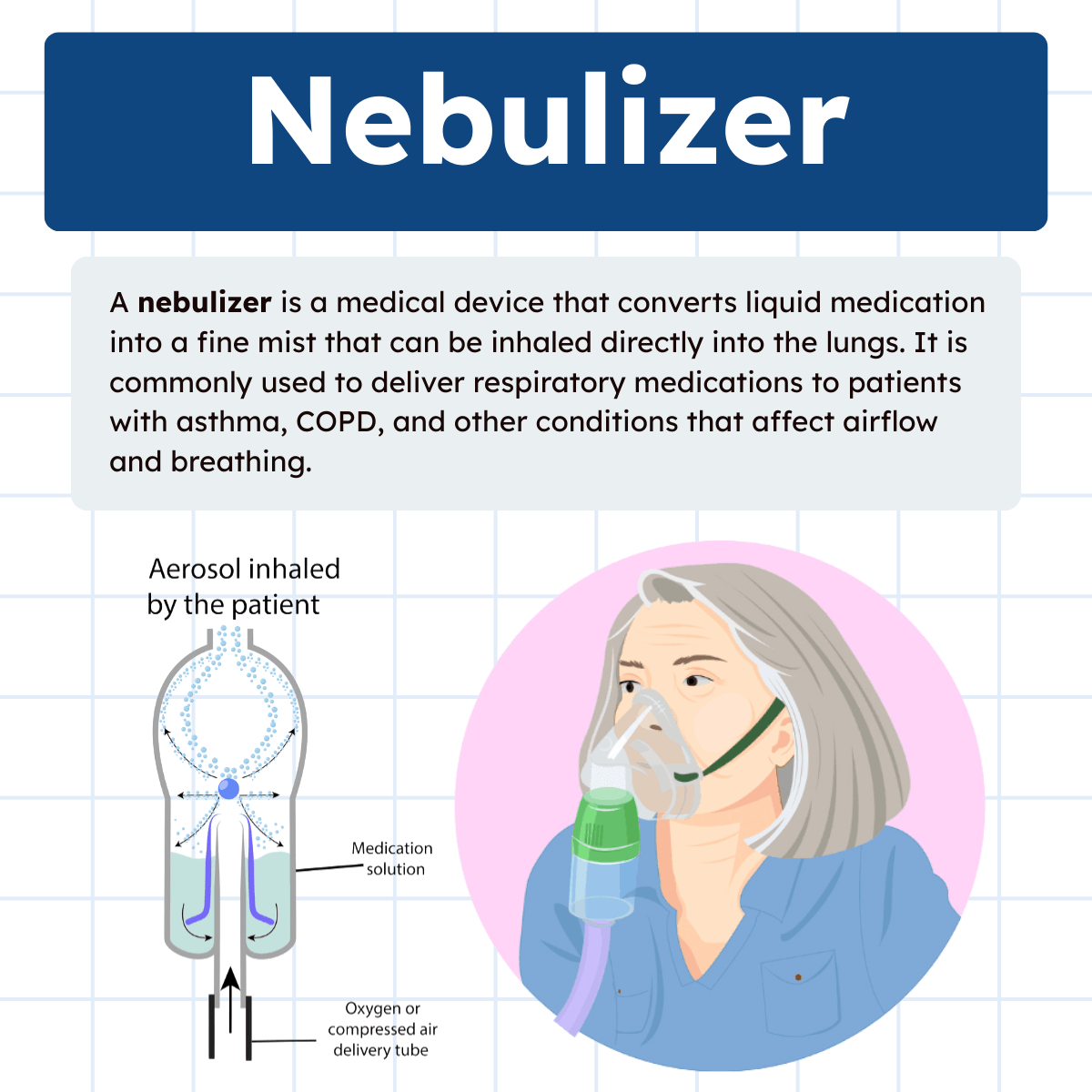
A nebulizer is a medical device that generates aerosols by dispersing liquid solutions or suspensions into small particles suspended in a carrier gas. These aerosolized particles can then be inhaled into the respiratory tract, where they deposit in the airways or alveoli, depending on particle size, airflow, and patient technique.
Nebulizers are commonly used to deliver bronchodilators, corticosteroids, antibiotics, mucolytics, hypertonic saline, and bland aerosols such as sterile water or normal saline. Unlike metered-dose inhalers (MDIs) and dry-powder inhalers (DPIs), nebulizers do not rely heavily on patient coordination or inspiratory flow, making them especially useful for infants, critically ill patients, and those with severe respiratory compromise.
Why Nebulizers Are Important in Respiratory Care
Nebulizers remain highly relevant in modern respiratory care for several reasons:
- They can deliver medications to patients who are unable to use handheld inhalers
- They are compatible with masks, mouthpieces, ventilator circuits, CPAP, BiPAP, and tracheostomy interfaces
- They allow delivery of larger medication doses or continuous aerosol therapy
- They are essential in neonatal and pediatric populations
- They are frequently used in acute care, long-term care, and home care settings
Note: For respiratory therapists, nebulizers are not merely medication devices but therapeutic tools that must be selected, assembled, operated, cleaned, and monitored correctly to optimize aerosol deposition while minimizing waste and infection risk.
Types of Nebulizers
Medical nebulizers are generally divided into three major categories:
- Pneumatic (Jet) Nebulizers
- Ultrasonic Nebulizers (USNs)
- Vibrating Mesh (VM) Nebulizers
Note: They are also classified by reservoir size, which affects clinical application.
Small-Volume Nebulizers (SVNs)
Small-volume nebulizers typically hold 5 to 20 mL of solution and are most commonly used for aerosolized medication delivery. SVNs are standard in hospitals and home care for intermittent drug administration.
Large-Volume Nebulizers
Large-volume nebulizers can hold up to 200 mL of fluid and are commonly used for bland aerosol therapy, continuous drug delivery, aerosol masks, T-pieces, and tracheostomy collars. Because of their design and prolonged use, large-volume nebulizers pose a higher risk for healthcare-associated infections if not handled properly.
Pneumatic (Jet) Nebulizers
Jet nebulizers have been used in clinical practice for over a century. They operate using a high-pressure gas source, such as compressed air or oxygen, delivered through a restricted orifice called a jet. The high-velocity gas stream creates a region of low lateral pressure that draws liquid medication up a capillary tube from the reservoir.
As the liquid enters the gas stream, it is sheared into filaments that break into droplets, forming a primary aerosol spray. This spray is heterodisperse, containing particles ranging from approximately 0.1 to 500 micrometers (μm).
Role of Baffles
Baffles are critical components in jet nebulizer design. They act as impact surfaces that remove large droplets from suspension while allowing smaller particles to remain airborne. Droplets that strike the baffles often fall back into the reservoir and are re-nebulized.
Well-designed baffles reduce:
- Mass median aerodynamic diameter (MMAD)
- Geometric standard deviation (GSD)
Note: This results in a more respirable aerosol with improved lung deposition. In contrast, atomizers without baffling produce larger, less controlled particle sizes and are not suitable for pulmonary drug delivery.
Factors Affecting Jet Nebulizer Performance
Nebulizer performance is highly variable and influenced by multiple interacting factors.
Gas Flow and Pressure
Droplet size and nebulization time are inversely related to gas flow. Higher gas flow rates:
- Produce smaller particles
- Increase aerosol output
- Shorten treatment time
However, excessively low flow or pressure can result in minimal or negligible aerosol generation. Hospital wall outlets typically deliver 50 psi, whereas home compressors may generate as little as 10 psi. This difference can significantly increase particle size and reduce output if the nebulizer is not properly matched to the gas source.
Residual Volume (Dead Volume)
Residual volume refers to the medication that remains in the nebulizer after aerosol production stops. For a nominal 3 mL dose, residual volume can range from 0.5 to over 2.2 mL, meaning a large portion of the medication may never be aerosolized.
Increasing fill volume improves delivery efficiency. For example:
- A 3 mL fill with a 1.5 mL residual volume yields only 50% usable medication
- A 5 mL fill yields more than 70% usable medication
Although increasing diluent volume may increase available dose, it is considered off-label use and generally does not produce significant differences in clinical response.
Nebulizer Position
Some SVNs stop generating aerosol when tilted as little as 30 degrees from vertical. Improper positioning can therefore reduce drug delivery and prolong treatment time.
Gas Density and Heliox
Gas density affects both aerosol generation and deposition. Lower-density gases, such as heliox, reduce turbulent flow and airway impaction, improving aerosol penetration into the lungs.
However, when heliox is used to power a jet nebulizer at standard flow rates:
- Aerosol output decreases substantially
- Particles become smaller
- Two- to threefold higher flow rates are required to achieve comparable output
Note: Heliox concentrations of 40% or greater have been shown to improve aerosol deposition, but careful adjustment of flow is necessary to maintain therapeutic delivery.
Effects of Humidity and Temperature
Humidity and temperature influence aerosol behavior in several ways:
- Evaporation and adiabatic gas expansion can reduce aerosol temperature by up to 10°C
- Cooling increases solution viscosity and reduces output
- Fully saturated warm gas causes aerosol particles to enlarge and coalesce
Particle growth depends on solution tonicity:
- Isotonic aerosols tend to maintain size
- Hypertonic aerosols enlarge
- Hypotonic aerosols may evaporate and shrink
Note: These changes can significantly alter deposition patterns, particularly in ventilator circuits or humidified systems.
Drug Formulation Characteristics
The viscosity and density of a drug formulation directly affect nebulizer output and particle size. Highly viscous medications, such as certain antibiotics, may not nebulize effectively in standard SVNs.
In suspension formulations:
- Some aerosol particles may contain no active drug
- Larger particles often carry the active medication
Note: This variability further complicates dose predictability and underscores the importance of device-drug compatibility.
Types of Small-Volume Jet Nebulizers
There are four main categories of jet SVNs:
Continuous Nebulizer with Simple Reservoir
This is the most common design. Aerosol is generated continuously throughout the respiratory cycle, resulting in significant medication waste.
- 30% to 60% of the dose remains as residual volume
- Over 60% of emitted aerosol is lost to the environment
- Adult lung deposition is often less than 10%
- Neonatal deposition may be as low as 0.5%
Continuous Nebulizer with Collection Reservoir Bag
These systems collect aerosol generated during exhalation and store it for the next inhalation. Larger particles settle out in the bag, while smaller particles remain suspended. Reservoir bags can increase inhaled dose by approximately 30% to 50%.
Breath-Enhanced Nebulizers
Breath-enhanced designs use one-way valves to reduce aerosol loss during exhalation, improving efficiency compared with continuous output designs.
Breath-Actuated Nebulizers
Breath-actuated nebulizers generate aerosol only during inspiration, minimizing waste and environmental contamination. These systems offer improved efficiency but may require higher inspiratory effort.
Ultrasonic and Vibrating Mesh Nebulizers
Ultrasonic nebulizers generate aerosol using high-frequency vibrations from a piezoelectric crystal. Aerosol output is determined by vibration amplitude, and aerosol density depends on the ratio of amplitude to gas flow.
Vibrating mesh nebulizers use a perforated mesh plate that vibrates to produce uniform, fine particles. They are quiet, efficient, and increasingly used in hospitals and ventilator circuits.
Note: The most common problem with mesh nebulizers is clogging of the mesh plate with residual drug, which emphasizes the importance of meticulous cleaning according to manufacturer guidelines.
Aerosol Output and Emitted Dose
Aerosol output refers to the mass of aerosol generated per unit time or per actuation. Emitted dose describes the amount of drug exiting the nebulizer mouthpiece as aerosol.
Measurement methods include:
- Gravimetric analysis (weight-based)
- Drug assay (most accurate)
Note: Many particles that leave the nebulizer never reach the lungs due to impaction, sedimentation, and exhalation. Understanding these losses allows RTs to optimize aerosol delivery through proper device selection and technique.
Infection Risks and Nebulizer Safety
Nebulizers, especially large-volume jet nebulizers, are well-documented sources of healthcare-associated infections. Contaminated medications or tap water have been linked to outbreaks of pneumonia, including Legionnaires’ disease.
Key infection prevention principles include:
- Use only sterile water or sterile saline
- Do not top off partially filled reservoirs
- Discard remaining fluid before refilling
- Clean, disinfect, rinse with sterile water, and air dry between treatments
- Dedicate nebulizers to a single patient whenever possible
- Replace disposable nebulizers every 24 hours
- Avoid draining condensate back into the reservoir or airway
Note: For cystic fibrosis patients, strict adherence to infection prevention guidelines is essential due to heightened vulnerability.
Nebulizers in Ventilated and Noninvasive Patients
Nebulizers are frequently used in patients receiving mechanical ventilation, CPAP, BiPAP, or IPPB. Proper placement of the nebulizer adapter near the patient interface is critical for effective delivery.
When delivering aerosols through noninvasive ventilation:
- The gas driving the nebulizer should approximate the delivered FiO₂
- Oxygen should be used to power the nebulizer if the patient requires high FiO₂
- Neonates and infants require precise FiO₂ blending and continuous pulse oximetry
Role of Nebulizers in Home Care
Nebulizers remain widely used in home care for both bland aerosol therapy and medication delivery. Jet nebulizers powered by low-output compressors, as well as portable electronic nebulizers, are common.
RTs play a critical role in:
- Matching nebulizers to appropriate compressors
- Educating patients and caregivers
- Preventing infection through proper cleaning
- Ensuring adherence to prescribed therapy
Nebulizer Practice Questions
1. What is the primary function of a medical nebulizer?
To generate an aerosol from liquid medication for inhalation into the lungs.
2. What are the three main categories of medical nebulizers?
Pneumatic jet nebulizers, ultrasonic nebulizers (USNs), and vibrating mesh nebulizers (VMNs).
3. What type of nebulizer is most commonly used for routine aerosol drug therapy?
Small-volume jet nebulizers (SVNs)
4. What is the typical medication volume held by a small-volume nebulizer?
Approximately 5 to 20 mL
5. What is the primary use of large-volume nebulizers?
Bland aerosol therapy or continuous medication delivery.
6. What power source is commonly used to operate pneumatic jet nebulizers?
Compressed air or oxygen from a wall outlet, cylinder, or compressor.
7. How does a jet nebulizer generate aerosolized particles?
A high-velocity gas stream creates negative pressure that draws liquid up a capillary tube and shears it into droplets.
8. What component of a nebulizer removes large particles from the aerosol?
The baffle
9. Why are baffles essential in nebulizer design?
They reduce particle size and narrow the particle size distribution.
10. What term describes the medication remaining in the nebulizer after aerosol production stops?
Residual volume (dead volume)
11. Why is a high residual volume undesirable?
It reduces the amount of medication available for inhalation.
12. How does increasing the fill volume affect nebulizer efficiency?
It increases the proportion of medication that can be aerosolized.
13. How does gas flow affect nebulizer particle size?
Higher flow produces smaller particles and shortens treatment time.
14. What happens to nebulization time when gas flow is increased?
Nebulization time decreases.
15. Why must nebulizers be matched to home compressors?
Low pressure or flow can significantly reduce aerosol output.
16. What problem can occur if nebulizers are not cleaned properly?
Clogging of the jet orifice and reduced aerosol output.
17. How does gas density influence aerosol delivery to the lungs?
Lower-density gases reduce impaction and improve lung deposition.
18. Why does heliox require higher flow rates to drive a jet nebulizer effectively?
Its lower density reduces aerosol output at standard flows.
19. How do humidity and temperature affect aerosol particles?
Warm, humid gas can cause particles to grow and coalesce.
20. How does solution tonicity affect aerosol particle size?
Isotonic solutions maintain size, hypertonic solutions enlarge, and hypotonic solutions shrink.
21. How does medication viscosity affect nebulizer performance?
High-viscosity drugs reduce output and may be difficult to nebulize.
22. What is the most common type of small-volume jet nebulizer design?
Continuous-output nebulizers
23. Why is continuous nebulization inefficient?
Aerosol is produced during exhalation and lost to the atmosphere.
24. What percentage of aerosolized medication typically deposits in adult lungs during continuous nebulization?
Less than 10%
25. Why is aerosol deposition especially low in infants and neonates?
Small tidal volumes and high airway impaction reduce deposition.
26. How do reservoir systems improve nebulizer efficiency?
They store aerosol generated during exhalation for the next inhalation.
27. Where is a collection bag reservoir typically placed?
On the expiratory side of the nebulizer T-piece.
28. How much can a reservoir bag increase inhaled drug dose?
Approximately 30% to 50%
29. What is the main advantage of breath-enhanced nebulizers?
They increase aerosol delivery during inspiration and reduce waste.
30. What is the primary goal when selecting and operating a nebulizer?
To maximize respirable aerosol delivery while minimizing medication waste.
31. Why are large-volume jet nebulizers commonly associated with healthcare-associated infections (HAIs)?
Because they generate aerosols capable of dispersing pathogenic microbes into the environment.
32. Can small-volume nebulizers (SVNs) also contribute to healthcare-associated pneumonia?
Yes, SVNs can generate bacterial aerosols if contaminated.
33. What specific infection has been linked to contaminated nebulizer equipment or solutions?
Legionnaires’ disease
34. What are two common sources of nebulizer contamination that can lead to infection?
Contaminated medication solutions and contaminated tap water used to rinse the nebulizer reservoir.
35. What infection-control practice is recommended for reusable nebulizers in hospitalized patients with cystic fibrosis?
Dedicating reusable nebulizers to a single patient.
36. How often should disposable nebulizers be discarded for patients with cystic fibrosis in the hospital?
Every 24 hours
37. What term describes the mass of fluid or medication produced by an aerosol generator per unit time?
Aerosol output
38. What does the term “emitted dose” refer to in aerosol drug delivery?
The mass of drug exiting the nebulizer or inhaler mouthpiece as aerosol.
39. How can aerosol output be measured using filters?
By collecting aerosol on filters and measuring either weight or drug content.
40. Why is gravimetric analysis considered less reliable than drug assay for aerosol measurement?
Because weight can change due to water evaporation, whereas drug mass remains constant.
41. What method provides the most accurate measurement of aerosol drug output?
Drug assay
42. Why does a large portion of aerosolized medication fail to reach the lungs?
Because deposition depends on particle size, airway anatomy, and breathing pattern.
43. What factors most strongly influence aerosol deposition in the lungs?
Particle size, breathing pattern, and airway characteristics.
44. What is the primary benefit of understanding aerosol delivery variables?
It allows optimization of pulmonary drug delivery.
45. What is meant by “bland aerosol therapy”?
The delivery of aerosolized water or saline without medication.
46. Which devices are commonly used to generate bland aerosol therapy?
Large-volume jet nebulizers and ultrasonic nebulizers.
47. Why is it important to follow manufacturer instructions when assembling a nebulizer?
Improper assembly can reduce performance and increase contamination risk.
48. What general precaution should be taken during nebulizer assembly to reduce infection risk?
Avoid contact with internal components.
49. What is the primary purpose of aerosol drug delivery systems?
To administer medications through inhalation into the lungs.
50. What fill volume is considered ideal for most small-volume nebulizers?
Approximately 4 mL
51. When should a mask be used instead of a mouthpiece with an SVN?
When the patient cannot effectively use a mouthpiece.
52. Why is it important to confirm visible aerosol production before starting treatment?
To ensure proper nebulizer function and effective drug delivery.
53. What patient instruction is essential during nebulizer therapy?
Proper breathing technique during aerosol inhalation.
54. What should be done with an SVN after medication administration is complete?
Rinse with sterile water, blow dry with gas, and store aseptically.
55. Why should sterile water be used instead of tap water when rinsing nebulizers?
To prevent microbial contamination.
56. What is the primary goal of proper nebulizer cleaning and storage?
To reduce the risk of infection and maintain device performance.
56. What is the first step when preparing an electronic (mesh) nebulizer for use?
Verify that the power source is functioning properly, whether using batteries or an AC adapter.
57. Why should the mesh plate never be touched when filling a mesh nebulizer?
Touching the mesh can damage or clog it, impairing aerosol generation.
58. After filling the medication container of a mesh nebulizer, what should be done next?
Reinstall the medication container securely onto the main unit.
59. What patient breathing pattern is recommended during treatment with an electronic nebulizer?
Slow, deep inhalation through the mouthpiece or mask with brief breath-holding when possible.
60. What should be done once nebulization is complete?
Turn the device off and clean it according to the manufacturer’s instructions.
61. What is the most common performance problem associated with nondisposable mesh nebulizers?
Clogging of the mesh plate with residual medication.
62. How is mesh plate clogging most effectively corrected?
By cleaning the device according to the manufacturer’s protocol.
63. Why do many hospital mesh nebulizers use disposable aerosol-generating components?
To reduce clogging and minimize infection risk.
64. Under what condition may a jet nebulizer be used instead of an ultrasonic nebulizer for aerosol induction?
If it can deliver continuous aerosol for the full 15–20 minute treatment period.
65. In an ultrasonic nebulizer, what setting primarily controls aerosol output (mg/min)?
The amplitude setting
66. How does aerosol density change in an ultrasonic nebulizer when amplitude increases and gas flow decreases?
Aerosol density increases.
67. What does it indicate if aerosol mist disappears during inspiration when using a large-volume nebulizer?
The gas flow is inadequate.
68. How can inadequate flow during large-volume nebulizer therapy be corrected?
By increasing flow, using multiple nebulizers in parallel, or using a gas-injection nebulizer.
69. What simple test suggests that an MDI canister may be empty or nearly empty?
The canister floats horizontally when placed in water.
70. What does visible caked powder inside a dry-powder inhaler indicate?
Insufficient inspiratory flow or exhalation into the device.
71. What type of fluid should always be used when filling large-volume nebulizers?
Sterile water
72. Why should condensate never be drained back into a nebulizer reservoir or airway?
It may contain contaminants that increase infection risk.
73. How should condensate be managed in large-volume nebulizer circuits?
Collected in a water trap or drained at a low point in the circuit.
74. How often should nondisposable large-volume nebulizers be replaced or reprocessed?
Every 24 hours
75. What type of fluid should be used for small-volume nebulizer treatments?
Only sterile fluid dispensed aseptically.
76. Why are single-dose medications preferred for nebulization?
They reduce the risk of contamination.
77. How should small-volume nebulizers be handled between treatments for the same patient?
Cleaned, rinsed with sterile water, and air-dried.
78. Which category of equipment includes nondisposable nebulizers based on infection risk?
Semicritical items
79. What level of processing is required for semicritical respiratory equipment?
Sterilization or high-level disinfection.
80. Which disinfection method involves immersion in hot water at temperatures above 70°C (158°F) for 30 minutes?
Pasteurization
81. What level of disinfection is appropriate for noncritical items such as stethoscopes?
Low- or intermediate-level disinfection.
82. How should a stethoscope diaphragm be cleaned between patients?
Wiped with 70% alcohol and kept visibly wet for at least 10 seconds.
83. Why is frequent cleaning of nebulizer equipment essential?
To prevent device malfunction and reduce infection risk.
84. What is the primary infection risk associated with improperly cleaned nebulizers?
Healthcare-associated respiratory infections.
85. Why are large-volume nebulizers considered a higher infection risk?
They can generate and disperse aerosols that spread pathogenic microorganisms.
86. What type of large-volume nebulizer is preferred to reduce infection risk?
Prefilled, sterile, disposable nebulizers.
87. How often should disposable large-volume nebulizers be replaced?
Every 24 hours
88. How should small-volume nebulizers be handled between treatments on the same patient?
They should be cleaned, rinsed with sterile water, and allowed to air dry.
89. Where should an SVN or MDI adaptor be placed when delivering aerosol therapy through CPAP or BiPAP?
As close as possible to the patient interface (mask or airway).
90. Why should the driving gas for an SVN match the FiO₂ delivered during CPAP or BiPAP?
To avoid unintended changes in the patient’s inspired oxygen concentration.
91. What gas source should be used to drive a nebulizer if a patient is receiving a high FiO₂ on BiPAP?
Oxygen should be used to drive the nebulizer.
92. What device should be used to control FiO₂ when delivering aerosol therapy to neonates or infants?
An oxygen blender
93. What monitoring is essential when aerosol therapy is delivered to neonates or infants?
Continuous pulse oximetry
94. What common respiratory therapy circuit typically includes a built-in nebulizer?
IPPB circuits
95. What must always be followed when using nebulizers integrated into IPPB circuits?
The manufacturer’s instructions.
96. What is bland aerosol therapy primarily used for in patients with tracheostomies?
To correct humidity deficits.
97. Which patient population commonly uses bland aerosol therapy as part of airway clearance?
Patients with cystic fibrosis.
98. What types of nebulizers can generate bland aerosol therapy?
Jet nebulizers or ultrasonic nebulizers.
99. What pressure source is required to operate a jet nebulizer for bland aerosol therapy?
A 50-psi air compressor.
100. What fluid must always be used to fill large-volume nebulizer reservoirs?
Sterile water
Final Thoughts
Nebulizers are complex aerosol generators that require more than simple assembly and operation. Their performance depends on a wide range of technical, physical, and clinical variables that directly influence patient outcomes.
For respiratory therapists, understanding nebulizer principles, device differences, performance limitations, and infection risks is fundamental to delivering safe, effective respiratory care.
Despite advances in inhaler technology, nebulizers remain indispensable in modern respiratory therapy. When used knowledgeably and responsibly, they continue to provide reliable aerosol delivery across diverse patient populations and clinical settings.

Written by:
John Landry is a registered respiratory therapist from Memphis, TN, and has a bachelor's degree in kinesiology. He enjoys using evidence-based research to help others breathe easier and live a healthier life.
References
- Fink JB, Stapleton KW. Nebulizers. J Aerosol Med Pulm Drug Deliv. 2024.