

Passing the TMC Exam is one of the most important milestones for respiratory therapy students who want to advance their careers and earn the Registered Respiratory Therapist (RRT) credential.
For most students, the Therapist Multiple-Choice (TMC) Exam represents the final step between graduation and professional practice. It is designed to evaluate whether candidates possess the foundational knowledge and clinical reasoning skills required to provide safe and effective respiratory care.
Because respiratory therapists often care for critically ill patients, the examination process is intentionally rigorous. The goal is to ensure that new practitioners are prepared to work in hospitals, emergency departments, intensive care units, and other healthcare settings where respiratory care plays a vital role.
Passing the TMC Exam demonstrates that you understand the core concepts of respiratory therapy. It also shows that you are capable of applying this knowledge to real-world patient care scenarios.
For many students, earning a passing score brings both relief and excitement. It marks the beginning of a professional journey dedicated to helping patients breathe easier and improving health outcomes.
However, success on the TMC Exam does not happen by accident. It requires preparation, focus, and a strategic approach to studying and test-taking.
This guide provides practical strategies and proven tips on how to prepare for (and pass) the TMC Exam. Whether you are preparing for your first attempt or retaking the exam, these insights can help you approach the test with confidence.

Take our free course to learn essential tips, insights, and strategies to pass the TMC Exam on your first (or next) attempt.
What is the TMC Exam?
The Therapist Multiple-Choice Exam is a standardized test administered by the National Board for Respiratory Care (NBRC).
The NBRC is the primary credentialing organization for respiratory therapists in the United States. Its mission is to ensure that respiratory care practitioners meet high professional standards and possess the competencies necessary to deliver quality patient care.
The TMC Exam evaluates a candidate’s understanding of the core knowledge areas required for entry-level respiratory therapists. These areas include patient assessment, oxygen therapy, mechanical ventilation, pharmacology, airway management, pulmonary diagnostics, and therapeutic procedures.
Questions on the exam are designed to test both knowledge and clinical reasoning. Rather than simply asking you to recall facts, many questions present clinical scenarios that require you to analyze patient data and determine the most appropriate intervention.
Passing the TMC Exam is also a critical step toward licensure and certification. Most states require respiratory therapists to obtain professional credentials before they can practice. For this reason, the exam is not only an academic challenge but also a professional gateway into the field of respiratory care.
About the TMC Exam
The TMC Exam is designed to measure the competency of respiratory therapy graduates. It evaluates whether candidates possess the knowledge required to make safe clinical decisions and provide effective patient care.
Respiratory therapy is a complex discipline that involves working with patients across all age groups, from premature infants to elderly adults. Therapists must understand physiology, disease processes, medical equipment, and therapeutic interventions.
Because of this broad scope, the TMC Exam covers a wide range of topics that reflect real-world respiratory care practice.
Note: Understanding the structure and scoring of the exam can help reduce anxiety and allow you to prepare more effectively. Here is a closer look at how the exam works.
Exam Structure and Content
The TMC Exam consists of 160 multiple-choice questions that must be completed within a three-hour testing window. Each question includes four possible answer choices, and candidates must select the single best answer.
The exam is designed to assess your understanding of several major content areas, including:
- Patient assessment and data interpretation
- Airway management
- Oxygen therapy and aerosol therapy
- Mechanical ventilation
- Pulmonary function testing
- Blood gas analysis
- Respiratory pharmacology
- Infection control and patient safety
Many questions are scenario-based and include patient information such as vital signs, laboratory values, or ventilator settings. These scenarios require you to interpret clinical data and determine the most appropriate course of action.
Because of this format, memorizing information alone is not enough. You must also understand how to apply your knowledge in realistic clinical situations.
Note: Students who perform well on the exam typically have a strong grasp of respiratory physiology, patient management strategies, and ventilator operation. Practicing with exam-style questions is one of the best ways to develop these skills.
Scoring and Outcomes
The NBRC uses two different passing thresholds for the TMC Exam: the low cut score and the high cut score. Understanding these scores is important because they determine which credentials you are eligible to earn.
Achieving the low cut score allows you to earn the Certified Respiratory Therapist (CRT) credential. This certification indicates that you have demonstrated the minimum competency required to enter the profession.
However, most respiratory therapists aim for the high cut score. Reaching this score not only earns you the CRT credential but also qualifies you to take the Clinical Simulation Examination (CSE). The CSE is the second exam required to earn the Registered Respiratory Therapist (RRT) credential, which is widely considered the gold standard in the profession.
Many hospitals and healthcare organizations prefer or require therapists to hold the RRT credential. As a result, achieving the high cut score on the TMC Exam is often the ultimate goal for respiratory therapy students.
Why the TMC Exam Matters
Preparing for the TMC Exam can feel overwhelming, but it is important to remember why the exam exists in the first place. Respiratory therapists play a critical role in patient care. They assist patients who are experiencing respiratory distress, manage mechanical ventilators in intensive care units, and help diagnose and treat complex pulmonary conditions.
Because these responsibilities directly impact patient safety, respiratory therapists must demonstrate a high level of competency before entering the workforce. The TMC Exam helps ensure that new graduates have the knowledge and clinical judgment required to perform these duties safely.
For students, passing the exam represents more than just a test score. It is the moment when years of education, clinical rotations, and late-night study sessions finally pay off. Earning your credential allows you to transition from student to healthcare professional and begin making a meaningful difference in the lives of patients.
How to Pass the TMC Exam
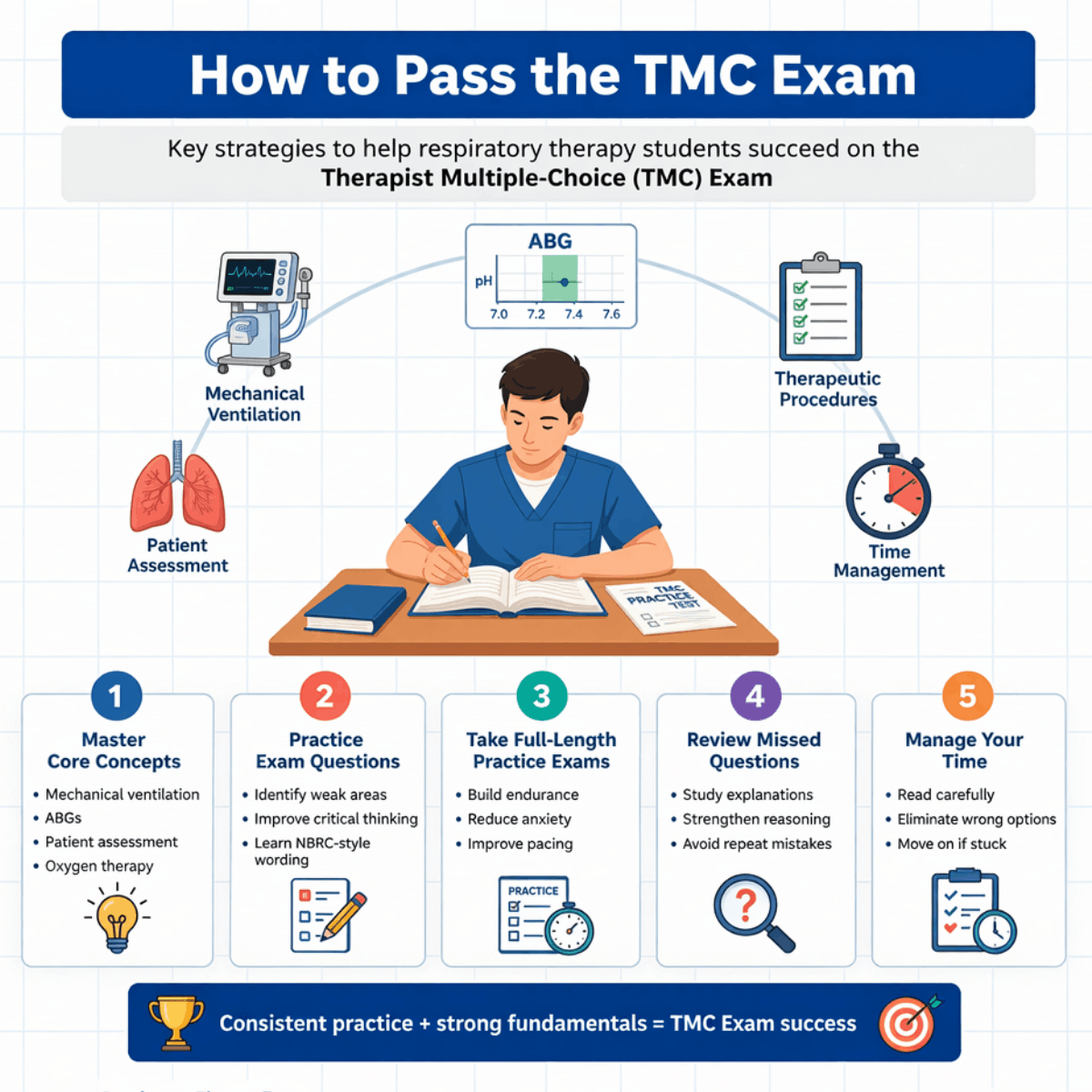
Passing the TMC Exam requires more than simply reviewing your notes from respiratory therapy school. Success on this exam typically involves a combination of strong content knowledge, consistent practice, and effective test-taking strategies.
Many students underestimate how challenging the exam can be. The key is to approach your preparation with a structured study plan and proven techniques that help reinforce learning.
The following strategies have helped thousands of respiratory therapy students prepare for the exam and achieve a passing score.
- Take Practice Exams
- Utilize TMC Practice Questions
- Familiarize Yourself with the Exam Rules
- Be Aware of the Time Limit
- Answer Every Question
- Strategically Use Your Scratch Paper
- Carefully Read Each Question
- Prioritize Key Topics
- Develop Stress Management Techniques
- Avoid Last-Minute Cramming
- Condition Your Body and Mind
- Believe in Yourself
- Don’t Go at It Alone
Watch this video and keep reading to learn more about the most effective strategies for preparing for and passing the TMC Exam on your first (or next) attempt.
Take Practice Exams
Taking practice exams is one of the most effective strategies for preparing for the TMC Exam. Practice exams simulate the format and difficulty level of the real test. This experience helps you become familiar with the types of questions you are likely to encounter.
Another advantage of practice exams is that they help identify your strengths and weaknesses. After completing a practice test, you can review your results to determine which topics require additional study.
For example, you might discover that you consistently struggle with ventilator management questions or arterial blood gas interpretation. Identifying these gaps early allows you to focus your study time more effectively.
Practice exams also help improve your pacing. Since the real exam contains 160 questions within a limited time frame, developing a sense of timing is essential. We offer a free online TMC practice exam, and the NBRC also provides one. Taking both can help you gain valuable experience before exam day.

Utilize TMC Practice Questions
In addition to full-length exams, studying with practice questions is another highly effective way to prepare for the TMC Exam. Practice questions allow you to actively engage with the material instead of passively reviewing notes or textbooks. This active learning approach strengthens your ability to recall information during the exam.
Working through questions also exposes you to the wide range of topics that may appear on the test. Over time, you will begin to recognize patterns in how questions are written and which concepts appear most frequently.
When reviewing your answers, pay close attention to the explanations and rationales provided. Understanding why an answer is correct or incorrect helps reinforce learning and prevents the same mistakes from occurring again.
Incorporating practice questions into your daily study routine is one of the most effective ways to build confidence and improve retention.
If you are looking for a comprehensive set of exam-style questions, consider using our TMC Test Bank. It contains a large collection of practice questions designed to mirror the style and difficulty of the real exam.

Access sample exam-style practice questions, quizzes, and real-life practice exams to pass the TMC Exam on your first (or next) attempt.
Familiarize Yourself with the Exam Rules
Understanding the procedural aspects of the TMC Exam is almost as important as mastering the clinical content. Many students focus entirely on studying respiratory therapy concepts but overlook the practical details of the testing process.
The NBRC has established specific rules and procedures that must be followed during the exam. These guidelines are designed to maintain fairness, protect exam integrity, and ensure a standardized testing environment for all candidates.
Before exam day, it is highly recommended that you review the NBRC Candidate Handbook. This document provides detailed information about testing policies, identification requirements, and what to expect during the exam.
For example, you will typically be required to present a valid form of identification before entering the testing center. Personal items such as phones, smartwatches, study materials, and bags are generally not allowed in the testing area.
In most testing centers, you will be asked to store your belongings in a locker before the exam begins. Understanding these rules ahead of time helps eliminate unnecessary stress. The last thing you want is to arrive on exam day and feel anxious because you are unsure about the testing procedures.
Note: Being prepared allows you to focus entirely on answering the questions and performing at your best.
Be Aware of the Time Limit
Time management is one of the most important skills you can develop while preparing for the TMC Exam. You will have three hours to answer 160 questions. While this may seem like a generous amount of time, it can pass quickly if you are not careful with pacing.
On average, you have just over one minute per question. Some questions can be answered quickly, while others may require more thought and careful analysis.
Because of this, it is important to develop a strategy for managing your time effectively. One useful approach is to answer the easier questions first. If you encounter a question that seems confusing or time-consuming, consider bookmarking it and returning to it later.
This strategy prevents you from getting stuck on a difficult question early in the exam and losing valuable time that could be spent answering questions you already know. Many testing systems allow you to flag questions so you can review them before submitting the exam.
Practicing with full-length practice exams can help you develop a sense of pacing. Over time, you will learn how quickly you should move through each section and how to balance speed with accuracy.
Note: Keep an eye on the clock, but do not allow the time limit to create unnecessary anxiety. Staying calm and focused will help you think clearly and make better decisions.
Answer Every Question
Selecting an answer for every question is one of the simplest but most important strategies for maximizing your score on the TMC Exam. The exam does not penalize incorrect answers. Your score is based solely on the number of questions answered correctly.
Because of this scoring method, leaving a question blank guarantees that you will receive zero points for that item. However, making an educated guess gives you a chance to earn the point. Even if you are unsure about the correct answer, try to eliminate the options that you know are incorrect. This process narrows your choices and increases the probability of selecting the right answer.
For example, if you can eliminate two incorrect options, you now have a fifty percent chance of choosing the correct response.
Another helpful strategy is to trust your initial instinct. In many cases, your first impression is based on knowledge that you have already learned and practiced. Constantly changing answers can sometimes lead to second-guessing and unnecessary mistakes.
Of course, if you notice that you misread a question or discover new information later in the exam, it is reasonable to reconsider your answer. Practicing with sample questions can help you build confidence in your decision-making process and improve your ability to eliminate incorrect options quickly.

Get TMC-style practice questions delivered to your inbox daily to keep your skills sharp and exam-ready.
Use Your Scratch Paper Strategically
During the TMC Exam, candidates are typically provided with scratch paper that can be used for calculations, notes, or diagrams. Many students only use this paper for solving math-related questions. However, it can also be used as a powerful organizational tool during the exam.
Before starting the exam timer, you may have a brief moment to gather your thoughts and prepare. Some students choose to write down key formulas, normal values, or reference diagrams that they expect to use during the exam.
Examples of information you might include are:
- Normal arterial blood gas values
- Ventilator equations and calculations
- Pulmonary function testing reference values
- Simple diagrams that help you visualize respiratory mechanics
For example, drawing the “lung box” can help with questions related to pulmonary function testing (PFT). Having these reminders available can reduce mental strain and allow you to focus more clearly on interpreting the questions.
Note: Just remember that the scratch paper must be returned to the testing staff at the end of the exam. The testing center will collect your scratch paper before you receive your score report. This policy helps protect the confidentiality of the exam content.
Carefully Read Each Question
One of the most common mistakes students make during the TMC Exam is reading questions too quickly. The pressure of the time limit can cause candidates to rush through questions and overlook important details.
However, many exam questions are designed to test your ability to interpret information carefully. Missing a single keyword can completely change the meaning of a question.
For example, words such as not, except, or most appropriate can dramatically affect which answer is correct. Taking a moment to read the entire question and each answer choice thoroughly can prevent simple errors.
Another challenge is that some questions include extra information that may not be relevant to the correct answer. These details are sometimes included to test whether you can identify the most important data.
Developing the habit of identifying key clinical clues can help you quickly determine what the question is truly asking. If a question appears complicated, try breaking it down into smaller parts. Identify the patient problem, interpret the clinical data, and then determine which intervention best addresses the situation.
Note: Practicing with exam-style questions can help you build this analytical skill.
Prioritize Key Topics
Many students feel overwhelmed when studying for the TMC Exam because the field of respiratory therapy covers such a wide range of topics. Trying to review every possible concept at the same time can quickly lead to frustration and burnout.
Instead, it is more effective to focus on the high-yield topics that appear frequently on the exam.
Some of the most important areas to prioritize include:
- Mechanical ventilation
- Arterial blood gas interpretation
- Pulmonary function testing
- Oxygen delivery systems
- Airway management
- Respiratory pharmacology
- Patient assessment and monitoring
Among these topics, mechanical ventilation is particularly important. Questions related to ventilator settings, patient-ventilator interaction, and troubleshooting ventilator alarms frequently appear on the exam. By focusing on these core concepts, you can maximize the effectiveness of your study time and improve your overall performance.
Our TMC Exam Hacks course was created to help students identify the most important exam topics and develop strategies for answering difficult questions.

Unlock insider strategies and proven exam hacks to master key concepts, avoid common pitfalls, and pass the exam on your first (or next) attempt.
Develop Stress Management Techniques
There is no denying that preparing for the TMC Exam can be stressful. Respiratory therapy students often spend months reviewing textbooks, completing practice questions, and preparing for one of the most important exams of their careers.
Feeling some level of anxiety is completely normal. In fact, a small amount of stress can sometimes improve focus and motivation. However, excessive stress can negatively impact concentration, memory recall, and decision-making. For this reason, developing effective stress management techniques is an important part of exam preparation.
One of the most helpful strategies is to schedule regular breaks during your study sessions. Long periods of continuous studying can lead to mental fatigue and reduced productivity. Taking short breaks allows your brain to reset and process information more effectively.
Physical activity is another excellent way to reduce stress. Even a short walk, a workout at the gym, or a few minutes of stretching can improve mood and help clear your mind.
Some students also benefit from mindfulness techniques such as meditation or deep breathing exercises. These practices can help calm your nervous system and improve your ability to stay focused during stressful situations.
It is also important to maintain a balanced lifestyle while studying. Spending time with friends, family, or hobbies that you enjoy can help prevent burnout and keep your motivation high. Preparing for the exam should be taken seriously, but it should not consume every moment of your life.
Note: Keeping your stress under control will allow you to approach the exam with a clear mind and greater confidence.
Avoid Last-Minute Cramming
Cramming refers to attempting to memorize large amounts of information in a short period of time, usually the night before an exam. While this strategy might seem tempting, it is generally ineffective for a comprehensive exam like the TMC.
The TMC Exam evaluates your understanding of respiratory therapy concepts and your ability to apply that knowledge in clinical situations. Simply memorizing facts at the last minute rarely prepares you for the type of analytical thinking required during the exam.
In addition, last-minute cramming often increases stress and fatigue. Staying up late to study can interfere with sleep, which reduces mental clarity and memory recall on exam day.
A much more effective strategy is to study consistently over time. Spreading your learning across several weeks allows your brain to gradually absorb and retain information. This process, often called spaced repetition, has been shown to improve long-term memory and understanding.
Creating a structured study schedule can help you stay organized. For example, you might dedicate certain days to reviewing mechanical ventilation, arterial blood gases, or pulmonary diagnostics.
Note: By studying a little each day, you will arrive at exam day feeling more confident and less overwhelmed.
Condition Your Body and Mind
Preparing for the TMC Exam is not only about studying. It also involves taking care of your physical and mental well-being. Your body and brain work together, and both need to be in good condition to perform at their best.
One of the most important factors is sleep. Getting a full night of rest before the exam helps improve concentration, memory recall, and problem-solving ability. Students who stay up late studying often arrive at the testing center feeling tired and unfocused.
Nutrition is another important factor. Eating a balanced meal before the exam can help maintain energy levels and prevent distractions caused by hunger. Many students choose a breakfast that includes protein and complex carbohydrates, which provide sustained energy throughout the morning.
Hydration also plays a role in cognitive performance. Drinking enough water before the exam helps maintain alertness and concentration.
Arriving early to the testing center can also make a big difference. Giving yourself extra time to check in, store your belongings, and get comfortable allows you to settle your nerves before the exam begins. Many students find it helpful to take a few deep breaths and mentally review their preparation before starting the test.
Note: Small habits like these can have a meaningful impact on your performance.
Believe in Yourself
As the exam approaches, it is common for students to experience self-doubt. You may wonder whether you studied enough or worry about the difficulty of the questions. While these feelings are normal, it is important to remember how far you have already come.
Completing a respiratory therapy program requires years of education, clinical training, and dedication. You have already demonstrated the ability to learn complex material and apply it in real clinical environments.
The TMC Exam is simply the final step in that journey. Maintaining a positive mindset can make a significant difference in your performance. Confidence allows you to approach each question calmly and think more clearly.
Instead of focusing on the possibility of failure, remind yourself of the hours you spent studying and the practice exams you completed. Those efforts have prepared you for this moment. Even if you encounter difficult questions during the exam, stay focused and continue moving forward. Every exam includes questions that challenge even the most prepared students. What matters most is your ability to remain calm and continue applying your knowledge.
Note: Believing in yourself is not just motivational advice. It is a practical strategy that helps you perform at your best.
Don’t Go at It Alone
Another common mistake students make while preparing for the TMC Exam is trying to handle everything on their own. Respiratory therapy is a collaborative profession, and studying for the exam can benefit from collaboration as well.
Joining a study group can provide several advantages. Discussing concepts with classmates often helps clarify difficult topics and reinforces your understanding of the material. Teaching a concept to someone else is also one of the most effective ways to strengthen your own knowledge. Study groups can also provide motivation and accountability. When you know others are counting on you to participate, it becomes easier to stay committed to your study schedule.
In addition to peer support, many students benefit from structured review programs and study resources. We offer several exam prep tools designed specifically for respiratory therapy students preparing for the TMC Exam.
These resources provide organized study material, practice questions, and exam strategies that can help you prepare more efficiently.
Note: You do not have to face this challenge alone. Support from classmates, instructors, and study resources can make the preparation process much more manageable.

Final Thoughts
Passing the TMC Exam requires preparation, discipline, and a clear strategy. The exam is designed to ensure that respiratory therapy graduates possess the knowledge and clinical judgment required to provide safe and effective patient care. Although the exam can seem intimidating at first, thousands of students pass it every year. With the right approach, you can join them.
Successful candidates typically combine several key strategies. They practice with exam-style questions, focus on high-yield topics, manage their time effectively, and maintain a positive mindset throughout the preparation process.
Consistency is often the most important factor. Studying a little each day, reviewing difficult concepts, and regularly testing your knowledge can gradually build the confidence you need to succeed.
It is also important to remember that the TMC Exam represents more than just a test. Passing the exam marks the transition from student to healthcare professional. It opens the door to a rewarding career where you will help patients breathe easier and support life-saving medical care.
Respiratory therapists play a vital role in hospitals, clinics, and emergency settings across the world. The knowledge and skills you have gained during your education will soon be used to improve the lives of real patients. Approach the exam with determination and confidence. Trust the preparation you have completed and the experience you gained during your clinical training.
With persistence, dedication, and the strategies outlined in this guide, passing the TMC Exam is well within your reach. Earning your credential will allow you to begin a meaningful career as a respiratory therapist, helping patients breathe easier and making a lasting impact in healthcare.

Written by:
John Landry is a registered respiratory therapist from Memphis, TN, and has a bachelor's degree in kinesiology. He enjoys using evidence-based research to help others breathe easier and live a healthier life.
References
- “Registered Respiratory Therapist (RRT).” The National Board for Respiratory Care, https://www.nbrc.org/examinations/rrt/. Accessed 9 Apr. 2024.