

Mechanical ventilation is one of the most important and challenging topics that respiratory therapy students must master for the board exam. It requires a strong understanding of ventilator settings, patient monitoring, airway management, and troubleshooting strategies.
Because mechanical ventilation is such a central part of respiratory care, it is frequently tested on the board exam. Students are expected to understand how ventilators function, how to interpret patient responses, and how to adjust settings to improve ventilation and oxygenation.
Developing a solid foundation in these concepts not only improves your chances of passing the exam but also prepares you to provide safe and effective care for critically ill patients in the clinical setting.
In this guide, we’ll walk through essential tips and strategies to help you confidently approach the mechanical ventilation portion of the board exam and move one step closer to earning your RRT credentials.

Take our free course to learn essential tips, insights, and strategies to pass the TMC Exam on your first (or next) attempt.
Why Mechanical Ventilation Is an Important Topic on the Board Exam
Mechanical ventilation is one of the most important subjects on the board exam because respiratory therapists play a central role in managing ventilated patients in hospitals and critical care settings.
The exam evaluates your ability to understand ventilator modes, interpret patient responses, adjust ventilator settings, and troubleshoot common problems. These skills are essential for ensuring proper oxygenation, removing carbon dioxide, and preventing complications such as ventilator-induced lung injury or auto-PEEP.
Because ventilator management requires both clinical knowledge and critical thinking, exam questions often present patient scenarios that require careful analysis.
A strong understanding of mechanical ventilation concepts not only helps you perform well on the exam but also prepares you to deliver safe, effective respiratory care in real-world clinical environments.
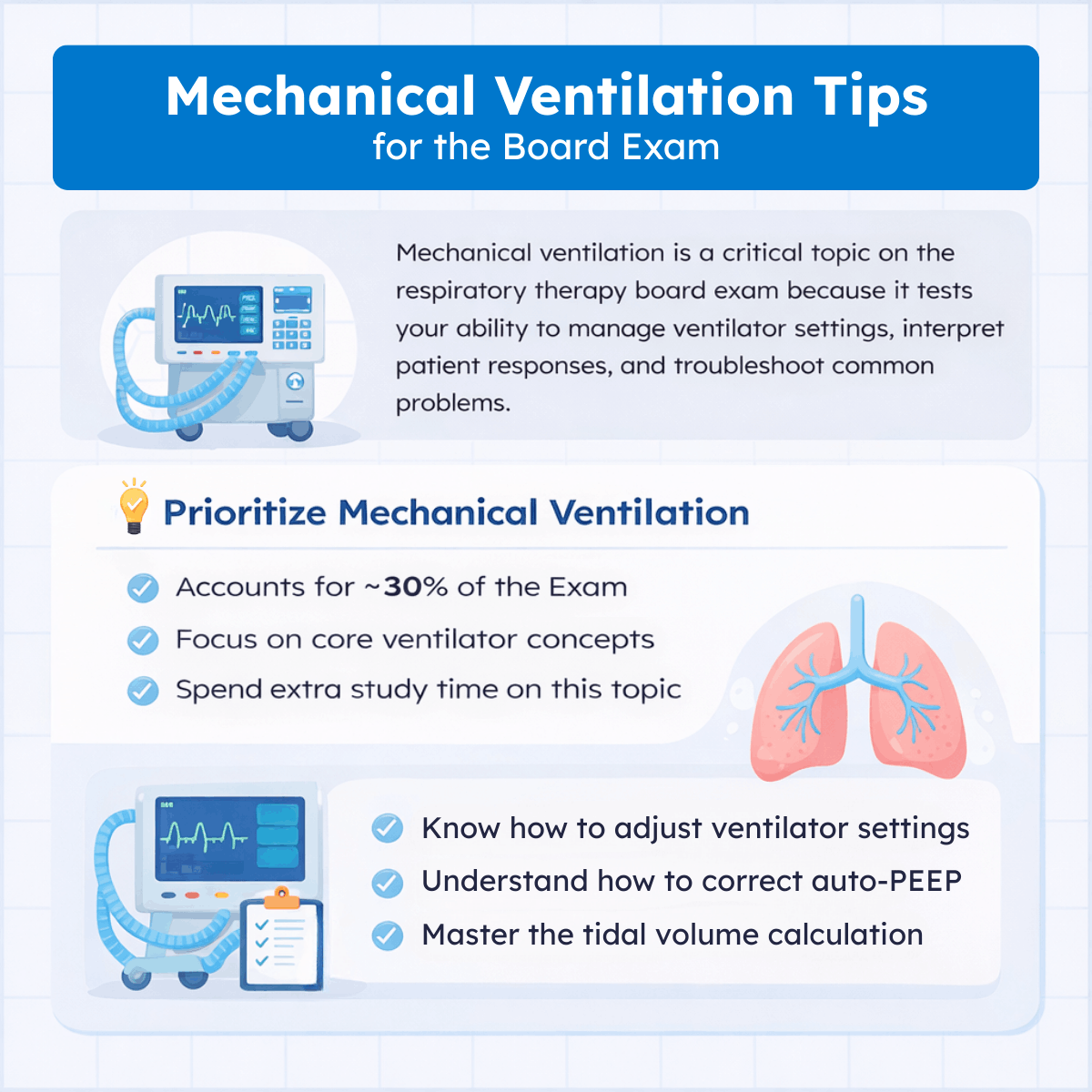
Mechanical Ventilation Tips for the Board Exam
- Prioritize mechanical ventilation in your study plan
- Focus on conventional ventilator modes
- Understand how to identify and correct auto-PEEP
- Learn the medications used during mechanical ventilation
- Master tidal volume calculations
- Develop strong ventilator troubleshooting skills
- Understand how to adjust ventilator settings
Watch this video and continue reading to learn practical strategies for mastering mechanical ventilation concepts on the board exam.
1. Prioritize Mechanical Ventilation
Mechanical ventilation is one of the most heavily emphasized topics on the board exam, which makes it a critical area to focus on during your preparation. A significant portion of exam questions involve ventilator management, patient assessment while on mechanical support, and identifying appropriate adjustments to improve patient outcomes.
This topic spans several essential concepts, including ventilator modes, ventilator settings, waveform interpretation, troubleshooting alarms, and patient-ventilator synchrony. Because of its broad scope and clinical importance, dedicating sufficient study time to this subject can have a major impact on your exam performance.
In many ways, mastering mechanical ventilation can be the key difference between passing and failing the board exam. Students who are comfortable interpreting ventilator data and adjusting settings tend to perform much better on exam scenarios that involve critically ill patients.
To improve your chances of success, make mechanical ventilation a priority in your study plan. Review ventilator concepts regularly, practice applying them to clinical scenarios, and reinforce your knowledge with practice questions.
Note: Mechanical ventilation questions often require clinical reasoning rather than simple memorization. Focus on understanding why ventilator adjustments are made and how they affect oxygenation and ventilation.

Access our quiz, which includes sample TMC practice questions and detailed explanations to master the key concepts of mechanical ventilation.
2. Focus on Conventional Ventilator Modes
A strong understanding of conventional ventilator modes is essential for success on the board exam. Many exam questions involve selecting the most appropriate ventilator mode for a given patient condition or determining how a mode will affect ventilation and oxygenation.
Instead of trying to memorize every advanced ventilator mode available on modern ventilators, it is far more important to focus on the core modes that are commonly used in clinical practice.
Note: Understanding how these modes function, when they are used, and how they respond to patient effort will help you answer exam questions with confidence.
Primary Control Variables to Know
- Volume Control (VC): Delivers a set tidal volume with each breath. This ensures consistent minute ventilation and is commonly used when precise control of ventilation is required.
- Pressure Control (PC): Delivers breaths based on a preset inspiratory pressure. This mode helps limit peak airway pressures and is often used for patients with reduced lung compliance, such as those with ARDS.
Primary Ventilator Modes to Master
- Synchronized Intermittent Mandatory Ventilation (SIMV): Provides a combination of mandatory breaths and spontaneous breaths. This mode is commonly used when patients are beginning to regain spontaneous respiratory effort or during the weaning process.
- Assist/Control (A/C): Delivers mandatory breaths when the patient initiates a breath or when a set time interval is reached. This mode is frequently used for patients who require full ventilatory support.
Spontaneous Ventilator Modes to Understand
- Continuous Positive Airway Pressure (CPAP): Maintains constant positive pressure in the airway during spontaneous breathing. This helps keep alveoli open and improves oxygenation.
- Pressure Support (PS): Assists spontaneous breaths by providing additional inspiratory pressure. This reduces the patient’s work of breathing and helps overcome airway resistance or endotracheal tube resistance.
While modern ventilators offer many advanced modes, these are rarely emphasized on the board exam. Instead, your study time is better spent mastering the foundational modes that appear most frequently in exam questions.
Examples of less commonly tested modes include:
- Proportional Assist Ventilation (PAV): Adjusts ventilatory support in proportion to the patient’s inspiratory effort.
- Adaptive Support Ventilation (ASV): A closed-loop mode that automatically adjusts ventilator support based on patient needs.
- Neurally Adjusted Ventilatory Assist (NAVA): Uses signals from the diaphragm to synchronize ventilator support with the patient’s breathing effort.
- Automatic Tube Compensation (ATC): Compensates for resistance caused by the endotracheal tube.
Although it is helpful to recognize these modes, they rarely appear in exam scenarios. Focus your attention on understanding conventional modes such as A/C, SIMV, CPAP, and pressure support.
Note: Exam questions often test your ability to recognize how a ventilator mode affects patient ventilation. Make sure you understand which variable is being controlled and how spontaneous breathing interacts with each mode.
3. Understand How to Correct Auto-PEEP
Auto-PEEP, also known as intrinsic PEEP, is a common complication that can occur during mechanical ventilation. It develops when air becomes trapped in the lungs at the end of exhalation, resulting in residual positive pressure within the alveoli.
This typically happens when a patient does not have enough time to fully exhale before the next breath is delivered. The trapped air gradually increases intrathoracic pressure and can negatively impact both ventilation and circulation.
Auto-PEEP is an important concept to understand for the board exam because it appears frequently in clinical scenario questions involving ventilator management and patient distress.
If not recognized and corrected, auto-PEEP can lead to several complications, including:
- Increased work of breathing
- Difficulty triggering the ventilator
- Elevated peak airway pressures
- Reduced venous return and decreased cardiac output
- Worsening gas exchange
How to Identify Auto-PEEP
Patients experiencing auto-PEEP often show recognizable clinical and ventilator signs. Recognizing these patterns can help you quickly identify the problem on exam questions.
- Increased work of breathing
- Patient struggling to trigger the ventilator
- Elevated peak airway pressures
- Flow waveform that does not return to baseline before the next breath
- Dyspnea or patient agitation while on the ventilator
How to Correct Auto-PEEP
The primary strategy for correcting auto-PEEP is to increase the expiratory time. Allowing more time for exhalation helps prevent air trapping and allows the lungs to empty more completely.
This can be accomplished through several ventilator adjustments:
- Decrease the Respiratory Rate: A lower rate increases the total breathing cycle time and provides more time for exhalation.
- Increase Inspiratory Flow: Increasing the flow rate shortens the inspiratory time and automatically lengthens the expiratory phase.
- Decrease the Tidal Volume: Delivering smaller tidal volumes reduces the amount of air that must be exhaled.
- Adjust the I:E Ratio: Increasing the expiratory portion of the breathing cycle can help reduce air trapping.
Other Causes of Auto-PEEP
Although insufficient expiratory time is the most common cause, several additional factors can contribute to auto-PEEP:
- High Respiratory Rate
- Excessive Minute Ventilation
- Patient-ventilator asynchrony
- Airway obstruction from bronchospasm or secretions
- Reduced lung compliance
Understanding these contributing factors can help you recognize the best intervention when presented with a clinical scenario on the board exam. In most cases, the correct answer involves increasing the expiratory time through ventilator adjustments.

4. Learn the Medications Used During Mechanical Ventilation
Medications play a critical role in managing patients who require mechanical ventilation. These medications are used to improve patient comfort, facilitate airway management, and promote better synchrony between the patient and the ventilator.
Questions related to sedation, analgesia, and neuromuscular blockade frequently appear on the board exam, so it is important to understand the purpose of each drug class.
Note: Several medication categories may be used depending on the patient’s clinical condition.
Key Medication Categories and When to Use Them
Analgesics (Pain Control)
Analgesics are used to relieve pain and provide comfort for patients receiving mechanical ventilation. Pain management is an important component of critical care and helps prevent agitation and stress.
Examples include:
- Morphine
- Fentanyl
Sedatives (Anxiety and Agitation)
Sedatives help reduce anxiety, decrease awareness, and promote patient comfort. They also improve patient-ventilator synchrony in patients who are restless or anxious.
Common examples include:
- Diazepam (Valium)
- Midazolam (Versed)
Neuromuscular Blocking Agents (Rapid Paralysis for Intubation)
Neuromuscular blocking agents are commonly used during rapid sequence intubation to facilitate airway placement by producing temporary muscle paralysis.
Example:
- Succinylcholine (Anectine)
Paralytics (Longer-Term Muscle Relaxation)
In certain cases, paralytic agents may be required to eliminate spontaneous breathing efforts and improve ventilator synchrony.
These medications are sometimes used in patients with severe ventilator asynchrony or elevated intracranial pressure.
Examples include:
- Pancuronium (Pavulon)
- Atracurium (Tracrium)
- Cisatracurium (Nimbex)
Bronchodilators (Airway Resistance)
Bronchodilators are administered to reduce bronchospasm and improve airflow in patients with obstructive lung diseases such as asthma and COPD.
Examples include:
- Albuterol
- Ipratropium Bromide (Atrovent)
If a patient is experiencing patient-ventilator asynchrony or appears to be fighting the ventilator, adjusting ventilator settings should usually be attempted first. However, medications such as sedatives or paralytics may sometimes be necessary to improve patient comfort and safety.
Note: On the board exam, carefully read each scenario to determine whether the best answer involves adjusting ventilator settings or administering medication.
5. Master the Tidal Volume Calculation
Tidal volume is one of the most important ventilator settings and is frequently tested on the board exam. Respiratory therapy students must understand how to calculate the appropriate tidal volume based on a patient’s ideal body weight (IBW).
Exam questions commonly provide a patient’s height and ask you to determine the correct tidal volume range.
Because of this, memorizing the IBW formula and practicing the calculation is essential.
How to Calculate Ideal Body Weight (IBW)
The formula used to calculate IBW for adult males is:
- IBW = 50 kg + (2 x number of inches over 5 feet)
Once IBW is calculated, the recommended tidal volume range is typically 6 to 8 mL per kilogram of IBW.
This range provides adequate ventilation while minimizing the risk of ventilator-induced lung injury.
Example Question
Question: What tidal volume should be set for a male patient who is 5 feet 10 inches tall?
Step 1: Calculate IBW
IBW = 50 kg + (2 x inches over 5 ft)
IBW = 50 + (2 x 10)
IBW = 70 kg
Step 2: Determine tidal volume range
70 x 6 = 420 mL
70 x 8 = 560 mL
Answer: The appropriate tidal volume range is 420 to 560 mL.
Note: Understanding this calculation allows you to quickly determine the correct ventilator settings when presented with height-based exam questions. Practicing this formula repeatedly will help you solve these problems quickly and accurately during the board exam.
6. Master Ventilator Troubleshooting
Mechanical ventilators are sophisticated devices, and problems can occur at any time during patient care. For this reason, respiratory therapists must develop strong ventilator troubleshooting skills. These skills allow clinicians to quickly identify problems, correct them, and ensure the patient continues to receive safe and effective ventilatory support.
Troubleshooting is also a common topic on the board exam. Many exam questions present a ventilator alarm or a sudden change in patient status and ask you to identify the most appropriate intervention.
In these scenarios, the key is to focus on patient safety while systematically identifying the underlying cause of the problem. Below are several common ventilator issues and how they should typically be addressed.
Sudden Decrease in Tidal Volume
A sudden drop in tidal volume often indicates a leak somewhere in the ventilator system.
This may occur due to:
- A disconnection in the ventilator circuit
- A leak around the endotracheal tube cuff
- A damaged or malfunctioning ventilator component
The first step is to inspect the ventilator circuit and reconnect any loose tubing. If the problem persists, check the cuff pressure of the artificial airway. If the cuff is damaged or cannot maintain a seal, the endotracheal tube may need to be replaced.
High-Pressure Alarms
High-pressure alarms occur when the ventilator encounters excessive resistance while delivering a breath.
Common causes include:
- Secretions in the airway
- Kinked ventilator tubing
- Patient biting the endotracheal tube
- Bronchospasm
- Patient-ventilator asynchrony
In these situations, assess the patient first. If secretions are suspected, suctioning the airway may resolve the issue. You should also check the ventilator tubing for obstructions and confirm that the patient is not biting the tube.
Note: If the problem is related to ventilator synchrony, it may be necessary to adjust ventilator settings to improve patient comfort and breathing coordination.
Low-Pressure Alarms
Low-pressure alarms usually indicate that the ventilator circuit has become disconnected or that a large leak is present.
Possible causes include:
- Circuit disconnection
- Loose tubing connections
- Endotracheal tube cuff leak
- Extubation
Note: In these cases, immediately inspect the ventilator circuit and reconnect any disconnected tubing. Always assess the patient to ensure the airway remains secure.
When to Change a Ventilator Circuit
Another concept frequently tested on the board exam involves ventilator circuit changes.
According to guidelines from the American Association for Respiratory Care (AARC), ventilator circuits should not be routinely changed. Instead, they should only be replaced when they become visibly soiled or contaminated.
Routine circuit changes increase the risk of infection and unnecessary manipulation of the ventilator system.
Understanding these principles will help you answer troubleshooting questions more confidently during the board exam.
Note: When answering troubleshooting questions, assess the patient first whenever possible. Patient safety always takes priority over equipment adjustments.
7. Learn How to Adjust Ventilator Settings
Ventilator settings determine how the ventilator delivers breaths and how effectively the patient is ventilated and oxygenated. A solid understanding of these settings is essential for both clinical practice and success on the board exam.
Many exam questions present arterial blood gas (ABG) results or patient symptoms and ask which ventilator adjustment should be made. To answer these questions correctly, you must understand how each setting influences oxygenation and ventilation.
Treating Hypoxemia
Hypoxemia occurs when the blood oxygen level is too low.
The two most common ventilator adjustments used to correct hypoxemia are:
- Increase FiO2: Increasing the fraction of inspired oxygen raises the amount of oxygen delivered to the patient.
- Increase PEEP: Positive end-expiratory pressure helps keep alveoli open and improves oxygenation.
Note: In exam questions, the correct answer often involves adjusting one of these two settings.
Treating Elevated PaCO2
If a patient has an elevated PaCO2 level, this indicates hypoventilation and inadequate removal of carbon dioxide.
The solution is to increase the patient’s minute ventilation.
This can be achieved by:
- Increasing the respiratory rate
- Increasing the tidal volume
Note: Both adjustments increase the total volume of air moving through the lungs each minute, which helps remove excess carbon dioxide.
Treating Low PaCO2
If the PaCO2 is too low, the patient is being ventilated too aggressively.
To correct this issue, the ventilator settings should be adjusted to reduce minute ventilation.
This can be accomplished by:
- Decreasing the respiratory rate
- Decreasing the tidal volume
- Adding mechanical dead space
Key Ventilator Settings to Understand
Students preparing for the board exam should be familiar with the following ventilator settings and how they influence ventilation and oxygenation:
- Mode: Determines the type of breath delivered.
- Tidal Volume (VT): The amount of air delivered with each breath.
- Respiratory Rate: The number of breaths delivered each minute.
- FiO2: The percentage of oxygen delivered to the patient.
- Inspiratory Flow Rate: The speed at which gas is delivered during inspiration.
- I:E Ratio: The ratio of inspiratory time to expiratory time.
- Sensitivity: Determines how easily the patient can trigger the ventilator.
- PEEP: Maintains positive pressure at the end of exhalation.
- Alarm Settings: Alerts clinicians to abnormal pressures, volumes, or disconnections.
Understanding how these settings interact will allow you to interpret clinical scenarios and select the correct ventilator adjustment during the exam.
Note: Many board exam questions test your ability to connect ABG results with ventilator adjustments. Practice interpreting ABGs and determining how ventilator settings should be modified.

Unlock insider strategies and proven exam hacks to master key concepts, avoid common pitfalls, and pass the exam on your first (or next) attempt.
Final Thoughts
Mechanical ventilation is one of the most challenging but important topics respiratory therapy students encounter while preparing for the board exam. Because ventilator management is such a central responsibility for respiratory therapists, the exam places significant emphasis on understanding these concepts.
By mastering ventilator modes, tidal volume calculations, ventilator troubleshooting, and medication management, you will be well prepared to answer mechanical ventilation questions confidently.
Consistent practice is key. Review the core concepts regularly, apply them to clinical scenarios, and reinforce your knowledge through practice questions and mock exams.
If you found these tips helpful, consider exploring our TMC Exam Hacks video course for additional strategies, expert insights, and practical techniques to help you pass the board exam and earn your RRT credential.

Written by:
John Landry is a registered respiratory therapist from Memphis, TN, and has a bachelor's degree in kinesiology. He enjoys using evidence-based research to help others breathe easier and live a healthier life.
References
- Hickey SM, Sankari A, Giwa AO. Mechanical Ventilation. [Updated 2024 Mar 30]. In: StatPearls [Internet]. Treasure Island (FL): StatPearls Publishing; 2025.