

Airway management is one of the most important clinical skills for respiratory therapists and a major topic on the respiratory therapy board exam. Questions in this area evaluate your ability to maintain a patent airway, select the appropriate airway device, and respond effectively to emergencies such as airway obstruction, respiratory failure, or difficult intubations.
A strong understanding of airway management is essential not only for passing the board exam but also for protecting patient safety in real clinical situations. Respiratory therapists are often responsible for managing artificial airways, assisting with intubations, maintaining airway patency, and responding quickly when a patient’s airway becomes compromised.
In this guide, we will review essential tips and strategies that can help you confidently navigate the airway management section of the board exam while strengthening the practical knowledge required for clinical practice. Mastering these concepts will move you one step closer to earning your RRT credentials.

Take our free course to learn essential tips, insights, and strategies to pass the TMC Exam on your first (or next) attempt.
Why Airway Management Is Important for the Board Exam
Airway management is one of the most important topics on the respiratory therapy board exam because maintaining a patent airway is the first priority in many critical care situations. Respiratory therapists are frequently responsible for assisting with intubations, managing artificial airways, and responding to airway emergencies.
As a result, the exam often tests your ability to recognize airway obstruction, select the appropriate airway device, and determine the safest intervention for a given patient scenario. You must also understand key concepts such as airway maneuvers, pharyngeal airways, endotracheal tube placement, tracheostomy care, and extubation readiness.
A strong grasp of these principles not only improves your exam performance but also prepares you for real clinical situations where quick decisions can directly impact patient survival and outcomes.
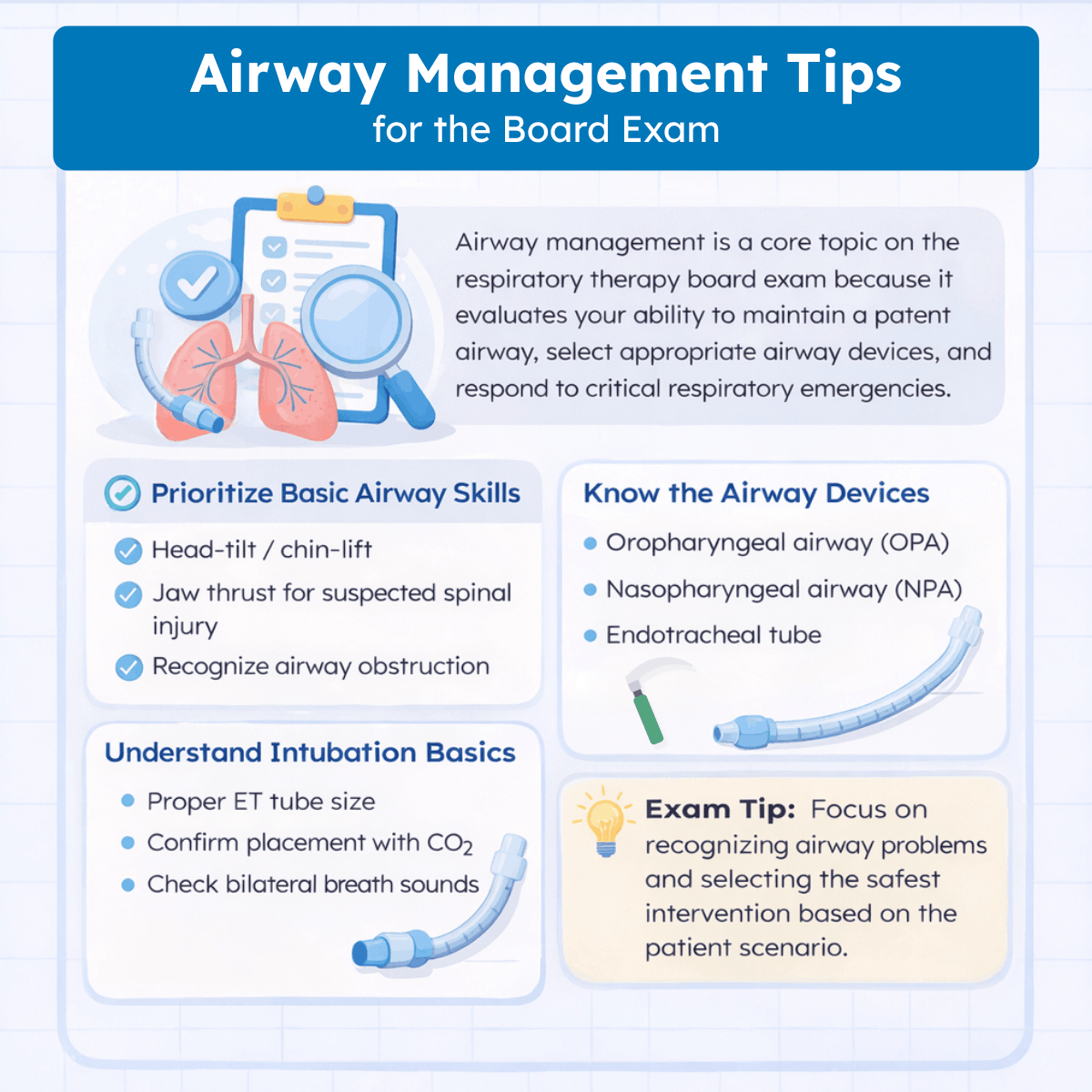
Airway Management Tips for the Board Exam
- Understand how to establish an airway
- Understand pharyngeal airways
- Master endotracheal intubation
- Understand tracheostomy care
- Understand extubation
Watch this video and keep reading to learn essential tips and strategies for mastering airway management concepts that frequently appear on the respiratory therapy board exam.
1. Understand How to Establish an Airway
Proper airway management is one of the first priorities when caring for a patient in respiratory distress. Before advanced airway devices can be used, the clinician must ensure that the airway is open and unobstructed. Establishing a clear and patent airway allows oxygen to reach the lungs and carbon dioxide to be removed from the body.
When airway obstruction occurs, the tongue is often the primary cause, especially in unconscious patients. Basic airway maneuvers reposition the tongue and surrounding structures to restore airflow and improve ventilation.
Two primary techniques are commonly used depending on the patient’s condition and the potential presence of spinal injury.
Preferred Airway Technique
The head-tilt/chin-lift maneuver is the preferred technique for opening the airway during routine airway management. This method works by tilting the head backward while lifting the chin upward, which moves the tongue away from the posterior pharynx.
This maneuver is simple, effective, and widely used in emergency care when there is no concern for cervical spine injury.
- How It Works: Tilting the head and lifting the chin shifts the tongue forward and away from the oropharynx, creating a clear passage for airflow into the trachea.
- When It Is Used: This technique is commonly used in patients who are unconscious but do not have suspected neck trauma.
- Contraindications: Suspected cervical spine injury or neck fracture. Moving the neck in these situations could worsen spinal damage or lead to neurological injury.
Alternative Technique
If a cervical spine injury is suspected, the jaw thrust or modified jaw thrust maneuver should be used instead. This technique opens the airway while keeping the neck in a neutral position, which protects the spinal cord from further injury.
The maneuver is performed by placing fingers behind the angles of the lower jaw and lifting it forward. This action pulls the tongue away from the back of the throat without extending the neck.
- How It Works: Lifting the mandible forward moves the tongue anteriorly and opens the airway without requiring head movement.
- When to Use: This technique is recommended for patients with suspected cervical spine trauma, multi-trauma injuries, or any condition where spinal alignment must be maintained.
Key Takeaway
- Head-Tilt/Chin-Lift: Used when there is no suspected neck injury.
- Jaw Thrust or Modified Jaw Thrust: Used when cervical spine injury is suspected.
Note: Understanding when to use each airway maneuver is extremely important for both the board exam and clinical practice. Many exam questions test your ability to identify the safest airway technique based on the patient scenario.

Access our quiz, which includes sample TMC practice questions and detailed explanations to help you master the key concepts of airway management.
2. Understand Pharyngeal Airways
Pharyngeal airways are simple airway adjuncts designed to maintain airway patency by preventing the tongue from obstructing the upper airway. These devices extend only into the pharynx and help create a passage for airflow when the patient cannot maintain an open airway independently.
For the respiratory therapy board exam, it is important to understand the two primary types of pharyngeal airways, their indications, and when they should not be used.
Oropharyngeal Airway
An oropharyngeal airway (OPA) is a curved plastic device inserted through the mouth and positioned in the oropharynx. Its primary purpose is to prevent the tongue from falling backward and blocking the airway.
OPAs are most commonly used in unconscious or deeply sedated patients who do not have a gag reflex.
- Indication: Oropharyngeal airways are used in unconscious patients to prevent airway obstruction caused by the tongue. They are also commonly used to facilitate bag-mask ventilation.
- Contraindication: OPAs should never be used in conscious or semi-conscious patients because they can stimulate the gag reflex and lead to vomiting or aspiration.
- Additional Use Case: When an orally intubated patient bites down on an endotracheal tube, an oropharyngeal airway can function as a bite block to protect the tube and maintain airflow.
Nasopharyngeal Airway
A nasopharyngeal airway (NPA) is a soft, flexible tube inserted through the nose and advanced into the nasopharynx. Unlike an OPA, an NPA can be used in patients who are awake or have an intact gag reflex.
Because it is softer and less stimulating to the airway, it is often better tolerated in semi-conscious patients.
- Indication: Nasopharyngeal airways are useful for patients who require frequent nasotracheal suctioning or those who cannot tolerate an oropharyngeal airway.
- Benefits: NPAs are generally more comfortable for conscious patients and are less likely to trigger gagging compared with OPAs.
- Clinical Tip: Always lubricate the airway and insert it gently to reduce nasal trauma.
Note: Understanding the differences between OPAs and NPAs is essential for selecting the correct airway device in clinical scenarios that appear on the respiratory therapy board exam.
3. Master Endotracheal Intubation
Understanding the principles of endotracheal intubation and proper endotracheal (ET) tube management is critical for both clinical practice and success on the respiratory therapy board exam. Intubation is performed to secure the airway, provide mechanical ventilation, and protect the lungs from aspiration.
Because respiratory therapists frequently assist with airway placement and ventilator management, exam questions often test your understanding of proper tube selection, positioning, and methods for confirming placement.
In adult patients, an orally inserted endotracheal tube is generally preferred over the nasal route. Oral intubation allows clinicians to use a larger diameter tube, which helps reduce airway resistance. Lower resistance improves airflow through the airway and helps reduce peak, plateau, and mean airway pressures during mechanical ventilation.

Proper ET Tube Sizes for Oral Intubation
Selecting the correct tube size is important to ensure adequate airflow while minimizing airway trauma.
- Men: Size 7.5 to 8.0
- Women: Size 7.0 to 7.5
Note: Using a tube that is too small may increase airway resistance, while using a tube that is too large may cause airway injury or difficulty with placement.
Confirming Proper Tube Placement
After intubation, it is essential to confirm that the ET tube is correctly positioned within the trachea. Improper placement can result in inadequate ventilation, hypoxemia, or complications such as mainstem intubation.
Several clinical methods are used to verify correct tube placement.
- Through the Vocal Cords: The ET tube should typically be inserted about 3 to 4 cm past the vocal cords in adult patients.
- Lip Marking: The tube is usually positioned between 21 and 24 cm at the patient’s lip depending on patient height and anatomy.
- Above the Carina: The tube tip should sit approximately 3 to 6 cm above the carina to ensure both lungs receive ventilation.
In addition to observing tube depth, clinicians must verify placement using several bedside assessments.
- Auscultation: Bilateral breath sounds should be present in both lungs.
- Chest Expansion: Symmetrical chest rise indicates effective ventilation.
- SpO2 Monitoring: Oxygen saturation should improve following intubation.
- Condensation: Moisture inside the ET tube may indicate airflow through the airway.
- Colorimetric CO2 Detector: A color change during exhalation suggests the presence of carbon dioxide.
- Capnography: Continuous waveform capnography provides the most reliable confirmation of tracheal placement.
- Chest X-Ray: A chest radiograph should show the tube tip between the T2 and T4 vertebrae near the level of the aortic knob.
How to Correct Tube Position
Board exam questions frequently test your ability to identify improper tube placement and determine the correct intervention.
Example Scenario
After intubating an adult patient, you auscultate the chest and notice breath sounds are absent on the left side. Which action should be taken first?
A. Obtain a stat chest radiograph
B. Withdraw the endotracheal tube by 1 to 2 cm
C. Reintubate the patient
D. Insert a large-bore needle in the left chest
This situation most likely indicates right mainstem intubation. Because the right main bronchus is wider and more vertical than the left, the ET tube can advance too far and ventilate only the right lung.
Correct Answer: B. Withdraw the endotracheal tube by 1 to 2 cm
After repositioning the tube, breath sounds should be reassessed to confirm bilateral ventilation. A chest radiograph can then be used to confirm final positioning.
Note: Many board exam questions focus on identifying right mainstem intubation and knowing the correct intervention.
4. Understand Tracheostomy Care
A tracheostomy is a surgically created opening in the trachea through the neck that allows insertion of a tracheostomy tube. This tube functions as an artificial airway that provides a direct pathway for airflow into the lungs.
Tracheostomies are commonly used for patients who require prolonged mechanical ventilation or when traditional oral or nasal intubation is not possible.
Understanding tracheostomy care, indications, and tube features is important for answering airway management questions on the respiratory therapy board exam.
Indications for a Tracheostomy
- Long-Term Mechanical Ventilation: If a patient is expected to require ventilatory support for approximately 21 days or longer, converting from an endotracheal tube to a tracheostomy is often recommended.
- Upper Airway Obstruction: Tumors, trauma, or anatomical abnormalities may prevent oral or nasal intubation.
- Improved Patient Comfort: Tracheostomies are generally more comfortable for patients requiring long-term airway support.
- Reduced Airway Resistance: The shorter airway length reduces resistance and improves airflow.
Note: Because the tracheostomy creates a direct pathway into the airway, sterile technique must be used during tracheostomy care and suctioning to prevent infection.
Tracheostomy Tube Features
Several types of tracheostomy tubes exist, and understanding their features can help you answer board exam questions more confidently.
- Cuffed Tracheostomy Tubes: These tubes contain an inflatable cuff that seals the airway when the patient is receiving mechanical ventilation.
- Inner Cannula: Many tracheostomy tubes contain a removable inner cannula that must be cleaned regularly to prevent obstruction from secretions.
- Fenestrated Tubes: These tubes contain a small opening that allows airflow through the vocal cords so the patient can speak.
Tracheostomies can also make airway suctioning easier and improve secretion clearance compared with prolonged endotracheal intubation.
Note: On the board exam, when a patient requires prolonged mechanical ventilation, the best recommendation is often to transition from an endotracheal tube to a tracheostomy.
5. Understand Extubation
For many patients, mechanical ventilation is a temporary intervention used to support breathing during illness, surgery, or respiratory failure. Once the underlying condition improves, the next step is extubation, which involves removing the artificial airway.
Successful extubation requires careful assessment to ensure the patient can maintain adequate ventilation and protect their airway independently.
Criteria for Extubation
Before extubation, the patient should demonstrate several important clinical criteria.
- Ability to Protect the Airway: The patient should be awake enough to cough and clear secretions.
- Adequate Ventilation: Respiratory rate and tidal volume should be stable without excessive ventilator support.
- Effective Secretion Management: The patient must be able to clear airway secretions.
- Adequate Oxygenation: Oxygen saturation and PaO2 levels should remain stable on minimal oxygen support.
- Stable Hemodynamics: Blood pressure and heart rate should be stable.
- Ability to Follow Commands: The patient should be cooperative and responsive.
Note: Many clinicians also perform a spontaneous breathing trial (SBT) to determine whether the patient can sustain independent breathing before extubation.
Steps for Extubation
Extubation should be performed carefully while monitoring the patient closely.
- Preoxygenate the Patient: Provide supplemental oxygen prior to removing the tube.
- Suction the Airway: Clear secretions from the mouth and trachea.
- Deflate the Cuff: Fully deflate the cuff before removing the tube.
- Remove the Tube: Ask the patient to take a breath and remove the tube smoothly during exhalation.
- Suction the Upper Airway: Remove any remaining secretions.
- Monitor the Patient: Observe respiratory effort, oxygen saturation, and airway patency.
Common Complications After Extubation
Even when a patient meets extubation criteria, complications can still occur.
- Aspiration
- Laryngospasm
- Hoarseness
- Laryngeal Edema
If a patient develops inspiratory stridor following extubation, this often indicates laryngeal edema. Treatment may include humidified oxygen therapy and nebulized racemic epinephrine to reduce airway swelling.
If severe respiratory distress or hypoxemia develops, immediate reintubation may be necessary to prevent respiratory failure.
Note: Recognizing post-extubation complications and knowing how to respond is a common testing concept on the respiratory therapy board exam.

Unlock insider strategies and proven exam hacks to master key concepts, avoid common pitfalls, and pass the exam on your first (or next) attempt.
Final Thoughts
Airway management is one of the most critical topics on the respiratory therapy board exam because it reflects real-world responsibilities that respiratory therapists handle every day.
By mastering airway maneuvers, airway adjuncts, endotracheal intubation principles, tracheostomy care, and extubation procedures, you will be well prepared to answer airway-related questions with confidence.
Consistent practice, reviewing clinical scenarios, and understanding the reasoning behind each intervention will significantly improve your ability to succeed on the exam.
If you found these tips helpful, consider exploring our TMC Exam Hacks course for additional study strategies, exam insights, and proven techniques that can help you pass the respiratory therapy board exam.

Written by:
John Landry is a registered respiratory therapist from Memphis, TN, and has a bachelor's degree in kinesiology. He enjoys using evidence-based research to help others breathe easier and live a healthier life.
References
- Avva U, Lata JM, Kiel J. Airway Management. [Updated 2023 May 19]. In: StatPearls [Internet]. Treasure Island (FL): StatPearls Publishing; 2025.